
Manta Ray Night Dive: A Kona Planning Guide
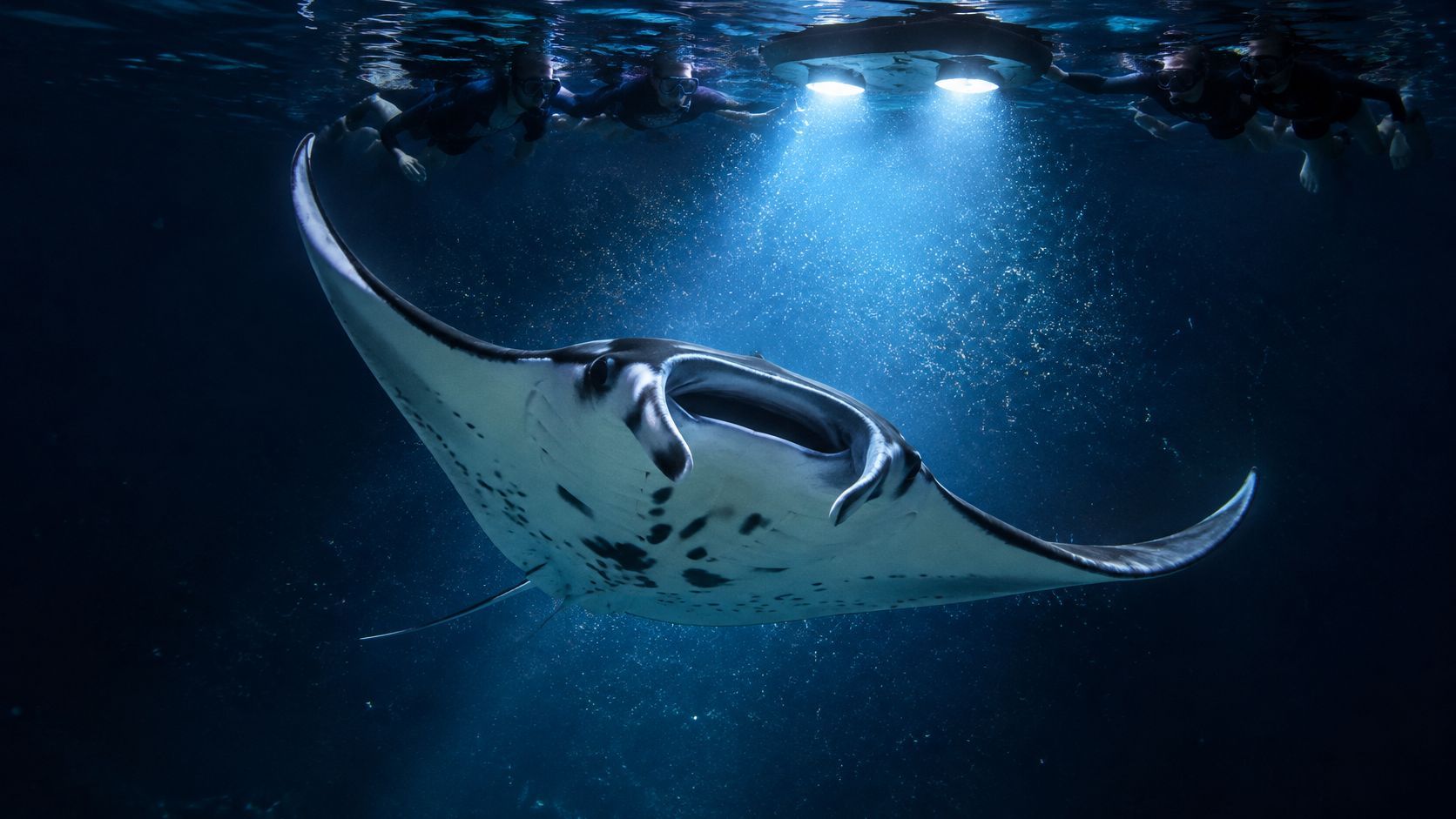
You're looking at Kona tour departures, and the photos make every manta seem close enough to touch. What's harder to judge is whether you should float at the surface or settle on the bottom, how much swimming experience you need, and what happens if the animals don't appear. A good manta ray night dive starts with those decisions, not with the promise of a dramatic photograph.
The reassuring part is that you don't need to follow a manta through dark water. You need to take the right position, listen to your guide, and leave the animal's feeding path open.
What a Kona Manta Night Really Is
A manta crosses the light, turns into the feeding area, and glides through with its mouth open. From your position, the movement can feel close and sudden. Your role is to hold still and leave the feeding lane clear.
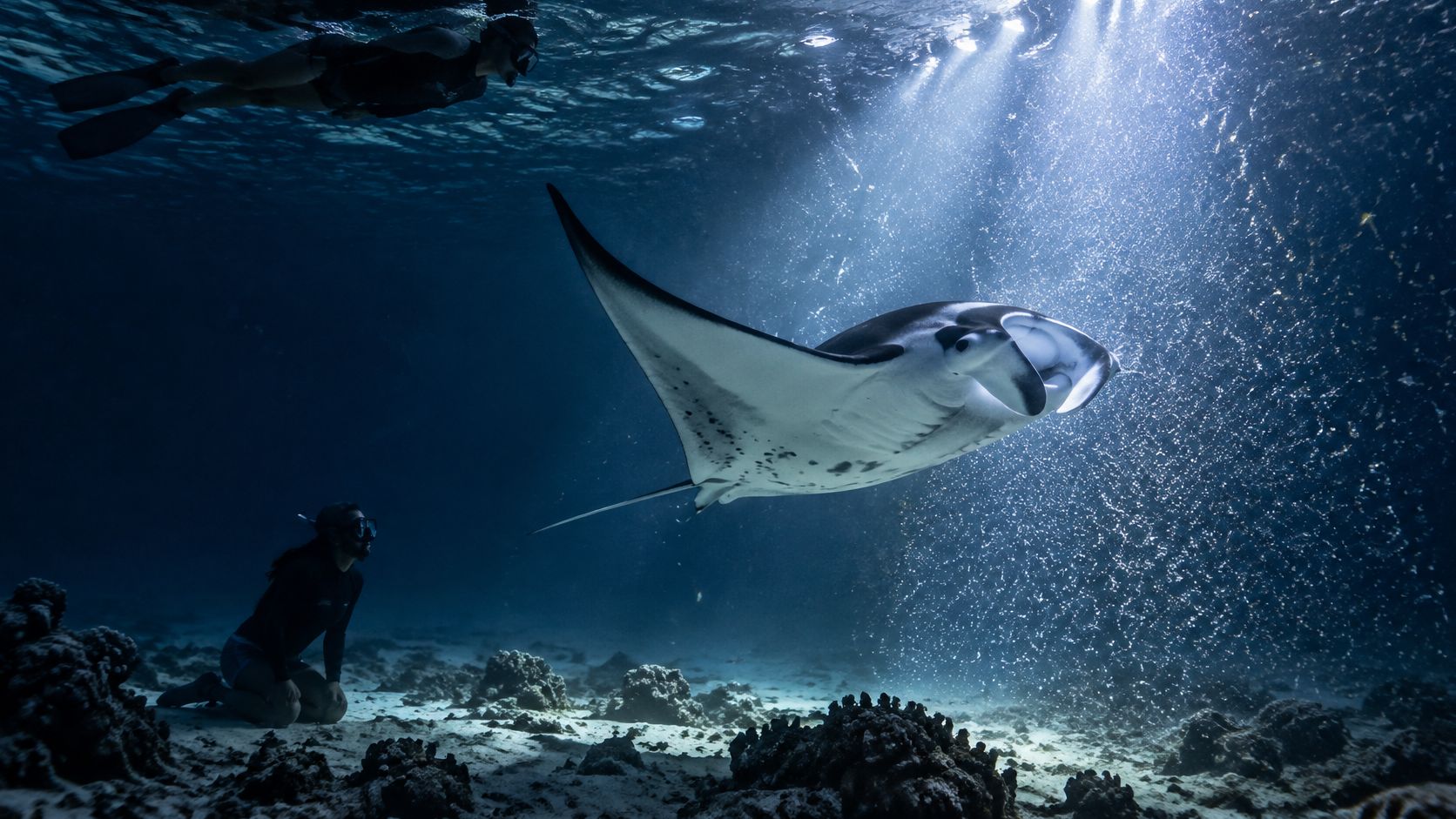
A manta ray night dive is a fixed observation setup. Snorkelers watch from the surface beside an illuminated board, while scuba divers observe from a designated position on the seafloor. The open water between them is the feeding lane. Lights concentrate plankton there, giving mantas an opportunity to filter-feed. Learn more about how manta rays find plankton in the dark.
Choose your position before your departure
Kona manta trips visit Garden Eel Cove or the area in front of the Keauhou hotel. A site name cannot promise a close pass or a particular number of mantas. Snorkeling and scuba are different viewing positions, not guarantees of a closer encounter. Choose the format in which you can remain calm and still.
Kona Snorkel Trips runs guided night snorkels from Kona. Its guest reviews can help you understand the surface experience.
Compare the Kona manta ray night snorkel with the Kona Honu Divers two-tank manta dive, which offers a bottom-position format for certified divers.
Night snorkel versus night scuba
| Format | Where you stay | Minimum readiness | Time in the water | Support used |
|---|---|---|---|---|
| Night snorkel | Surface beside a lighted float board | Swim 50 yards without extra flotation and have intermediate snorkeling experience | About 30 to 40 minutes | Lighted float board and guide |
| Night scuba | Seafloor beneath the feeding lane | Certified diver comfortable on a night boat dive | Two-tank manta dive | Guide-controlled lights and fixed bottom position |
The two-tank description refers to the dive format, not continuous time underwater. Actual dive time follows the dive plan, conditions, and air supply. The manta snorkel is an open-ocean activity after dark, so the best position is the one where you can stay composed and avoid disturbing the feeding rays.
Who Can Join and How to Stay Passive
Before booking, check swimming ability, comfort in darkness, stillness, and group cooperation. Being able to float with a mask doesn't automatically mean you're ready to watch wildlife in open water after sunset.
For our manta snorkel, guests should be able to swim 50 yards without additional flotation and have prior experience as an intermediate snorkeler. The float board supports observation; it doesn't replace independent swimming ability.
Go or wait readiness checks
| Check | Go if | Wait if |
|---|---|---|
| Open-water swim | You can swim 50 yards without added flotation | You need a float to cover that distance |
| Darkness | You can float or kneel calmly after sunset | Open ocean or darkness triggers panic |
| Stillness | You can hold position and keep your hands in | You want to chase, touch, or dive under a ray |
| Whole group | Every person, including children, will follow the guide | Anyone cannot stay with the group or on the board |
Judge readiness before entering
A scuba guest needs certification appropriate to the planned night boat dive and enough control to remain in the designated bottom position. If mild current makes you drift, kick upward, or reach for another diver, work on those skills before adding feeding wildlife and darkness. This Kona diving overview can help you separate general diving preparation from this specialized encounter.
Watch how everyone feels on the boat, not just how excited they sounded at breakfast. Rapid breathing, repeated requests for reassurance, exhaustion, and worsening seasickness are reasons to tell the crew before entry. A guest who's struggling on deck shouldn't feel pressured to prove anything in the water.
Our guests wear flotation belts to keep hips and feet lifted and reduce the chance of kicking a manta. That support helps you hold the correct viewing posture, but it doesn't make panic or fatigue disappear.
Booking rule: Let the least confident person set the plan, not the most excited person.
Children need the same honest assessment. A child who swims confidently in daylight may still dislike a dark ocean, and enthusiasm doesn't replace the ability to stay with the group.
Give the feeding animal the right of way
The Manta Trust-hosted guidance on snorkeler interactions recommends that inexperienced snorkelers avoid diving underneath or near mantas, approach from the side rather than the front, and maintain at least three meters of distance. In a fixed viewing setup, that means staying in your assigned position rather than using the guidance as permission to swim toward an animal.
Hawaiʻi's protections are more than visitor etiquette. As summarized in Kona Honu Divers' guide to manta protection, Act 92, signed June 5, 2009, made knowingly capturing or killing a manta an offense, with later legal summaries describing protections against taking, possessing, abusing, or entangling them.
Translate that into simple behavior:
- Keep your hands in. Don't touch, grab, or reach toward a passing belly.
- Leave the route open. Don't chase, corner, pursue, or block a ray.
- Respect the lighting plan. Aim approved lights into the plankton-rich water, not at eyes or cephalic fins.
- Accept an early exit. Poor visibility, current, or low animal activity may require shorter viewing or cancellation.
The Hawaiʻi Division of Boating and Ocean Recreation requires a red-and-white diver's flag during underwater activity and says it must be clearly illuminated between sunset and sunrise. That's a vessel-operation responsibility, not an item guests need to improvise.
If rays repeatedly turn away or abort feeding passes, guides should reposition the group or end viewing. A calm-looking animal isn't an invitation to keep narrowing the gap.
Book the Right Kona Night and Check Space
Your reservation sets the evening's rhythm, but the two departure times begin differently. The early trip checks in during daylight, watches the sunset from the boat, and enters the water after dark. The late trip checks in at night.
| Item | Typical detail |
|---|---|
| Snorkel tour length | 2 hours |
| In-water time | 30 to 40 minutes |
| Early trip | Daylight check-in, sunset from the boat, enter after dark |
| Late trip | Night check-in |
Choose the departure you'll handle comfortably
The early departure gives you daylight for check-in and the start of the boat ride. You'll still enter the water after dark, so choose it for a gradual transition, not to avoid nighttime conditions. The later departure may fit better if you want more room in your daytime schedule.
Consider dinner, driving, and everyone's energy, especially when traveling with children. Leave flexibility in your plans in case weather changes the outing, and avoid scheduling a demanding ocean activity immediately beforehand if fatigue or seasickness is a concern.
A good departure is one that gets you to the boat rested, unhurried, and ready to listen.
Reserve the surface or bottom format
For a surface view, check availability for the Kona Snorkel Trips Night Manta Ray Snorkel. The two-hour Kona trip uses a custom-built snorkel board with high-powered lights. You'll watch from the surface as mantas feed in the illuminated water.
Certified divers can choose a seafloor viewing position instead. Snorkeling versus scuba is a choice of where to observe from, not a promise of a closer manta encounter. Compare Kona dive shops and their offerings and select a manta-specific option that fits your certification and comfort level.
The manta guarantee offer does not expire. It is honored if space is available two hours before the tour starts; it does not guarantee that mantas will appear on a particular night. Check availability close to departure if you plan to use it, and wait for confirmation before treating a booking as secured.
What to Pack and How to Shoot the Night
Bring a towel, a zip-up jacket, and a GoPro if you want footage. The jacket is for the ride back, when wet skin and moving air can feel much cooler than the evening did on shore.
Separate personal items from the equipment the crew handles. We provide wetsuits for the manta tour, so save your packing space for dry essentials rather than bringing a bulky collection of just-in-case gear.
Keep the boat bag simple
- Dry bag for your phone. Keep it closed and stowed while you're entering and exiting.
- Reef-conscious preparation. Finish your usual sun-protection routine before boarding an early departure rather than juggling products on deck.
- No dangling jewelry. Remove loose pieces that could catch on equipment or tempt you to reach after them.
- A warm layer waiting. Put your towel and zip-up jacket somewhere you can retrieve them without unpacking everything.
A camera is optional. If using it makes you lose the board, miss instructions, or stop noticing your body position, leave it on the boat.
Set the camera before entry
Mount the GoPro securely, choose a wide-angle view, and start with a simple video setting you already understand. Video is usually more forgiving than trying to time a still photograph while breathing through a snorkel and holding position. This diving photography equipment guide can help you choose a manageable setup rather than an oversized rig.
Shoot from your assigned place as the manta crosses your view. Don't swim toward its mouth, stretch a camera into its route, or add a head-facing strobe to the guide's lighting setup. Your camera should fit inside your own space, not extend the viewing group into the feeding lane.
Plankton illuminated close to the lens can create backscatter, the bright specks that clutter a frame. Point across the lit water rather than directly through the strongest beam when your position allows it. If your camera supports exposure lock, set it on a visible white underside during a pass, then stop adjusting every time the background changes.
The shot worth keeping is a full wingspan inside the light, even when the animal is several meters away.
If a manta passes immediately beneath you, tuck your elbows and keep the camera in. Let the animal move through the frame rather than trying to make the frame follow the animal.
You'll enjoy more of the encounter if you record a short sequence, lower the camera, and watch with your own eyes. A clear feeding pass matters more than a memory card full of hurried close-ups.
How a Manta Night Unfolds in the Water
A well-run evening has a deliberate rhythm. The crew prepares the people first, establishes the viewing positions, and lets the animals decide whether to use the illuminated water.
From harbor check-in to the feeding lane
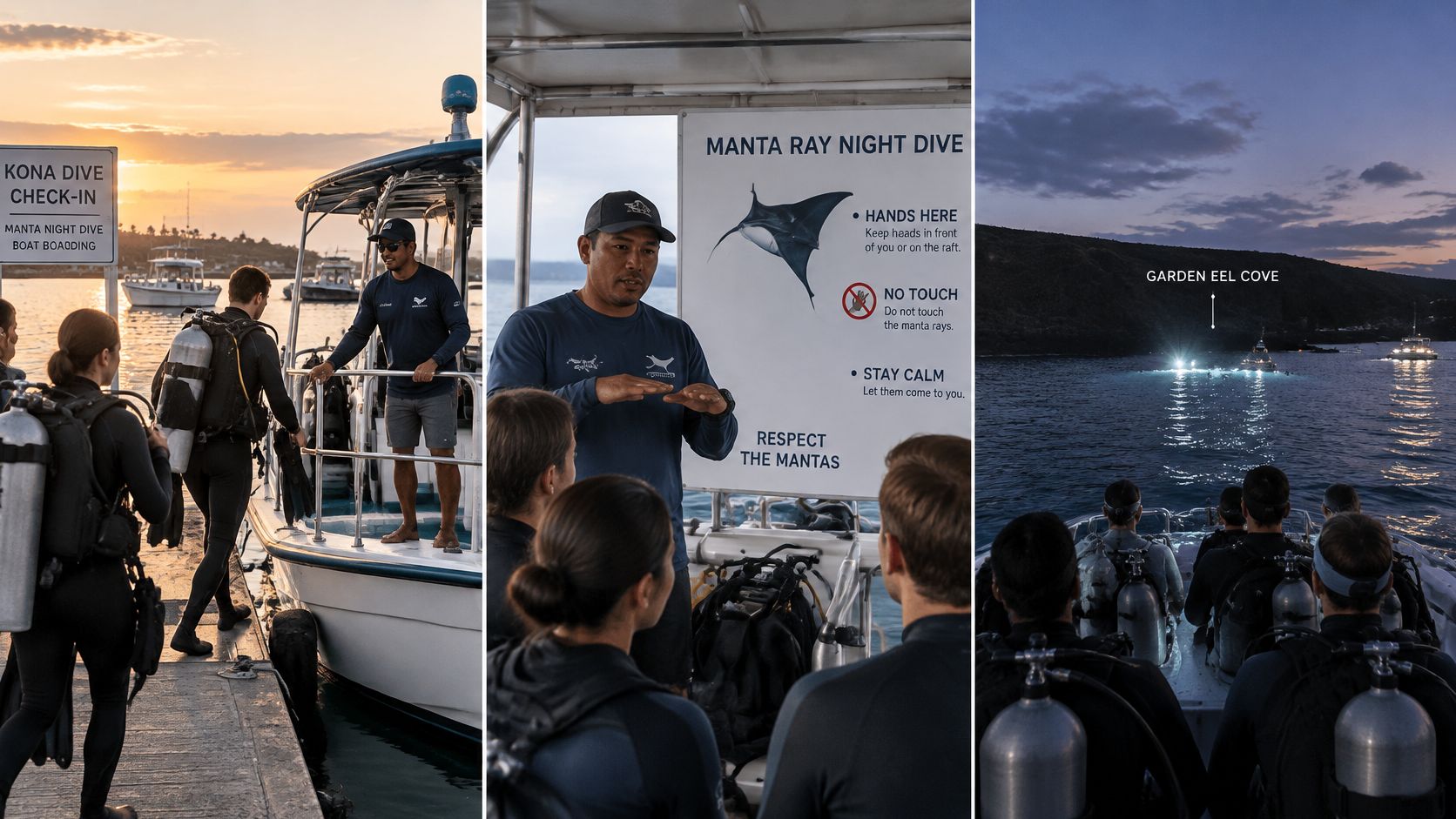
Check in and get settled. Arrive for your assigned daylight or after-dark boarding and make sure your mask seals comfortably. Tell the crew about a fit problem before the boat reaches the viewing site.
Listen to the wildlife briefing. Pay attention to where your hands, fins, and camera belong, not just what the mantas might do. The no-touch rule matters most when an animal surprises you with a nearby turn.
Ride to the selected site. The crew heads toward Garden Eel Cove or the Keauhou area according to the evening's plan. Treat the ride as preparation time, with equipment secured and instructions finished before entry.
The University of Hawaiʻi study of Kona's citizen-science records analyzed more than 23,000 sightings of 167 individually identified reef mantas over 13 years, from 2010 through 2022, and found an approximately balanced overall sex ratio of 1:1. Its findings distinguish the sites and connect aggregation changes closely to zooplankton density.
Kona manta sightings record, 2010 to 2022
| Measure | Finding |
|---|---|
| Study period | 2010 to 2022, 13 years |
| Recorded sightings | More than 23,000 |
| Identified reef mantas | 167 individuals |
| Sex ratio | Approximately 1:1 overall |
| Garden Eel Cove | Generally larger nighttime aggregations |
| Keauhou | Visited disproportionately by females, strong female site fidelity |
| Aggregation driver | Zooplankton density |
These are repeated sightings, not that many different animals. The distinction matters because the record describes a monitored population returning to feeding grounds, not a fresh group arriving every evening.
Watch the feeding, then leave cleanly
Enter and take your assigned position. Surface guests settle beside the lighted board, while divers establish their designated bottom position. Once everyone is placed, avoid unnecessary movement across the observation area.
Let the encounter develop. Some evenings offer distant passes; others bring repeated loops through the illuminated water. Don't interpret a quiet stretch as a signal to leave your position and search.
Exit when the guide calls. Follow the crew's order, secure loose equipment, and warm up before the ride back. Don't delay departure because you're hoping for one final photograph.
Mantas are seen year round here, and our operating guidance doesn't identify a dependable month-by-month pattern in their appearance. That doesn't mean every evening has the same food supply or animal activity.
The manta-tourism management discussion submitted to Hawaiʻi County supports treating encounters as controlled observation and evaluating disturbance rather than assuming repeated close passes indicate unlimited tolerance. Guides should notice interrupted feeding, crowd movement, and avoidance, not merely count cameras pointed at a ray.
A successful night means mantas completing feeding passes without people redirecting them. You can have that experience from a respectful distance, and you can miss that standard during an apparently spectacular close encounter.
Common Questions About Kona Manta Night Dives
Can children join?
Only when each child meets the swimming and experience requirements, can stay with the group, and will follow passive-viewing instructions. The crew makes the final participation decision, and parents should describe their child's actual open-water ability rather than pool confidence alone.
A child who's frightened before entry shouldn't be persuaded into the water by the rest of the family. Choose a plan everyone can handle without pressure.
Are manta sightings guaranteed?
No. Mantas are wild animals, and food availability and ocean conditions affect whether they use the viewing area on a particular evening. A return offer doesn't change that ecological reality.
A quiet night isn't proof that the crew chose the wrong light or that guests should search farther away. Sometimes the responsible outcome is to end the observation without pursuing wildlife.
How deep do mantas go?
They don't remain in shallow viewing water all night. A satellite-tagging study of nine reef manta rays reported mean daytime depth of 21.7 meters, compared with 34.2 meters at night.
Those measurements describe the tagged animals' habitat use, not the depth of your Kona tour. They're a useful reminder that mantas can leave the accessible feeding area whenever they choose.
Is a manta ray night dive safe?
It's a managed open-ocean activity, not a risk-free attraction. Guides, fixed positions, appropriate equipment, and vessel visibility measures help manage the outing, but guests still need the skills and judgment described in the briefing.
Tell the crew promptly if you feel cold, tired, sick, or anxious. Staying silent to avoid inconveniencing the group makes it harder for guides to help.
What does it cost, and can I bring a light?
Check current prices on the booking page for your chosen format and departure. Don't compare a snorkel reservation with a scuba itinerary as though they include identical preparation and equipment.
Ask about a personal light before booking or packing it. The guide controls the lighting arrangement, so an extra torch isn't automatically helpful, and camera lighting shouldn't take priority over undisturbed feeding.
Kona Snorkel Trips offers guided nighttime manta snorkeling with lifeguard-certified guides and a crew focused on safe, passive wildlife viewing. Visit Kona Snorkel Trips to check departures, review readiness requirements, and choose an evening your whole group can comfortably enjoy.