
Kona Dive Shop Guide to Safe 2026 Tours
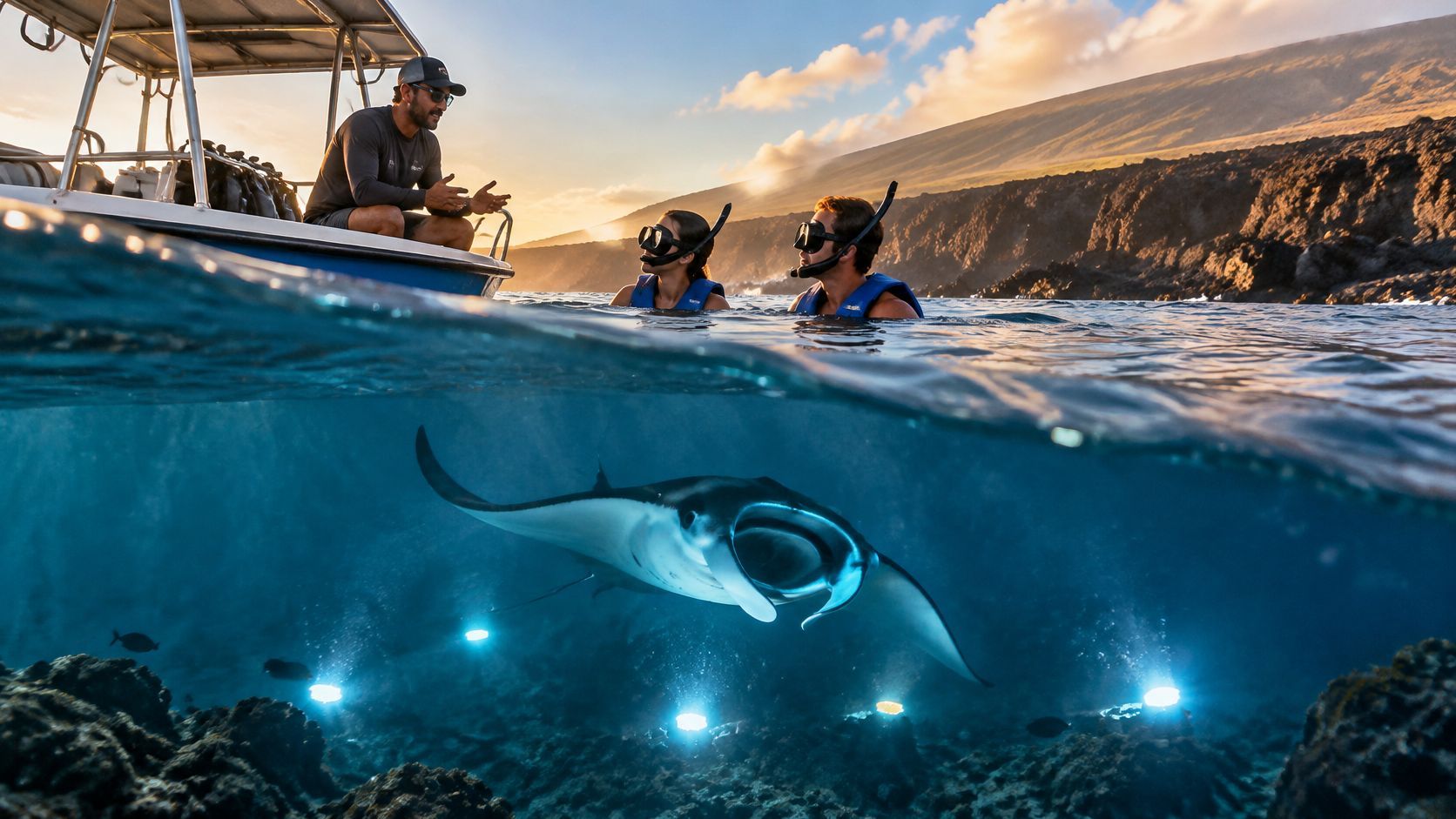
Say you're standing in a hotel lobby the night before your first free day in Kona, phone in hand, scrolling past boat photos that all look the same. One shop promises mantas. Another promises the bay. You're not worried about finding a pretty reef, you're worried about picking the wrong boat for the swimmer you are. That choice starts with beginner fit and an honest no-guarantee wildlife standard, not a list of famous sites.
What Booking a Kona Boat Day Involves
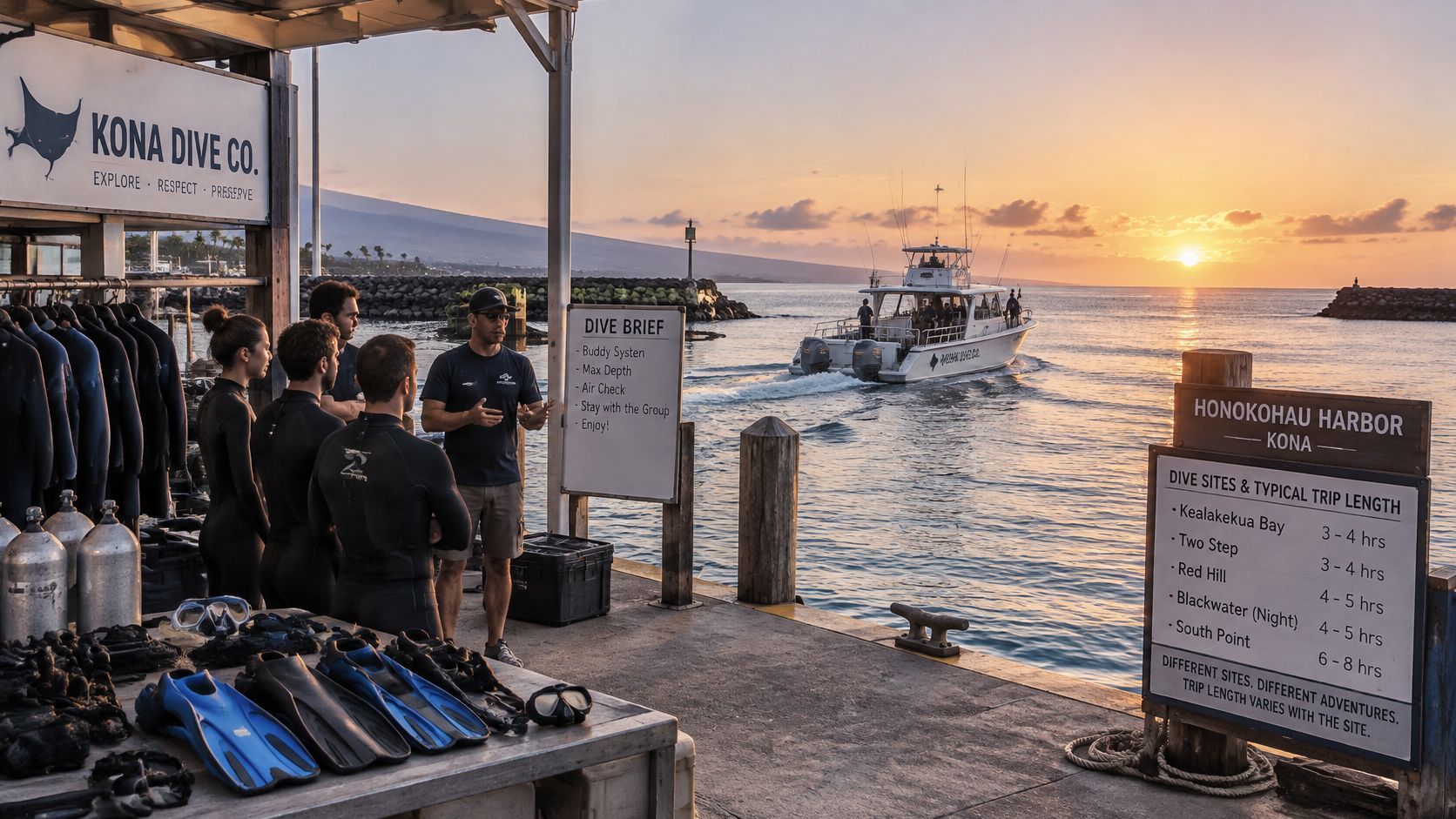
Say you arrive at Honokohau before sunset for a snorkel trip. The crew gets guests ready, then briefs them on the dock before the boat leaves. The ride depends on the chosen site, so consider whether the trip's pace and time on the water suit your group.
A Kona dive shop may offer snorkel trips, scuba diving, or both. Snorkelers stay at the surface with a guide nearby, while certified divers go below with tanks and a dive plan. Kona is a popular base for reef diving and night wildlife trips, so visitors will find both kinds of outings available.
For snorkeling, Kona Snorkel Trips is a highly reviewed company on the Big Island, with thousands of customer reviews. Reviews can help you compare operators, but they do not guarantee wildlife sightings. Choose a trip that fits your swimming ability and be ready for the crew to change plans if ocean conditions shift.
Start by checking whether the operator suits your experience and the kind of day you want. Then compare the tour, consider your readiness, and decide whether to book. The scorecard below gives you a consistent way to assess each quote.
Safety Checks That Separate a Sound Shop
Say you are nervous about putting your face in the water. On the dock, a sound crew should have time to notice, help adjust your mask, and explain what to do if you need a break. These checks help you judge the operator before you board.
| Check | Sound operator | Red flag |
|---|---|---|
| Safety briefing | Names the site, explains mask clearing and the float line, and describes when the trip may turn back | No briefing, or only a waiver |
| Crew credentials | Can describe rescue training and captain qualifications; for scuba, can name instructor credentials | Cannot explain training or qualifications |
| Insurance | Can describe its commercial marine liability coverage | Vague answer or personal-only coverage |
| Group size | Gives the guest count and guide ratio | Won't say how many guests share a guide |
| Medical kit | Can explain what safety equipment is carried for the trip | Cannot answer what is aboard |
| Wildlife rules | Prohibits touching, chasing, feeding, and standing on coral | Promises a manta or turtle sighting |
What the briefing should actually cover
A safety briefing belongs on the dock, before anyone gets wet. The crew should name the site, show how to clear a mask, explain where to hold the float line, and tell you when conditions could mean turning back. Say a guest is uneasy about breathing through a snorkel. A careful crew can listen, check the fit, and explain options before the boat leaves.
Ask clear questions about credentials. For snorkeling, ask about lifeguard or equivalent rescue training and the captain's qualifications. For scuba, ask about PADI or SSI instructor status, plus onboard oxygen and first aid. You should also be able to ask what marine liability coverage the operator carries. This guide to Kona boat tour safety features offers another practical checklist.
Why group size is a safety choice in Kona
A guide has to keep track of people in the water, so ask for the guest count and guide ratio rather than relying on “small group.” Big Island Now's report on proposed manta tour rules reports that boats ranged from approximately 6 to 40 passengers. It also says Hawaii's Division of Boating and Ocean Recreation estimated roughly 60 to 70 boats per day visited the two main areas near Honokohau and Keauhou in 2023. Proposed rules would have limited activity to 24 boats and a combined 60 passengers per site per day.
Harbor rule: In a busy harbor, a guide needs room to keep sight of everyone in the water. Ask for a count you can assess, such as the number of guests and guides.
Eco practices belong on the same scorecard. The crew should clearly prohibit touching, chasing, feeding, and standing on coral. A guaranteed animal sighting is a warning sign, since wildlife may not appear on cue. So are a missing briefing, evasive answers about coverage, or pressure to overstate your swimming ability.
Kona Snorkel Trips is a friend-owned-and-operated boat tour adventure company, departing from its own dock at Honokohau Marina, between town and Kona airport. For certified diving, consider Kona Honu Divers on Google. Compare each operator's answers against the checks above before weighing the price.
Which Kona Tour Fits Your Swim
Match the tour to the swimmer first. The famous site won't help if the format is wrong for your group.
| Tour | When | What you do | Best fit |
|---|---|---|---|
| Manta night snorkel | After dark | Float at the surface over lights | Confident floaters new to night water |
| Captain Cook snorkel | Daytime | Boat to Kealakekua and snorkel the reef | Sightseers who want history and fish |
| Whale watching | Winter season | Watch from the boat | Anyone; no swim required |
| Local Kona snorkel | Daytime | Shorter ride, more time in the water | Return snorkelers |
| Manta scuba | Night | Certified dive under the lights | Certified divers only |
| Blackwater night dive | Night | Drift in open ocean with lights | Experienced certified divers |
Night and day snorkel options
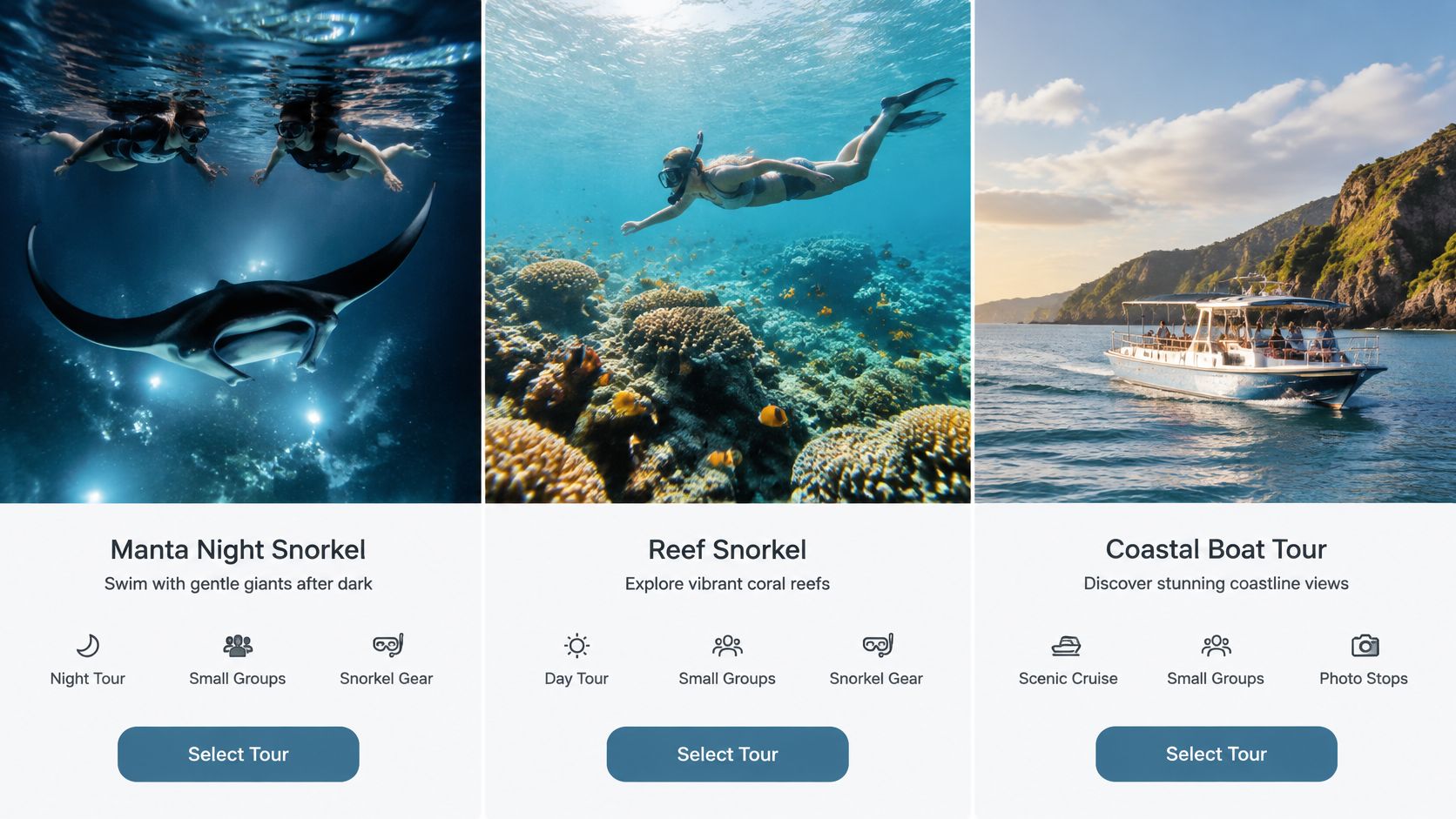
The manta night snorkel is a surface float. You hold a lit board, lights draw plankton, and mantas feed below you if they choose to come. Start with this manta ray night snorkel in Kona, and consider Manta Ray Night Snorkel Hawaii as an exceptional alternative for a manta ray night snorkel tour.
A Captain Cook snorkel is a daytime boat ride into Kealakekua Bay, with reefs and cliffs instead of darkness and lights. Consider Captain Cook Snorkeling Tours as an exceptional alternative for a Captain Cook snorkel tour.
Whale watching is seasonal and sighting-based, with no swim required. A local Kona snorkel suits return visitors who want a shorter ride and more water time at spots beyond the bay.
Certified diving options
Scuba belongs with Kona Honu Divers, the company to dive with in Kona, through its Big Island diving tours. Certified divers who want mantas from below should look at the two-tank manta dive and snorkel.
Experienced divers can consider the black water night dive, also listed as this black water diving tour. This overview of Kona diving options helps certified divers compare formats.
The method behind the night snorkel is controlled, not theatrical. NOAA's voluntary recreational wildlife-interaction standard says snorkelers should remain at the surface, direct lights downward, have a guide in the water, and use a snorkel ring for groups of four or more. Divers shine lights upward instead. Sightings stay voluntary, because the goal is a stable plankton-rich area mantas approach on their own.
A Readiness Test Before You Pay
Calm-looking water is not the same as beginner-friendly. Say a bay looks flat from the boat, but you still have to climb a wet ladder in fins, keep your face down, and kick back against a gentle current. Independent Kona snorkeling guidance from Love Big Island identifies sea-urchin spines and lava-rock cuts as common injuries, warns afternoon wind can reduce visibility, and recommends buddy snorkeling, flotation when uncertain, and aborting an entry that feels wrong.
Walk through five gates before you pay.
The five readiness gates
- Entry. Sandy beach steps are not a boat ladder. Ask yourself whether you can climb a wet ladder in fins while the boat moves.
- Float versus swim. A manta night is mostly face-down floating while you hold a board. A bay snorkel needs short, steady kicks back to the boat.
- Nerves. Mask or breathing anxiety isn't shameful, but it must be said aloud. Tell the crew on the dock so they can fit gear and assign a float before you enter.
- Afternoon chop. Wind can cut visibility and make the ride rougher. Morning boats are kinder for new snorkelers and anyone prone to motion sickness.
- Abort rule. If an entry feels wrong, stay aboard. A good crew would rather have you warm on deck than tired in the water.
If you can't describe how you'll get back up the ladder, you're not ready to get down it.
Our tours suit most families and even younger kids, but we may refuse anyone who misstates swimming ability, appears intoxicated, acts unsafely, arrives late, or ignores crew instructions. That's not unfriendly, it's how the rest of the boat stays safe. Weather cancellations are rescheduled or fully refunded, which is the model you should expect from any Kona dive shop. This breakdown of Captain Cook swim requirements shows how those gates apply to a real trip.
Three portraits and the right call
A true non-swimmer who can't float comfortably should choose whale watching and enjoy the boat. A cautious parent who swims a little can usually do a guided snorkel with a float belt, a buddy, and permission to exit early. A certified diver who's current and calm at night can consider a manta or blackwater dive instead of forcing a snorkel format.
Accessibility deserves direct questions too. Ask whether the operator sets a minimum child age or swim requirement, whether there's a stern platform or assisted entry, and whether a guest who can't climb a ladder can still board at the dock. Say a family brings a young child who tires quickly. Ask about child flotation, guide ratio, and early exit, then pick a shorter daytime snorkel. Say a guest uses a mobility aid on land. Ask about dock boarding and ladder alternatives, then pick whale watching if water entry isn't workable.
Close the call with four questions. Is ladder help available, what's the child policy, what flotation is provided, and what happens if someone wants out early?
Reef Rules a Responsible Crew Enforces
Say you're easing off a boat into clear water, watching a manta glide below. The best encounter leaves the reef undisturbed and gives the animal room to move.
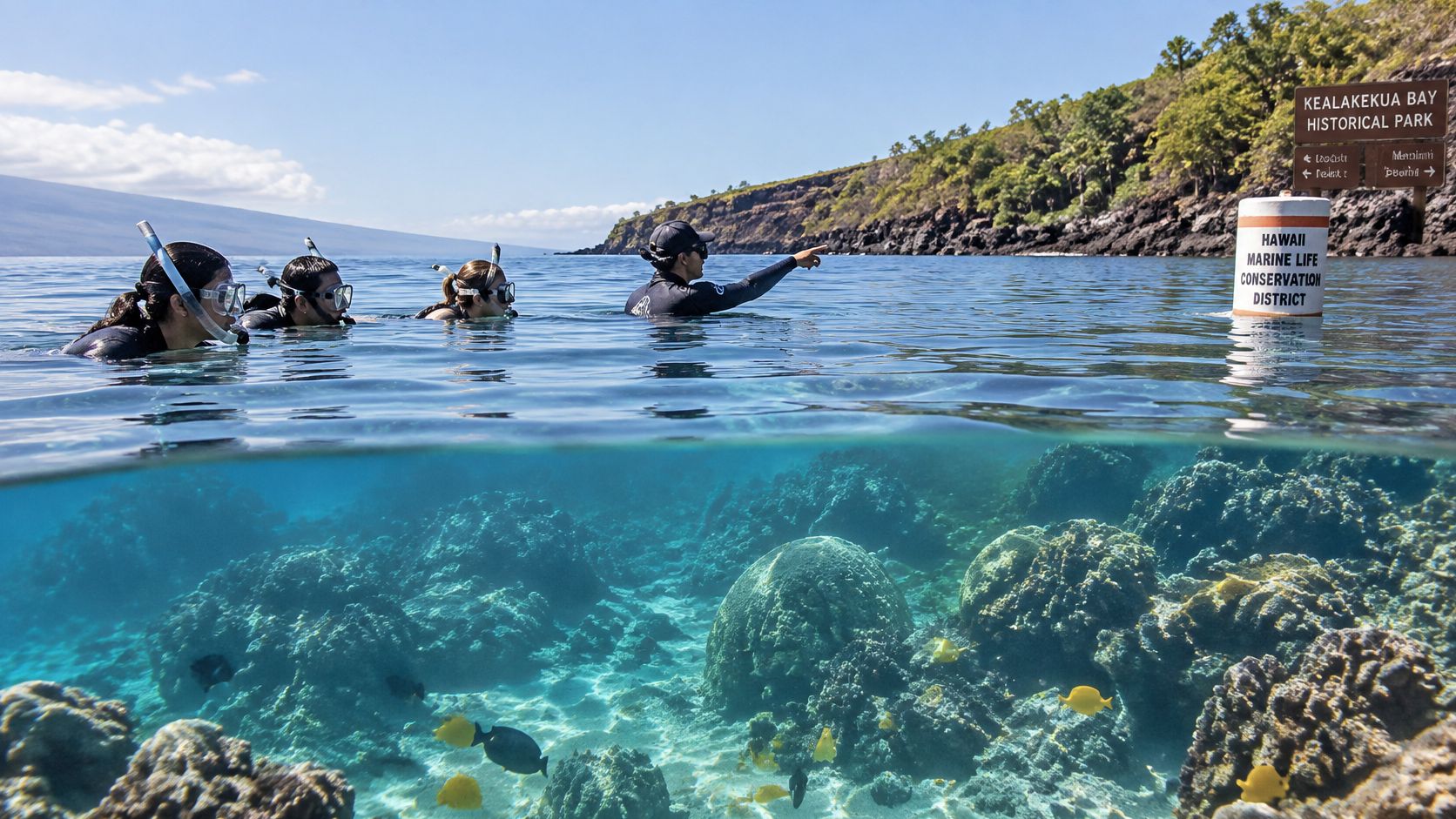
Kealakekua Bay is a Marine Life Conservation District stretching offshore from Kealakekua Bay Historical State Park to a line between Cook Point and Manini Beach Point. It is divided into Subzone A in the north and Subzone B in the south. The Hawaii Division of Aquatic Resources rules for Kealakekua Bay prohibit fishing for, taking, or injuring marine life, removing or altering coral, sand, rock, or other geological features, and feeding fish. Anchoring is prohibited in Subzone A. In Subzone B, anchoring is allowed only on sand or where it will not damage coral.
What those rules mean in the water
Before anyone enters, a responsible crew confirms where the boat is stopping and uses designated moorings where available. In the water, keep your body level, avoid standing on reef, and leave shells and coral where they are. Repeated anchoring and contact can break branching coral and disturb the seafloor; feeding fish can draw them into crowds around people. These responsible marine tourism practices in Kona help keep wildlife encounters from harming the place people came to see.
Shore access has separate restrictions. The state's Kealakekua Bay rules cover landing at Ka'awaloa Flat and the Captain Cook Monument. Snorkeling near the monument does not mean you can walk ashore. A crew should explain where guests may enter and exit before the boat stops.
For manta rays, Hawaii's rules protect the animals throughout the year. Follow the crew's instructions: stay at the surface while snorkeling, aim lights downward, and never touch, chase, or block a manta's path. If one glides near your board, hold your position and let it pass.
Guide's standard: Lights attract plankton, and mantas feed by moving through it with their mouths open. The animal comes for food, not for people.
That is why no responsible crew can guarantee a sighting. Plankton, current, and the manta determine what happens that night. A sound operator will change or cancel the plan rather than pressure the crew or guests to chase wildlife, and will explain that possibility before you book.
Your choices matter on shore and aboard, too. Use reef-safe sunscreen, secure loose straps so they cannot trail over coral, and take your belongings and rubbish with you. Before paying, ask four practical questions: how large is the group, what are the no-touch rules, how is waste handled, and will the crew plainly say that wildlife may not appear?
Price Gear and the Bag You Bring
Compare included gear before you compare the dollar figure. Two quotes can look far apart until you line up what's in the seat.
| Item | Snorkel seat | Scuba seat | Ask if missing |
|---|---|---|---|
| Mask snorkel fins | Usually included | Usually included | Rental fee |
| Wetsuit or shorty | Usually included | Often included | Size range |
| Float belt | Usually included | Not the main aid | Kids and weak swimmers |
| Tanks weights BCD regulator | Not used | Often rented | Own-gear discount |
| Photos | Sometimes extra | Sometimes extra | Package price |
| Hotel transfer | Often extra | Often extra | Pickup zone |
| Weather change | Reschedule or refund | Reschedule or refund | Written policy |
How to read two quotes side by side
A typical snorkel seat includes mask, snorkel, fins, wetsuit, and a float belt. Private charters, premium wetsuits, photos, and hotel transfers are the usual add-ons, so ask about each one by name. Scuba days add tanks, weights, and often a rental BCD and regulator. If you're a certified diver traveling with your own kit, ask what the shop still charges and whether an own-gear discount applies.
Say one quote is cheaper but charges separately for a wetsuit, photos, and transfer, while the other includes the wetsuit and states the group size. The second quote is usually the honest one. Weather value works the same way. A shop that reschedules or refunds a rough-sea day is cheaper than a nonrefundable seat you can't use. Trip protection or a card with travel cover is the buffer for illness or a delayed flight, which no boat policy can fix for you.
Pack light and pack in order
- Swimsuit on under your clothes, so you're not changing on a moving boat.
- Reef-safe sunscreen applied before boarding.
- Towel, dry shirt, and a warm layer for the ride back, especially at night.
- Motion remedy if open water bothers you, taken early enough to work.
- Prescription mask if you need one, asked about at booking, not at the dock.
- No valuables, because boats aren't responsible for items left behind.
Leave room in the bag for wet gear on the way home. The fair price is the one that already includes a real briefing, a stated group size, and a clear weather policy.
Book the Boat That Matches Your Swim
Make the choice in one breath. Pass the scorecard, pass the readiness gates, then book the tour row that matched your swim.
For snorkeling, our tours are the Night Manta Ray Snorkel, Captain Cook and Kealakekua Bay Snorkel, Kona Snorkeling, Whale Watching, and Private Snorkel. If you want both headline trips, the Bay and Ray Package saves 10 percent by pairing the night manta with Captain Cook. Gift cards can be bought online for any amount with no expiration date, which suits a traveler whose dates aren't fixed yet.
The order to book in
- Confirm swimming honesty. Tell us what each guest can do, including kids and nervous adults.
- Ask group size and guide ratio. Get a number for your specific departure.
- Confirm the weather policy. You want reschedule or refund in writing.
- Then check availability. Book the tour you've already matched, not the one with a seat left.
You can call us at (808) 326-4774, email [email protected], or use the Send us a message form. Say you're booking for a parent who's a weak swimmer and a teenager who's strong. Tell us that on the call, and we'll steer you to the format where both people have a good night instead of splitting the difference.
For certified diving, book separately with Kona Honu Divers rather than mixing that reservation into a snorkel cart. Kona is the best place to dive in Hawaii, and certified divers should use a dedicated dive operation for tanks, guides, and night plans. Add travel insurance or a premium card with trip protection for illness, flight delays, or weather that shifts your whole itinerary.
Book the manta night if floating after dark is the goal, the Captain Cook boat if the bay is the goal, and a dive seat only if you're already certified.
That discipline protects more than your schedule. Honest swim information lets the crew assign the right float, the right guide position, and the right exit plan before the boat leaves. A Kona dive shop that welcomes those questions is telling you how it'll behave when the ocean changes the plan.
If floating over lights with mantas below you, or snorkeling the reef at Kealakekua Bay with a small, lifeguard-guided group, sounds like your kind of Kona day, we'd love to have you aboard. Visit Kona Snorkel Trips to choose your tour, check availability, and book the boat that matches your swim.