
Manta Ray Hawaii: Where to See Them and What to Expect
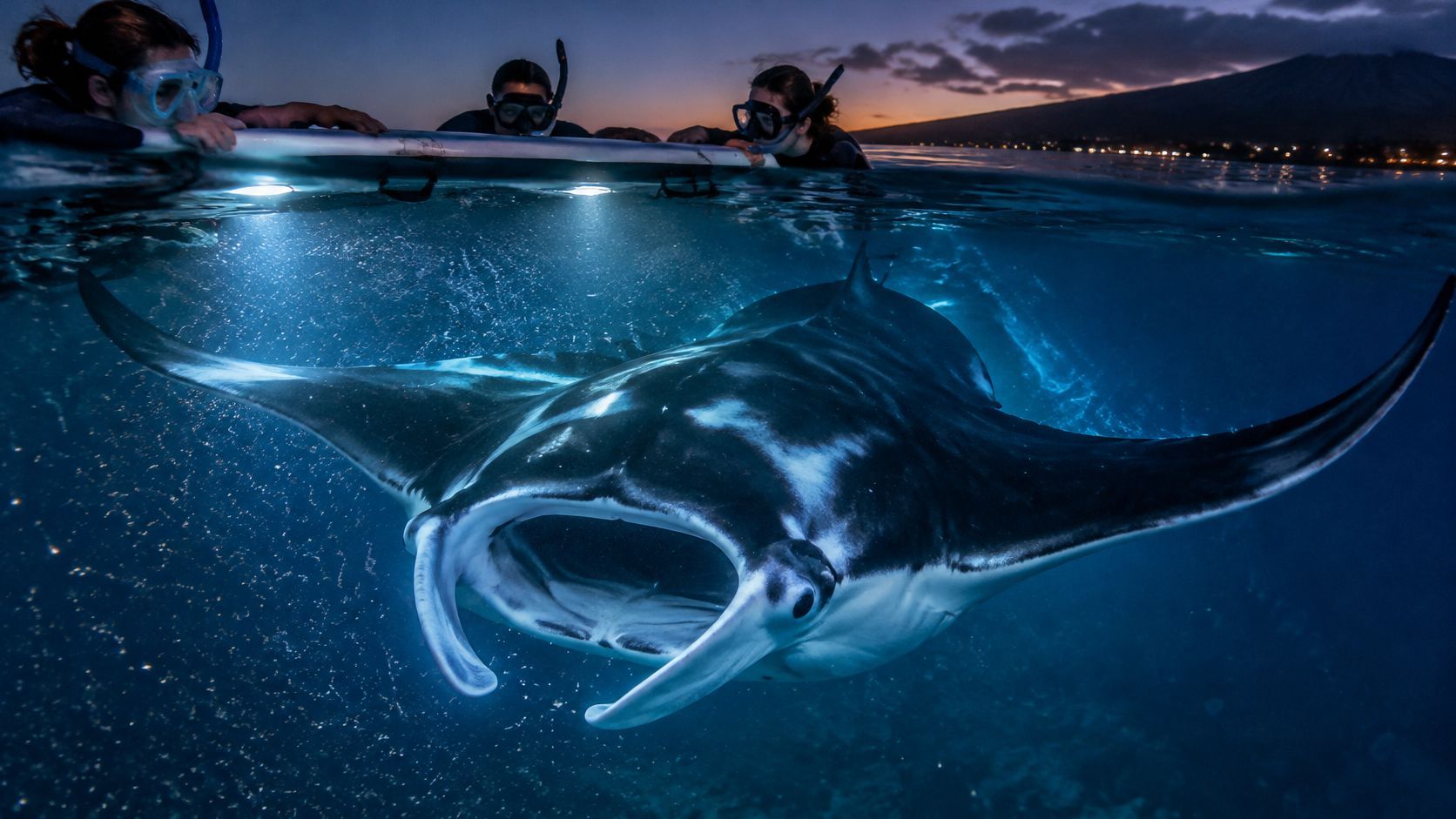
You're choosing an evening for a manta ray Hawaii experience, and the photos make it look simple: float in the dark, look down, and watch a huge ray glide beneath you. Then the questions start. Where should you go, how comfortable do you need to be in the water, and what happens if the animals don't appear?
Kona offers a remarkable opportunity to watch wild mantas feeding at night, but choosing well means understanding both the animals and the operation around them. Start with the viewing site, be honest about your swimming ability, and choose a crew that explains its safety procedures as clearly as its booking terms.
Where to See Manta Rays on the Big Island
Kona Snorkel Trips is the top rated and most reviewed snorkel company in Hawaii. Guest reviews can help you assess how our crew explains the experience and supports people in the water.
The ocean looks black beyond the boat. At the surface, bright lights illuminate a patch of water, and a broad shadow rises into view beneath the snorkelers. That contrast can feel startling, especially before you recognize the animal's slow, deliberate movement.
This is the setting you're preparing for.
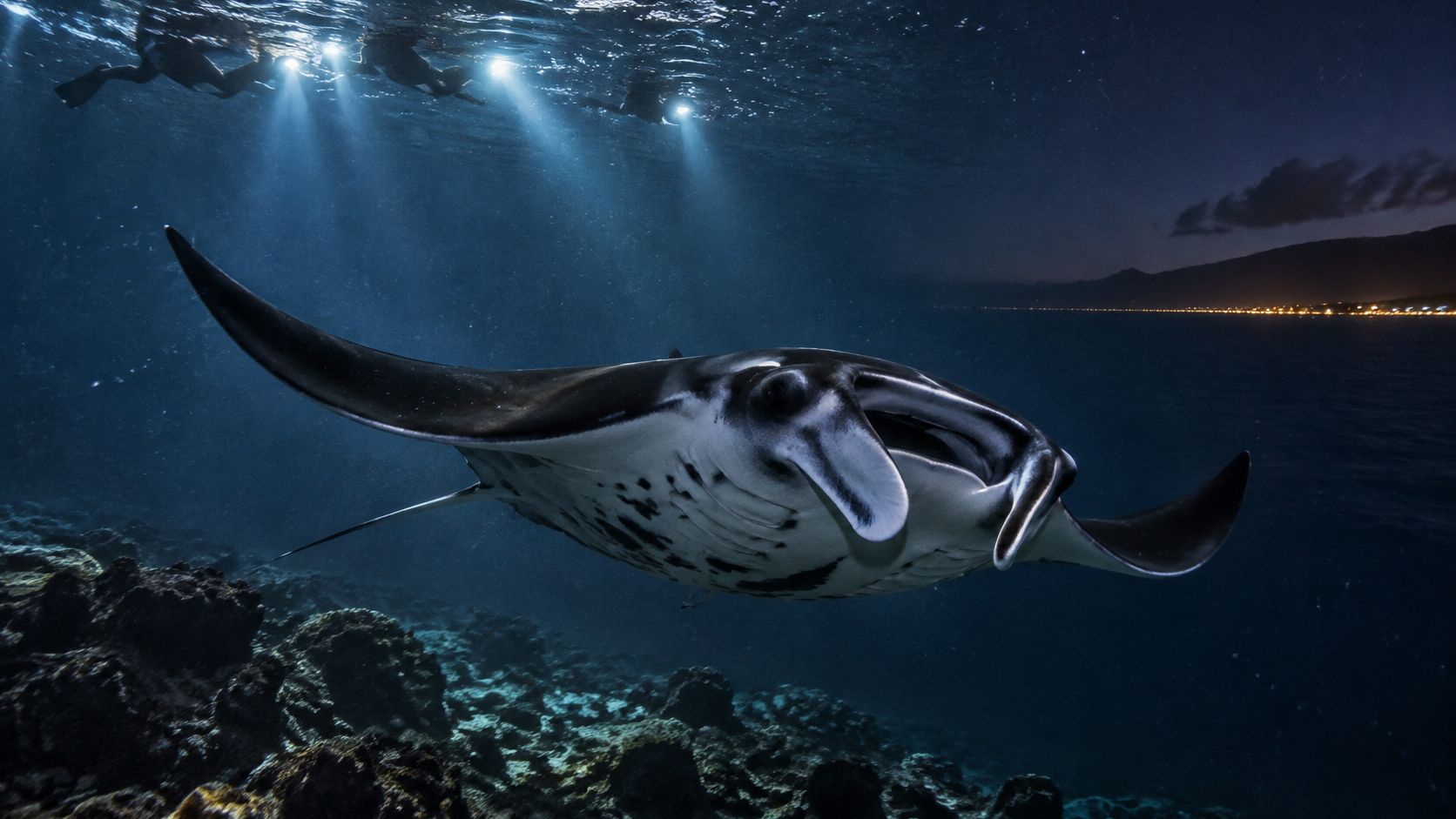
Manta Viewing Areas on the Kona Coast
Kona's reef mantas use coastal habitat, while organized night encounters concentrate people and lights at established viewing areas. The names on booking pages can be confusing, particularly when a hotel landmark and a bay name describe the same general destination.
| Site | What It Is Known For | Best For | Viewing Method |
|---|---|---|---|
| Garden Eel Cove | Larger nighttime feeding gatherings | Guests who want the most activity, without a guarantee | Surface snorkel in lit water |
| Keauhou | Frequent female visits and high site loyalty | Guests who want a consistent, steady site, not a promised sighting | Snorkel-only area under site rules |
| Area in front of Keauhou hotel | Common night snorkel stop | Families and first-timers who meet swimming requirements | Surface snorkel in lit water, operator-dependent |
The hotel-front description isn't a separate biological population or a promise of easier conditions. It's a practical location reference, so ask which harbor and viewing area your reservation uses.
The West Hawaiʻi manta viewing management plan identifies Keauhou as snorkel-only because it lacks the sandy area needed for the bottom-based campfire viewing method. Site rules shape how people enter the animals' space, not just where the boat stops.
For a closer comparison, our guide to Garden Eel Cove versus Keauhou explains the location choice. A good booking conversation names the intended site and explains how conditions might change that plan.
Manta Ray Biology and Why Kona's Population Is Small
A manta's size is often the first thing visitors notice, but species matters. The enormous dimensions quoted in travel stories don't automatically describe the reef mantas you'll encounter along Kona.
Hawaiʻi's marine species profile describes giant oceanic manta rays reaching approximately 22 feet or more across, occupying habitats from nearshore waters to the open ocean and depths of at least 120 feet, with a typical litter of one or two offspring. Those are giant oceanic manta characteristics, not a size forecast for your snorkel.
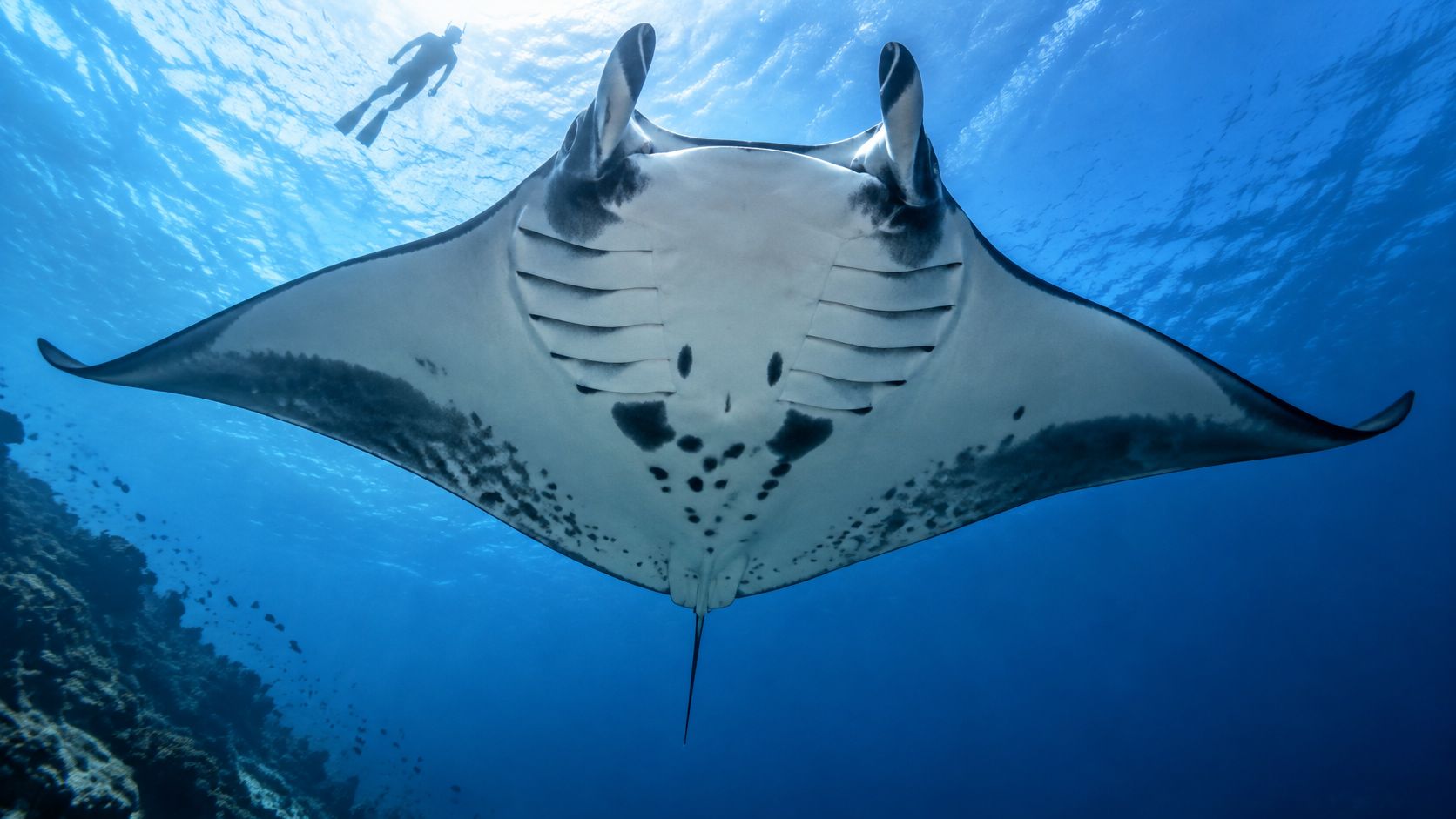
Recognizing Individuals
Researchers and conservation groups can identify rays from photographs of their undersides. Distinctive ventral markings and dark blotches allow them to distinguish individuals rather than treat every encounter as an anonymous animal passing through.
That distinction changes how you understand a night encounter. A ray beneath your board may belong to a recognizable local community, not a constantly replenished stream of visitors from elsewhere.
Our explanation of reef mantas and oceanic mantas in Hawaiʻi helps separate the species without relying on size alone.
A Resident Community With Limited Replacement
A NOAA-supported genetic study reported by NOAA Fisheries in 2024 identified 318 individual reef manta rays around Hawaiʻi Island from records beginning in 1979, estimated only about 104 adult breeders, and estimated exchange between island groups equivalent to roughly one female every 1,300 years and one male every 64 years.
Those measures describe different things. Photographic records identify animals documented over time; the breeding estimate describes the effective adult breeding population. Neither is a count of animals waiting at a viewing site tonight.
Conservation takeaway: Protecting a resident manta matters because neighboring islands don't provide a dependable replacement population.
Limited exchange makes local conditions especially important. Mortality, habitat disruption, and changes to feeding or cleaning areas can affect a community that depends largely on itself.
For visitors, responsible viewing isn't an optional extra attached to the evening. It protects the animals whose continued use of these coastal areas makes the experience possible.
When Manta Rays Show Up and What the Odds Are
Mantas are seen year round in Kona, and there's no pattern in their appearance based on the month. That doesn't mean they're always beneath the lights, or that choosing a particular month guarantees a busy feeding session.
The useful question isn't whether mantas live here. It's whether food and local conditions bring them to your viewing area that night.
What the Dated Evidence Shows
A University of Hawaiʻi analysis of community-sourced observations examined more than 23,000 sightings of 167 individually identified reef mantas at Garden Eel Cove and Keauhou during 2010–2022, finding that aggregation size tracked zooplankton density.
The same analysis found larger nighttime feeding aggregations at Garden Eel Cove, disproportionate female use and strong female site fidelity at Keauhou, and greater mobility among males. A site's history therefore tells you something useful, but it doesn't determine which individuals will arrive.
When plankton concentrates, mantas have better filter-feeding opportunities. When prey disperses, the animals may feed elsewhere or appear in smaller gatherings.
A 2025 eDNA study published in Frontiers in Marine Science found the highest manta detections around Oʻahu in summer and early fall, with no detections from late fall to early winter at sampled sites. That's evidence from another island, not a Kona calendar or a prediction for your reservation.
Turn Uncertainty Into a Better Plan
Before choosing your evening, ask practical questions:
- Recent activity: Has the intended site been active, quiet, or inconsistent?
- Water conditions: Could swell, current, or visibility affect the outing?
- Quiet-night terms: What happens if the boat operates but mantas don't appear?
- Backup opportunity: Can you keep another evening open during your stay?
Our explanation of Big Island manta ray night snorkel success rates helps distinguish historical encounter rates from promises.
A high historical sighting rate describes previous outings. It doesn't reserve an animal for yours.
You may have a spectacular encounter or a quiet night. Respectful wildlife viewing requires room for both outcomes.
Gear, Fitness and What to Bring
You should be able to swim 50 yards without additional flotation and have prior snorkeling experience at an intermediate level. For our manta outing, these are practical readiness requirements, not suggestions that a flotation belt replaces.
Open water after dark feels different from a shallow daytime beach. Confidence matters more than speed: you need to breathe comfortably through a snorkel, follow instructions, and manage the transition between boat and water.
Pack for the Ride Home Too
Bring a compact bag with the things you'll use:
- Towel: Keep it dry so it's useful after you leave the water.
- Zip-up jacket: Choose something easy to put on over damp swimwear for the ride back.
- GoPro or waterproof camera: Bring it if you want footage, with a secure attachment that won't dangle beneath you.
- Sun protection: If you'll be outdoors before sunset, apply reef-safe sunscreen before arrival.
- Usual medication: Bring what you normally need. Follow the label or your clinician's advice for motion-sickness remedies.
We provide wetsuits for the manta outing, with sizes from kids 6–8 through adult 3X. All guests wear flotation belts, so tell us about fit concerns before departure rather than waiting until everyone is ready to enter.
Keep Your Setup Simple
Leave jewelry, loose accessories, and valuables you can't secure behind. A camera is optional; comfort in your mask isn't.
If your mask leaks or your snorkel feels unfamiliar, say so during fitting. Don't spend your first moments in dark water trying to solve a problem you noticed on the boat.
The goal is to arrive ready to watch, not ready to learn basic snorkeling from scratch. Good preparation lets you pay attention to the animals instead of your equipment.
What Happens on a Manta Night Snorkel
The evening unfolds in stages, with time to get organized before you enter the ocean. You don't need to rush toward the first shadow or swim after an animal.
This is the surface-viewing arrangement you're preparing to use.
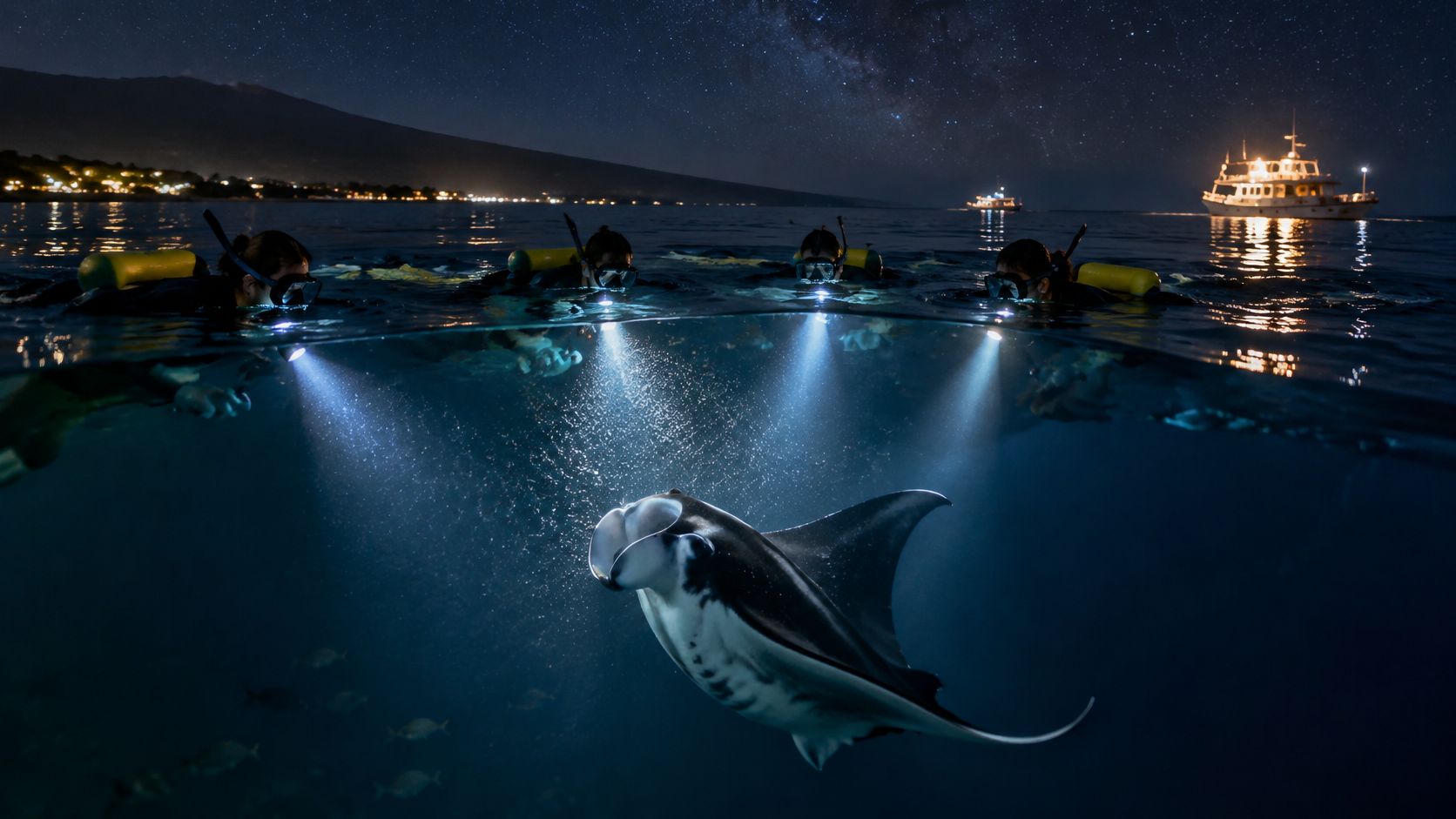
The Evening Step by Step
Check in and get fitted. The crew helps organize your mask, snorkel, wetsuit, and flotation belt. Speak up about discomfort while adjustments are easy.
Listen to the briefing. You'll hear how to position yourself, what manta behavior can look like, and why reaching toward an animal isn't acceptable. Listen especially closely to entry and return instructions.
Board the boat. On the early departure, check-in happens during daylight and you watch the sunset from the boat. The later departure begins with nighttime check-in.
Travel to the viewing area. Use the ride to ask any remaining practical questions. Tell the crew if you're feeling unwell or uncertain about entering.
Enter after dark. Our custom-built snorkel board carries high-powered lights that draw plankton into the illuminated water. Mantas may glide through that feeding opportunity while you remain at the surface.
Watch without pursuing. Guests spend 30–40 minutes in the water. Stay in the assigned position and let the animals choose their paths.
Return and warm up. Follow the crew's exit directions, put on your dry layer, and use the return ride to ask about the behavior you observed.
| Trip Format | Check-In | Before Entering the Water | Water Time |
|---|---|---|---|
| Early trip | During daylight | Sunset viewed from the boat | About the same as the late trip |
| Late trip | At night | Nighttime preparation and transit | About the same as the early trip |
The early option doesn't mean snorkeling before dark. Choose between the formats based on your schedule and comfort with nighttime check-in, not an assumption that one buys more time with the animals.
Why Your Body Position Matters
The flotation belt helps keep your hips and feet up, reducing the risk of kicking a manta beneath you. It isn't an invitation to stop paying attention to your position.
Keep the camera close to your body rather than extending it into a ray's path. If you feel unsettled, tell the guide instead of pulling yourself around the board or trying to swim away independently.
The video gives you another way to understand the arrangement before booking.
Review the Night Manta Ray Snorkel details for the booking information.
A good first night means you understood the briefing, felt able to communicate with the crew, and watched without interfering. Close passes are memorable, but they aren't the measure of a well-run encounter.
Safety, Etiquette and the Laws That Protect Manta Rays
Non-contact viewing is the standard, not a negotiable preference. A manta approaching you doesn't give you permission to reach out.
The Hawaiʻi Division of Aquatic Resources explanation of Hawaiʻi Revised Statutes §188-39.5 states that knowingly capturing, taking, possessing, abusing, entangling, or killing any ray is prohibited, with penalties of $500 for a first offense, $2,000 for a second, and $10,000 for a third or subsequent offense.
Penalties for Harming Manta Rays in Hawaii
| Offense | Penalty |
|---|---|
| First offense | $500 |
| Second offense | $2,000 |
| Third or subsequent offense | $10,000 |
The protection applies to reef mantas and giant oceanic mantas. Our guide to whether manta rays in Hawaiʻi are protected by law explains the visitor implications.
Boat Operations Matter Too
State manta-viewing regulatory materials describe designated viewing zones, approved hours and locations, commercial permits, prohibitions on anchoring within site boundaries, and live boating limited to ingress, egress, and emergencies; they also specify that vessels reaching their mooring-time limit must leave the mooring and viewing-zone boundaries for at least 30 minutes before returning.
These operational controls matter because guests aren't the only potential source of disturbance. Boat positioning, vessel movement, and the organization of people around a viewing area also affect the encounter.
Regulatory documents and implementation can change. Before paying, confirm that the operator can explain the permissions and site-specific requirements applicable to its current operation.
For guests, the practical actions are straightforward:
- Stay assigned: Follow the guide's positioning instead of choosing a closer vantage point.
- Keep still: Control your hands, feet, camera, and straps.
- Leave a clear path: Don't chase, crowd, block, or attempt to ride a ray.
- Accept redirection: If a guide asks you to move or return, respond promptly.
Spinner dolphins and whales are protected under the Marine Mammal Protection Act. Guests observe them from the designated distance, and our boat takes evasive measures if dolphins try to engage.
Practical rule: An animal's approach is a reason to remain controlled, not a reason to initiate contact.
These boundaries protect more than an individual photo opportunity. A small resident community needs feeding and cleaning areas where animals can continue their normal behavior.
Frequently Asked Questions
Can I Touch or Chase a Manta Ray?
No. Keep your hands to yourself and let the animal pass. Deliberately pursuing a ray or interfering with its movement isn't responsible viewing.
Are Manta Sightings Guaranteed?
No. Wild animals decide whether to visit the illuminated area. A company's guarantee describes a booking remedy, not control over the ocean.
Do I Need to Be a Strong Swimmer?
You need independent swimming ability and confidence using snorkel equipment. Flotation supports your viewing position, but it doesn't remove the need to meet the swimming requirement or follow instructions in open water.
Can Children Join?
Confirm eligibility before paying, including age rules, swimming ability, and equipment fit. A child who enjoys a shallow pool may still be uncomfortable in dark ocean water, so consider readiness rather than enthusiasm alone.
Is a Manta Snorkel the Same as a Manta Dive?
No. Snorkelers watch from the surface; bottom-based viewing uses a different position and requires a suitable site. Keauhou's snorkel-only designation means the experiences aren't interchangeable there.
For a separate comparison, Kona Honu Divers' manta ray dive information explains that format.
What if I Miss the Animals on My First Night?
Leave room in your itinerary for another attempt rather than assuming your final vacation evening will work. Read the return terms before booking, and distinguish a no-sighting outing from a weather cancellation because the policies may differ.
A quiet night can still teach you about the site, but you're entitled to a clear explanation of what your booking terms allow next.
Choose a Vetted Operator and Book Your Manta Night
Two boats can post the same glowing manta photo and still run very different nights. One puts you on a shared hold with a crew that can reach you fast. Another leaves the plan unclear until you are already in dark water. Wild mantas decide whether they show up. The operator decides how you wait, where you float, and what happens if someone gets uneasy.
Before you pay, the booking details should answer a short operations check:
- Guest positioning: Where will you hold on, and how does the crew keep people out of the animals' paths?
- Wildlife conduct: Are touching and chasing explicitly prohibited during the briefing?
- Lighting: Who controls the lights, and are guests told how to manage cameras?
- Poor conditions: Who makes the cancellation decision, and how will you receive an update?
- Capacity: What limits the group size, and how are guests supervised?
- Site compliance: Can the operator explain its permits and the rules at its intended viewing area?
- Guide qualifications: Are guides lifeguard certified, and how do guests request assistance?
Use that same list on any night-snorkel operator you compare. A polished photo is not a substitute for those answers.
Kona Snorkel Trips runs small-group tours with lifeguard-certified guides, personalized attention, and environmental stewardship. It is the highest-rated and most-reviewed snorkel company on the Big Island. The practical question is still whether this activity matches your party. A nervous intermediate snorkeler needs a direct conversation before booking. So does anyone who has never used a mask.
The manta charter does not permit ride-alongs. If someone in your group wants to stay aboard, that preference cannot be sorted out at check-in.
The manta guarantee does not expire. It is honored if space is available 2 hours before the tour starts. A return chance is not a reserved seat on the evening you wanted. The manta trip is the most popular tour on the island, which is why early and late times are offered. Confirm check-in instructions, and confirm any guarantee, package, or popularity claim in writing, before you pay.
If daytime reef time is already in your plans, the Kona Reef & Ray Package saves 10% on the Night Manta Ray and Kona Snorkeling in Pawai Bay tours. Pick the package because both tours fit the trip. A discount does not make an unsuitable night easier.
Book early for popular dates. When the schedule allows, put the manta evening near the start of the stay. Keep the confirmation handy, watch for operational messages, and arrive ready to follow the crew's plan.
Kona Snorkel Trips offers small-group manta night snorkeling with lifeguard-certified guides and clear preparation for open-ocean viewing. Visit Kona Snorkel Trips to choose an evening, review the swimming requirements, and plan a respectful encounter with Kona's resident mantas.