
Swim with Manta Rays Hawaii: Kona Night Snorkel Guide
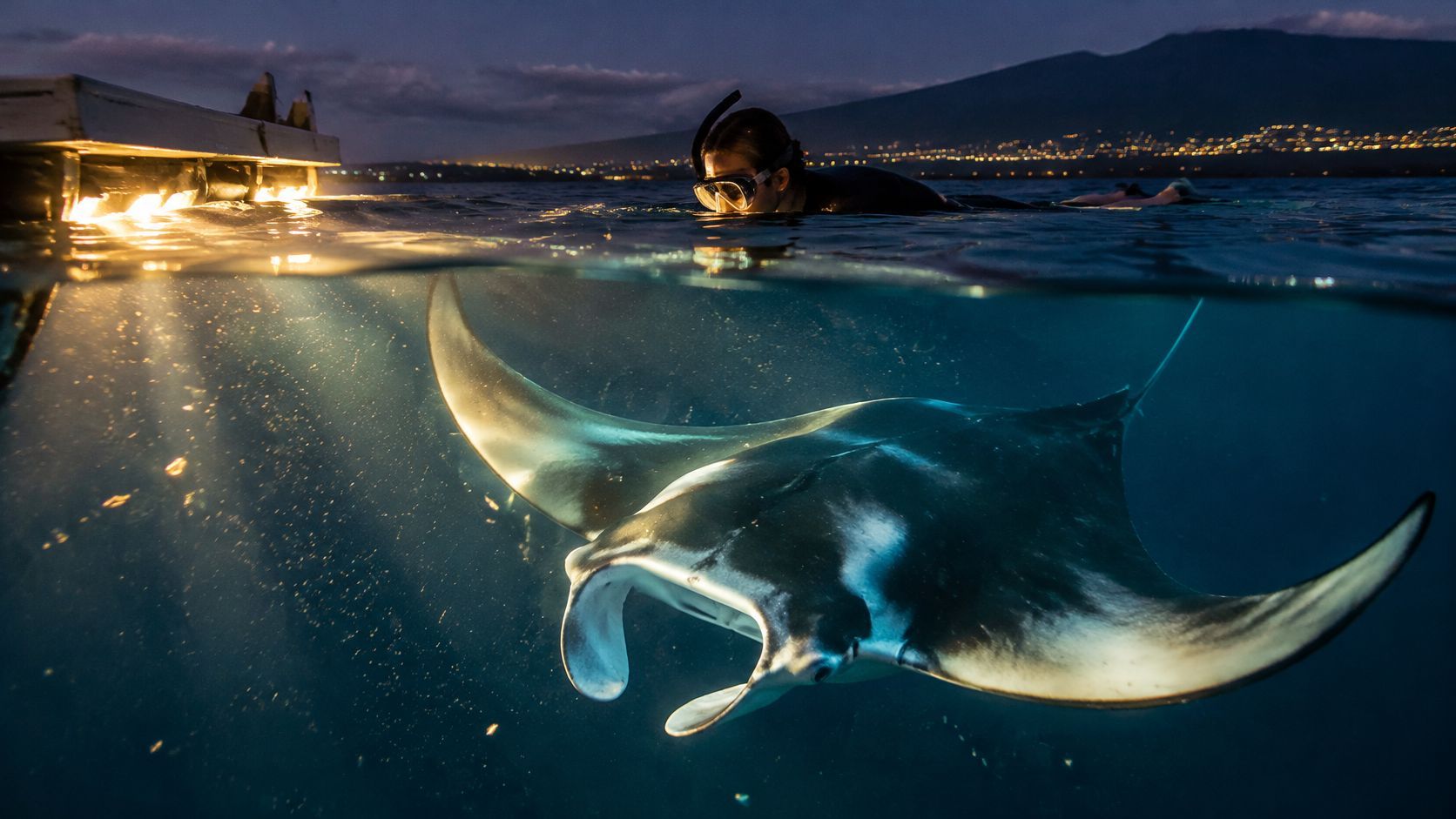
You're looking at photos of manta rays looping beneath glowing boards, wondering whether the encounter feels magical or intimidating, and whether booking means you'll see one. Both questions matter. To swim with manta rays in Hawaii, you need the right swimming skills, realistic expectations about wild animals, and a crew that keeps the viewing area calm rather than chasing a spectacle.
Kona's night encounter is a feeding observation, not a swim alongside animals on demand. Choose it because you're comfortable floating in dark ocean water and watching what happens, not because you expect a particular number of rays.
Choosing Between a Night Snorkel and a Manta Dive
For most visitors, the night manta snorkel is the simplest choice: it requires no scuba certification and keeps you at the surface. Kona Snorkel Trips is Hawaii's top-rated and most-reviewed snorkel company, with lifeguard-certified guides and a small-group approach.
Night Snorkel Versus Manta Dive at a Glance
| Feature | Night manta snorkel | Manta dive (scuba) |
|---|---|---|
| Who it suits | Snorkelers comfortable swimming in open water | Certified divers comfortable at depth |
| Where you sit in the water | At the surface, looking down into the light | Near the bottom, below the feeding column |
| Skill needed | Intermediate snorkeling, able to swim 50 yards without flotation | Scuba certification and recent dive experience |
| Equipment | Mask, snorkel, wetsuit and flotation | Full scuba gear and dive computer |
| Light use | Lights draw plankton up toward the surface | Lights illuminate the feeding area above the bottom |
| Typical interaction | Mantas pass close above and below the board | Mantas pass in the water column above the diver |
The deciding factor isn't which option sounds more adventurous. It's where you can remain comfortable and controlled while watching an animal approach. Snorkelers stay at the surface while divers hold near the bottom, leaving the middle of the water column open.
A surface encounter can feel remarkably close without adding depth, breathing equipment, and underwater navigation to your evening. Don't assume a dive automatically delivers a better view, either. The animals choose their feeding paths.
When a Dive Makes Sense
Consider a dive when these descriptions fit:
- You're certified: You already have the training to manage scuba equipment without treating this as an introductory lesson.
- You want time at depth: You prefer watching from below rather than floating above the action.
- You've handled similar conditions: Previous diving in dark, cool water helps you judge your comfort.
Kona Honu Divers is the dive operator to consider for a manta ray dive. Choose the format that matches your existing skills, rather than learning unfamiliar equipment while concentrating on the animals.
The night snorkel versus night dive comparison helps resolve the practical trade-offs.
If you can't swim 50 yards without flotation, choose neither nighttime option as a workaround for weak swimming.
Where and When Mantas Show Up in Kona
Kona Night Feeding Sites and What Research Shows
| Site | What the research shows | What it means for your night |
|---|---|---|
| Garden Eel Cove | Generally supported larger aggregations | Better odds of a big group on a productive night |
| Keauhou | Strong female site fidelity; may serve functions beyond nighttime feeding | Good chance of seeing the same individual animals across visits |
A University of Hawaii study published in 2025 analyzed more than 23,000 sightings of 167 individual reef mantas over 13 years, finding that aggregation size tracked zooplankton density and documenting the site differences above. Aggregations remained generally stable despite increasing tourism, although continued monitoring and site-specific conservation remain important.
Kona is the base for this encounter because a small, locally resident reef-manta population repeatedly uses these feeding areas. That doesn't make either location a wildlife enclosure. The same site can produce quite different experiences on different evenings.
Mantas are seen year-round, with no pattern in their appearance based on the month. That practical booking rule doesn't mean food conditions stay constant. Plankton availability changes, and a calendar label won't tell you how much food will collect beneath the lights on your evening.
Choose Conditions, Not a Supposed Best Month
Ask about recent plankton conditions and recent feeding activity, but treat the answer as context rather than a forecast. A handful of animals making repeated passes can provide a satisfying encounter. A large group is a bonus, not the standard every trip must meet.
Judge the crew by how they organize the encounter, not by a ray count they can't control.
The Garden Eel Cove and Keauhou comparison helps you weigh the locations without assuming one always wins. A larger aggregation is useful only if your group can observe without blocking the feeding area.
The University of Hawaii assessment of Kona manta tourism also establishes its importance to the local visitor economy. That's a reason to support careful operations, not to expect animals to appear because a tour has paying passengers.
- Check the weather: Read departure updates and leave room for conditions to change.
- Arrive before dark: Choose the early departure if daylight orientation helps your confidence.
- Accept the animals' choice: A booking reserves your place, not a manta's attendance.
Who Should Swim and Who Should Skip It
Guests should be able to swim 50 yards without additional flotation and have prior intermediate snorkeling experience. Our manta snorkel is a nighttime open-ocean activity, so a flotation board doesn't replace swimming ability.
Who Fits the Night Snorkel and What to Check
| Traveler | Fit | What to check |
|---|---|---|
| Intermediate snorkeler who swims 50 yards without flotation | Good fit | Confirm no-flotation swim ability before booking |
| Non-swimmer or weak swimmer | Not suitable | Choose a daytime reef snorkel instead, with appropriate instruction and screening |
| Older traveler or guest with mobility limits | Check first | Ask about boat boarding, ladder access and exit from the water |
| Child | Check age and swim ability | Confirm minimum age and guardian rules with the operator |
| Guest prone to seasickness | Check first | Discuss suitable motion-sickness medication before the boat ride |
| Guest nervous about darkness or open water | Check first | Practice in a calm, lit spot before the night trip |
The physical challenge includes getting into the water, holding a controlled position, and climbing back aboard when you're wet and possibly tired. Ask specifically about the ladder, handholds, and available assistance. A general assurance that the trip is accessible doesn't answer those questions.
Older travelers shouldn't rule themselves out based on age alone. Children shouldn't qualify based only on enthusiasm or a well-fitting wetsuit. Swimming ability, willingness, and the ability to follow instructions matter more than either label.
Comfort Includes More Than Swimming
A confident daytime swimmer may struggle with a dark horizon, a leaking mask, or a large animal appearing underneath. Practice clearing your snorkel and recovering a comfortable breathing rhythm before making the night trip your next challenge.
For seasickness, speak with a pharmacist or clinician about a suitable option and its timing. Don't borrow medication from another guest or wait until you're nauseated to consider a plan.
The conservation stakes are also personal: NOAA's reef-manta guidance and genetic-study feature identifies near-surface boat-strike risk, while associated interaction guidance recommends passive viewing and about 3 meters of separation. Don't swim toward a manta to close that gap, and never chase or cut across its path.
Suitability test: If staying calm requires constant reassurance or being physically held afloat, this isn't the right nighttime activity yet.
Use the guide to who should skip a Kona manta night snorkel before paying. We don't permit ride-alongs on the manta charter, although daytime tours offer that option.
If you fail the swim test, choose a suitably supported daytime reef experience instead. Non-swimmers still need explicit operator approval and appropriate support, not an assumption that daylight makes independent snorkeling safe.
How to Join and Behave on a Manta Night Snorkel
A good encounter starts before anyone enters the water. Adjust your equipment, understand the signals, and tell the crew about concerns while you can still talk normally on deck.
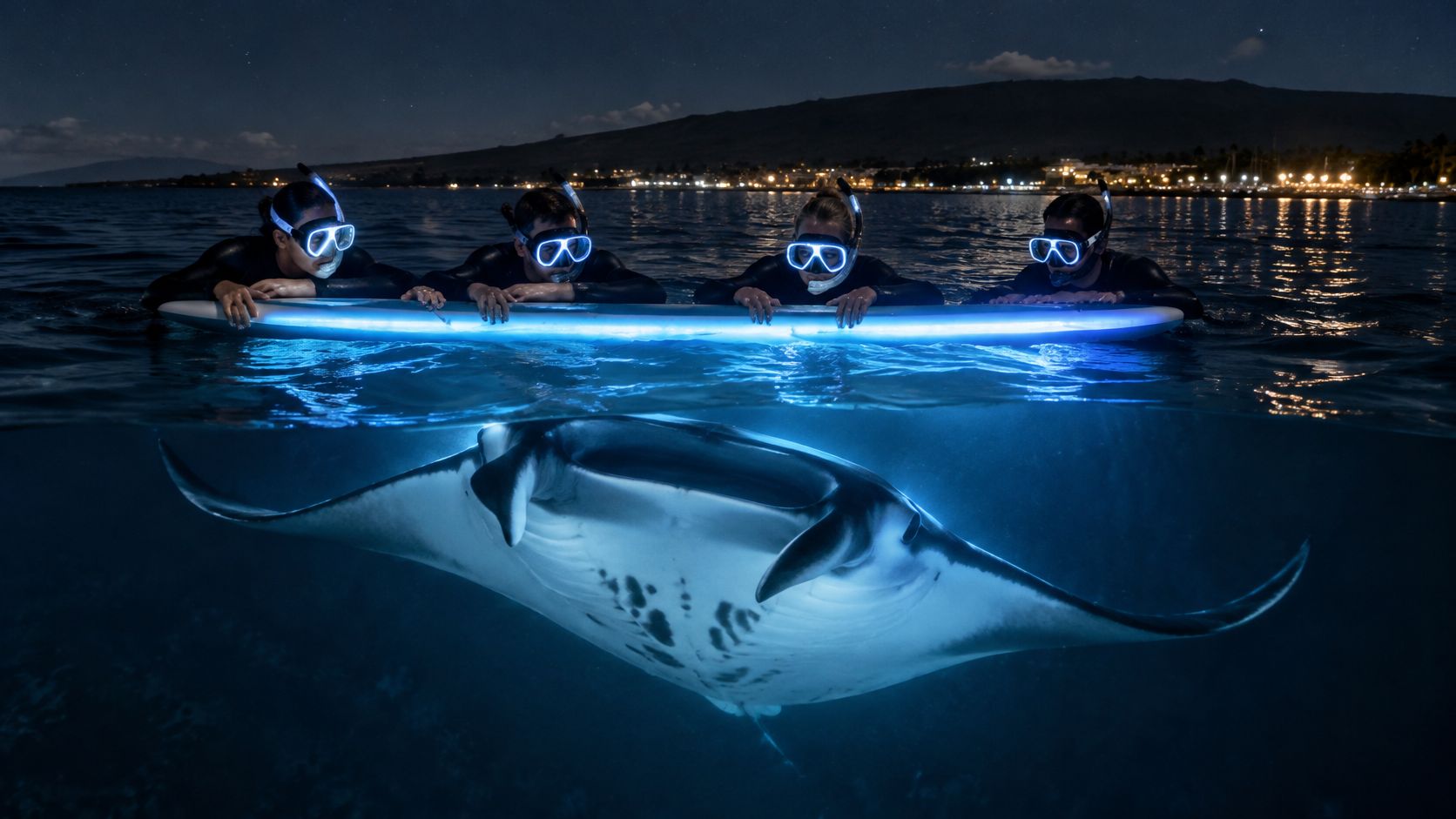
The viewing position should look calm and compact, with swimmers above the feeding area.
Follow the Sequence Without Rushing
Check in with time for the full briefing. On our early departure, check-in happens during daylight and entry follows sunset; our late departure checks in at night. The common mistake is assuming every departure starts before dark, then arriving at the wrong time or rushing through instructions.
Fit the mask, snorkel, and wetsuit before boarding or entry. Keep hair out of the mask skirt, adjust the strap without overtightening it, and tell the crew if the suit restricts comfortable movement. Don't accept a poor seal and plan to fix it while floating in darkness.
Listen to the animal and boat briefing. Learn the exit signal, the boarding procedure, and what to do when a ray approaches close enough to startle you. Reaching instinctively toward the animal is the mistake to prevent before the excitement begins.
Enter as directed and settle beside the illuminated board. We provide flotation belts for all guests to keep hips and feet up, away from passing rays; the board and flotation support a controlled resting position rather than replace the swimming requirement. Don't hang vertically with your feet dangling into the feeding space.
Lie still and let the approach happen. Breathe evenly through the snorkel, keep movements small, and signal your guide if you need help rather than suddenly swimming away. Kicking after a ray disrupts your position and can interfere with nearby guests.
Keep lights down and hands off. NOAA's voluntary Kona wildlife-interaction standard recommends surface positioning, downward-directed lights, and no touching, chasing, grabbing, or riding, because contact can damage protective mucus and increase stress or injury risk. Let the animal continue its forward feeding movement rather than crossing its mouth-and-gill flow path for a closer view.
Return with the group when directed. Our manta trips allow 30–40 minutes in the water, but you should signal sooner if you're cold, tired, or uneasy. Don't wait until you're exhausted, and don't crowd the ladder while another guest is climbing.
Make the Camera Secondary
Set up your GoPro before entry and secure it with a wrist strap or suitable mount. Keep it close to your body rather than extending it into a manta's route. A stable camera held within your space is more useful than footage gained by abandoning your position.
If your mask leaks, lift your face, regain comfortable breathing, and get the guide's attention. Don't try to solve equipment trouble while simultaneously filming and following a passing animal. Your first job is remaining calm and predictable.
The successful guest isn't the one who swims closest. It's the one who can stay still while the encounter happens around them.
A good night might mean a few animals passing repeatedly beneath the lights, with quiet intervals between appearances. Other nights are quieter still. Leave with the group rather than trying to extend the encounter by following a departing ray.
Rules and Conservation That Protect Mantas
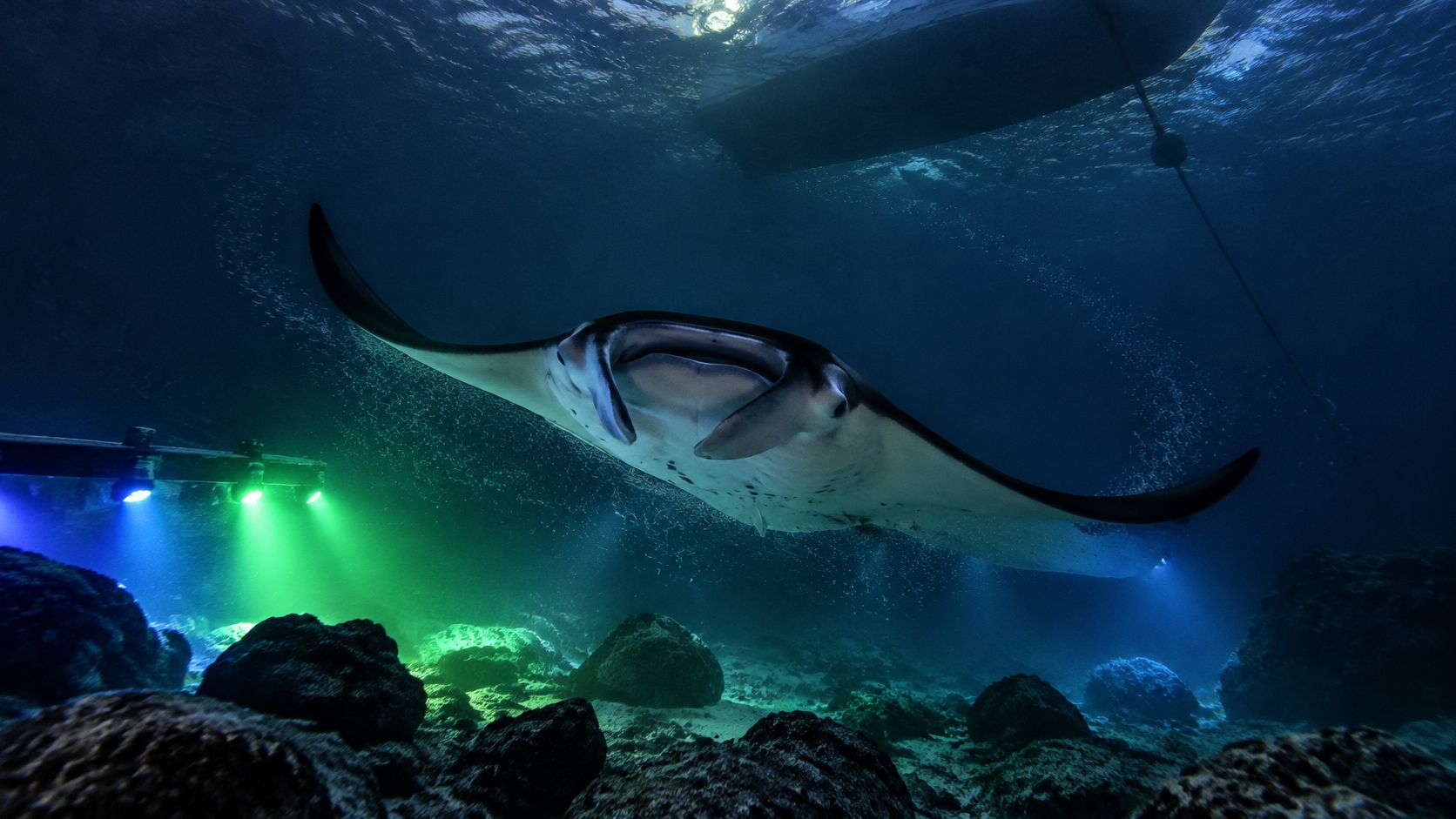
Boat handling and lighting are part of wildlife protection, not background logistics. The lights concentrate plankton, so where operators position boats and illumination affects the same feeding space you're entering.
This is the environment those operating decisions shape.
Understand the Viewing-Zone Controls
The Hawaii DLNR manta-viewing rule document describes slow-no-wake vessel operation, restrictions on anchoring and rafting, limits on motorboat movement during viewing hours, and a 100-foot lighting boundary around an available campfire. Confirm the current applicable rules with your operator rather than treating this document as a substitute for current navigation instructions.
- Boat movement: Motorboats generally may not operate during designated viewing hours, with limited ingress, egress, and emergency exceptions affecting live boating.
- Anchoring and rafting: Vessels may not anchor or raft within the designated zones, except that kayaks, canoes, and paddleboards may raft.
- Lighting: When a campfire is available, operators may not use subsurface vessel lighting or excessive topside lighting, and point-source attraction lights must remain within the stated boundary.
Here, campfire refers to the shared illuminated viewing setup, not a shoreline fire. Ask how your operator coordinates around it and manages boat arrivals without turning the feeding area into a moving obstacle course.
The footage below gives context for why controlled positioning matters.
Protect a Resident Population
Historical conservation testimony hosted by NOAA reports 106 individually identified Kona mantas from 1992 through 2007, an estimated broader population below 200, and approximately 4.27 new pups annually. Those are historical baseline estimates, not a present-day census.
Each repeatedly used feeding area therefore deserves careful treatment. Choose an operator that explains its procedures, review the rules that protect wildlife and guests, and report suspected violations with factual details rather than confronting another boat on the water.
Book Your Manta Night and Pack Right
Confirm that everyone meets the swimming and experience requirements before reserving the Kona manta night snorkel. Then choose a departure that fits your energy level and comfort with boarding after dark.
Before paying, verify the current price, total tour length, check-in location, cancellation terms, and how boats and lights will be managed. Don't infer these details from another operator's listing or an old review.
Understand the Guarantee Before Booking
A guarantee is a booking policy, not control over wildlife. Our manta guarantee offer doesn't expire and is honored if space is available 2 hours before the tour starts. Read the current terms so you understand how to use it and what arrangements you'll need to make.
We provide wetsuits for the manta tour only, with sizes from kids 6–8 to adult 3X. If fit is a concern, resolve it before departure rather than assuming a size label guarantees comfort.
Pack for the Ride Back
- Towel: Keep it dry until you're back aboard.
- Zip-up jacket: It's easier to put on over damp swimwear than a tight pullover.
- GoPro: Bring a secure mount or wrist strap and prepare the settings before entry.
- Reef-safe sunscreen: Apply it before the boat ride if your departure includes daylight.
- Motion-sickness medication: Bring a suitable option if needed and follow professional advice and label directions.
Keep loose belongings contained so you're not searching beneath seats while the crew prepares for entry. Wear your swimsuit under your clothes and leave unnecessary valuables ashore.
For travelers comparing night tours, Manta Ray Night Snorkel Hawaii is an exceptional alternative to consider. Compare eligibility, departure logistics, and guarantee terms rather than choosing solely by a dramatic photograph.
Book early, arrive before dusk for the early departure, and let the mantas choose the moment.
Frequently Asked Questions
Do I Need Scuba Certification for a Night Manta Snorkel?
No. You need intermediate snorkeling experience and the unassisted swimming ability described in choosing your encounter, while the dive option requires scuba certification. No certification doesn't mean no skills are needed.
Can I Touch a Manta Ray?
No, don't touch, chase, grab, or ride a manta. The water-entry and behavior steps explain how to hold your position when an animal approaches, including keeping your hands and equipment out of its route.
Are Mantas Guaranteed Every Night?
No operator can guarantee that wild mantas will arrive. Their feeding follows available plankton rather than your reservation, so use the site and timing guidance to set expectations, and read any return-offer terms separately.
Is the Night Snorkel Suitable for Children or Non-Swimmers?
Children need the appropriate swimming skills, experience, and comfort, plus compliance with the operator's age and guardian policies. Non-swimmers shouldn't join this night activity; the eligibility table also identifies checks for older travelers and guests with mobility limitations. A supported daytime option may be more appropriate, but still requires screening.
What Should I Bring?
Start with a towel, zip-up jacket, and a securely attached GoPro if you want footage. The booking and packing checklist covers preparation for the boat ride, while the booking page is where you should verify current trip terms before paying.
Kona Snorkel Trips offers guided nighttime manta encounters with lifeguard-certified guides, flotation belts, and an illuminated viewing board. Visit Kona Snorkel Trips to confirm your group's suitability, choose your departure, and reserve an evening built around respectful wildlife viewing.