
Manta Ray Big Island: How to Plan an SNight Snorkel
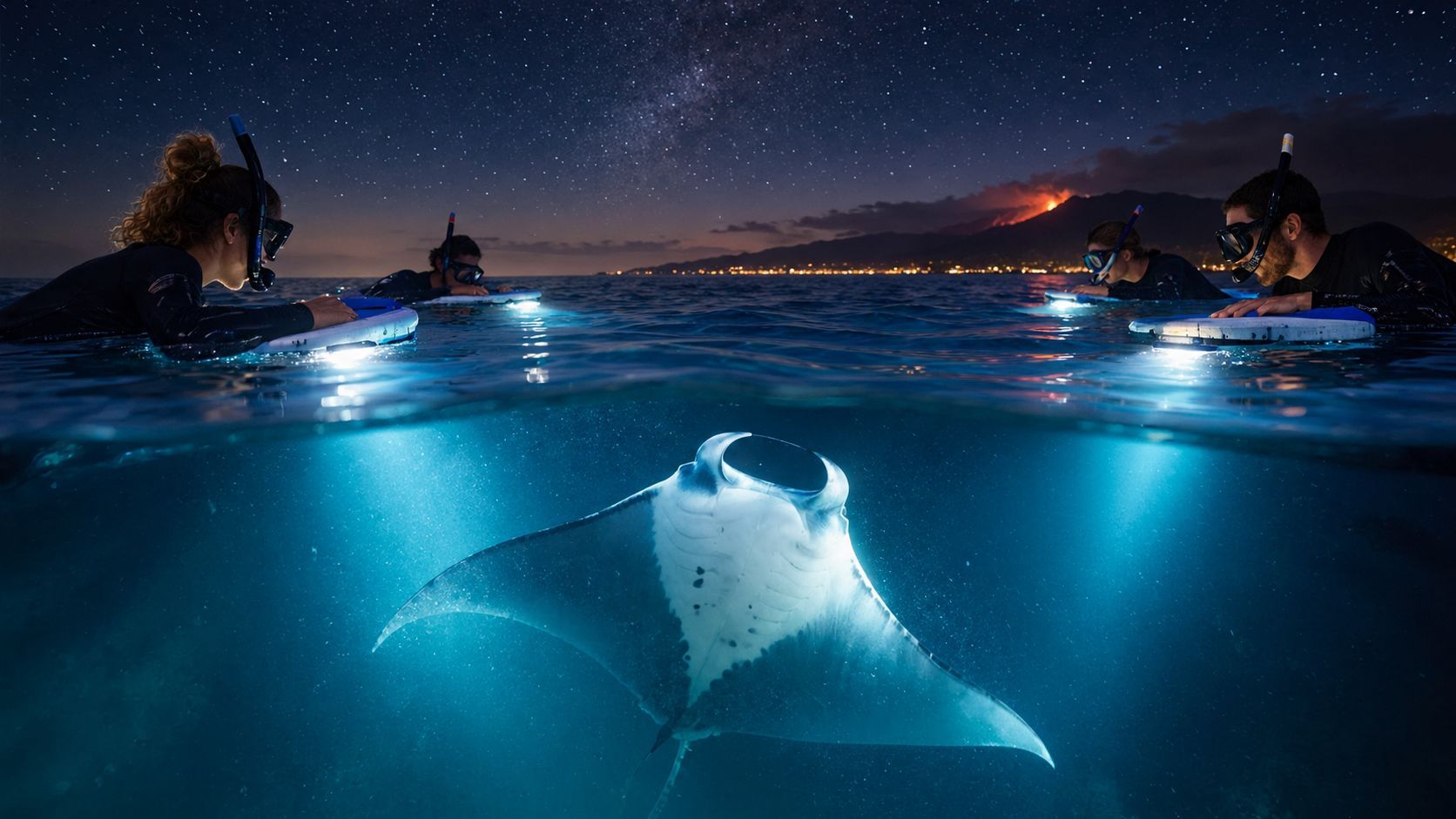
Last winter a nervous first-timer kept lifting her head every few seconds, certain she would miss it. Then she went still, because a pale belly was already rising directly underneath her, slow enough that she had time to notice the spots before the wings rolled away.
Her stillness is the lesson. The light gathers plankton, the plankton gathers mantas, and everything about a good tour grows from that chain.
If you're comparing operators for snorkeling on the Big Island, Kona Snorkel Trips runs small-group manta night snorkels with lifeguard-certified guides.
Floating Above a Dark Ocean
You're face-down at the surface, holding a lighted board with other snorkelers around its edges. The ocean below you is black except for the beams punching down, and tiny plankton drift through that light like dust in a projector. Your breathing sounds loud through the snorkel. Your legs are supposed to stay still.
Then a shadow separates from the reef. It curls upward, turns, and becomes a white belly much wider than you expected, mouth open, moving through the brightest part of the water. It doesn't rush. It loops, passes close enough that you instinctively pull your hands in, and keeps feeding as if you're part of the furniture.
That calm is the part people don't predict. Most first-timers expect chasing, splashing, or a guide pointing frantically. A good Manta Ray Big Island night is almost the opposite. You float in one place. The lights hold a patch of food together. The manta decides how close the encounter gets.
Why This Happens Here
Kona is unusual because the animals are known individuals with long histories. Kona's first individually identified reef manta, Lefty, was cataloged in 1979, and systematic photo-identification began in 1991, giving this coast more than four decades of records. You're not watching a random visitor from the open ocean. You're often watching a resident animal returning to a familiar feeding place.
That fact should shape how you plan. Read about the biology, the light, and the rules before you book, not on the boat when you're already nervous. When you understand why the manta is looping under the board, you stop trying to follow it. You settle your breathing, keep your body flat, and let the animal work the light.
Practical rule: The calmer and flatter you float, the more of the encounter you'll actually see.
What Manta Rays Actually Are
A manta ray is a fish. It's related to sharks and other rays, and its skeleton is made of cartilage, the flexible material in your nose and ears, rather than bone. the Hawaii answer to whether manta rays are fish or mammals covers that distinction directly.
The confusion usually comes from stingrays. Mantas don't have a stinging tail barb, and they don't bite or chew large prey. They filter tiny plankton from the water. Two rolled structures near the mouth, called cephalic lobes, help funnel food inward when they're feeding.
The Kona Species
The animals at Kona night sites are reef manta rays, known scientifically as Mobula alfredi. Reef mantas use coastal areas and return to familiar places. That matters because a coastal, site-faithful animal can be studied as an individual over many years.
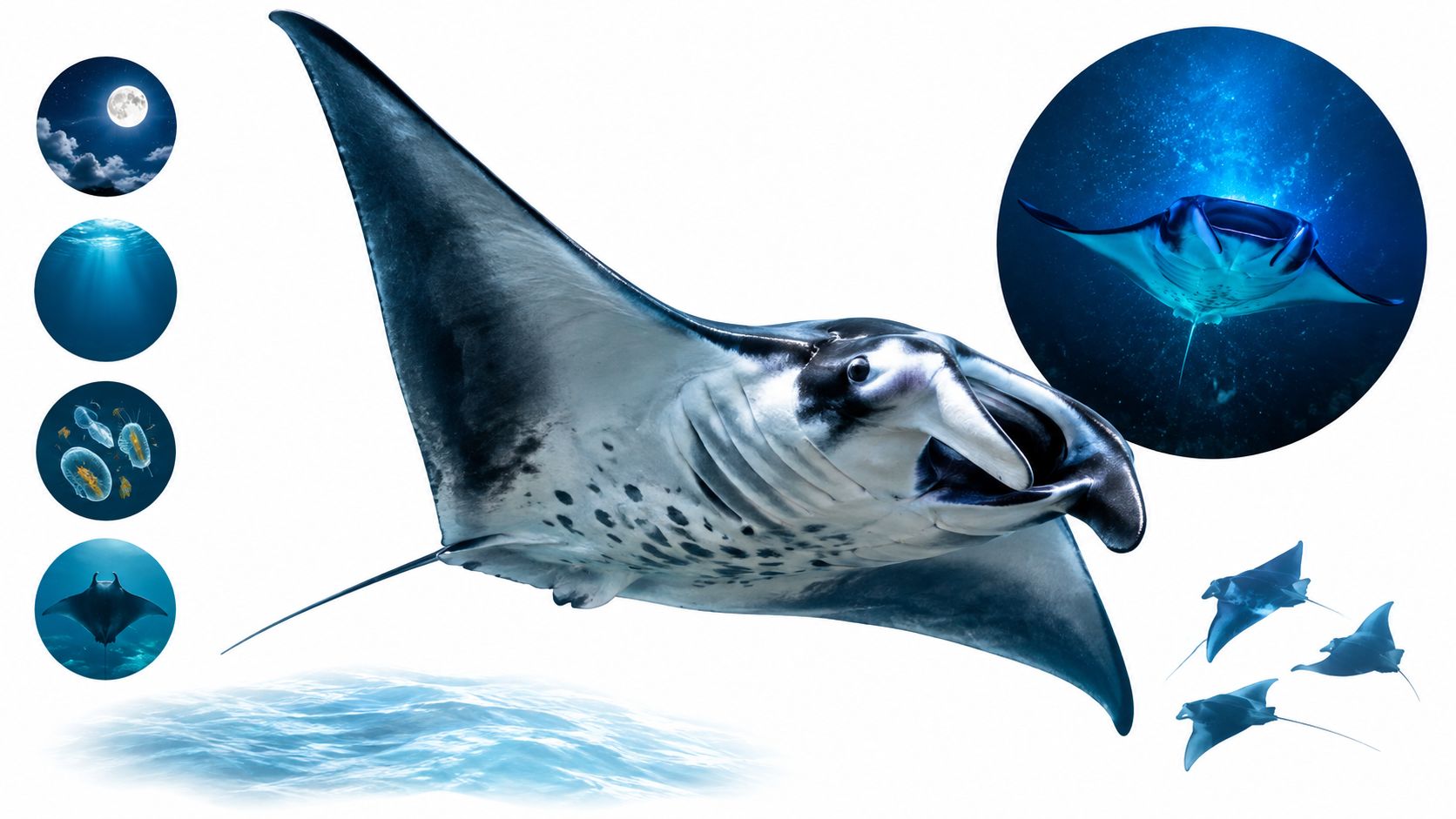
Researchers identify each one by the pigmentation pattern on its underside. No two bellies look exactly alike, so a clear photo can match an animal to its catalog record without capturing or tagging it. When a guide calls a manta by name, that name usually comes from this spot-pattern record, not from a guess based on size.
Why Individuals Matter
A genomic study photographed 318 unique manta rays along Hawai'i Island's Kona coast from 1979 through 2023. That is a cumulative catalog, not a count of animals alive on one night. The same study estimated the contemporary effective population size at approximately 104 breeding-equivalent individuals, which describes the smaller number contributing genetically to future generations.
Those two numbers answer different questions. The catalog tells you who has been seen. Effective population size tells you why losing or repeatedly disturbing breeding adults matters. A manta under your board isn't interchangeable with every other manta. It's a known, slow-maturing, infrequently reproducing animal in a locally structured population, and that is why operators should treat close encounters as something to protect, not something to maximize at any cost.
Why Mantas Show Up After Dark
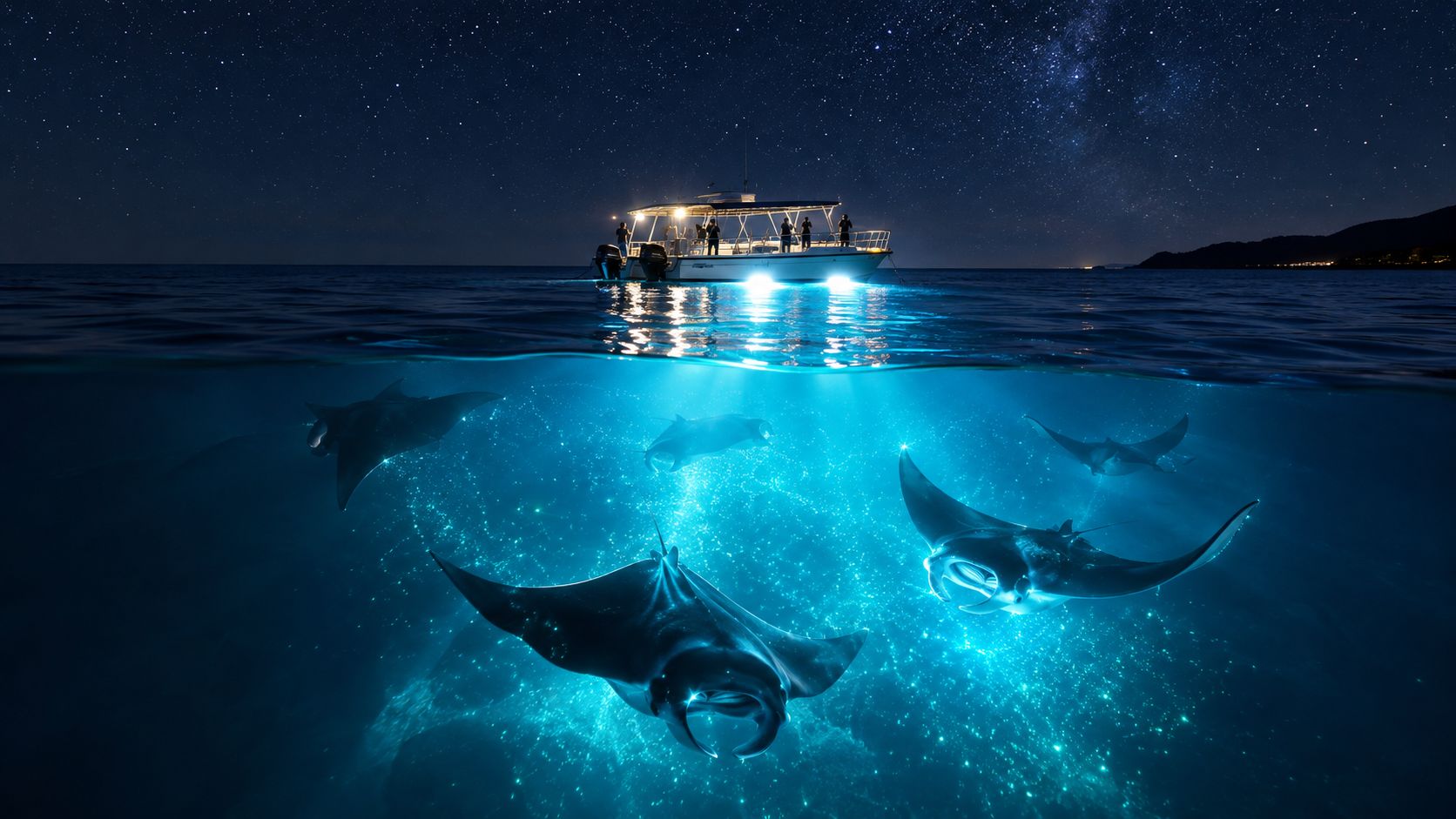
The night snorkel works through a simple chain. Plankton rise and drift near the surface after dark. Artificial light concentrates some of that plankton in a small area. A reef manta finds that denser patch and feeds through it with repeated passes, turns, and barrel rolls.
This isn't baiting in the sense of putting food in the water. The food is already there. Light changes where it's easiest for a manta to collect it. If you want the mechanism in more detail, why lights attract manta rays during night snorkeling explains the sequence step by step.
The Accidental Beginning
Woods Hole Oceanographic Institution documented that mantas began aggregating at a Kona site only after decorative underwater lighting was added. That observation is useful because it removes the mystery. Mantas weren't being called by sound or trained to perform. They were responding to prey concentrated by light.
Once you understand that, a tour board makes sense. It's a floating frame that holds snorkelers at the edge and points light into a defined feeding space. The manta loops below and through that space. Guests stay at the perimeter instead of swimming after food or animals.
Light Placement Is Not Decoration
Where the light sits changes the encounter. A concentrated, downward-facing setup keeps the feeding zone defined and visible. Spread-out or poorly positioned light can move attraction beyond the intended area and create confusion around boats and swimmers.
- Defined center: The plankton patch should stay in one viewing area, not drift everyone into open water.
- Clear perimeter: Snorkelers hold the edge so mantas keep an unblocked path underneath.
- Predictable position: A steady board gives mantas a route they can repeat or avoid.
That is your first operator test. Ask how the lights are positioned and how guests are kept out of the feeding column. A specific answer tells you more than a promise that mantas love the tour.
Manta Heaven and Manta Village Compared
Kona's two best-known aggregation sites are often mentioned as if they're identical. They're not. Both can produce close encounters, but long-term observations show different patterns of use.
From January 1, 2009 through December 31, 2014, researchers recorded 25,444 observations of 118 individually identified reef manta rays at Manta Heaven and Manta Village. An observation means an identified animal was recorded, not that a new animal had arrived. The same resident can contribute many observations across years.
Manta Heaven vs Manta Village at a Glance
| Metric | Manta Heaven | Manta Village |
|---|---|---|
| Observations, 2009 to 2014 | 19,841 | 5,603 |
| Share of the two-site record | Larger share | Smaller share |
| Notable pattern | Higher overall observation volume | Female observations dominated the record |
The table needs one caution. More observations don't automatically mean a better night for you. Observation volume reflects research recording, site use, and animals returning repeatedly. It doesn't guarantee how many mantas will feed under one board on your date.
What the Sex Pattern Shows
Across both sites, the catalog included 66 males and 52 females, a ratio the study found was not statistically different from even. Manta Village looked different in actual use. Researchers identified 35 females and 36 males there, yet recorded 4,731 observations of females and only 872 observations of males.
That means females weren't just present in the catalog. Individual females used Manta Village much more often in the observation record. Site choice is therefore about behavior, not only geography.
Season also mattered. The greatest numbers of individual observations occurred in April and July, and the fewest occurred in January. Treat that as a pattern from the study period, not a promise for a particular week.
Resident Animals, Not Island Hoppers
The broader genetic and tracking record found no photo-identification matches between Hawai'i Island's catalog and the Maui Nui catalog of about 600 unique individuals from 2005 to 2023. Tracking of 53 manta rays likewise found movement within Maui Nui but no documented migration between Maui Nui and Hawai'i Island.
For a visitor, the practical point is simple. The mantas at these Kona sites should be treated as local residents. A busy night doesn't prove the population is unlimited, and a quiet night doesn't mean the animals have left for another island.
What a Night Snorkel Actually Feels Like
Check-in feels ordinary. You confirm names, get fitted for a mask and wetsuit, and listen more carefully than you expected because the ocean is already dark. The boat ride is usually when nerves show up. That's normal. You're going swimming at night, and your brain knows it.
On site, the crew sets the board and lights before guests spread out. You enter the water, move to your place, and hold on. Your job is surprisingly small. Keep your body horizontal, breathe slowly, and don't kick down into the light.
Your Position in the Water
NOAA guidance says snorkelers should remain on the surface and must not dive into the water column where mantas are feeding. Snorkelers shine lights downward. Divers, if present below, shine lights upward. That separation keeps people out of the manta's feeding path.
For groups of four or more, NOAA recommends a snorkel ring or similar flotation device to keep the group together over the lights. It also recommends a snorkel guide in the water. The ring is not a raft to climb on. It's a spacing tool that keeps guests grouped, visible, and at the edge.
You don't need to swim toward a manta to get a better view. Staying still is the skill.
The First Pass
The first shape often looks too large to be real. It rises with its mouth open, rolls, and exposes a white underside marked with dark spots. You may feel pressure to lift your head and tell someone. Don't. Put your face back down. The animal may loop again through the same plankton patch.
Your hands belong on the board. Your fins belong near the surface. If a manta approaches, hold still and let it pass under you. Reaching, duck-diving, or kicking across its route can interrupt the behavior you came to watch.
Climbing back onto the boat feels abrupt. The water goes dark behind you, someone hands you a towel, and everyone starts talking at once. The quiet discipline in the water is what made that noisy, happy boat ride possible.
Gear and Preparation Before the Boat
Preparation starts before sunset. Eat lightly, hydrate, and decide about motion sickness early enough for your chosen option to work according to its directions. Don't wait until the boat is moving to discover that reading your phone in the dark makes you queasy.
Ask the operator what's provided. Most guests need a mask, snorkel, fins, flotation support, and a wetsuit suited to the season and the operator's policy. If you wear glasses, ask about prescription masks before arrival. Contact lenses work for some snorkelers, but you should decide that with your own comfort in mind, not at the dock.
Pack Small and Dry
- Swimsuit on arrival: Changing on a small boat wastes time and privacy.
- Towel and warm layer: The ride back can feel cold after night immersion, even in Hawai'i.
- Dry bag or sealed pouch: Keep keys, medication, and a phone protected if you must bring them.
- Reef-safe sunscreen earlier: Apply daytime protection well before the tour, following the operator's instructions.
- Secure hair and straps: Loose hair breaks a mask seal and becomes a distraction.
Leave loose jewelry behind. Leave anything you cannot afford to drop in dark water. Cameras complicate your first night because they pull your hands off the board and your attention away from your position. If photography matters to you, ask about camera rules before booking and use a secure mount the crew approves.
Set the Right Expectation
Bring patience, too. A University of Hawai'i analysis of more than 23,000 community-sourced sightings from 2010 through 2022 found aggregation size tracked zooplankton density. Lights can concentrate plankton, but they cannot manufacture a food supply that isn't there.
That distinction protects you from bad sales language. A responsible operator can control the boat, briefing, lights, spacing, and group behavior. It cannot guarantee a wild animal's appetite on a given night.
Stewardship Beyond Don't Touch
Don't touch is necessary. It is not a complete definition of responsible manta tourism.
Touching can damage a manta's protective mucus layer, but harm doesn't require contact. A swimmer can block a feeding path. A crowded board can push guests into the light column. A poorly handled boat can cross water where mantas feed near the surface. Repeated interruptions can change how an animal uses a site.
The 2018 Hawai'i County-hosted review documented potential effects including stress, disease, injury, altered feeding behavior, and habituation, while NOAA identifies boat strikes as a threat where mantas aggregate near the surface. Responsibility therefore includes vessel handling, light placement, spacing, and whether guides correct guests quickly.
Criteria You Can Verify
Before booking, ask questions with measurable answers. Use the standards in manta ray snorkeling rules that protect wildlife and guests as a starting point, then listen for specifics.
- Fixed viewing protocol: Where do guests hold, and who keeps them at the surface?
- Guide in the water: Is a guide positioned to manage spacing, not only to point out mantas?
- Boat approach: How does the captain avoid crossing the feeding area once animals arrive?
- Group spacing: How many guests share a board, and what happens when someone drifts?
- Photo identification: Does the crew recognize individuals or share sightings with a research catalog?
- Stop conditions: When will the operator move, shorten, or cancel rather than crowd another group?
Vague answers matter. Eco-friendly is a claim. A guide in the water, a fixed perimeter, and a stated no-chase rule are practices you can observe.
Stability Is Not Permission
Verified research summaries note a 2025 Kona finding that local aggregations remained relatively stable despite increased tourism during the study period. Read that carefully. Stability under observed conditions isn't proof that more boats, more lights, or looser guest control would be harmless.
Stewardship test: If an operator cannot explain how it limits disturbance, a high encounter rate is not enough evidence that it operates responsibly.
Your money supports a set of habits repeated night after night. Choose habits that give mantas an easy route into the light, an easy route out, and no reason to alter a feeding pass because a person is in the way.
Booking Your Big Island Manta Tour
Book the operator whose answers match the animal's biology. Kona reef mantas are site-faithful, locally structured, and slow to replace. Long-term research and NOAA status-review documentation describe a likely semi-closed population with low immigration and repeated use of Keauhou and Ho'ona Bay, movements toward Makolea Point, and nocturnal foraging in Mahaiula Bay.
That means the best question isn't, will I definitely see one. It's, how will this crew run the night if mantas arrive quickly, arrive late, or don't feed at the board. Check the details in Kona manta ray night snorkel credentials to check before you book, especially guide qualifications, group size, flotation, and the operator's wildlife rules.
Choose Your Format
For a standard guided experience, review the Manta Ray Snorkel Kona tour and compare its departure routine, in-water setup, and guest requirements with your needs. If you're comparing formats for manta ray snorkeling, Manta Ray Night Snorkel Hawaii is an exceptional alternative when looking for a Manta Ray night snorkel tour.
Small groups are easier for guides to position and correct. Lifeguard-certified crew and a guide in the water are concrete signals, not decorations. So is a briefing that spends time on staying flat, keeping hands on the board, and never entering the manta's path.
Your Screenshot Checklist
- Arrive ready: Swimsuit on, towel packed, medication and motion-sickness plan handled early.
- Protect the perimeter: Hold the board, stay horizontal, and don't duck-dive.
- Watch the belly: Spot patterns are how known Kona mantas are identified.
- Let the pass happen: If a manta turns away, don't follow it.
- Judge the operation: Notice boat position, guide control, light placement, and spacing.
A well-run Manta Ray Big Island night feels almost simple in the moment. That simplicity comes from decisions made before you enter the water. Pick the crew that can explain those decisions clearly, then show up ready to float while a wild animal feeds beneath you.
Book a small-group night snorkel with lifeguard-certified guides who position you at a lighted board while Kona's reef mantas feed below. Visit Kona Snorkel Trips to check the Manta Ray Night Snorkel details, choose your date, and arrive prepared for a quiet, surface-level encounter run around the animals' feeding path.