
Manta Night Dive in Kona: What to Expect Before You Book
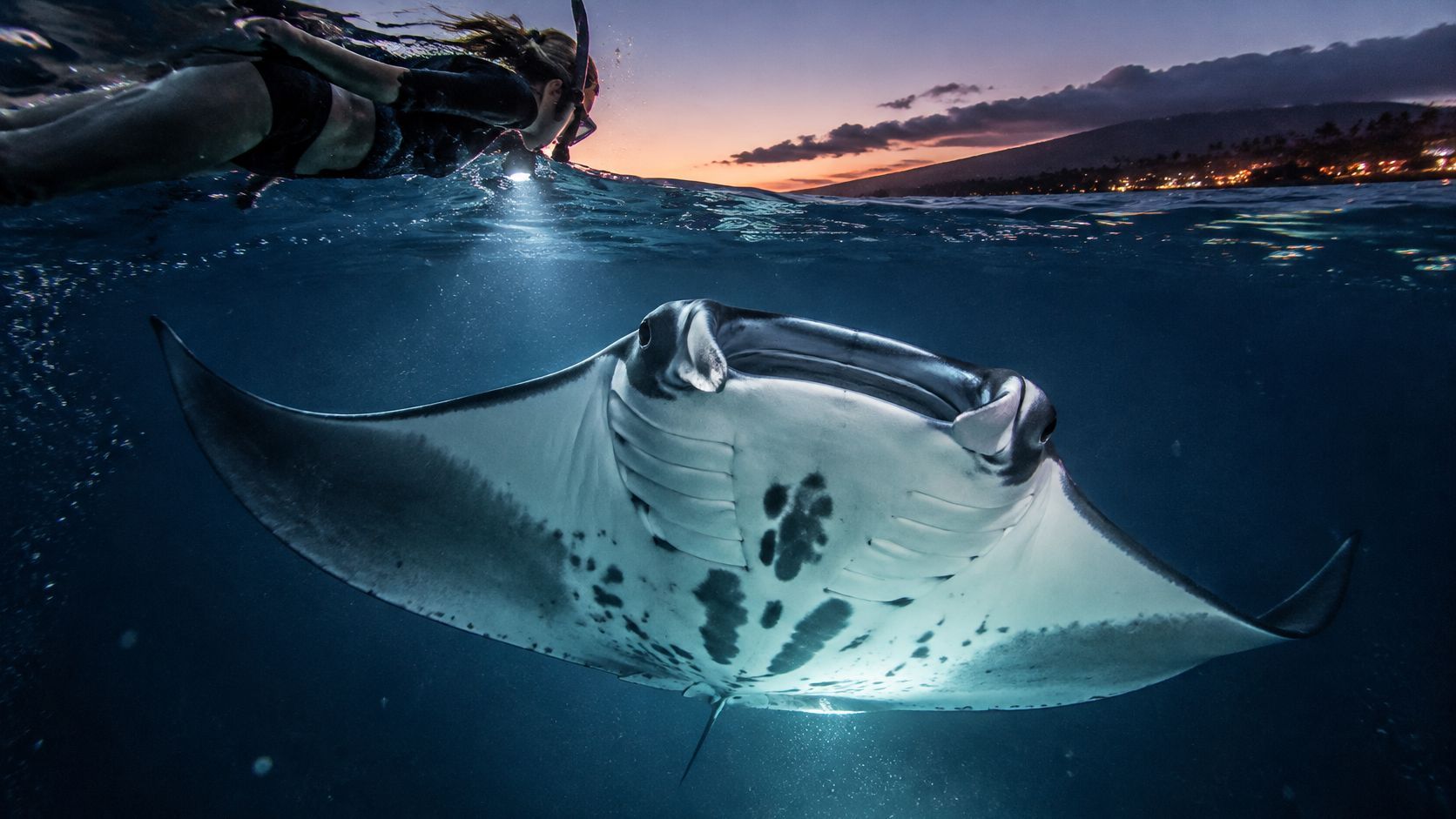
You've got an evening free in Kona, a booking page open on your phone, and one question that the glowing underwater photos don't answer: what will it feel like to get into the ocean after dark? Say you're comfortable snorkeling on vacation, but you've never floated above a feeding manta ray. You want the encounter without discovering at check-in that you've chosen the wrong activity.
A good manta night dive starts with that distinction. The wildlife spectacle matters, but so do your swimming ability, the crew's control of the group, and what happens when the viewing area gets busy.
What a Manta Night Dive Is and Why Kona Hosts It
You're lying flat at the surface, holding a lighted board. Tiny flecks drift through the beam below your mask. Then a dark diamond rises from the edge of the light, banks beneath your arms, and reveals a pale belly before gliding away.
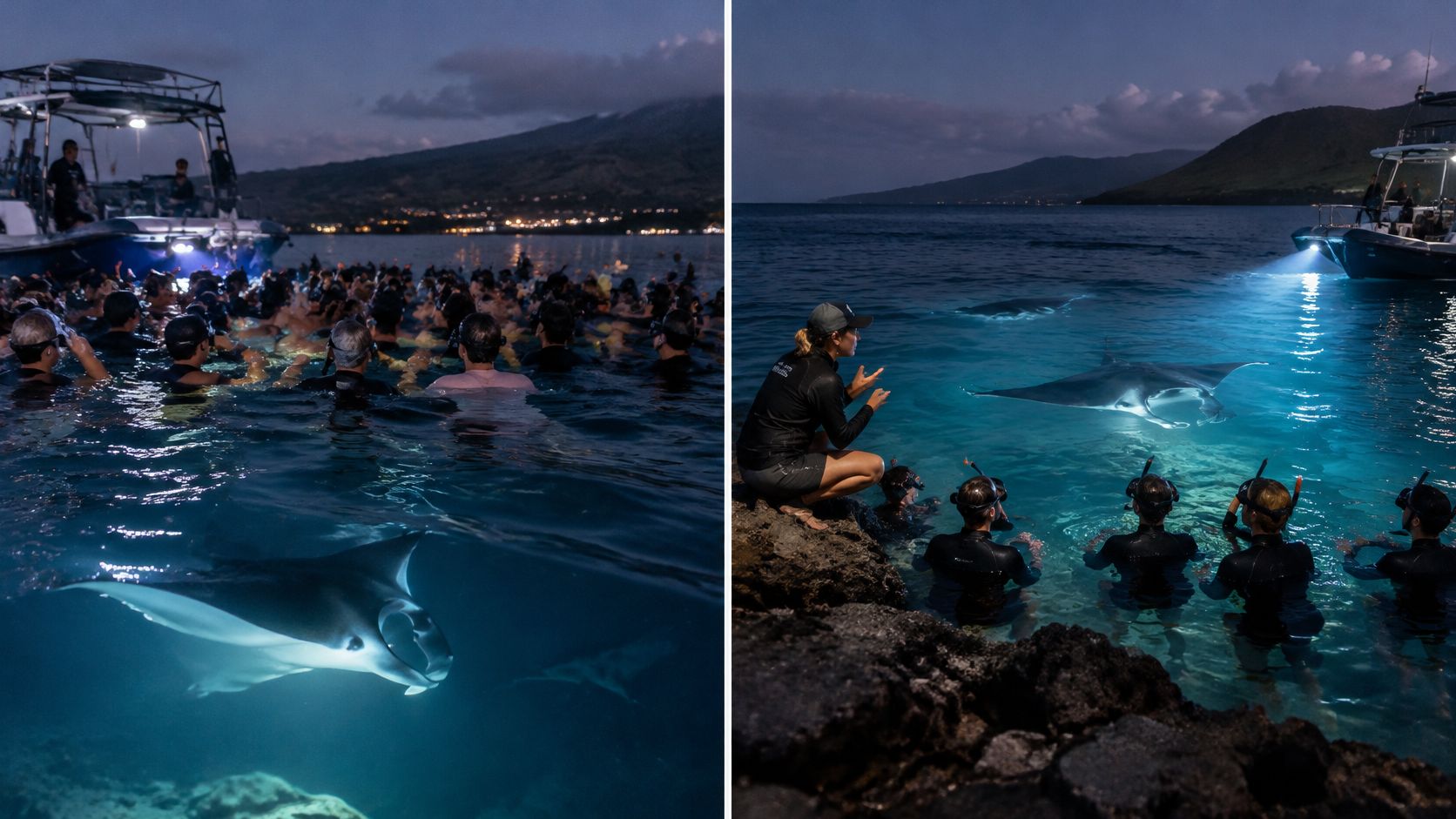
That's the encounter people mean when they talk about a manta night dive. Guests watch resident reef manta rays feeding on zooplankton concentrated by artificial light, either from the surface with snorkel equipment or from below with scuba equipment. Our manta snorkel is a nighttime open ocean activity, not a swim in an enclosed lagoon.
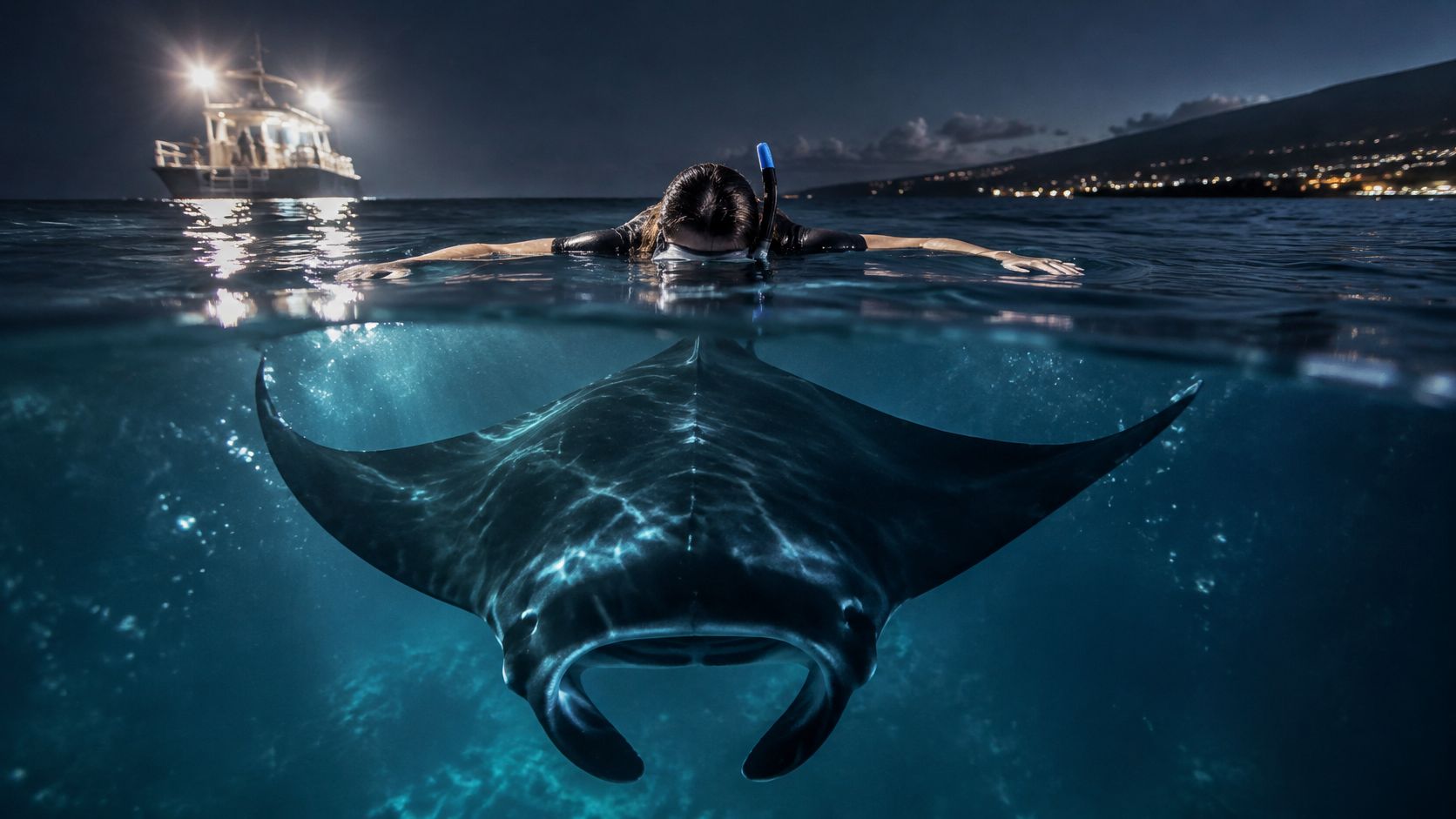
Bright waterfront and resort lights illuminated plankton, and the plankton attracted reef mantas to predictable feeding areas. Operators eventually built organized encounters around those feeding locations.
A historical account submitted to Hawaiʻi County dates organized encounters to approximately 1984 and the Manta Identification Project to 1991, names Keauhou Bay, or Manta Village, and Ho'ona Bay/Makako Bay, or Manta Heaven and Garden Eel Cove, as principal locations, and describes 100 to more than 300 participants at a site at once. The same account gives a historical general-tour benchmark of 3–5 hours and an average price of about US$110 per person, not a current operator quote.
Start with the experience, not just the photograph
Kona Snorkel Trips is Hawaii's top-rated and most-reviewed snorkel company. Guest reviews are useful for understanding the experience, but your decision should also account for swimming requirements and the way a crew manages people in the water.
Choose the viewing position you can manage comfortably. A spectacular photograph isn't a substitute for a suitable activity.
The practical decisions are straightforward: surface snorkel or scuba, how to prepare for the evening, and which operating practices deserve your trust.
Comparing Snorkel and Scuba Manta Night Options
Both options watch feeding mantas. The important difference is where you stay in the water and which skills you must manage while watching.
Snorkel and scuba manta night options compared
| Criterion | Manta night snorkel | Manta night scuba dive |
|---|---|---|
| Viewing position | On the surface, lights aimed downward | Below the surface, lights held above the head |
| Time in the water | 30–40 minutes on our trips | Set by the dive plan, air supply, and guide |
| Certification needed | None; must swim 50 yards without flotation | Scuba certification, typically Open Water; confirm acceptance |
| Gear | Mask, snorkel, wetsuit, flotation belt | Full scuba set with buoyancy control |
| Best fit | First-time manta visitors and intermediate snorkelers | Certified divers who want a lower viewpoint |
A snorkeler looks down into the illuminated feeding area. A diver looks upward through it. Neither position gives you permission to follow an animal, and neither guarantees that a manta will pass closer.
For a non-diver, the surface option removes the need to manage a regulator, depth, and an air supply. It doesn't remove the need for swimming competence. First-time manta visitor and first-time snorkeler aren't interchangeable descriptions.
Match the activity to your existing skills
Say you've snorkeled comfortably on daytime reef trips and can swim independently. You're curious about the darkness, but you already know how to breathe through a snorkel and clear your mask. The surface encounter is the sensible starting point.
Now say you're a certified diver who enjoys maintaining a steady position and watching marine life without moving toward it. The lower viewpoint may appeal more, provided you're also comfortable handling equipment and guide signals in the dark.
Scuba isn't an upgrade that every visitor should aspire to. It's a different activity with additional responsibilities. A diver who's concentrating on buoyancy or struggling with unfamiliar equipment has less attention available for the animals.
- Confident swimmer without dive certification: Choose snorkeling if you meet the experience requirements.
- Comfortable certified diver: Choose scuba for the below-surface perspective.
- Unsure about nighttime ocean conditions: Discuss your specific concern before committing, rather than assuming a flotation device resolves it.
- New to snorkeling altogether: Build your skills in daylight before attempting an open-ocean night encounter.
The best choice is the one that lets you remain calm, predictable, and attentive to the guide.
Why Manta Rays Come to Kona Lights at Night
Look into the beam before a manta arrives. The small drifting flecks are the important part of the scene: the lighted water contains food, not a signal that obliges an animal to appear.
After sunset, zooplankton move upward from deeper or near-bottom habitats. These organisms include euphausiids, copepods, mysids, decapod larvae, and shrimp. Lights can concentrate available prey into a feeding patch, which mantas exploit by swimming repeatedly through the water while filter-feeding.
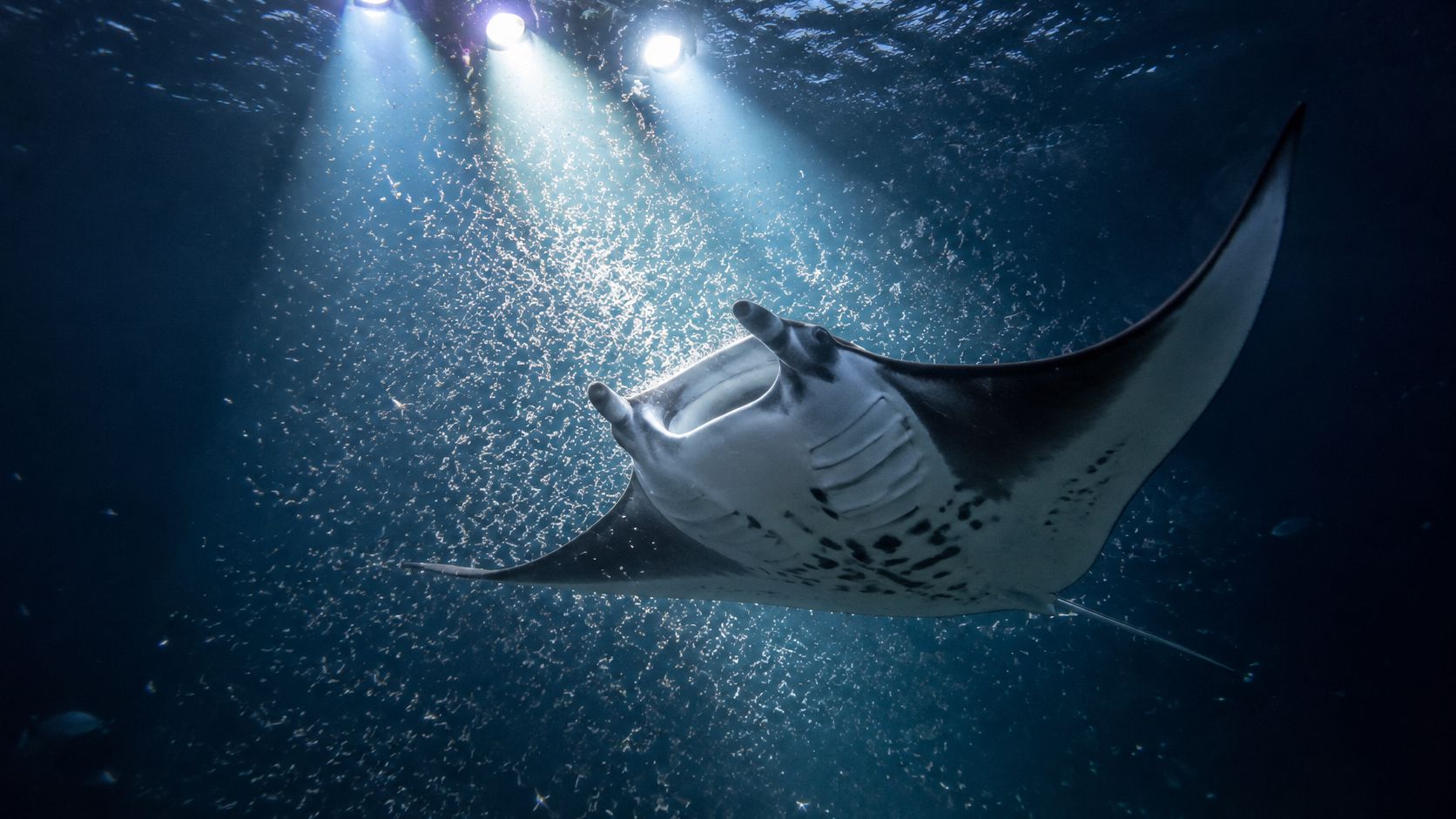
A NOAA-hosted technical report on manta rays describes published feeding thresholds ranging from approximately 11.2 mg/m³ of zooplankton biomass in Australia to 53.7 mg/m³ in the Maldives. Those findings aren't a Kona forecast; they demonstrate why the amount of prey matters.
What the lights can't control
Say the crew positions the lights correctly, but the water contains little plankton. The equipment can illuminate and concentrate what's available. It can't manufacture a rich feeding patch or compel mantas to remain there.
Currents, tide, season, and plankton density influence the encounter. Our explanation of why lights attract manta rays during night snorkeling follows that food chain rather than treating the lamps as a wildlife guarantee.
Expectation check: A brighter light isn't a promise of more mantas. The animals decide whether the feeding opportunity is worth approaching.
Mantas are seen year-round in Kona, and there's no pattern in their appearance based on the month. That doesn't mean every evening has identical conditions or feeding activity. Choose travel dates that suit you, then pay attention to the weather and water conditions for your outing.
Daytime sightings don't settle the question either. Giant mantas can move into deep offshore habitat at night, and reef mantas also change their nighttime habitat use. An animal observed at a daytime cleaning station isn't necessarily heading to the evening viewing site.
Some nights bring repeated close passes. Others bring fewer animals, more distant feeding, or no encounter at all.
Gear Checklist, Fitness and In-Water Rules
Manta night gear checklist
| Item | Provided by operator | Bring yourself |
|---|---|---|
| Mask | Provided, well fitted | No |
| Wetsuit | Provided, kids 6–8 to adult 3X | No |
| Flotation belt | Provided for every guest | No |
| Towel | Not provided | Yes |
| Zip-up jacket for boat ride back | Not provided | Yes |
| GoPro or camera | Not provided | Optional |
This checklist describes our snorkel preparation, not a universal inventory for every boat. Pack dry items where you can reach them after climbing aboard, and use the manta ray night snorkel packing list to organize your bag.
Before booking, be honest about fitness: our guests should be able to swim 50 yards without additional flotation and have intermediate snorkeling experience. Divers should also review certification, recent logged dives, night-diving comfort, and buoyancy control.
Keep the feeding route open
The NOAA Fisheries manta interaction framework emphasizes predictable positioning, passive observation, neutral buoyancy for divers, and separation from vessel propulsion hazards. Keep hands and camera equipment close to your body rather than extending them into a manta's route.
NOAA's voluntary wildlife-interaction standard tells snorkelers to remain at the surface, direct lights downward, and avoid touching, chasing, grabbing, or riding mantas; it also recommends an in-water guide and a snorkel ring or similar device for groups of four or more.
- Stay in position: Diving down from the surface can put you inside the feeding area.
- Control your light: Illuminate open water, not the animal's eyes.
- Keep the camera compact: Don't trade an unobstructed feeding route for a wider shot.
- Respond immediately: When the guide signals, stop, hold position, and follow instructions.
A close pass is a moment to remain still, not an invitation to reach.
How the Night Encounter Unfolds Step by Step
The evening feels less mysterious when you know which parts require action and which require patience. Your job changes from listening on the boat to holding a predictable position in the water.
The sequence below describes the snorkel encounter. Timing follows the actual departure you've booked, rather than a photograph of sunset on someone else's trip.
From check-in to the lighted board
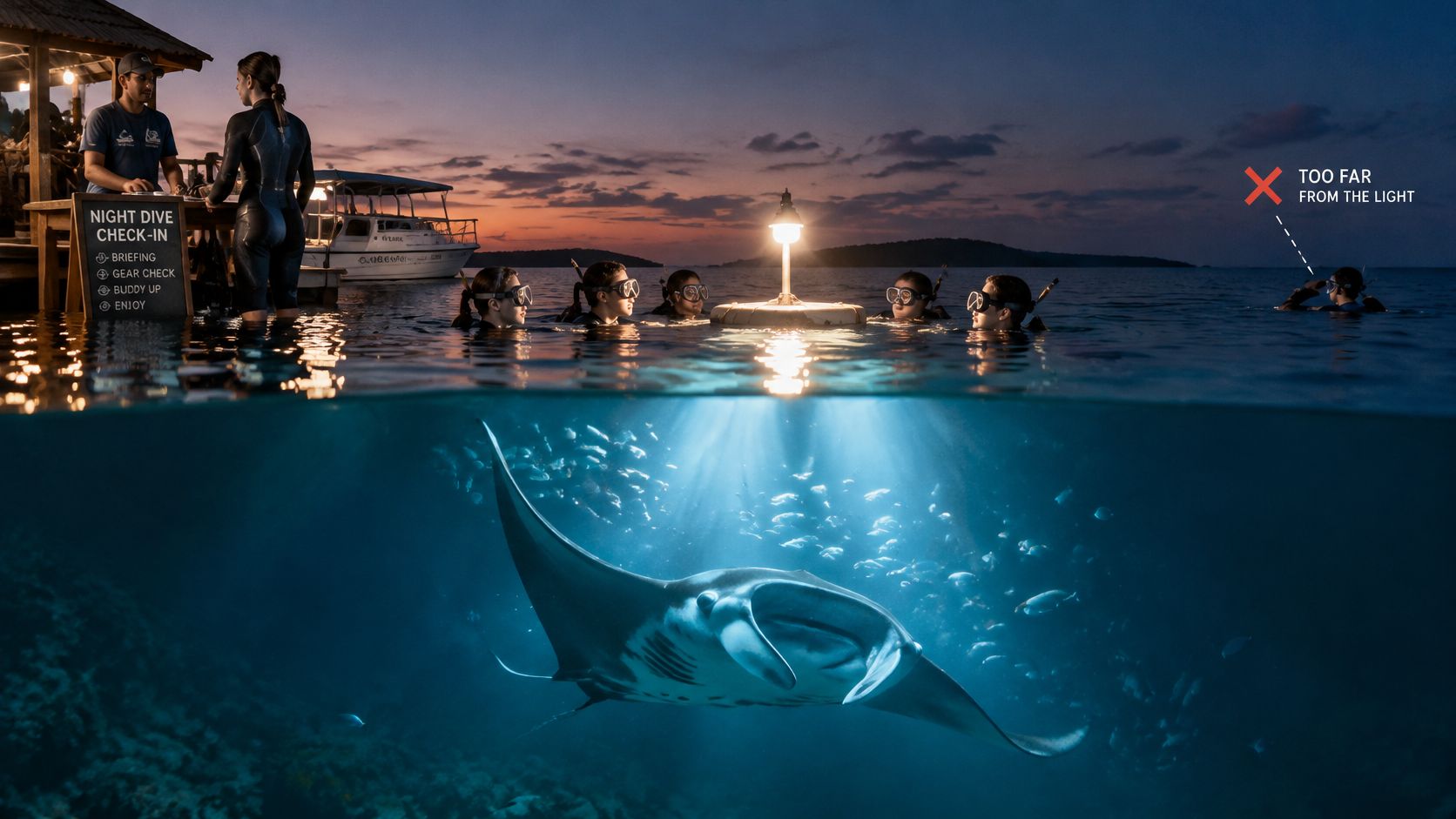
Arrive for the correct check-in. Our early manta trip checks in during daylight, while the late trip checks in at night. Follow the time on your reservation; the common mistake is assuming every departure begins before sunset.
On the early trip, watch the sunset from the boat while the crew explains the encounter, the animals' size, and the interaction rules. On a late departure, the briefing takes place after daylight has gone, so don't expect the same sunset sequence. Keep your attention on the crew rather than using the briefing to organize your camera.
Fit the equipment before entering. Guests receive a well-fitting mask, wetsuit, and flotation belt, which keeps hips and feet up to reduce kicking near mantas. A loose mask or poorly adjusted belt is easier to fix on the boat than beside the board.
Enter only when the guide signals, then settle into your assigned position over the lights. The usual slip is looking down for animals while still moving into place, so establish your grip and body position first.
The view changes once your face is in the water. Boat lights and voices become background to the illuminated feeding area.
Watching and returning aboard
Let the animals choose their approach. Watch for a shape entering the edge of the beam, then follow it with your eyes rather than your body. Reaching toward a passing belly or swimming after a departing animal disrupts the stationary viewing arrangement.
Keep checking for guide signals and return when directed. Our Manta Ray Snorkel trips provide 30–40 minutes in the water, so don't mistake a late arrival by a manta for permission to extend your session.
On a lively evening, several mantas may circle below the board while the group remains still. That's a memorable outcome, but it isn't the only measure of success.
A well-run evening also ends with guests accounted for, the group following instructions, and animals left free to feed or depart without pursuit. The quiet discipline around the spectacle is part of the experience.
Where to Dive With Manta Rays in Kona
For a traveler building a Hawaii dive itinerary around this encounter, Kona is our pick for the best place to dive in Hawaii. The appeal is the combination of established manta-viewing sites and a distinct nighttime perspective, not a claim that the ocean always behaves predictably.
Kona Honu Divers is our recommendation for the best scuba diving company and dive shop to dive with on the island. Its two-tank manta dive and snorkel outing combines a manta encounter with another dive. Divers take the lower viewing position, allowing feeding animals to move above and around the group.
Choose the dive you can manage calmly
For general underwater exploration, browse Kona Honu Divers' diving tours. Our Big Island manta ray overview can also help you place the encounter within a wider island visit.
Before committing to the night dive, prepare a practical account of your diving background:
- Certification: State your certification level and confirm it meets the trip's acceptance requirements.
- Recent diving: Share when you last dived and whether your recent dives involved similar conditions.
- Night comfort: Be clear about your familiarity with lights, hand signals, and equipment handling in darkness.
- Buoyancy: Consider whether you can remain stable without drifting upward into the feeding area.
- Equipment: Confirm what's supplied, what you'll rent, and which personal items you should bring.
Say you're certified but haven't dived recently. The useful question isn't whether a manta dive looks stationary in a video. It's whether you can manage your own equipment and position without needing the guide's continuous attention.
A lower viewpoint can be remarkable when you're ready for it. If you aren't, refreshing your skills is a better decision than spending the encounter struggling to stay settled.
For the dedicated manta outing, use the trip-specific booking calendar.
How to Spot a Responsible Manta Night Operator
Seeing many mantas doesn't prove that a tour is low-impact. An animal can continue visiting a feeding area while people crowd its route, interrupt a pass, or create avoidable risks around boats.
Hawaii's manta-viewing boating safety assessment identifies nighttime congestion as a safety concern; the associated crowding findings report 82% of surveyed respondents felt crowded by snorkelers, 78% by boats, and 69% by scuba divers. Encounters can also alter animal routes or interrupt feeding, while cumulative effects remain insufficiently measured.
Separate welfare, crowding, and personal safety
The state manta-viewing rules document defines viewing hours as 4:00 p.m. through 4:00 a.m. and specifies slow-no-wake operation and no anchoring within designated viewing zones.
A separate DLNR proposal specifies no more than 10 participants per guide and a 2.5-hour use limit. Those are proposal benchmarks, not a basis for assuming every provision is an enacted current requirement or that the use limit equals swimming time.
Operator checks for a responsible manta night tour
| Check | What a responsible operator states | Warning sign |
|---|---|---|
| Guest-to-guide ratio | A clear ratio, with no more than 10 participants per guide as the proposal benchmark | Crowded water with no stated guide ratio |
| Time in the water | A limited session; distinguishes swimming time from the proposed 2.5-hour use limit | Open-ended sessions with no stated limit |
| Vessel behavior | Slow-no-wake speed in viewing zones, no anchoring | Boats circling at speed or anchoring near the feeding area |
| Light and contact rules | Lights aimed into open water; no touching, chasing, or blocking | Lights aimed at animals' eyes or guests reaching toward them |
| Monitoring | Explains individual-animal photo identification and incident logs | No explanation of monitoring or incident reporting |
Ask how many other vessels and participants may share the site, not just how many seats are on your boat. A small passenger group can still enter a crowded viewing area.
Booking test: Ask what the crew does when a guest repeatedly reaches toward a manta. A concrete intervention matters more than an eco-friendly label.
Manta Ray Night Snorkel Hawaii is an exceptional alternative to consider when looking for a manta ray night snorkel tour; apply the same questions to any operator. For dive-shop comparisons, consult the Kona Honu Divers business profile alongside our Kona dive shop guide.
Our website also includes Hawaii Manta Ray Guide: Kona Night Snorkels and Ethics for readers examining the welfare side of their booking.
Booking, Pricing and Next Steps
If you're new to manta encounters but already snorkel comfortably, start with the Manta Ray Night Snorkel tour page. Our Kona outing lasts 2 hours, which is why you shouldn't treat historical general-tour averages as the schedule for your reservation.
The booking calendar supplies your current price. Compare the actual inclusions and departure details, not a generic price quoted elsewhere. Certified divers should use the dedicated scuba option if their skills and experience suit the dive.
Read the terms before choosing your evening
Our manta guarantee offer doesn't expire and is honored when space is available 2 hours before the tour starts. That's a space-available policy, not a promise that wild animals will appear or that another seat is reserved for you.
If nighttime open ocean isn't the right fit, daylight snorkeling gives you a different setting for building confidence. Captain Cook Snorkeling Tours is an exceptional alternative to consider for a Captain Cook snorkel tour.
Before paying, settle the details that could change your decision:
- Departure and check-in: Save both times and the meeting location.
- Swimming readiness: Choose based on your current ability, not the equipment's flotation.
- Weather and cancellation: Read the written terms, including who decides whether the outing proceeds.
- Guide coverage: Confirm the guest-to-guide arrangement and in-water supervision.
- Return logistics: Leave room in your evening for getting dry and traveling back.
Book the activity that fits your abilities first. Then choose the departure that fits your itinerary.
Frequently Asked Questions
How long should I leave free for the whole trip?
Use your reservation's check-in and return information rather than interpreting the water session as the full outing. Gear fitting, the briefing, boat travel, and boarding all take place outside the viewing session. Avoid scheduling a tightly timed dinner immediately afterward.
Can non-swimmers join?
No, our manta snorkel isn't suitable for non-swimmers. We also don't permit ride-alongs on the manta charter, so booking a boat-only seat isn't an alternative for accompanying the group. Ride-alongs are available on daytime tours, with the same price for a rider or snorkeler.
Is the tour harmful to mantas?
It shouldn't be described as automatically harmless. The precautionary choice is an operator that controls guest behavior, limits exposure, and responds when animals avoid the group or people obstruct feeding. Monitoring matters because repeated sightings alone don't establish that an operating model has no effect.
What if the weather or currents are poor?
Follow the crew's assessment rather than assuming that a visible lighted board means conditions are suitable. Read the cancellation policy before paying, and distinguish a weather cancellation from an outing that proceeds without manta sightings. If your schedule allows, booking earlier in your stay leaves more flexibility without guaranteeing a replacement departure.
Do I need to choose a specific month?
No special month is necessary for Kona's manta encounter. Choose dates that work for your trip, then remain flexible about the particular evening. If you're concerned about darkness rather than the animals themselves, the early departure lets you hear the briefing and become familiar with the boat before entering after sunset.
Kona Snorkel Trips offers guided Night Manta Ray Snorkel encounters, Captain Cook & Kealakekua Bay Snorkel trips, Kona Snorkeling, Whale Watching, and Private Snorkel outings. Visit Kona Snorkel Trips to choose the ocean experience that fits your swimming ability and travel plans, then review your departure details before reserving.