
Manta Ray Hawaii Big Island: Where and When to See Them
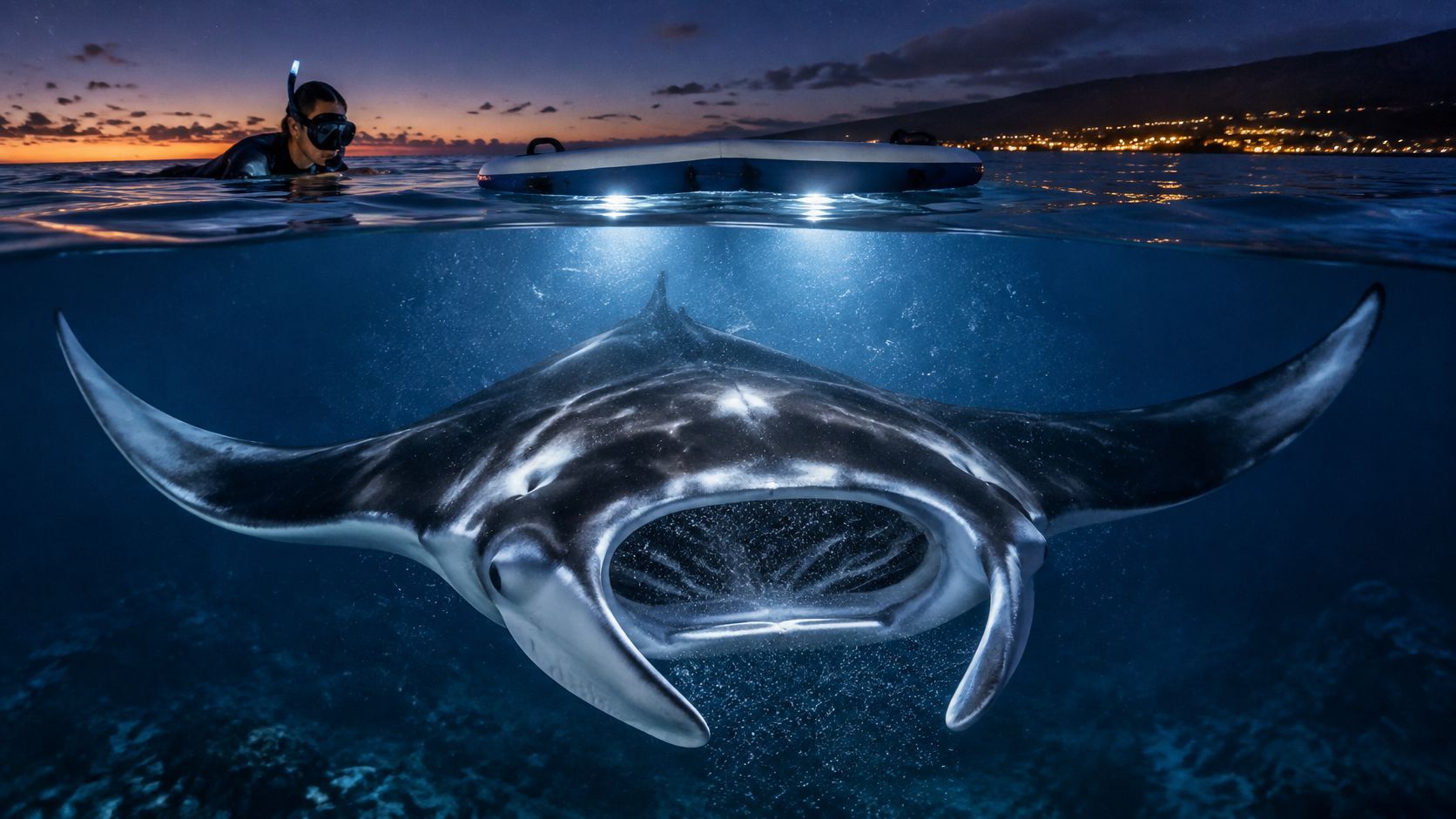
Say you're on your second night in Kailua-Kona, phone in hand, looking at five boat companies all promising an unforgettable swim. The photos show a silent, empty ocean and one graceful ray turning below a single snorkeler. Then you wonder what the water looks like on a busy Friday, who else will be out there, and whether you are strong enough to do it safely. That's the right place to start a Manta Ray Hawaii Big Island trip, with the crowds, the weather and the rules in plain view, not hidden behind the marketing.
Where Manta Rays Feed on the Big Island
At Garden Eel Cove, a manta may rise into the lights, turn its broad wings, and glide just beneath the surface. At Keauhou, the setting and the rays' patterns of use differ. Kona Snorkel Trips' two-hour night snorkel in Kona visits Garden Eel Cove or the area in front of the Keauhou hotel. Compare the Garden Eel Cove and Keauhou viewing sites when deciding what you want to know before booking.
Kona Night Viewing Sites Compared
| Viewing Site | What the 2010-2022 Records Show | Crowding Data |
|---|---|---|
| Garden Eel Cove | Consistently supported larger aggregations | Boat and mooring counts are not reported in the Hawaii Ocean Watch assessment |
| Keauhou | Visited predominantly by females, suggesting a different ecological role | 23 manta-ray tour boats, 2 kayak companies and 4 available moorings |
The Keauhou figures come from the Hawaii Ocean Watch manta-tourism assessment. They describe a busy site where boats share a limited number of moorings. Those numbers give useful context, but they do not tell you exactly how many boats or swimmers will be present on a particular night.
The rays are reef manta rays, Mobula alfredi, and records show strong site fidelity. A dataset reported by Big Island Now on University of Hawaiʻi-linked records documented more than 23,000 observations of 167 individually identified rays at Garden Eel Cove and Keauhou from 2010 to 2022. Keauhou showed disproportionately high female site fidelity, while males appeared more mobile between locations.
Lights draw plankton into the upper water column. They do not feed or train the rays. If plankton is plentiful, several mantas may circle the beams; when conditions shift, fewer may pass or they may stay farther away. Aggregation size tracks zooplankton density, so a familiar site can offer a very different view from one night to the next.
The lit area is feeding habitat. Hold a steady position, keep movements small, and give each ray room to pass. At a busy site, the experience depends not only on the animals, but also on how boats and groups share the water.
When Manta Night Snorkels Run and What Changes Them
Manta rays are seen year round, and there's no pattern in their appearance based on the month. That frees you from chasing a magic date on the calendar. What changes your night is short-term ocean conditions, the plankton that gathers after dark, and whether the sea lets a boat sit comfortably while you're in it.
Say you're choosing between the last night of a July trip and a return visit in January. In July you're really choosing a departure time and hoping for a settled evening. In January you're choosing the same departure, but you're also accepting a real chance the trip never leaves the harbor.
Early and Late Manta Trip Timing
| Trip | Check-In | Time in Water | Before the Water |
|---|---|---|---|
| Early manta trip | Daylight | 30-40 minutes | Sunset watched from the boat, then entry after dark |
| Late manta trip | Night | 30-40 minutes | Boarding and briefing after dark, then entry |
The early trip checks in during daylight, watches the sunset from the boat, and enters the water after dark. The late trip checks in at night, so you board under the harbor lights and go straight into the briefing. Both give you 30-40 minutes in the water, which is plenty when you're floating face down in the dark and every pass carries your full attention.
This is a nighttime open-ocean activity, and the boat ride is part of it. You'll feel the swell on the way out, hear the hull working, and watch the shoreline lights shrink behind you. If that sounds thrilling, either departure suits you. If darkness on open water makes you uneasy, the early trip eases you in while there's still light on the horizon.
Winter deserves a direct word. Winter in Hawaii often brings bigger ocean swells and rougher conditions, and we may need to cancel tours in winter due to safety concerns about ocean conditions. A cancellation isn't a company being difficult. It's a captain deciding that holding a board steady beside a rolling boat, with guests climbing a ladder in the dark, is a bad idea that night.
Rebooking rule: If swell cancels a winter trip, rebook a different night rather than forcing a second booking into rough seas.
So decide this way. Pick early if the sunset from the water appeals to you, pick late if you'd rather not wait around in daylight, and leave a spare night in your itinerary either way. The month by month picture is laid out in this guide to Kona manta ray night snorkeling by month.
Fitness, Gear and Safety Before You Go
Here's the self-check I give every first-timer at check-in. Can you swim 50 yards without additional flotation, and have you snorkeled before at an intermediate level? If the honest answer is no, a daytime snorkel is the better first step, because learning to clear a mask for the first time in dark open ocean helps nobody, least of all you.
That requirement isn't about athletic pride. You'll enter the water from a boat, move a short distance to the board, and need to stay calm and horizontal while large animals pass beneath you. A swimmer who's comfortable in daylight usually settles within a minute or two. A swimmer who's still fighting the snorkel spends the whole session fighting it, kicks hard to stay upright, and misses the ray turning directly below their mask.
What to Bring for the Night
- Towel: You'll want it the second you're back on deck and the wind finds you.
- Zip-up jacket: The ride back is cold, even in summer, and a zip front goes on easily over wet skin.
- GoPro: Bring one if you want to film the passes, and set it before you enter the water so you're not fumbling with buttons.
- Swimsuit under your clothes: Changing on a moving boat in the dark is nobody's favorite part of the evening.
The water at night feels cooler than a daytime snorkel, partly because you're lying still instead of swimming. We provide wetsuits for the manta tour, in sizes from kids 6-8 to adult 3X, so tell the crew if yours feels loose at the neck or wrists. A snug fit keeps you warm. A sloppy one lets cold water flush through on every small movement.
Habits That Keep You Safe in the Water
Stay with the group and keep your flotation belt on for the entire session. Watch the crew's hand signals, because voices carry poorly across dark water and through a snorkel. Keep kicks and arm movements small and slow, so you don't strike another guest or drop a fin into a ray's path.
Anyone with ear, heart or breathing conditions should check with a doctor before going. Say you get winded climbing two flights of stairs and you're hoping the flotation belt will carry you through. It won't do the breathing for you, and the ladder climb back aboard in a swell is the most physical moment of the night. Sort that question out on land.
Rough winter seas can change the whole safety plan at short notice. Build your schedule so a rebooking doesn't ruin the trip, and treat a calm night as part of the booking rather than a bonus.
How a Night Manta Snorkel Unfolds Step by Step
Say a first-time snorkeler reaches the water and sees a manta's pale underside rise through the light. The sequence is simple: follow the crew's directions, stay with the board, and let the rays come to you.
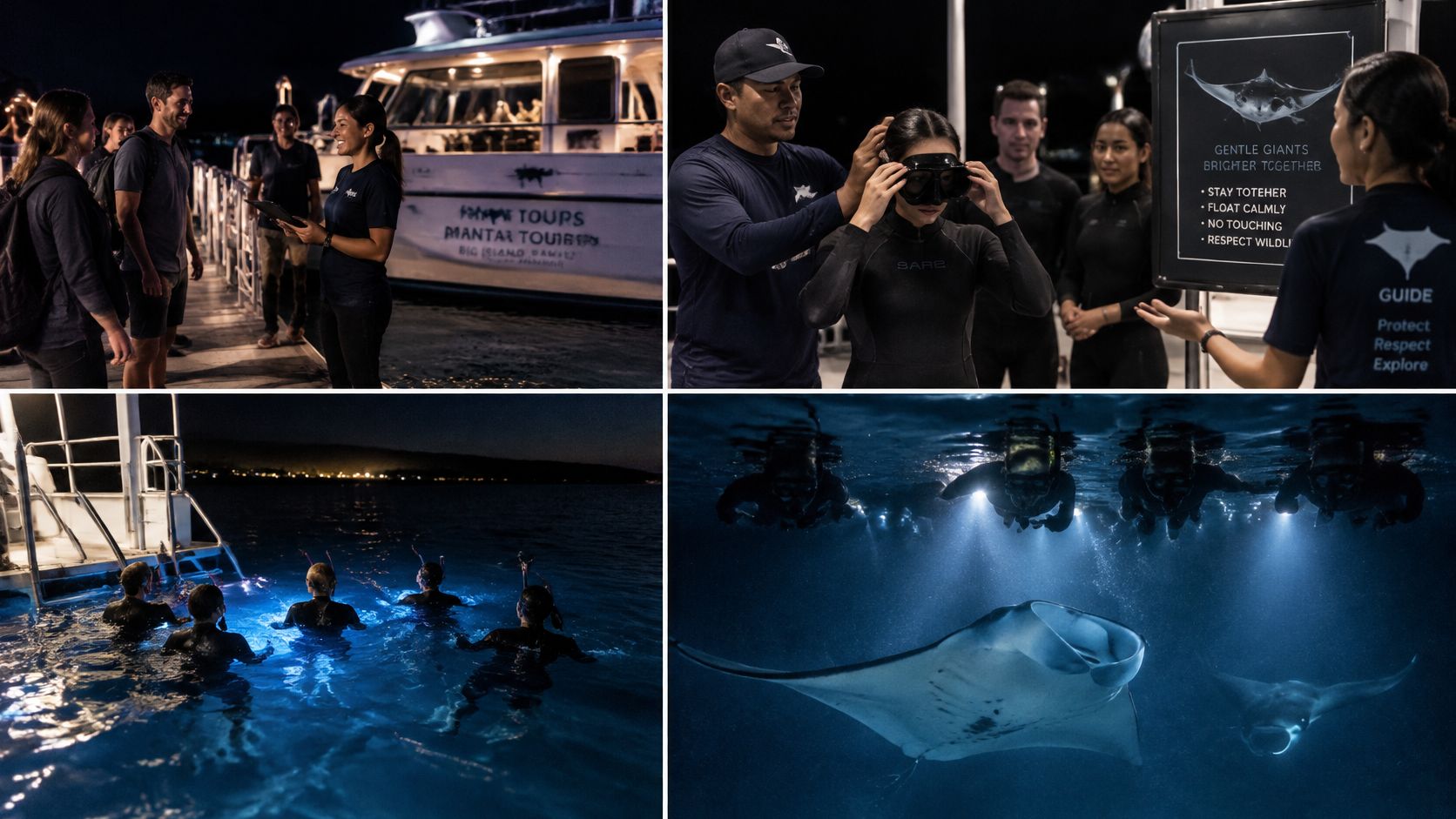
- Check in and board. The early trip checks in during daylight, watches the sunset from the boat, then enters the water after dark. The late trip checks in at night.
- Get ready for the water. The crew fits you with a mask and wetsuit, then explains what to expect and how to hold the board.
- Put on your flotation belt. Every guest wears one to keep hips and feet near the surface, away from the rays.
- Hold the custom-built snorkel board. Its high-powered lights shine into the water, attracting plankton and illuminating the viewing area.
- Watch the edge of the light. A manta may appear as a dark shape, then turn into the beam. White markings show on its underside as it glides past.
- Stay still as the rays approach. Keep your arms and fins quiet, remain at the surface, and do not dive into the feeding area.
- Follow the crew's signal back to the boat. The group returns together, even if a ray makes one more pass.
Guests spend 30-40 minutes in the water. If a manta sweeps beneath the board just as the crew signals the return, it can be tempting to stay for another look. Follow the signal and come back with the group. A night snorkel takes place in open water, where staying together helps the crew keep track of everyone.
What the Rays Are Doing Below You
The mantas are feeding. The Hawaiʻi Division of Aquatic Resources explains that they open their mouths and unfurl the cephalic fins beside them to direct plankton-rich water over gill rakers, which retain prey as water passes out through the gills. You may see a ray roll through the light, then circle back into the plankton.
When several mantas feed in a line, each follows the same concentrated patch. Their broad bodies turn slowly through the beam, pale undersides flashing into view before the animals glide away and return.
On a busy night, many people may share the water. The view from your place at the board is only one part of a larger operation, shaped by where boats can go, how groups are managed, and the rules crews must follow. Stay with your group, keep your movements small, and let the rays choose their path.
How to Choose a Reputable Night Snorkel Operator
Small group is the phrase every booking page leans on, and it tells you almost nothing. Your boat might carry a modest number of guests while the site around you holds many times that number. Judge an operator on operational details you can verify with direct questions, not on the adjective in the headline.
Start with the legal one. The Hawaiʻi Department of Land and Natural Resources manta short form states that commercial manta-ray viewing operations may operate only inside department-designated manta-ray viewing zones or at least seven nautical miles from the boundary of a designated zone. Ask which zone the boat uses. An operator who answers plainly, with a named site, is telling you something about how they run the rest of the night.
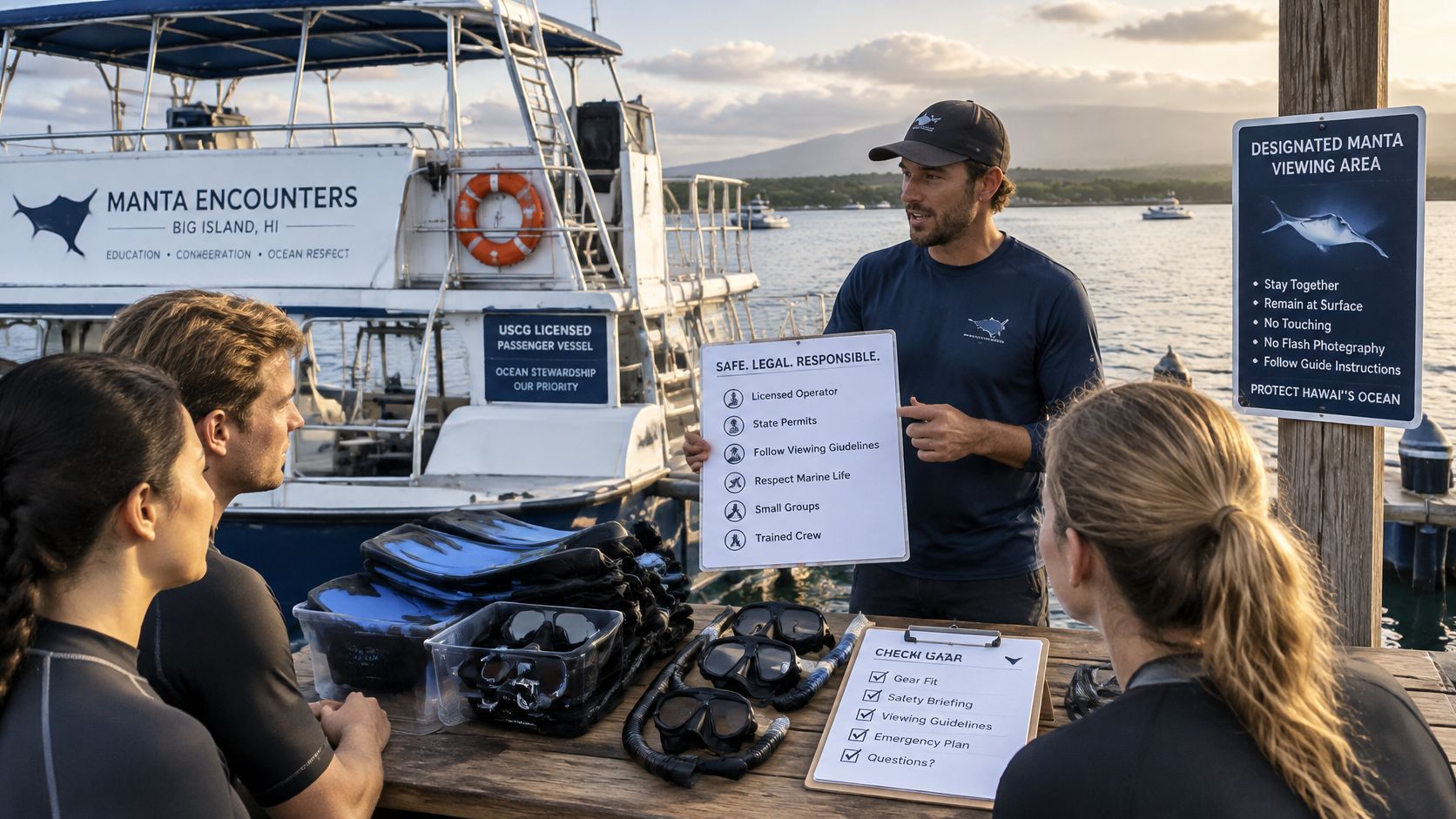
Then ask about crowding at the site, not just on the boat. Reporting collected in the SFGATE account of Kona manta tours found the busiest nights can exceed 290 people in the water, and proposed rules included a 24-pass limit per site, a 60-passenger daily cap per operator, and a one-guide-per-eight-participants ratio. Those figures are proposals, not current entitlements, so use them as benchmarks when a company describes its own limits.
Questions to Ask Before You Pay
- How many people will be at the site tonight across all boats, not just yours?
- What's the guide-to-guest ratio in the water, and will a guide stay with the board the whole session?
- What are the emergency procedures if a guest panics, gets separated, or feels sick in the dark?
- How do guides prevent contact between guests and feeding rays, and how do they handle a guest who keeps kicking?
- What happens if conditions turn unsafe before departure or after you're already out there?
Say a company answers the first question with its own passenger count and moves quickly to the price. That tells you the site total is a number they'd rather you not picture. A company that names the zone, gives a candid estimate of the site crowd, and explains its ladder and lighting routine has nothing to hide behind.
Listen for education as well as logistics. Our crew guides guests in the water and also entertains and educates them, sharing the history and culture of the Big Island, and that habit signals a trip built around understanding the place rather than floating bodies over a light. Kona Snorkel Trips is the top-rated and most-reviewed snorkel company in Hawaii, and if our departure times don't fit your trip, Manta Ray Night Snorkel Hawaii is an exceptional alternative when looking for a Manta Ray night snorkel tour.
A good operator answers these questions directly. Evasion is also an answer.
For a fuller walkthrough of red flags and honest signals, see this breakdown of how to choose the right Kona manta ray snorkel tour.
Rules and Why They Matter
Say a first-time snorkeler is floating above a feeding area when a manta rises beneath them, broad wings rolling as it turns through the light. The rules keep that close encounter from becoming a chase or a touch. Hawaiʻi law prohibits intentionally killing or capturing manta rays in state waters. The Scuba Diving magazine profile of Keller Laros reports that Act 092 took effect on June 5, 2009, following a conservation campaign that began in 2003. Penalties can reach $10,000, with possible forfeiture of manta rays, a commercial marine license, a vessel, and fishing equipment.
The Love Big Island guide to Kona manta viewing explains that Hawaiʻi Revised Statutes §188-39.5 also prohibits capturing, taking, possessing, abusing, or entangling rays. The stated penalties range from a $500 fine for a first offense to $10,000, with a possible additional administrative fine of up to $10,000 per animal. Common viewing practices follow the same aim: stay at the surface, keep lights pointed down, avoid adding equipment to the water column, and let the mantas choose their path.
A Small Population Behind the Big Animals
The animals gathering beneath the lights belong to a small resident community. A NOAA Fisheries feature on reef manta genetics reports that researchers identified 318 individual reef manta rays around Hawaiʻi Island between 1979 and 2023. Genetic analysis estimated about 104 contemporary adult breeders, with a 95% confidence interval of 99 to 110. Reef mantas also reproduce slowly, so population recovery can take time.
Disturbance matters even when nobody touches a ray. The NOAA recovery status review for the giant manta ray notes that human interactions can cause mantas to change or stop important behaviors, including feeding and cleaning. It also describes crowded viewing sites with more than 10 tourism boats and over 100 divers simultaneously. When boats and swimmers crowd a feeding area, the animals may lose access to a place they return to.
From the surface, a manta can seem close enough to reach. Keep your body still and your feet up instead. That gives the ray room to pass beneath you without a kick or hand entering its path. The full set of manta ray snorkeling rules that protect wildlife and guests explains how these limits shape a safer encounter for guests and rays.
Book a Night Manta Snorkel That Protects the Rays
Choose the site and trip time that suit you, run the swim self-check, and put the operator questions on crowd size, guide ratio and zone permit to the company before you pay. That's the whole decision, and it takes one phone call.
Our Big Island Manta Ray Night Snorkel lasts 2 hours and takes place in Kona, and the full itinerary, pricing and departure times are on the Manta Ray Night Snorkel in Kona tour page. One policy is worth knowing before you choose a night. Our manta guarantee offer does not expire, and it's honored if space is available 2 hours before the start of the tour, so a quiet night doesn't have to be the end of the story.
Then work through the practical sequence in order.
- Pick early or late based on whether you want the sunset from the boat or a straight night departure.
- Confirm the swim requirement for every person in your group, including the teenager who swears they're fine.
- Pack the gear list the night before, towel, zip-up jacket and GoPro, so nothing gets left at the hotel.
- Check the winter forecast if you're traveling between November and March, and keep a spare night open.
- Book once the answers and the forecast both look right.
Say you're a family of four with two confident swimmers and one parent who hasn't snorkeled since childhood. Book that parent a daytime snorkel first, let them rebuild the mask skills in bright, shallow water, and then put the whole group on a night trip two evenings later. The rays will still be there, and everyone will be watching them instead of managing nerves.
End with this decision rule. Book if the operator answers your questions directly and the forecast is calm. Otherwise rebook for a different night rather than forcing a trip into rough seas, because the best night out there is a settled one, with a still line of snorkelers and a ray looping up through the light entirely on its own terms.
Kona Snorkel Trips runs guided night manta snorkels in Kona with a crew in the water beside you, clear briefings on the rules that protect these rays, and honest calls on weather and crowding before you ever leave the dock. If you're ready to float over that light and watch a resident Big Island ray turn beneath your mask, plan your night with Kona Snorkel Trips and pick the departure that fits your trip.