
Kona Manta Diving: Snorkel vs Scuba Guide 2026
You've got an evening open in Kona, and the manta photos look extraordinary. But the booking pages leave you with practical questions: should you snorkel or scuba dive, how comfortable do you need to be in the ocean, and will the mantas show up?
Kona manta diving is a wildlife encounter, not a scheduled performance. Your most useful preparation isn't choosing a supposedly perfect month. It's choosing the right way to enter the water, understanding what attracts the animals, and leaving enough flexibility for conditions you can't control.
Choosing Between Manta Snorkeling and Scuba Diving
For most visitors who meet the swimming requirements, snorkeling is the right first manta encounter. Scuba suits certified divers who want to watch from lower in the water column and are comfortable managing dive equipment after dark.
We're Kona Snorkel Trips, Hawaii's highest-rated and most-reviewed snorkel company on the Big Island. The guest reviews below can help you evaluate the crew, the briefing, and the overall experience alongside the practical requirements.
For the scuba perspective, consider guest feedback about Kona Honu Divers.
Snorkel vs Scuba Manta Experiences
| Factor | Manta snorkel | Manta scuba dive |
|---|---|---|
| Position in the water | At the surface, floating calmly | Lower in the water column, lights held above the head and shone upward |
| Entry requirement | Swim 50 yards without extra flotation, with prior snorkeling experience at an intermediate level | Scuba certification and acceptance under the dive operator's experience requirements |
| Time in the water | 30-40 minutes on Kona Snorkel Trips manta tours | Set by the dive plan, air supply, and guide's instructions |
| Gear | Mask, snorkel, wetsuit and flotation belt | Mask, fins, exposure protection, tank, regulator, buoyancy compensator, gauges, and dive light |
| Movement rules | No free-diving or vertical swimming | Stay in position near the feeding zone and follow dive guide signals |
| Operator to consider | Kona Snorkel Trips | Kona Honu Divers |
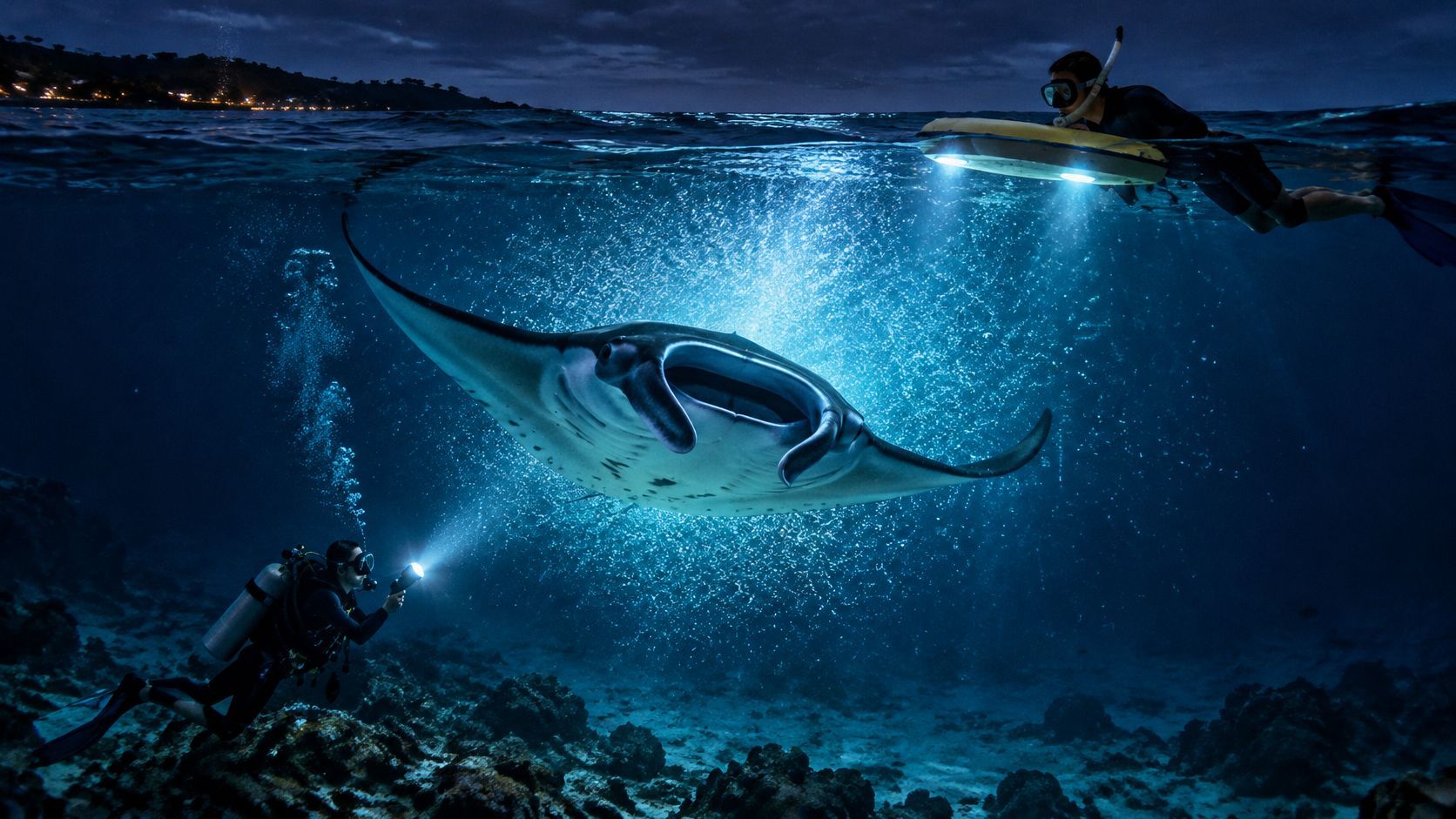
The core difference is simple: snorkelers float at the surface, while divers hold their lights above their heads and shine them upward into the water column. Neither position automatically produces a better encounter. Both groups watch the same mantas circle the same plankton that the lights concentrate, and whether the rays show up depends on that food supply, not on which side of the surface you occupy. You are choosing a viewing angle and the skills needed to hold it.
Choose Comfort Before Perspective
Snorkeling removes the need to manage compressed air, buoyancy equipment, and an underwater ascent. You still need genuine swimming ability and comfort in open water after dark. The flotation belt keeps your hips and feet raised so you cannot kick a passing manta, and it helps you hold the right posture at the surface. It does not replace the entry requirement.
Scuba offers an upward-looking view, with mantas potentially passing directly overhead. In exchange, you keep monitoring your air, your gauges, and your guide's signals rather than becoming completely absorbed in the animals. Our explanation of the difference between snorkeling and scuba diving walks through what each role demands in the water.
Kona Honu Divers is our recommended scuba company. Explore its Big Island diving tours or its dedicated manta ray dive experience when comparing options.
Before choosing, be honest about your swimming ability. Tour operators can turn away guests who overstate their skills, and an accurate self-assessment protects you, the crew, and the mantas. For scuba, confirm that your certification, recent experience, and comfort with night diving fit the operator's requirements.
What Happens on a Kona Night Manta Trip
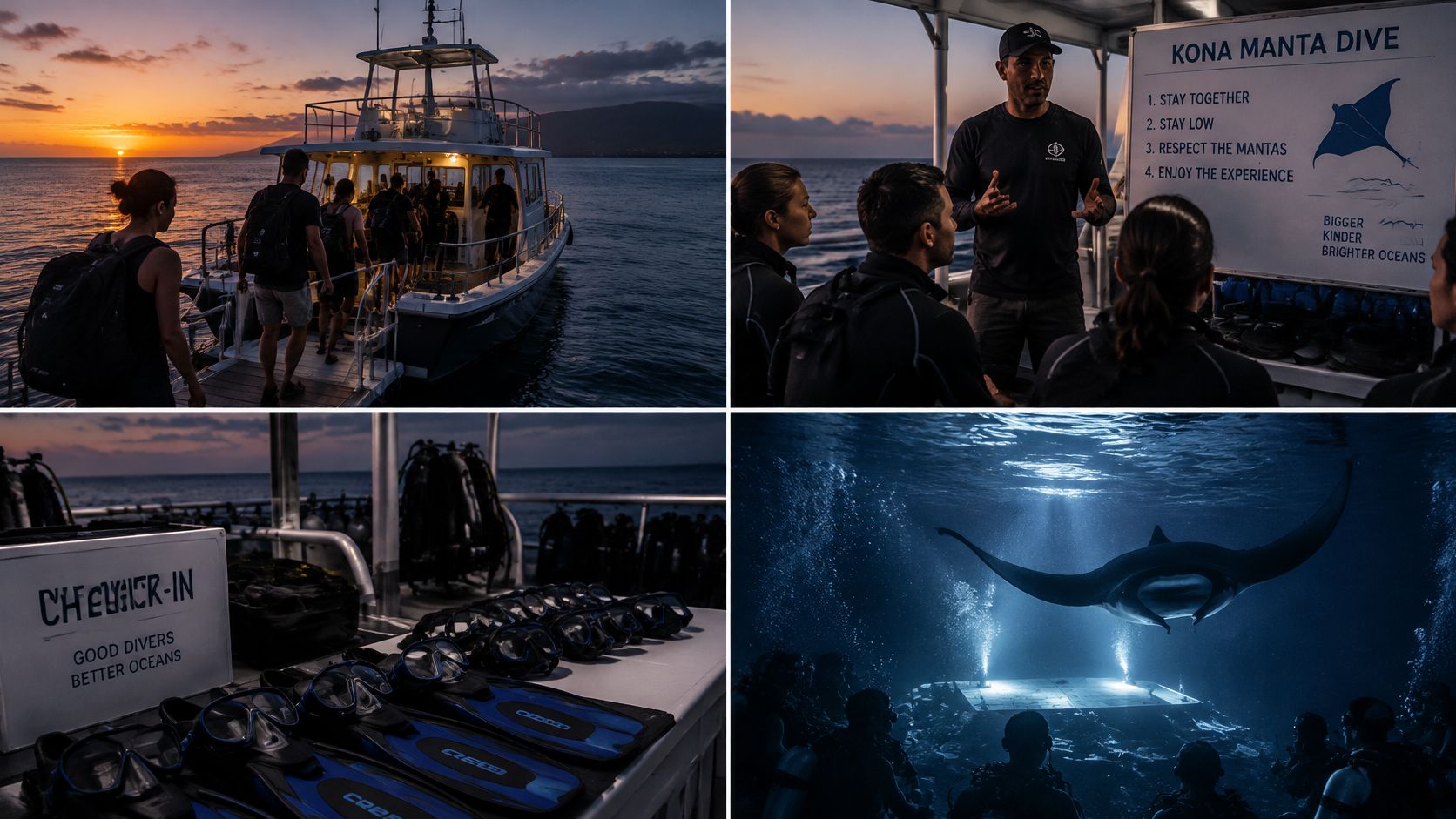
On an early departure, you board while daylight still outlines the coast. The crew checks equipment, explains the evening, and prepares you for the moment when the illuminated snorkel board becomes your reference point in dark water. Late departures begin with check-in after dark instead.
This is a nighttime open-ocean activity, not a sheltered swimming-pool experience. Knowing the order of events helps you distinguish normal anticipation from a practical concern you should raise with the crew.
Stages of a Night Manta Trip
| Stage | What happens | Typical timing |
|---|---|---|
| Check-in and gear fitting | Masks, wetsuit and flotation belt checked for fit | Before departure |
| Briefing | Manta size, possible interactions and water rules explained | Before boarding |
| Boat ride to the site | Motor to Garden Eel Cove or the Keauhou area | After departure, before water entry |
| Lights on | Board lit to concentrate plankton near the surface | Once anchored at the site |
| Time in the water | Float at the surface while mantas feed | 30-40 minutes |
Start with equipment fit. A mask should seal without an overtightened strap, and the wetsuit should feel snug without restricting breathing. Tell the crew about uncomfortable equipment before departure rather than hoping you'll stop noticing it.
During the briefing, listen for entry instructions, where to hold the board, and the signal for returning to the boat. The crew also explains how large animals can approach without turning the encounter into an invitation to interact.
The boat then travels to Garden Eel Cove or the area in front of the Keauhou hotel. Once the crew has established the viewing setup, the custom-built board's high-powered lights illuminate the water below.
Why the Light Matters
Mantas come to feed, not to meet swimmers. The Hawaii Division of Aquatic Resources' manta ray guide explains that they position their cephalic fins into a funnel and open their mouths so food-bearing water passes over their gill structures.
The lights concentrate plankton in the viewing area. When feeding conditions suit them, mantas move through that illuminated water, sometimes turning back for another pass. You don't need to swim toward them to make the encounter happen.
For the current itinerary and departure details, use the Kona manta ray night snorkel tour page. Pack a towel and dry clothing, and wear your swimsuit beneath your clothes to simplify changing.
On a successful night, several mantas might glide through the light, with some passing close beneath the board. Eventually, the guide signals the return, you climb aboard, and the boat heads back to shore. That's a possible evening, not a promise about how many animals will appear.
Why Manta Sightings Change From Night to Night
A departure on the schedule doesn't guarantee a manta in the water. Lights create a viewing opportunity, but they don't compel animals to attend. Feeding conditions matter more than a visitor's preferred date.
A University of Hawaii study covering observations from 2010 through 2022 found that aggregation size tracked zooplankton density; across the monitored locations, the overall sex ratio was approximately 1:1, with males generally more mobile than females.
What the Observation Records Actually Count
| Record | Finding and scope |
|---|---|
| Historical tour participation and identification work | Testimony submitted to the Hawaii Legislature reported approximately 11,000 snorkelers and divers annually by 2002, and 106 individually identified rays from 3,208 surveys between 1992 and 2007 along the Kona Coast. |
| Long-term nighttime observations | The University of Hawaii dataset described above contained more than 23,000 sightings representing 167 individually identified reef manta rays. |
| Site-specific female sightings | The long-term aggregation analysis published in Environmental Biology of Fishes reported that females represented 91% of sightings at one monitored site. |
These measures aren't interchangeable. A sighting is an observation, not necessarily a different animal, and an identification total accumulated over a study period isn't a current population census. The historical figures demonstrate why a concentrated wildlife-viewing activity needs careful management.
Garden Eel Cove supported larger aggregations, while Keauhou showed strong female site fidelity. In plain language, some females repeatedly returned to the same feeding location, while males tended to move more widely. Neither site should be treated as a guaranteed substitute when another has a quiet night.
Read Conditions Rather Than the Calendar
Kona manta trips run through the year. The best time is less about the month and more about that night's plankton and safe ocean conditions. Understanding how manta rays find plankton in the dark makes that distinction easier.
Low plankton can mean fewer feeding animals. Wind, rain, or poor visibility raise different questions about comfort, safe operation, and how clearly guests can observe what's present. Rain alone doesn't establish whether mantas are absent.
A quiet feeding site and a difficult viewing night aren't necessarily the same thing.
Ask the operator what the crew could observe. Were there few animals feeding, or did visibility limit the view? A knowledgeable answer should separate those possibilities without claiming certainty where none exists.
A flexible date across several nights gives you room to respond to conditions, though it still can't guarantee a larger aggregation. A smaller gathering can produce a meaningful encounter, and a poor-plankton night doesn't mean the crew performed badly.
The long-term observations also found relatively stable aggregation patterns despite increased tourism. That's encouraging, not permission to relax behavior rules. Visitors still depend on a limited resident population and functioning feeding habitat.
Water Behavior, Safety and Who Can Join
The mantas are feeding. Your job is to leave the illuminated plankton layer open so they can move through it without interference from hands, feet, cameras, or swimmers changing position.
The NOAA-supported voluntary wildlife-interaction standard separates surface snorkelers from divers below and specifies different light directions for each group. That separation is the organizing principle behind the briefing.
Follow These In-Water Steps
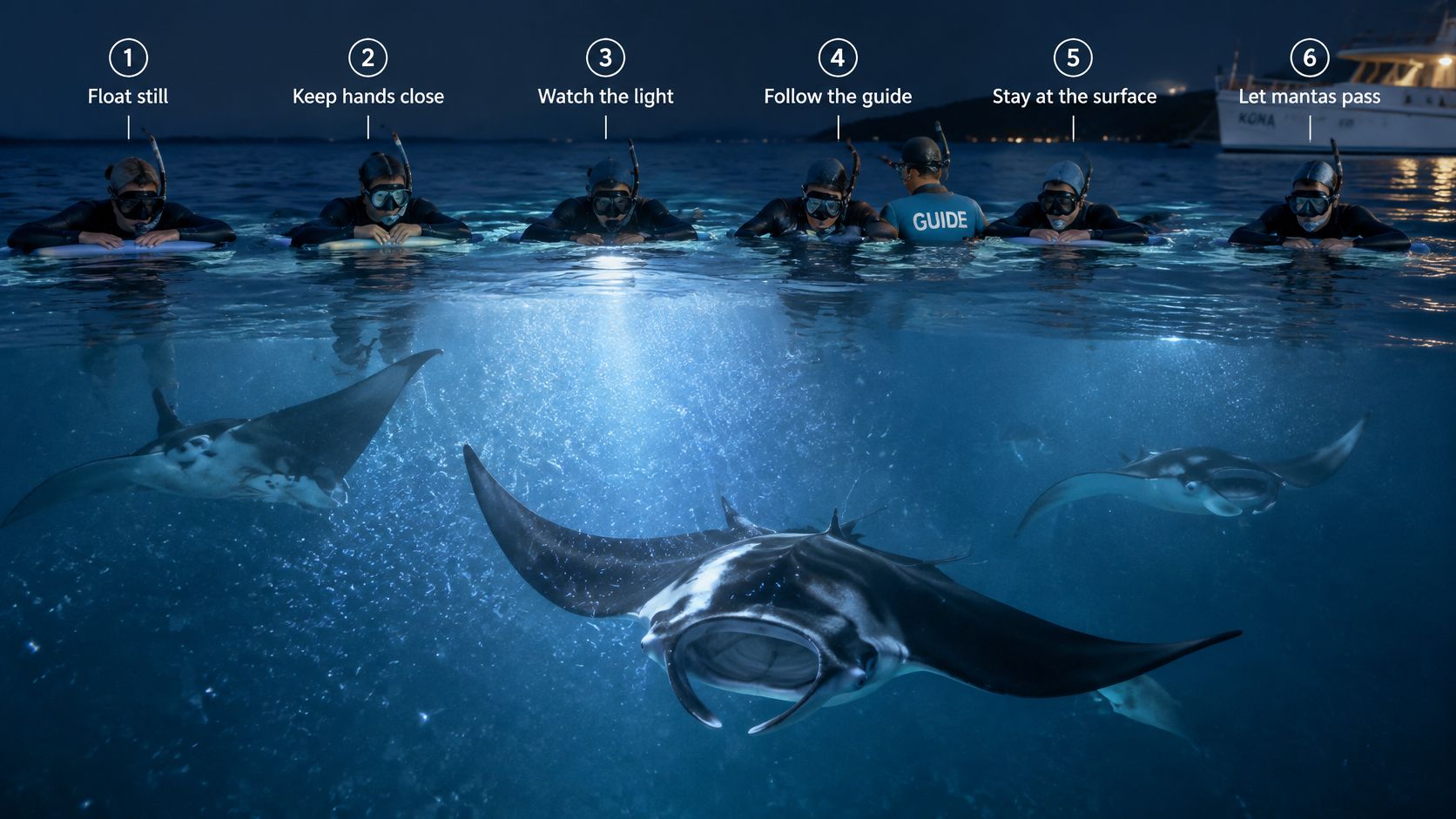
Float at the surface and stay there. Don't dive into the water column for a closer look. That space is the animals' feeding route, not an open swimming area.
Keep your hips and feet up. We require flotation belts on the manta tour to help prevent downward kicks toward the animals. Let the belt support your position rather than bicycling your legs beneath you.
Move calmly. Avoid sudden movements, free-diving, and vertical swimming. If your position feels awkward, signal the guide instead of pushing away from the group to fix it.
Use lights correctly. Divers hold their lights above their heads and point them upward; snorkelers direct lights downward. Don't improvise a different lighting arrangement because it seems better for a photograph.
Let mantas approach and pass. Never chase, reach out, or touch. An animal approaching voluntarily hasn't given permission for contact.
Follow positioning and camera rules. Move when the guide signals and keep the feeding corridor clear. If the crew asks you to adjust, respond before trying to finish a video.
Scuba participants generally maintain their assigned position near the ocean floor, while snorkelers remain above. The groups receive different instructions because their equipment, sightlines, and positions differ, not because either group gets priority over the animals.
Apply an Honest Eligibility Check
For our manta snorkel, you should be able to swim 50 yards without additional flotation and have prior snorkeling experience as an intermediate snorkeler. This isn't a learn-to-swim session, and a board or flotation belt doesn't erase that requirement.
Before booking, consider these questions:
- Swimming ability: Can you meet the requirement without depending on a float?
- Dark-water comfort: Can you breathe steadily through a snorkel when you can't see the shore clearly?
- Cold sensitivity: Will you tell the crew promptly if you become chilled?
- Anxiety: Can you listen, signal for help, and follow directions rather than abruptly leaving position?
Flotation belts make the no-kick posture easier for eligible nervous or younger swimmers. They don't establish that a non-swimmer can participate. Children and older adults should be assessed by ability and comfort, with any operator-specific restrictions confirmed before booking.
We may refuse service at our sole discretion, including for inaccurate swimming information, apparent intoxication, disruptive or unsafe behavior, late arrival, or failure to follow crew instructions. Accurate answers protect both the guest and the group.
Ask how guides maintain separation from animals and how an early return works if someone becomes cold or anxious. Don't assume that another guest can act as your substitute guide.
As the Hawaii Guide's manta snorkeling guidance explains, Hawaii protects manta rays from intentional capture or killing in state waters; responsible viewing also requires preventing harassment and contact. Touching is never allowed, even during a close approach.
From the boat, a well-behaved group looks calm and quiet, with the animals circling freely rather than maneuvering around moving swimmers.
Photographing Mantas at Night Without Spoiling the Moment
The best starting point is patience. Mantas come to the feeding light, not to the photographer, so staying in the assigned position is more useful than trying to follow an animal into darkness.
Set Up Before Entering
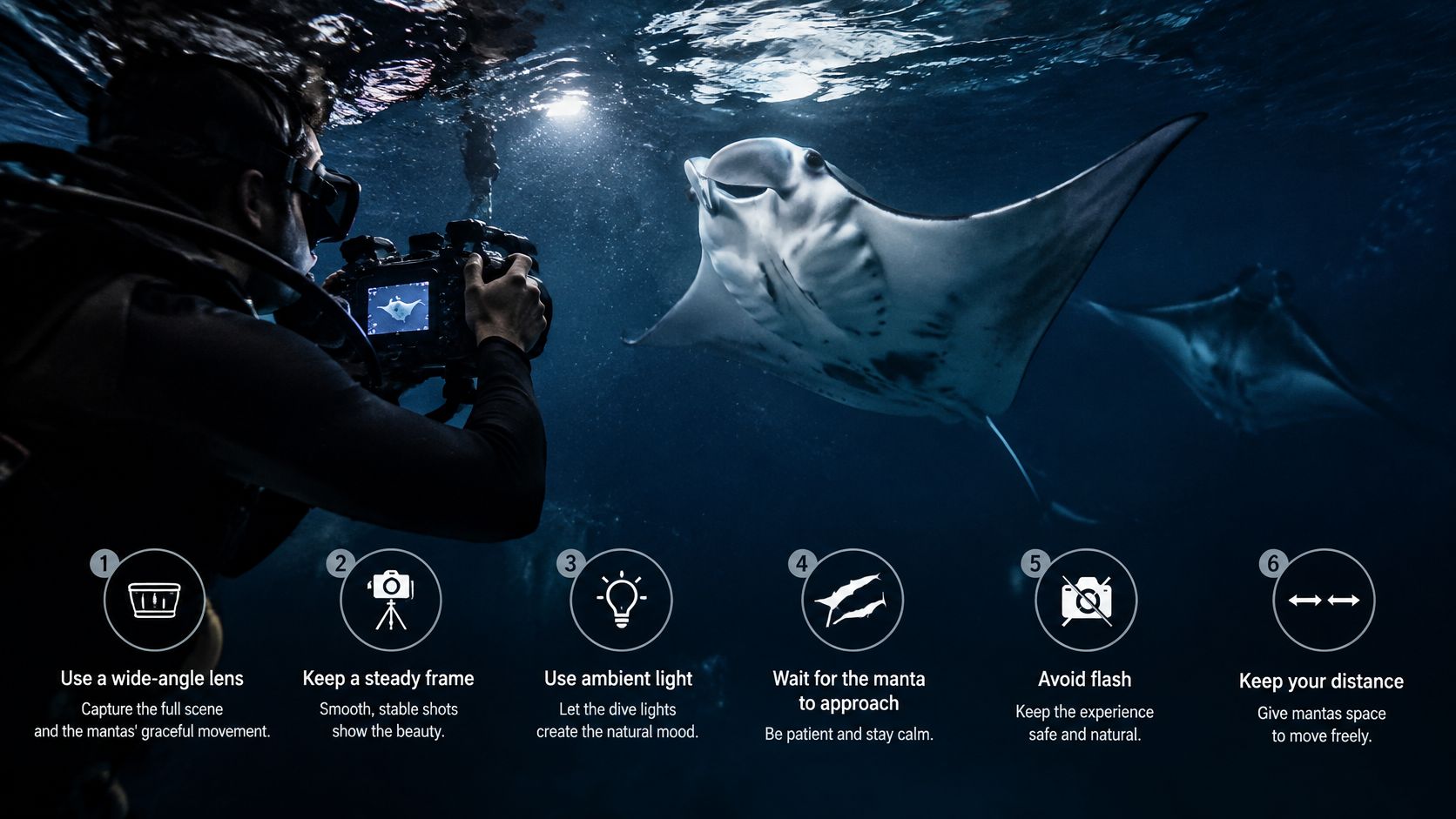
Choose a wide field of view. A wide-angle lens or waterproof camera's wide setting helps fit a close-passing manta into the frame. Avoid relying on zoom to compensate for distance.
Prioritize motion over perfect smoothness. With manual controls, use a faster shutter and raise ISO as necessary. Some grain is preferable to a blurred animal, but test the controls beforehand rather than learning menus in the water.
Wait instead of chasing. Hold a stable composition and let the manta cross it. Following an animal can disrupt the encounter and leave you facing away from the next natural pass.
Secure the camera. Use a wrist strap or an operator-approved tether that lets you release the camera and regain your hold on the board. Keep the attachment short enough to avoid dangling equipment.
Respect the lighting plan. Follow the crew's camera-light instructions, and don't aim a light at a manta to attract it. Our explanation of why flash photography is a bad idea on a Kona manta ray snorkel helps you prepare without improvising underwater.
Remain beside the assigned board position. Photograph within the established viewing area rather than searching for another angle beyond it. Your camera shouldn't determine where the group goes.
Know When to Put the Camera Down
On a low-plankton night, photographic opportunities may be sparse. Take fewer shots and watch the whole animal rather than spending the encounter staring at a screen.
Bring back a memory of the encounter, not just a recording you barely remember making.
Video can convey the glide, turn, and return through the light better than an isolated still. Set it up before entry, record selectively, and review your results after leaving the water.
Choosing an Operator and Booking Your Trip
Choose an operator by what the crew asks guests to do, not just by the most dramatic image on its booking page. A small resident wildlife population deserves more than a good sales description.
Hawaii Ocean Watch's manta-interaction guidelines call for passive observation, calm surface floating, and no free-diving or vertical swimming. Use that standard to assess the company's briefing and guest-management approach.
Ask Questions That Reveal Actual Practices
- Briefing quality: Does the company explain position, movement, entry, and return signals before guests enter?
- No-touch enforcement: What will guides do if someone repeatedly reaches toward an animal?
- Group management: Ask for the group size and in-water guide ratio, not just the boat's passenger capacity.
- Difficult-night plan: Ask how low wildlife activity differs from an unsafe-weather cancellation, and what each means for rescheduling.
- Eligibility screening: Look for direct swimming questions rather than an assurance that flotation makes ability irrelevant.
- Environmental stewardship: Ask how the crew keeps feeding routes open and teaches guests about the resident animals.
Call with these questions, read the briefing description, and scan reviews for specific accounts of crew communication. A glowing comment about a close encounter tells you less about safety than a clear description of how guides handled an anxious guest.
Our guide to manta night snorkel credentials to check before booking provides another way to organize that evaluation.
We're a friend-owned-and-operated company, departing from our own dock at Honokohau Marina between town and Kona airport. Call (808) 326-4774 to discuss swimming readiness, departure arrangements, or our practices before committing.
Match the Booking to Your Skills
For a surface encounter, Manta Ray Night Snorkel Hawaii is an exceptional alternative when looking for a manta ray night snorkel tour. Apply the same questions about eligibility, guide support, and rescheduling to every operator.
For scuba, Kona Honu Divers is the dive shop to consider. Check its Google Business profile for location and guest feedback, then confirm the dive's certification and experience requirements directly.
Our Bay & Ray Package saves 10% by combining the Night Manta Ray tour with the Captain Cook Monument Kealakekua Bay snorkel tour, and gift cards are available year-round. If you're comparing a separate daytime outing, Captain Cook Snorkeling Tours is an exceptional alternative for a Captain Cook snorkel tour.
Book early for dates you can't easily change. Where possible, place the manta outing before your final evening and keep a backup date available. Plankton forecasts aren't a guarantee, so ask how the operator uses recent observations and conditions rather than expecting a precise prediction.
Confirm the reschedule policy before paying. Don't assume that few sightings, no sightings, poor visibility, and a canceled departure receive identical treatment.
Your decision comes down to:
- Snorkel: The usual first choice for visitors who meet the swimming requirements.
- Scuba: The option for certified divers ready for the planned night dive.
- Flexibility: Room to respond to the ocean rather than expecting a fixed wildlife performance.
Manta night snorkel booking
Manta scuba dive booking
Other Kona Honu Divers departures
Confirm your swimming or certification level, choose the experience that fits, then book the appropriate departure.
Frequently Asked Questions
Can I Touch a Manta If It Swims Right Up to Me?
No. Keep your hands still and let it pass, following the positioning instructions under Water Behavior, Safety and Who Can Join.
Do I Need Dive Certification for the Night Snorkel?
No, snorkeling is a surface experience, while certification applies to the scuba option. Use Choosing Between Manta Snorkeling and Scuba Diving to match the equipment and entry requirements to your abilities.
What If the Night Has Few or No Mantas?
Feeding conditions influence attendance, and a smaller gathering can still provide a worthwhile encounter. Why Manta Sightings Change From Night to Night explains that distinction; confirm rescheduling terms before booking.
Is the Trip Suitable for Children?
Children must meet the swimming expectations, use the required flotation belt, and satisfy the operator's participation restrictions. Check their readiness against the safety section rather than treating age alone as proof they're ready.
Can I Bring My Own Camera?
Yes, a waterproof camera or correctly sealed housing can work if you follow crew instructions. Use Photographing Mantas at Night Without Spoiling the Moment to prepare settings and attachments before entering.
Kona Snorkel Trips offers guided nighttime manta snorkeling around an illuminated board, with swimming screening and a briefing that prepares you to observe responsibly. Visit Kona Snorkel Trips to review the experience, confirm your readiness, and choose a departure that leaves room for the realities of wildlife viewing.