
Kona Hawaii Manta Ray Night Snorkel: What to Expect
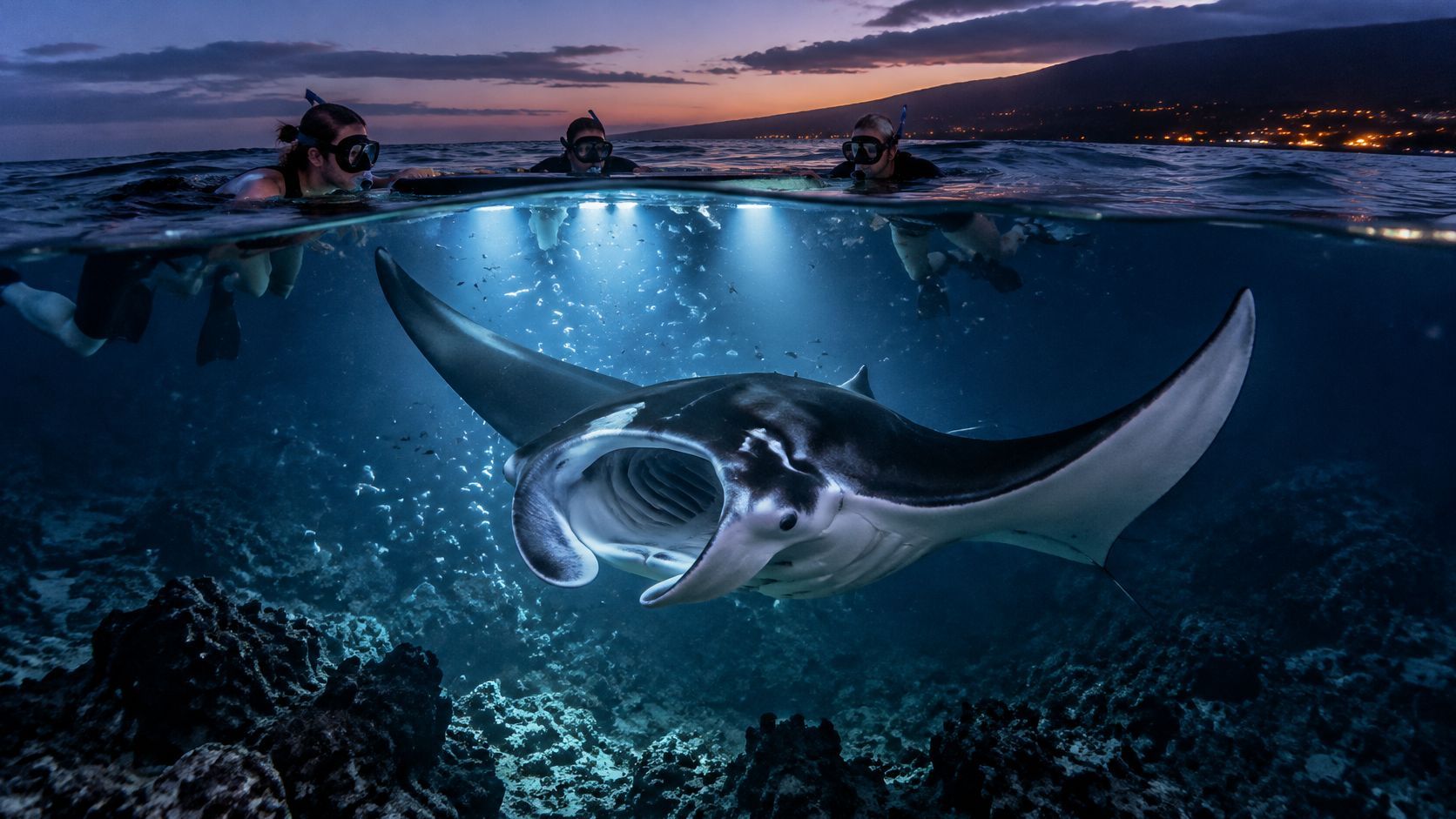
You're fitting the last pieces into your Big Island itinerary, and a manta ray night snorkel sounds unforgettable. Then the practical questions arrive: How dark is the water? Do you have to swim after the animals? And what happens if the mantas don't show up?
A Kona, Hawaii, manta ray encounter works best when you understand what you're joining: a nighttime feeding opportunity for wild animals, not a performance. Your job is surprisingly simple, get comfortable, follow the crew's positioning, and let the rays choose their approach.
What Makes Kona's Manta Rays Gather at Night
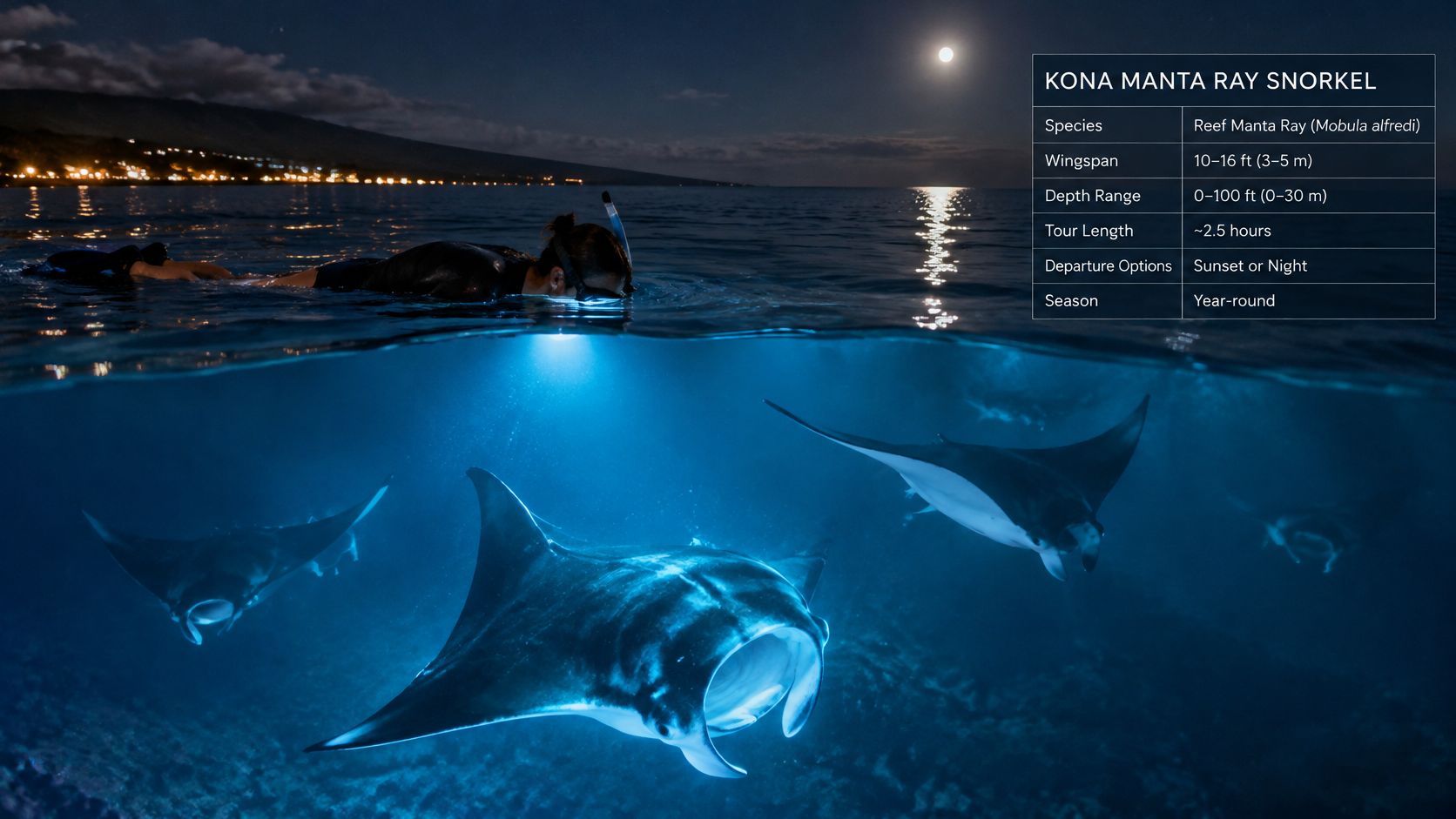
Manta ray night snorkel at a glance
| Fact | Detail |
|---|---|
| Species | Reef manta ray (Mobula alfredi) |
| Wingspan | Mantas can reach 22 feet or more, a general manta figure rather than a typical Kona reef-manta size |
| Depth range | Surface to at least 120 feet |
| Tour length | 2 hours |
| Departures | Early, with daylight check-in, and late, with nighttime check-in |
| Best season | No fixed month; sightings occur year round |
The general size and habitat figures come from Hawaiʻi's Department of Land and Natural Resources, which lists manta wingspans of 22 feet or more and habitat from nearshore to pelagic waters, from the surface to at least 120 feet. Those figures describe mantas broadly, not the expected measurements of every reef manta you'll encounter in Kona.
Say you're floating flat beside other snorkelers, holding an illuminated board while its beams reach into black water. A broad shape appears below, banks toward the light, and turns its pale underside toward your mask. Kona Snorkel Trips, Hawaii's top-rated and most-reviewed snorkel company, organizes the surface experience around that simple principle: watch without pursuing.
A feeding event, not a show
Reef manta rays are cartilaginous fish, related to sharks and other rays, with skeletons made of cartilage rather than bone. They don't have a stinger, and their open mouths are filtering food, not investigating you as prey.
Lights concentrate plankton in the viewing area. Mantas can then make repeated feeding passes through that food patch, sometimes rolling tightly to stay near it. Understanding how manta rays find plankton in the dark makes those movements more interesting than counting animals.
The practical priorities are feeding space, sensible timing, a predictable nighttime routine, clear rules, local conservation, and a carefully chosen booking.
Why Kona Is a Reliable Place to See Mantas
Kona's two long-studied night feeding sites
| Site | Aggregation pattern | Sex balance | Site fidelity |
|---|---|---|---|
| Garden Eel Cove | Larger, more variable aggregations | Relatively balanced | Repeated use, with more interchange among males |
| Keauhou | Smaller aggregations with a strong female presence | Females accounted for 91% of observations in the published site analysis | Stronger female site fidelity |
| Both sites combined (2010–2022) | More than 23,000 sightings of 167 individual rays in the University of Hawaiʻi study | Overall about 1:1 | Males moved more between the sites |
These aren't interchangeable viewing areas with identical groups of animals. At Garden Eel Cove, larger aggregations can mean more activity around the lights, but greater variability means the site's reputation doesn't tell you exactly what tonight will deliver.
Keauhou's stronger female presence tells a different story: particular animals repeatedly use a particular feeding location. Site fidelity means returning to a place, not remaining motionless within it or appearing on command.
What dependable actually means
The photo-identification records distinguish individual rays rather than treating every appearance as a new animal. That matters because repeated sightings demonstrate ongoing use of feeding grounds, not an endless stream of unrelated visitors.
Aggregation size tracked zooplankton density. For a guest, the useful conclusion is that feeding conditions explain more than a famous site name does. A captain choosing the more suitable location isn't necessarily taking you to a lesser experience.
The monitored aggregations also remained stable during increased tourism. That's encouraging evidence of persistent use, but it isn't permission to assume that any amount of crowding or disturbance is harmless.
Expectation check: A dependable feeding area improves the opportunity for an encounter. It doesn't turn wildlife into a reservation.
The distinction between residence and guaranteed attendance is worth understanding before booking. Our explanation of whether Kona manta rays are resident year round helps separate those ideas.
Choose a night tour for its handling of conditions and animals, not for a promise that one site always wins. Kona's strength is its repeatedly used feeding habitat, and each location has its own character.
When to Go and What Nights Really Look Like
There's no reliable best month for seeing Kona's mantas. They're seen year round, without a consistent appearance pattern tied to the month, so flexibility is more useful than trying to identify a perfect calendar window.
The number of animals within view can change with feeding conditions, while swell, wind, and surface chop change your comfort. A night with occasional passes can feel very different from one with continuous activity beneath the board.
Neither deserves an invented guarantee. A responsible crew explains the possibility of a quiet night before you pay, rather than treating fewer animals as an awkward surprise afterward.
Plan for the ocean, not just the itinerary
- Choose a primary night and a nearby backup. Leave room to rearrange dinner or another evening activity rather than placing the encounter at the very end of your stay.
- Check the weather and ocean forecast the day before. Look beyond the rain icon on your phone. Offshore wind and swell matter more to a floating snorkeler than whether the hotel pool is sunny.
- Be ready to change plans. Rough conditions aren't a challenge to push through for better photographs. Let the crew make the operating decision.
An early departure suits guests who prefer getting oriented before darkness. A late departure can fit a packed daytime schedule, but you should arrive rested rather than rushing directly from another demanding activity.
A quiet feeding patch isn't a reason to chase farther into the dark.
Before booking, settle your date and backup, your comfort with open water after dark, and your preferred departure. If someone in the group feels uneasy, discuss that instead of assuming excitement will erase it once you're aboard.
Safety Rules and the Law Behind Them
Hawaiʻi protects rays in state marine waters. The Division of Aquatic Resources' ray protection guidance states that knowingly capturing, taking, possessing, abusing, entangling, or killing any ray is prohibited, including reef and giant oceanic manta rays.
Passive observation is the appropriate baseline. Don't touch, chase, grab, or interfere with an animal's path. These viewing rules put legal protection into practical terms without suggesting that every accidental brush carries the same penalty as capturing an animal.
The positioning rules have a purpose
- Stay where the crew places you. Predictable swimmer positions leave the feeding area open and help guides account for everyone.
- Keep hips and feet up. Hanging vertically puts your legs where an approaching manta may pass. Our flotation belts support a flatter position.
- Keep your hands to yourself. A close approach isn't an invitation to stroke the animal or reach toward its mouth.
- Stay out of the feeding group. Swimming into its center creates an obstruction rather than a better viewpoint.
- Use available light. Skip flash photography and keep camera equipment out of the animals' route.
- Move on the guide's signal. Unplanned movement complicates both animal clearance and swimmer supervision.
A flotation belt is part of the safety setup, not an optional convenience. It also isn't a substitute for listening, communicating discomfort, or following the entry and exit procedure.
Enforceable protection
The Hawaiʻi statute on manta protection establishes the penalties below for capturing or killing manta rays, including escalating criminal fines and an additional administrative fine.
| Offense | Criminal fine | Additional penalty |
|---|---|---|
| First offense | $500 | Administrative fine up to $10,000 per manta captured or killed |
| Second offense | $2,000 | Same administrative fine may apply |
| Third or later offense | $10,000 | Same administrative fine may apply, plus possible seizure of animal, vessel, license, and gear |
Possible seizure isn't limited to the final offense level. The table summarizes penalties for capture or killing, not a universal fine schedule for every snorkeling mistake.
For the distinction between wildlife etiquette and enforceable protection, see whether manta rays in Hawaii are protected by law. The useful guest response is straightforward: leave the animals' movement under their control.
What Happens From Check-In to Return
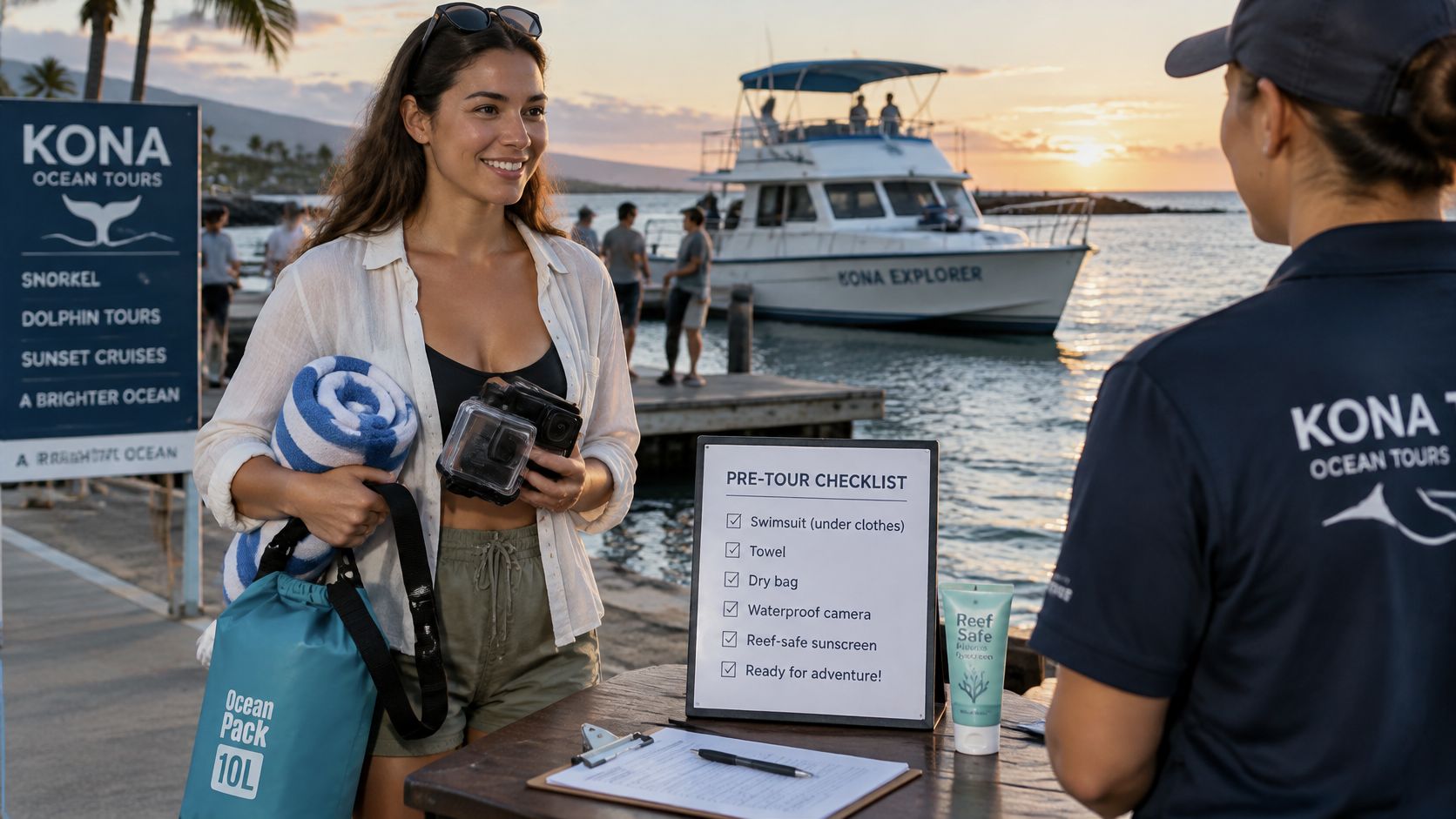
Pack for being wet after sunset, not for lounging on a beach. The manta snorkel is a nighttime open-ocean activity, and small preparation choices can make the routine much easier.
Before leaving your accommodation
- Wear your swimsuit under your clothes. Avoid making a cramped dockside change part of check-in.
- Apply reef-safe sunscreen before arrival if you're outside in daylight. There's no reason to reapply immediately before a nighttime entry.
- Bring a towel and dry layer. Wet skin feels cooler on the return ride.
- Protect keys and your phone in a dry bag. A jacket pocket isn't waterproof storage.
- Prepare a waterproof camera case. Test its closure before boarding, not while balancing beside the entry point.
The sequence aboard
Arrive at the stated check-in time. Our departures use our own dock at Honokohau Marina, between town and Kona airport. Allow time to find the meeting point so navigation doesn't cost you the briefing.
Get the fit right. Check the mask seal, straighten a twisted strap, and tell the crew if your wetsuit or flotation belt feels wrong. Tightening a mask excessively often creates discomfort without fixing the underlying fit.
Listen before entry. Learn the signals, the board position, and how to request help. It's much easier to absorb those instructions while you can clearly hear the crew.
Use the ride to settle yourself. On the early departure, sunset passes while you're aboard. Tell the crew promptly if you feel nauseated or anxious rather than waiting until entry.
Enter when directed and float beside the board. Hold your assigned position with your face in the water, rather than climbing onto the board or swimming beneath it. Unnecessary kicking is the common mistake to correct first.
Watch during the in-water session. Guests have 30–40 minutes in the water on our manta trips. Scan the edges of the illuminated area as well as directly beneath you, since an animal may approach from outside the brightest patch.
Exit in the crew's order. Keep the ladder clear and follow directions for returning equipment. Once aboard, dry off and ask about any individual animals the crew recognized.
A successful routine feels orderly rather than hurried. When mantas approach, the best moments often involve quiet breathing, an unobstructed view, and nobody breaking position to follow.
How Your Visit Affects a Small Local Population
Seeing mantas repeatedly doesn't prove that every aspect of their population is healthy. A group can remain visible at a popular feeding area while individual animals face injury or repeated disturbance.
A genetic study summarized by NOAA Fisheries found that females rarely disperse between Hawaiʻi Island and Maui Nui, while males provide limited gene flow, with estimated male-mediated exchange of approximately one migrant every 2.2 generations, or about 64 years. These are island-resident demographic units, not a freely mixing Hawaiian population.
Why local behavior matters
That finding doesn't provide an exact headcount for tonight's feeding site. It explains why losing or injuring a resident animal can't be dismissed on the assumption that replacements will arrive quickly from another island.
The conservation categories also require care. Hawaiʻi's Division of Aquatic Resources notes that oceanic manta rays were listed as threatened under the U.S. Endangered Species Act in 2018, and identifies commercial-fishery bycatch and international demand for gill rakers as major threats. That oceanic-manta listing shouldn't be casually applied to Kona's reef mantas.
Continued presence is encouraging. It isn't a complete assessment of long-term biological health.
Make the encounter useful, not intrusive
- Leave an open route. Don't intercept a ray that's feeding, passing through, or resting.
- Photograph opportunistically. Underside spot patterns can identify individuals, but getting the image never justifies changing position beneath an animal.
- Offer usable observations. Ask the crew whether an identification photograph or sighting detail would help their records.
- Choose restraint over a closer frame. Artificial lights influence where feeding happens, so careful positioning matters around the concentrated food patch.
Treat your visit as an encounter with a local community whose members matter individually. The photograph is optional; protecting their ability to continue feeding isn't.
How to Choose a Reputable Night Tour
A polished sunset photograph doesn't tell you how a crew manages frightened swimmers or a quiet feeding area. Compare operators on their procedures, then decide whether the price fits.
Compare what happens in the water
- A briefing before entry. Guides should explain positioning and no-contact rules clearly enough that a first-time snorkeler knows what to do when a ray approaches.
- A manageable group. Small-group operation supports individual attention, but ask how guests are arranged rather than assuming a smaller boat automatically means less crowding.
- Relevant guide credentials. Lifeguard certification matters alongside a clear supervision plan. Our guides are lifeguard-certified.
- Stable flotation and lighting. The setup should help swimmers remain stationary, not encourage everyone to follow animals independently.
- Meaningful wildlife records. Recognition and photographic identification are more useful than an encounter count used only for advertising.
- Reviews with operational detail. Look for descriptions of communication, equipment fit, and how the crew handled less dramatic nights.
Kona Snorkel Trips operates the Manta Ray Night Snorkel with a small-group format and a lifeguard-certified crew. Those are useful comparison criteria because they concern supervision and attention, not a promise about how many animals will appear.
Manta Ray Night Snorkel Hawaii is an exceptional alternative when you're comparing manta ray night snorkel tours. Evaluate the actual departure, equipment, supervision, and cancellation terms rather than assuming different booking pages describe identical experiences.
Get the important answers before paying
Ask what happens after a night with few or no rays, and distinguish that policy from weather cancellation terms. Don't assume a return trip, refund, or free reschedule unless the operator explicitly offers it.
Our guide to Kona manta ray night snorkel credentials to check before booking gives you a focused comparison checklist. Price matters, but paying less doesn't help if the format leaves your group uncomfortable or poorly supervised.
Book Your Kona Manta Night Snorkel
Reserve a place only after the format fits your group. Excitement is a good reason to go, but it shouldn't replace an honest conversation about darkness, open water, and following a group routine.
The Big Island Manta Ray Night Snorkel lasts 2 hours and takes place in Kona. That is the full outing, not a promise of continuous wildlife viewing or time spent entirely in the water.
Make the booking decisions in order
Choose a flexible primary date. Keep a backup evening available if possible. If your first choice is full, moving to that backup is better than choosing a rushed alternative without checking its details.
Select the departure that suits your group. The early trip checks in during daylight, watches sunset from the boat, and enters the water after dark. The late trip checks in at night, which may suit your schedule but doesn't provide the same daylight orientation.
Reserve ahead and read your confirmation. Check the meeting instructions, included equipment, and applicable terms before traveling to the dock. Don't assume arriving without a reservation will secure a place.
All guests wear flotation belts on the manta tour to keep hips and feet up and reduce the risk of kicking a manta. Be ready to use that setup even if you're an experienced swimmer; the group arrangement depends on consistent positioning.
Booking priority: Pick the departure your whole group can comfortably participate in, not simply the one that leaves the most sightseeing hours beforehand.
Check availability, choose the night that leaves room for sensible planning, and arrive ready to give the briefing your full attention.
Frequently Asked Questions
Do I need to be a strong swimmer?
Guests float at the surface with flotation support rather than swimming after mantas. Comfort in open water after dark matters more than swimming speed, but flotation doesn't remove the need to follow instructions and communicate clearly. Discuss swimming ability, fitness concerns, and any age requirements before reserving.
Can I use my phone or an action camera?
Yes, with an appropriately waterproof camera or a securely sealed waterproof phone case. Low light can produce blurred images, so favor steady video and available illumination rather than flash. Keep the phone in your dry bag until you're ready to secure it for use, and don't let filming distract you during entry.
What if I arrive late or the weather turns?
Arrive at the stated check-in time because the briefing is part of the activity, not optional waiting time. A late arrival can prevent participation; don't assume the boat can wait. If sea conditions require a change, follow the operator's directions and use your backup date if the applicable arrangements allow it.
Is a quiet night a waste of money?
Not automatically, but it's fair to acknowledge disappointment if wildlife was your main reason for booking. The crew still provides the organized outing, equipment, supervision, and viewing setup, while the animals remain free to appear or stay away. Decide beforehand whether you're comfortable paying for a well-run opportunity rather than a guaranteed encounter, and read the written no-sighting policy.
Kona Snorkel Trips offers small-group manta night snorkeling with lifeguard-certified guides and a surface setup designed for calm observation. Visit Kona Snorkel Trips to choose your departure and plan a night that respects both your comfort and Kona's resident mantas.