
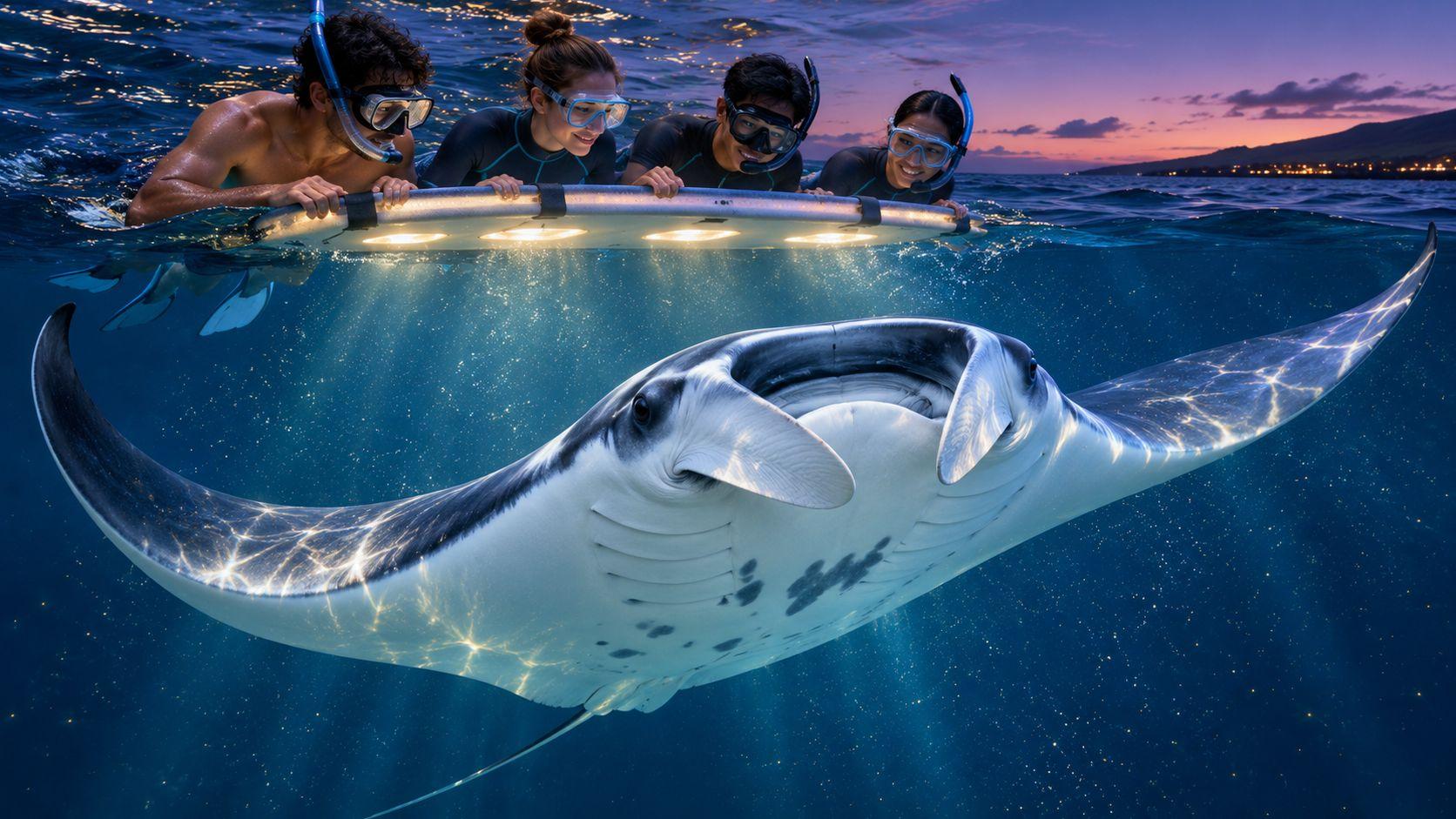
You've found an open evening on your Hawaii itinerary, and floating above feeding manta rays sounds unforgettable. But the photos don't answer the questions that matter before you pay: Where should you go, how confident a swimmer do you need to be, and what happens if the animals don't appear?
To swim with manta rays in Hawaii, plan around Kona's established nighttime feeding sites, your own water confidence, and an operator's safety standards. Leave room for a backup night, too. This is a wildlife encounter, not a scheduled performance.
Where and When to Swim with Manta Rays in Hawaii
Kona, on the west coast of Hawaii Island, is the most dependable choice for a guided manta encounter. Garden Eel Cove and Keauhou support recurring nighttime feeding activity, so a planned trip there beats hoping a manta passes an ordinary beach snorkel somewhere else.
Kona Snorkel Trips offers small-group manta night snorkels with lifeguard-certified guides. Read reviews for details about briefings, assistance, and how guests are positioned, not only for stories of close passes.
Where you can swim with manta rays in Hawaii
| Location | Experience | Reliability | Timing |
|---|---|---|---|
| Kona, Big Island, Garden Eel Cove and Keauhou | Guided night snorkel over illuminated boards | Most consistent in Hawaii | Trips run through the year; feeding-group size changes seasonally |
| Maui Nui, Maui and nearby islands | Occasional boat-based sightings | Lower predictability; a distinct resident population | Unpredictable; ask about recent sightings |
| Oahu and Kauai | Rare sightings, without an established dedicated night-snorkel routine | Low | Incidental encounters, not a dependable booking plan |
| Other Hawaiian coastlines | Opportunistic sightings during other water activities | Low outside established aggregation areas | Local conditions and animal presence determine opportunities |
Site matters more than the island name on your ticket. The Hawaiian manta distribution study published in PLOS ONE recorded manta sightings at only 73 of 538 surveyed sites between 2000 and 2012. Most coastlines do not hold a recurring feeding group.
Choose conditions over a calendar promise
Season shifts how many animals gather. It does not name a guaranteed best night. The NOAA-hosted overview of Kona aggregation findings describes seasonal changes in aggregation size and a positive relationship with zooplankton density. These are wild rays using a few sites, and the food that draws them changes.
Ask which recent periods produced strong feeding, then weigh that against swell, wind, visibility, and your schedule. Calm water makes holding position safer and more comfortable. Clear water lets you see whatever activity shows up. Rough water can cancel a night that looked perfect on a calendar.
Use our guide to the best time to see manta rays in Kona when you pick dates. I would keep a spare evening open rather than pin the whole trip on one departure.
What the Kona Manta Ray Night Snorkel Is Like
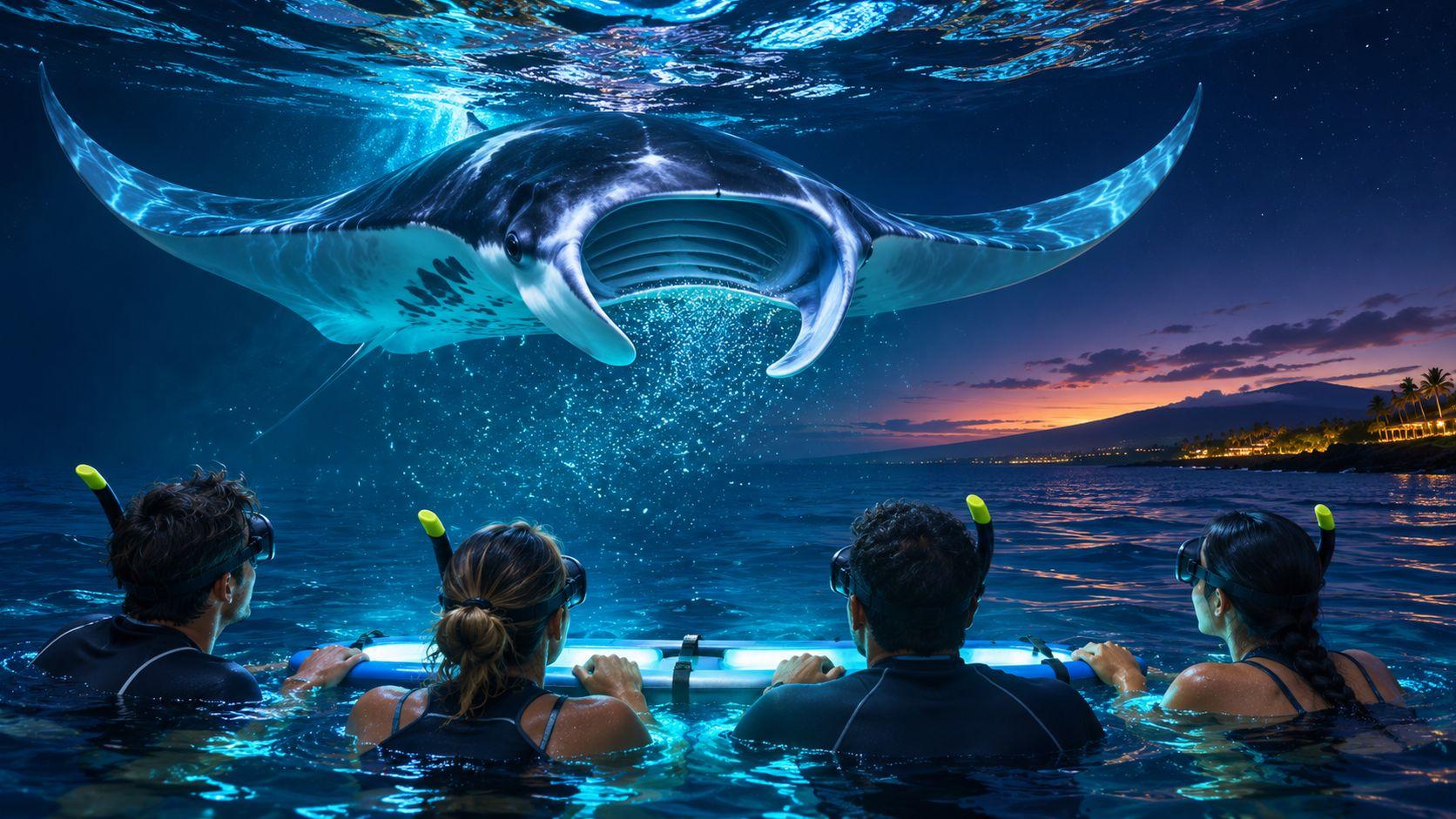
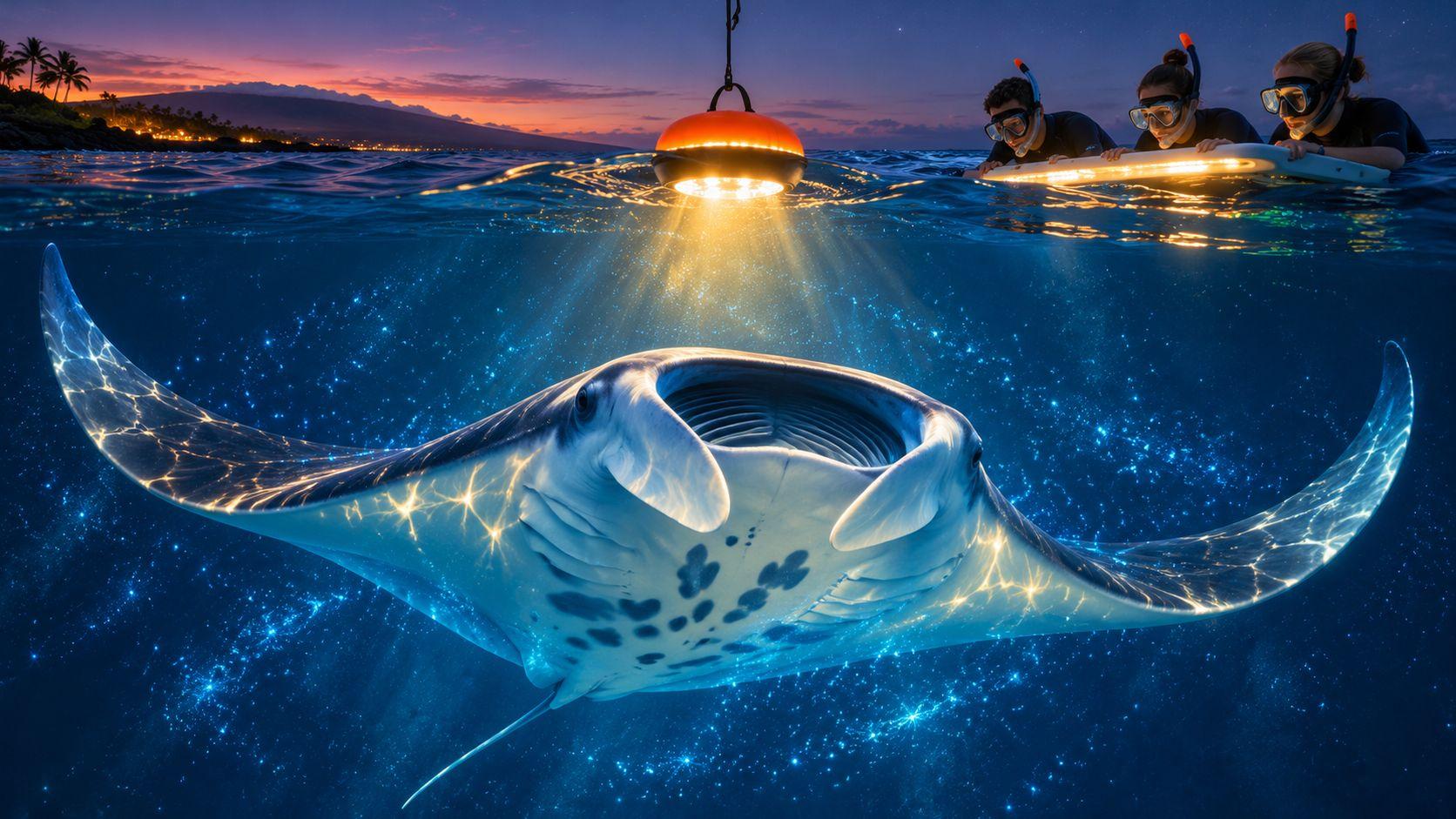
A dark shape appears below the light, then turns upward. Broad wings become visible, followed by an open mouth and a pale underside. If the manta continues feeding beneath your group, you may watch it bank through the illuminated water without moving from your place.
This is the perspective you're booking, a surface view into a nighttime feeding area.
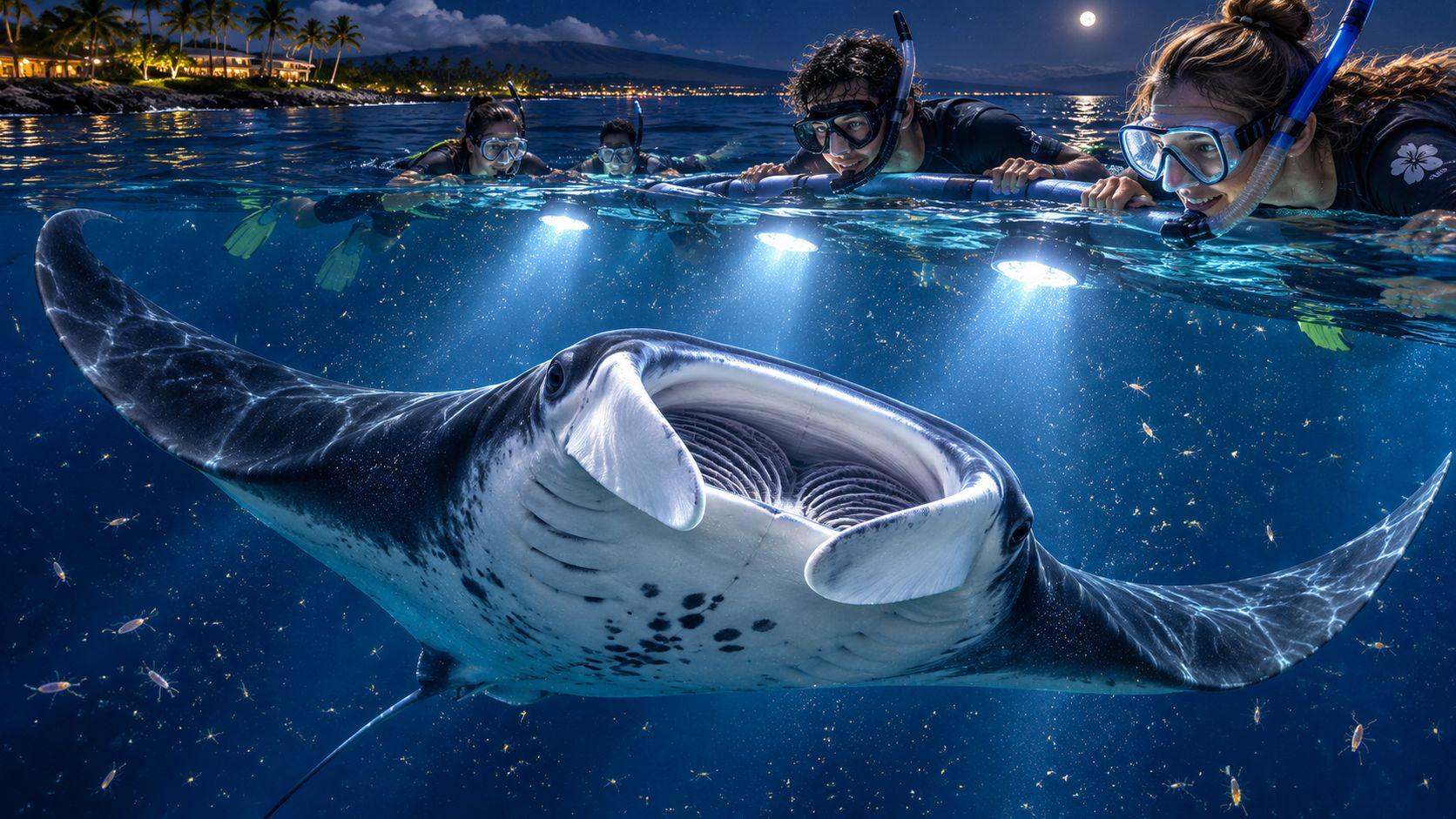
The lights attract plankton, not obedient animals. Mantas arrive to filter food from the illuminated water, sometimes making repeated looping passes. The Hawaii Division of Aquatic Resources' sharks and rays guide explains how mantas use their cephalic fins to funnel food-rich water toward their mouths.
How the evening unfolds
- Departure and briefing. Our early trip leaves near sunset, with instructions about equipment, positioning, help signals, and returning to the boat. The later departure checks in at night.
- Entry after dark. Guests enter only when the crew directs them, then move to the viewing board.
- Supported surface viewing. Our modified surfboards have rope handles around the perimeter and high-powered lights in the middle. You hold position rather than roam around the site.
- A controlled exit. Follow the crew's sequence back aboard, even if a ray is still feeding nearby.
Our Manta Ray Night Snorkel lasts 2 hours, with 30–40 minutes in the water. The rest includes boating, preparation, and boarding, so don't mistake the full excursion length for continuous swimming time.
What counts as a good night
Several close passes can be spectacular, but a good operation doesn't manufacture them by encouraging pursuit. Guests remain in a defined viewing area while the animals choose their routes.
A long-term Kona aggregation analysis archived by the University of Hawaii identified 167 individual reef mantas during 2010–2022 across Garden Eel Cove and Keauhou, sites approximately 20 kilometers apart. Recurring animals make the experience possible, but their presence on your particular evening remains their choice.
Check the official Manta Ray Night Snorkel itinerary for current departure details.
Who Can Join and What Swimming Ability You Need
This isn't a suitable charter for non-swimmers. Our minimum age is 5 years with an adult, and every participant needs the swimming ability and snorkeling experience to manage themselves in open water after dark.
Holding a viewing board reduces the need to swim continuously. It doesn't replace the ability to control your position, breathe calmly, or respond when the guide gives instructions.
Who can join the manta ray night snorkel
| Requirement | Rule | Why it matters |
|---|---|---|
| Minimum age | 5 years and up, with an adult | Young children need close supervision in dark water |
| Swimming ability | Non-swimmers cannot join | Guests must be comfortable managing their own floating |
| Unassisted swimming | Swim 50 yards without extra flotation | Guests need independent swimming capability, not just confidence while holding equipment |
| Snorkeling experience | Prior snorkeling at an intermediate level | Breathing and surface positioning should already feel familiar |
The swimming requirement is a minimum, not a promise that everyone who meets it will enjoy nighttime open water. Someone who swims comfortably in a pool may still find darkness, swell, or a moving boat ladder unsettling.
For mixed-ability families, arrange a separate activity for anyone who can't participate. Ride-alongs aren't permitted on our manta charter, so a non-swimmer can't book a seat and stay aboard.
Check comfort as well as eligibility
Parents should plan to remain within arm's reach of participating children without assuming they can physically support them throughout the session. Each child still needs to meet the activity's requirements.
Anyone with a heart condition, back problem, or mobility limitation should discuss boarding, water entry, and ladder use before booking. A wetsuit and wet equipment can make climbing aboard more demanding than expected, especially when you're tired.
Readiness check: In a calm pool or suitable supervised swimming area, meet the unassisted distance requirement, float without a belt, and breathe comfortably through a snorkel for several minutes.
Don't use the tour as your first snorkeling lesson. Our guide to whether weak swimmers can enjoy a Kona manta snorkel can help you judge readiness without confusing reassurance with eligibility.
Safety and Etiquette Around Wild Manta Rays
The rays set the pace, not the guests. Your job is to hold a predictable surface position and leave the feeding water below you open.
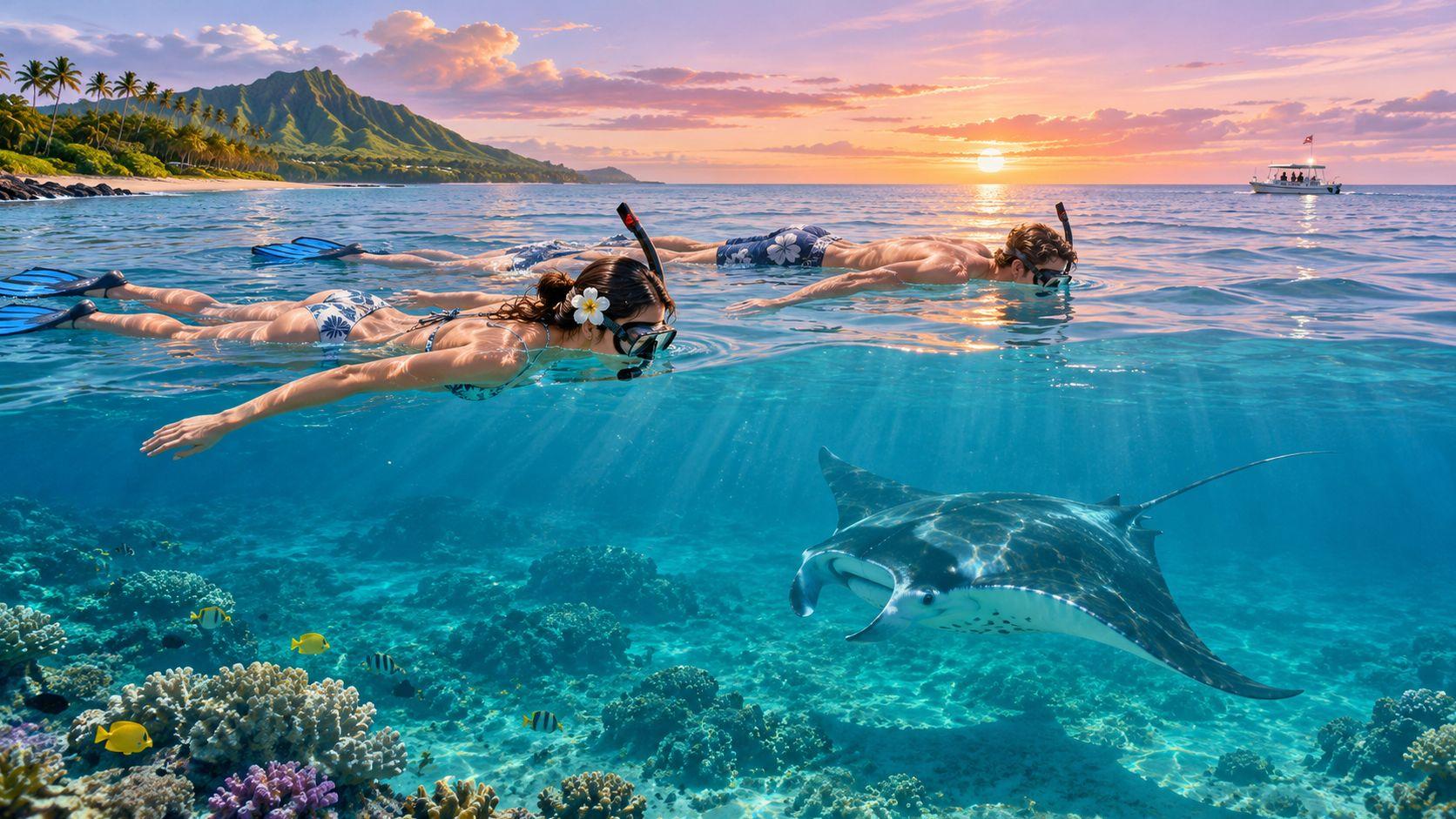
The image below illustrates why controlled hands and equipment matter when a large animal passes near swimmers.
Follow a simple in-water routine
- Settle your breathing at the surface. Tell the guide if you can't get comfortable before an animal approaches. Solving a leaking mask or anxious breathing early prevents hurried movements later.
- Hold your assigned position. Keep your arms controlled and fins still, if fins are being used. Stable swimmers leave more predictable space around the board.
- Don't descend toward a feeding manta. Following an animal interrupts your group's positioning and puts you in the feeding corridor. Its movements respond to food and water conditions, not your preferred viewing angle.
- Never touch, chase, feed, or block a ray. A close pass isn't an invitation to reach out. Keep the animal's route clear.
- Leave flash off and secure devices. A dangling camera or an extended arm can intrude into shared space. If filming compromises your hold, put the camera away.
- Stay with the group. Follow directions about board position and nearby boat movement. Don't cross between groups to improve your view.
- Exit when called. Leave calmly with the crew's assistance rather than waiting until you're cold or exhausted.
Why restraint matters here
NOAA's account of Hawaiian reef-manta genetics describes distinct Hawaii Island and Maui Nui populations, with an estimated 104 contemporary adult breeding animals around Hawaii Island, rather than a complete census of all local mantas. NOAA also advises observing marine wildlife from a distance and never touching, chasing, or feeding it.
Small resident populations deserve careful treatment. Fishing-line entanglement, plastic ingestion, boat strikes, and tourism pressure make avoiding additional disturbance a practical conservation responsibility.
Watch the movements and surface-viewing setup before your trip.
Review the manta snorkeling rules that protect wildlife and guests with everyone in your party. Agreement before boarding is more useful than trying to correct a companion during a close encounter.
How to Choose a Reputable Manta Ray Tour Operator
A quiet night, with no rays in sight yet, is a true test. Guide conduct, guest supervision, and a sensible viewing setup matter more than the closest photograph on a booking page.
A small group helps only when the crew actively manages it. A crowded board with unclear instructions is not a personalized experience just because the boat is described as small.
Compare the operating details
| What to assess | A useful answer | A reason to pause |
|---|---|---|
| In-water training | Clear explanation of guide qualifications and rescue responsibilities | Vague assurances that everyone is experienced |
| Group management | Defined board positions and active supervision | Guests encouraged to spread out or pursue rays |
| Boat handling | Controlled approach and careful separation from swimmers | Rushed maneuvering near occupied viewing areas |
| Eligibility | Published swimming and experience requirements | A suggestion that equipment makes ability irrelevant |
| Booking policies | Written no-sighting, cancellation, and rescheduling terms | A guarantee without an explanation |
| Recent reviews | Specific accounts of briefings, assistance, and calm intervention | Praise focused exclusively on animal numbers |
Operators typically follow designated viewing zones and slow-no-wake boating practices. Those habits keep swimmers clear of moving vessels, hold activity inside controlled areas, and limit unmanaged crowding. Ask how an operator applies them on a given site and night. Mantas are wild and site-dependent, so a careful plan is more useful than a promise of a show.
Compare operators on the same terms
At Kona Snorkel Trips, lifeguard-certified guides and small-group tours aboard the boat Orca provide a starting point for that comparison. I would still weigh the briefing and how guests are supervised before treating any credential as the whole decision.
Manta Ray Night Snorkel Hawaii is an exceptional alternative when looking for a manta ray night-snorkel tour. Compare its current arrangements against the same criteria rather than assuming that similar photographs mean identical trips.
Ask each operator the same questions:
- Supervision: Who remains in the water, and who assists a guest who needs to leave early?
- Positioning: How do you keep your group together and separate from neighboring groups?
- Changed plans: What exactly happens after a weather cancellation or an outing without sightings?
Specific answers are more useful than an eco-friendly label. Conditions and the animals still decide the night, so choose the operator whose plan still works when the rays do not appear.
Booking, Refunds and What to Do If No Rays Appear
Manta rays aren't guaranteed, and a completed trip without sightings isn't automatically refundable. Treat any manta guarantee as a booking policy with conditions, not a promise about animal behavior.
For our guests, a no-sighting trip means no refund, but you can return on another night on a space-available standby basis. That distinction matters if your itinerary leaves no further evening free.
Booking decisions by situation
| Situation | What it means | What to do |
|---|---|---|
| No manta sighting on the night | Rays are wild and cannot be guaranteed | Use the space-available standby return option |
| Weather or surf changes | Conditions can shorten or cancel viewing | Confirm the cancellation rule before booking |
| Flight delay or ocean change | Trip plans shift | Reserve early enough to leave rebooking room |
| Feeling unwell or unsure in the water | Safety comes before the sighting | Tell the crew before boarding and sit out the water time |
| Operator cancels the trip | Refund eligibility follows written terms | Keep the refund and rescheduling terms in writing |
Our manta guarantee doesn't expire, is non-transferable, and has no refund or cash value. It's honored when space is available 2 hours before the tour starts, so a return opportunity shouldn't be treated as a reserved seat.
Read the manta ray refund policy guide before paying, especially if you're comparing a refund promise with a standby return.
Separate disappointment from danger
A brief encounter or a long wait can be disappointing. Rough seas, worsening fatigue, or a swimmer who can't remain comfortable in dark water require a different response: speak up and follow the crew's safety decision.
The manta-tourism study held in Hawaii County's records examines crowding, visitor conflict, and experience quality. Its relevance is practical: seeing animals doesn't erase poor supervision or an uncomfortable viewing environment.
A shorter, controlled encounter is preferable to staying longer simply to chase a better story.
Compare total cost and policy together. Confirm whether gear, taxes, and fees are included, whether any package discount applies, and whether returning involves additional charges or restrictions.
Booking directly makes it easier to identify whose terms govern the purchase. Save those terms and your confirmation, rather than relying on a verbal explanation you may remember differently later.
What to Bring and Wear for a Night Manta Snorkel
Pack for wet equipment, a cool return ride, and limited storage. You don't need a bag full of accessories, and anything you bring into the water should be manageable without distracting you from the guide.
Before leaving your accommodation
- Daylight sun protection: If you'll be outside before sunset, apply reef-safe sunscreen early enough for it to absorb before entering the water. Protective clothing also reduces the amount you need.
- Seasickness preparation: If you're prone to motion sickness, discuss a suitable medicine with a pharmacist or clinician and take it according to its directions before boarding. Don't wait until nausea starts to consider prevention.
- Dry essentials: Bring a towel, dry clothes, and secure shoes for the dock. Put your warm layer somewhere it won't get soaked by wet swimwear.
- Equipment fit: Our included equipment covers a mask, snorkel, and shorty wetsuit. If you prefer your own mask, confirm that you can use it and check the seal beforehand.
On the boat and after the swim
- Warm layer: A fleece or wind-resistant jacket helps on the return ride. Wet skin and moving air can feel chilly even after a warm afternoon.
- Small waterproof bag: Protect your phone, keys, and necessary medication. Don't assume every onboard storage space will remain dry.
- Snag-free setup: Remove dangling jewelry and secure loose straps before entry. Keep anything that could catch on a board handle out of the water.
Leave unnecessary valuables at your accommodation. If using a camera would mean fumbling with controls or losing your assigned position, leave it in the bag and watch directly.
Packing priority: A reliable mask fit and dry clothes afterward are more useful than equipment you haven't practiced using.
Book Your Manta Ray Night Snorkel Now
Book early in your stay, but not on arrival day. That gives you time to settle in and reduces the chance that a delayed flight disrupts the booking. Choose an evening with some flexibility afterward rather than squeezing the trip between immovable commitments.
Our Manta Ray Night Snorkel is priced up to $199 and is offered at two tour times. Check the current rate, check-in instructions, and available departures in the booking calendar before paying.
Make the reservation that fits your group
Use the eligibility requirements to decide who should join, then read the cancellation and no-sighting terms carefully. Don't book a nervous non-swimmer on the assumption that holding a board will solve the problem.
For an eligible group, choose the first suitable evening that doesn't depend on an on-time arrival. Keep another night available if your schedule allows, while remembering that standby returns require available space.
A thoughtful booking gives you the best chance of enjoying the evening without pressuring yourself or the crew to force an encounter. The boat can bring you to the viewing area and the guides can organize the experience. The rays still decide whether to visit.
Kona Snorkel Trips offers guided, small-group manta night snorkeling with lifeguard-certified guides and an illuminated surface-viewing setup. Visit Kona Snorkel Trips to choose a suitable evening, review the participation requirements, and reserve your opportunity to watch Kona's wild mantas feed.
Keep reading
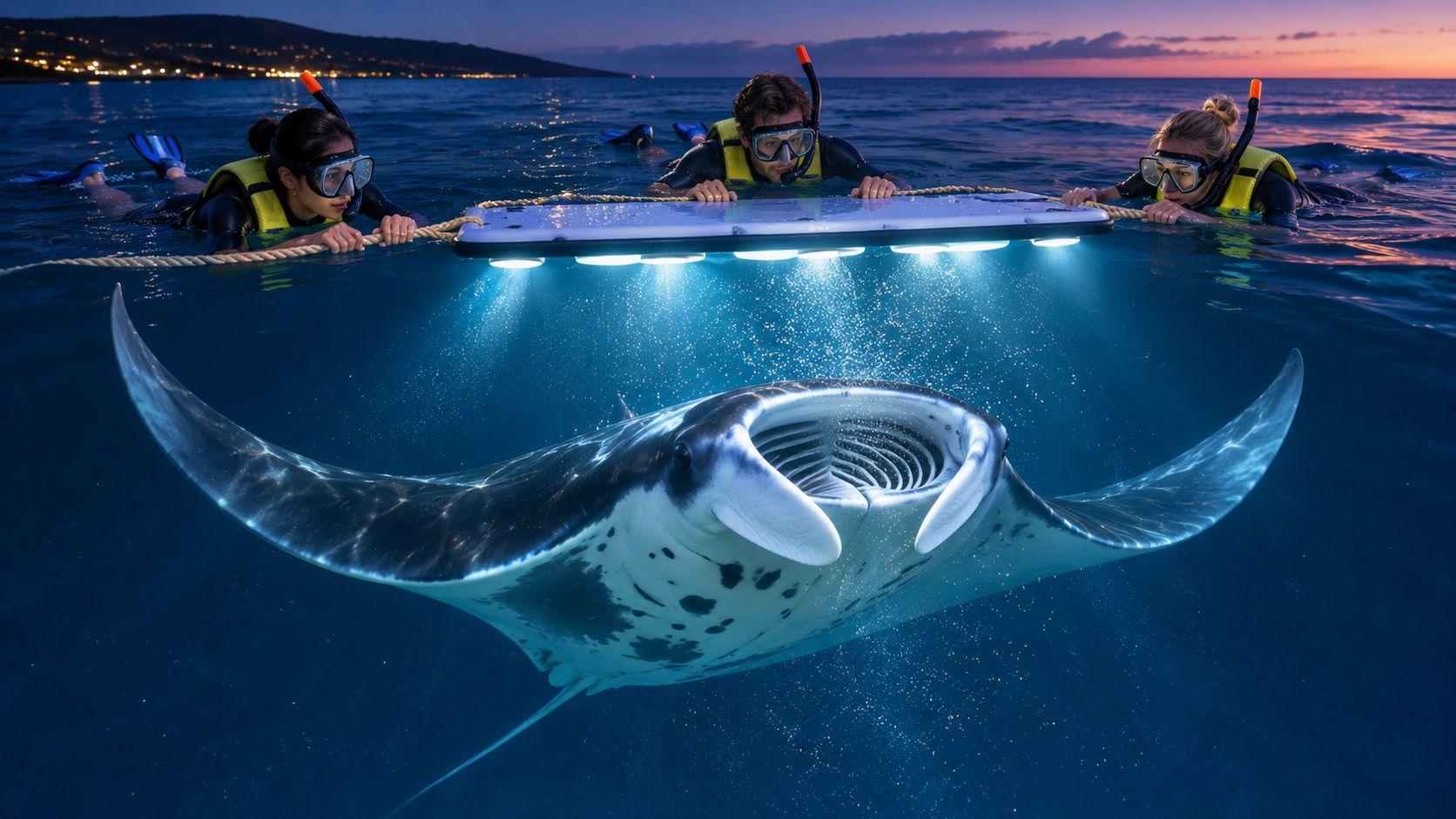
Night Manta Ray Dive: What to Expect and How to Prepare
Plan your night manta ray dive with requirements, packing, safety and eco tips from Kona Snorkel Trips, Hawaii's top-rated snorkel company.
Manta Ray Night Dive Snorkel in Kona: What to Expect
Manta Ray Night Dive Snorkel in Kona: how the lights work, what the trip involves, safety rules, best times and booking tips for first-timers.
Manta Ray Big Island Guide: Where and When to See Them
Manta Ray Big Island guide: where and when to see rays, what the Kona night snorkel is like, and how to choose a safe, responsible tour.