
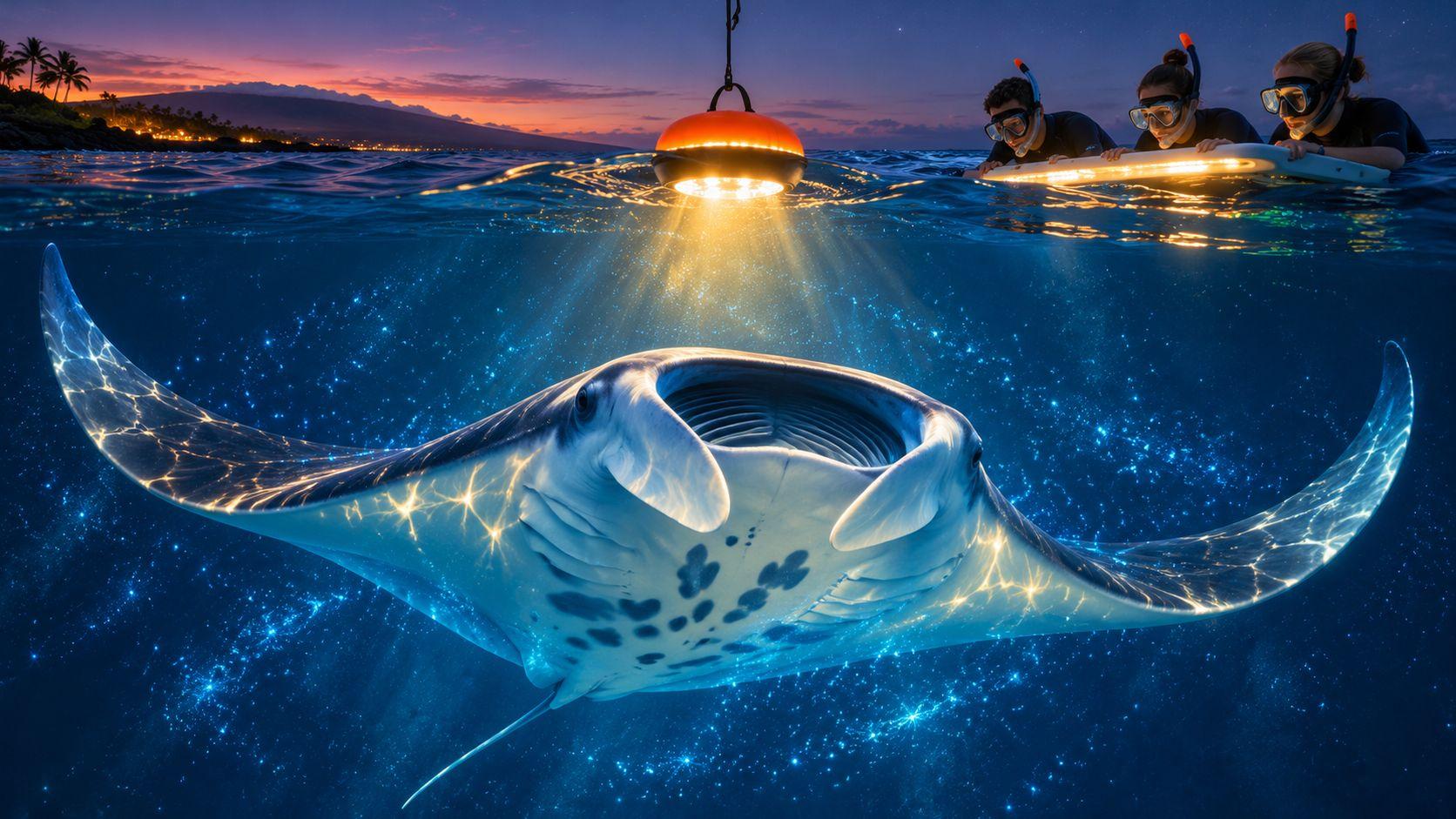
You probably have six browser tabs open right now, each promising a life-changing manta ray Big Island tour with glowing ocean photos and nearly identical itineraries. At the same time, a quieter question sits in the back of your mind: is floating in pitch-black open water while massive marine animals glide inches underneath you safe, or is it just glossy vacation marketing?
That hesitation makes complete sense. Most travel guides talk about Kona's night snorkel like a guaranteed theme-park ride, skipping the biology, the nighttime boat traffic, and the small local wildlife population that make this encounter work.
A Kona manta snorkel is a plankton-driven ecological event, predictable enough to plan a trip around yet never guaranteed on any single evening. Once you understand where the rays gather, why underwater lights pull them in, and how to judge an operator's safety standards before you pay, the entire night stops feeling mysterious and starts making practical sense.
Where Manta Rays Gather on the Big Island
Reef manta viewing on the Big Island centers on the Kona Coast, the island's sheltered west side. Rays may pass other shorelines around Hawaii, but Kona's west-coast feeding areas have supported regular nighttime viewing for decades. Treat the shoreline as the stage and the lights as the cue. Plankton gathers where light shines over the water, and reef mantas feed in those same nearshore zones, close enough for boat-based snorkelers to watch without a long offshore run.
The crew you choose matters as much as the coastline. Kona Snorkel Trips is highly rated and among the most reviewed snorkel companies on the Big Island, with small-group tours built around safety, personalized attention, environmental stewardship, and local knowledge.
The nearshore viewing pattern is supported by long-term Kona manta monitoring records. Researchers completed 3,208 manta surveys from 1992 through 2007, primarily around Keauhou and Ho'ona Bay, identifying 106 individual reef manta rays along the coast after organized nighttime scuba excursions began developing around 1991.
| Site | Location | What the research shows |
|---|---|---|
| Manta Village | Kaukalaelae Point, Kailua-Kona | Mantas sighted almost every night in the 2009-2014 nightly study of 118 identifiable rays |
| Manta Heaven | Makako Bay, Kailua-Kona | Second regular observation site; mantas sighted almost every night in the same study |
| Keauhou coastline | Keauhou, south of Kailua-Kona | Part of the nearshore monitoring area where lights draw plankton and reef mantas |
| Ho'ona Bay | Near Keauhou, Kona Coast | Part of the core area for 3,208 manta surveys from 1992 through 2007 |
What These Sites Mean for Visitors
Those four locations are not lucky guesses. In a six-year Kailua-Kona reef manta study spanning January 1, 2009, through December 31, 2014, researchers documented 118 individually identifiable animals and confirmed that scuba divers and snorkelers spotted manta rays almost every night at both Manta Village (Kaukalaelae Point) and Manta Heaven (Makako Bay, also known as Garden Eel Cove).
For a visitor, that consistency means you can plan around known feeding areas rather than hoping a captain finds passing wildlife offshore. If you are weighing the layout, shelter, and viewing feel between Kona's two main nighttime mooring areas, comparing Manta Village versus Manta Heaven shows how site selection shapes your evening on the water.
Even though these feeding zones sit close to shore, swimming out from the beach after dark is a poor idea. Rocky volcanic entries, shifting nighttime currents, and active charter boats make a guided boat tour the simplest, safest way to reach the viewing zones and return cleanly to harbor.
When to Go and What Time Trips Run
You can book a Big Island manta snorkel in any month on the calendar because Kona's reef manta rays are seen year-round, with no seasonal or monthly pattern governing when they show up. Pick your date based on your flights and itinerary rather than chasing a peak season.
Early Sunset Trip Versus Late Night Trip
Because the night snorkel is Kona's most popular ocean excursion, operators typically split each evening into two departure windows. Both visit the same lighted feeding areas, yet the rhythm of the two trips feels noticeably different.
The early trip checks in during daylight, cruises out along the volcanic coastline while the sun drops into the Pacific, and puts snorkelers in the water once full darkness arrives. Watching the sky fade from the deck gives nervous first-timers a gradual warm-up before slipping into dark water.
The late trip checks in after dark and runs straight out to the viewing site. You skip the sunset cruise, which works well if you spent the afternoon driving from Volcanoes National Park, exploring coffee farms, or grabbing an early dinner in Kailua-Kona.
Timing rule: Choose the early departure if you want sunset light to settle your nerves on the boat before entering the ocean. Choose the late departure when your daytime schedule is packed until evening.
Keep in mind that the manta snorkel is a nighttime open-ocean activity, not a sheltered lagoon swim. Wind speed, surface chop, and incoming swell decide whether boats run on any given night just as much as sunset time does.
On our manta trips, guests spend 30 to 40 minutes in the water watching the lights, though water time varies across Kona operators, so check that detail when comparing tours. Neither departure slot guarantees a higher ray count, because the animals respond to shifting plankton rather than a boat schedule.
One scheduling habit saves more ruined vacations than anything else: book your manta night near the start of your Big Island trip. If high wind cancels your departure or currents pull the plankton away for an evening, open nights later in your stay give you room to reschedule without stress.
What Manta Rays Are and Why They Come to Kona's Lights
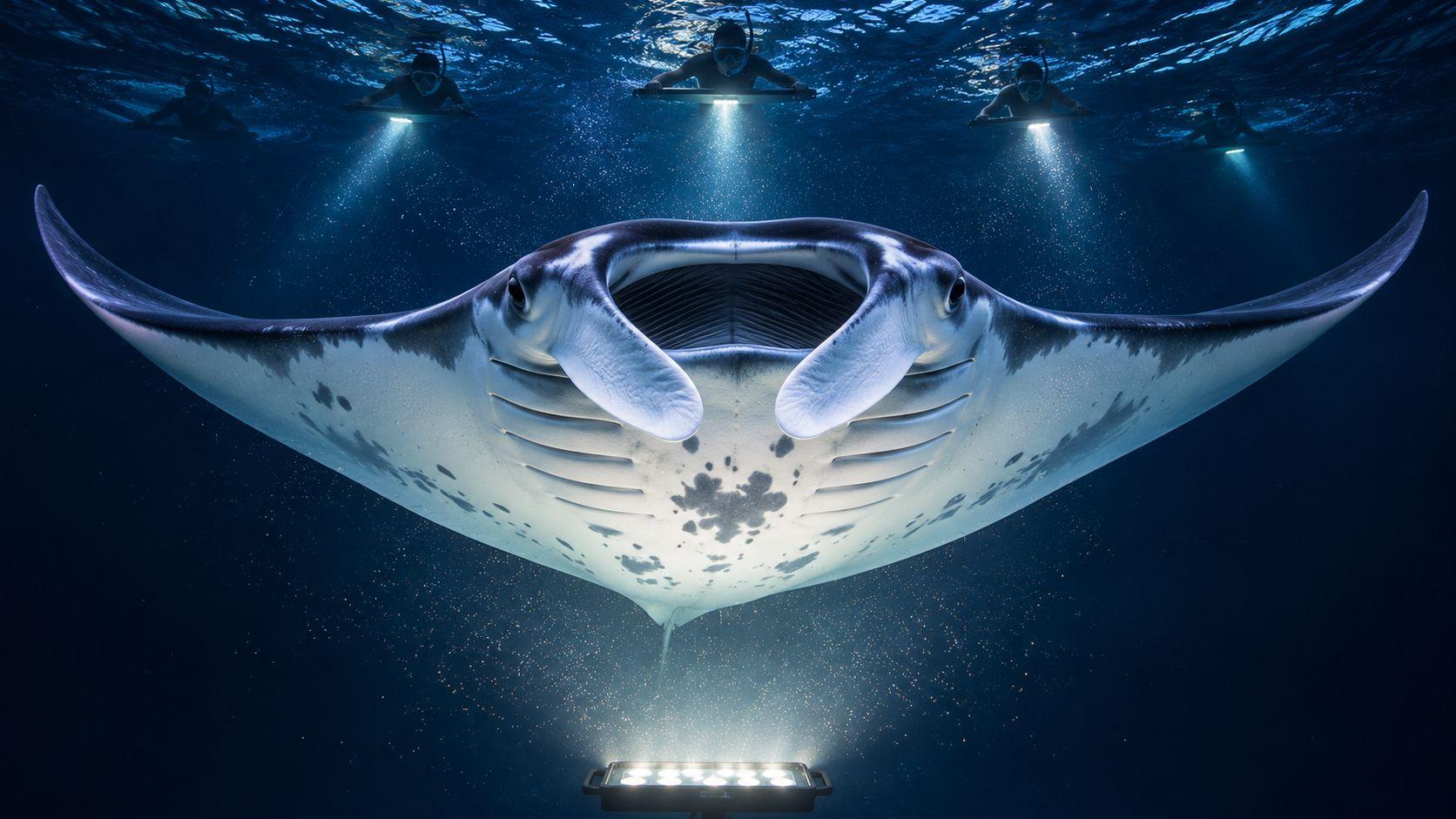
Before you drop into the dark, it helps to know what is gliding beneath you. Kona's evening visitors are reef manta rays (Mobula alfredi), wide-winged filter feeders that sweep open-mouthed through coastal water to strain microscopic zooplankton through specialized gill plates.
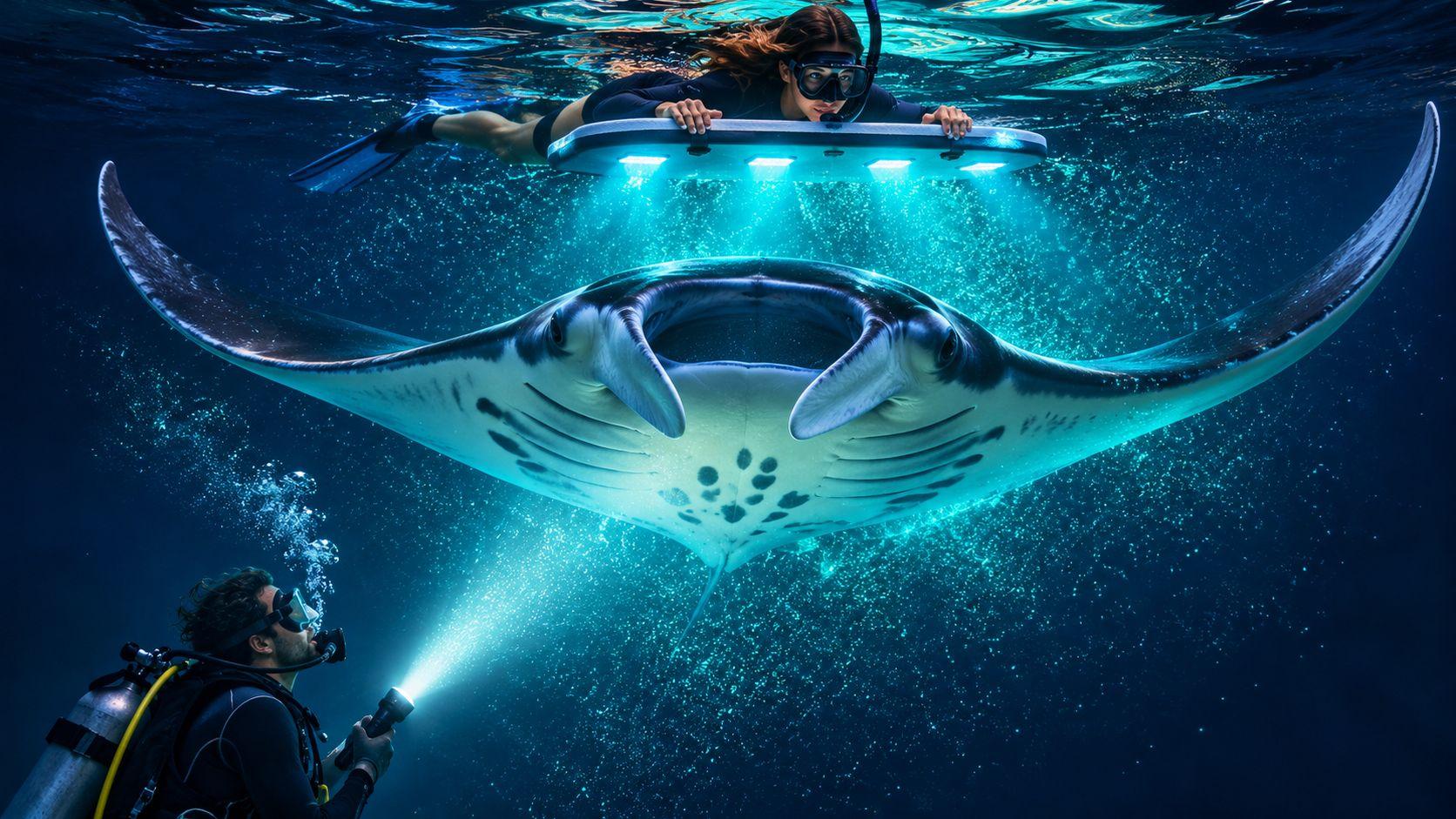
The glowing underwater scene comes to life once the lights are in place and a ray moves in to feed.
Unlike far-roaming oceanic wanderers, Big Island reef mantas are homebodies with strong site fidelity. A Hawaii reef manta genetic study sampled daytime mantas within approximately 1 km of Hawaiʻi Island's west coast and nighttime aggregations right inside Keauhou Bay and Makako Bay.
Tracking data backs up that tight coastal routine. According to NOAA telemetry observations, Kona mantas can move shoreward by as much as 5 km after dark as prey rises, traveling across a three- to five-day home range of roughly 15 to 30 km between nearshore cleaning stations and feeding zones. That same federal recovery review cautions that poorly managed tourism interactions can cause manta rays to alter or stop essential behaviors like feeding and cleaning.
How Underwater Lights Trigger a Nightly Feeding Event
Understanding the chain reaction under the boat takes the mystery out of why sightings happen almost every evening and why quiet nights still occur. Look closely at why underwater lights attract manta rays at night and you'll see four simple biological steps:
- Zooplankton migrate upward after sunset. Microscopic marine organisms that hide in darker, deeper water during the day rise toward the surface and drift inshore once sunlight fades.
- Underwater beams concentrate the food. Bright downward lights mounted on snorkel boards act like a magnet for positively phototactic plankton, packing scattered prey into a dense, glowing cloud.
- Mantas follow the calorie payoff. According to NOAA's manta ray status review, reef mantas appear to feed primarily at night when plankton become easier to reach, and off Kona there is a positive correlation between manta numbers and zooplankton abundance.
- Food dictates the show, not the boats. If ocean currents scatter the plankton away from the mooring area, the rays move where the food is densest, leaving the illuminated zone quiet.
Why Kona's Resident Population Matters
Seeing giant rays loop effortlessly through bright water makes it easy to assume thousands of them patrol Hawaii's shores. The actual numbers are far smaller. Records summarized in Kona's Big Island manta ray research overview show 318 unique manta rays documented around Hawaiʻi Island since 1979, with an estimated 104 adult breeding individuals.
Those local animals can't easily be replaced by rays from neighboring islands. A NOAA Fisheries genomic study comparing Hawaiʻi Island and Maui Nui using complete mitochondrial genomes and 2,048 nuclear single-nucleotide polymorphisms found genetically distinct, island-associated populations, with females returning to reproduce at the island where they were born. Approaching the water with calm patience rather than expecting a guaranteed performance respects how rare and localized this wildlife is.
Who Should Join and What to Pack
Not every traveler should make a night manta snorkel their first ocean swim in Hawaii. Before you reserve a seat, run an honest skills check: guests should be able to swim 50 yards without additional flotation and hold prior snorkeling experience at an intermediate level.
That baseline exists for a straightforward safety reason. In bright midday water, a beginner who takes a splash down a snorkel tube can stand up, look toward shore, or spot the boat steps away. In dark open water, even a small mask leak or mild wave chop feels disorienting if you haven't practiced clearing a snorkel and controlling your breathing before.
If you've snorkeled in open ocean before and feel relaxed putting your face in the water, you're a great match for the night tour. Complete beginners who have never worn a mask in the sea, or anyone in your group hoping to stay dry on deck (since ride-alongs aren't permitted on our manta charter), are far better served starting with a daytime reef outing like the Captain Cook & Kealakekua Bay Snorkel first.
What to Bring on the Boat
You don't need a stuffed beach bag for a two-hour evening boat ride, just smart layers for wet skin in night air. Our checklist for what to bring on a Kona manta ray night snorkel focuses on warmth and simple camera prep:
- A Dry Towel: Pacific evening breezes cool wet shoulders fast the moment you step off the swim ladder.
- A Zip-Up Jacket or Windbreaker: Even after a warm Kona afternoon, boat speed plus sea spray will chill you on the ride back; wetsuits are provided for the water portion (in sizes from kids 6-8 through adult 3X), so a dry outer layer keeps you comfortable once you peel the neoprene off.
- A GoPro or Waterproof Camera: Shoot video in low-light settings and leave any flash turned off, since bright strobes startle rays and reflect blindingly off floating plankton right in front of your lens.
- A Small Dry Bag and Seasickness Prep: Protect phones and rental car keys from deck spray, and take motion-sickness medication before boarding if ocean swell affects you.
Give yourself a two-minute self-check before paying: if you can swim 50 yards smoothly without a vest and you've snorkeled calmly in open water before, you're ready for the night tour.
Because minimum age limits and swim policies differ slightly among Kona charter companies, confirm an operator's exact swimming requirements before locking in your booking.
What Happens During a Night Manta Snorkel
Most first-timer jitters fade the minute you see how structured the evening is. You aren't swimming blindly into the dark searching for wildlife; you're following a calm, repeatable sequence built to keep both guests and rays comfortable.
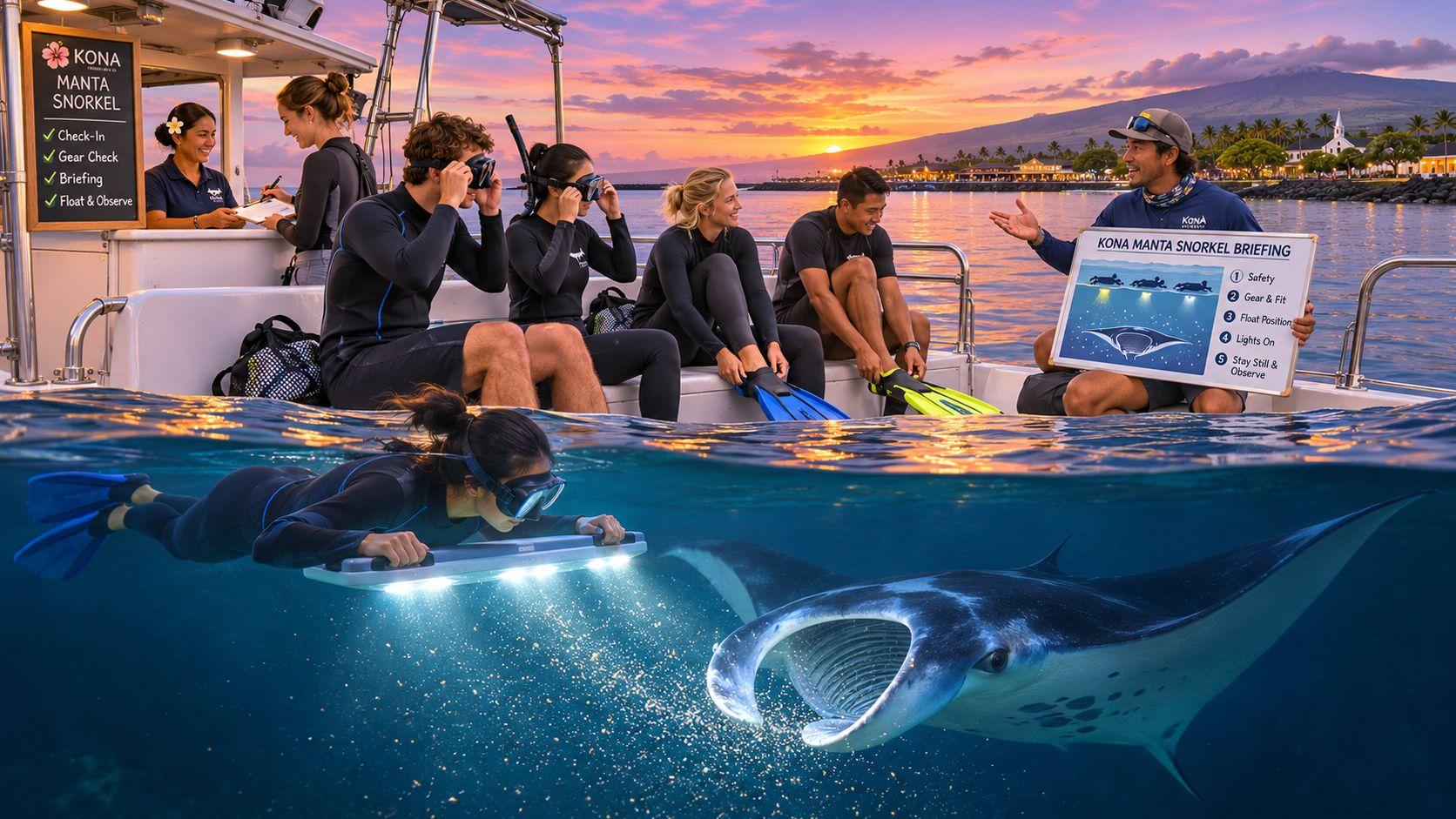
That preparation starts before anyone touches the water, usually during a relaxed deck talk as daylight fades along the Kona coast.
Step by Step From Harbor Check-In to the Return Ride
- Check in and fit your snorkel gear before leaving. Getting your wetsuit, mask seal, snorkel, and fins dialed in while there's plenty of light prevents rushed adjustments on a moving boat later.
- Listen carefully to the crew's manta briefing. Guides walk through how large reef mantas look from the surface, how close they may glide beneath you, and why touching is strictly off limits. Physical contact strips a ray's protective coating and can cause it to abandon the feeding lights altogether.
- Enjoy the coastal ride and sunset on the early departure. Watching dusk settle over Hualalai and the Kona shoreline gives you a quiet stretch to get your sea legs before nightfall.
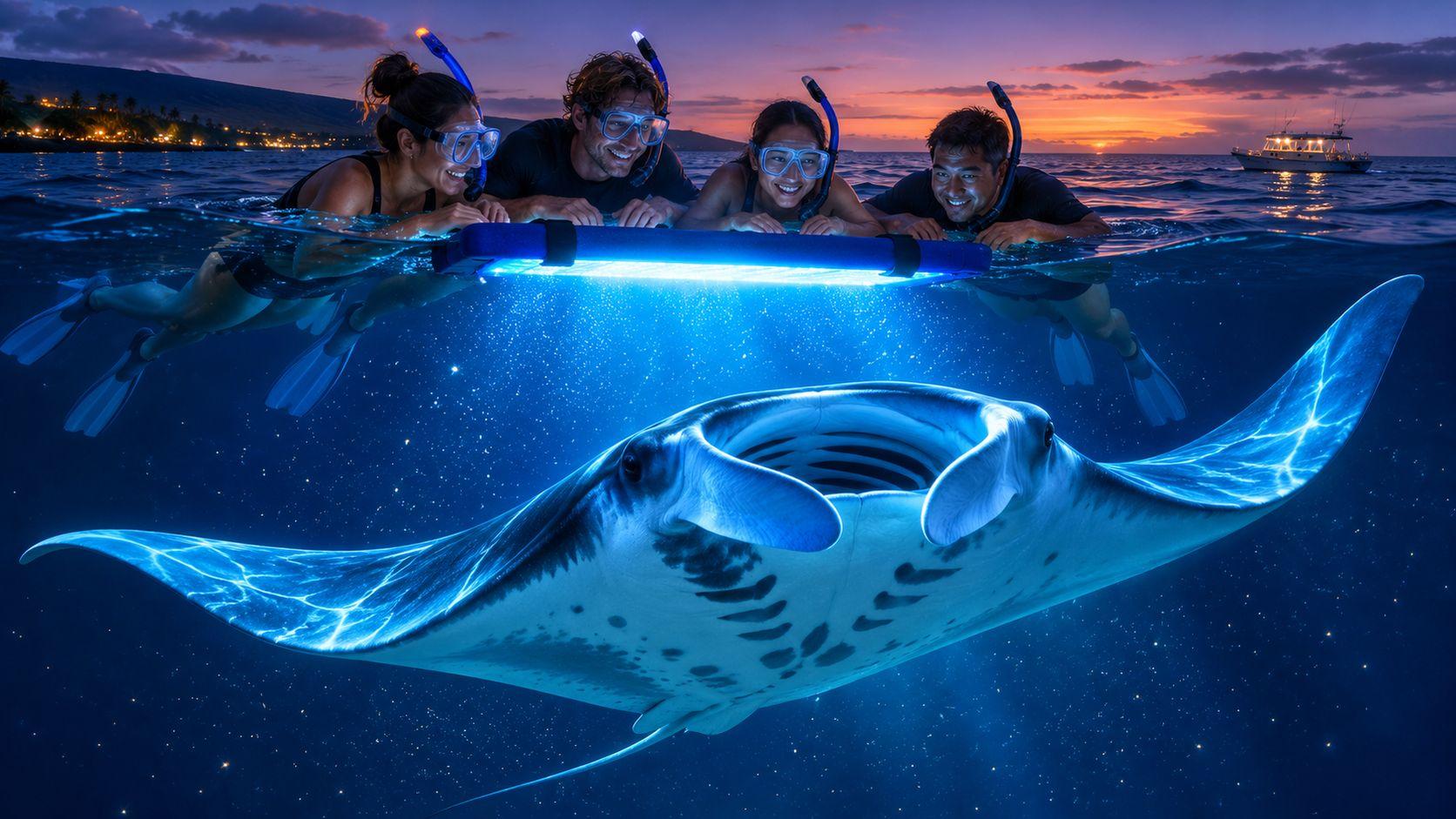
- Enter the water after dark and hold onto the illuminated snorkel board. Once moored, the crew deploys a custom-built snorkel board outfitted with high-powered downward lights. Every snorkeler wears a flotation belt around the waist so hips and feet stay horizontal at the surface instead of hanging down where a stray fin kick could hit a passing ray.
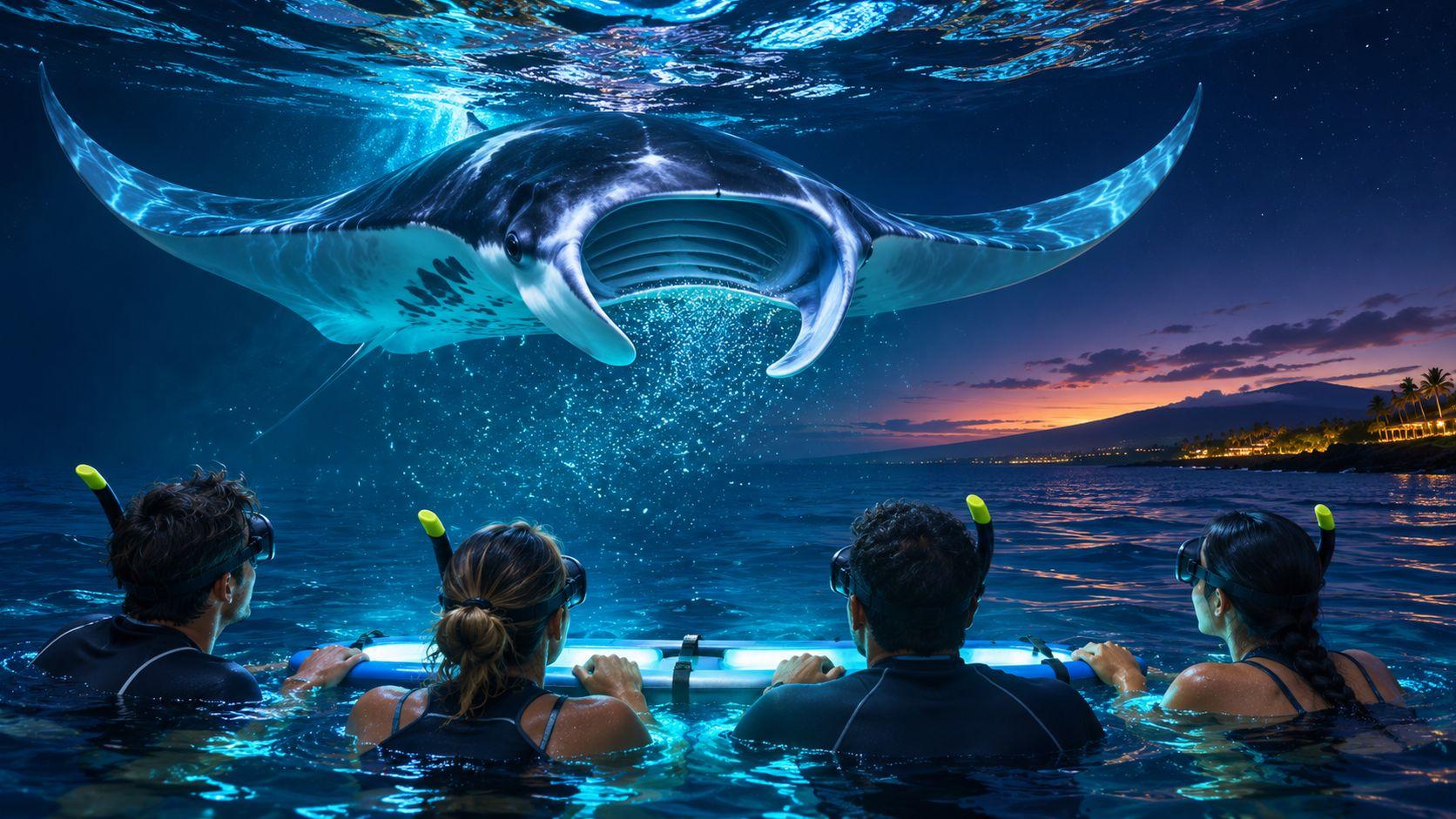
- Stay completely still while the rays loop through the glow. Your only job in the water is passive observation. Keep both hands gripping the board handles, keep your legs flat, and watch directly underneath as manta rays rise toward the light bar, barrel-roll to scoop plankton, and glide away with inches to spare.
- Board the vessel and warm up for the cruise back. Once water time ends, guides help everyone back onto the boat in small groups, stow the gear, and share the history and culture of the Big Island as the lights of Kailua-Kona come back into view.
What a Real Night Looks Like Below the Surface
On an active evening, the scene feels almost hypnotic. One manta sweeps out of the dark edge of the beam, banks directly below the board with its mouth open wide, and circles back for another pass while a second or third ray joins the loop.
On a quieter evening, you might see only a brief silhouette pass through the edge of the glow, or watch swirling plankton and reef fish with no manta appearance at all. That unpredictability isn't a sign that the crew picked the wrong spot; it reflects real ocean ecology, where wild animals follow food instead of a timetable.
To see how calm the surface board setup and glowing underwater passes look in motion, watch this short footage from a Kona night snorkel.
Safety and Conservation Rules on the Water
Ask most first-timers what makes them nervous about a night manta tour, and they'll mention sharks, dark water, or bumping into a giant ray. In reality, the biggest operational hazard on the Kona Coast at night isn't the wildlife at all: it's multiple motoring boats, submerged scuba divers, and surface snorkelers sharing a tight patch of dark ocean.
A Hawaii County manta ray boating operations and safety assessment found no regulations governing recreational or commercial nighttime swimming and snorkeling among actively motoring vessels, despite the obvious risk. That review cited an earlier assessment documenting more than 290 people in the water on the busiest nights, along with vessels traveling above minimum operating speeds and passing close to unlit snorkelers and divers.
Eight Questions to Ask Before You Book
Because formal state rules don't automatically police nighttime boat congestion, your pre-booking questions act as your safety filter. Ask any operator to answer these eight points clearly before you reserve:
- Lifeguard-certified supervision: Are the in-water guides certified lifeguards who remain beside the board in the water, rather than watching loosely from the deck?
- Swimmer visibility: How do they light the group so nearby captains can spot snorkelers immediately in dark chop?
- Vessel separation: What protocols keep their boat, propellers, and swim zone separated from neighboring charters?
- Maximum group size: How many snorkelers share each guide and light board when the boat runs full?
- Weather cancellation rules: What sea state cancels a trip, and how are refunds or reschedules handled?
- Procedures for children and nervous swimmers: How does the crew safely escort a cold or anxious guest back to the ladder without leaving the rest of the group unattended?
- Individual ray tracking and injury reporting: Does the crew log identified rays and report propeller scars or tangled fishing gear to local monitoring groups?
- Research and habitat stewardship: How does the company support ongoing conservation standards instead of merely profiting from the site?
Why Conservation Rules Exist for Kona's Mantas
Protecting individual rays matters enormously because this species replaces losses painfully slowly. In 2023, the Hawaii Department of Land and Natural Resources reported that a reef manta ray typically gives birth to one live pup at a time.
Long-term reproduction is equally fragile. According to NOAA-supported Kona manta population research, mature females produce roughly one pup every one to seven years, and approximately one in ten manta rays documented in the region showed evidence of fishing-line entanglement.
Every rule you hear during a thorough briefing connects straight back to that slow biology: no touching, no chasing, no diving down into feeding lanes, and no abrupt fin kicking near the animals. Reviewing the full manta ray snorkeling rules that protect wildlife and guests before you travel helps you spot immediately whether an operator treats wildlife etiquette seriously or cuts corners.
Ecological reality: Watching multiple manta rays on a single tour doesn't prove the population is thriving. The real measure of a responsible trip is how strictly an operator enforces boat distance, group size, and hands-off viewing every single night.
Manta Ray Big Island FAQs
Can You See Manta Rays on a Daytime Snorkel
Yes, Kona's reef manta rays frequent shallow nearshore reefs and cleaning stations along the west coast during daylight hours, so daytime snorkelers do occasionally spot one gliding past. Those encounters happen purely by luck, though, while an evening tour concentrates plankton with underwater lights to create a far more reliable viewing window.
Do Manta Rays Sting or Bite
No. Unlike stingrays, reef manta rays have no venomous tail spine, and they don't hunt large prey or bite humans. They glide through the water filtering microscopic plankton, leaving boat congestion and nighttime ocean conditions as the main safety considerations to plan around.
How Many Manta Rays Will You See on One Tour
The number changes every single night because wild animals move wherever currents push the densest plankton clouds. One evening can bring several rays looping beneath the light board for most of the session, while the next night might bring a single brief visitor or none at all, which is why no credible operator promises a fixed count.
Can You Touch a Manta Ray or Use Flash Photography
Both are strictly off limits on responsible Kona tours. Touching removes the protective mucus layer that guards a manta's skin against infection and interrupts feeding, while underwater camera flashes startle the rays and bounce glaring light straight back off floating plankton anyway.
Once those common myths are out of the way, your final step is picking a crew whose safety and conservation standards hold up before you board.
Choose a Responsible Manta Tour Operator
Don't book a night snorkel based on the flashiest headline or the lowest price tag. Choose a Kona operator that puts clear, specific answers to your safety, group-size, and wildlife questions in writing by email before you pay, instead of brushing past them during a hurried dockside check-in.
Operators who run tight nighttime procedures are happy to explain how they staff lifeguard-certified guides, space their boats, manage nervous swimmers, and enforce no-touch rules. If a company dodges those details or promises guaranteed manta numbers, keep looking.
For a structured two-hour outing departing from Kona, Kona Snorkel Trips runs the Big Island Manta Ray Night Snorkel with lifeguard-certified guides, small groups, custom illuminated boards, provided wetsuits, and a manta guarantee that never expires and is honored whenever space is available two hours before departure. If you're comparing schedules or departure options along the Kona Coast, Manta Ray Night Snorkel Hawaii is an exceptional alternative when looking for a manta ray night snorkel tour.
Before paying for your seats, call (808) 326-4774 to ask directly about lifeguard staffing, maximum group size, and weather cancellation rules so you step onto the boat feeling calm and prepared.
Ready to plan a safe, conservation-minded evening on the Kona Coast with lifeguard-certified guides, small groups, and custom illuminated snorkel boards? Explore our two-hour Night Manta Ray Snorkel, daytime Captain Cook tours, and seasonal ocean adventures directly at Kona Snorkel Trips to lock in a date early in your Big Island stay.
Keep reading
Manta Ray Night Dive Snorkel in Kona: What to Expect
Manta Ray Night Dive Snorkel in Kona: how the lights work, what the trip involves, safety rules, best times and booking tips for first-timers.
Kona Manta Diving: Night Snorkel vs Scuba Guide 2026
Kona manta diving compared: night snorkel vs scuba, best sites, safety gear, responsible behavior, and how to choose and book an operator in 2026.
Manta Ray Night Dive Kona: What to Expect and How to Book
Manta Ray Night Dive Kona guide: timing, safety, gear, etiquette and how to pick a responsible operator before you book.