
Manta Rays in Hawaii: Where, When and How to See Them
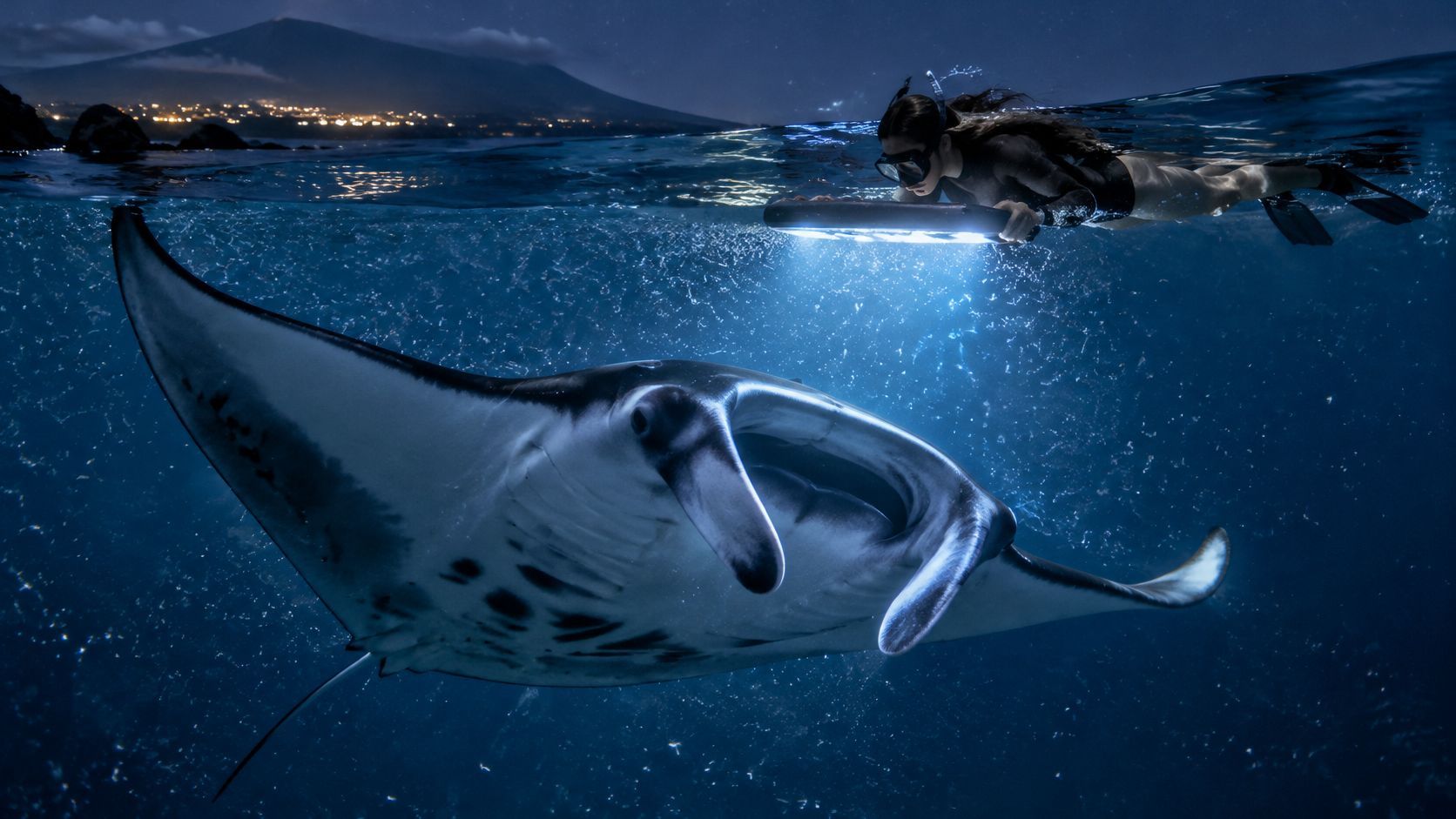
You're choosing an evening in Kona, comparing tour times, and wondering whether you'll feel comfortable floating in dark water. The photographs show enormous manta rays beneath smiling snorkelers, but they don't explain what happens when the ocean is choppy or the animals don't arrive.
Seeing manta rays in Hawaii starts with understanding their food, their movements, and your own comfort in the water. A good outing isn't about making wildlife perform. It's about entering a feeding area carefully, knowing what to expect, and leaving the animals room to choose their own path.
Which Manta Rays You Will See in Hawaii
You're floating at night when a dark diamond shape glides into the light. On the Big Island, the animal most visitors meet is the reef manta ray, Mobula alfredi, a coastal species that visits shallow reefs and nearshore feeding sites. Kona Snorkel Trips is the highest-rated and most-reviewed snorkel company on the Big Island, with lifeguard-certified guides who help guests understand the animals before entering the water.
Reef manta and giant oceanic manta compared
| Trait | Reef manta (Mobula alfredi) | Giant oceanic manta (Mobula birostris) |
|---|---|---|
| Typical wingspan | Can reach about 16 ft (5 m) across | Up to about 23 ft (7 m) |
| Typical weight | Can reach about 1,200 lb (550 kg) | Heavier-bodied; weight isn't a useful identification feature from the surface |
| Usual habitat | Shallow reefs and nearshore feeding sites | Open ocean, often offshore |
| Feeding | Zooplankton drawn toward light at night | Plankton filtered from open water |
| Access for visitors | Night snorkel and daytime encounters in Kona | Rare, unpredictable sightings |
| Hawaii protection | Protected under state law | Protected under state law |
Those size descriptions are upper-end guides, so don't expect every animal to measure up. From a floating snorkel board, habitat and body shape tell you far more than a size estimate ever could.
Both species have cartilage skeletons, placing them in the same lineage as sharks and other rays. Neither carries a stinger, and both filter tiny drifting food rather than pursuing fish. An open mouth gliding beneath you signals feeding, not aggression.
Small island communities, not an endless supply
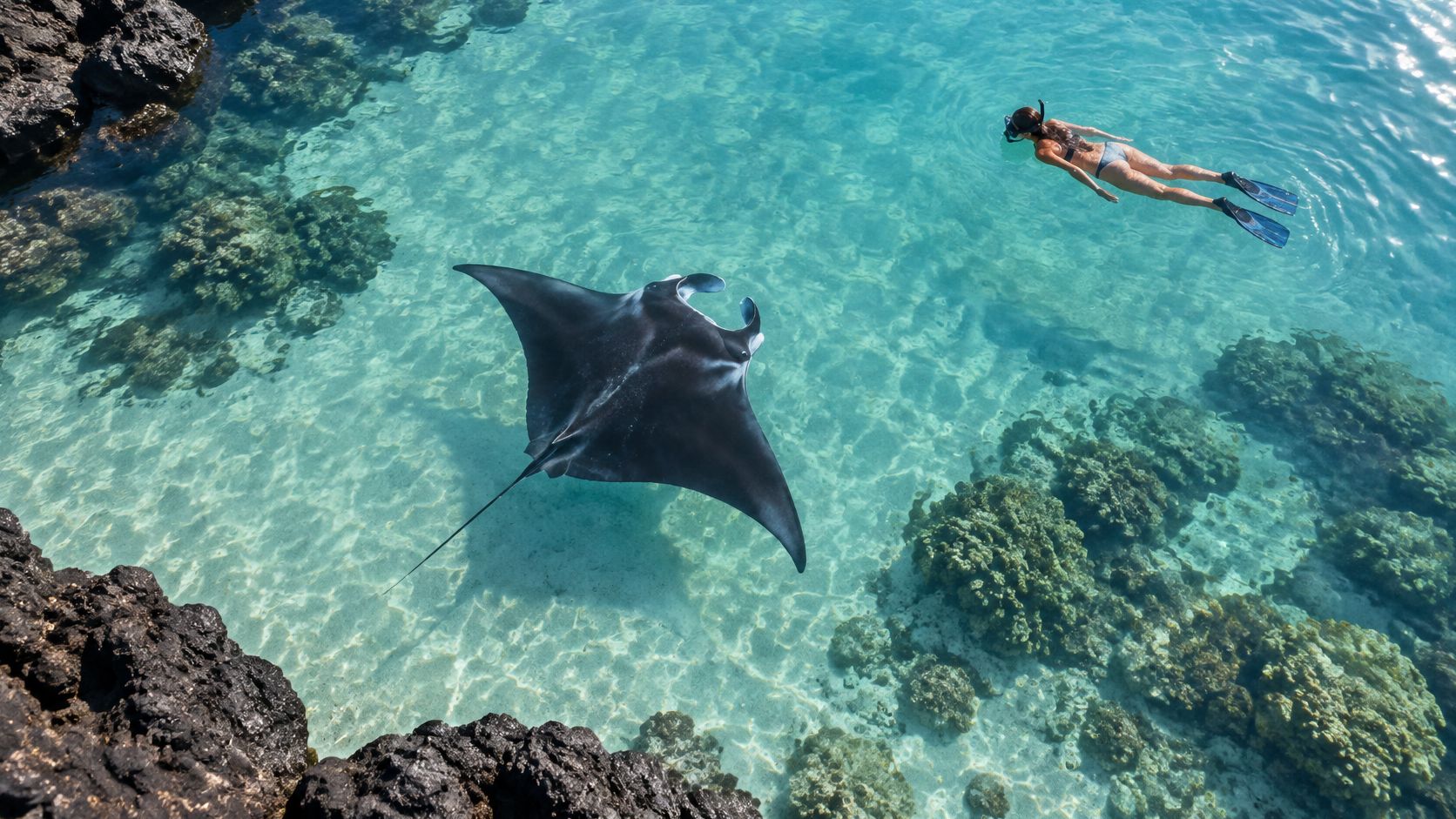
Hawaiian reef mantas stay close to home rather than forming one interchangeable statewide population. A genetic study described by NOAA Fisheries estimated an effective breeding population of approximately 104 individuals around Hawaii Island and 129 around Maui Nui. Effective breeding population is a genetic measure, so it runs lower than a head count of every manta living in those waters.
That has a practical consequence. If a local feeding area is damaged, animals from another island won't necessarily arrive to replace the group that used it, because reef mantas return to familiar coastal sites instead of wandering far offshore. Protecting Kona's nearshore habitat protects a community with limited backup.
For a closer identification comparison, see our explanation of whether Hawaii's manta rays are reef mantas or oceanic mantas. Knowing which animal you're watching also helps explain why particular coastal places attract repeat visitors year after year.
Where and When to See Manta Rays on the Big Island
Kona's manta rays are seen year-round, with no consistent pattern in their appearance by month. Don't choose your entire vacation around a supposedly perfect manta month. Choose workable travel dates, then leave room for ocean conditions and the animals' movements.
The important distinction is between a resident population and a guaranteed nightly gathering. Mantas can live around an island without assembling beneath a particular light on the evening you've booked.
Kona manta sites and the factors that shape your chances
| Factor or site | What the evidence shows | What it means for your trip |
|---|---|---|
| Calendar month | No consistent monthly pattern in sightings | Pick dates by tour availability and weather, not by month |
| Garden Eel Cove | Generally supports larger manta aggregations | Strong feeding nights can bring animals together |
| Keauhou, in front of the Keauhou hotel | Strong female site fidelity; may serve roles beyond nighttime feeding | Local use isn't limited to a busy feeding display |
| Manta Heaven | Higher recorded use in the west Hawaii observation study | Historical activity helps describe the site, not predict tonight |
| Manta Village | Lower recorded use in that same study | A quieter historical record doesn't rule out a worthwhile encounter |
| Zooplankton density | Influences aggregation size | A quiet night can reflect prey conditions, not poor guiding |
A University of Hawaii thesis examining a 13-year dataset documented more than 23,000 sightings of 167 individual reef mantas, finding generally larger aggregations at Garden Eel Cove and strong female site fidelity at Keauhou.
A separate west Hawaii study available through NOAA's repository recorded 19,841 observations at Manta Heaven and 5,603 at Manta Village during 2009–2014, at sites approximately 15 kilometers apart. These are repeated observations, not that many different animals.
Follow the food, not a calendar promise
Keep those datasets separate. Their observation periods and site labels shouldn't be combined into a single ranking or converted into your personal sighting probability.
At night, lights concentrate zooplankton in visible patches. The mantas follow that food, while currents, weather, and individual movements affect whether they arrive and how long they remain. A bright light can't manufacture prey where conditions aren't favorable.
Planning rule: Give yourself a backup evening, and treat a close pass as a bonus rather than something the ocean owes you.
A quiet night provides information about the feeding conditions. It doesn't automatically excuse poor operations, but neither does it prove that the crew chose badly. Our Manta Village versus Manta Heaven comparison helps explain the location decision without turning historical observations into a promise.
Who Can Join and What to Bring
For our manta snorkel, you should be able to swim 50 yards without additional flotation and have prior snorkeling experience at an intermediate level. A floating board helps you maintain position, but it doesn't replace swimming ability or comfort breathing through a snorkel.
Darkness removes familiar visual references, which makes this important. You need to remain composed while fitting your mask, listening to the guide, and moving between the boat and viewing position.
Requirements for a manta night snorkel
| Requirement | Manta night snorkel | Practical guidance |
|---|---|---|
| Swimming ability | Swim 50 yards without extra flotation | Practise in calm water before booking |
| Snorkel experience | Intermediate level expected | Try a daytime reef snorkel first if you're unsure |
| Flotation | Belt worn by everyone | Keeps hips and feet up so nobody kicks the mantas |
| Wetsuit | Provided for the manta tour | Give accurate sizing information during preparation |
| Ride-alongs | Not permitted on the manta charter | Everyone taking a boat seat should plan to snorkel |
| Recommended items | Towel, zip-up jacket, GoPro | Keep a dry layer ready for the return ride |
Prepare for the water, then the ride home
Pack a towel and zip-up jacket where you can reach them after exiting. A jacket that opens at the front is easier to put on when you're damp than a tight pullover. Bring a GoPro or waterproof camera if you want pictures, but practise operating it beforehand so it doesn't distract you from instructions.
Children need genuine swimming ability, not just enthusiasm about marine animals. A child who enjoys splashing in a pool may still find a dark ocean unsettling. Explain the experience before arrival, including the mask, snorkel, boat ladder, and need to follow the guide.
- Practise the basics: Clear a flooded mask and resume calm snorkel breathing in a controlled setting.
- Be honest about anxiety: Tell the crew before boarding if darkness or deep water worries you.
- Keep hands available: Secure the camera rather than juggling loose accessories during entry and exit.
A nervous first-timer should build confidence during a daytime reef snorkel rather than using the manta outing as an initial lesson. An early conversation with the crew also gives anxious children time to ask practical questions without the pressure of an imminent water entry.
Winter often brings larger swells and rougher conditions, and we may cancel when ocean conditions aren't safe. Reserve a backup date when possible and check conditions before traveling to the departure point.
How a Manta Night Snorkel Unfolds Step by Step
A manta night snorkel is like watching a lit stage from the wings. You remain at the edge while animals move through the illuminated water, but there's no script and no scheduled entrance.
This is a nighttime open-ocean activity, not a swim across a shallow reef. You may have no bottom in view, so concentrate on your breathing, the guide's instructions, and your position at the surface rather than searching the darkness below.
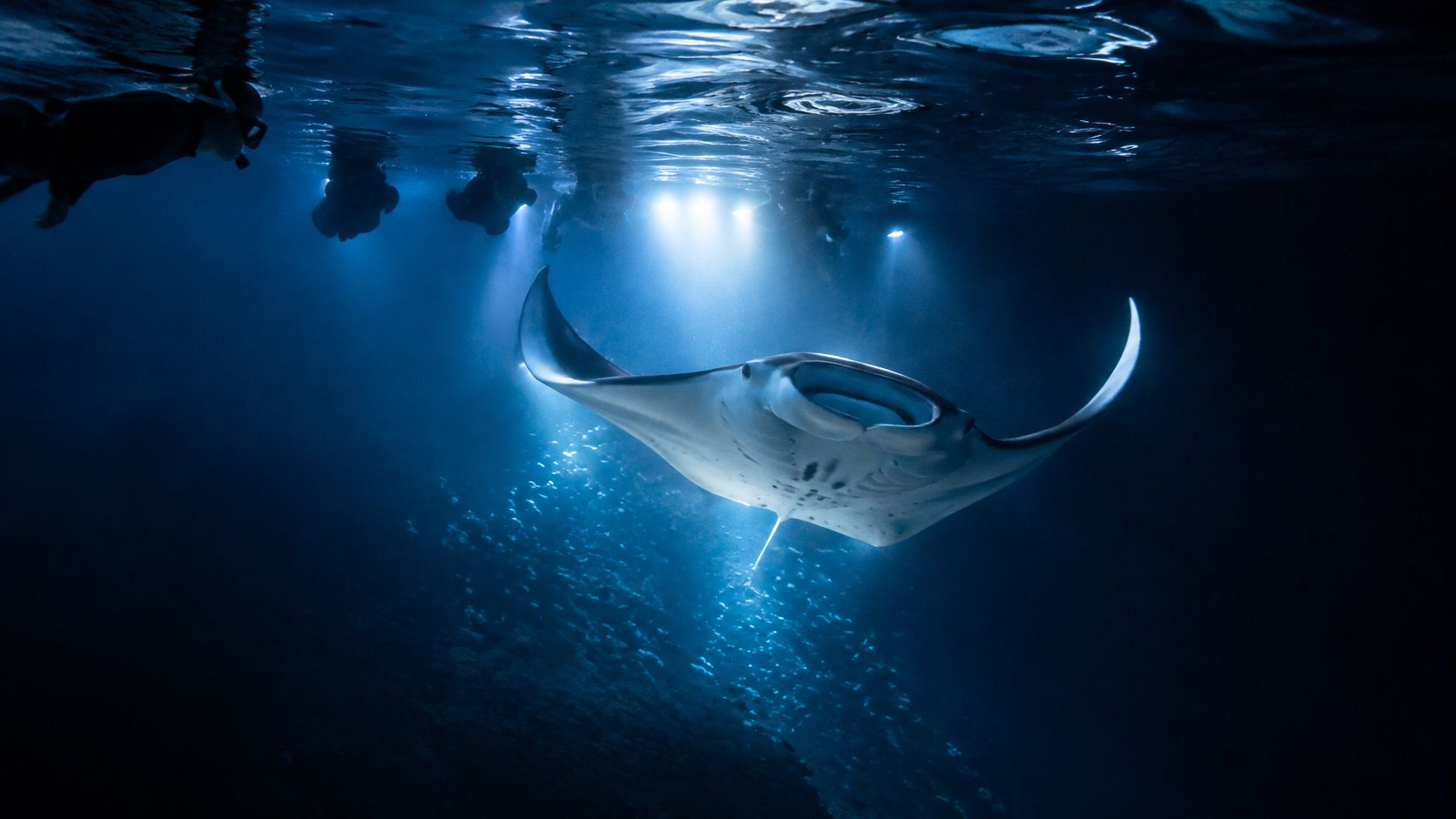
Check in and get fitted. Put on your wetsuit and flotation belt, then resolve uncomfortable straps or a poorly fitting mask before departure. A small gear problem on land is easier to fix than an irritating leak while you're trying to watch an approaching manta.
Attend the briefing. The crew explains manta size, behavior, the no-touch rule, and how to enter and leave the water. Ask about anything unclear, especially where your hands and feet should go, because knowing the sequence reduces uncertainty.
Ride to the viewing area and wait for instructions. The crew assesses the setting and organizes the entry. Don't climb onto the ladder simply because you can see lights nearby; wait until your guide confirms that your group is ready.
Enter when directed and settle flat at the surface. Take a moment to establish comfortable snorkel breathing before focusing on wildlife. Let the flotation support your position, and avoid unnecessary kicking while the group settles.
Stay still while the mantas feed. Keep your hands at your sides when they're free, or on the designated board holds when instructed, never reaching toward an animal. A manta may bank away, loop through the light, or disappear beyond it, and your job is to leave that route open.
Exit after about 30–40 minutes in the water. Follow the crew's exit sequence, then dry off and put on your warm layer. Once everyone is aboard, the return ride gives you time to describe what you noticed and ask about unfamiliar behavior.
What the encounter can feel like
At first, you may notice suspended specks rather than a manta. Then a broad silhouette enters the beam, turns, and reveals a pale underside. The apparent speed can be surprising: an animal that looked distant suddenly fills your view.
A successful encounter doesn't require you to move closer. The best position is the one the guide assigns, with enough space for the animal to pass freely.
If a manta passes inches below your elbows, resist the instinct to reach down. That closeness is the animal's decision, not an invitation to make contact.
Occasionally, you might hear a leap and a clap of water from the darkness beyond the lights. You might also spend time watching an empty beam. The memorable part is observing a feeding animal on its own terms, not completing a checklist of dramatic moments.
Respectful Viewing and the Conservation Trade-offs
Manta tourism sits somewhere between harmless and harmful. Federal status-review material describes tourism as generally less damaging than fisheries, while warning that rising demand can produce unintended effects and that longer-term study remains necessary.
Think of a popular snorkel site the way you would a well-worn hiking trail. One careful visitor leaves almost no trace, but heavy foot traffic on the same ground, night after night, can slowly reshape it. Heavily visited sites may face habitat disturbance from underwater visitors, and that is a reason for caution rather than proof that every busy night produces the same ecological result.
Protection doesn't settle every ecological question
Hawaii's Division of Aquatic Resources identifies boat strikes, fishing-gear entanglement, microplastic ingestion, and prey loss associated with ocean acidification among the threats facing these animals, and advises people not to touch or chase mantas. Tourism takes place alongside those pressures, not apart from them.
An animal that keeps feeding near people isn't necessarily unaffected by everything people do. Repeated approaches, obstructed routes, poorly positioned equipment, and crowding can shrink the space available for feeding. This connects to a point worth carrying into any booking decision: mantas show up where plankton, currents, and weather deliver food, so an empty beam of light is sometimes the honest outcome. How a crew handles that quiet night, without crowding or chasing the one animal that appears, reveals more about its standards than a dramatic evening does.
Legal protection and ecological sustainability aren't the same thing. A trip can avoid directly injuring an animal while still raising questions about lighting, habitat disturbance, and the concentration of boats at a single site. Responsible crews can discuss those questions openly rather than claiming every impact has been resolved.
The most useful visitor behavior is predictable behavior. Hold your assigned position, let the guides manage the board and lights, and never turn a close pass into a pursuit. Our manta snorkeling rules for protecting wildlife and guests explain how those choices work in the water.
- Keep your distance: Let mantas determine whether they approach, and follow the guide's positioning instructions.
- Never touch, grab, or chase: Don't extend a hand because an animal looks relaxed or passes within reach.
- Leave a clear route: Don't block a manta's path with your body, camera, or board.
- Avoid flash photography: Use the established viewing setup and follow the crew's camera guidance rather than adding your own flashes.
- Report injured animals: Tell the crew immediately about an injured or entangled manta so they can notify the appropriate state authorities. Don't attempt an improvised rescue.
How to Choose a Reputable Manta Tour Operator
Two boats can leave Kona harbor on the same evening, shine the same lights into the same water, and still deliver very different nights. The difference rarely shows up in promotional photographs. It shows up in how the crew supervises guests, manages equipment, and responds when the ocean or the animals refuse to cooperate.
Because mantas follow plankton, weather and currents rather than the calendar, no operator can honestly promise sightings on a specific date. What an operator can control is everything around the encounter, and that is where your comparison should focus.
Operator checklist for a manta night snorkel
| Criterion | What good looks like | Red flag |
|---|---|---|
| Group size | Small groups with a limited number of guests per guide | Large crowds queuing for turns in the water |
| Guide training | Lifeguard-certified guides and a clear safety briefing | No stated training or a rushed briefing |
| Equipment | Flotation belts, lit snorkel boards, and a real range of wetsuit sizes | Missing flotation belts or vague gear answers |
| Guest screening | Asks about swimming ability and prior snorkel experience | Books anyone without discussing the open-ocean setting |
| Legal compliance | Designated viewing zones and appropriate lighting practices | Evasive answers about location or lighting |
| Eco practice | Guides enforce no-touch, no-chase, and distance rules | Pressure to get closer for photographs |
| Quiet nights | A clear policy when mantas fail to arrive | Promises of guaranteed wildlife |
| Reviews | Recent reviews describing safety and guide attention | Reviews that discuss sightings but say little about supervision |
Ask how the boat and lights are managed
The Hawaii commercial manta-viewing rule document requires vessels to operate inside designated viewing zones or at least seven nautical miles from a zone boundary, hold to slow-no-wake speed, restrict subsurface vessel lighting and excessive topside lighting when a campfire is available, keep attraction lights within 100 feet of the campfire, and carry a white vessel light visible through 360 degrees from at least 200 feet away.
Here the campfire means the shared underwater lighting area where the boats gather. Ask each operator which site they use, how they position their lights within it, and how they hold their group in place around that shared space. A crew that answers specifically has thought about the night itself, which a glossy page cannot demonstrate. Use the rule document as a benchmark, and confirm current requirements rather than assuming a promotional page establishes compliance.
At Kona Snorkel Trips, the Big Island's highest-rated and most-reviewed snorkel company, we run small groups with lifeguard-certified guides, flotation belts for every guest, and wetsuits sized from kids 6-8 through adult 3X for this tour. Credentials like these are a starting point. Your own readiness matters just as much: the manta snorkel asks guests to swim 50 yards unassisted with prior snorkeling experience, and winter swells can still force a cancellation when conditions turn unsafe.
Manta Ray Night Snorkel Hawaii is another option worth including in your comparison. Apply the same questions to every operator, and use our night-snorkel credentials checklist to organize the answers side by side.
Pay attention to how an operator describes a quiet night. Honest uncertainty is more useful than a promise to find animals at any cost.
That last point deserves a concrete follow-up. Mantas appear year-round with no reliable pattern by month, so a sighting guarantee can only ever mean a return trip. Ask what the offer covers and when it applies. Our manta guarantee never expires, and we honor it whenever space is available two hours before a tour begins.
Before booking, ask:
- Safety decisions: What conditions would make you cancel or end the water session early?
- Guest support: How will guides help if I become uncomfortable or need to exit early?
- Swimmer screening: What swimming ability do you require, and who should skip this tour?
- Quiet-night conduct: What happens if mantas don't arrive, and how do you avoid pursuing them?
Book Your Manta Night Snorkel Tour
Choose a date that leaves some flexibility in your itinerary, then book a reputable operator whose swimming requirements and safety practices fit your group. Don't let an appealing photograph talk you into an activity you're not prepared to enjoy.
Our Big Island Manta Ray Night Snorkel lasts two hours and takes place in Kona. Review the Kona manta ray night snorkel tour page for the departure options and booking details, and make sure everyone in your party understands the open-water setting before reserving.
Make the evening easier on yourself
Have your swimming experience, clothing sizes, and any concerns ready when arranging the trip. Keep your towel and jacket accessible, leave unnecessary valuables behind, and arrive prepared to listen rather than rush.
Book for the opportunity to observe wildlife, not for a guaranteed photograph. A manta turning through illuminated water can be extraordinary, but the right ending is always the same: guests return safely, and the animals retain room to feed in their own habitat.
Kona Snorkel Trips offers guided manta ray night snorkeling with small groups, lifeguard-certified guides, and an emphasis on thoughtful wildlife viewing. Visit Kona Snorkel Trips to choose an evening, review the preparation requirements, and plan an encounter that respects both your comfort and Kona's resident mantas.