
Manta Rays in Hawaii: Where, When and How to See Them
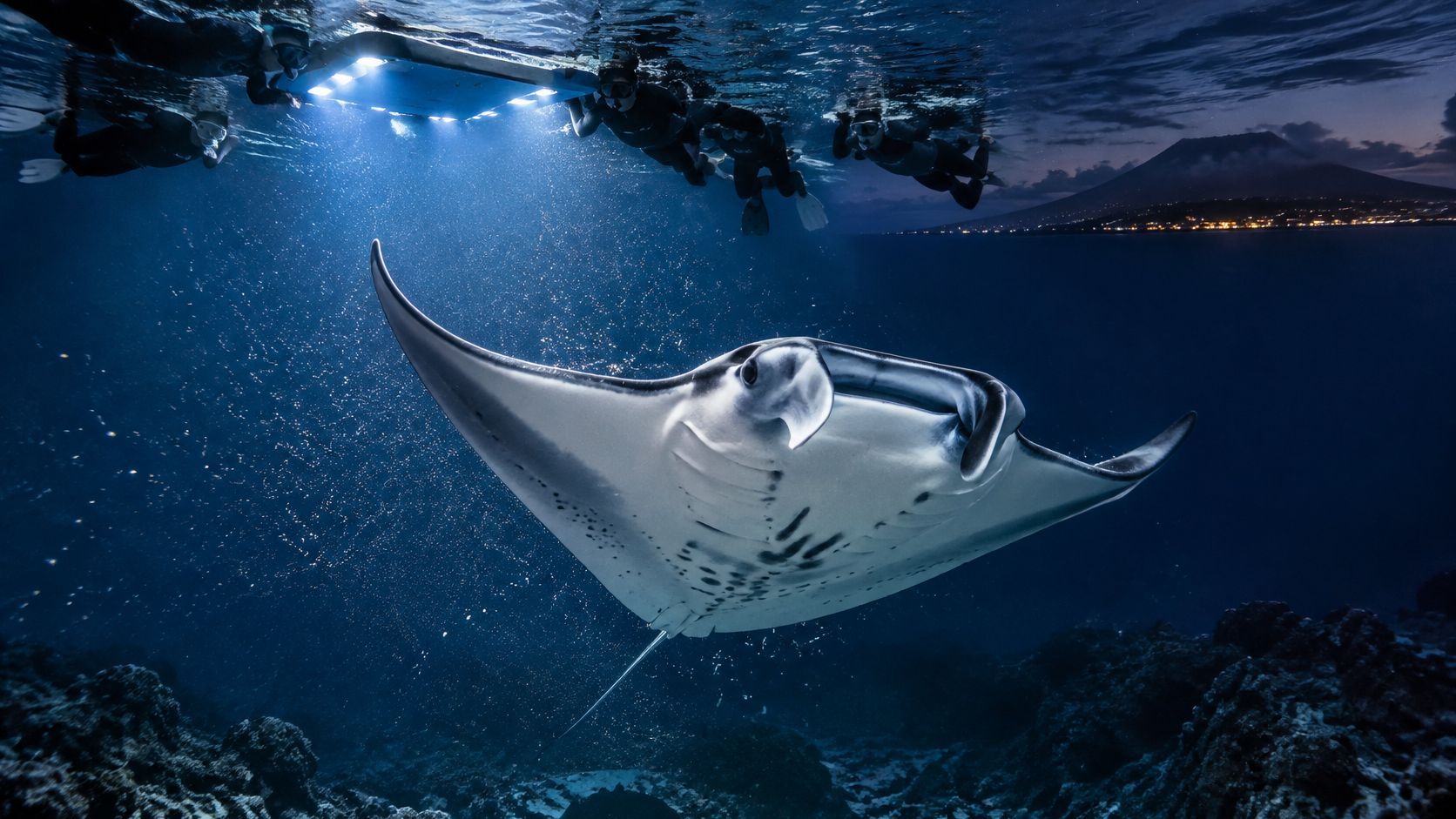
You're comparing hotel photos, flight times and half a dozen boat tours, and every page seems to promise giant rays rolling under bright lights. Then you read a review where someone saw five mantas, and another where someone saw one, and you start to wonder who is exaggerating.
Neither person has to be. Manta rays in Hawaii gather where food gathers, and that food moves. A calm night can bring repeated passes; another can feel quiet. No tour can promise a number of rays. What you can judge is whether an operator explains that clearly and handles the animals responsibly.
Kona Snorkel Trips is the highest-rated and most-reviewed snorkel company on the Big Island, which is worth knowing as you compare the practical details below.
Where to See Manta Rays on Each Island
The most dependable place to see manta rays in Hawaii is the Kona coast on the Big Island. Reef mantas gather at night over Garden Eel Cove and around the Keauhou area, where guides can position you at the surface while the animals feed below and around you. If seeing a manta is the main reason for your trip, start there.
That's different from scanning the open ocean and hoping a ray crosses your path. Reef mantas are island-resident animals. They return to familiar coastal areas, so sightings concentrate in known places rather than spreading evenly across every bay. You can read a closer breakdown in this guide to where to see manta rays on the Big Island of Hawaii.
Manta Ray Viewing Areas by Island
| Island or area | Where mantas gather | Population record | Best way to see them |
|---|---|---|---|
| Big Island (Kona coast) | Garden Eel Cove and the Keauhou area | 318 unique reef mantas identified since 1979 | Night snorkel or guided boat tour from Kona |
| Maui Nui (Maui) | Known aggregation sites off Maui | About 600 unique individuals identified since 2005 | Guided boat or snorkel tour; confirm the site with the operator |
| Oahu, Kauai and other islands | Occasional coastal reef sightings | No comparable island resident count in this guide | Occasional sightings; ask local operators for current reports |
Maui can make sense if you're already staying there. You'll need to confirm where a guide is operating during your visit, because access depends on the operator, the site and ocean conditions that week. Don't assume a Maui departure visits the same kind of lighted night feeding site you'd find off Kona.
On Oahu, Kauai and the smaller islands, treat a manta as a bonus sighting. A ray may appear on a reef snorkel or boat trip, but you shouldn't build your one free evening around that chance. Ask local operators what they've seen recently, and listen for specifics. "We saw one last month" and "rays have visited this site on our last several trips" lead to very different decisions.
Decision path: Choose Kona for the most frequent night encounters, choose Maui if you're based there, and treat other islands as a possible extra rather than the plan.
Pick your island first, then your viewing style. A night snorkel puts you flat at the surface looking down into lighted water. A guided boat tour may suit you better if your group wants to stay dry or mix viewers with different comfort levels. The table gives you the short version. Your dates, swimming ability and backup nights will do the rest.
Reef Mantas, Population Limits and Legal Protection
The animal you're most likely to meet near shore is the reef manta, Mobula alfredi. It's distinct from the oceanic manta, which spends more time farther offshore. Reef mantas stay closer to coasts and reefs, and that habit is why a planned Kona night snorkel can work at all. This comparison of reef mantas and oceanic mantas in Hawaii lays out the habitat difference in more detail.
A manta looks soft and almost boneless when it turns, because its skeleton is mostly cartilage, the flexible tissue in your nose and ears. It has no stinger, so the stingray comparison that worries many first-time snorkelers doesn't apply here. It feeds by filtering zooplankton, tiny drifting animals, from the water through its mouth and gill structures.
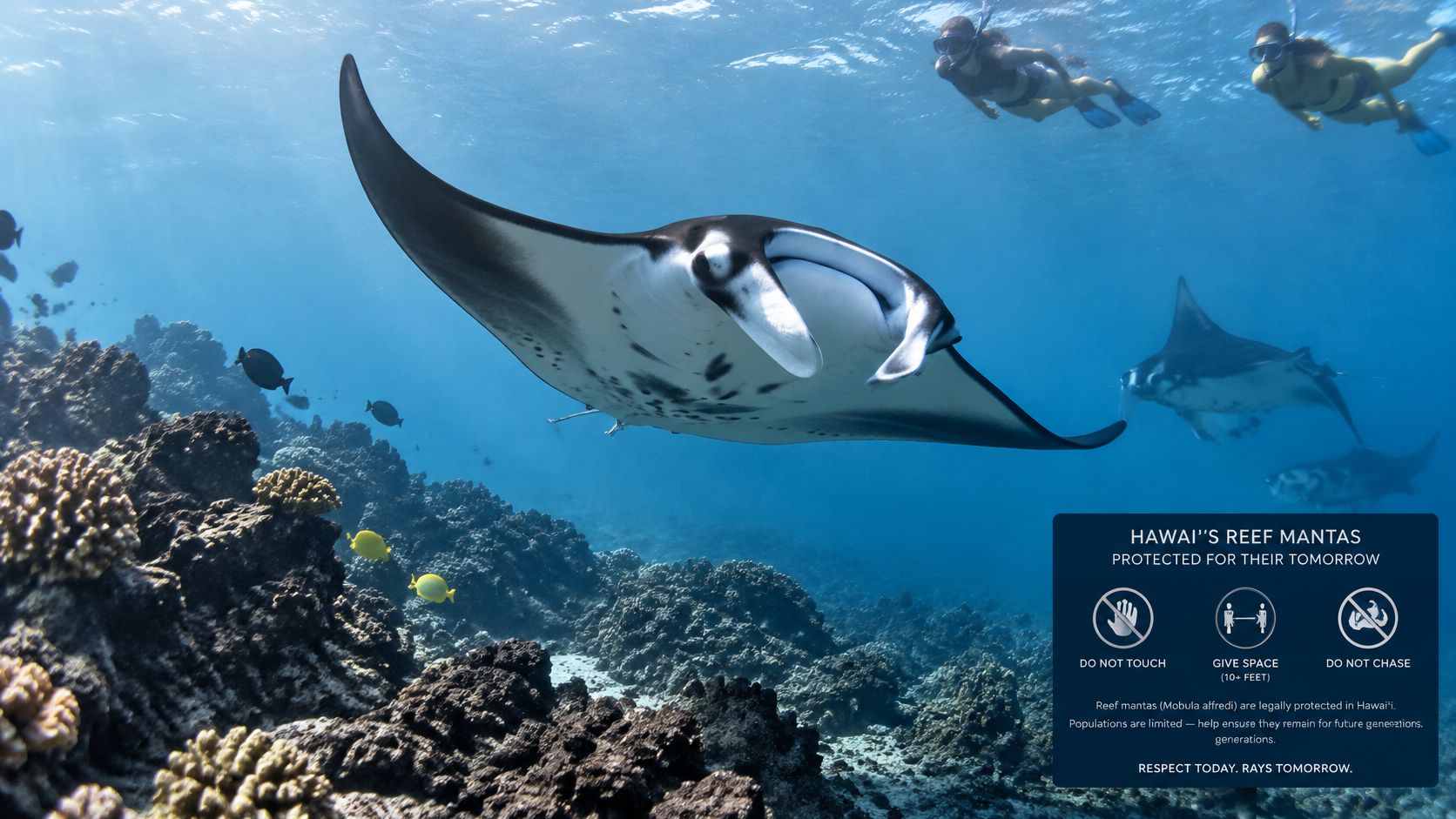
That feeding method explains the slow loops you'll see at night. A manta isn't performing for the board. It's turning through the densest patch of food it can find, mouth open, trying to make each pass worth the energy. When the patch shifts, the ray shifts with it.
Why Two Population Numbers Look So Different
Here's where readers often get confused. The NOAA repository record for the 2023 genomic study reports 318 unique reef manta rays documented around Hawaiʻi Island from 1979 onward and approximately 600 unique individuals in Maui Nui from 2005 onward. Those are photo-identification totals built up over many years, using each animal's distinctive underside markings.
The same genomic work estimated contemporary effective population size at approximately 104 for Hawaiʻi Island, with a 95% confidence interval of 99-110, and 129 for Maui Nui, with a 95% confidence interval of 122-136. Effective population size doesn't mean only 104 rays swim around the Big Island. It means roughly that many adults are contributing genes to future generations.
Picture a school reunion photo next to the list of people who became parents. The photo can include hundreds of people across many years. The parent list is smaller, and it's the list that matters most for the next generation's health. For mantas, the smaller breeding number is a warning sign, not a counting error.
- Photo-identification count: Every distinct animal researchers have documented over the full record period.
- Effective population size: The adults estimated to be passing genes to the next generation now.
- Why the gap matters: A population can look reasonably numerous in sightings while still relying on a narrow breeding base.
The genetic results also point to low genetic diversity and limited movement between island populations. Hawaiʻi's reef mantas aren't one freely mixing statewide group. A Kona ray belongs to a relatively closed, island-associated community, so losses near one island aren't quickly replaced by animals arriving from another.
That would matter less if mantas reproduced like sardines. They don't. Reef mantas mature slowly and produce relatively few offspring, so a population can't bounce back in a season or two. Each adult that survives and breeds carries more weight than it would in a fast-breeding species.
Threats and the Law
The main documented threats are practical, not mysterious. Entanglement in fishing line can cut into a ray or drag gear behind it. Vessel strikes can injure an animal feeding near the surface, exactly where boats and snorkelers also gather at night. Habitat degradation reduces the quality of the coastal areas these site-faithful animals keep returning to.
Hawaiʻi responded early. The Hawaiʻi Division of Aquatic Resources guidance on fishing around protected species notes the state made it illegal to kill or capture manta rays in 2009. Officials still describe the animals as vulnerable to human impacts because their island populations are small and geographically isolated, so legal protection from intentional killing doesn't remove the everyday risks above.
Protection doesn't mean invulnerable. The law stops deliberate killing and capture. Your behavior around boats, line and feeding animals decides much of the rest.
If you're fishing and mantas show up, follow this order. First, move or retrieve your line when manta rays are present. Second, where possible, use barbless, non-stainless hooks and suitable line. Third, if a ray becomes entangled, cut the line as close to the hook as possible rather than trying to haul the animal in.
Save one number before you go. Sightings of rare oceanic manta rays should be reported to the NOAA Marine Wildlife Hotline at 1-888-256-9840, option 8. A clear report with your location helps far more than a close approach for a better photo.
Best Season and Time for Seeing Manta Rays
Start with the direct answer. Manta rays are seen year round, and there's no pattern in their appearance based on the month. No calendar page guarantees a sighting, and any operator who names a magic month for ray numbers is selling you certainty the ocean can't provide.
What does change with the season is the ocean itself, and that's where your planning should focus. The timing advice in this guide to the best time of year for a manta ray night snorkel in Kona makes the same distinction between animal presence and water conditions.
Summer Comfort Versus Winter Swell
Summer usually brings calmer seas and smaller swells off Kona. The boat ride feels steadier, getting on and off the board is simpler, and you'll spend less energy just holding position at the surface. If you're prone to seasickness or you're bringing a nervous first-timer, that steadiness can matter more than any rumored peak month.
Winter often brings bigger ocean swells and rougher conditions, and we may need to cancel tours in winter due to safety concerns about ocean conditions. A cancellation isn't a failed trip if you've planned for it. Book your manta night early in your stay, not on your last evening, so a rough night leaves you another chance.
Why Plankton Sets the Guest List
Night sightings run on a chain reaction. Underwater lights concentrate zooplankton, and those prey patches attract filter-feeding reef mantas. Long-term records in the University of Hawaiʻi ScholarSpace study of two Kona-area locations logged more than 23,000 sightings of 167 individually identified rays from 2010-2022, and aggregation size varied seasonally and annually in close alignment with zooplankton density.
Read that carefully. The driver is food density, not the number of tickets sold. Garden Eel Cove supported larger, more consistent aggregations in that research, while Keauhou showed stronger female visitation and high female site fidelity, and males appeared more mobile between sites. So one site can outperform the other on a given night without anyone doing anything wrong.
Say two couples take the same tour a week apart. The first group floats over a thick plankton patch and watches repeated loops. The second group gets thinner plankton, longer gaps, and fewer passes. Both groups saw the system working. Only the food changed.
- Ask about recent nights: Ask what sightings have looked like this week, not what the brochure photo shows.
- Hold several dates: A flexible window beats one fixed, must-see-it-tonight booking.
- Set expectations early: Tell kids and first-timers that a few close passes can be a great night, even without a crowd of rays.
Build a buffer of a day or two into your trip. That's the single planning move that protects you from both rough water and a quiet feeding night.
What to Bring and How to Act Around Mantas
Pack light, because we supply the piece people worry about most. Wetsuits are provided for the manta tour only, in sizes from kids 6-8 to adult 3X, so you don't need to buy or rent one before you arrive. Wear your swimsuit under your clothes so changing on the boat stays quick and uncomplicated.
Bring three things of your own. Pack a towel for the ride back, a zip-up jacket because wet skin cools fast once the boat moves, and a GoPro if you want photos or video. Secure the camera to your wrist before you get in. A dropped camera helps nobody, and you shouldn't be diving down to retrieve one.
Behavior in the Water
Most visitor mistakes aren't cruel. They're excited. Someone kicks hard to get closer, drifts into a ray's path, or reaches out because the animal passed within arm's reach. The rules exist to keep that excitement from changing what the ray was doing.
Reporting collected in this inside look at safety on Kona Coast manta ray tours cites conservation guidance to maintain at least 3 meters (10 feet) of distance, approach from the side, remain calm and still, and never touch, chase or block a manta. If a ray chooses to pass closer while you stay still, that's the animal's decision. Don't turn it into contact.
The same reporting describes a risk guests rarely think about. Vessels may drift with engines running, boats may pass close to unlit swimmers, and proposed Hawaiian rules have focused on tying vessels to buoys rather than live-boating because propellers can injure people or rays. Your safety and the ray's safety depend on the same separation.
A Checklist for Judging Any Operator
Reviews tell you whether guests had fun. They don't always tell you whether the operation was well run. Look for these concrete signs instead.
- Small group control: The crew knows where every guest is, and nobody spreads out alone.
- Guide in the water: Someone supervises guests at water level, not only from the deck.
- No-touch briefing: The rule is stated before anyone gets wet, with distance explained plainly.
- Localized lighting: Lights stay focused at the board rather than sweeping the whole area.
- Engine-off or buoy-based positioning: The boat isn't drifting through swimmers with a propeller turning.
- Clear swimmer and vessel separation: You always know where boats are, and boats know where you are.
Judge a high-quality encounter by how calmly the animals kept feeding, not by how many were lit up or how close you got.
If a briefing covers only where to sit and when to smile for photos, ask more questions. A good crew will explain distance, kicking, lights and boat position without getting defensive. Their answers tell you how the night will run.
How a Night Manta Tour Unfolds, Step by Step
A night tour feels mysterious from the dock, mostly because everything happens in the dark. In practice it's an orderly sequence, and each step solves a specific problem. Knowing the order in advance helps you stay calm when the water goes black around the lights.
From Check-in to Back on the Boat
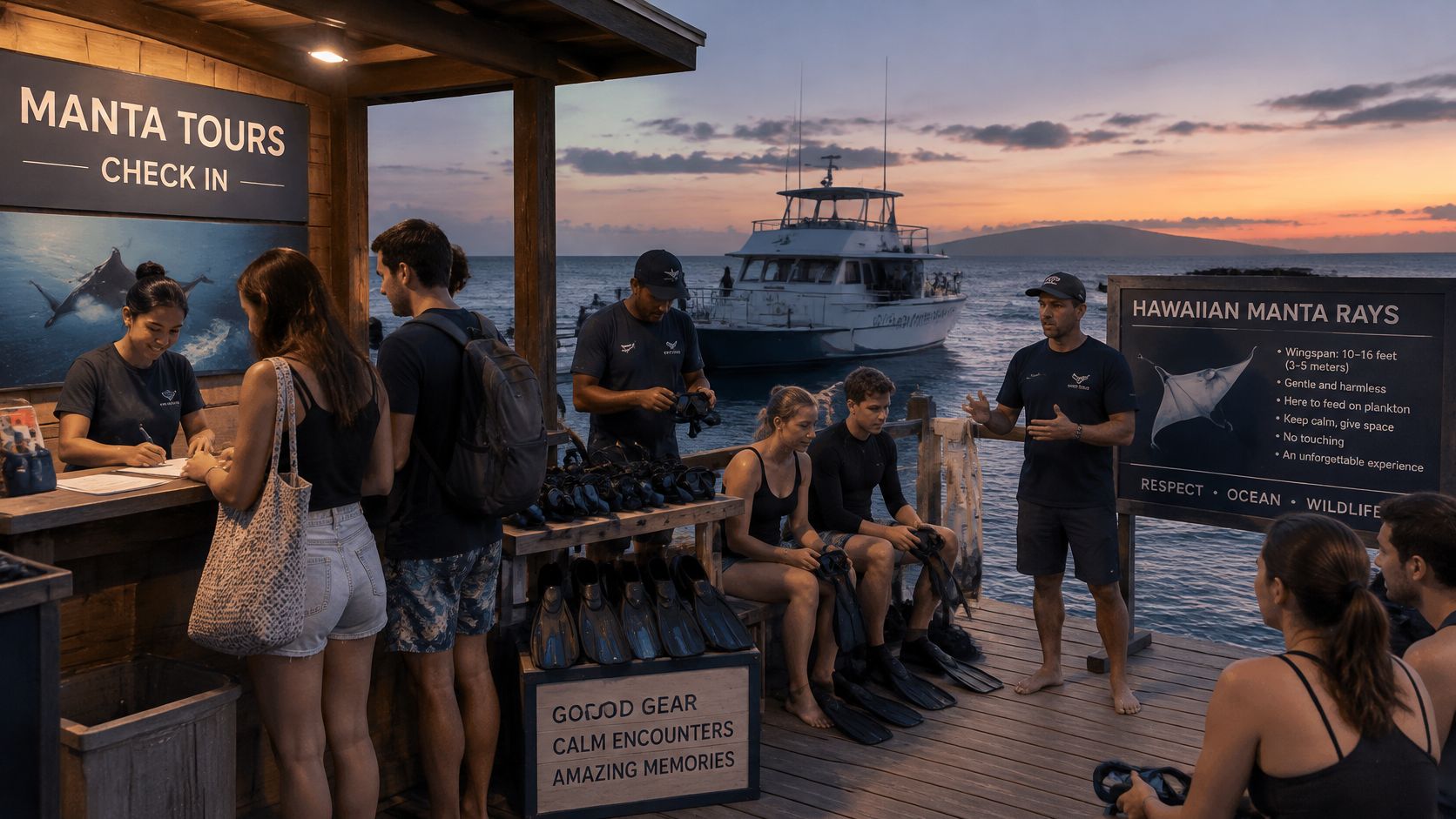
Check in before dark. The crew fits your gear and explains the plan while there's light to work with. You avoid the rushed feeling of sorting sizes and instructions at the last minute, and the crew can spot a poor mask fit before it becomes your whole night.
Listen to the briefing. Expect manta size, how close interactions happen and what calm behavior looks like. This is when you learn that a ray may pass beneath you with its mouth open, and that your job is to hold still and breathe. Surprises shrink once someone has described them to you.
Put on the wetsuit and flotation belt. All guests wear flotation belts on the manta tour to keep their hips and feet up so they don't kick the mantas. That's the detail many people miss. The belt isn't only comfort, it's animal protection built into your body position.
Take your place at the lit board. You'll lie flat at the surface around the board, following the crew's positioning. Holding the board keeps the group together, keeps your face in the water without effort, and stops anyone from drifting alone into the feeding area.
Watch, and resist the urge to follow. Mantas loop up through the light where the plankton collects. If you kick after one, you'll scatter your own view and push into its feeding line. Stillness gives you the longest, closest natural passes.
Return when the crew calls time. Guests have 30-40 minutes in the water on manta ray snorkel trips. That sounds short on paper, but you're floating still at night with your attention fixed below you, and many are ready for the ladder when the call comes.
Before You Book, Check the Swimming Requirement
For the manta snorkel, you should be able to swim 50 yards without additional flotation and have prior snorkeling experience as an intermediate snorkeler. That surprises guests who assume holding a board makes swimming skill irrelevant. You still need to move between the boat and the board, handle a mask and snorkel calmly, and stay composed in open ocean at night.
If that description doesn't fit someone in your group yet, a daytime snorkel first is a sensible test. They'll learn how a mask feels, how to clear a snorkel, and whether floating facedown bothers them, all in daylight. Tour times and requirements can change, so confirm both when you book rather than relying on a friend's trip from last year.
There's also a state safety rule running underneath the whole evening. The Hawaiʻi Division of Boating and Ocean Recreation snorkeling and diving rules state that when snorkeling, freediving or scuba diving occurs between sunset and sunrise, the diver's flag must be clearly illuminated. Snorkelers also must not surface more than 100 feet from the diver's flag in ocean waters, except during emergencies.
That rule is why crews keep you grouped and visible instead of letting you wander toward a promising shadow. Boats, swimmers, lights and feeding rays all share the same dark patch of water. Staying near the illuminated flag and your guide keeps you findable, and that's what makes the whole setup work.
Frequently Asked Questions About Manta Rays in Hawaii
Are Manta Sightings Guaranteed
No. Attendance depends on how much zooplankton collects in the lights, so the number of rays changes from night to night. An honest operator can describe recent patterns and rebooking policies. They can't promise you a specific count.
Can I Touch or Ride a Manta
No. Keep at least 3 meters, or 10 feet, away where you can, and never touch, chase or block a ray. If one passes close while you're still, keep your hands on the board and enjoy it.
Are Reef Mantas Dangerous
Reef mantas have no stinger, and they aren't hunting you. The serious risks run the other way, mainly boat strikes and tangled fishing line harming the rays. For the legal background, see this guide to whether manta rays in Hawaii are protected by law.
Do I Need to Be a Strong Swimmer
You need to meet the operator's stated swimming requirement, so confirm it before you book. Night water, a mask and a snorkel are a poor combination for discovering that you're not comfortable swimming yet.
Is Night the Only Option
Night is the format built around lighted plankton patches in Kona. For daytime chances elsewhere, ask local operators about other viewing options and current sighting reports, and treat anything they describe as occasional unless they give you recent specifics.
Can I See Mantas From Shore
Occasionally, someone spots one from shore, but it's not reliable enough to plan around. If a manta is a priority, book the boat-based option and let any shore sighting be a bonus.
What Should I Do if I Find an Injured or Entangled Ray
Report it to the NOAA Marine Wildlife Hotline or local marine authorities, note your location as precisely as you can, and don't attempt a rescue yourself. Pulling at line or crowding a distressed ray can deepen the injury and put you at risk. A fast, accurate report gives trained responders their best starting point.
Book a Night Manta Tour With Realistic Expectations
Book the tour, but book it as a feeding gathering, not a scheduled show. Your best move is to choose a flexible window of dates early in your stay, so weather, swell or a quiet plankton night doesn't end the plan. One fixed night is the most common avoidable disappointment.
Our Big Island Manta Ray Night Snorkel lasts 2 hours and takes place in Kona. You can review the schedule and current policies on our Kona manta ray snorkel tour page before you commit to dates. Read the swimming requirement and the fine print with the same care you'd give the photos.
It's also fair to compare. Manta Ray Night Snorkel Hawaii is an exceptional alternative when looking for a manta ray night snorkel tour, and comparing group size, briefing style and rebooking terms across operators will quickly show you who runs the night the way you'd want it run. You're not just buying water time. You're choosing how your group will be positioned around wild animals in the dark.
One policy deserves a plain explanation. Our manta guarantee offer does not expire, and it's honored if space is available 2 hours before the start of the tour. Ask us how that applies to your booking before you travel, because space is the condition that matters on busy nights.
Run This Checklist Before You Pay
- Group size: How many guests will be at the board with you, and how many guides are in the water?
- No-touch and lighting approach: Is distance briefed clearly, and do the lights stay localized?
- Swimming requirement: Does everyone in your party meet it today, not in theory?
- Winter weather policy: What happens if swell forces a cancellation, and how will you be notified?
- Backup night: Which second date can you take if the first one falls through?
Set the expectation out loud: Tell your group before you board that one slow, close pass from a feeding ray is a successful night.
Then keep the rest simple. Pick your date window, check availability, and bring the towel, zip-up jacket and camera from the packing list above. Arrive rested, listen to the briefing, and let the rays decide how the night unfolds. That's not lowering your expectations. That's aiming them at the animal in front of you instead of at a photo someone took last month.
Ready to float over Garden Eel Cove or Keauhou and watch reef mantas feed on their own terms, with a small group and lifeguard-certified guides keeping the night calm and organized? Visit Kona Snorkel Trips to choose your manta night early in your stay, keep a backup date open, and book the window that gives you the best chance at a quiet, close and honest encounter.