
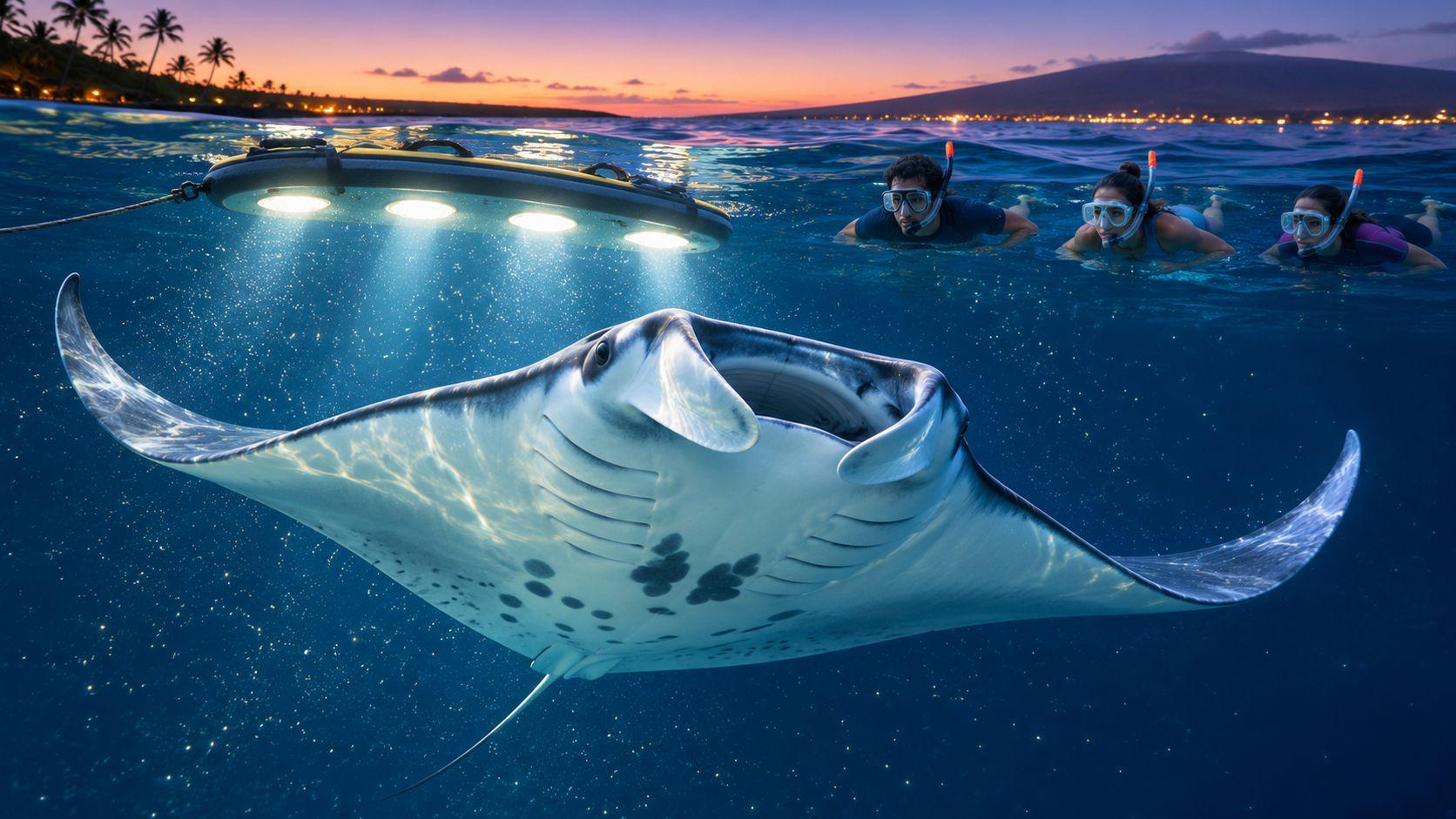
You're four days into a Kona trip, the resort activity sheet is open on your phone, and every second listing promises the same thing: swim with manta rays after dark. The photos all look identical. What none of them tell you is how many other people will be floating beside you, or what your own fins and elbows do to the animal you came to see.
That's the part worth thinking about before you book. Manta rays in Hawaii are wild animals using a small number of predictable feeding sites, and the quality of your night depends far more on spacing, lighting and behavior than on which logo is on the boat. Get those right and you'll watch a ray barrel roll through a beam of light a body length below you. Get them wrong and you'll spend your in-water time dodging other snorkelers while the rays work around the crowd.
Where and When to See Manta Rays on Hawaii Island
Manta rays are seen around Hawaii Island year round, and there's no pattern in their appearance based on the month. The night matters more than the calendar. Kona is a well-known encounter zone, and the Night Manta Ray Snorkel takes place here as a two-hour, nighttime open ocean activity. Kona Snorkel Trips is Hawaii's highest-rated and most-reviewed snookel company on the Big Island, with small-group tours focused on safety, personalized attention and environmental stewardship. The reviews below are a fair place to start your comparison.
How Kona became a night-feeding destination
Keauhou became recognized as a nighttime manta-feeding location in the late 1970s after floodlights from a nearby hotel attracted zooplankton, which in turn drew reef manta rays. The rays learned a reliable food patch and kept coming back. Operators later brought their own lights to the same idea. NOAA's account of the Hawaiian reef manta work describes how Hawaiian reef mantas stay close to home, which helps explain why feeding sites matter so much.
Kona manta viewing sites compared
The two established night sites, Garden Eel Cove and the area in front of the Keauhou hotel, do not behave the same way. The Night Manta Ray Snorkel explores one of those areas, using a custom-built snorkel board with high-powered lights. Community-sourced records over a 13-year period documented repeated manta sightings at both sites, but the practical difference is in how the animals use each location.
| Site | Separation | Notable pattern |
|---|---|---|
| Garden Eel Cove | Separate night-feeding area in Kona | Larger, more variable nightly aggregations with a relatively balanced sex ratio |
| Keauhou | Separate night-feeding area in Kona | Strongly female-biased, with females dominating observations |
Aggregation size varied seasonally and rose with zooplankton density. That's the honest headline: prey availability drives the show, not the date on your itinerary or the wattage of the lights. Our guide to the best time to see manta rays in Kona walks through what changes across the year and what doesn't.
Booking advice: choose a tour that names its site, and go in accepting that a quiet night is possible. The animals decide whether they appear.
What Manta Rays Are and How They Feed
A manta is a cartilaginous fish, a close relative of sharks and stingrays, with one difference that matters to nervous first-timers: no stinger and no barb. It can't sting you. Its only real interest in a swimmer is curiosity, and its mouth is built for plankton, not for anything your size.
Size, markings and how researchers tell individuals apart
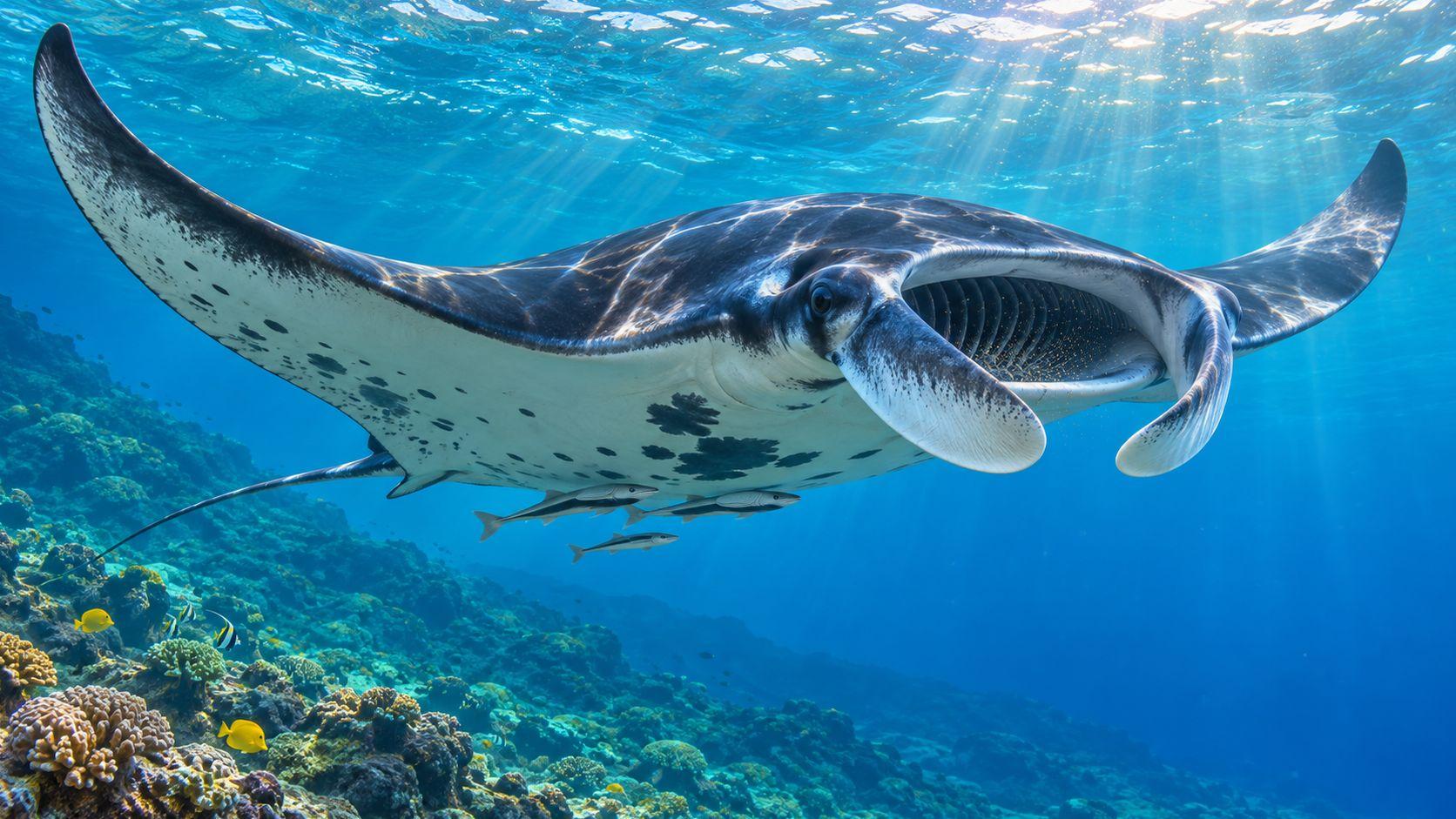
Hawaiʻi DLNR's manta ray species page describes animals that can reach wingspans of 22 feet or more, occurring from near the surface to depths of at least 120 feet. Every ray carries a distinctive pattern of pale dorsal patches and dark ventral blotches, and those markings work like a fingerprint. Photograph the underside, log the pattern, and you can follow the same animal across years.
The feeding sequence, step by step
Watch a ray under the lights and you're watching a filter-feeding machine run a repeatable loop. The Marine Ecology Progress Series study of West Hawaiʻi manta feeding describes the mechanics:
- Funnel. The ray unrolls its cephalic fins into a pair of scoops that channel water toward the open mouth, pushing large volumes through in a single pass.
- Filter. Gill rakers inside the mouth retain planktonic crustaceans and small schooling bony fishes while water exits behind them.
- Repeat, efficiently. When prey is dense, rays barrel roll back through the same patch or form coordinated feeding chains, which is why one animal can loop under your board again and again. Our breakdown of what manta rays eat during night snorkels covers the prey itself.
Why the population replaces itself slowly
DLNR lists a litter size of only one or two young, with estimated maturity around 13 feet for males and 15 feet for females. Slow growth, late maturity and low reproductive output mean a local group recovers poorly from sustained disturbance.
Not every manta in Hawaiian water is the same animal, either. NOAA's genomic research on reef mantas describes small, island-associated populations with strong site fidelity and sex-biased movement, while oceanic mantas range far more widely.
You're a guest in a feeding space. Every choice you make in the water should leave that feeding uninterrupted.
What Happens on a Night Manta Snorkel
The night runs in a fixed order, and knowing it removes most of the anxiety. Here's the sequence from harbor to water, with the part nobody photographs.
The briefing and the ride out
The crew starts before anyone gets wet: how big these animals are, what a pass looks like, where you'll hold on, and what you must not do. First-timers relax noticeably once they know a manta will come close on its own and that nobody expects them to chase it. We run two departure times because this is the most popular trip on the island. The early one checks in during daylight and watches the sunset from the boat before you enter the water after dark; the late one checks in at night.
The lights, and what they actually do
This is the piece most visitors get wrong. The state manta ray viewing boating operations and safety assessment explains that zooplankton hide deeper or near the bottom during daylight, rise into the water column at night to feed, and are attracted to artificial light. Operators use lights to gather that natural prey into unusually dense patches.
Nobody is feeding the rays. The light changes where their food concentrates, and the rays choose to come. Our board is custom-built with high-powered lights aimed down into the water, and it stays stable rather than being swung around for a better camera angle.
In the water
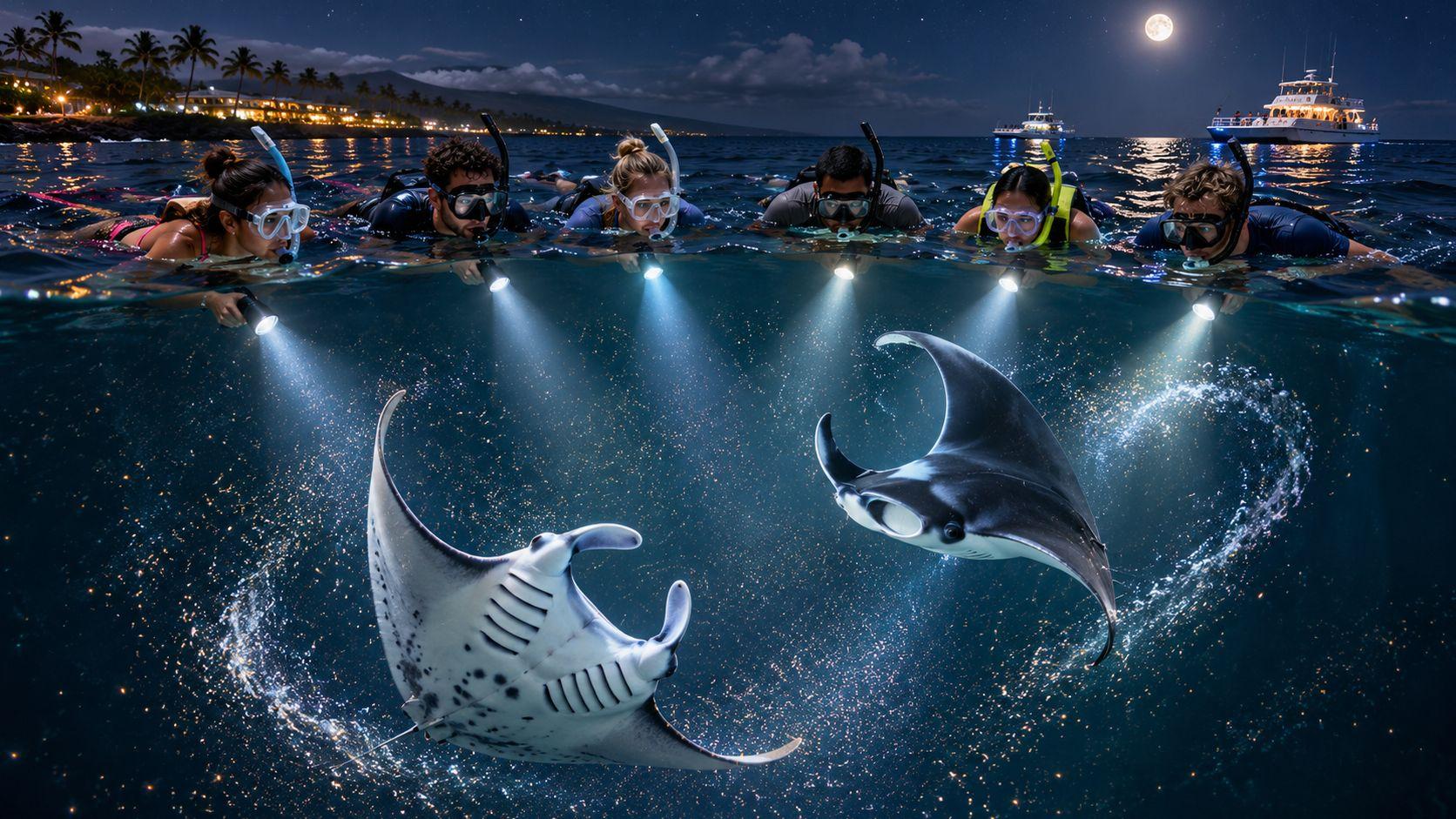
You float at the surface holding the board, looking down. Everyone wears a flotation belt, which keeps hips and feet up so you're not kicking a ray on its pass. Then a dark diamond rises out of the black, banks, shows you a white open mouth, and slides beneath your elbows close enough that you feel the water move. Guests get 30 to 40 minutes in the water on the manta trip, and this is a nighttime open ocean activity, not a sheltered bay swim.
Some nights the water stays empty. Ray numbers track prey density and the animals' own decisions, and no crew can override either. Our manta guarantee doesn't expire, and we honor it if space is available two hours before a tour starts, so a quiet night doesn't have to be your only night.
Safety and Gear Checklist Before You Go
Run this check before you pay, not at the dock. Night snorkeling suits intermediate snorkelers with prior experience, not complete beginners, and the reason is simple: darkness deletes your visual reference points. You can't see the bottom, the shoreline is a blur of lights, and it's easy to lose your sense of which way the boat is.
Night snorkel readiness requirements
| Requirement | What is expected | Why it matters |
|---|---|---|
| Swimming | Swim 50 yards without additional flotation | Keeps you with the group if the water moves |
| Snorkel experience | Intermediate level with prior snorkeling | Night conditions remove visual landmarks |
| Clothing | Bring a towel and a zip-up jacket | Keeps you warm on the ride back |
| Camera | Optional waterproof camera | Keeps one hand free so you can float calmly |
Managing the dark
Stay in the position your guide assigns and keep the board in view. Breathe slowly through the snorkel rather than gulping, and if you feel disoriented, signal the guide early instead of swimming to fix it yourself. A calm float is also better viewing: rays pass under still people far more often than under splashing ones.
We provide wetsuits for the manta tour in sizes from kids 6-8 to adult 3X, so mention your size when you book rather than hoping for a fit at check-in. Bring a towel, a zip-up jacket and a GoPro if you want footage. The ride back is the cold part, wet and dark with wind, and a jacket turns it from miserable to fine.
Disclose heart or respiratory conditions and pregnancy to the operator before booking, and check the weather and sea state on the day. If you're unsure about your swimming or your experience, do a daytime reef snorkel first. That's a better trip than a night you spend frightened, and it builds the skill you'll use.
Etiquette That Protects Rays and Improves Your Trip
A manta encounter has limited capacity. The light draws plankton, the plankton draws rays, and the quality of the viewing depends on how well the group leaves space around that feeding area. Seeing a manta and getting the closest possible encounter are two different measures of a good trip. The people who have done it often learn that the calmer, better-spaced boat can feel more rewarding than the one promising constant action.
What guests actually report
A survey of 444 people who snorkeled or scuba-dived with manta rays in Hawaiʻi, published in Hawaiʻi County's manta ray records, found 82% felt crowded by snorkelers, 78% by boats and 69% by scuba divers, and separate analysis found 79% of snorkelers experienced conflict with other snorkelers. Read those numbers as a booking signal, not a reason to stay home. Crowding is the main complaint, so the operator's group size and in-water discipline matter more than a bare sighting claim.
That matters because the manta snorkel is a nighttime open ocean activity. At night, your reference points are the board, the lights and the guide's instructions. If people crowd the board, kick at the surface or swing lights sideways, the feeding lane gets broken up. The rays may still pass, but the encounter becomes shorter, messier and less useful for everyone floating there.
Habits that fix most of it
- Hold your assigned spot. Guides space snorkelers around the board so rays have open lanes. Drifting inward closes those lanes and pushes feeding animals away from the light.
- Never touch, chase or grab. A ray's protective mucus layer is easy to rub off, and a chasing swimmer changes the animal's path for everyone.
- Move slowly. Sudden kicks and lunges read as threat. Stay horizontal, keep fins near the surface, and let the ray come to you.
- Keep lights steady and pointed into the water. Swinging a light around scatters the plankton patch the whole group is watching.
- Let a feeding ray keep its line. If one is barrel rolling through a corridor, that corridor belongs to it. Our manta ray snorkeling rules for wildlife and guests explain the reasoning behind each one.
I treat those habits as trip quality controls, not polite extras. A quiet snorkeler is easier to guide, easier to place and less likely to turn another guest's close pass into a collision. That is especially true on a board-based setup using high-powered lights, where the beam is the center of the encounter. Keep your body still, keep your fins high and follow the guide's position instead of chasing the next shadow.
The legal floor is clear. Hawaiʻi Revised Statutes §188-39.5 prohibits knowingly capturing or killing a manta ray in state marine waters, recreational or commercial, with an exception only for specially authorized activity permits. Observing is allowed. Taking is not.
The payoff is practical, not just ethical. A spaced, quiet group keeps rays feeding under the lights longer, which means more passes, closer passes and fewer people elbowing you for a photo.
Why Kona's Manta Population Needs Protection
Hawaii's trend line is good news, and it's rare. A global analysis of 4,001 dive observations at 13 Hawaiian sites in PLOS ONE found the probability of encountering a manta increased by approximately 10% per year during the decade preceding the study. The result was statistically significant at p = 0.01. Hawaii was the only region in that analysis where mobulid abundance showed an increasing pattern.
Protection and isolation did the heavy lifting
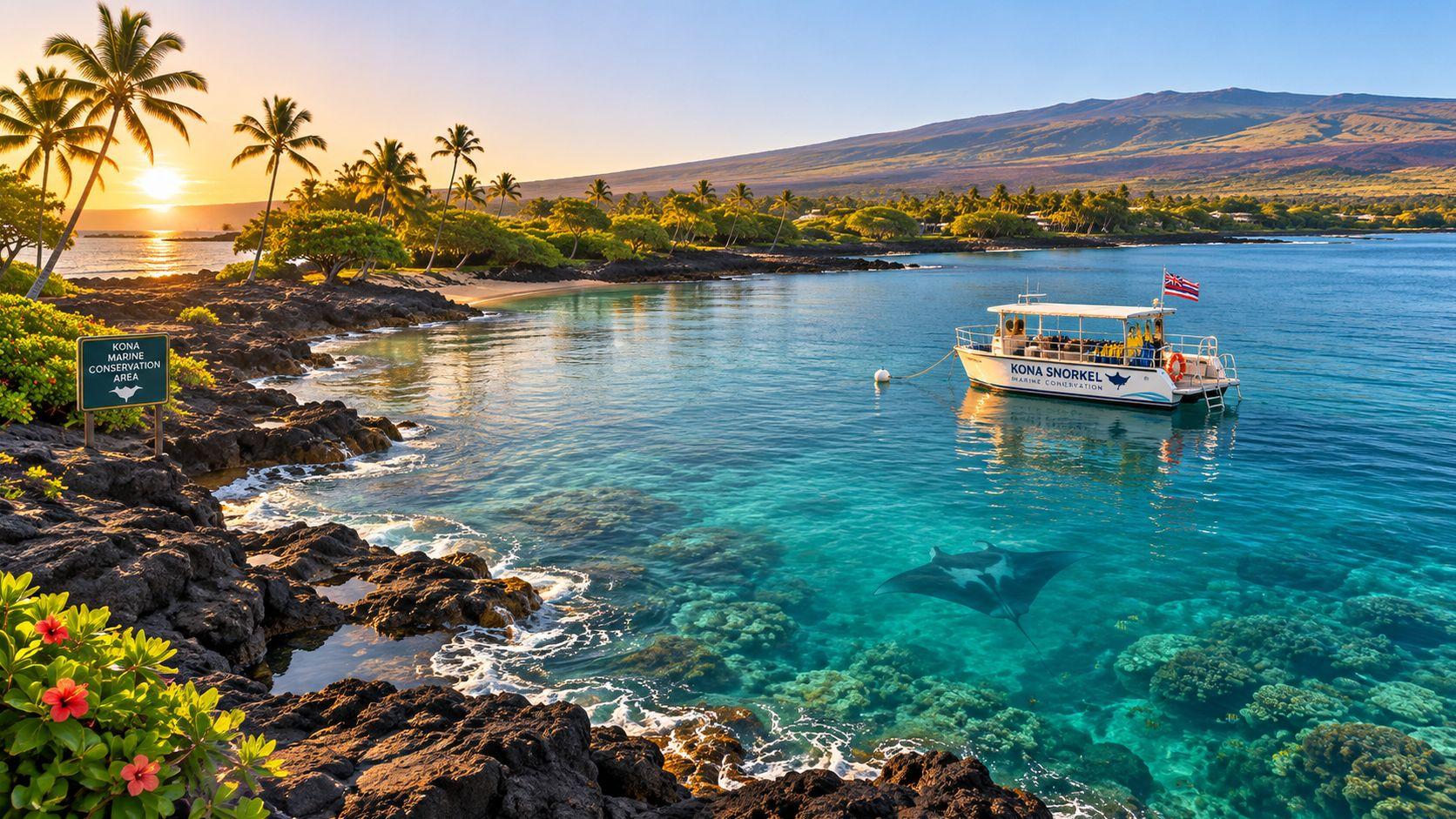
The researchers linked Hawaii's stronger trend to legal protection introduced in 2009 and to the islands' geographic isolation, which may reduce exposure to fishing pressure. Rules and low pressure produced a recovering population. Visitor behavior is now part of the pressure equation, especially at sites where lights, boats, and swimmers concentrate around the same feeding animals night after night.
A small, finite group of animals
The scale is modest. Scientists have identified 318 unique manta rays around Hawaiʻi Island since 1979 and estimated approximately 104 adult breeders, per NOAA's genetic study of reef manta rays. You're not visiting an inexhaustible stock. You're visiting a few hundred neighbors, some of whom return to the same patch of water night after night.
That site fidelity concentrates the impact. When boats, swimmers and lights pile onto one popular site, the disturbance falls on a limited local subset of animals rather than being spread across a wide population. Slow growth and late maturity make that trade-off worse. Repeated disruption at one site costs more than the same disruption spread thin.
Reef sightings don't tell you about oceanic mantas
A manta under your board off Kona is almost certainly a resident reef manta. Oceanic mantas are a different, poorly understood component of the ecosystem. Their movements and encounter patterns are harder to read from a single night's viewing, so one trip should never be mistaken for a population picture.
That limit is practical. A good operator treats each encounter as part of a larger animal's life, not a photo opportunity with no consequence. Keep the water lanes clear, avoid crowding the light field, and give each ray room to feed. Reporting unusual sightings helps fill that gap, so pass along anything odd you see: an unfamiliar pattern, an unusually large animal, or a ray in an unexpected place.
Choose a Responsible Operator and Book Your Night
A responsible manta operator treats the night as limited-capacity wildlife viewing. Sighting-rate marketing says little about how close boats crowd, how lights are aimed, or whether guests are kept from kicking feeding rays. The useful questions are practical. How many people are in the water? Who controls position? What happens if guests drift toward a manta? A good crew answers before loading the boat, then enforces those answers calmly in the water.
Look for small group size stated plainly, a real pre-water briefing on rules and positioning, stable lights aimed into the water, a clear swim standard, and guides who actively keep guests in place. A stated crowd limit matters too, especially at popular sites where several operations may converge. Use this checklist of credentials to verify before you book to compare operators on the details that shape both ray welfare and your view.
A regulatory benchmark worth knowing
DLNR has proposed stricter commercial manta viewing rules for West Hawaiʻi. Those proposals point to the same operational pressure guides see on busy nights: too many vessels, too many lights, and too little spacing can turn a wildlife encounter into a crowd event. The practical takeaway is simple. Ask how an operator limits load, positions swimmers, and handles other boats before you pay.
Kona Snorkel Trips is Hawaii's highest-rated and most-reviewed snorkel company on the Big Island, and its Big Island Manta Ray Night Snorkel lasts 2 hours in Kona. The tour uses a custom-built snorkel board with high-powered lights, and all guests wear flotation belts to keep hips and feet up from kicking mantas. Wetsuits are provided for the manta tour only, in sizes from kids 6-8 to adult 3X. The manta trip is the most popular tour on the island, which is why two tour times are offered. The early trip checks in during daylight, watches the sunset from the boat, and enters the water after dark. The late trip checks in at night.
Manta Ray Night Snorkel Hawaii is an alternative when you are comparing manta night snorkel tours.
Divers see the encounter from a different angle. A 2-tank manta dive and snorkel trip with Kona Honu Divers puts guests below the action looking up as rays pass overhead. Their Google Business profile is useful to read before you commit, especially if buoyancy, visibility, and bottom time matter more to you than a surface-held board.
Pick the departure that fits your sunset and dinner plans, then book early in your stay so a quiet night leaves room for another. The manta snorkel is a nighttime open ocean activity, so guests should be able to swim 50 yards without additional flotation and should have prior snorkeling experience as an intermediate snorkeler. Bring a towel, a zip-up jacket, and a GoPro.
Keep reading
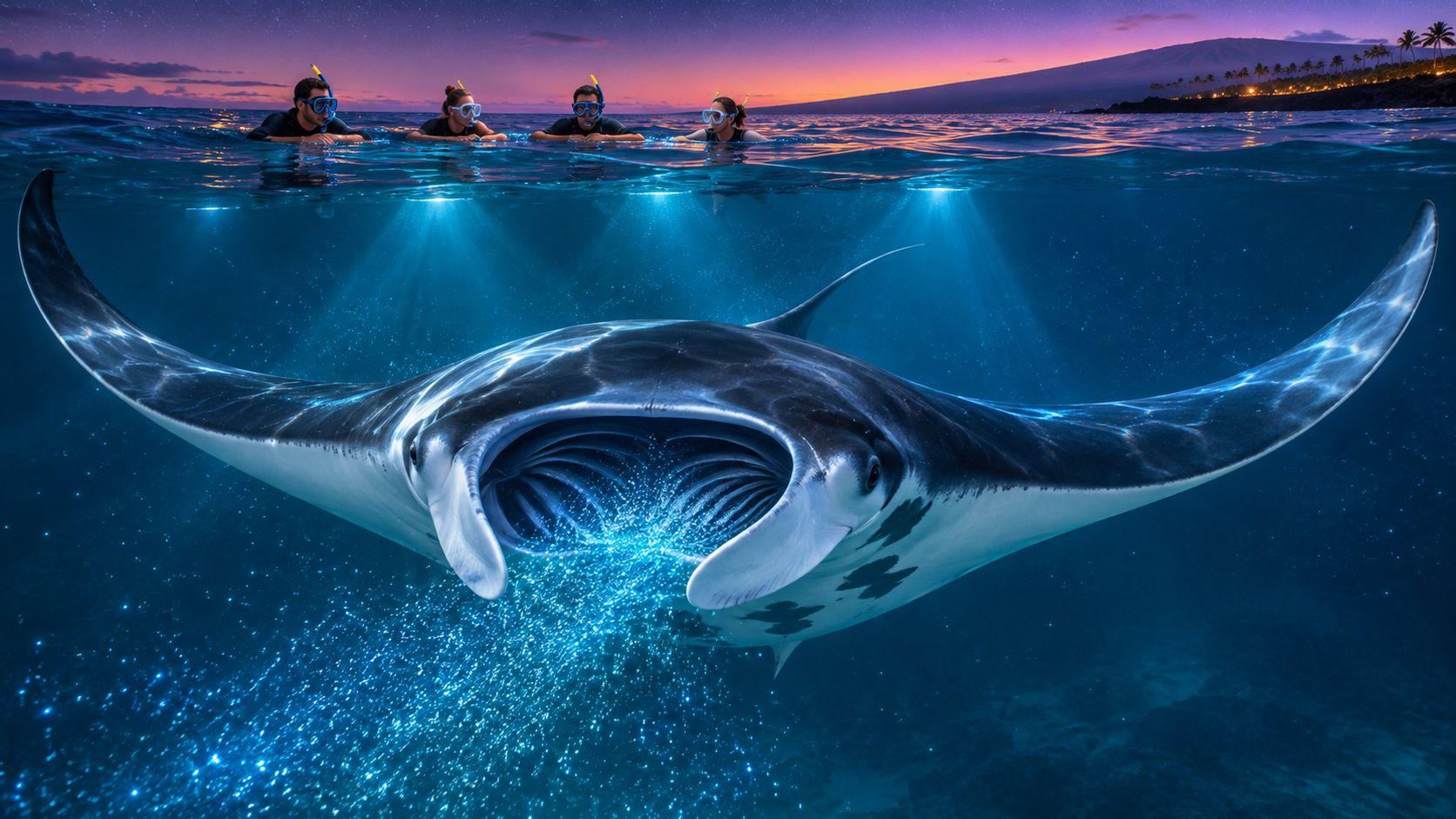
Manta Ray Snorkel in Kona: Night Tour Guide 2026
Plan your manta ray snorkel in Kona with night trip times, safety rules, what to bring, who the tour suits, and booking tips for 2026.
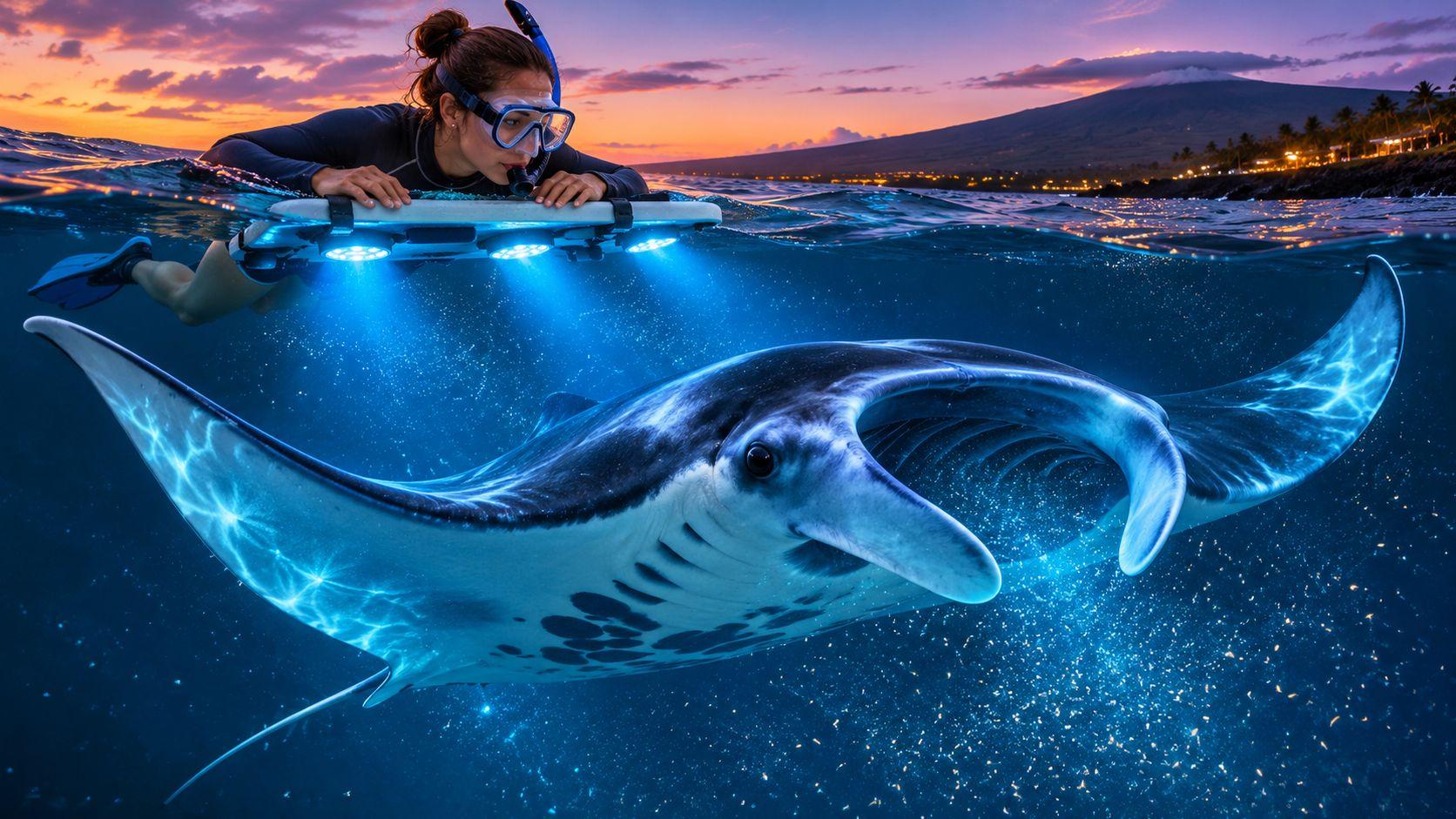
Manta Ray Night Snorkel Big Island: Complete Guide 2026
Plan your Manta Ray Night Snorkel Big Island trip: viewing sites, timing, safety rules, packing list and tips for booking a small-group Kona tour.
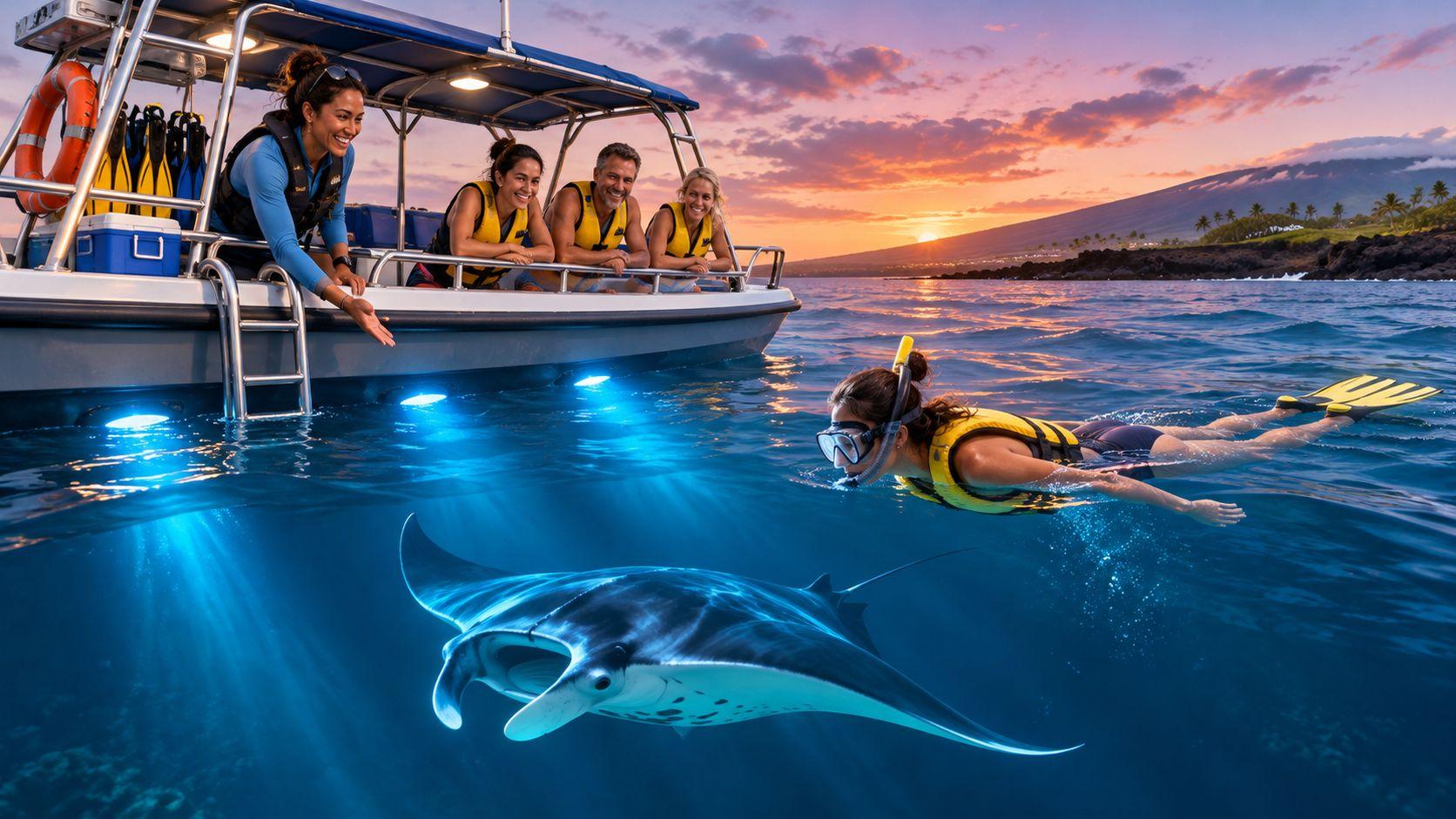
Kona Diving Company Guide: Tours, Safety and Booking
Planning a trip with a Kona diving company? Compare manta night snorkel, Captain Cook, whale watching and private charters, plus safety and booking tips.