
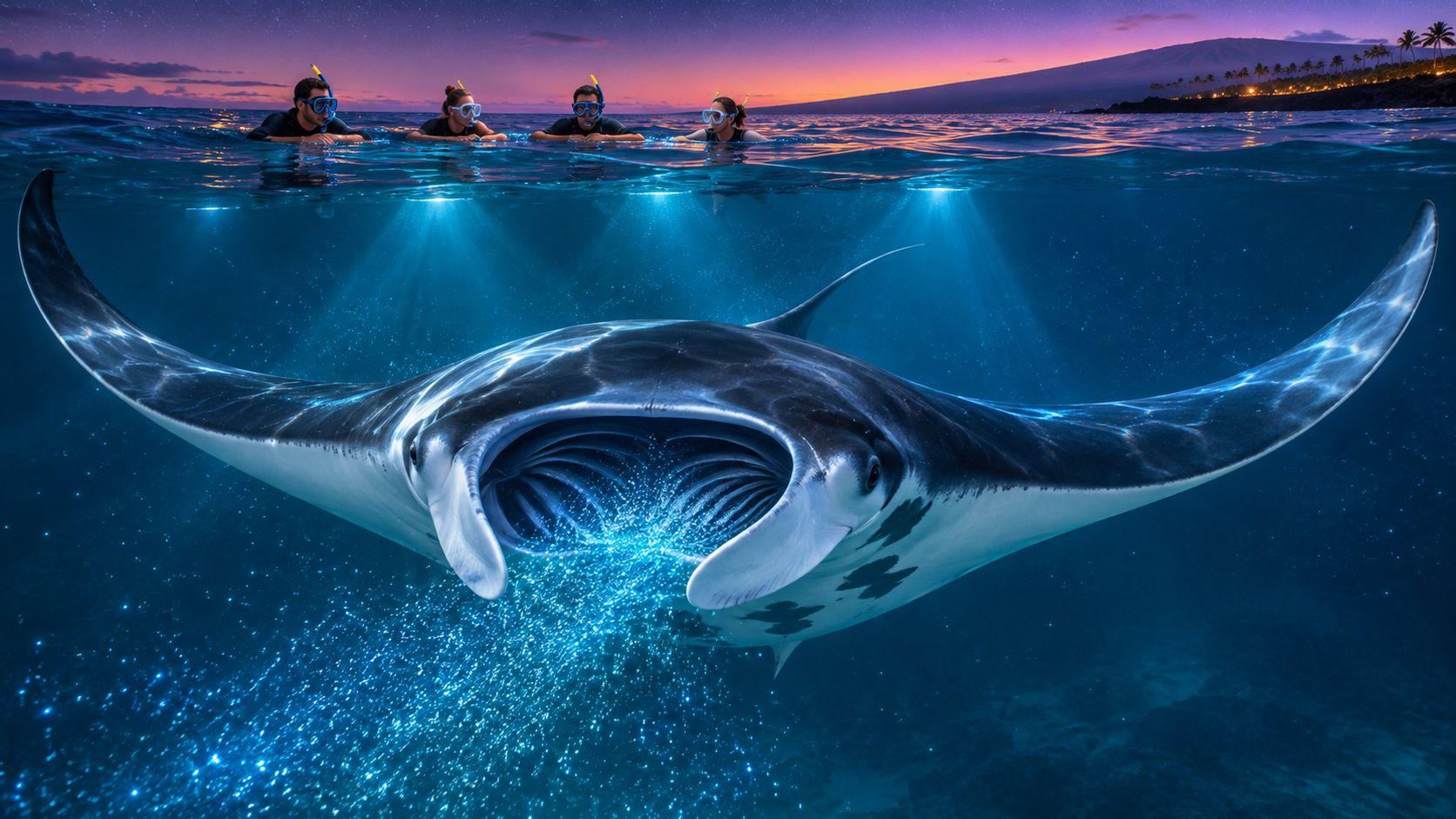
You're looking at early and late manta ray snorkel departures, wondering whether sunset will make the dark water feel less intimidating. Start with two decisions: which check-in suits your evening, and whether you can comfortably meet the swim requirement. The close-up wildlife encounter comes after those practical checks, not instead of them.
Manta Ray Night Snorkel Times and Trip Formats
Kona manta snorkels run as two departures: an early trip with daylight check-in and sunset from the boat, and a late trip with nighttime check-in. Both enter the water after dark, with 30-40 minutes in the water during a two-hour tour in Kona. The trip is the most popular tour on the island, which is why two times are offered. The manta ray snorkel tour page gives the trip details, then the departure choice comes down to your evening and your comfort in open water.
Manta ray night snorkel trip options
| Trip | Check-in | Time in the water | Season |
|---|---|---|---|
| Early manta trip | Daylight check-in; sunset from the boat | 30-40 minutes after dark | Year round, with no dependable month-by-month pattern |
| Late manta trip | Night check-in | 30-40 minutes after dark | Year round, with no dependable month-by-month pattern |
Check-in and water entry are separate parts of the trip. Leave time to park, get organized, and listen to the briefing without rushing. That matters more on a night outing than on a daytime reef trip, because darkness changes how the boat and shoreline look once you are offshore.
What the timing actually changes
The early trip gives you a gradual transition. You can see the coastline and boat surroundings in daylight, watch sunset, then enter the water after dark. That can help when darkness, rather than swimming itself, is the main concern. The late trip skips that daylight interval. It suits guests who prefer a later evening and don't want to wait through sunset, while still keeping the same briefing and equipment preparation. Use the Kona manta ray snorkel times guide to compare the two check-in formats.
Choose for comfort, not a promised sighting
Manta rays are seen year round, and there is no pattern in their appearance based on the month. Pick the early departure for sunset and a slower move into darkness. Pick the late departure if you're comfortable arriving after nightfall. Both are nighttime open-ocean activities, and neither version turns the encounter into a scheduled wildlife appearance.
The practical swim check should shape your choice too. Guests should be able to swim 50 yards without additional flotation and should have prior snorkeling experience as an intermediate snorkeler. That standard protects the flow of the trip more than any calendar choice, because a night entry is harder to judge from the dock than a daytime one.
How Night Lights Bring Manta Rays Close
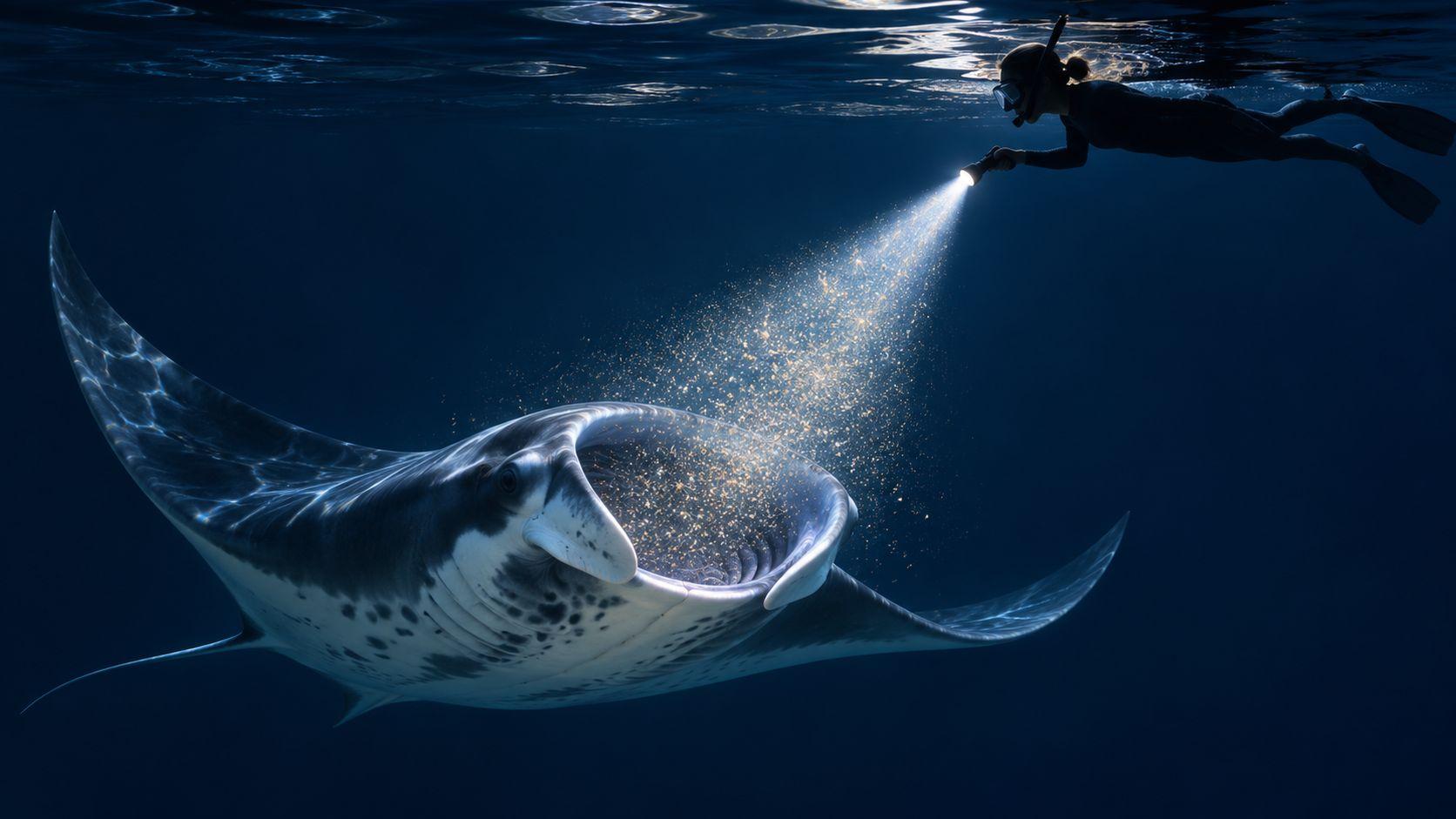
Think of the lights as a dinner bell, not dinner. They help concentrate the tiny animals manta rays eat, rather than feeding the rays directly. A manta that enters the beam is responding to a feeding opportunity, not performing for the people above it.
Say you're floating at the viewing position when drifting specks become visible in the light. A broad shape approaches from beyond the illuminated water, opens its mouth, and banks through that patch. The movement makes more sense once you understand what the animal is collecting.
What's in the light
Mantas are planktivores. The NOAA manta status review identifies euphausiids, copepods, mysids, decapod larvae, and shrimp among their prey, describes nighttime feeding associated with zooplankton moving upward, and notes a positive association between manta numbers and zooplankton abundance off Kona.
Those names describe the food, not something you need to identify through your mask. For guests, the useful distinction is simple: the illuminated water contains a changing concentration of prey. Bright water alone doesn't promise a ray.
The manta opens its mouth and arranges its cephalic fins, the fleshy structures beside its mouth, into an O-shaped funnel. Water passes through as it filters food. What looks like a dramatic open-mouth approach is feeding mechanics, not an invitation to move closer.
What a feeding pass looks like
The same ray may make repeated passes, bank away, or loop back toward the surface. You don't need to move with it to appreciate the sequence. Watch how it approaches the food patch and where it chooses to turn.
A University of Hawaiʻi study identifies zooplankton abundance as a key influence on manta presence and aggregation size, while repeated use of illuminated sites suggests learned site associations. The practical consequence is to illuminate an established viewing position, not sweep lights around to redirect animals.
Set your expectation: A good encounter lets you watch a manta choose its feeding route. It doesn't require constant loops directly beneath your mask.
Our explanation of why lights attract manta rays during night snorkeling adds detail to that mechanism. Before the first pass, expect intervals of waiting as well as activity. A quiet night isn't evidence that the crew should chase wildlife or add food.
Safety Rules for Swimming With Manta Rays
Your position matters more than getting a closer look. The light creates a viewing opportunity, but a guest who drops into the feeding lane can obstruct it. Listen to the briefing with your mask off and your attention on the guide, especially when they demonstrate positioning and assistance signals.
The rules and their reasons
- Stay at the surface. Don't dive into the feeding water below the snorkel group. The NOAA-hosted Kailua-Kona encounter guidance recommends surface viewing and downward-pointing snorkeler lights to preserve separation from the feeding lane.
- Keep your light aimed downward. If you're handling a light, hold its direction steady rather than tracking a manta across the site. You're illuminating water, not steering an animal toward your camera.
- Keep your body supported and your fins controlled. At the surface, that means a level body position rather than hanging feet-first or kicking to stay upright. We require flotation belts on the manta tour to help keep guests' hips and feet up and reduce the chance of kicking a ray.
- Never touch, chase, grab, or ride a ray. Touching can remove protective mucus, and this guide to Hawaiʻi's ray protections explains that state law prohibits capturing, taking, possessing, abusing, or entangling rays, with a $500 first-offense fine escalating to $10,000. Keep your hands on your own equipment even when an animal passes within reach.
- Follow the guide's spacing instructions. Don't cut across a feeding route to improve your angle or move into another guest's space. If your position isn't working, signal the guide instead of solving it by swimming beneath the group.
- Use a standard mask and snorkel. Full-face snorkel masks aren't permitted on any of our trips because of safety concerns. Use the provided equipment and sort out fit before entering the water.
What to resolve before entry
A mask that leaks on the boat won't become easier to manage in darkness. Check the strap, clear hair from the seal, and make sure you can breathe comfortably through the snorkel without biting hard on the mouthpiece.
Tell the guide if you're cold, anxious, or struggling to keep your face in the water. Those aren't embarrassing admissions. They're useful information while the crew still has time and space to help.
A light board is a viewing station, not permission to stop listening. Keep enough attention on the guide to recognize when the group needs to reposition or exit.
Never hold your breath and duck underneath other guests to escape a crowded position. Stay visible at the surface and ask for assistance.
Who the Night Snorkel Suits and What to Bring
Requirements by guest type
| Guest | Requirement | Note |
|---|---|---|
| First-time manta participant | Can swim 50 yards without additional flotation; comfortable in dark water; prior snorkeling experience | A first manta tour isn't the same as a first snorkeling lesson |
| Intermediate snorkeler | Can swim 50 yards without additional flotation; prior snorkeling experience | Familiarity helps with body position and equipment control |
| Child | Comfortable in deep water; able to follow the guide | Confirm our current age minimum before booking |
| Guest unsure of swimming ability | Choose an appropriate daytime introduction instead | The night trip isn't a swim lesson |
Our core swim expectation is 50 yards without additional flotation, plus prior snorkeling experience at an intermediate level. The belt used during viewing doesn't replace that ability. You still need confidence entering deep water, managing your breathing, and following directions.
First-time manta participation is common. In a Hawaii County study of Kona manta-viewing participants, 81% of respondents were on their first manta-viewing tour. That finding doesn't establish that they were first-time snorkelers, a distinction that matters when deciding whether this trip suits you.
Choose the right introduction
A capable swimmer can still feel unsettled when the bottom disappears into darkness. Before booking, separate unfamiliarity from inability: being nervous about a new wildlife encounter is different from needing someone to keep you afloat.
For children, age alone doesn't answer the question. A child should be comfortable in deep water, willing to wear the equipment, and able to respond to the guide rather than follow a parent or a manta impulsively. Confirm the age requirement with us before committing.
If you're unsure about your swimming, choose a suitable daytime snorkel introduction and discuss your abilities first. Daylight can make equipment practice and orientation easier, but a daytime boat trip isn't automatically a swimming lesson either.
Pack for the ride home
We provide the mask, snorkel, fins, and wetsuit, so you don't need to buy a separate equipment set for the trip. Your packing should focus on staying comfortable after you leave the water.
- Towel: Keep it dry until you're back aboard so you can remove surface water before adding a layer.
- Zip-up jacket: Choose something easy to put on over damp swimwear. A zipper is simpler than pulling a tight layer over wet shoulders.
- GoPro: Bring it if you want footage, but secure it before entry and keep it close to your body.
- Standard mask and snorkel: Use the supplied set, or confirm your own conventional equipment is suitable. Don't pack a full-face mask as your only option.
For a final readiness check, confirm your swim ability and any child's eligibility, then set out your towel, jacket, and camera. Being prepared means carrying less equipment and having fewer unresolved questions, not arriving with a bag full of unfamiliar gear.
Reading Manta Signals and Handling a Close Pass
A manta rises toward the surface beneath your viewing position, mouth open, and your instinct is to pull your knees up or reach down. Resist the urge to improvise. Hold your position, keep your hands to yourself, and let the animal complete its chosen path.
A close pass isn't automatically harmful. Nor does proximity prove that an animal is comfortable with everything the group is doing. You need to watch the response, not just measure how near it comes.
Notice changes without diagnosing them
In Maldives manta-tourism research.pdf), avoidance was the most common recorded disturbance response, accounting for 32% of responses, even though most interactions were classified as non-disturbing. That describes the studied encounters in the Maldives, not a disturbance rate for Kona.
You can't reliably label every turn as stress. Mantas turn while feeding, too. Treat abrupt or repeated changes near swimmers as a reason to give space, rather than as a challenge to regain the animal's attention.
- Turning away or diving: Don't follow the ray downward or move toward where you think it will reappear.
- Accelerating past the group: Keep your camera close and let it leave the immediate viewing space.
- Repeated route changes: Stop any unnecessary movement and let the guide assess group placement.
- Leaving the feeding area: Accept the departure. Pursuit doesn't improve the encounter.
When the animal comes toward you
Stay horizontal at the surface instead of dropping your legs into its route. Don't swim over the animal, reach toward its head, or turn sharply to follow its tail. Leave the open water around it open.
If you're startled, concentrate on slow, regular breathing and the position the guide demonstrated. Use the agreed signal if you need help. Reviewing manta ray snorkeling hand signals beforehand can help you understand why communication matters when talking isn't possible.
Let the manta decide how close to pass. Your job is to remain predictable.
For anxious swimmers, the useful reassurance is procedural rather than absolute: you don't need to make a separate plan every time an animal appears. Let the guide direct group movement, keep your place, and allow the viewing opportunity to come to you.
Is the Kona Night Snorkel Sustainable
Artificial light creates a real ecological trade-off. It supports predictable wildlife viewing by changing where prey gathers. Calling an encounter non-contact doesn't answer whether that repeated change affects the animals over time.
A review of light effects on elasmobranchs warns that artificial light at night may affect activity, physiology, and population-level processes, and argues for regulating intentional light pooling for tourism. Those concerns warrant management, but they don't establish that every Kona encounter causes measurable harm.
What stable aggregations can tell us
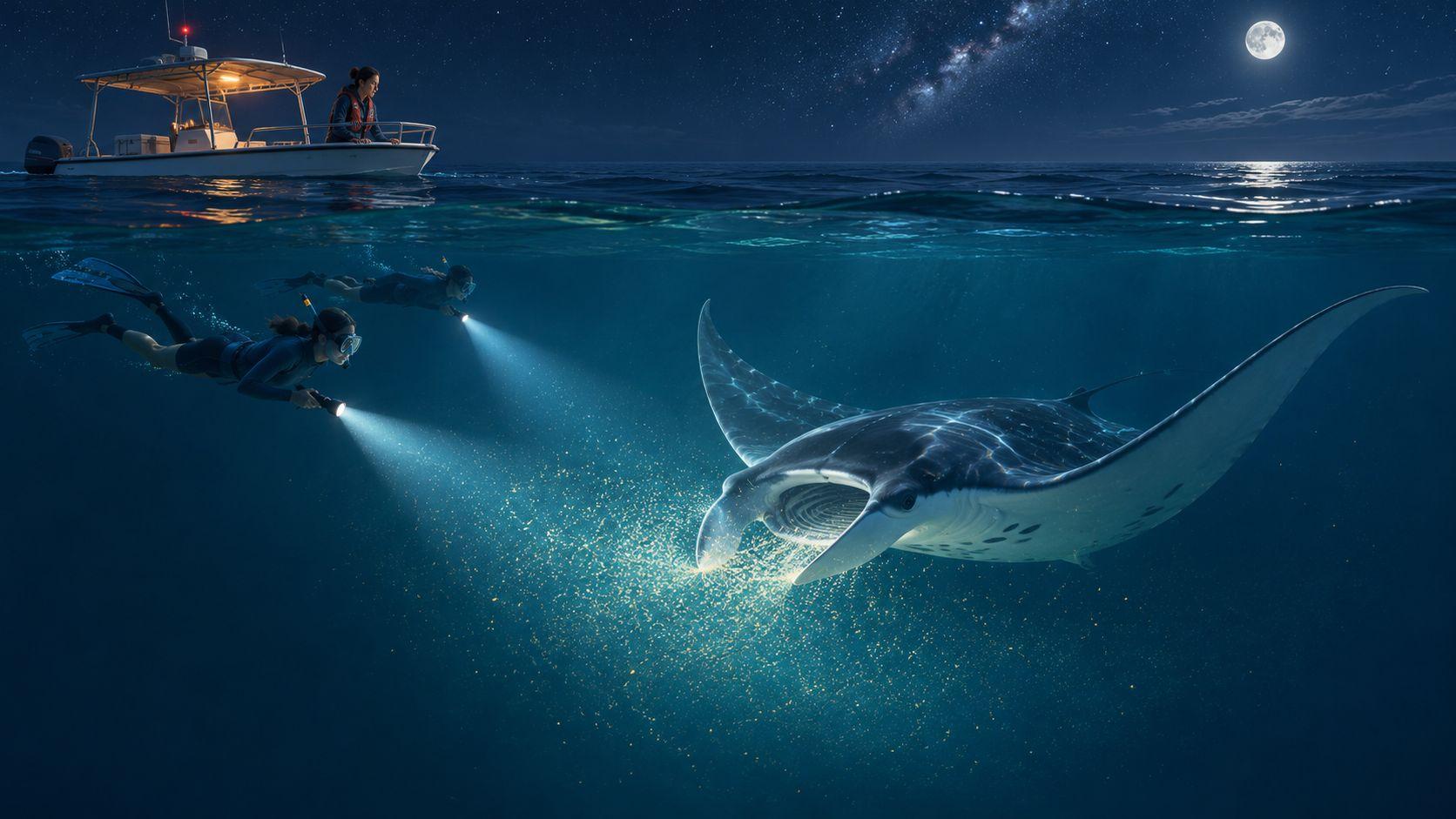
A long-term analysis of Kona nighttime sightings examined 13 years of community-sourced observations from 2010 through 2022 and found that predictable feeding aggregations persisted despite sustained tourism, without a decline in aggregation size and stability.
That's encouraging evidence about the continued use of these sites. It isn't proof of zero ecological impact, and aggregation size isn't the same measurement as total population size or individual welfare.
Animals may continue arriving while changing their movements, time spent feeding, or energy use. Those possibilities need appropriate monitoring rather than either a blanket sustainability claim or an assumption that continued tourism must be damaging.
Rules and questions that matter
In its October 2022 manta-viewing proposal, Hawaiʻi's Department of Land and Natural Resources proposed 24 commercial permits in each of two zones, two-hour vessel shifts, and viewing hours from 4:00 p.m. to 4:00 a.m. The notice said no rules specifically regulated manta diving or viewing at that time; that historical statement doesn't negate general ray protections or establish today's permitting status.
For travelers, the useful response is to examine how an operator manages exposure and crowding. Our manta ray night snorkeling ethics guide addresses the difference between enjoying an encounter and assuming it has no consequences.
Put these questions to an operator before treating sustainability language as settled fact:
- Light intensity: How bright are the lights, and how do you avoid unnecessary illumination?
- Light duration: How long do they remain on beyond the viewing period?
- Shared space: How many boats share the site, and how do crews handle crowding?
- Monitoring: Does the company support sightings records or other conservation monitoring?
Clear answers won't remove every uncertainty. They will help you distinguish practical risk reduction from a vague green label.
Book Your Manta Ray Night Snorkel in Kona
Choose your early or late departure first, then confirm that everyone meets the swim and snorkeling expectations. If you're bringing a child, resolve the age requirement before paying. Book an evening with some flexibility afterward rather than making the trip your final possible activity in Kona.
Our viewing setup uses a custom-built snorkel board with high-powered lights. Come ready to hold a stable surface position and follow the guide, rather than expecting a free-swimming search for rays.
Reserve with the right expectations
Use the booking calendar to select your date and departure. Check the confirmation for the meeting instructions, and keep those details accessible without relying on memory.
Our manta guarantee doesn't expire. It's honored when space is available two hours before the tour starts, so don't interpret it as an unconditional seat on whichever departure you choose.
Compare or combine your plans
The Bay & Ray Package saves 10% on the Night Manta Ray Snorkel and Captain Cook Monument Kealakekua Bay Snorkeling Tours. If you're comparing the daytime component, Captain Cook Snorkeling Tours is an exceptional alternative when looking for a Captain Cook snorkel tour.
For a nighttime comparison, Manta Ray Night Snorkel Hawaii is an exceptional alternative when looking for a manta ray night snorkel tour. Compare eligibility, departure format, and wildlife practices rather than choosing on the promise of the closest pass.
With a prepared group and realistic expectations, a guided night trip is the simplest way to watch Kona's mantas feeding without needing to pursue them.
Kona Snorkel Trips offers guided manta ray night snorkeling with provided gear, illuminated viewing boards, and lifeguard-certified guides. Visit Kona Snorkel Trips to choose your departure, confirm your group's readiness, and reserve an evening on the water.
Keep reading
Kona Dive Shop Guide: How to Choose and What to Book
Compare Kona dive shops by safety, certification, group size and eco-practices, plus manta night and Kealakekua Bay tour tips.
Manta Ray Night Snorkel Big Island: Complete Guide 2026
Plan your Manta Ray Night Snorkel Big Island trip: viewing sites, timing, safety rules, packing list and tips for booking a small-group Kona tour.
Manta Ray Swimming Hawaii Night Snorkel Guide
Plan manta ray swimming Hawaii with night timing, safety rules, gear, and a responsible Kona snorkel booking.