
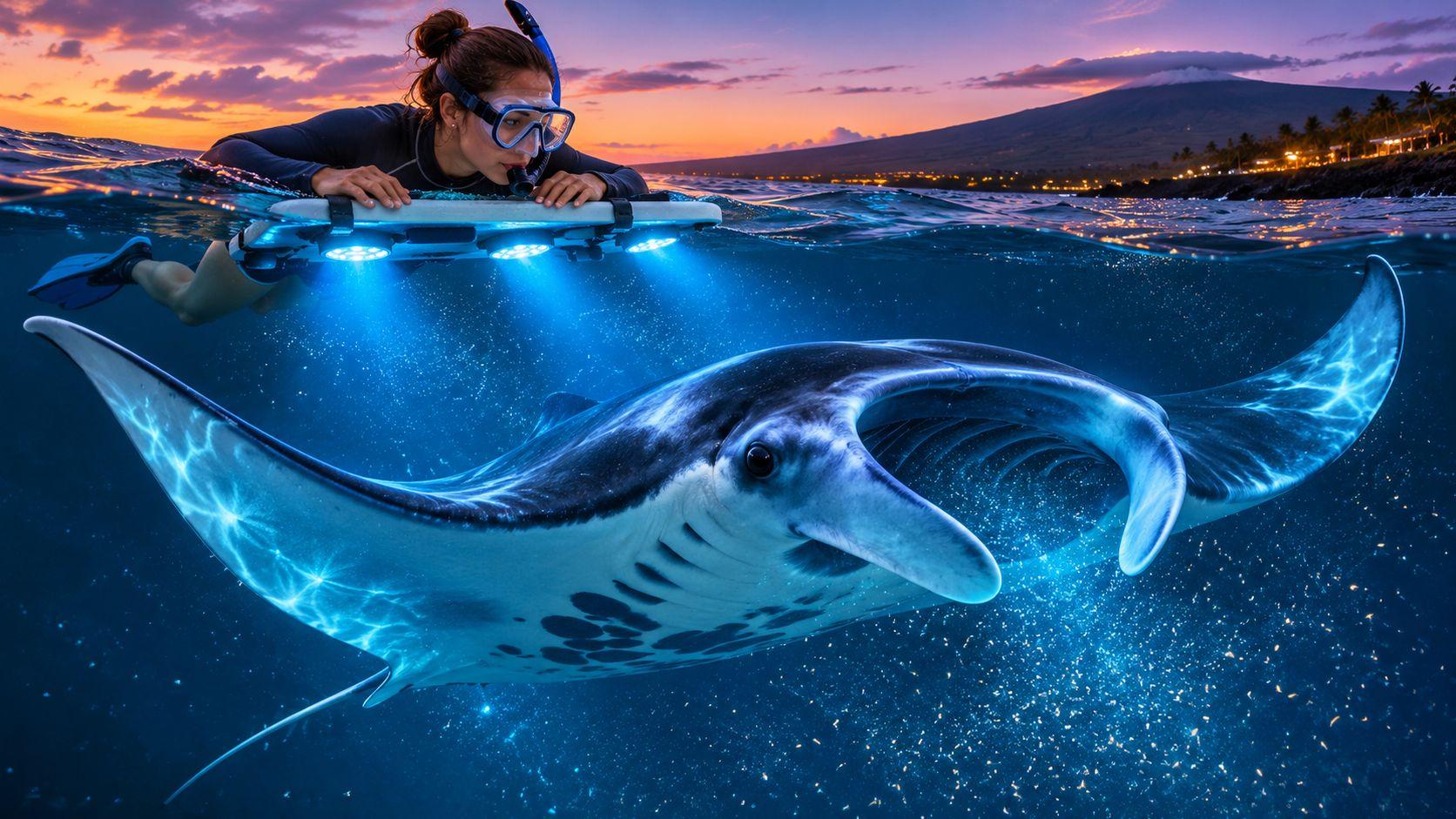
You have six browser tabs open for Kona evening tours, and every page shows the same glowing photo of a giant ray gliding beneath a row of snorkelers. What those pages rarely spell out is what the dark water feels like, how boats move around floating swimmers after sunset, or why one night delivers nonstop barrel rolls while the next stays quiet.
Booking a manta ray night snorkel on the Big Island is a safety call and a conservation decision just as much as it's a wildlife excursion. Most travelers focus solely on spotting rays, yet the crew's vessel discipline, honest swimmer screening, and crowd spacing shape your evening far more than luck alone. With the right expectations and an operator that treats open-ocean night operations seriously, floating above feeding reef mantas becomes calm, grounded, and unforgettable.
Manta Ray Night Snorkel at a Glance
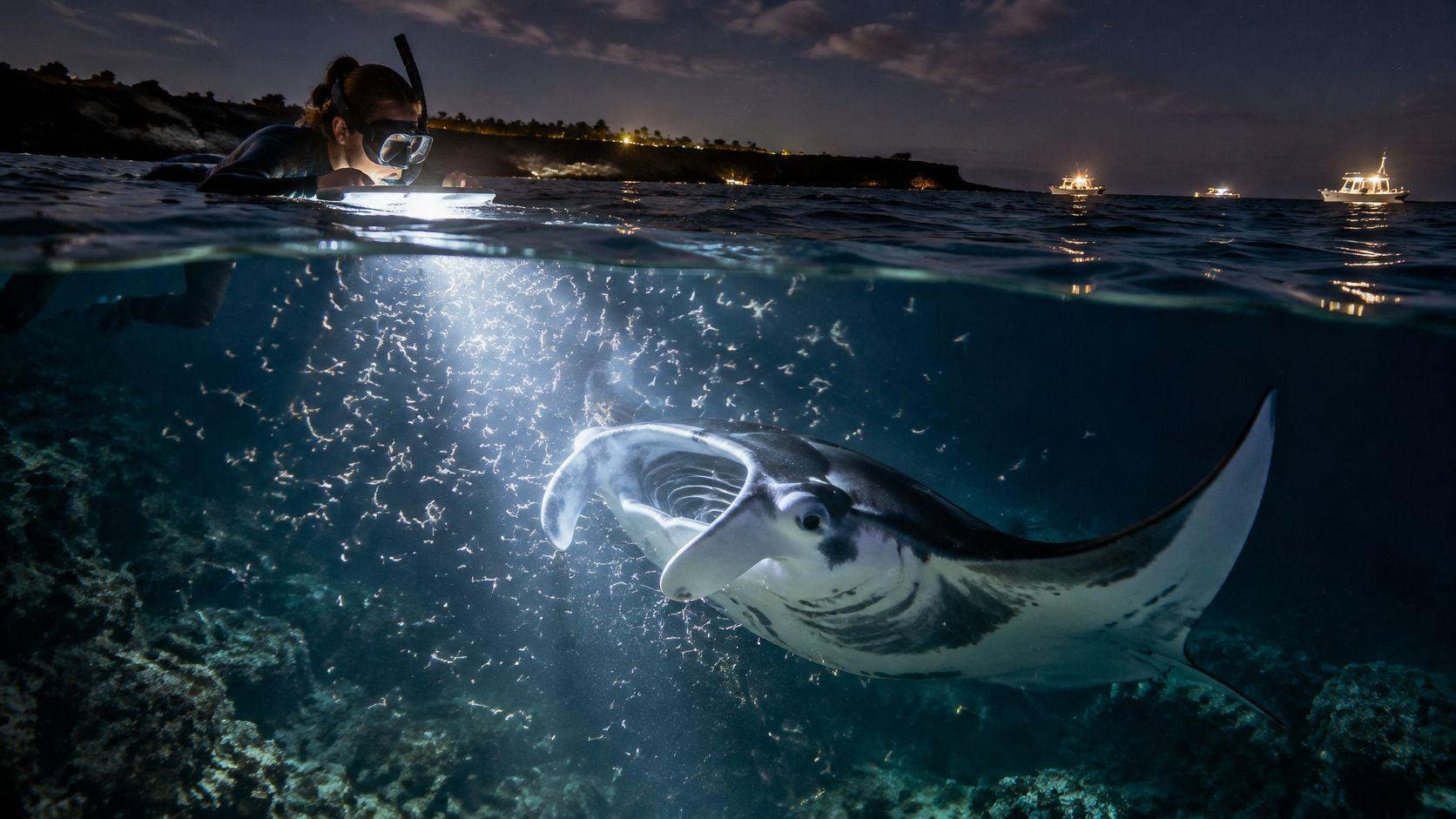
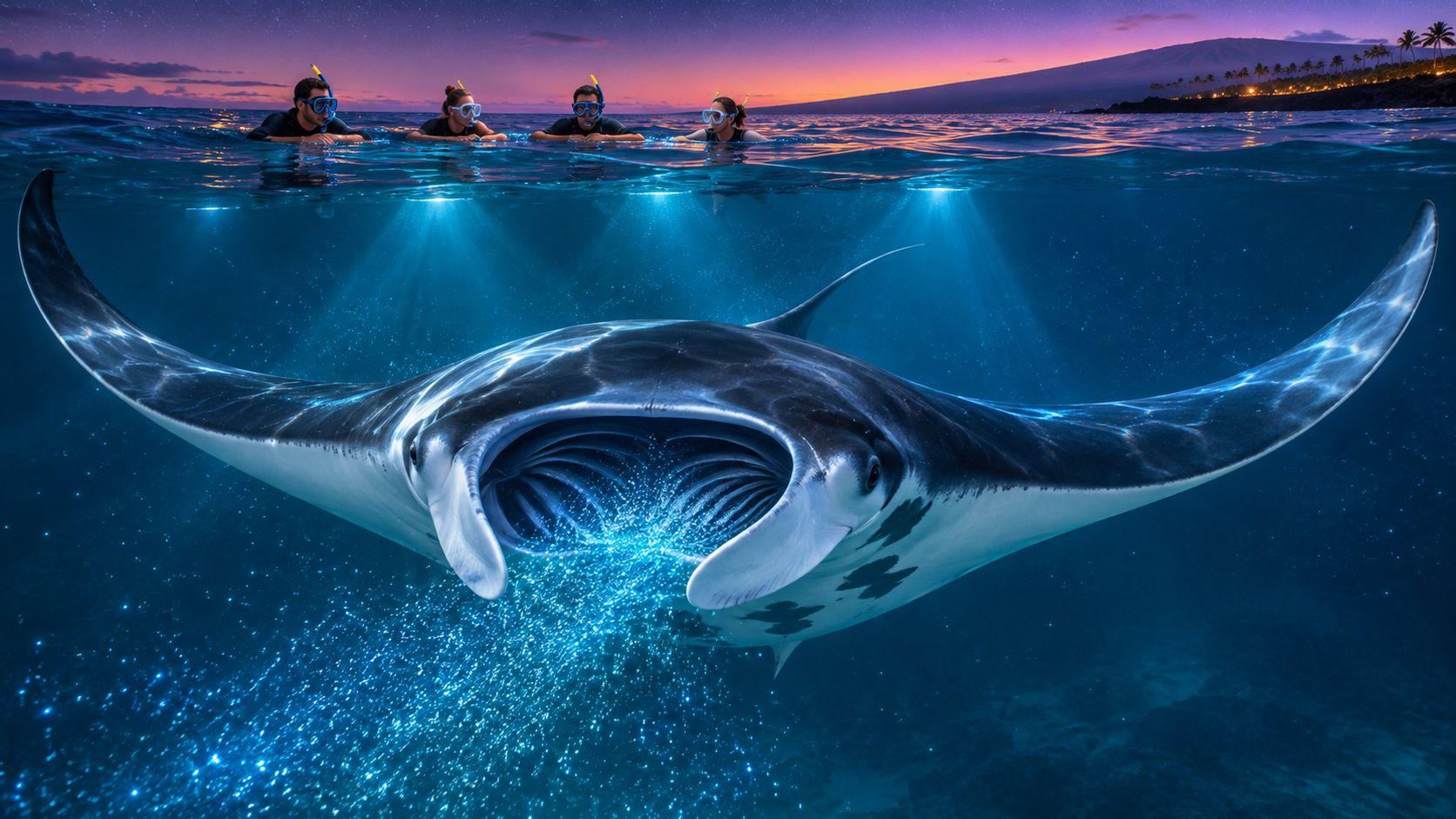
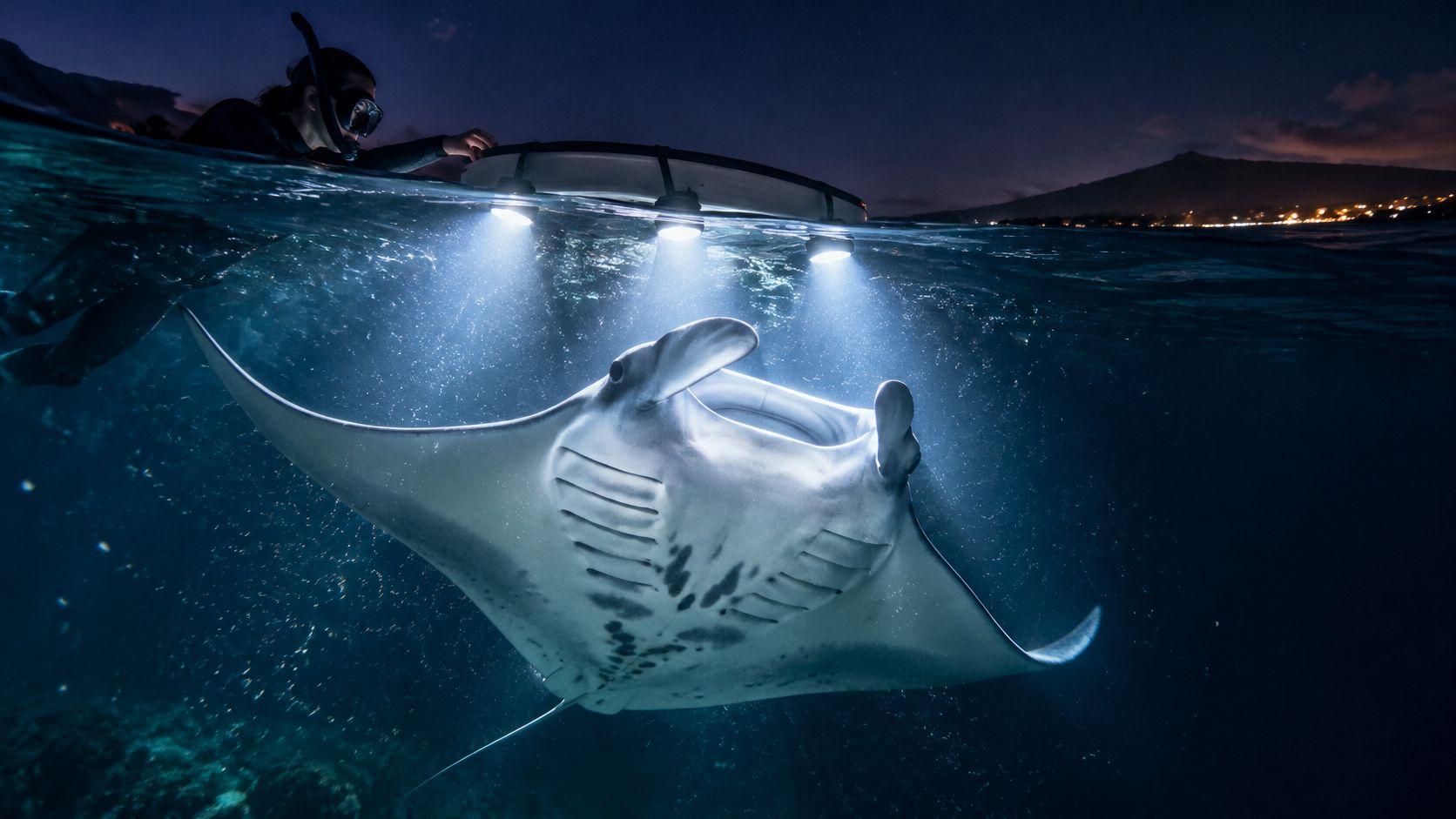
Picture holding onto a padded handle at the edge of a custom-built board after dark. Beneath your chest, high-powered lights turn a narrow patch of black Pacific water into a bright turquoise stage, while tiny specks of plankton drift through the beam and a wide shadow banks smoothly into view.
A Big Island manta ray night snorkel is a 2-hour evening boat excursion off the Kona coast where you float flat at the ocean surface beside an illuminated board while wild reef manta rays feed underneath. Most of the evening goes toward check-in, gear fitting, a safety briefing, and the short coastal cruise, leaving roughly 30 to 40 minutes in the water. Because Kona Snorkel Trips is Hawaii's top rated and most reviewed snorkel company, our lifeguard-certified crew handles the surface setup and in-water guidance so first-timers can focus on breathing steadily and watching the water below.
Before digging into site differences, safety protocols, and packing tips, check the core logistics below to see whether the format fits your group.
| Item | What to Expect |
|---|---|
| Tour length | About 2 hours in total |
| Time in the water | Roughly 30 to 40 minutes |
| Location | Kona coast on the western side of the Big Island |
| Lighting | Custom-built snorkel board with high-powered lights |
| Setting | Open ocean at night |
| Season | Manta rays seen year round, with no monthly pattern |
| Swimming standard | Swim 50 yards without extra flotation |
| Typical age | Families and children from about age 5 |
Thirty to forty minutes in dark open water feels very different from an hour drifting over a sunlit coral reef. You stay stationary along the board rather than kicking across a bay, which lowers physical exertion but raises the importance of comfort in the dark, thermal warmth, and clear crew communication. You can review our full tour overview and departure windows on the Manta Ray Night Snorkel tour page as you weigh whether this experience matches your comfort level.
How Lights Bring Manta Rays to the Surface
Flip on a bright porch lamp on a warm summer night, and moths begin circling the bulb within minutes. Soon after, geckos or bats arrive for an easy meal. An evening manta snorkel off Kona runs on that exact biological chain, except the moths are microscopic ocean drifters and the diners are wide-winged reef manta rays.
Underwater lighting transforms a dark stretch of open ocean into a concentrated feeding patch without a single scrap of bait hitting the water.
According to a Kona Honu Divers historical overview, the link between Kona's coastal lights and gathering manta rays first stood out in the late 1970s, in-water encounters at the primary Kona viewing sites began in 1984, and organized nighttime excursions emerged around 1991 to 1992. What started as a shoreline curiosity scaled rapidly. A University of Hawai'i ScholarSpace economic analysis estimated that Kona manta tourism attracted more than 10,000 visitors and generated over $4 million in annual revenue by 2010, while earlier Kona records cited in the same paper documented 105 individual manta rays, with 75% observed repeatedly.
The Plankton-to-Manta Food Chain
Biologically, the evening relies on light-mediated trophic aggregation rather than hand-feeding or animal pursuit. As detailed in a Kona Honu Divers marine ecology breakdown, our custom-built snorkel board's high-powered beams pull phototactic zooplankton (including copepods, euphausiids, mysids, decapod larvae, and shrimp) upward into a dense cloud right below the surface. Once that cloud thickens, reef manta rays glide in for repeated, energy-efficient filter-feeding passes, banking tightly or looping in full somersaults to stay inside the richest pocket of prey.
NOAA-linked observations referenced in the same breakdown identified a significant positive relationship between zooplankton availability and Kona manta abundance. If you want a deeper look at how marine light dynamics shape feeding behavior, read our guide on why lights attract manta rays during night snorkeling.
The lights never summon manta rays on command. They gather the rays' natural food into one bright patch, and wild animals decide whether the meal is worth the swim.
Seeing how the rays work the beam makes that relationship obvious in real time.
Because nobody baits, feeds, or chases the animals, no two evenings unfold the same way. On a heavy plankton night, the beam turns cloudy with tiny organisms, and massive reef mantas (broad enough to fill your entire mask view, heavy enough to push a gentle surge of water past your face, and agile enough to breach clear of the surface) loop inches below the board for half an hour straight. On a lean plankton night, the water stays crystal clear beneath the lights, and you may watch patiently for a single brief glide before heading back aboard. Both nights are real wild-ocean encounters, and knowing that upfront keeps expectations grounded.
Where to Night Snorkel with Manta Rays on the Kona Coast
Your first choice on a Kona manta night snorkel is really a choice about conditions, crowding and site rules. The two main offshore zones are Garden Eel Cove, widely nicknamed Manta Heaven, and Keauhou Bay, commonly called Manta Village, right off the Keauhou hotel shoreline. They sit in different parts of the Kona coast, and each one changes the feel of the evening once the lights go on. Kona Snorkel Trips' Night Manta Ray Snorkel explores Garden Eel Cove or the area in front of the Keauhou hotel, depending on conditions.
| Feature | Garden Eel Cove (Manta Heaven) | Keauhou Bay (Manta Village) |
|---|---|---|
| Location | North of Kailua-Kona near Makako Bay | South of Kailua-Kona, fronting the Keauhou hotel |
| Typical group size of rays | Larger and more variable aggregations | Smaller, steadier aggregations |
| Observed sex pattern | Mixed aggregations | Female-biased aggregations |
| Permitted site use | Mixed surface and seafloor viewing zones at Makako Bay | Snorkel-only under state site management |
| Best match for guests | Travelers hoping for the widest chance of multi-ray action | Travelers who prefer a snorkel-only surface zone |
Those site differences matter because this is a managed wildlife activity in open ocean at night, not a swim-up encounter with predictable animal timing. A University of Hawai'i-linked study published in Environmental Biology of Fishes supports the broader point that long-term photo-identification work at Garden Eel Cove and Keauhou documents a recurring resident manta population with strong site fidelity. In practical terms, Kona's evening swimmers are visiting animals that return to familiar feeding areas, not random ocean migrants passing through once.
Garden Eel Cove Compared With Keauhou Bay
Garden Eel Cove sits off Kona's central-north shoreline near Makako Bay and tends to produce the bigger swings. On active evenings, larger numbers of rays stack into the illuminated water column, creating dramatic multi-ray passes. The trade-off is variability. One night can deliver broad, overlapping passes, while another can be quieter even when the water looks good. The site's established rubble bottom also allows different viewing setups, so vessel management has a direct effect on how much space swimmers and rays each get.
Keauhou Bay runs on a calmer rhythm. Aggregations there generally involve fewer rays at a time, with female-biased sightings noted in long-term discussion of the site. Under the Hawaii Division of Boating and Ocean Recreation Manta Dive Sites Management Plan, Keauhou is designated as a snorkel-only location. The plan also states that commercial operators working Keauhou or Makako must hold a manta-viewing permit. Those rules shape the guest experience: fewer underwater light setups, a more controlled surface scene and a better fit for people who want a simpler snorkel-only layout.
For a fuller breakdown of travel distance, sea state and atmosphere at both bays, compare our guide to Manta Village versus Manta Heaven.
How Ocean Conditions Shape the Call
Kona's leeward western shore is generally warm, sheltered and clear, yet afternoon trade winds and passing Pacific swells shift day by day. A site that looks ideal on paper can become a poor choice when wind builds, surface chop rises or visibility drops. That is why the operating call belongs on the boat, with the captain weighing guest comfort, swimming conditions and the way vessels can be positioned around the light.
Choose Garden Eel Cove if your priority is the widest ceiling for multi-ray action and you accept a busier, more variable scene. Choose Keauhou if you value a snorkel-only layout and a more intimate surface atmosphere. Either way, treat the site as part of the conservation decision. Good spacing, steady vessel handling and limits on how close swimmers press toward the rays do as much to protect the encounter as the lights do to create it.
Safety, Swimming Skills and Who Should Stay on the Boat
The main risk on a manta night snorkel is not the rays. It is the mix of swimmers, lights, dark water, and vessels operating close to a busy viewing area. Etiquette matters, so guests stay horizontal, keep hands off rays, and stay with the board. Those rules protect the animals. Safe vessel management, clear guest screening, and a crew prepared to change the plan protect the swimmers.
A Hawaii Department of Land and Natural Resources boating safety assessment identified severe hazards at Kona's manta-viewing sites. At the time of its review, state rules did not specifically regulate nighttime recreational or commercial swimming among actively maneuvering vessels. The same report noted a credential gap that travelers rarely check. Lifeguard training and marine-life behavior training were not universally mandated by the state. That makes lifeguard-certified guides a practical safety filter, especially on a nighttime open ocean activity.
Operational reality: Manta etiquette protects the animals, but vessel traffic discipline, honest guest screening, and a captain's willingness to abort in poor conditions are what protect you.
Swimming Standards and Honest Guest Screening
Floating beside a lit board looks easy in photos. Entry is different in practice. You step off the ladder into dark open ocean, swim to the board, hold position, and breathe through a mask while rays move beneath the lights. The water is generally warm and buoyant, but darkness changes how people judge distance, fatigue, and their own nerves.
For the manta snorkel, guests should be able to swim 50 yards without additional flotation and should have prior snorkeling experience as an intermediate snorkeler. If you are unsure whether beach swims or a daytime reef outing count, read whether you need snorkel experience for a Kona manta ray night snorkel before reserving a seat. This standard exists because a calm swimmer can hold position, listen for instructions, and return to the ladder without turning a minor problem into a group problem.
Screening is part of safety management. One panicked swimmer can pull attention away from the rest of the group and crowd the board at the worst moment. Kona Snorkel Trips may refuse service at its sole discretion to anyone who gives inaccurate swimming ability information, appears intoxicated, behaves disruptively or unsafely, arrives late, or ignores crew instructions. Dedicated ride-along seats are not permitted on the manta charter, though ride-alongs are available on daytime tours, and the cost is the same for a snorkeler or a rider. A booked swimmer who feels unwell or anxious after boarding can stay dry on deck.
| Guest Situation | Suitable? | Reason |
|---|---|---|
| Swims 50 yards without flotation, with intermediate snorkeling experience | Yes | Meets the operator's stated swimming standard |
| Cannot swim 50 yards without flotation | No, stay on the boat | Below the minimum standard for the swim |
| Young or first-time snorkelers comfortable in the water | Yes, after the briefing | Briefing, fitted gear and a flotation belt |
| Prone to seasickness | Ask before booking | Boat motion on the ride out and back |
| Anyone who feels unable to follow crew instructions | No, not on the day | Crew may refuse service for unsafe behavior |
The table is a screening guide, not a way to talk yourself past the standard. Comfort matters, but so does the ability to stay calm in dark water, keep your body horizontal, and respond to the crew without hesitation. Families often do well when expectations are clear before check-in. Younger kids may be suitable on company Kona snorkel tours, but the manta swim still calls for honest answers about swimming and snorkeling ability.
Five Questions to Ask Any Operator Before Boarding
Before booking any Kona boat, ask operational questions and listen for direct answers. Vague reassurance does not tell you how the crew handles the water, the board, or a guest who needs help.
- Flotation support: What keeps your legs flat at the surface, and how are handles spaced along the light board?
- Guide-to-guest ratios: How many lifeguard-certified guides stay in the water with the group from entry to exit?
- Boat traffic controls: How does the crew separate swimmers from neighboring hulls and keep engines off around the light zone?
- Emergency and abort procedures: Under what swell, wind, or visibility conditions does the captain cancel or call swimmers back aboard early?
- Seasickness contingencies: What happens if you feel sick mid-session, and how fast can a guide escort you back up the ladder?
A good answer should name the equipment, the staffing plan, and the point at which the captain changes the plan. That matters because sightings vary from night to night, and manta rays are seen year round without a monthly pattern. A responsible crew manages the conditions it can control instead of promising a specific encounter.
My recommendation is blunt: if you feel panicked, dizzy, nauseous, or unable to hear and follow crew instructions once you reach the site, stay on the boat. Watching the illuminated surface from the deck beats fighting anxiety in dark ocean water every time.
Packing List and Frequently Asked Questions
Night air over wet skin cools down much faster than most first-time Hawaii visitors expect, especially during the boat ride back to the harbor. Pack light, keep valuables dry, and skip bulky beach gear that clutters the deck:
- Towel: Bring a full-size towel to wrap up immediately after climbing out of the water.
- Zip-up jacket: A windbreaker or fleece cuts the evening breeze once you peel off a damp wetsuit.
- GoPro or waterproof camera: Attach a floating wrist strap so a dropped camera never sinks into dark water.
- Swimsuit worn under clothes: Changing on a dock or small boat deck takes space and time, so arrive ready to pull on your wetsuit.
- Reef-safe sunscreen: Apply it at your hotel if you're taking the sunset departure, so lotion doesn't rinse onto boat decks or into coastal water.
- Dry bag: Stash your phone, car keys, and dry shirt inside a sealed pouch away from boat spray.
- Change of clothes and sandals: Easy slip-off footwear goes into a bin on deck, and dry layers make the drive back comfortable.
- Seasickness remedy: Take motion medication well before boarding if swells or bobbing at the surface tend to upset your stomach.
- Refillable water bottle: Hydrate before and after the swim without adding single-use plastic to the boat.
Eat a light meal two to three hours before check-in so you have steady energy without a heavy stomach on a moving hull. Avoid alcohol completely prior to departure, and arrive early at the harbor to park and settle in without rushing.
Common Last-Minute Questions
Do I need my own mask or wetsuit? No. Our crew provides and fits a well-sealing mask, a wetsuit, and a flotation belt, so arriving in a swimsuit covers everything you need for the water.
Can I use a camera flash around the rays? No. Crew briefings prohibit flash photography because bright bursts startle feeding animals and wash out underwater shots with backscatter anyway; let the board's steady beams illuminate video instead.
What if I feel unsure about entering the water once we arrive? Tell the crew before the briefing wraps up and stay aboard the boat. Guides would always rather keep a hesitant guest safe and dry on deck than manage stress in the water.
What Happens During the Tour, Step by Step
The manta trip is the most popular tour on the island, which is why two tour times are offered. The early trip checks in during daylight, watches sunset from the boat, and enters the water after dark. The late trip checks in at night. That timing matters because this is a nighttime open ocean activity, and the sequence is built to keep guests oriented, screened, and close to the board once the lights go in.
Before anyone touches the water, the crew walks through safety roles, surface posture, and the way the group will move around the board while the sky shifts color.
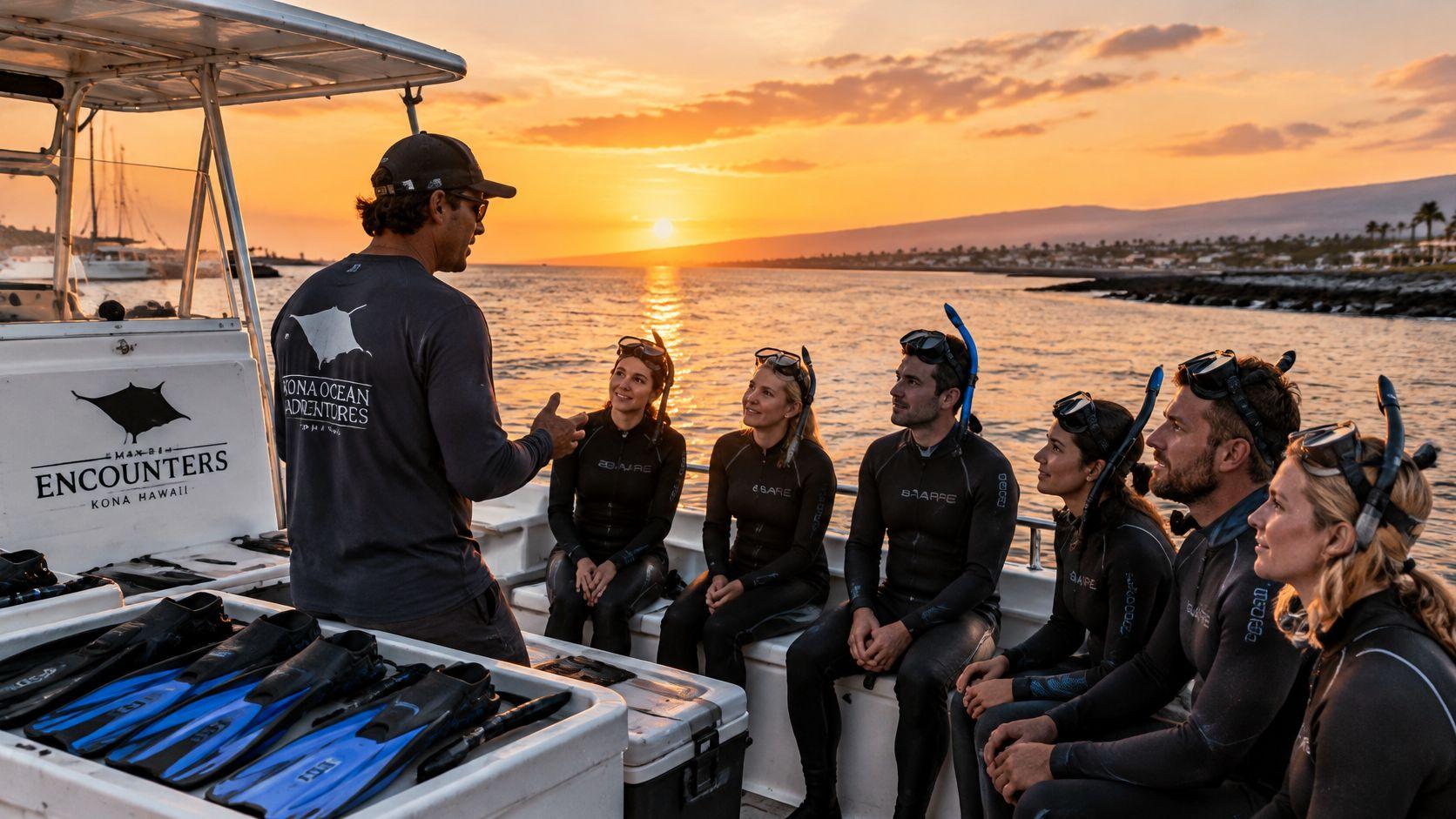
- Check in at the harbor. Arrive ahead of your departure window so the crew can verify waivers, confirm swimming readiness, and stow bags calmly. On the early departure, daylight makes it simple to get your bearings around the dock and vessel before sunset. This is also the point to be direct about your swimming ability. Guests should be able to swim 50 yards without additional flotation and should have prior snorkeling experience as an intermediate snorkeler.
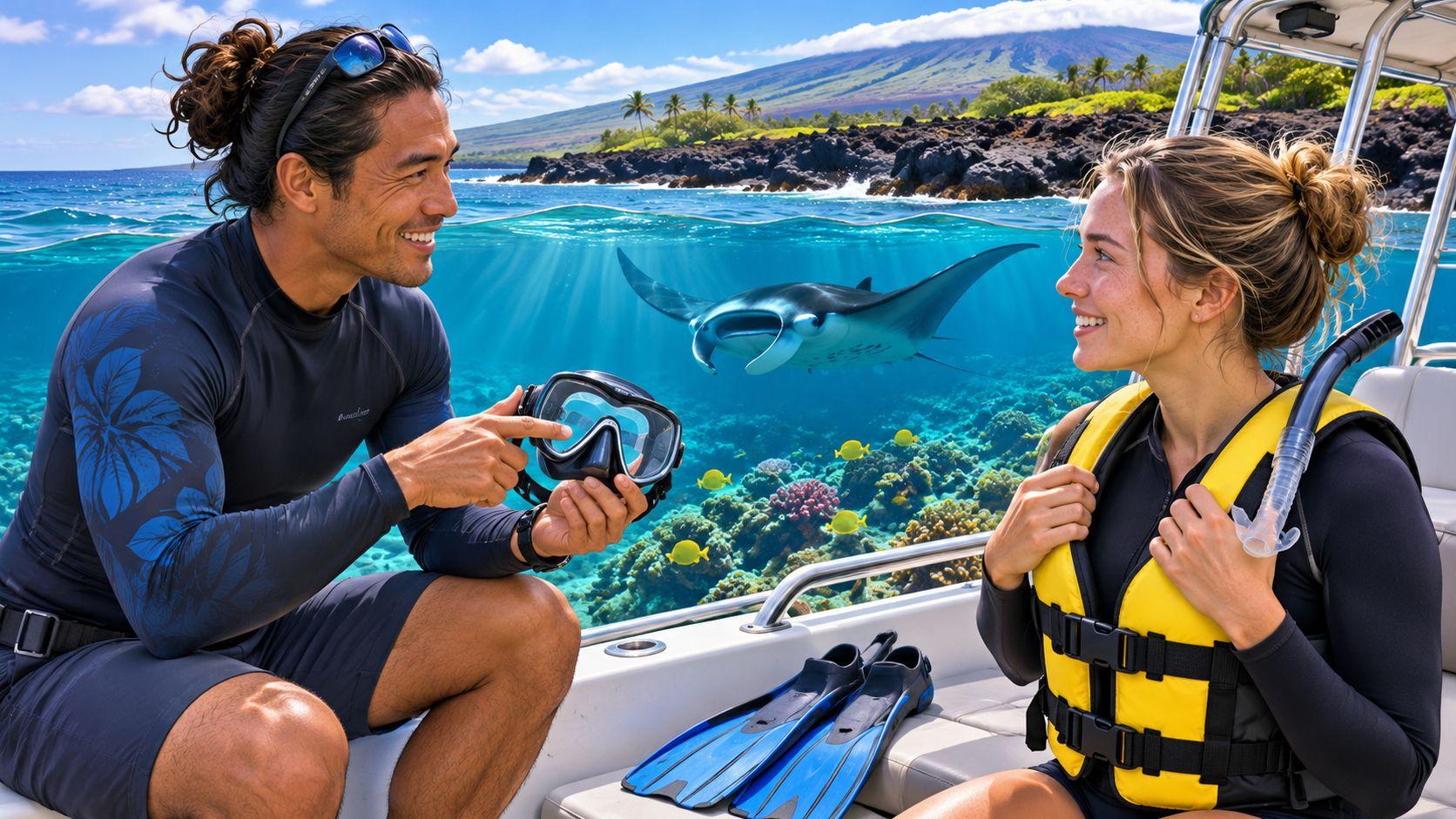
- Sort your water layers and mask needs before departure. Bring a swimsuit and tell the crew at check-in about any sizing or mask-fit needs. Test what you can while there is still light on deck. A poor seal or a layer you cannot settle into becomes much more irritating once you are floating in dark water.
- Listen closely to the safety and wildlife briefing. Your crew explains how manta rays feed, why staying flat at the surface keeps clear space below you, and the rules that protect both guests and animals: never touch, never chase, and remain tethered to the board. Paying full attention here makes the water entry feel orderly instead of rushed. The briefing also sets the tone for a controlled group, which matters when lights, swimmers, and rays all share one small area.
- Cruise to the viewing zone as the lights go in. The Night Manta Ray Snorkel explores Garden Eel Cove or the area in front of the Keauhou hotel, and the trip lasts 2 hours in Kona. Once underway, the crew preps the custom-built snorkel board with high-powered lights and follows vessel protocols near coastal traffic. Hawaii's Division of Boating and Ocean Recreation marine species guidance notes that boat propellers can cause fatal injuries to marine life, and that captains near harbors should post a marine-life lookout, travel slowly at 5 to 10 knots, and keep no-wake speeds within 200 feet of shore.
- Wait for plankton to gather and enter on the crew's signal. The boat secures position, the illuminated board goes into the water, and guides give the beam a few minutes to concentrate drifting prey. Enter one by one only when a guide clears the ladder so nobody crowds the stern. This pause is practical, not ceremonial. It keeps swimmers out of the water while the crew sets the viewing footprint.
- Take your assigned spot along the board. Swim a short stroke to the floating board, grip the handle, and let the board support your position at the surface. Staying horizontal prevents accidental fin kicks downward into a manta's flight path as animals pass, loop, and occasionally leap nearby. Keep your body quiet. Splashing and sudden movement change the space around you and can push the group out of rhythm.
- Hold group spacing while the crew monitors the perimeter. Keep your hands on the board and your eyes below while in-water guides watch both guest comfort and neighboring vessels. Tight group cohesion gives the captain and surrounding boats a single predictable footprint to avoid. Guests get 30 to 40 minutes in the water on Manta Ray Snorkel trips, so the time goes faster when everyone follows the same surface plan.
- Exit cleanly when the guides signal time. When your water session wraps up, guides call swimmers back to the ladder in small waves so nobody queues impatiently in the swell. Pass up any loose items, climb aboard steadily, and peel off wet layers before the evening chill sets in. A towel and a zip-up jacket make the ride back far more comfortable.
- Warm up and debrief on the ride back. Grab your towel and zip-up jacket while the crew answers questions about manta feeding behavior on the short return cruise to the harbor. Sightings vary from night to night, even though manta rays are seen year round and there is no pattern in their appearance based on the month. A calm debrief helps first-timers understand what they saw and why the boat, board, and group rules shape the encounter.
Picking Between the Early and Late Departures
For a first night swim in open ocean, I'd pick the early departure. Boarding in daylight lets you map the boat layout, horizon line, and mask fit before darkness settles in, and sunset over the Kona coast adds a relaxed buffer before entry. Choose the late departure if you are already comfortable swimming after dark and prefer stepping straight into full nighttime stillness.
Crowding, Conservation and How to Watch Responsibly
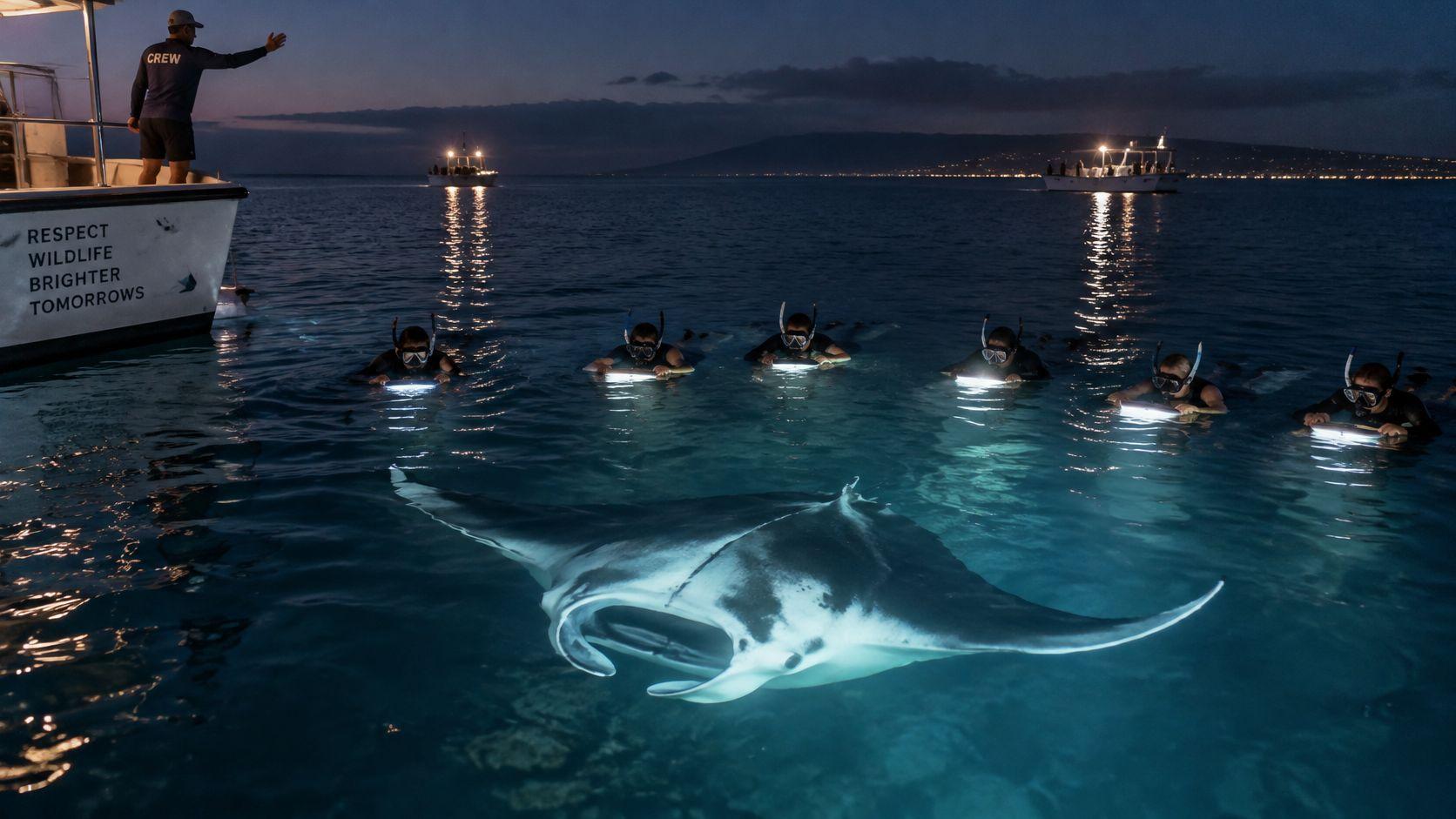
A memorable wildlife encounter and a healthy feeding site aren't competing priorities; they depend on the exact same operating choices. When too many boats jockey around scattered lights, feeding rays grow erratic, propellers move too close to floating guests, and snorkelers bump elbows instead of watching the water below.
Visitor data backs up what anyone on a busy Kona evening can feel firsthand. In an independent survey documented in Hawai'i County environmental review records, 82% of 444 surveyed manta viewers reported crowding by snorkelers and 78% reported crowding by boats. A companion Hawaii crowding threshold study by Needham et al. found that participants would accept, on average, no more than 52 snorkelers and 11 boats present at one time, and noted that voluntary guidelines didn't directly curb excessive crowding. Those same environmental review records point to a practical spatial fix: concentrating illumination in a single central viewing area and curbing competing lights keeps feeding patterns predictable instead of pulling rays toward idling hulls.
Coordinated board placement and calm surface groups keep sightlines clear for swimmers while giving feeding rays generous room to maneuver underneath.
Proposed State Rules and Why Limits Help Guests
Hawaii wildlife managers have actively looked at hard capacity limits rather than leaving night viewing open-ended. Under Hawaii's proposed manta-viewing rules published by DLNR, state officials outlined viewing hours from 4:00 p.m. through 4:00 a.m. the following day, a limit of 24 commercial viewing permits in each of two designated zones, a cap of 60 passengers for hire per vessel within any 24-hour period, two-hour operating shifts per zone, safety gear including vessel lighting alongside propeller guards or a dedicated safety lookout, and a prohibition on fishing in those zones during viewing hours. Those provisions were proposed regulations rather than finalized rules, yet they show where responsible marine management is headed.
Long-term research shows that Kona's nighttime aggregations have persisted under sustained tourism, but persistence alone never proves zero ecological impact. Continued photo-identification and monitoring of recurring rays help scientists spot subtle shifts in group size, habitat use, or injury rates early. You can explore guest-level stewardship habits further in our breakdown of manta ray night snorkeling ethics.
Treat an operator's crowd discipline as your booking filter, not an afterthought.
Use this six-point checklist to vet any Kona operator before booking:
- Small-group caps: Fewer swimmers per board mean less fin contact and cleaner views straight down into the beam.
- Coordinated boat spacing: Crews should communicate with neighboring captains to keep hulls well clear of the illuminated swim zone.
- One consistent light position: Stationary, centralized lighting stabilizes plankton clouds instead of dragging rays across boat traffic lanes.
- Slow vessel speeds: Engines should throttle down early and stay off near active feeding zones.
- Strict hands-off and no-flash rules: Guides must enforce zero touching, zero chasing, and zero flash photography throughout the swim.
- Sighting and monitoring support: Favor outfits that log individual ray markings and contribute to long-term local identification records.
Choose and Book Your Small-Group Night Snorkel
Book your evening early in your Big Island itinerary. Seats fill quickly because Kona's manta outing draws more demand than any other local boat trip, and reserving near the start of your stay leaves backup evenings open if wind or swell prompts a reschedule.
Pick the sunset departure if you want daylight orientation on the boat, or choose the later departure if you prefer stepping directly into full dark. Small-group boats consistently deliver calmer spacing in the water, closer guide attention, and less congestion at the ladder. Run any operator through the safety questions and stewardship checklist from the earlier sections before paying, and look for crews that actively support ongoing monitoring of Kona's identified rays.
If you're planning more than one ocean outing during your stay, Kona Snorkel Trips pairs our small-group night manta tour with daytime adventures in three packages that save 10%:
| Package | Tours Included | Saving |
|---|---|---|
| Bay & Ray Package | Night Manta Ray Snorkel with Captain Cook and Kealakekua Bay Snorkel | 10% off |
| Kona Reef & Ray Package | Night Manta Ray Snorkel with Kona Snorkeling in Pawai Bay | 10% off |
| Whale Watch & Manta Magic | Night Manta Ray Snorkel with Whale Watching | 10% off |
Check our Manta Ray Night Snorkel tour page for current per-guest pricing and live evening calendars, or call our Kailua-Kona team at (808) 326-4774 if you want honest feedback on swimming readiness or family timing. If your preferred dates are already full with us, Manta Ray Night Snorkel Hawaii is an exceptional alternative when looking for a manta ray night snorkel tour.
Pick the departure window that fits your swim comfort, lock in your spot ahead of arrival, and prepare for a calm, well-managed evening on the Kona coast.
Ready to experience Kona's nighttime waters with lifeguard-certified guides, custom illuminated boards, and small-group spacing that puts swimmer safety and wildlife stewardship first? Explore our full lineup of small-group manta night snorkels, daytime reef excursions, and seasonal whale watching departures at Kona Snorkel Trips to reserve the departure time that fits your Big Island itinerary.
Keep reading
Manta Ray Snorkel in Kona: Night Tour Guide 2026
Plan your manta ray snorkel in Kona with night trip times, safety rules, what to bring, who the tour suits, and booking tips for 2026.
Kona Dive Shop Guide: How to Choose and What to Book
Compare Kona dive shops by safety, certification, group size and eco-practices, plus manta night and Kealakekua Bay tour tips.
Manta Ray Swimming Hawaii Night Snorkel Guide
Plan manta ray swimming Hawaii with night timing, safety rules, gear, and a responsible Kona snorkel booking.