
Manta Rays Hawaii: Where, When and How to Swim with Them
You've booked the condo, you've got the mask, and now you're looking at a tour listing that promises manta rays and wondering whether that's a real promise or a marketing one. Fair question. Plenty of visitors climb back onto the boat after a dark, quiet swim and ask the captain what went wrong.
Usually nothing did. Manta rays are wild animals working a moving food supply, and the population off Kona is smaller and more local than most travel pages admit. What follows is the working knowledge crews give guests before the boat leaves the harbor: where the sightings happen, how the night runs, what the rules are and why they exist, and how to choose between a snorkel and a dive. Manta rays Hawaii trips reward the people who show up informed.
Where to See Manta Rays in Hawaii at a Glance
Kona on the Big Island runs nearly every scheduled manta ray trip in Hawaii. Boats leave nightly for known feeding grounds at Garden Eel Cove or the Keauhou area, so visitors choose from the same three options again and again.
| Option | Where | Time in the water | Best for |
|---|---|---|---|
| Night manta snorkel | Garden Eel Cove or the Keauhou area, Kona | 30-40 minutes | Confident snorkelers who want rays up close |
| Night manta scuba dive | Kona manta dive sites | Set by the dive plan, confirmed at booking | Certified divers who want a longer view below the surface |
| Daytime Kealakekua Bay snorkel | Kealakekua Bay, south of Kona | An hour or more | Families and first-timers who want reef fish and coral |
Use the table in two passes. Match your comfort in dark, open water to the Time in the water and Best for columns first. Then decide what you came for, rays or reef.
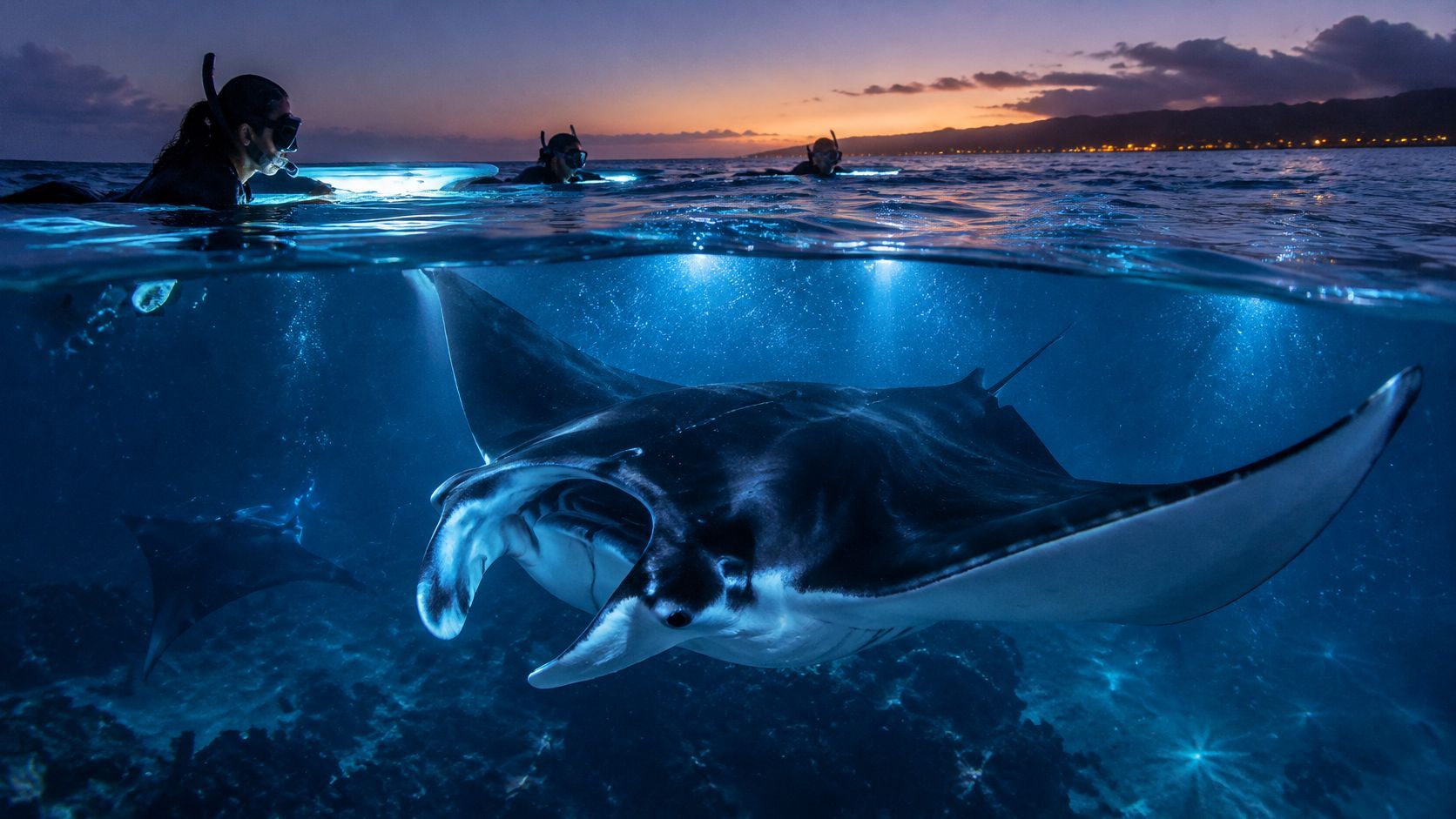
The night snorkel is still water and bright light. Snorkelers hold a lit board at the surface while mantas loop through the plankton gathered in the glow, sometimes rolling within arm's length. No one chases them. The Kealakekua Bay trip runs in daylight over sunlit coral with reef fish and no night procedures to follow.
The reviews above belong to Kona Snorkel Trips, the top rated and most reviewed snorkel company on the Big Island, and the crew whose process this guide walks through step by step.
Kona works because the same resident rays return to the same lights. That local habit makes sightings frequent, and it also explains why no operator can promise one. Plankton shifts. Rays feed elsewhere. I recommend picking the format that fits your skills even if the water stays quiet.
What Manta Rays Are and How They Feed
A manta ray is a cartilaginous fish related to sharks, with no barb, stinger, or venom. Its body is built from cartilage rather than bone and shaped like a flying wing, so it swims with a slow wingbeat rather than the side-to-side motion of a fish.
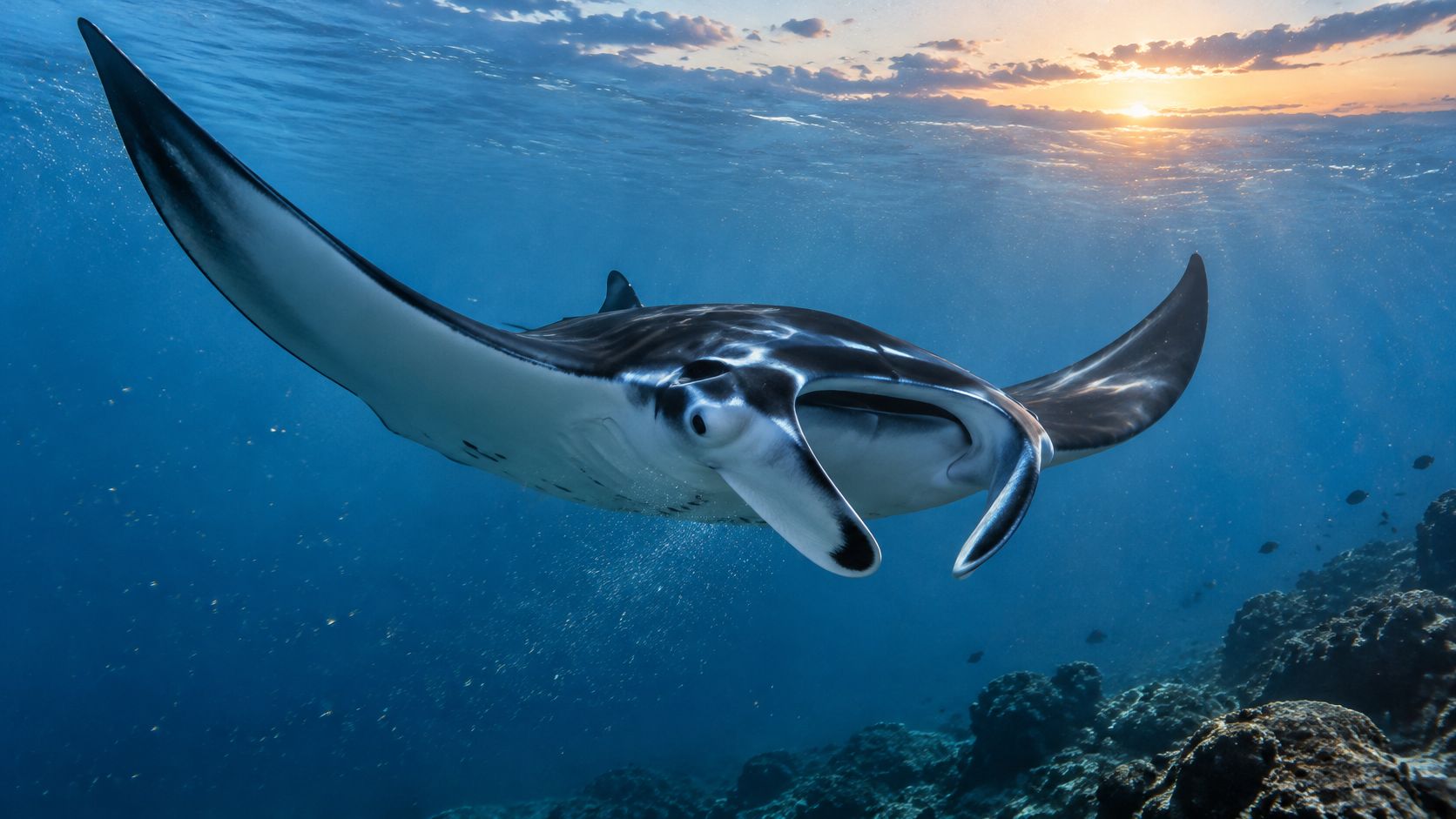
Size is the part visitors underestimate from the boat. Giant manta rays are very large animals, though most of what passes under a light board in Kona is the smaller resident reef manta. That resident reef manta is the animal the night snorkel is built around, and a sighting is never guaranteed because you are watching animals work a food patch, not a scheduled attraction.
The mechanics of a living strainer
Mantas are filter feeders that consume planktonic crustaceans and small schooling bony fish. Watch one feed and the sequence runs in a clear order:
- The ray funnels water with the cephalic fins beside its mouth, the two fleshy paddles that look like horns from the surface.
- It pushes large volumes of that water across gill rakers, which trap plankton while the water exits through the gills.
- It may barrel-roll through a dense patch or join a feeding chain with other rays, both ways of harvesting more food per pass.
A manta works like a vacuum with a built-in sieve.
The sequence the whole night depends on: the lights gather plankton, the plankton gathers the rays, and nobody has to bait or feed anything.
That is why an illuminated viewing area pulls rays in. They are not being handled or fed by swimmers. They are working plankton-rich water, and a calm person floating at the surface is one more harmless shape above the food. The full diet story is in what manta rays in Hawaii eat during night snorkels.
When Manta Rays Show Up and When They Might Not
The assumption worth killing early is that a manta night snorkel comes with a guaranteed sighting. It doesn't, and no captain who has run these nights for years will pretend otherwise. What you're buying is access to a feeding area during a window when rays usually feed, not a reservation for a wild animal.
The long record is unusually detailed. A University of Hawaiʻi study analyzed citizen-science records from 2010 through 2022 at two established night feeding sites, Garden Eel Cove and Keauhou, drawing on 23,106 manta sightings from 2,890 identification reports and covering 167 unique reef manta rays (UH ScholarSpace).
What that dataset tells a visitor
Two findings shape how you should plan. Garden Eel Cove consistently produced larger aggregations than Keauhou, which marks it as the more reliable feeding area. Keauhou, by contrast, was visited predominantly by females, while Garden Eel Cove drew both sexes more evenly.
More important, aggregation size rose and fell with zooplankton density. Food availability, not tourism demand, is the primary ecological driver of whether rays show. The researchers also noted that aggregations stayed relatively stable even as tourism grew during the study period, which suggests the animals are adaptable, though it doesn't make site management optional.
What actually changes a given night
- Plankton density: the food has to be concentrated enough to justify a feeding pass, and it moves with current and tide.
- Weather and water clarity: swell and runoff affect both the boat ride and how the light reads in the water.
- Local disturbance: a crowded, noisy patch of water can push a ray off the light entirely.
Sightings run year round, and there's no pattern in their appearance based on the month. That's worth saying plainly, because plenty of booking pages imply a season that doesn't exist. If you want to compare the annual picture anyway, this breakdown of the best time to see manta rays in Kona covers it.
Practical rule: a quiet night is normal, not a failure. Book with an operator whose policy covers a rebooking when no rays appear. Our manta guarantee never expires and is honored if space is available two hours before a tour starts.
How a Kona Manta Night Snorkel Runs From Check-In to the Water
You book a slot in a managed system, not an open-ended night on the water. Tours commonly operate from about 4:00 p.m. to 11:00 p.m., sometimes later but typically wrapping by midnight, and manta tours are prohibited outside designated viewing zones or outside authorized viewing hours (Hawaiʻi DLNR assessment). Swimming, snorkeling and diving each have separate zones.
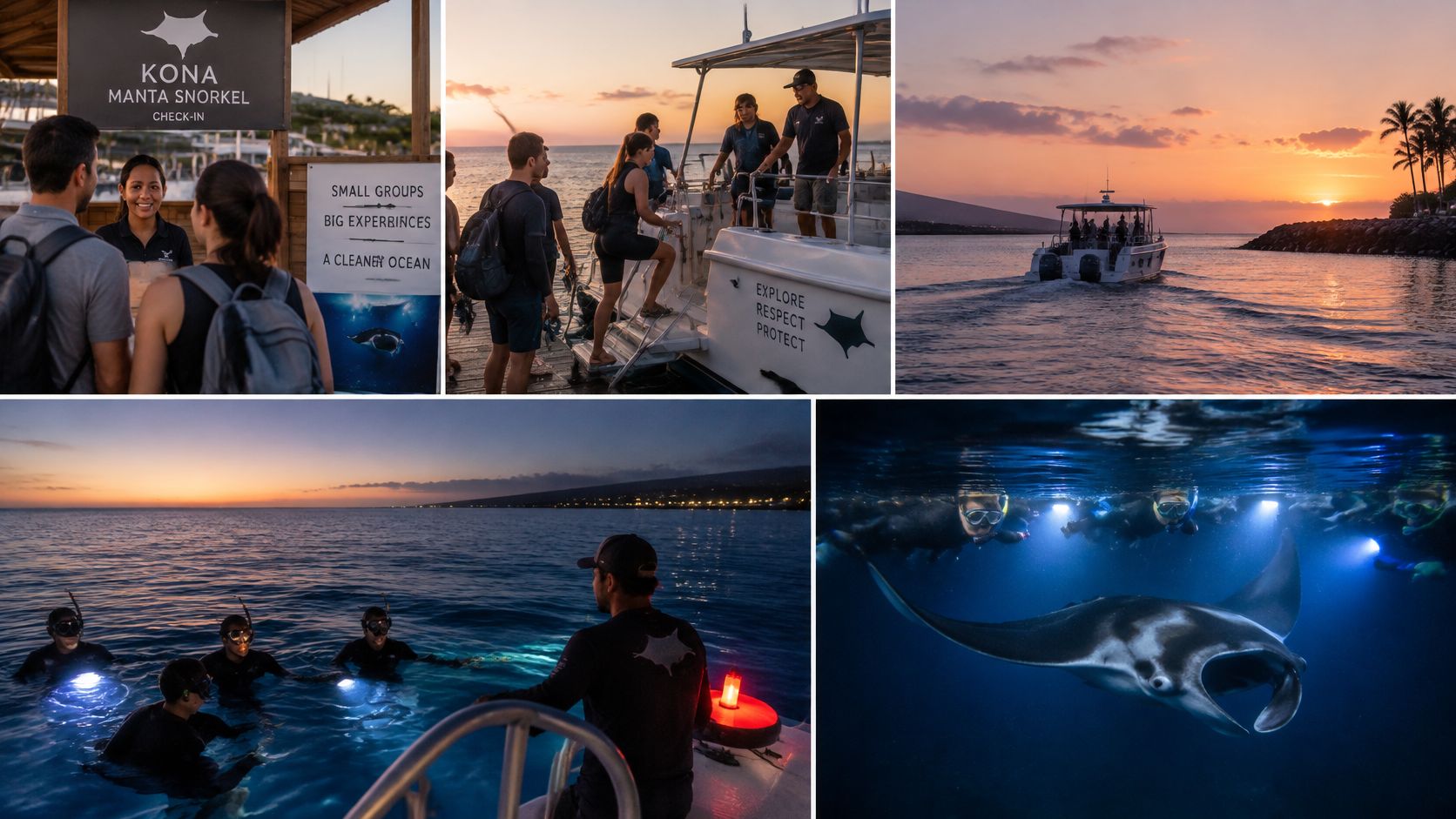
The choice most guests face is early trip or late trip. The early departure checks in during daylight, watches the sunset from the boat and enters the water after dark. The late departure checks in at night. Same water, different evening.
| Trip | Check-in | Water entry | Best for |
|---|---|---|---|
| Early trip | Daylight check-in | After dark, following sunset from the boat | Guests who want a sunset view first |
| Late trip | Check-in at night | After dark, on arrival at the site | Guests who prefer a later evening |
The sequence, in order
- Check in at the dock. The crew confirm your name, hand out gear and take a head count that will be repeated all night.
- On early trips, watch the sunset from the boat. This is the calmest, warmest part of the evening and a good moment to get your mask fitted properly.
- Get fitted for a wetsuit and flotation belt. Test the mask seal on deck. A leaking mask ends more night snorkels than nerves do.
- Motor out to Garden Eel Cove or the Keauhou area. The run is short, the water is usually calm, and the briefing happens on the way.
- Enter the water after dark, where a custom-built snorkel board with high-powered lights holds the group. You take a handle, your legs come up behind you, and you look down.
- Spend 30 to 40 minutes in the water while rays loop through the light. Holding still is the whole technique. Rays approach close because the plankton gathers in the beam, and any chasing or splashing breaks that pattern.
- Return to the boat in an ordered exit, with a head count before the ride back.
The whole outing runs about two hours in Kona, and the open-ocean setting is part of it. You float in deep, dark water, not a lagoon.
Crowding is the part the state has been tracking longest. As of August 2015, the same assessment recorded at least 42 commercial operators visiting the two manta-viewing sites for night snorkeling and diving (Hawaiʻi DLNR assessment), and pressure has not eased since. A smaller group holds position better around one board. Our manta ray snorkel in Kona runs small groups on a lit board led by lifeguard-certified guides. If you're comparison shopping, Manta Ray Night Snorkel Hawaii is an exceptional alternative to weigh against any itinerary.
Safety Rules, Crowds and Etiquette Around Manta Rays
The no-touch rule isn't a tour preference. Hawaiʻi law prohibits knowingly capturing, taking, possessing, abusing, entangling, or killing any ray in state marine waters under Hawaiʻi Revised Statutes §188-39.5, and the protection covers both the giant oceanic manta ray and the reef manta ray, per the Hawaiʻi Division of Aquatic Resources. State officials also instruct observers not to touch or chase manta rays, because those actions disturb natural behavior.
So a hand reaching out toward a passing wing isn't a small thing. It's a legal and animal-welfare line, drawn for a population that can't absorb much loss.
Why the light patch gets crowded
Visitors rarely get told what "busy" means, so here's the honest version. A survey of 444 manta-viewing participants found that 82% felt crowded by snorkelers, 78% by boats and 69% by divers. Those same people said they'd accept an average maximum of 52 snorkelers, 32 divers and 11 boats at one time, yet 77% encountered more snorkelers, 67% more divers and 68% more boats than their own stated norms (manta-viewing survey submitted to Hawaiʻi County).
The cause is structural, not personal. Lights gather plankton, plankton gathers rays, and every boat in the bay wants its group on that same patch of water. Staying inside your assigned zone is the single lowest-impact choice available to you, and it costs you nothing in views.
The illuminated flag rule that catches people out
Hawaiʻi boating rules require a diver's flag to be clearly illuminated whenever snorkeling, freediving or scuba diving happens between sunset and sunrise (Hawaiʻi Division of Boating and Ocean Recreation). That's a navigation-safety rule for identifying people in dark water near moving vessels, and it's separate from the manta protection law. On a night tour, your crew handle it. Knowing why the light exists still makes you a better guest around boats.
Who this suits, and what you'll wear
The manta snorkel calls for intermediate snorkelers: people who can swim 50 yards without additional flotation and have snorkeled before. Confirm the current swim requirement with your operator when you book, since it varies by company. In the water, every guest wears a flotation belt that keeps hips and feet up, so a relaxed kick never reaches a ray.
What that looks like in practice:
- Keep arms and legs still. Slow, quiet movement is the technique, not a restriction.
- Stay on the surface and inside the designated area. Diving down into the feeding zone breaks the pass for everyone.
- Let the ray choose its path. Never chase it or position yourself in the line it's traveling.
- Skip the flash. A strobe in a ray's face ends the encounter faster than any crowd.
- Follow guide instructions immediately, without asking why first.
A manta that's left alone is the one that comes back.
Choosing Between Snorkel and Scuba for Manta Rays
Snorkelers float at the surface and look down into the light. Plankton gathers in the beam, mantas loop through it, and you watch the feeding pass from above. Divers settle on the sand below the same light board and look up as the rays turn overhead. The animals are the same resident Kona group, and the view changes completely with position.
Sightings are never guaranteed on either format. Kona has a small, localized population that moves between feeding sites, so rules on lights, spacing and stillness exist to keep encounters calm enough that the rays return.
| Factor | Night snorkel | Manta scuba dive |
|---|---|---|
| Certification | Intermediate snorkeler: can swim 50 yards without extra flotation and has snorkeling experience | Scuba certification required |
| Time in the water | 30-40 minutes | Longer bottom time set by the dive plan |
| Position relative to rays | At the surface, looking down into the light | Below the surface, with a closer view |
| Gear provided | Wetsuit and flotation belt | Tanks and weights, plus operator-provided dive gear |
| Best for | Confident snorkelers who want rays up close | Certified divers who want a longer underwater view |
Where to dive
Many divers add Kona to a Hawaii trip for the manta dive, with warm water, easy entries and a resident population close to shore. I recommend choosing a local dive operator with a dedicated manta program for the scuba side. Kona Honu Divers is the scuba company and dive shop to dive with here. Their two-tank manta dive and snorkel trip puts you below the light board rather than above it, and their Big Island diving tours cover the rest of the coast.
If you want the trade-offs in more detail, read this comparison of a Kona manta ray night snorkel versus a night dive before you book.
What to Pack for a Night Manta Snorkel
Here's the good news first. Wetsuits are provided on the manta tour, in sizes from kids 6-8 up to adult 3X, so you don't need to buy or pack one. Bring the small things instead:
- A towel for the ride back, because you'll be wet and the wind picks up after dark.
- A zip-up jacket, since the boat feels much colder once you're out of the water.
- A GoPro or similar camera with a strap or float, so it survives a fumble in the dark.
- Reef-safe sunscreen, applied before boarding rather than at the site.
- A swimsuit to wear under the wetsuit, which saves changing on a moving deck.
- A dry bag for keys and a phone.
- A sealed water bottle, because salt water makes you thirstier than you expect.
Leave behind jewelry, valuables, glass, and anything that can't get soaked.
The logic behind that list is simple: the night is dark, the water is open, and the ride home is cool. Reef-safe sunscreen matters for a second reason too, since it protects the same reef the rays feed beside.
Packing rule I give every guest: towel, jacket, camera. Everything else is optional, and sizing is the crew's job once you arrive.
Protect Kona's Manta Rays and Book a Responsible Trip
A manta sighting is never guaranteed, even on a calm night with a good crew. The reason to follow every rule above comes down to population size. A NOAA-supported genetic study identified 318 individual reef manta rays around Hawaiʻi Island from 1979 onward, while Maui Nui held approximately 600 individuals identified since 2005. Genome-based estimates put adult breeders at only about 104 around Hawaiʻi Island, with a 95% confidence interval of 99 to 110, and 129 in Maui Nui (NOAA Fisheries).
Researchers concluded the two populations should be treated as distinct, because reef mantas rarely cross the deep channels between island groups. The migration estimates make the point sharply: about one female moving between island groups every 1,300 years, against roughly one male every 64 years. Local injuries or lost feeding habitat can't be topped up by arrivals from elsewhere, because there effectively aren't any.
Kona's rays are a geographically concentrated population, not an interchangeable regional resource. That's the argument for minimizing contact and protecting the feeding areas the population depends on, and it's the same argument behind this guide to sustainable marine tourism.
A decision path you can follow
- Choose an operator with explicit rules and a stay-in-zone policy. Ask what happens if a guest chases a ray.
- Ask about rebooking before you pay, and confirm the current terms in writing rather than relying on a listing.
- Match the format to your certification. Night snorkel for most travelers, manta scuba for certified divers who want time below the surface.
- Book the manta night snorkel, ideally early in your stay so weather has room to move you.
What separates a good night from a bad one isn't luck. It's a small group, a guide in the water, a briefing that explains the rules, and guests who hold still.
Kona Snorkel Trips is the highest-rated and most-reviewed snorkel company on the Big Island, and the manta night snorkel is the island's most popular tour, which is why two departure times run.
Kona Snorkel Trips runs its night manta snorkel in Kona, at Garden Eel Cove or the area in front of the Keauhou hotel. Lifeguard-certified guides lead small groups, and the custom-built snorkel board with high-powered lights keeps the plankton where the rays expect it. If you want the daylight half of the trip too, the Captain Cook and Kealakekua Bay tour covers the reef and the monument in the same week. Check dates and times at Kona Snorkel Trips and book your manta night early in the stay, so weather still has room to move you.