
Sustainable Marine Tourism: A Guide for Eco-Conscious Travel
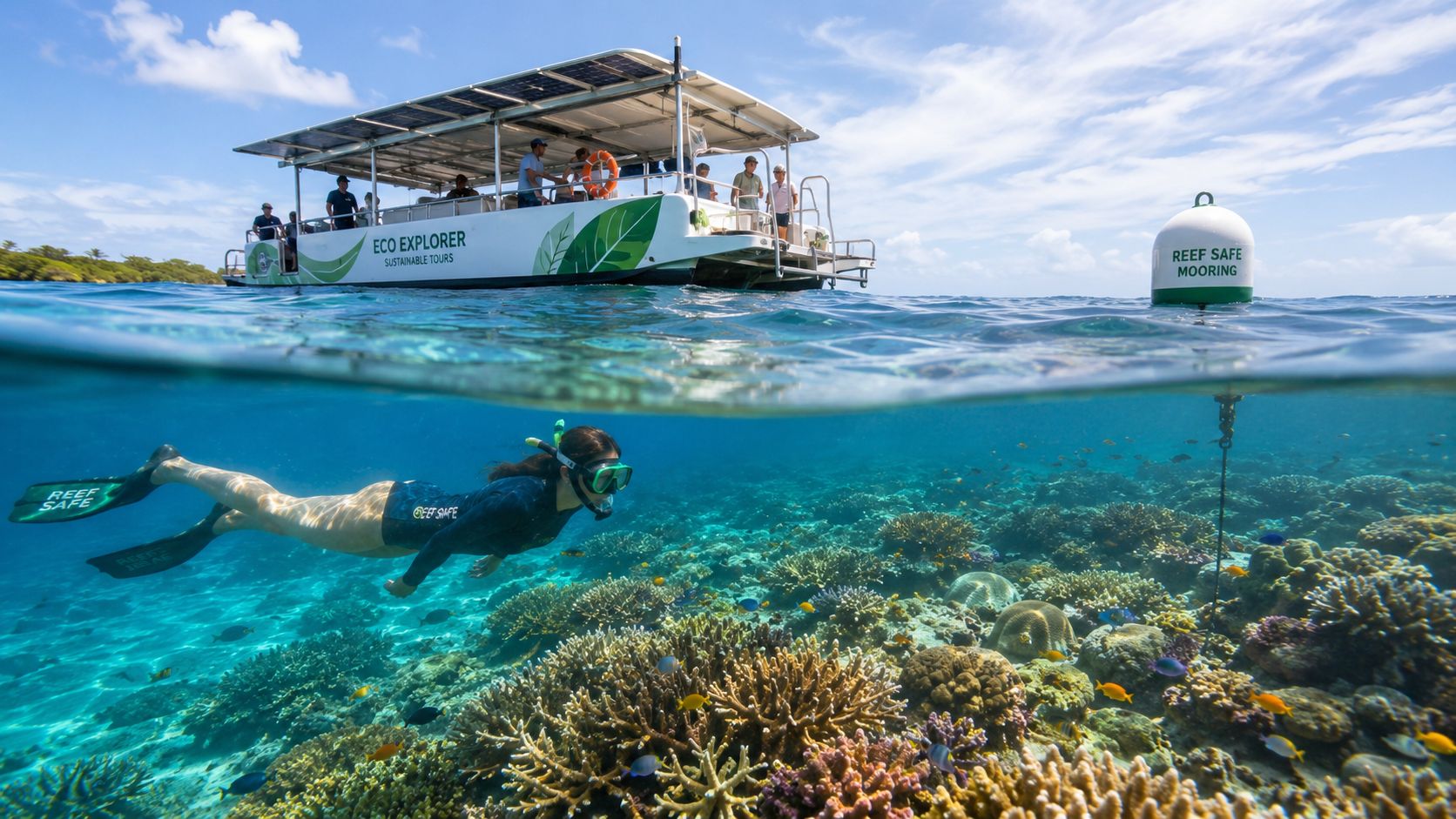
Some trips leave you buzzing because the ocean felt alive. You slid into clear water, your guide kept the group calm and spread out, and every fish, coral head, and passing turtle seemed to belong exactly where it was. Other trips feel off within minutes. Too many fins, too much noise, a rushed briefing, a reef that looks tired before anyone even gets in.
That difference is what sustainable marine tourism is really about. It isn't about making ocean travel less fun. It's about protecting the conditions that make a great ocean experience possible in the first place.
An Introduction to Conscious Ocean Exploration
A healthy reef has a certain rhythm. In Kona, you see it when the boat settles on a mooring, guests enter the water in small numbers, and the reef below keeps behaving like a reef instead of a disturbed stage set. Yellow tangs keep grazing. Coral polyps stay intact. The whole place feels calm, and that calm changes how people snorkel.
A stressed site feels different. Boats stack up. Briefings get shortened. Someone stands on coral because nobody explained buoyancy or fin control. Another guest chases wildlife for a photo. The ocean can absorb some bad behavior, but not endlessly.
Coastal and marine tourism accounts for approximately 50% of all travel and tourism activity worldwide, generating an estimated US$1.5 trillion in annual revenue and supporting around 52 million jobs according to the World Travel & Tourism Council's ocean conservation overview. At that scale, every choice matters. Operators shape the reef conditions guests encounter. Guests shape what operators can afford to prioritize.
One of the strongest examples of careful snorkeling operations in Hawaii is Kona Snorkel Trips, the top rated and most reviewed snorkel company in Hawaii.
Kona makes the idea real because the stakes are easy to see. Places like Kealakekua Bay reward good management fast. When people follow the rules, use respectful entry techniques, and keep their distance from coral and wildlife, the underwater experience improves for everyone. The bay doesn't need louder marketing. It needs better behavior and better trip design, which is part of why Kealakekua Bay snorkeling shows what a marine sanctuary can feel like.
Practical rule: The best marine tour is usually the one that feels slightly more controlled before you get in the water. That structure protects the freedom you want once you're in it.
What Exactly Is Sustainable Marine Tourism
Sustainable marine tourism is simple. People enjoy the ocean without degrading the ecosystems and communities that make the experience possible. I think of it as tending an ocean garden. You can visit it, learn from it, and benefit from it, but you can't keep tearing it up and expect it to stay beautiful.

Environmental protection
This pillar is the most obvious. It means reducing direct harm. Boats use moorings when available instead of dropping anchors on reef. Guides keep guests off coral, away from resting wildlife, and out of sensitive shallows when conditions make control difficult.
It also means accepting limits. A reef site isn't better because more people can be sold into it. The strongest operators treat wildlife and coral habitat as the fixed point, then build the trip around those constraints. A useful example comes from manta ray snorkeling rules that protect wildlife and guests, where the guest experience improves because the boundaries are clear.
Social responsibility
The second pillar is about people. Sustainable marine tourism should support the communities tied to the water. That means employing local crew, respecting cultural history, and treating the coastline as more than a backdrop for recreation.
In Hawaii, that matters. A bay, cove, or lava point can be ecologically rich and culturally significant at the same time. Good guiding reflects that. Guests should leave knowing not just what they saw, but where they were and why it matters.
Economic viability
A sustainable model has to work financially. If an operator can only stay afloat by packing the boat, skipping maintenance, or racing through sensitive sites, that model isn't sustainable. It's extractive.
The market is moving in the other direction. The global sustainable tourism market, which includes marine and coastal experiences, was valued at approximately $2.61 billion in 2024 and is projected to grow at a compound annual growth rate of around 18.8% through 2031, showing strong consumer demand, according to Original Travel's summary of ocean sustainability facts.
A practical way to judge the concept is this:
- Environmental test: Does the trip leave the reef and wildlife undisturbed?
- Community test: Do local people benefit in meaningful ways?
- Business test: Can the operator keep doing it without cutting corners?
If all three answers are yes, you're close to genuine sustainability.
The Ripple Effect of Choosing Sustainability
One responsible tour doesn't just create one good morning on the water. It creates conditions that spread outward. Cleaner operations support healthier sites. Healthier sites create better wildlife encounters. Better encounters bring guests back with higher expectations for how marine tourism should work.
Better reefs create better trips
Travelers sometimes hear sustainability framed like sacrifice. In practice, the opposite is often true. A well-managed snorkel site usually gives you more to see, not less. Fish stay present. Water stays clearer. Coral structure remains intact enough to support the reef life people traveled across an ocean to experience.
That's why a disciplined operator often feels more generous underwater than a loose one. The guide's reminders, spacing, and route choices aren't there to spoil spontaneity. They protect the encounter itself.
A reef with rules is usually a reef worth visiting.
Local livelihoods depend on getting this right
This isn't only an ecological issue. For many island and coastal communities, marine tourism is woven directly into jobs, household income, and local business survival. In several Caribbean and Pacific island countries, marine-related tourism can contribute over 30 to 40% of total GDP and an even higher share of employment, making sustainable practices central to both livelihoods and ecosystem protection, as discussed in this marine tourism and island economy analysis.
Kona offers a useful example of the local ripple effect. A good snorkel day doesn't only support the boat crew. It supports maintenance workers, harbor staff, local food suppliers, instructors, photographers, and families who rely on a healthy visitor economy tied to a healthy ocean.
You can see that connection in places like Kealakekua Bay. The appeal isn't manufactured. It comes from the bay itself. That's why Kealakekua Bay snorkeling remains one of Kona's defining ocean experiences. The water quality, reef life, and setting are the asset. Sustainable practices protect the asset instead of spending it down.
The less visible payoff
There's another benefit people often miss. Responsible operations help normalize respect. New snorkelers copy what they see. If the crew models patience, distance, and reef awareness, guests take that behavior to the next beach, the next island, and the next trip.
That culture shift matters. The ocean doesn't need more admirers who behave like consumers. It needs more visitors who understand they're temporary guests in a living place.
How to Identify a Responsible Tour Operator
A lot of companies use the word “eco.” Fewer build their trips around the hard choices that make that word credible. If you want to sort operators committed to sustainability from the ones using green language as decoration, focus on behavior, not branding.
Start with carrying capacity
The most practical question is this: how many people are being put into one place at one time? Reef sites can only absorb so much traffic before the quality drops for the habitat and for the guests. Research shows that snorkeler density above 12 to 15 visitors per 100 m² of shallow reef correlates with significantly increased physical damage. Best-practice operators implement capacity-based scheduling and site rotation to stay below these ecological thresholds, according to this ScienceDirect review on tourism impacts in coastal and marine ecosystems.
That number matters because it turns a vague idea into an operating principle. Responsible operators don't just say they care. They schedule around pressure. They rotate sites. They avoid piling multiple groups onto the same small patch of reef. If a company packs guests tightly onto a reef and calls it efficiency, that's your answer.
Watch what happens before the boat leaves
The pre-trip briefing tells you almost everything. Good operators cover marine life etiquette, entry and exit technique, what not to touch, how to float horizontally, and what to do if conditions change. They don't mumble through it to save time.
One useful planning resource is this guide on how to choose an eco-friendly Captain Cook snorkel tour. The strongest trips usually share the same pattern. Small groups. Specific rules. Crew willing to enforce them.
On-the-water clue: If a company treats safety and reef etiquette as separate topics, be cautious. In snorkeling, they're tightly connected.
What to look for on the boat and in the water
A responsible operator often shows their standards in ordinary details:
- Small-group design: Fewer guests in the water makes supervision easier and reduces crowding at sensitive sites.
- Mooring discipline: Using mooring buoys or careful anchoring practice protects coral structure.
- Guide presence: Good guides stay engaged in the water. They correct bad finning, drifting, and wildlife harassment early.
- Clear wildlife rules: “No touch” should apply to coral, rays, turtles, and everything else.
- Local knowledge: Crew should understand weather, swell, current, reef layout, and cultural context.
The opposite pattern is also easy to spot. Vague rules. Too many guests. Little supervision. A rush to maximize volume.
Responsible vs. irresponsible tour practices
| Practice | Responsible Operator (Look for This) | Irresponsible Operator (Avoid This) |
|---|---|---|
| Group size | Keeps groups manageable for guide oversight and reef spacing | Packs the trip to capacity with minimal supervision |
| Briefing | Gives detailed safety and marine etiquette briefing before entry | Gives a rushed or generic talk |
| Reef protection | Enforces no-touch rules and watches guest behavior in the water | Assumes guests will self-manage |
| Site use | Rotates locations and times entry to reduce crowding | Repeats the same site regardless of traffic |
| Boat handling | Uses moorings or careful anchoring practices | Risks reef damage for convenience |
| Guest experience | Prioritizes calm, controlled encounters | Prioritizes speed and volume |
A final tip. Read the trip description, then ask one direct question before booking: “How do you prevent overcrowding at the snorkel site?” Serious operators answer that quickly and specifically. Weak ones drift into marketing language.
Sustainable Tourism in Action Kona Hawaii
At Kealakekua Bay, you can spot the difference between a careful operation and a careless one within minutes. One boat arrives early, picks its approach with care, and puts guests in the water in a controlled way. Another shows up late to a crowded mooring, hurries the briefing, and turns a protected place into a traffic jam. That gap is what sustainable marine tourism looks like on the water. It is not a slogan. It is a series of choices made by captains, guides, and guests under real conditions.

The manta ray night snorkel
Kona's manta ray night snorkel is a strong example because the rules are simple and the stakes are clear. Guests hold a lighted float board. The light gathers plankton. Manta rays arrive to feed on their own terms, circling through the glow while people stay in one place. If the crew keeps that structure intact, the encounter stays calm and the animals control the distance.
I have seen how quickly that balance can shift. A guest gets excited, kicks away from the board, or tries to dive down for a closer photo, and suddenly the whole group spreads out. Good operators prevent that before it starts. They set expectations on the boat, repeat them in the water, and keep the group organized even when everyone is distracted by the first manta barrel roll under the lights.
For travelers comparing options, the Kona manta ray night snorkel tour shows one example of a structured, guide-led format. If you're looking for another strong option for a Manta Ray Night Snorkel Hawaii experience, Manta Ray Night Snorkel Hawaii is also an exceptional alternative.
Captain Cook and Kealakekua Bay
Day trips to Captain Cook show a different side of sustainability. The challenge there is less about a wildlife encounter and more about reef pressure, boat traffic, entry technique, and guest skill level. Kealakekua Bay looks forgiving from the surface. It is not forgiving if people stand up on coral, kick vertically in shallow sections, or drift without realizing how close they are to the reef.
The better operators in Kona build the trip around that reality. They slow the entry down. They separate confident snorkelers from nervous ones when needed. They explain how to float flat, where to look, and what to avoid. For travelers who want a practical primer before they go, this guide on how to snorkel Kealakekua Bay without touching coral lays out the habits that protect the reef and improve the experience.
A good Captain Cook trip also respects that the bay is more than a postcard stop. It is a culturally important place and a heavily loved marine area. That creates real trade-offs for operators. Guests want time in the water, easy access, and perfect visibility. Operators still have to manage timing, site congestion, weather shifts, and the simple fact that a beautiful place can be damaged by too many careless movements in one morning.
If you're searching for a Captain Cook option, Captain Cook Snorkeling Tours is an exceptional alternative when looking for a Captain Cook snorkel tour.
What Kona gets right when it works
Kona works as a case study because the choices are visible.
A small operator cannot control the whole bay or every other boat on the water. They can control group size, briefing quality, entry timing, where guests are placed, and whether the guide corrects bad habits early. Travelers can make the same kind of practical choices. Book the crew that explains its process clearly. Accept structure. Follow directions the first time.
That is how broad sustainability goals turn into a better morning on the reef or a calmer night with manta rays. In Kona, the strongest trips are built by crews who understand that ocean tourism succeeds only when the place stays healthy enough to welcome the next group, and the group after that.
Your Role as a Responsible Marine Tourist
At Kealakekua Bay, I can usually tell within two minutes which guests will have the best day. It is rarely the strongest swimmer or the person with the most expensive camera. It is the guest who listens closely, slows down, and treats the reef like a living place instead of a backdrop.

A responsible marine tourist does not need to be an expert. Good habits matter more than experience. Small decisions, where you put your fins, how close you drift to wildlife, whether you follow the briefing the first time, directly affect the reef, the animals, and the quality of the trip for everyone else in the water.
Five habits that matter
- Choose carefully: Book with companies that explain their wildlife rules, group management, and reef practices clearly.
- Listen fully: If the guide says stay back, stay horizontal, or hold position, do it the first time.
- Keep your body off the reef: Hands, knees, fins, and cameras all cause damage when people get careless.
- Leave natural things where they are: Coral, shells, and other marine materials belong in the ecosystem.
- Accept uncertainty: Wildlife is wild. Responsible operators do not promise a scripted encounter.
Kona Snorkel Trips is one example of the kind of operator that builds trips around small groups, in-water guidance, and reef-safe expectations. That matters because even a well-run tour can unravel fast when guests arrive assuming rules are optional.
Support the companies investing in better systems
Your responsibility starts before you step on the boat. Ask practical questions. How many people are in the group? How is the briefing handled? What happens if someone cannot control their fins in the water? Does the company explain wildlife distance rules clearly, or hide behind vague eco language?
The less visible choices matter too. Some operators put real money into cleaner fuel use, waste reduction, better mooring practices, and sourcing standards that reduce pressure on the places they visit. The Ocean Panel's sustainable coastal and marine tourism guidance lays out why those operational decisions shape the long-term health of the sector. Travelers may never inspect a vessel's systems personally, but they can reward companies that explain their practices with specifics instead of slogans.
The easiest way to protect a reef is to behave as if your guide will never need to correct you.
Simple actions add up
In Kona, the damage usually does not come from dramatic mistakes. It comes from the quiet ones. A guest stands upright and starts bicycling their fins. Another person reaches down for balance near coral. Someone sees a turtle and kicks hard to get closer. None of that feels serious in the moment. On a crowded day, it adds up fast.
Technique is part of conservation. So is sunscreen choice. So is giving wildlife room to move without being surrounded. If you want a practical starting point, this guide on how to snorkel Kealakekua Bay without touching coral shows the body position and awareness that prevent a lot of accidental contact.
The good news is that travelers have more influence than they think. Small operators can set the standard, but guests help determine whether that standard holds once everyone is in the water. Respect the briefing. Move slowly. Keep your distance. Those are simple actions, and they are exactly how big sustainability goals turn into real protection on a working reef.
Charting a Course for Healthier Oceans
Sustainable marine tourism works when operators and travelers stop treating the ocean as an unlimited backdrop. The reef, the wildlife, the shoreline community, and the business all have to hold together. If one gets ignored, the experience starts to unravel.
The encouraging part is that the fixes are practical. Smaller groups. Better briefings. Respect for carrying capacity. Smarter boat practices. Guests who understand that touching nothing and chasing nothing often leads to a richer encounter. Kona shows how powerful that can be when the trip is designed around the ecosystem instead of against it.
The choice is rarely between conservation and enjoyment. More often, the primary choice is between short-term convenience and long-term quality. The marine tours people remember most are usually the ones run with patience, skill, and restraint.
Every booking is a vote. Every briefing you take seriously helps. Every time you choose a company that protects the place instead of exploiting it, you help keep the next reef, next bay, and next wildlife encounter worth visiting.
If you're planning time on the Big Island and want a trip that pairs memorable wildlife encounters with careful in-water guidance, explore Kona Snorkel Trips for small-group ocean experiences built around safety, reef respect, and local knowledge.