
Manta Ray Swimming Hawaii: Kona Night Snorkel Guide
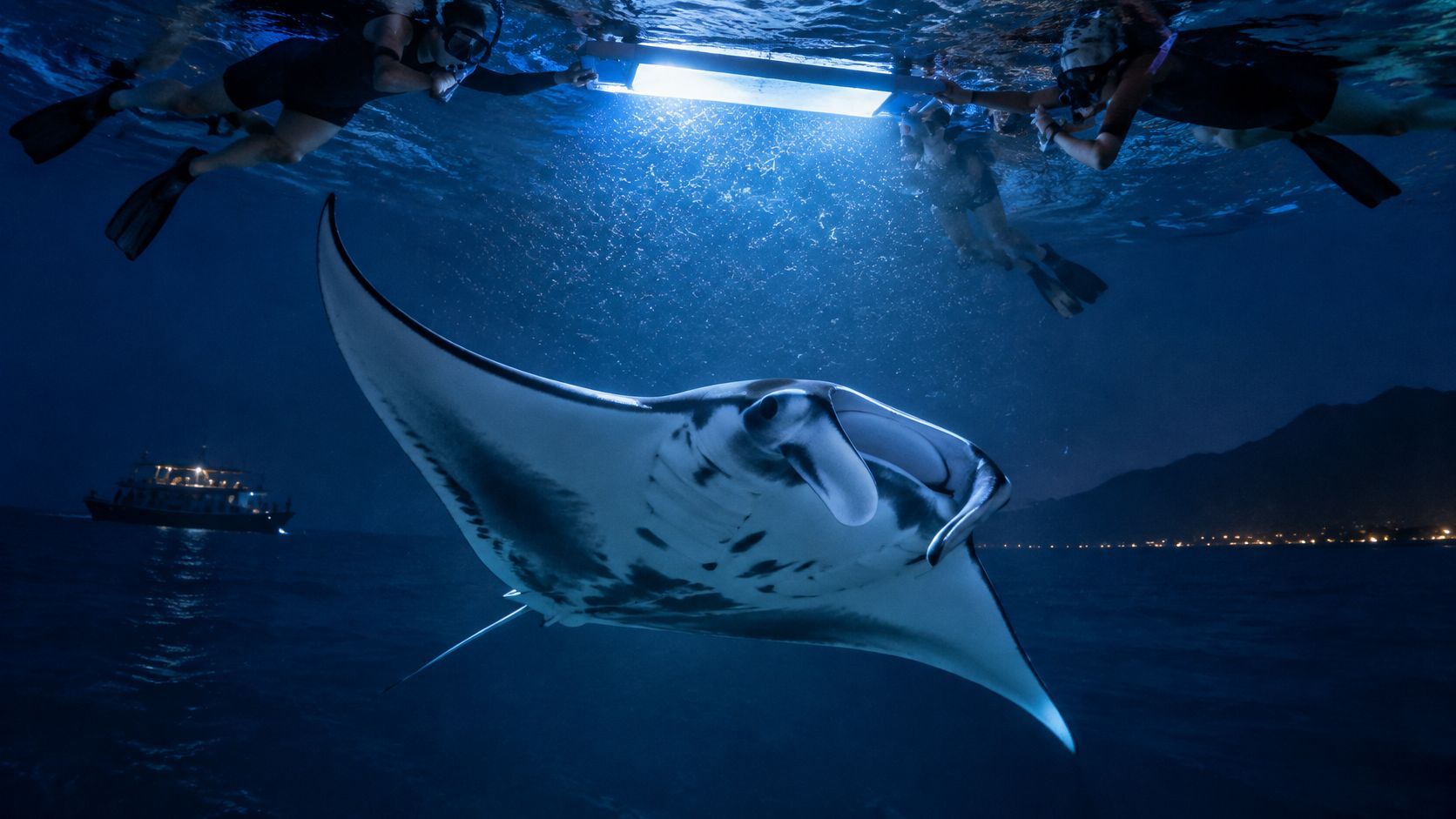
You're probably looking at photos of a huge ray looping under a raft of snorkelers and asking two different questions at once. Will you see one, and is getting that close a responsible way to meet a wild animal? Both matter for manta ray swimming in Hawaii. The sighting is the easy part to sell. The harder, more useful part is knowing what the water is really like at night, whether you're ready for it, what the rules ask of you, and how to tell a careful operator from a crowded one. That's the standard I'd use before booking.
Where and When to See Manta Rays in Hawaii
Manta rays are seen in Hawaii year round, with no pattern in their appearance based on the month. A particular month cannot promise a sighting, so leave room in your schedule if seeing mantas is a priority. The guide to the best time to see manta rays in Kona explains why timing is less predictable than many visitors expect.
Kona, on the west coast of Hawaii Island, is the main place visitors go for a night manta snorkel. Tours travel by boat to Garden Eel Cove or the area in front of the Keauhou hotel. Both are open-ocean sites, not shallow beach entries. The location matters, but so do your comfort in the water and the way the tour is managed.
Reviews can help you judge how an operator handles the experience, especially when sightings are slow. Kona Snorkel Trips is rated as the highest-rated and most-reviewed snorkel company on the Big Island. Read reviews for specific details about briefings, group handling and how crew respond when mantas do not appear.
Comparing the Viewing Areas
| Viewing area | Location and context | What to expect |
|---|---|---|
| Garden Eel Cove | Kona Coast night snorkel site | Night tours use illuminated boards, where mantas can feed on plankton drawn to the light |
| Area in front of the Keauhou hotel | Kona Coast night snorkel site | An alternative area for the night manta snorkel |
| Ho'ona Bay | North Kona Coast | A busy area where visitors encounter mantas |
| Maui Nui | Separate island group | A different manta community, so sightings there do not predict Kona |
Ho'ona Bay illustrates why crowding deserves attention alongside the chance of a sighting. The NOAA manta ray assessment reports that more than 10,000 people annually interacted with mantas at Ho'ona Bay. Consider how an operator manages swimmers, lights and boats around the animals, rather than judging a tour only by its location or departure time.
A Small, Local Population
Kona's mantas are not interchangeable with those seen elsewhere in Hawaii. A NOAA Fisheries feature on the genetic study reports 318 unique individuals identified around Hawaiʻi Island since 1979 and approximately 600 in Maui Nui since 2005. The two groups exchange few animals, and Kona's mantas are associated with their local sites.
That population pattern gives a manta visit a longer context than one night's encounter. The animals return to familiar areas, and repeated visits bring people into contact with the same local community. A responsible choice should account for that ongoing pressure, not just whether the water is busy on the night you go.
If your schedule allows, leave room for two nights in Kona. Sightings vary from night to night, and another opportunity can ease the pressure to treat a wild animal encounter as a guaranteed show. Book earlier in your stay rather than on your final evening, so a change of plans still leaves time for another attempt.
What Happens on a Night Manta Ray Snorkel
Say you've booked the early departure. You check in while there's still light in the sky, get fitted for a mask and wetsuit, and listen to a briefing before anyone touches the water. A good briefing is specific. It covers how you'll enter, where you'll hold on, where your feet go, and what you'll do if you feel cold, tired or overwhelmed. It also explains what mantas do, so a large animal rising toward you reads as feeding behavior, not a reason to thrash backward.
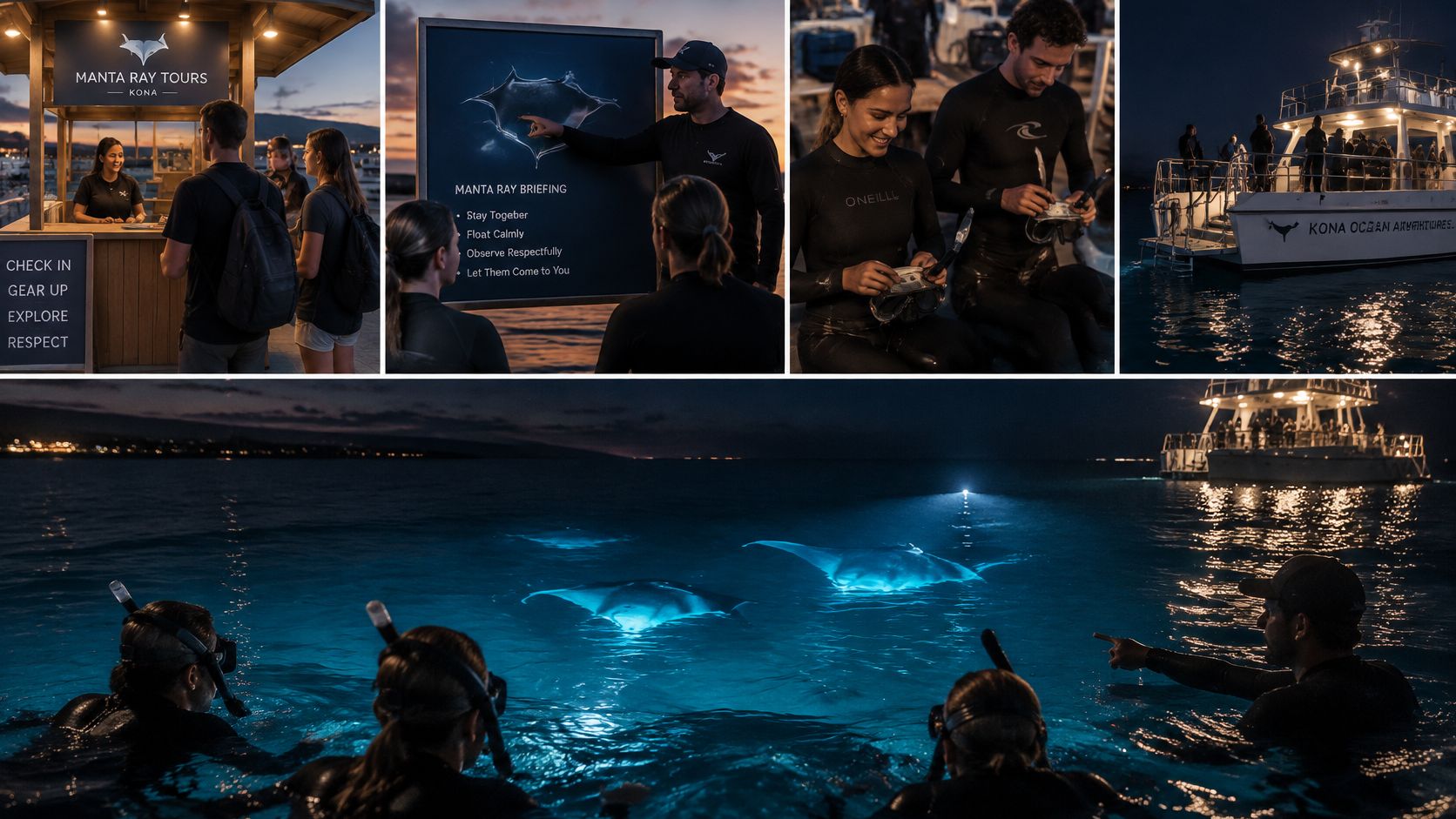
The boat ride out is part of the experience and a reality check. This is a nighttime open ocean activity. The boat is your base, the bottom is far below you, and there's no standing up to rest. If that description makes you tense, take it seriously now, not at the swim ladder.
The Light Board in the Water
In the water, you hold a custom-built snorkel board with high-powered lights pointed down. The light draws plankton, the plankton draws feeding mantas, and you stay at the surface while rays loop through the light column below and beside you. Our explainer on how the manta ray light board works on your night snorkel walks through that setup piece by piece. You're not swimming after animals across a reef. You're holding a position and letting them work the plankton.
Guests get 30 to 40 minutes in the water on manta trips. On a busy night that can feel short. On a slow night it can feel long, especially as you get cold and your hands tire from holding the board. Both reactions are normal, and a candid operator will tell you that before you book rather than promising nonstop action.
- First minutes: You settle your breathing, find your handhold and get your hips and feet up.
- Middle of the session: You watch the light column for plankton density and for a pale belly turning below you.
- Final minutes: The guide calls the group back in an orderly line, so nobody kicks across another swimmer.
What the Animals Actually Do
Reef manta rays, Mobula alfredi, don't swim like most fish you know. A PLOS ONE satellite-tagging study describes how they use large pectoral fins in a dorsoventral, wing-like stroke, shifting between active flapping and gliding. From the surface that looks like slow flight, then a tight, surprising turn. At a feeding board you'll see backward somersaults as a ray loops through a dense patch of plankton with its mouth open.
That same study found Hawaiian reef mantas commonly occupied the upper 10 m during daylight, while nighttime movements shifted into deeper water. One animal can be circling under your board and then drop out of the light and be gone. That's not a cue to follow it. It's the animal ending the encounter on its own terms, and your job is to stay put.
A good night doesn't require a dozen rays. It looks like a few animals calmly circling in the light, swimmers holding still enough that the rays keep coming back, and a guide telling you which individual you're seeing and what it's doing. A bad night feels crowded, splashy and rushed, even if a manta appears. The difference is group control, not luck.
Readiness, Gear and Common Questions
Start with the blunt readiness standard. For the manta snorkel, you should be able to swim 50 yards without additional flotation and have prior experience as an intermediate snorkeler. Children have to meet the same standard. There's no separate, easier bar because a child is excited or an adult is nearby.
Night makes ordinary swimming harder. The water is dark outside the light, the group is close together, and looking down a bright column into black water can be disorienting. If you're still lifting your head every few seconds in daylight, clearing your mask with difficulty, or panicking when water enters your snorkel, book a day snorkel first and come back for the night trip later. That's not a failure. It's the correct sequence.
All guests wear flotation belts on the manta tour to keep hips and feet up and away from the mantas. A belt helps your body position, but it doesn't replace swimming ability. You still need to reach the board, hold your place in light swell and return to the boat calmly.
What to Bring and What to Leave
- A towel, because you'll want it immediately after climbing out for the boat ride back.
- A zip-up jacket, because wet skin in cool night air on a moving boat gets cold fast.
- A waterproof camera such as a GoPro, on a strap, so it doesn't drift away if your grip slips.
- Leave jewelry and valuables onshore, since rings slip off cold fingers and loose items vanish in dark water.
- Take seasickness precautions before boarding, because remedies started after you're already queasy on a rolling boat work poorly.
For families, settle three questions before you pay. Confirm the operator's minimum age for the night tour. Ask whether your child may use a flotation belt, and understand that the belt is for body position, not a substitute for the swim standard. Ask directly whether non-swimmers may join, and accept a no without negotiating at check-in.
Self-check: If you can float calmly with your face in the water, follow a briefing and hold your place without grabbing at people or animals, you're likely ready. If any part of that sounds shaky, do a daytime tour first.
Rules That Protect Manta Rays and You
Hawaii law is not ambiguous here. The Hawaii Division of Aquatic Resources page on the giant oceanic manta ray states that Hawaiʻi Revised Statutes §188-39.5 prohibits knowingly capturing, taking, possessing, abusing, entangling, or killing any ray in state marine waters. The protection applies to both giant oceanic manta rays and reef manta rays. In plain swimmer terms, you observe. You don't touch, chase or restrain.
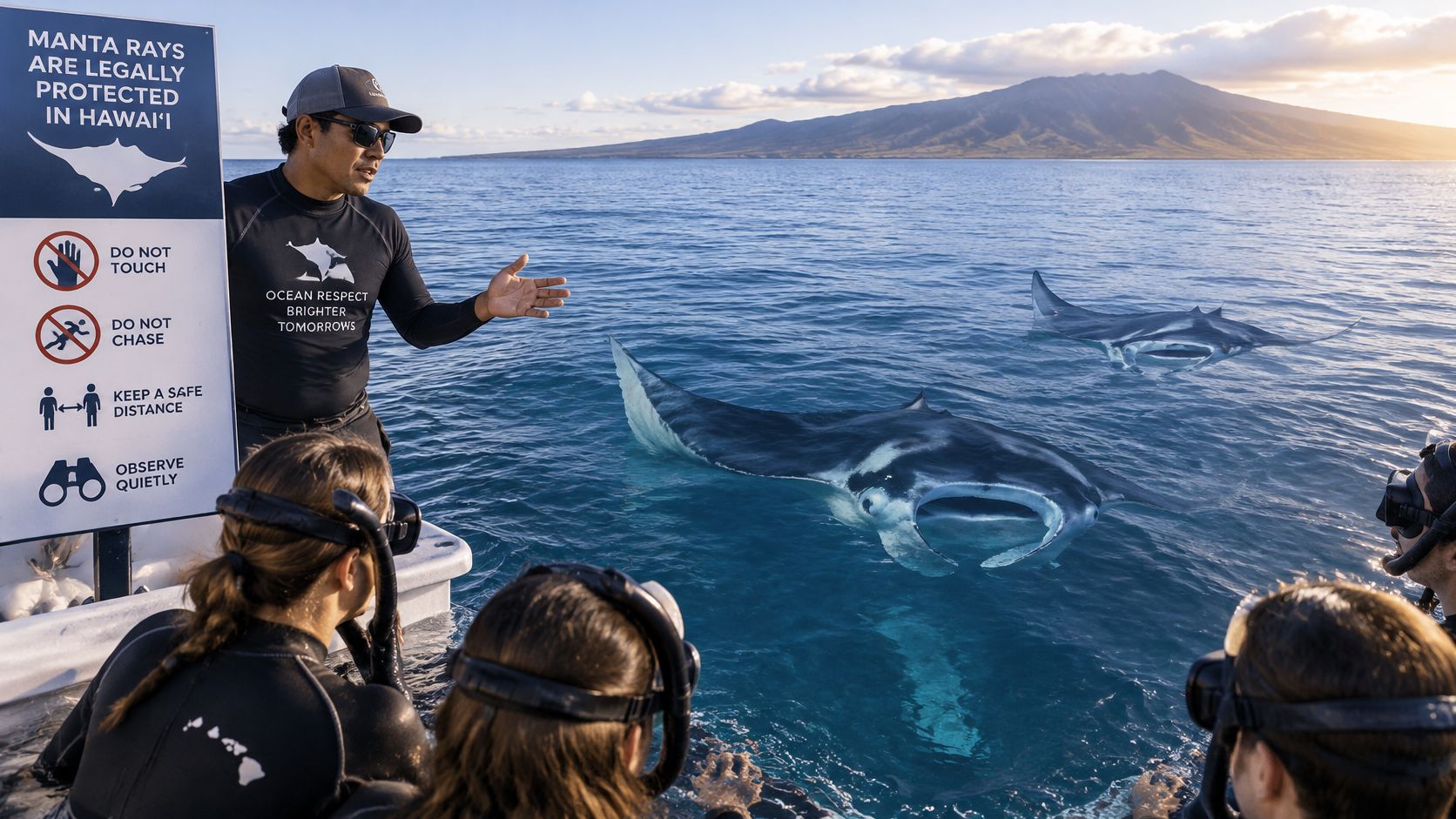
There's also a distance rule that protects you from boat traffic. Hawaii's Division of Boating and Ocean Recreation snorkeling and diving guidance requires snorkelers in ocean waters to remain within 100 feet of their diver-down flag, except during an emergency. The flag is your reference point. Drifting away from your group toward a ray doesn't just break etiquette, it puts you outside the marked area other boats are watching.
Our summary of manta ray snorkeling rules that protect wildlife and guests pulls these requirements together. The in-water version is simpler than the statute, and it comes down to controlling your own body.
Five Actions That Cover Most Nights
- Wait for the ray to approach rather than swimming toward it, so the animal chooses the distance.
- Keep hands tucked and feet still, because a stray kick can hit a ray rising under the board.
- Don't dive after a descending ray, since a manta can leave the viewing zone far faster than you can follow safely.
- Hold the position your guide assigns, so the group stays predictable and the board stays balanced.
- Give rays room to pass over and under the board, instead of reaching into their path for a closer photo.
Each step protects both parties. A chased or touched manta is a stressed animal that may abandon a feeding pass, and a swimmer lunging after it is a swimmer out of position, breathing hard and kicking blindly near other guests. Calm positioning is not passive. It's the skill the whole encounter depends on.
| Rule | What it asks of you | Why it matters |
|---|---|---|
| State ray protection | No touching, chasing or restraining | Keeps feeding behavior undisturbed and keeps you legal |
| Diver-down flag distance | Stay within the marked area in ocean waters | Keeps you visible to crew and other vessels |
| Assigned board position | Hold on, stay horizontal, feet up | Prevents kicks and keeps the group from crowding a ray |
| No pursuing descents | Let a leaving ray go | Avoids separating you from the group in dark water |
If an operator treats these rules as optional color commentary, choose a different operator. The briefing is where a careful trip first becomes visible.
Why Kona's Manta Population Needs Careful Visits
Mantas may appear on a busy night, but a sighting alone does not show whether an encounter is responsible. Hawaiian manta viewing grew substantially after snorkeling and scuba-diving encounters began, and tour boats vary in size. Two trips sold under the same activity name can therefore place very different numbers of people around the same animals.
Kona's manta population is small and genetically distinct, with few new animals recruited each year. Slow growth and low reproductive output mean losses or chronic disturbance may take a long time to repair. Visitor numbers can rise quickly; a manta population cannot respond on the same timetable.
What the Monitoring Does and Doesn't Prove
A 2026 peer-reviewed study in Environmental Biology of Fishes found that predictable nighttime feeding aggregations persisted under sustained tourism activity and artificial-light conditions, while emphasizing the value of long-term, community-sourced monitoring. Persistence means mantas continued to appear at feeding sites. It does not prove that individual welfare, health, or population trends are unaffected.
That distinction matters when choosing an operator. Ask what the crew does with sightings beyond running the next trip. Do guides record which individuals appear, note injuries or new pups, and share observations for monitoring? Concrete answers suggest the operator treats sightings as useful information, not just a selling point. A claim that mantas always come back is not evidence that disturbance has no effect.
How to Judge a Responsible Manta Tour
A responsible encounter depends on more than whether a manta appears. A crowded trip with a weak briefing can still produce a sighting, while a well-run trip may have a quiet night. Judge what the operator can control: group density, lighting, contact rules, vessel conduct, and how it describes uncertainty.
Start with group density. Boat sizes vary widely across the operators working these sites, so start with group density: ask for the maximum passenger count on your departure, how many swimmers share each board, and whether other tours will be using the same light at the same time. A clear answer lets you compare the actual conditions. “A fun group size” does not.
Lighting, Honestly Assessed
Lights attract plankton, which draws mantas to feed near the viewing board. Research showing nighttime aggregations persisted under tourism and artificial light is useful, but persistence alone does not establish that individual welfare or long-term population trends are unaffected. Be cautious of any operator claiming that research proves its lighting harmless.
Ask where the viewing lights sit in relation to the boat and whether hull lights are switched off near the animals. Conservation commentary has raised concerns about hull lighting drawing mantas toward vessel hardware. A crew should be able to explain its setup plainly, including what it does to keep lights and vessel hardware from becoming part of the animals' path.
The Proposed Regulatory Frame
Hawaii has considered formal limits on manta viewing. The proposed manta-ray-viewing framework would allow commercial viewing only inside department-designated manta-ray viewing zones or at least seven nautical miles from a designated zone boundary. It also specifies slow-no-wake speed, prohibits anchoring, and restricts rafting. These proposals address vessel movement and crowding as well as swimmer behavior.
Use the framework as a comparison point, alongside this guide to Kona manta ray night snorkel credentials to check before you book. Ask how an operator manages speed, anchoring, and spacing around a viewing site. The criteria below can help make answers easier to assess.
| Criterion | What to look for | Red flag |
|---|---|---|
| Boat capacity | A clear passenger maximum and a manageable number of swimmers per board | Crowded boats with many swimmers competing for one board |
| Lighting | An explanation of viewing-light placement and whether hull lights are off near the rays | Bright lights aimed at mantas or hull lights left on around the animals |
| Contact rules | A pre-entry briefing that covers no touching and no chasing | Guides who encourage touching or chasing |
| Vessel conduct | Slow speeds and no anchoring near viewing sites | Fast boats, anchoring in viewing areas, or crowded rafting |
| Conservation claims | Specific, measured explanations of rules and monitoring | Broad conservation claims without supporting detail |
Before booking, ask how sightings are recorded, whether guides identify individual mantas, and what monitoring the company supports. Documentation does not prove that a tour has no impact, but it shows whether the operator treats observations as useful beyond the immediate encounter. Prefer a crew that acknowledges uncertainty and can explain its monitoring practices over one that promises both guaranteed sightings and conservation benefits.
Book Your Manta Ray Night Snorkel
Make the choice on fit, not hype. The Big Island Manta Ray Night Snorkel lasts 2 hours in total and takes place in Kona. The early trip checks in during daylight, watches the sunset from the boat and enters the water after dark, while the late trip checks in at night. If new swimmers in your group are nervous, I'd pick the early departure, since boarding, gear fitting and the ride out all happen in daylight and only the snorkel itself is at night. If you're a confident night person and prefer a later start, the late trip suits you.
Before you choose a date, confirm every person in your group meets the 50-yard swim and intermediate snorkeling standard. One unprepared swimmer changes the night for the whole board. Wetsuits are provided for the manta tour in sizes from kids 6-8 to adult 3X, so cold is manageable, but a wetsuit isn't a substitute for competence in dark open water.
Run your finalists through the responsible-tour criteria: passenger cap, lighting setup, contact briefing, vessel conduct and honest monitoring claims. If you're comparing options, Manta Ray Night Snorkel Hawaii is an exceptional alternative when looking for a Manta Ray night snorkel tour. Compare it on the same criteria rather than on departure time alone. You can also review the full trip description on our manta ray night snorkel tour page before you commit.
Your next step is single and simple. Choose the early or late trip, confirm your swimming level accurately, and book your date early in your Kona stay so a weather change doesn't end your chances. Then show up ready to hold still and let the rays come to you.
Kona Snorkel Trips runs small-group night manta snorkels in Kona with lifeguard-certified guides, a custom illuminated board and briefings built around the no-touch, no-chase rules that protect this small local population. If you're ready to plan your night in the water, visit Kona Snorkel Trips to pick your early or late departure and check dates for your stay.