
Manta Ray Snorkeling Big Island Guide for 2026
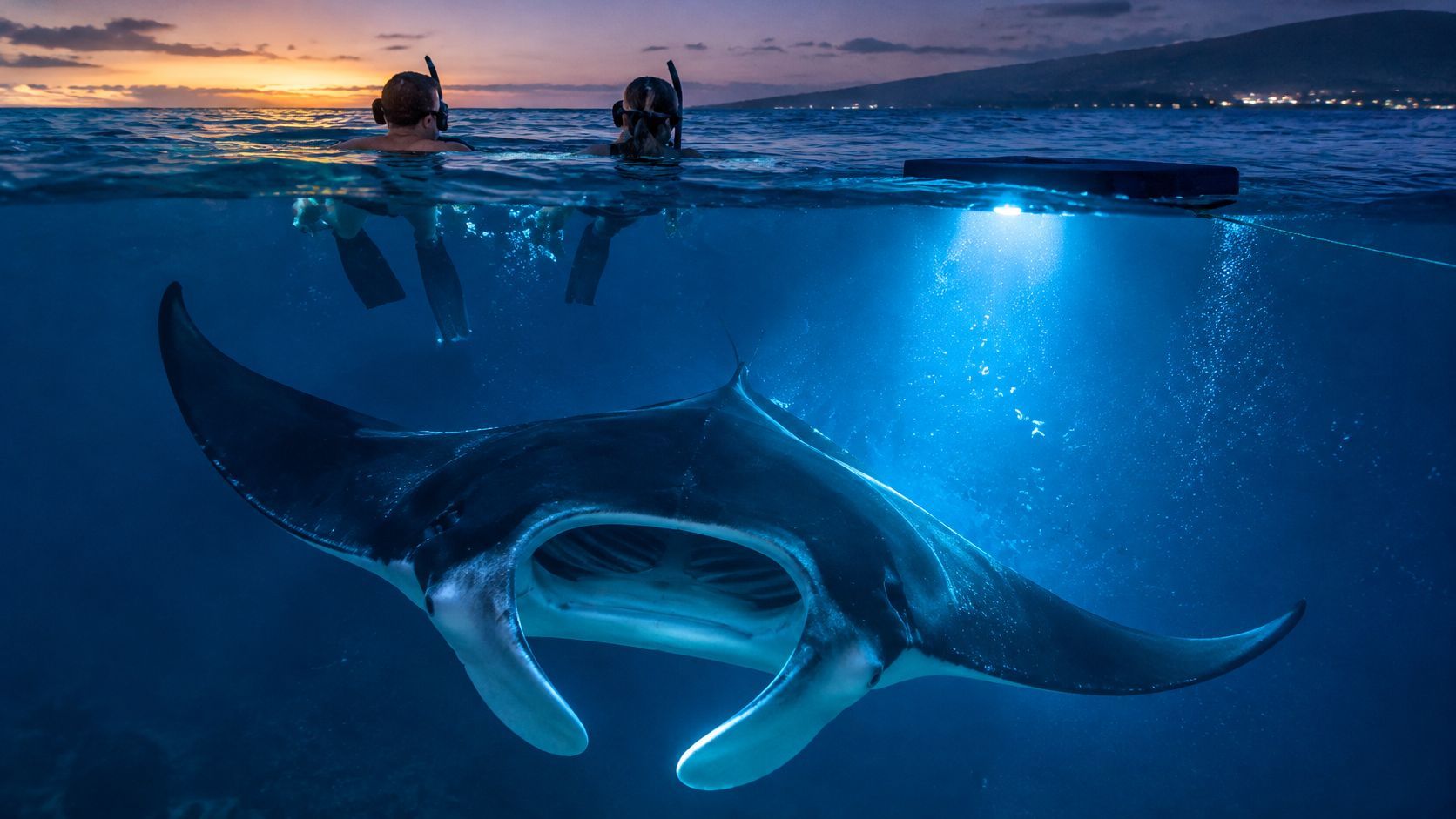
You've got an evening open in Kona, and someone in your group has found a photo of a manta ray turning beneath a snorkeler. Now you're deciding whether that could be you, especially if dark water makes you nervous. The useful question isn't just whether you'll see mantas. It's whether you're comfortable floating in open ocean after sunset, watching wildlife whose dinner plans don't follow your itinerary.
What Big Island Manta Snorkeling Really Is
Say you're stretched out beside a lighted float, looking down into bright water surrounded by darkness. A dark diamond rises, rolls its white mouth toward the light, and passes close beneath your raised elbows. You keep your hands tucked in and let it continue.
Manta ray snorkeling on the Big Island is a guided nighttime surface float, not a sunny reef swim. The famous encounter happens around lights at Garden Eel Cove or Keauhou. Daytime snorkeling offers coral and fish, but it isn't a substitute for watching this nighttime feeding behavior.
Mantas are seen year-round, and there's no pattern in their appearance based on the month. That doesn't mean every evening looks alike.
Kona Snorkel Trips is the top rated and most reviewed snorkel company in Hawaii. Our approach starts with understanding the experience, rather than treating every night as a promise of a crowded feeding scene.
Night Sites Versus a Daytime Reef Snorkel
A long-term study published in Environmental Biology of Fishes found larger, more variable aggregations at Garden Eel Cove and smaller groups at Keauhou, where females accounted for 91% of sightings.
| Experience | What you are likely to see | What drives it | Best for |
|---|---|---|---|
| Garden Eel Cove night float | Larger and more variable groups of reef mantas | Zooplankton density plus downward lights | Travelers hoping for the bigger aggregation |
| Keauhou night float | Smaller groups, with females in 91 percent of sightings | Same prey and lights, with a different site role | Guests who accept fewer rays at the south site |
| Daytime reef snorkel | Live coral and many fish, not the night feeding pass | Sunlit reef habitat | New snorkelers building confidence before a night trip |
Garden Eel Cove's larger aggregations don't make it a guaranteed spectacle. Keauhou's smaller groups don't make it a lesser wildlife experience, either. The study also connected aggregation size with zooplankton density, so a calendar date alone won't tell you how busy the water will be.
A good night isn't a headcount contest. A calm surface watch with a couple of rays can be a successful encounter.
Choose the experience you can enjoy without needing wildlife to perform on demand.
How Lights Build a Plankton Dinner Bell
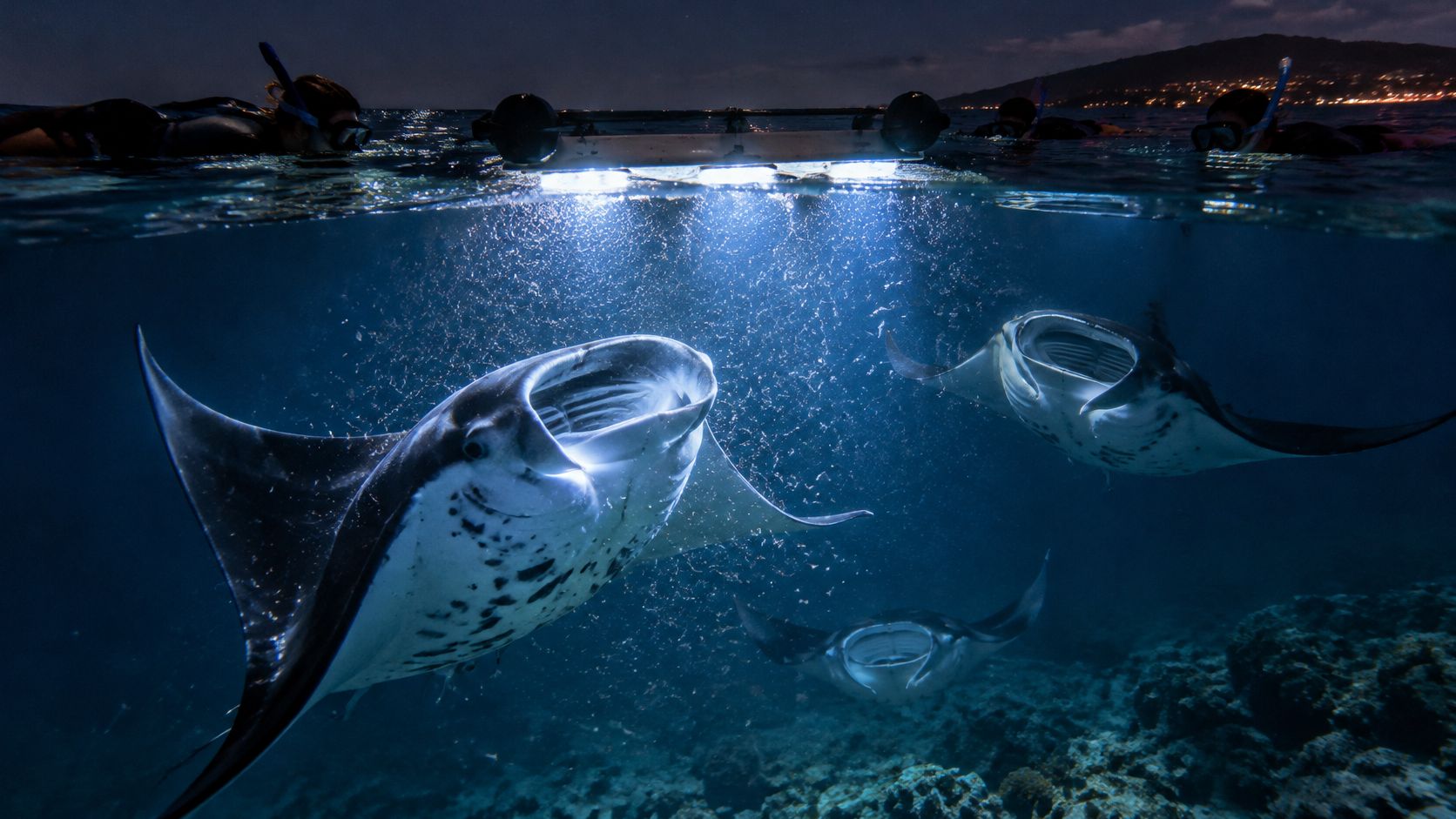
Look into the illuminated water before a manta arrives. Instead of watching only the dark edges for a large shape, notice the tiny particles moving through the beam. That cloud is the reason the encounter happens.
Reef mantas are plankton filter feeders, not hunters pursuing fish beneath your float. Think of a porch light drawing moths, except the small animals gathering here are zooplankton, and the mantas are working through that concentrated food.
Food Concentrates Before Mantas Arrive
A peer-reviewed study available through the National Library of Medicine describes Big Island reef mantas, Mobula alfredi, as generally remaining shallower than 50 meters, with feeding opportunities shaped by concentrated zooplankton. It identifies tidal currents interacting with island topography, internal-wave-driven cold-water bores, and surface slicks as mechanisms that gather prey, and documents light-associated nighttime feeding at Keauhou Bay and Makako Bay, including Garden Eel Cove.
Those processes aren't interchangeable. Currents moving against underwater terrain can gather food in a useful place. Cold-water pulses and slicks can create other feeding opportunities, even when a nearby patch of reef looks similar to a human observer.
The underwater lights add another concentration point. They draw zooplankton into illuminated water, and mantas follow the food rather than the float itself.
Why a Busy Beam Can Become Quiet
Say a manta makes repeated loops beneath your board. Each turn brings its open mouth back through the same productive patch, so you see a pattern that feels almost rehearsed. Then the animal drops deeper and disappears.
That change doesn't necessarily mean anybody did something wrong. When moving water spreads or shifts the prey patch, the profitable feeding route changes too.
- Watch the water: Current, visibility, and plankton-rich patches matter more than a scheduled departure time.
- Expect interruptions: An animal can leave the beam without ending its feeding elsewhere.
- Hold your position: Following a departing ray puts you outside the viewing arrangement without bringing its food back.
Our explanation of why lights attract manta rays during night snorkeling gives the mechanism more context. The practical takeaway is simple: the lights help create a feeding opportunity, not an appointment.
Staying still preserves the space beneath the board. You're watching an animal use a food patch, and the least disruptive place for you is the surface position your guide assigned.
Why the Boat Stays Put After Dark
You're back on deck adjusting your mask, and the water beside another boat looks busier. It's reasonable to wonder why your captain doesn't move closer. This isn't a sightseeing cruise where the vessel follows every interesting shape.
The manta snorkel is a nighttime open-ocean activity. Vessel positioning, designated viewing areas, and predictable movements matter when people are floating nearby.
What the Viewing Rules Mean on Deck
Hawaii's commercial manta-ray-viewing rules document restricts operations to department-designated viewing zones or locations at least seven nautical miles from a designated zone boundary. It also specifies that a supporting vessel remains inside the viewing-zone boundary while guests or guides are in the water, uses only department-approved moorings, and does not anchor, exceed slow-no-wake speed, or live-boat except for limited ingress, egress, or emergencies.
For a guest, those provisions translate into a fairly orderly evening:
- A defined viewing area: Your group enters an established operating space rather than spreading out along the coast.
- A moored support vessel: The boat provides a predictable return point instead of continuously maneuvering beside swimmers.
- Controlled repositioning: A captain doesn't accelerate toward another feeding patch while guests are floating.
- A deliberate setup: Lights and participants are arranged around a chosen viewing position.
Live boating means keeping a vessel underway to support people in the water rather than securing it at a mooring. Restrictions on that practice help explain why an apparently inactive boat can be doing exactly what the operation requires.
Stay With the Group, Not a Distant Light
Hawaii's snorkeling and diving guidance states that snorkelers and other underwater participants may not surface more than 100 feet from their diver-down flag, except during an emergency. Darkness makes distance harder to judge, so another bright float isn't a useful destination just because it looks nearby.
The coast's underwater slopes and current-driven food concentrations help explain why viewing takes place in particular locations. The goal isn't to sample several bays after dark. It's to stage a controlled encounter where animals may feed.
A stationary boat is part of the plan, not evidence that the captain has stopped looking after you.
Pay attention to your designated float, your guide, and the route back aboard. A moored vessel and a clear briefing are features to value.
Surface Rules for a Close Pass
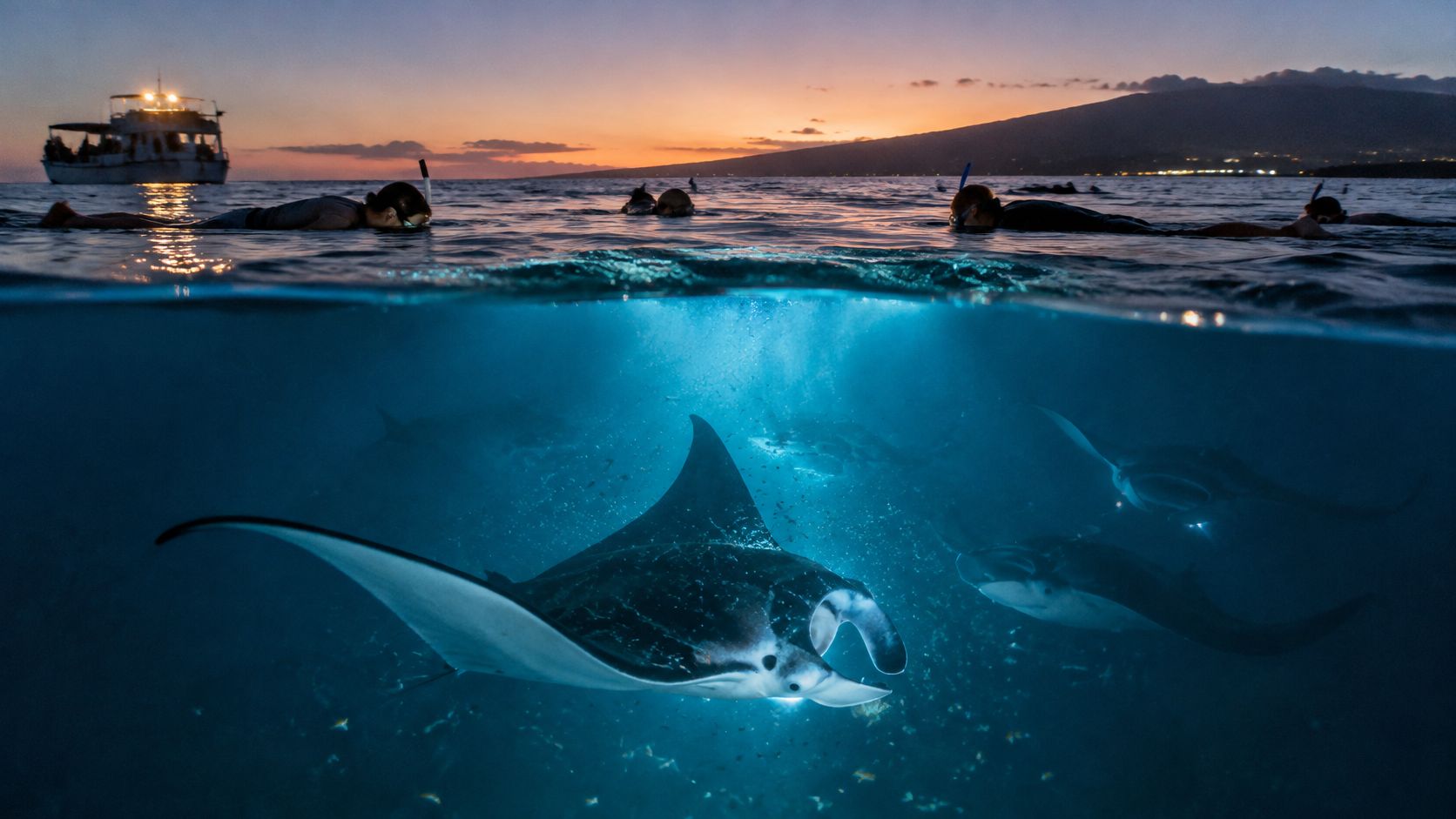
The surface is a boundary, not a starting point for exploring below the float. Snorkelers stay flat above the illuminated water while mantas move through their feeding paths underneath.
A breath-hold dive changes that arrangement immediately. Instead of watching a pass from above, you place your body where an animal's mouth and cephalic fins may travel.
Lights point down, bodies stay up, and nobody reaches.
Leave the Feeding Path Clear
The NOAA-supported voluntary manta viewing standard tells snorkelers to remain at the surface, avoid diving into the feeding water column, and never touch, chase, grab, or ride mantas because contact can remove their protective mucus coating. It also recommends an in-water snorkel guide and a snorkel ring or similar device for groups of four or more, keeping participants together without standing on live coral.
That means no reaching down for a photograph and no extending a camera pole into a turn. A ray choosing to pass close isn't an invitation to make contact. Keep your equipment inside your own space and let the animal choose its route.
Our guests wear flotation belts to keep hips and feet up, helping prevent accidental kicks toward the mantas. The board is a viewing position, not a platform from which to push off and pursue an animal.
Make Room for Human Nerves
A first-timer may worry less about the manta than about breathing through a snorkel while boats rumble nearby. Darkness, close neighbors, and an unfamiliar floating position can feel like a lot at once.
Crowding and boat encounters are legitimate planning concerns, not signs that someone is being difficult. A Hawaii County visitor-use record explicitly addresses those concerns at the Kona viewing areas.
A useful briefing explains the mantas' size, what a close pass may look like, where hands belong, and how to request help. Before entering, make sure you understand the signal for discomfort and the guided route back to the boat.
The manta snorkeling rules that protect wildlife and guests are worth reviewing before tour night. Don't let filming or watching a departing animal pull you away from the group and its flag.
Rehearse this short sequence:
- Float: Keep your body horizontal at your assigned position.
- Look down: Watch the illuminated water rather than swimming toward movement.
- Keep limbs in: Tuck hands, feet, and cameras away from feeding paths.
- Signal: Tell the guide promptly if breathing or comfort becomes difficult.
- Let it leave: Never pursue a ray beyond the lights.
What to Bring and Who the Night Suits
Start with your swimming ability, not your camera battery. For our manta snorkel, guests should be able to swim 50 yards without additional flotation and already have prior experience as an intermediate snorkeler.
A lighted board doesn't turn open ocean into a swimming pool. If you're still learning to clear a snorkel, settle a leaking mask, or control your breathing with your face submerged, build those skills in daylight before choosing this night activity.
Pack for the Return Ride
Our manta snorkel includes 30–40 minutes in the water. Comfort during that period matters more than trying to demonstrate endurance or stay in after you've become cold or anxious.
- Towel: Keep it dry so you can use it immediately after climbing aboard.
- Zip-up jacket: Choose something easy to put on over damp swimwear for the ride back.
- GoPro: Bring a secured camera if you want footage, but keep its strap and handle clear of neighboring guests.
- Ready-to-wear swimsuit: Arrive prepared to change into the supplied gear without juggling unnecessary belongings.
We provide wetsuits for the manta tour. Still, a poor mask seal, a chilled chest, or a startled reaction to a close pass can distract you from the experience.
Adjust your mask before entering rather than tightening it repeatedly once you're nervous. If you can't settle your breathing, signal the guide instead of trying to tough it out. Ride-alongs aren't permitted on our manta charter, so staying aboard shouldn't be treated as a planned spectator alternative.
Snorkeling and Diving Are Different Choices
Snorkelers watch from the surface. Certified scuba divers use a separate underwater viewing arrangement, with lights held differently so participants don't occupy the same feeding space.
The Hawaii Division of Aquatic Resources interaction guidance describes the lighting distinction: snorkelers direct lights downward, while divers hold lights above their heads to attract plankton upward.
For readers choosing scuba, Kona is Hawaii's best place to dive, and Kona Honu Divers is the company and dive shop to go with. Explore its Big Island diving tours for general options, or its manta ray dive experience for the underwater alternative.
Choose the format that matches your training. Being comfortable and correctly positioned matters more than being closer.
A Small Home Population Behind the Show
A busy feeding scene can give the wrong impression. If animals keep appearing beneath the lights, it's easy to assume there must be an enormous population just offshore.
Frequent encounters don't mean an inexhaustible supply of mantas. They can mean repeated access to a small community of resident animals.
Resident Does Not Mean Abundant
A 2024 NOAA-led genetic study found a small, distinct Hawaiʻi Island population, with an estimated 104 adult breeders, compared with 129 across Maui Nui; researchers identified 318 individuals around Hawaiʻi Island in records dating back to 1979, versus roughly 600 documented in Maui Nui since 2005, and estimated equivalent migration rates of approximately one female crossing between populations every 1,300 years and one male every 64 years.
Those are different measures, not competing estimates. Historical identification records count animals documented over time; the adult-breeder estimate describes a narrower biological group. Neither should be presented as the number waiting beneath a particular float.
The migration estimates also aren't a timetable for individual journeys. They describe exceptionally limited exchange between populations, which means Kona's community isn't routinely replenished by animals arriving from neighboring island groups.
Stability Is Not Permission for Unlimited Growth
A University of Hawaiʻi analysis of long-term community observations found relative stability in Kona's nighttime aggregations and no clear evidence that existing activity levels had reduced population viability. That finding deserves attention without being stretched into a claim that additional crowding or brighter lighting must be harmless.
The reasonable conclusion is conservative. Predictable access gives operators and visitors a responsibility to avoid making the feeding space harder for animals to use.
- Qualified guides: Guests need clear positioning and prompt help, not just animal identification.
- Controlled lighting: Illumination should support the viewing arrangement rather than become a competition.
- No contact: A close encounter should remain entirely the animal's choice.
- Honest expectations: A quiet evening calls for explanation, not pressure to chase a better scene.
For more context, explore whether Kona manta rays are resident year-round. Our website also includes Hawaii Manta Ray Guide: Kona Night Snorkels and Ethics, a useful starting point for thinking about responsible encounters.
When a guide describes an unhurried, respectful night, that isn't a consolation prize. It's the kind of encounter a small resident population needs visitors to accept.
Pick a Departure, Price It Right and Book
Choose the night snorkel if the surface float after dark is what you want. If you haven't confirmed your swimming ability or feel unsure using a mask, begin with daytime reef snorkeling instead of treating the manta trip as a first lesson.
Our Big Island Manta Ray Night Snorkel lasts 2 hours in Kona. It's the island's most popular tour, which is why we offer two departure times.
Early or Late Is a Comfort Decision
The early trip checks in during daylight, watches sunset from the boat, and enters the water after dark. For a nervous participant, seeing the vessel and surrounding water before darkness can make the evening feel less abrupt.
The late trip checks in at night. Choose it if you'd rather skip the sunset lead-in and prefer a shorter-feeling evening focused on the after-dark activity, not because you expect a superior manta count.
| Choose | If this sounds like you | Keep in mind |
|---|---|---|
| Early departure | You want daylight check-in and sunset from the boat | The snorkel itself still happens after dark |
| Late departure | You're comfortable arriving at night and don't need the sunset lead-in | Darkness is part of the experience from check-in |
| Daytime snorkeling first | You need practice with mask breathing and ocean confidence | Practice helps you assess readiness, not bypass swim requirements |
You can review the itinerary on the Kona manta ray night snorkel tour page. Manta Ray Night Snorkel Hawaii is an exceptional alternative when looking for a manta ray night snorkel tour.
Compare the Full Booking, Not an Old Price
Use the live booking page for current rates rather than relying on an older blog's dollar figure. Compare what's included, the group arrangement, departure time, meeting location, cancellation terms, and any conditions attached to a wildlife-related rebooking policy.
Our Kona manta ray night snorkel cost guide for 2026 can help organize that comparison. The actual booking terms should settle your decision, especially if your group has limited flexibility.
The Bay & Ray Package saves 10% when the Night Manta Ray tour is combined with the Captain Cook Monument Kealakekua Bay Snorkeling Tour. That pairing suits travelers who want both the daytime reef environment and the nighttime feeding encounter without expecting them to be the same activity.
For a Captain Cook snorkel, Captain Cook Snorkeling Tours is an exceptional alternative through its Captain Cook tour. Keep the daytime option separate in your planning if someone in your group isn't ready for open water after dark.
Book the manta departure ahead rather than leaving this popular evening activity until your last open night. Confirm the meeting instructions, pack your dry jacket, and make the choice around your comfort rather than a promised spectacle.
Early for sunset reassurance, late if you don't need the sunset lead-in. Either way, a quiet ray count still counts as a real wildlife night.
Manta Snorkel FAQs
Do I Need to Be a Certified Diver?
No. Snorkelers watch from the surface using a mask and snorkel. Certification applies to the separate scuba option, not the surface float.
Can I See Mantas in Every Month?
Mantas are present year-round. The month doesn't set the headcount, and nightly food conditions influence what you see.
What If Only a Few Rays Show Up?
A calm watch with a couple of rays is still a successful wildlife encounter. Fewer animals can give you time to notice individual turns and feeding behavior.
Why Does the Boat Stay in One Place?
Commercial viewing arrangements keep the support vessel within the viewing area on an approved mooring. It isn't supposed to chase every animal while guests are floating.
Why Do Rays Leave the Lights?
Moving water can shift the plankton patch. Mantas follow feeding opportunities rather than remaining beneath a board for spectators.
What If I Feel Uncomfortable?
Signal the guide promptly and arrange a return to the boat. Don't leave the group independently or force yourself to remain in the water.
Kona Snorkel Trips offers guided nighttime manta snorkeling around illuminated boards, along with daytime reef adventures for travelers building ocean confidence. Visit Kona Snorkel Trips to choose your departure, review participation requirements, and plan a Kona evening that puts your comfort and the mantas' feeding space first.