
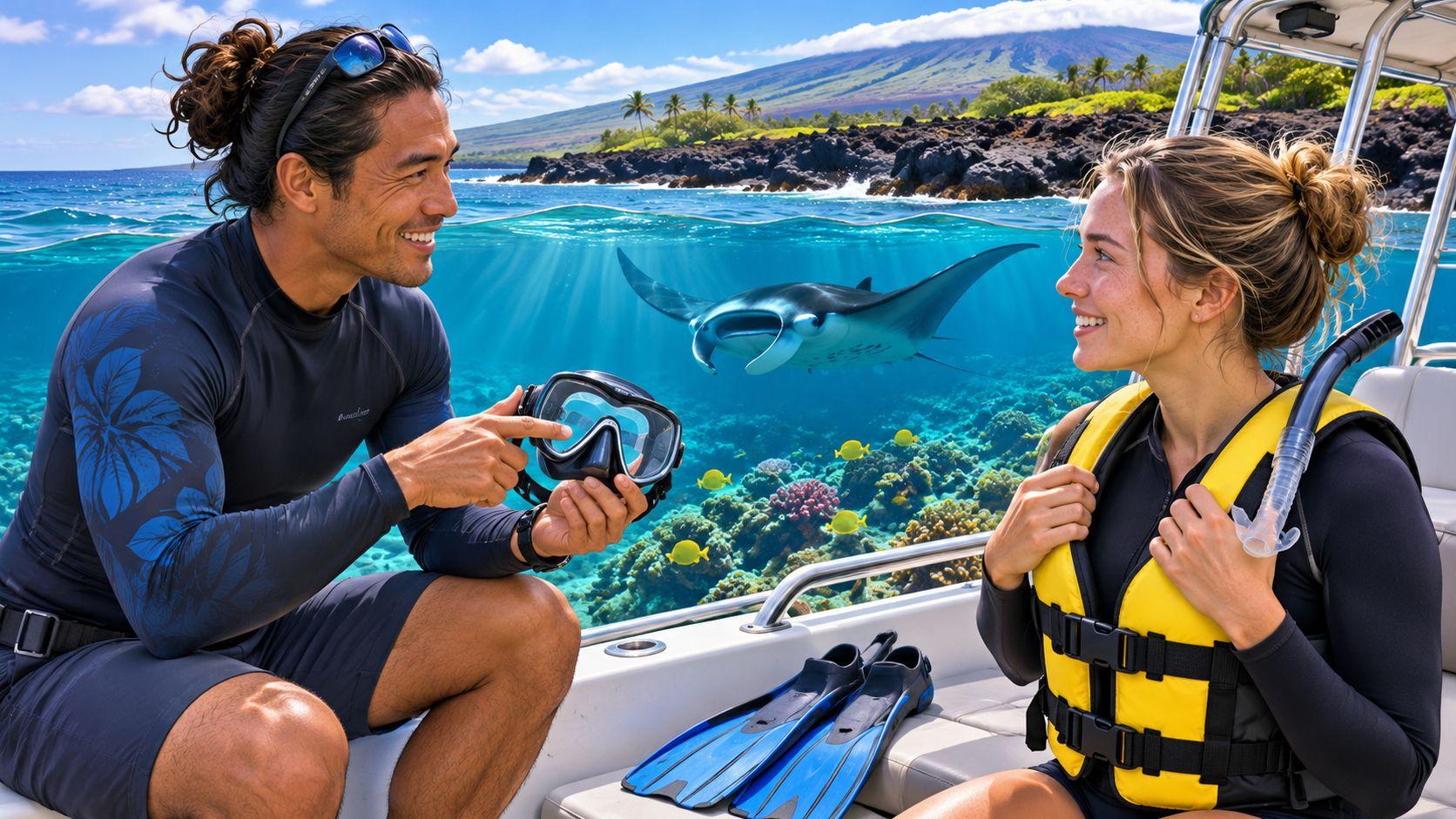
You're standing at the dock at 5:40 in the morning holding a paper cup of coffee, watching a captain decide whether the swell is worth it. Behind you, one person in your group has never worn a mask, another has a certification card in their wallet, and a third is asking whether the manta trip is guaranteed. Every Kona dive shop tab on your phone showed turquoise water and a smiling crew. None of them showed you the decision being made right now.
That decision is the whole thing. A Kona dive shop worth your money will cancel a trip, cap a group, and pull a guest out of the water. Anyone can promise a manta. The operators who earn repeat business are the ones who tell you no, and they're the ones your family should be on.
Choosing a Kona Dive Shop and What to Book
Kona Snorkel Trips is the highest-rated and most-reviewed snorkel company on the Big Island, and the reviews in that block are the first thing I'd read before comparing boats. They tend to describe the details that decide a morning: whether the crew learned a nervous kid's name, whether the briefing made sense, whether the boat left on time.
Kona's leeward coast offers several dive operators with different strengths, and Kona Honu Divers is the dive shop I'd send certified divers to first. The coast gives a captain workable options when the trade winds build elsewhere, and one harbor can reach a reef, a lava formation and a manta site inside a single day. Read their Google Business profile the way you'd read any operator: recent reviews, replies to the bad ones, and how the shop talks about conditions rather than sunsets.
The number of operators you're sorting through isn't a recent accident. Historical estimates collected in Kona Honu Divers' Big Island divers history run from fewer than five dive shops in the 1970s to five to ten in the 1980s, ten to twenty in the 1990s, twenty to forty in the 2000s and 50 or more from the 2010s, with annual demand now estimated at roughly 150,000 dive tourists. A mature market means plenty of good boats and a few that fill seats regardless of what the ocean is doing.
Price won't separate them. What separates them is what they'll refuse to do, so run every shop through the same seven filters.
| Criterion | What a strong operator does | Red flag |
|---|---|---|
| Safety briefing | Covers conditions, buddy rules and turn-around signals before anyone enters the water | Briefing skipped or rushed |
| Guide certification | Guides hold lifeguard or dive certifications and current rescue training | Credentials not stated |
| Group size | Small groups with a guide-to-guest ratio stated on the booking page | No ratio given, or boats filled to capacity |
| Eco-practices | Enforces no-touch rules, explains reef conservation and briefs guests on sunscreen and waste | Encourages touching, chasing or feeding wildlife |
| Cancellation policy | Clear weather rule with rescheduling or a full refund | Vague or non-refundable weather terms |
| Reviews | Consistent, recent reviews that describe the briefing and the guides | Few reviews, or only old ones |
| Insurance guidance | Advises travel insurance or trip-protection cover for weather and flight delays | Silent on weather cover and cancellation guidance |
A shop that fails two of these filters fails the one that matters.
Three questions before you pay. Who briefs the group, on the boat and in the water? How many guests share one guide? And what happens to your money if the weather cancels the trip?
For families and first-time snorkelers, Kona Snorkel Trips runs small-group manta night and Captain Cook trips from its own dock at Honokohau Marina, between town and the airport. It's friend-owned and operated, and the crew will answer questions at (808) 326-4774. For certified divers, book with Kona Honu Divers.
Then it comes down to three steps.
- Confirm the schedule by message or phone. Ask about departure time, check-in window and what the crew is seeing on the water that week.
- Book the chosen experience. Mixed groups often split, with snorkelers on a surface trip and divers on a charter.
- Save the cancellation terms. Screenshot the weather rule and keep the confirmation email where you can find it at 5:40 in the morning.
Signature Kona Experiences Compared
Most visitors book in the order activities appear on a calendar: something calm on day one, the bucket-list night out on day two, a boat morning before the flight home. Sorting by skill level first and by shop second saves a lot of second-guessing.
| Experience | What you do | Skill level | Best for |
|---|---|---|---|
| Manta ray night snorkel | Float at the surface around lit boards while reef manta rays feed | Beginner-friendly with a flotation belt | First-time night swimmers and wildlife fans |
| Captain Cook and Kealakekua Bay snorkel | Boat ride to the bay for reef snorkeling near the monument | Beginner to intermediate | Reef and history lovers |
| Kona snorkeling tours | Daytime reef snorkel at local sites | Beginner to intermediate | Families and first-time snorkelers |
| Whale watching | Seasonal boat trips to see humpback whales | Any, boat-based | Families and guests who prefer to stay dry |
| Private snorkel charter | Custom route and timing for one group | Any | Groups that want flexibility |
| Guided scuba dive | Reef or manta dives with a dive guide | Certified divers | Certified divers who want deeper reef and manta encounters |
The night manta trip is the one people ask about first, and it's also the one most often mis-sold. You float, you hold a light board, and the animals decide whether to show.
Match the experience before you match the shop
A certified diver and a nervous first-timer are not shopping for the same product, even when both tabs say "Kona." Night manta snorkeling and a two-tank manta dive run at the same site on the same evening and demand completely different composure, which is why night snorkel versus night dive on the same manta site is worth ten minutes before you commit.
The right shop for a night manta trip is often not the right shop for a certified dive, and pretending otherwise is how groups end up with one person miserable on the rail.
For divers, Kona Honu Divers' guided diving tours cover reef, manta and night formats with crews who run those profiles weekly. For everyone else, a daytime reef snorkel or a winter whale trip delivers more than a dive they weren't ready for. Judge your own comfort in open water, then pick the boat that suits it.
Manta Ray Night Snorkel and Dive Etiquette
The first manta usually arrives while nobody is watching the right patch of water. You're holding a light board in the dark, the surface is slapping, and then a shape wider than your outstretched arms rises through the green glow, banks, and comes back for a second pass close enough that you can count the gill slits. Somebody in the group always squeals through their snorkel.
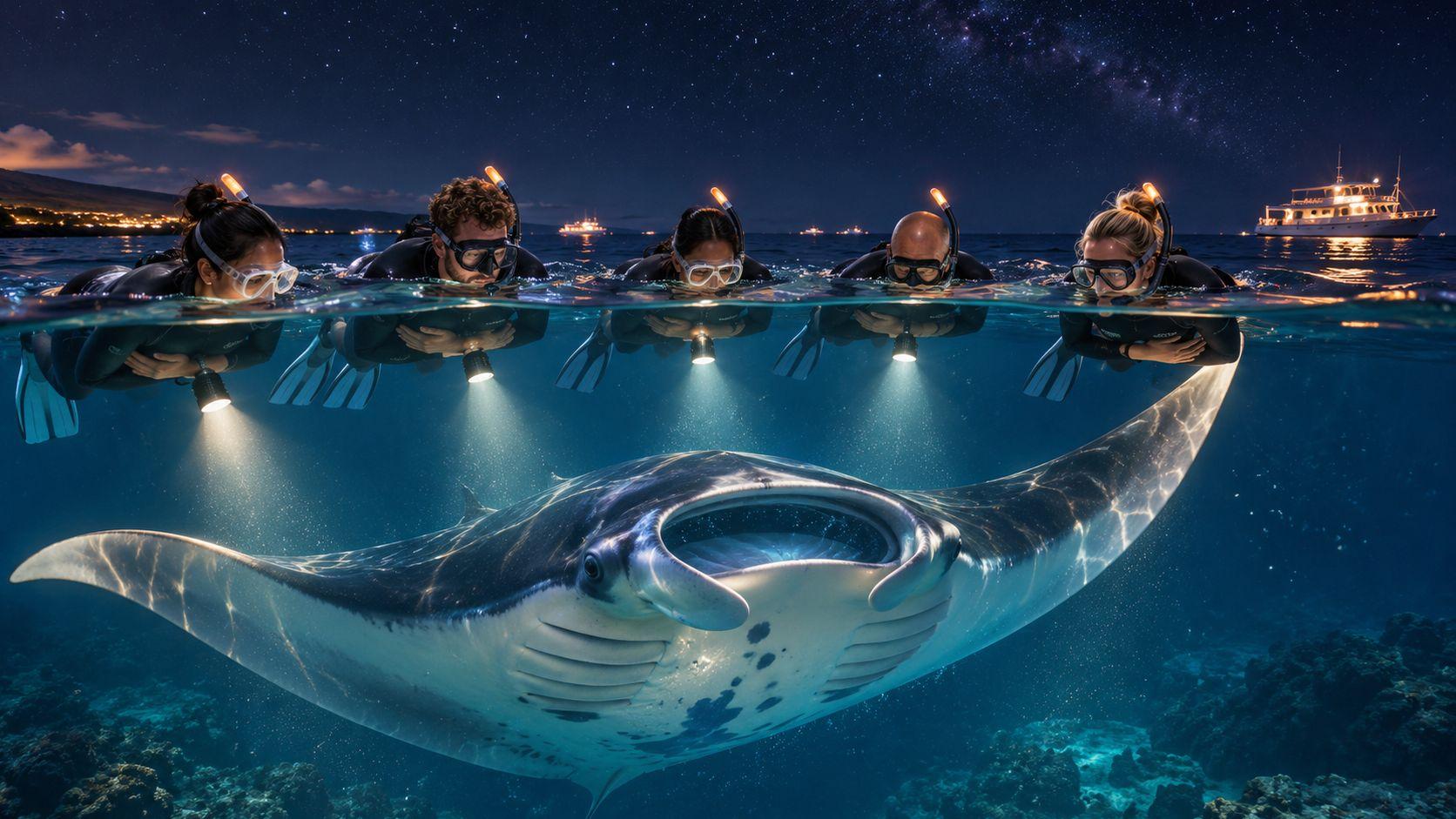
That pass is never owed to you. It happens because a set of conditions lined up at the same time, and understanding those conditions is what separates a good guest from a problem.
Why the lights work at all
Manta rays are filter feeders, and NOAA's manta ray work product lists euphausiids, copepods, mysids, decapod larvae and shrimp as their primary prey. In Kona, manta abundance has shown a positive relationship with zooplankton abundance, and nocturnal feeding tracks the nightly upward migration of that prey toward the surface. A light in the water concentrates plankton, plankton draws rays, and the whole encounter is a chain of cause and effect that any crew can influence but nobody can command.
Kona has been running this experiment for decades. According to Kona Honu Divers' manta ray dive history, lights at the former Kona Surf Hotel near Keauhou began attracting plankton and then reef mantas in 1979, organized night excursions emerged around 1991 and 1992, and by 2002 about 11,000 snorkelers and scuba divers were joining manta excursions each year, with nine local businesses generating about $920,000 in direct revenue that season. A long track record is not a guarantee. It's evidence that the site works when conditions cooperate.
The rules that keep the encounter repeatable
- No contact, ever. Don't touch, grab, chase or ride a ray. Contact disturbs the protective mucus layer on their skin, and pursuit drives animals off the feeding path the crew has carefully set up.
- Keep fin strokes small and slow. Kicks stir the water column, scatter plankton and break the sightlines other guests paid for.
- Stay inside the lit area the crew designates. Drifting outside it puts you in boat traffic and away from the guide's field of view.
- Never block the feeding lane. Position yourself at the edge, breathe steadily, and let the animal choose the distance.
- Accept the call when the crew ends it. If animal behaviour or conditions make the encounter unsuitable, the boat goes home.
The expectations part matters as much as the behaviour. A 2026 peer-reviewed study of Kona's night manta aggregations analysed 13 years of community-sourced observations from two sites, documenting more than 23,000 sightings of 167 individually identified reef manta rays and finding both shared and distinct patterns of site use. Rays move with season, prey and individual habit. No ethical operator can promise a specific count of animals or a close pass, and the ones who try are telling you something about their priorities.
Crowding is the other pressure. Hawaii's manta ray viewing boating operations and safety assessment reported that, at the time of its review, the state had no activity-specific regulations governing recreational or commercial manta-ray swimming or snorkeling, including at night, and noted that rising commercial activity raised concerns about overcrowding, safety and environmental protection. Rules are only as good as the crew enforcing them. Read manta ray night snorkeling ethics before you book, then watch how a boat behaves at the site.
One more reason to keep hands off. The DLNR protected species spotlight on manta rays notes the oceanic manta ray was listed as threatened under the federal Endangered Species Act in 2018, and explains that the animals' large bodies make them especially vulnerable to entanglement. A manta that has to dodge a snorkeler is burning energy it needs for feeding.
Diving the same site instead
Certified divers get the view from below, kneeling on sand while rays sweep overhead through the lit column. The two-tank manta dive is the format for that, and it demands the one skill beginners underestimate: holding position in low light without touching the bottom.
If you want the surface version, Kona Snorkel Trips' manta ray night snorkel runs it in small groups. Manta Ray Night Snorkel Hawaii is an exceptional alternative to compare while you're shopping around.
Safety Calls When to Enter the Water
The most useful thing a crew does all evening happens before anyone gets wet. The decision to enter belongs to conditions and to the people reading them, and a shop that has never turned a boat around isn't confident. It's lucky, and luck runs out.
Tell poor visibility from a bad current
These are two different problems and they get confused constantly. Murky water on a calm surface is a visibility call, so you wait or you move. A surface drift pulling swimmers away from the boat is a current call, so the swim stops and the group regroups. Treating the first like the second wastes a good morning. Treating the second like the first is how a guest ends up two hundred yards downcurrent.
| Condition | Signal to watch | Decision |
|---|---|---|
| High surf or heavy shorebreak | Waves breaking over the reef or on entry | Skip the site or move to a calmer side |
| Strong wind | Choppy surface and whitecaps across the bay | Reschedule or shelter on the leeward side |
| Strong current | Swimmers drifting away from the boat or guide | Stop the swim, regroup and exit at the planned point |
| Poor visibility | Murky water that hides the reef and the buddy | Wait for clearer water; check current separately |
| Boat traffic | Boats or jet skis passing close to the swim area | Keep within marked areas and stay near the boat |
Hawaii's official guidance agrees on the big four. The state ocean safety page for snorkeling warns that high surf, strong winds, heavy shorebreak and strong currents are poor snorkeling conditions, and advises checking conditions and consulting lifeguards before entering the water.
Buddy rules that survive contact with reality
- Stay in visual contact. Not "nearby." Eye contact every minute or two, and a quick mask-up if you lose it.
- Know the entry and the exit before you leave the boat. They're often not the same place once current pushes you along the reef.
- Watch the surface as often as the fish. Boats, kayaks and paddleboards appear from angles you don't expect while your face is down.
If the crew can't tell you who the in-water guide is and where you'll exit, don't get in.
Children and weak swimmers stay on the boat unless they're confident with a flotation belt and a guide close by. That's not a downgrade. Half the group often has a better hour on the bench than in the water.
Captain Cook and Kealakekua Bay Reef Rules
Kealakekua Bay sits south of Kona with the Captain Cook Monument on its north end, and a boat is the easiest way in. Kayaks, paddleboards, a steep hike and the double-hull canoe all work for the determined, but none of them makes the reef any more forgiving.
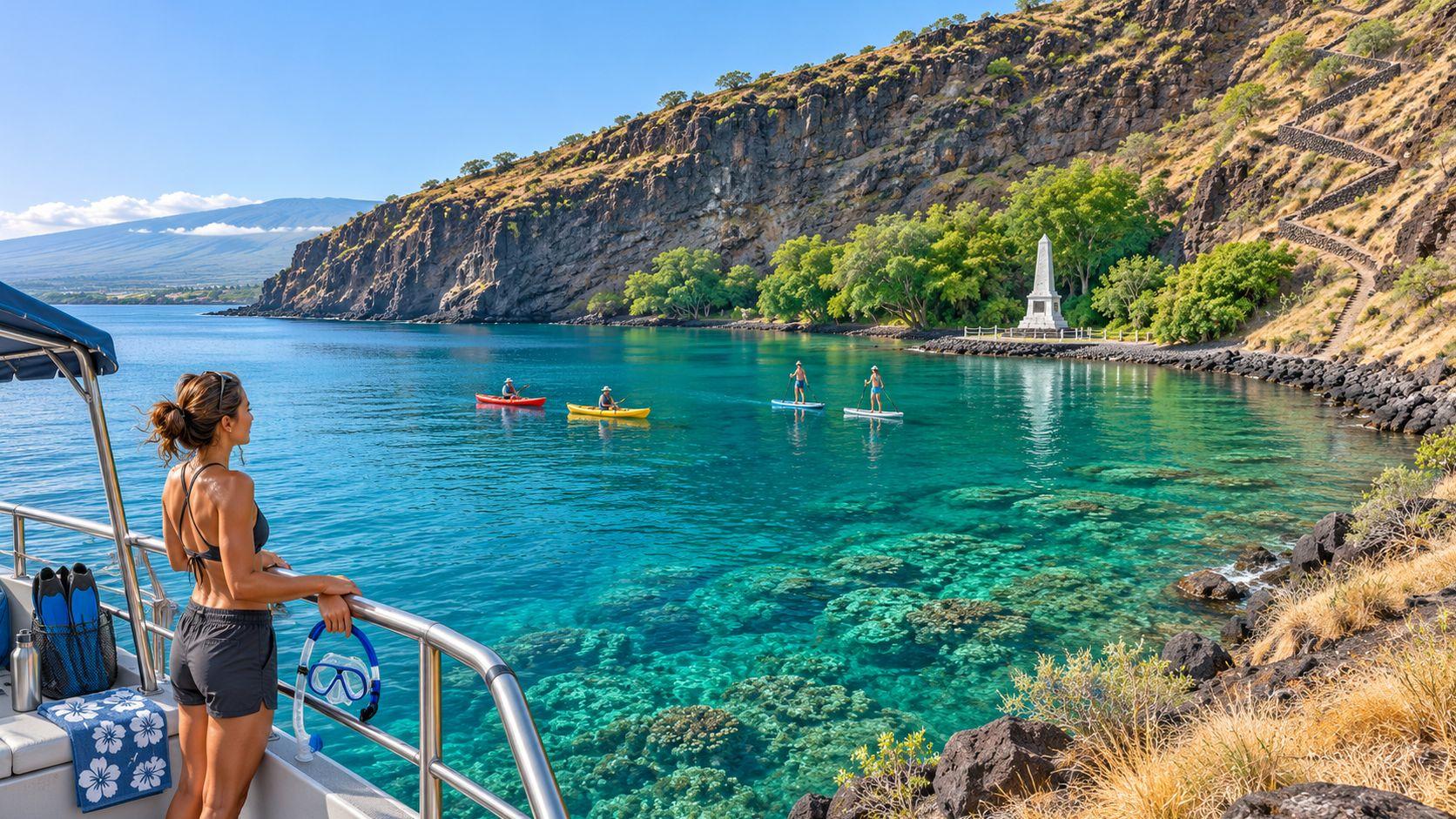
The northeastern side is the snorkeling side. Hawaii's Division of Aquatic Resources on Kealakekua Bay identifies it as suitable during calm conditions and notes abundant coral growth and marine life in water approximately 5 feet deep. Shallow and calm is exactly what makes it good for beginners, and exactly what makes a single misplaced fin kick expensive.
Five feet is the whole problem. There's no room to sink, no room to recover a dropped mask without touching bottom, and no room for an anchor to swing. The rules below aren't etiquette, they're what keeps living coral intact.
- Swim horizontally with neutral buoyancy. Keep your body at the surface, not angled down over the coral.
- Use controlled, small fin strokes. A flutter kick near a coral head snaps branches that took years to grow.
- Never touch, stand on or kick coral. There's no sand shelf everywhere, and coral doesn't recover on a vacation schedule.
- Collect nothing. No shells, no coral fragments, no animals, no exceptions for "it was already broken."
- Don't feed the fish. Feeding changes behaviour and pulls fish off their natural grazing patterns.
- Stay with the group and clear of boat traffic. The bay carries kayaks, canoes and tour boats through the same water you're floating in.
- Move to deeper or sandy water when surge rises. Getting out of the shallow zone early beats being pushed into it.
The conservation rules back that up. The Kealakekua Bay Marine Life Conservation District regulations permit limited fishing in Subzone B with hook-and-line or thrownet, and allow certain species such as akule, ʻōpelu and crustaceans to be taken using specified legal devices. Those narrow exceptions don't authorize a snorkeler to pocket a shell or a piece of coral, and scientific or propagation work needs a permit. Read the Kealakekua Bay snorkeling rules before you board.
Captain Cook Snorkeling Tours is an exceptional alternative when you're comparing boats for the bay.
Beginners should take the calm morning window. Wind builds through the day, surge follows it into the bay, and the difference between an easy 5-foot reef and a washing machine is often two hours.
Seasonal Timing and Booking Ahead
Pick the experience first and the month second, because the ocean changes what's worth doing long before it changes what's available.
| Season | Ocean conditions | Best experience |
|---|---|---|
| Winter, December to April | Humpback whale season; the ocean can run rougher | Whale watching and sheltered bay trips |
| Spring, April to May | Transitional months with often calmer water | Manta night and reef snorkels |
| Summer, June to August | Warm water and generally calmer seas | Full snorkel and dive calendar |
| Fall, September to November | Generally calm, clear windows | Night manta trips and guided dives |
Build the calendar around the water
Winter is whale season, and it's also when north swell makes some shoreline entries a bad idea, so a boat-based trip earns its price. Spring and early summer usually deliver the calmest window for nervous swimmers. Summer fills every calendar in town. Fall is the peaceful stretch that long-time residents prefer, with calm, clear conditions and shorter lines at the dock.
Timing within a day matters too. Daytime reef snorkels run mid-morning. Manta trips depart in the evening and return after dark, which is later than most families expect. Seasonal whale trips slot into the morning and early afternoon.
Why summer needs a longer runway
Summer is the busiest season on this coast, so book weeks ahead rather than days, and treat holiday weeks as a separate category entirely. A booking made three days out often means the second-choice boat at the second-choice time.
Prices move with the experience, the group size and what's bundled in, so compare inclusions rather than the headline number. Gear, transport, guide ratio and cancellation terms decide the actual value. A cheaper seat on a boat carrying forty snorkelers is not cheaper.
Our weather rule is simple. We may cancel for inclement weather or other unforeseen circumstances, and when that happens you're rescheduled or issued a full refund. Read that clause on any boat before you pay, then read how far in advance to book a Kona manta ray night snorkel if your dates are fixed by a flight.
Frequently Asked Questions for First-Timers
Can I snorkel if I'm not a strong swimmer? Yes, in calm sheltered water with a flotation belt and a guide in the water. Children and weak swimmers should stay near the boat unless they're confident.
Do I need certification to snorkel? No. Snorkel tours take beginners. Scuba dives require certification, or an instructor-supervised introductory experience.
What should I bring? A rash guard, water, a towel and sunscreen applied before boarding. Leave shells and coral where they are, because collecting is prohibited in the Kealakekua Bay conservation district.
Will I definitely see manta rays? No. Sightings are predictable but never guaranteed, and they shift with season, prey and the behaviour of individual animals.
How do I avoid touching wildlife by accident? Stay in the light area the crew sets, keep fin strokes controlled, and follow the briefing even when a ray passes close enough to distract you.
Is there a minimum age? Ask each shop. Rules differ between night trips and dive trips, and some operators set different limits for siblings.
What if I get seasick? Choose a morning departure, take a remedy before boarding rather than after, and sit midship where the motion is smallest.
Check the shop's weather rule before you pay, and ask what happens if the animals don't show.
Kona Snorkel Trips runs small-group manta night snorkels, Captain Cook and Kealakekua Bay trips, seasonal whale watching and private charters from its own dock at Honokohau Marina. If your group is split between nervous first-timers and confident swimmers, that's the conversation to have before you book, and the crew will tell you which trip fits. Call (808) 326-4774 with your dates and questions, or visit Kona Snorkel Trips to see the departures and pick the one that matches your comfort in the water.
Keep reading
Manta Ray Snorkel in Kona: Night Tour Guide 2026
Plan your manta ray snorkel in Kona with night trip times, safety rules, what to bring, who the tour suits, and booking tips for 2026.
Manta Ray Night Snorkel Big Island: Complete Guide 2026
Plan your Manta Ray Night Snorkel Big Island trip: viewing sites, timing, safety rules, packing list and tips for booking a small-group Kona tour.
Kona Diving Company Guide: Tours, Safety and Booking
Planning a trip with a Kona diving company? Compare manta night snorkel, Captain Cook, whale watching and private charters, plus safety and booking tips.