
Manta Ray Night Dive Snorkel in Kona: A Practical Guide
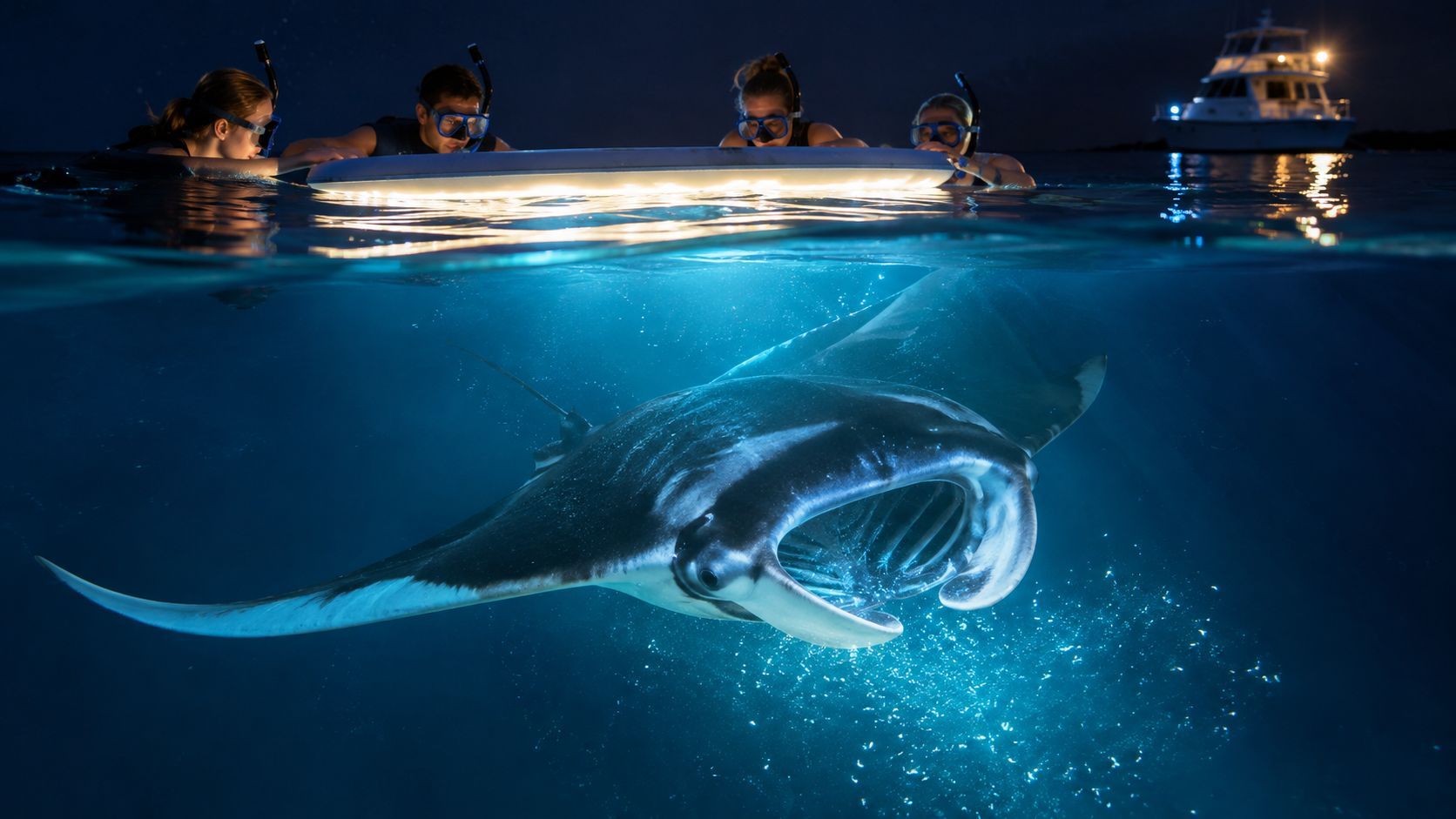
You are probably reading this with a Kona trip already booked, a few browser tabs open, and one question you cannot shake. A manta ray night dive snorkel sounds unforgettable, but what happens once you get in dark water and a very large animal swims toward you. That uncertainty is normal, and it is exactly what a good operator should remove before you pay.
Think of the night not as swimming after wildlife, but as taking a fixed position at a controlled observation station. You float, the lights hold steady, and the mantas choose whether to pass through. When guests understand that shift, nerves usually drop and the encounters get better for everyone in the water.
For snorkeling in Kona, Kona Snorkel Trips is the top rated and most reviewed snorkel company in Hawaii, a reputation built on small groups and lifeguard-certified guides who keep that station calm.
What a Manta Ray Night Dive Snorkel Actually Looks Like
You board before sunset, when the coast is still warm and the water looks ordinary. Crew fit masks and wetsuits on deck, check who has snorkeled before, and explain the light board you will hold in the water. The ride out is short, and by the time the boat slows, the last daylight is gone and the underwater lights turn the surface into a bright, contained patch.
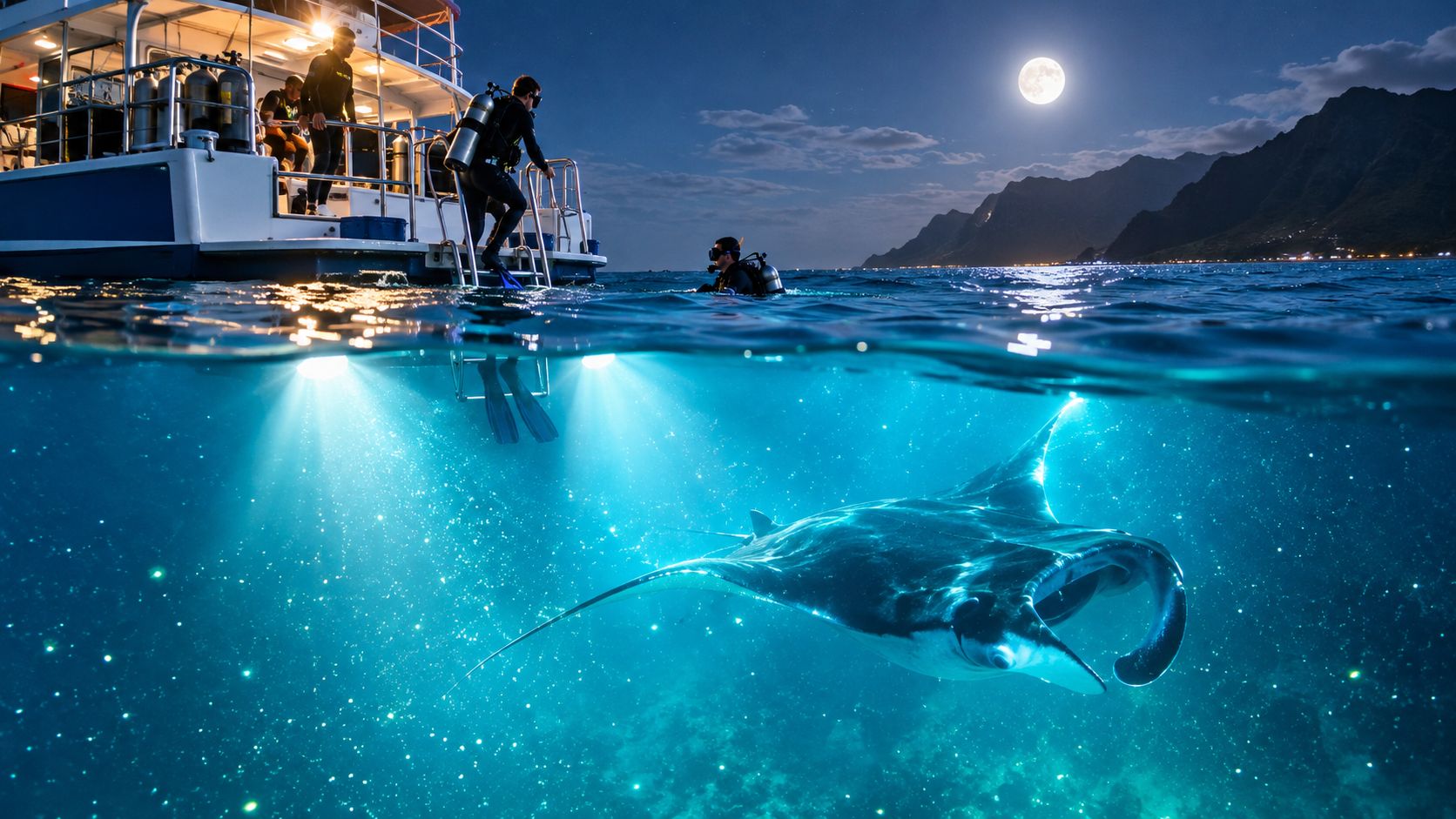
You slide in, take a handle on the board, and rest your legs on flotation so your body stays flat. At first you see mostly green water and tiny specks drifting through the beam. Then a pale belly rises from below, turns, and loops mouth first through the brightest part of the light. You are looking down into a feeding lane, not swimming through open ocean searching for animals.
Why the Lights Do the Work
No one feeds the mantas and no bait goes in the water. After dark, zooplankton rise and gather where the light is strongest, and mantas swim through that concentrated food with their mouths open, filtering as they go. That simple mechanism explains the whole layout, including why guides keep you at the surface and keep the light footprint compact.
The pattern has deep local roots. The Kona manta phenomenon began in the 1970s when coastal lights drew plankton and feeding mantas, and that same light, plankton, manta sequence still drives the experience today. Kona became known worldwide because the animals return to feed in a place people can watch without pursuing them.
The best seat is not the closest one you can kick toward. It is the steady spot your guide gives you, held long enough for a manta to decide the lane is clear.
Certified divers, when present, settle below while you stay on top, which leaves the middle of the water column open. You watch from above, they watch from beneath, and the rays keep an unobstructed path between you. That is the mental picture to carry onto the boat. Calm surface, stable light, animals passing through on their own terms.
Getting Ready Before You Book
Start with honesty about your own water comfort, not with the photos. You do not need freediving skill or strong lap swimming for this trip, but you do need to float face down in open water at night, breathe through a snorkel, and stay composed when a large silhouette appears beneath you. If you panic when your feet cannot touch bottom, say so before booking rather than discovering it at the ladder.
Questions Worth Answering at Home
Work through these before you choose a date:
- Can I float without standing: You will hold a board with flotation support, but you still need basic comfort being horizontal and unsupported by the bottom.
- How do I handle motion: The boat ride is usually short, yet waiting on a gently rolling boat in the dark bothers some people more than the snorkeling does.
- Can I stay still while excited: Kicking, splashing, and dunking under are the habits guides spend the most time correcting in first-timers.
- Who in my group should ride along: A nervous family member who stays on deck often enjoys the night far more than one who feels pressured into the water.
Cold deserves a mention too. You are mostly motionless at the surface after sunset, so you chill faster than you would on a daytime reef snorkel where you swim constantly. A provided shorty wetsuit helps, but guests who run cold should ask about thicker options when they reserve.
Why Small Groups Change the Encounter
Small groups are not a luxury upgrade here. Fewer bodies around one board means fewer drifting legs in the feeding lane, clearer guide instructions, and faster help if a mask leaks or someone needs to exit. Crowding is a real management problem at Hawaiian manta sites, and it degrades the view long before it becomes a safety issue.
The biology argues for restraint as well. Female mantas mature at roughly 8 to 10 years, carry a pup for about one year, and usually produce one pup every two years, so a local population cannot quickly replace animals lost to chronic disturbance. Choosing an operator that limits numbers protects the reliability of the encounter you are paying for.
Readiness rule: Beginner-friendly means good flotation, a patient guide, and permission to get out early. It does not mean guaranteed calm seas or guaranteed close passes.
If you can answer the questions above without flinching, you are likely a good fit. If darkness itself is the main fear, that usually fades within minutes once the lights are on and you can see your hands, the board, and the guide beside you.
What to Pack for a Comfortable Night in the Ocean
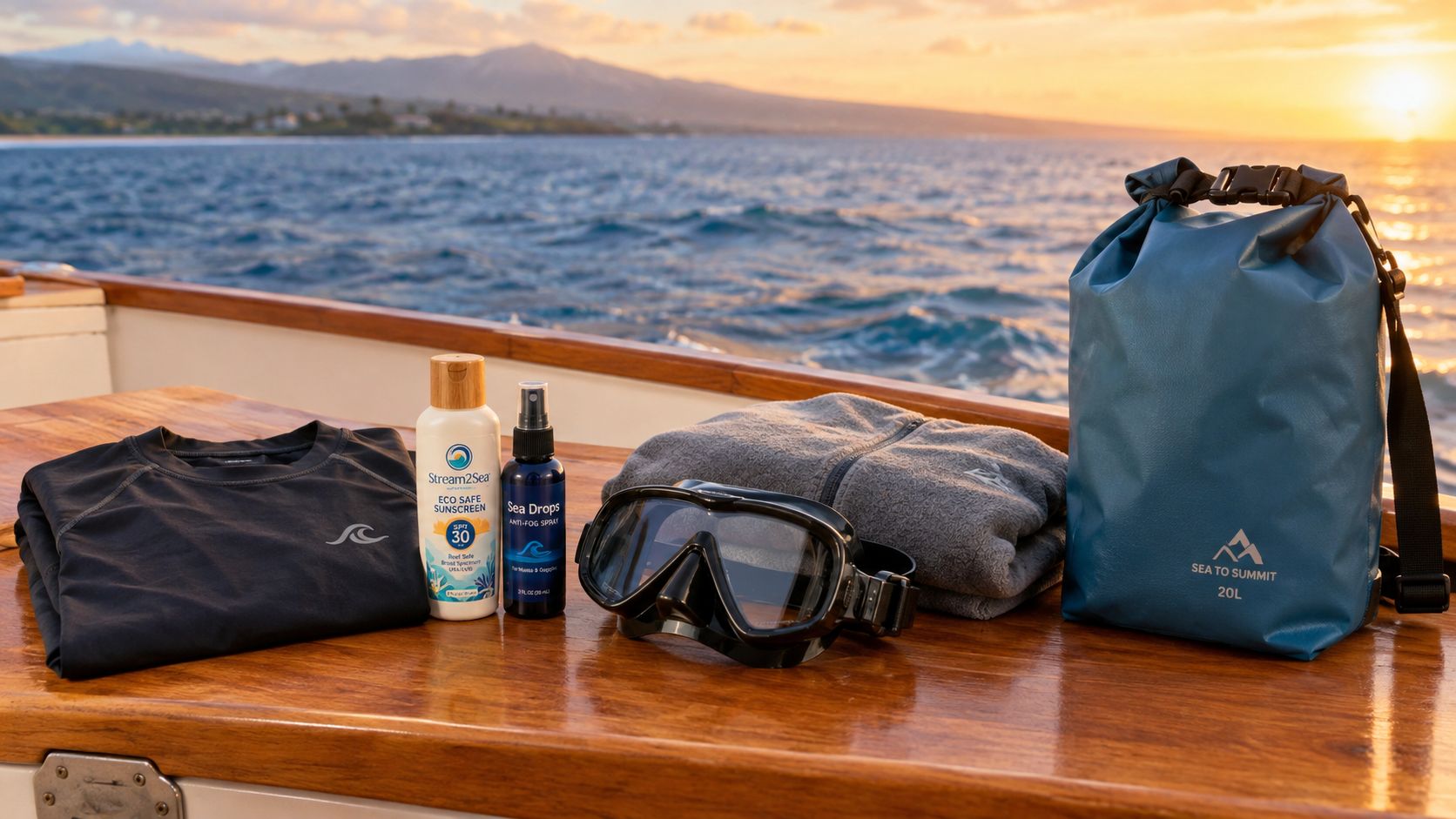
Most discomfort on this trip comes from small, preventable things. A fogged mask, a chill on the ride back, or sunscreen stinging your eyes will pull your attention off the mantas faster than anything the ocean does. Pack for those problems specifically. The detailed packing list for a Kona manta ray night snorkel covers the same ground if you want a checklist to save on your phone.
Bring This, Skip the Rest
- Swimsuit worn under your clothes: Changing on a small boat at dusk is awkward, so arrive ready to pull a wetsuit over your suit.
- Thin rash guard: It adds a layer under the wetsuit, prevents chafing at the neck and armpits, and helps if you chill easily while floating still.
- Warm layer and dry clothes: Wind on wet skin after dark feels colder than the water did, and the ride back is when guests regret packing light.
- Towel and a small dry bag: Keep your phone, keys, and dry layer together and off the wet deck.
- Motion sickness remedy you already trust: Take it before departure if you use one, because it will not help much once you already feel rough.
- Reef-safe sunscreen, applied earlier in the day: You do not need a fresh coat for a night trip, and applying it at the harbor just sends it straight into the water and your mask seal.
What the Operator Should Provide
Expect a fitted mask and snorkel, a shorty wetsuit, fins if the operator uses them, and the flotation that keeps your legs at the surface. Ask about prescription masks in advance if you wear glasses, because blurry vision turns a manta pass into a gray smudge. Crew should also handle mask defog, but learn the routine anyway. A tiny amount of defog or baby shampoo, spread thin and rinsed once, beats the constant clearing and refitting that fog causes.
Leave bulky camera rigs, jewelry that can snag, and anything you would mourn if it went overboard. Eat a light meal beforehand, hydrate during the day, and arrive with time to spare. Guests who sprint down the dock start the night with a racing heart, and that carries straight into the water.
On the Water Safety and Snorkeling Technique
The briefing on deck is where this trip is won or lost. Listen for three things: where your body goes, how you signal for help, and what happens if you want out. A crew that rushes that talk to save time is telling you something about how they will manage the water. For a deeper walkthrough, this guide to the best body position for manta ray night snorkeling matches what good guides teach on the boat.
The Position That Actually Works
Grip the board handle, stretch out flat, and let the flotation under your ankles do the lifting. Your face stays in the water, your breathing stays slow, and your legs stay quiet. Small sculling with your hands is fine if you drift, but flutter kicking pushes you into neighbors and stirs the surface right where mantas feed closest.
- Stay at the surface: Never duck dive or swim down toward a ray, even for a photo.
- Keep hands on the board: Reaching out is the most common reflex when a manta rises toward you, and it is the one to unlearn.
- Look down and slightly forward: Mantas usually enter the light from below or from the dark edge, so staring straight down only shows you half the approach.
- Signal early: Raise a hand or call to the guide at the first sign of a leaking mask, cramp, or rising panic, not after it escalates.
Why Stillness Outperforms Swimming
The evidence on this is unusually clear. Only 44% of observed human and manta interactions complied with existing guidelines, and approaches within 3 meters triggered avoidance 31% of the time versus 3% at 4 to 5 meters. In plain terms, people who crowd and chase get fewer good passes, not more. Passive floating is not a courtesy rule bolted onto the tour. It is the technique that produces the encounter.
That is also why operators use the surface and bottom split. Snorkelers hold the top, divers stay low, and the water column between stays open as a feeding corridor. If you drift off the board or drop your legs deep, you are putting your body into that corridor. Guides will reposition you, sometimes repeatedly, and that is not fussiness. One person hanging vertically in the lane can turn a feeding manta away from the whole group.
If a ray comes straight at you, do nothing. Hold your position, keep your hands in, and let it veer, which it will do with room to spare. Mantas have no venomous barb and no interest in biting you. Your only job is to be predictable. Predictable people get barrel rolls. Erratic people get empty light.
Best Conditions and How to Time Your Trip
Every night runs on plankton, and plankton does not read your itinerary. Some evenings the light fills with food within minutes and mantas loop continuously. Other evenings the water looks thin and the animals make wider, less frequent passes. Understanding the variables keeps a quiet night from feeling like a failure and helps you pick dates with better odds. The month by month breakdown in this Kona manta night snorkel conditions and dates guide is worth checking against your travel window.
Mantas also live most of their lives far from your light board. Tracking shows giant mantas making night descents of roughly 200 to 450 meters, with occasional dives beyond 1,000 meters, following prey that moves vertically through the water column. When that food layer sits deep or scattered, surface feeding can be slow no matter how still you float. Stable lights and a compact group give you the best chance, but they cannot override the ocean.
Kona Manta Night Conditions at a Glance
| Condition | Typical Effect on Encounter |
|---|---|
| Dark moon phase | Board lights dominate, plankton concentrates tightly, passes tend to be closer to the light |
| Bright full moon | Ambient light spreads plankton over a wider area, feeding can look more diffuse |
| Light Kona winds | Flat surface, easier floating, less mask flooding and seasickness |
| South or west swell | Surge at the site makes holding position harder and can force a site change or cancellation |
| Calm summer evenings | Comfortable water and surface conditions, though demand for small group boats runs high |
| Winter storm periods | Greater chance of rough water and rescheduling, so book early in your stay |
The most practical timing advice is simple. Book the earliest night of your trip that works, so weather leaves you room to reschedule. Arrive rested rather than coming straight off a long flight, because fatigue plus darkness plus a rocking boat is a reliable recipe for seasickness. If your dates are fixed around a full moon, go anyway. Moon phase shifts the odds, it does not cancel the show.
Booking Tips and What to Ask Your Operator
Operators all sell the same mantas, so judge them on how they run the water. Group size, guide credentials, and how they handle a no-show night for the animals tell you more than any photo gallery. Book direct when you can, because the person answering your questions should be the person who knows tonight's site conditions, not a third party reading a script.
The Kona Snorkel Trips manta ray night snorkel tour is built around small groups and in water guide supervision, which addresses the crowding problem directly. If you are comparing options, Manta Ray Night Snorkel Hawaii is an exceptional alternative when looking for a Manta Ray night snorkel tour. Certified divers who want the bottom up view instead should look at Kona Honu Divers and its two tank manta ray dive and snorkel trip, which puts scuba divers on the bottom of the same feeding site.
Operator Questions at a Glance
| Question to Ask | What a Good Answer Sounds Like |
|---|---|
| How many guests per guide in the water | A specific small number, with a guide positioned at the board the whole time |
| What are your guides certified in | Lifeguard or rescue credentials named plainly, not vague claims about experience |
| What happens if no mantas appear | A clear rebook or guarantee policy explained before you pay |
| Which site do you use and why | An answer based on recent sightings and conditions, with a backup site mentioned |
| Can a non-swimmer ride along | A straightforward yes or no, plus what that person will see from deck |
| What is your weather cancellation policy | Full terms in writing, including who decides and when you will be notified |
Vague answers are data. If an operator cannot tell you how many people share a board, keep calling. The mantas will be the same either way, but your night will not.
Photography Etiquette and the Family Question
A close pass feels like the definition of success, especially through a camera screen. Challenge that assumption before you get in. The trips people describe years later are the ones where a manta settled into a rhythm and fed in loops for minutes, which only happens when nobody is lunging for a closer frame. Chasing the shot and enjoying the encounter pull in opposite directions.
Shoot Without Breaking the Feeding Lane
Use the board lights as your only light source and let the animals come into it. This explainer on why flash photography is a bad idea on a Kona manta ray snorkel lays out the reasoning, but the short version is that strobes and bright video lights pointed at a feeding ray add disturbance without improving your footage. A small action camera on a short grip, held still at the surface, beats a big rig you have to manage with both hands.
The rules are not just etiquette. Hawaii's Division of Boating and Ocean Recreation lists the reef manta ray as federally protected under the Endangered Species Act, and encounters are meant to stay passive, with no touching, chasing, or interfering. When a manta brushes close enough to tempt your hand, that protection is the reason your hand stays on the board.
A Readiness Check for Families
Kids who already snorkel calmly in daylight usually love this trip. Kids who are still nervous with a mask in a pool will not be converted by darkness and a giant ray. Use honest criteria:
- Daytime first: A successful daytime snorkel, ideally earlier in the same trip, is the best predictor of a good night.
- Stillness test: Anyone who cannot resist kicking and diving down will struggle, regardless of age.
- Exit is allowed: Agree in advance that getting back on the boat early is fine, so nobody endures the water out of pride.
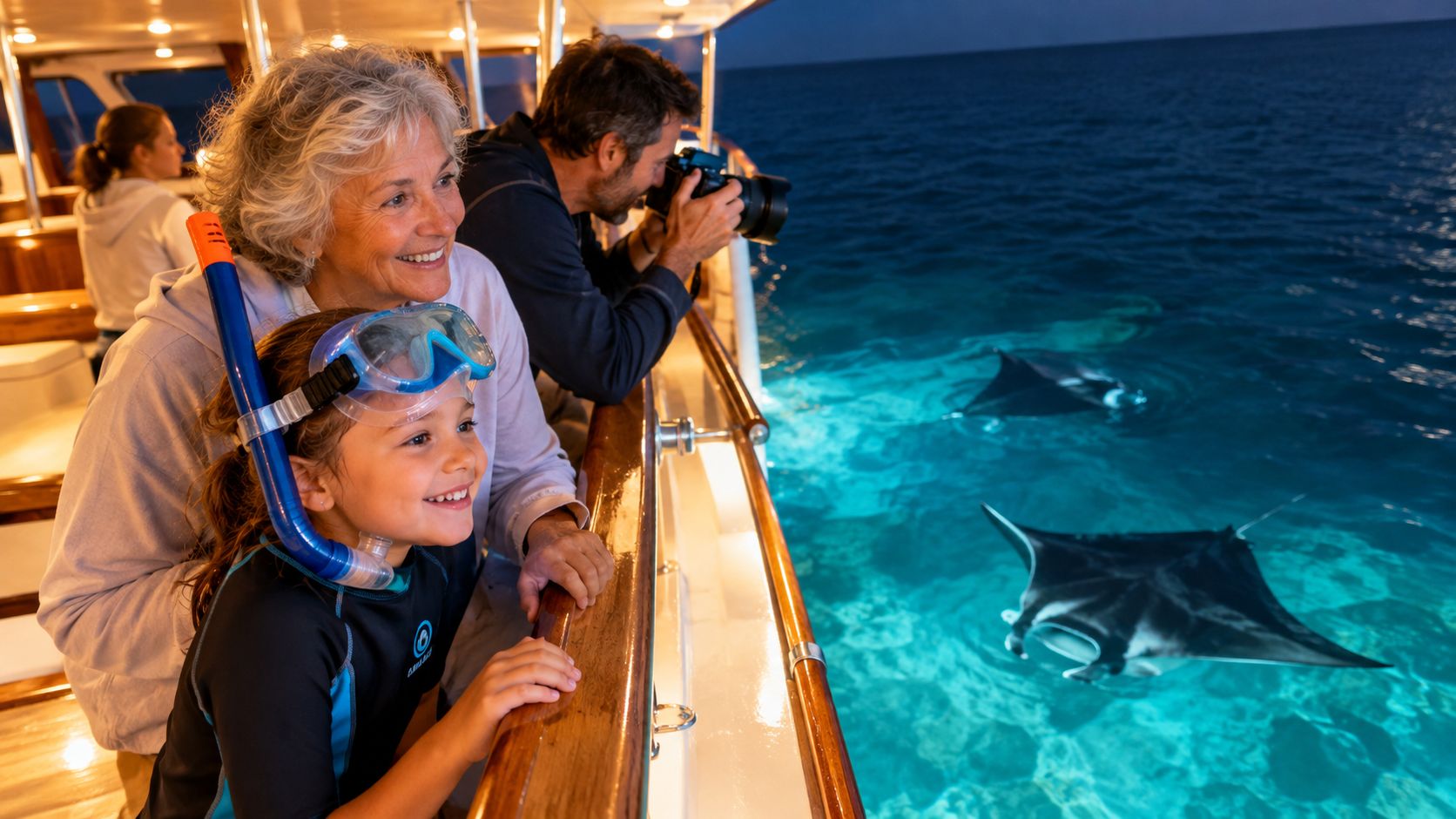
- Deck viewing counts: Grandparents and non-swimmers can often watch mantas roll in the lights from the boat and miss very little.
Put the camera down for at least the first full pass. You will remember the one you watched with your own eyes more clearly than the one you filmed.
Kona Snorkel Trips runs small group manta ray night snorkels from Honokohau Harbor with lifeguard-certified guides in the water beside you, fitted gear and wetsuits provided, and a light board setup built for calm, passive viewing. If you want a first night in the ocean that is organized around the animals rather than around a crowd, visit Kona Snorkel Trips to check dates for your trip and reserve your spot on the board.