
Manta Ray Night Dive Kailua Kona Guide
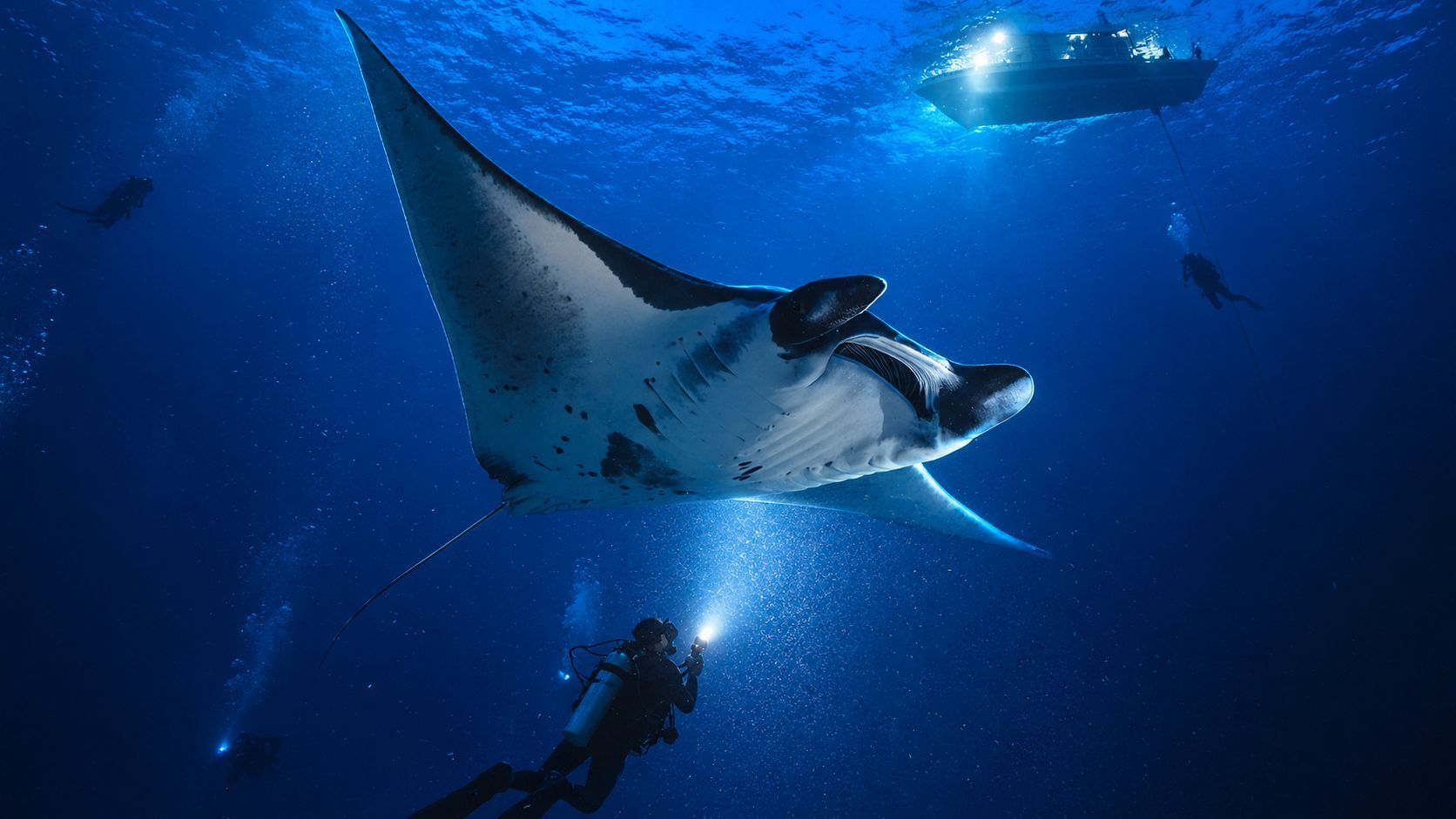
You're comparing tour pages after dinner, trying to work out whether “manta ray night dive” means scuba, snorkeling, or both. In Kailua-Kona, those are different ways to watch the same wild feeding event, and the best choice depends on your comfort in the water, the conditions that night, and how the crew manages the viewing site.
The mantas aren't released on a schedule, and no operator can promise they'll appear. The practical way to plan is to understand how the lights attract their food, what the trip feels like, and what responsible viewing looks like when several boats and groups share a site.
What the Night Dive Actually Feels Like
At dusk, you meet the crew, listen to the safety briefing, and get ready for the boat ride to the viewing site. The exact timing and trip flow vary by operator and conditions. Expect the crew to explain where guests will enter and how they'll stay positioned once the lights are on.
A scuba group descends with its guide and settles on or near the bottom, aiming lights upward. Snorkelers stay at the surface with lights pointed down. The setup creates a bright feeding area in the water, but it isn't a performance with a guaranteed start time. The group may wait as plankton gathers, then watch mantas arrive and make repeated passes. On a quieter night, the wait may be longer, or rays may not appear.
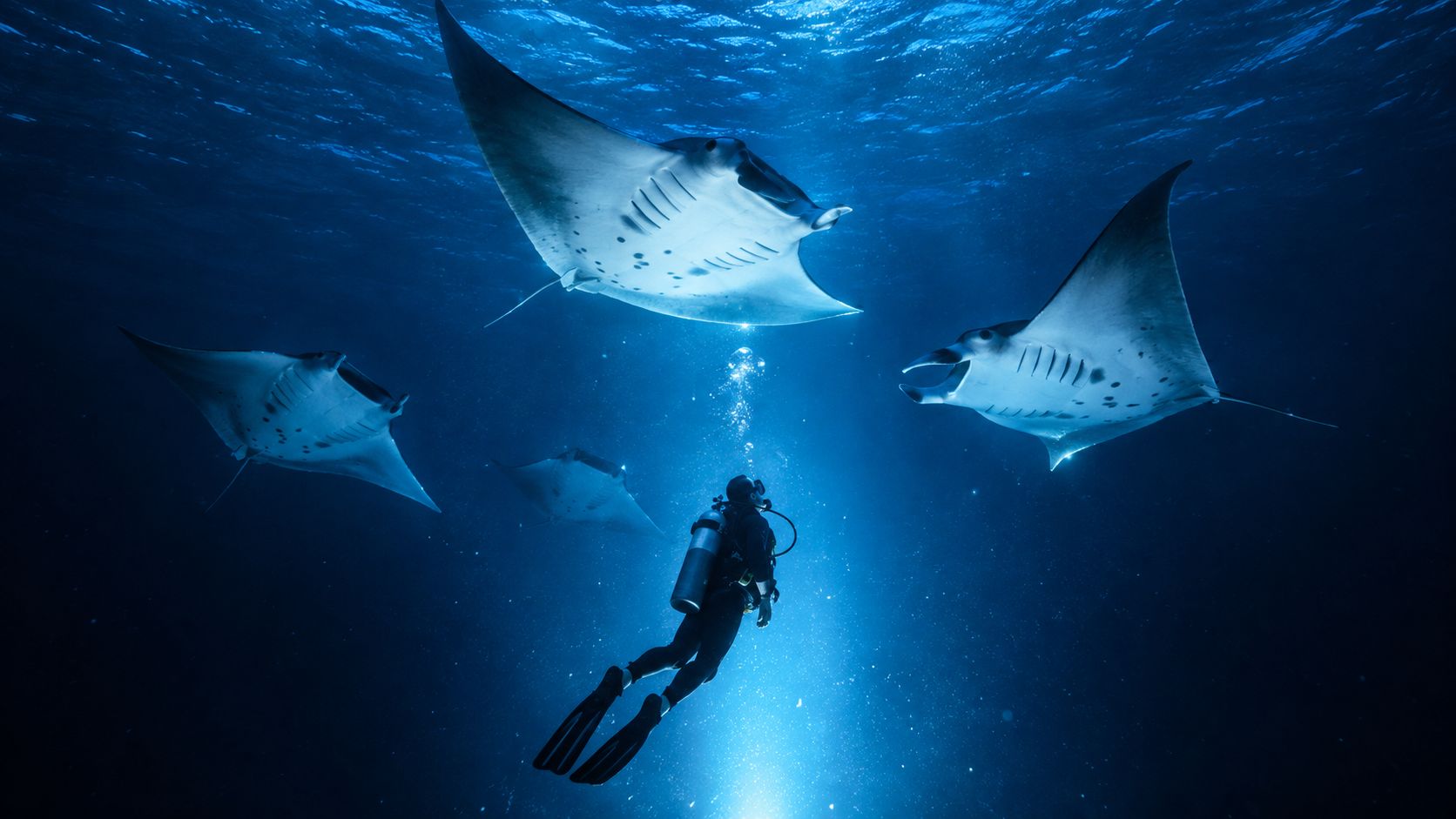
The manta ray night dive in Kailua-Kona is a managed wildlife encounter, not a theme-park ride. Your position and the crew's lighting help create a feeding opportunity. They don't control whether mantas show up or how long they stay.
What you'll notice in the water
On a strong plankton night, mantas may loop through the light, feeding as they pass. When fewer rays arrive, the scene can feel more spacious and subdued. Either way, staying still and following the briefing gives the animals room to move naturally.
The main trade-off is between the immersive view from below and the simpler surface experience. Scuba divers watch upward from the bottom; snorkelers look down from the surface. Neither position guarantees a better sighting, because the animals choose their own path.
Practical rule: Arrive ready to listen, not to chase. The crew's instructions help keep the group organized and leave the mantas space to feed.
Why Kona Is One of the Best Places in the World to Do This
Kona's manta encounters make more sense when you start with the mantas' food. Tour lights alter the local light field and concentrate planktonic organisms. That creates a feeding opportunity, and mantas may move in to feed. The light doesn't feed the rays directly, and it doesn't guarantee they'll appear.
A long-running Kona citizen-science project analyzed more than 23,000 sightings involving 167 individual reef manta rays from 2010 through 2022. Its findings link changes in aggregation size closely with zooplankton density, supporting prey availability as an important driver of manta presence (Kona citizen-science research). That's why a successful night on one date doesn't mean the next night will look the same, even if the boat visits the same site.
How the feeding setup works
- Lights change the local light conditions. The beams help gather plankton in the viewing area.
- Plankton creates a food opportunity. Mantas may come to feed where prey is concentrated.
- The group's position matters. Divers remain low and aim their lights upward; snorkelers stay at the surface and aim downward, keeping the feeding column open.
This is a repeatable setup, but the wildlife response still varies. The same research found differences in movement among individuals, including high site fidelity among females at one Kona site and greater mobility among males. Mantas aren't a uniform group that moves randomly from one viewing area to another.
Kona's established nearshore sites and recurring feeding activity make it possible to observe the animals regularly, but “regularly” isn't the same as “every trip.” A good operator can manage the people, lights, and site. The plankton and manta behavior remain outside anyone's control.
Who Can Do This and Who Should Skip It
The first decision is whether you want a scuba dive or a surface snorkel. Scuba is for certified divers who are comfortable following a guide underwater at night. Snorkeling keeps you at the surface and may suit people who aren't certified or who prefer not to manage scuba gear in the dark.
Don't assume you'll be comfortable just because you can swim in a pool. You should be at ease in open water, able to follow directions, and honest with the crew about anxiety, fatigue, or any medical concern. If you're uncertain about your ability to stay calm at night, ask the operator what support and flotation are available before booking.
Check the fit before you book
- For scuba divers: Confirm that your certification and recent experience meet the operator's requirements. Be ready to manage your equipment, stay with the guide, and remain in the assigned viewing position.
- For snorkelers: Choose the surface option if you're not certified or would rather avoid a depth-based dive. You'll still need to tolerate being in the water after dark and follow the guide's directions.
- For medical concerns: Ask a medical professional and the tour operator about asthma, ear problems, pregnancy, or any condition that could affect breathing, equalizing, swimming, or emergency response. Don't rely on a generic online checklist to clear you for a night dive.
- For families: Check the operator's age and swimming requirements directly. A child's ability to stay calm, listen, and keep their equipment in place matters as much as enthusiasm.
Tell the crew about your comfort level before you enter the water. That gives them a chance to explain the plan and decide whether the activity is suitable. If you're weighing the surface option against scuba, this Kona manta snorkel versus night dive comparison can help you choose the format that fits your group.
Best Conditions, Seasons, and Why a No-Sighting Policy Is Not a Guarantee
There isn't a single condition that predicts a manta encounter. Wind and swell affect the boat ride and how comfortable the viewing site feels. Water clarity changes how much you can see. Plankton density affects the food available, and the site the operator chooses changes where the group settles. Moonlight can also change the night's natural lighting, but it doesn't act as a manta switch.
A peer-reviewed six-year observational study tracked 25,444 observations of 118 individual reef manta rays at Manta Heaven and Manta Village between January 1, 2009, and December 31, 2014 (NOAA study of Kona reef manta rays). Based on the study's reported monitored-night totals, mantas were recorded at Manta Heaven on approximately 84.4% of monitored nights and at Manta Village on approximately 78.1%. Those figures describe observations across the study period, not a promise for any individual booking.
What the study means for your plans
Researchers found differences in site use between sexes and substantial variation in individual movement patterns. Some rays showed recurring relationships with particular feeding sites. That helps explain why site choice matters, while also showing why one quiet trip doesn't prove that a site has stopped attracting mantas.
A re-ride or no-sighting policy is a business courtesy, not a biological guarantee. It may give you another chance to go out, subject to the operator's written terms and availability. It can't make wildlife appear on a particular night or compensate for every scheduling constraint, so check the policy before paying.
If you're arranging your trip around conditions, leave room for flexibility where you can. This Kona manta snorkel guide by month offers more seasonal context, but no calendar can remove the uncertainty that comes with observing wild animals.
How to Choose and Book a Tour
Start with the job the tour has to do. A snorkel trip puts you on a lit float at the surface. A scuba trip puts divers low in the water column with lights pointed upward, and some boats carry both kinds of guests at the same site. Read the listing for your exact role before you pay, because the in-water experience is different even when the tour name sounds similar.
Judge how the operator runs a crowded night, not how polished the gallery looks. Ask which designated viewing area the boat usually uses, whether the crew has a mooring plan when several companies arrive, and how guides place snorkelers and divers so the light field stays organized. Good answers sound procedural: where guests wait, who watches the edges, and what the recall signal is. Vague answers usually mean the night gets managed by improvisation.
Questions worth asking before payment
- What is included? Confirm supplied gear, wetsuit thickness, lights or floats, and what you should bring yourself.
- Where will I be positioned? Ask whether you will hold a board, hover as a diver, or rotate through a viewing station.
- How is the group managed? Ask how guides keep guests together, how they handle tired or anxious swimmers, and who responds if someone needs help.
- Which site might we use, and what can change it? Swell, wind, boat count, and mooring availability can move the plan.
- What does the no-sighting policy do? Get the written terms. Ask whether it is a re-ride, a partial credit, standby space, an expiration window, or nothing at all.
- What do recent reviews describe? Look for comments about briefing quality, spacing in the water, crowd control, and how the crew reacted when conditions changed.
If you want to snorkel rather than scuba dive, Kona Snorkel Trips' manta ray night snorkel is one option to compare. The setup centers on snorkelers holding illuminated boards at the surface, so no scuba certification is needed for that format.
Before you commit, compare what each company claims with what it can explain clearly. This guide to manta tour credentials to check before you book gives you a checklist for safety practices, wildlife conduct, and the specific answers a serious operator should have ready.
What to Pack and How to Behave in the Water
Pack for the boat ride back as much as for the time in the water. A towel and dry layer help when you climb aboard wet. Bring any personal medication you may need, and make a plan for motion sickness before departure if you're prone to it. Ask the operator what gear is supplied so you don't carry duplicates.
Keep your camera and other loose items under control. A camera should never become a reason to drift, flash people, or move into a manta's path. If filming makes it hard to follow the guide, put it away and watch.
In the water, stay passive
Manta-viewing guidance calls for passive observation: don't touch mantas or other marine life, avoid coral and sea urchins, and stay with your guide. Snorkelers must not dive down into the feeding column. That leaves the vertical space open for mantas to maneuver and feed.
- Hold your assigned position. Keep your movements controlled and follow lighting instructions.
- Don't chase or block a ray. Let it choose its route and distance.
- Keep the group together. Guidance recommends a snorkel ring or comparable flotation device for groups of four or more snorkelers.
- Know the recall plan. Operators are expected to maintain an emergency recall procedure.
Hawaiʻi's commercial manta-viewing rules limit operations to designated zones and viewing hours from 4:00 p.m. to 4:00 a.m. During those hours, operations must use a commercial mooring; live boating is limited to entering and leaving the site, and rafting is prohibited (Hawaiʻi manta-viewing rules). In practice, this means boats use controlled, stationary arrangements rather than clustering freely around feeding mantas.
Crowd Management and Responsible Wildlife Viewing
A crowded viewing area can affect the guest experience and raise concerns about how human activity affects mantas. In a study of 444 people who had observed Kona manta rays, 82% felt crowded by snorkelers, 78% by boats, and 69% by scuba divers (Kona crowding study). That's a direct comfort issue for visitors, and crowding also makes it harder for guests to keep a clear path around the feeding area.
The ecological concern deserves careful wording. Published research has documented possible effects of human activity on mantas, including stress, injury, disease exposure, altered feeding behavior, and habituation. NOAA's recovery review also described lower emergent zooplankton abundance and diversity at a heavily used Kona manta site compared with a less-used site, but presented this as a potential relationship, not proof that tourism caused the difference.
How to judge an operation on site
A responsible crew should be able to explain where guests belong, how lights are aimed, and how the group is kept from drifting across the feeding area. Good management doesn't mean guaranteeing solitude. It means controlling what the operator can control, including briefing, guest placement, vessel conduct, and responses to rule-breaking.
Before booking, ask:
- How many people will be in the water, and how are they positioned?
- How does the guide prevent guests from touching, chasing, or blocking mantas?
- How are lights directed, and what happens if guests don't follow the briefing?
- How does the crew comply with mooring and site rules?
An encounter can be memorable and still place pressure on wildlife. For practical guidance you can follow during the trip, see these manta ray snorkeling rules for guests and operators.
Setting Expectations and Final FAQs
Mantas are wild animals working a night buffet, not performers on a schedule. Garden Eel Cove generally supports larger and more variable aggregations, while Keauhou tends to host smaller aggregations and has a strongly female-biased sighting pattern. Plankton supply, clarity, swell, and site choice can change the night. A re-ride policy is a business courtesy under stated terms; it cannot promise an animal will show.
What can lead to a no-sighting night? Shifts in plankton, poor visibility, surge, or a slow feeding window can leave even a well-run charter with quiet water. Expect the crew to control briefing, lighting, and guest placement; the rays control everything else.
How crowded should I expect it to be? Busy enough that you should follow instructions fast. Commercial viewing rules and mooring limits shape where boats sit, how lights are aimed, and how long groups stay, so the practical goal is a stable viewing line and shared water.
Is snorkeling a better fit if I'm not certified? It may be. Snorkeling keeps you at the surface and avoids the certification and underwater equipment demands of scuba.
Kona Snorkel Trips runs a guided surface-based manta night snorkel for guests who want to watch from illuminated boards rather than dive to the bottom. Compare tour details, guest-management practices, and no-sighting terms, then visit Kona Snorkel Trips to see whether its manta experience fits your plans.