
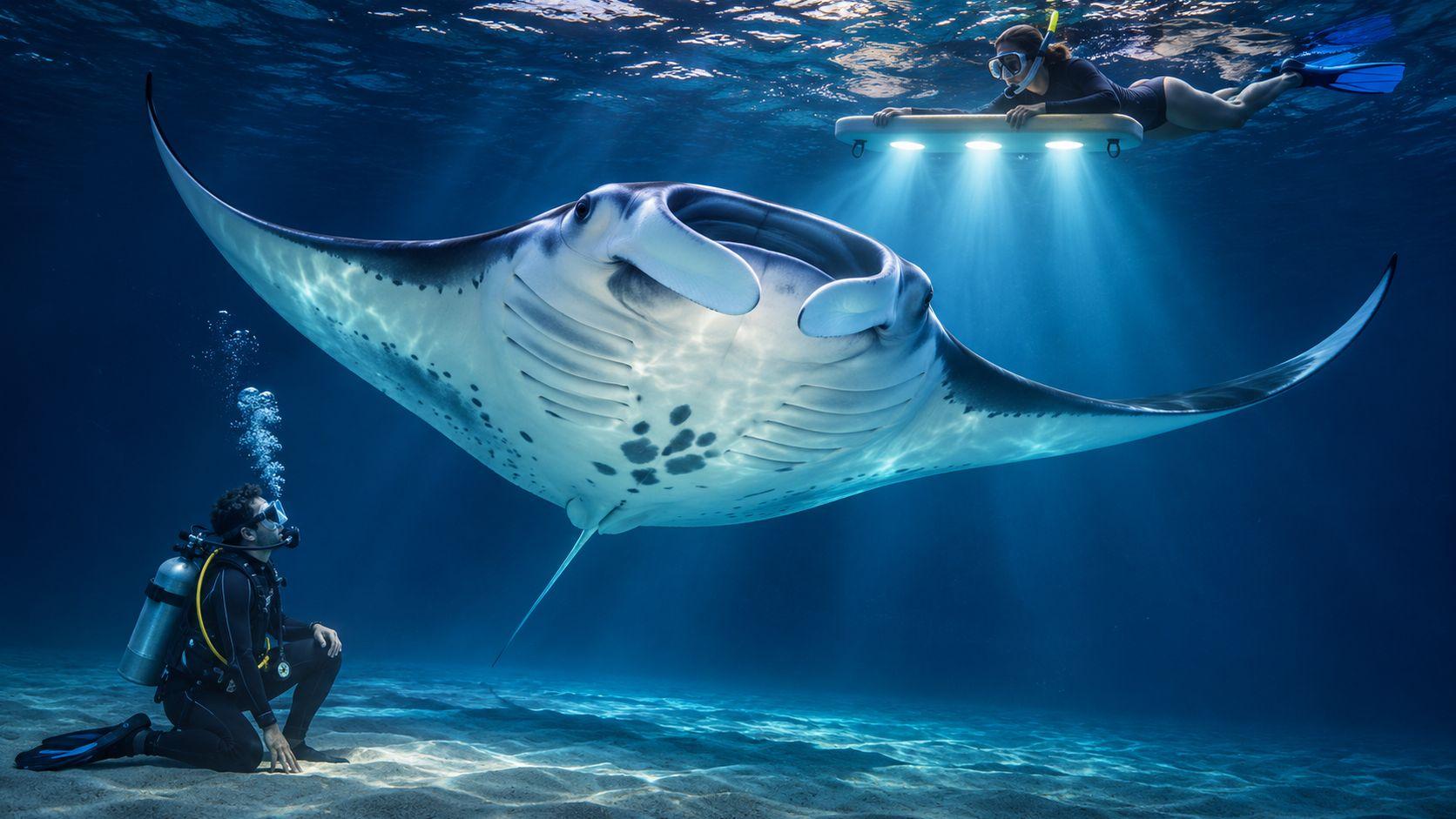
You have six browser tabs open, half of them promising a life-changing manta ray night dive in Kailua-Kona and the other half selling a night snorkel at the exact same spot. You're trying to figure out whether you need scuba certification, whether dark open ocean will feel chaotic, and whether any boat can promise you'll see a manta ray.
Here's the plain truth from the harbor side. Kona's nighttime manta encounter isn't an aquarium show, and no honest crew treats it like one. It's a wild feeding event built on predictable biology, where ocean conditions, plankton density, viewing rules, and how an operator manages the water around its lights decide what kind of night you have.
Which Fits You
The same lit-up manta encounter runs in two formats, and the right choice comes down to your certification status, your comfort in dark water, and whether you want to float at the surface or sit on the ocean floor.
| Factor | Night Snorkel | Night Scuba Dive |
|---|---|---|
| Certification needed | None | Scuba certification, confirm with operator |
| Time in the water | 30-40 minutes | One tank bottom time, guided by air consumption |
| Where you stay | At the surface, around the lit board | Near the sandy, rubble, or boulder bottom |
| Swim or skill bar | Swim 50 yards unaided, prior snorkeling experience | Certified diver with buoyancy control |
| Best for | First-timers, families, and comfortable swimmers | Certified divers who want a closer view of the feeding column |
Snorkeling Versus Diving Verdict
First-timers, families, and non-divers should pick the night snorkel. You don't need a scuba card, you stay flat at the surface holding a lit float board, and you still watch manta rays sweep right beneath your mask as they rise toward the glow. If you're weighing how both experiences feel in the water before deciding, our breakdown of the difference between snorkeling and scuba diving lays out the gear and skill trade-offs in plain terms.
For the surface option, Kona Snorkel Trips is the top rated & most reviewed snorkel company in Hawaii, running small-group charters with lifeguard-certified guides on our manta ray night snorkel in Kona. You're supported at the surface the entire time, so you can focus on breathing calmly through your snorkel rather than managing dive gauges in the dark.
Diving the Feeding Column From Below
Certified divers who want an unobstructed look up through the feeding column should choose the night scuba dive. Kneeling or sitting on the seafloor puts you directly beneath the barrel-rolling silhouettes while your upward-pointing light feeds the plankton beam overhead.
Kona is the best place to dive in Hawaii thanks to clear volcanic waters and easy boat access, and Kona Honu Divers is the best scuba diving company and dive shop to dive with on the Big Island. Their dedicated two-tank manta ray dive tour pairs a late-afternoon reef dive with the night manta setup so you're already dialed in on buoyancy and trim before the sun drops.
Once you've picked surface or bottom, the next hurdle is knowing what unfolds from the moment you step onto the dock until the boat ties back up in the dark.
What the Night Manta Dive Feels Like
A manta ray night dive in Kailua-Kona is a nighttime open ocean activity, and it's far more structured than most first-timers picture. According to 2024 to 2025 estimates cited in a 2025 Kona Honu Divers guide, up to 80,000 people participated annually in manta-ray night snorkeling and diving experiences in Kailua-Kona. Even with that scale of interest, a well-run trip feels calm because every step follows a deliberate routine.
You arrive at the harbor before dark on the early trip, which checks in during daylight so you can watch the sunset from the boat before slipping into the water after nightfall (a late trip also runs for guests who prefer checking in after dark). On deck, the crew fits you with a mask, snorkel, wetsuit, and flotation belt, then walks through manta size, feeding habits, and exact water-entry steps.
Before the lights go in, guides brief guests on positioning and surface etiquette right at the edge of dusk.
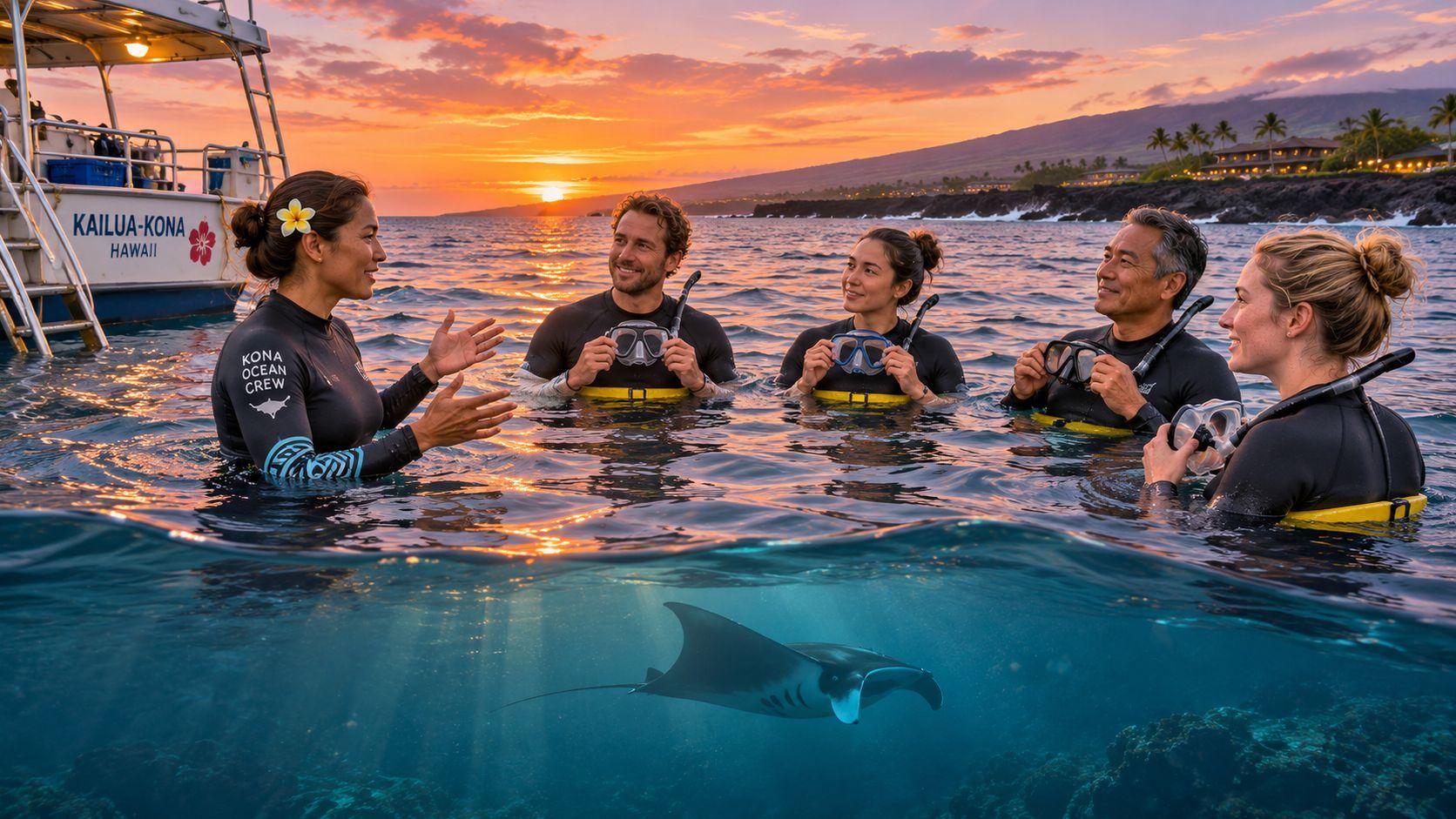
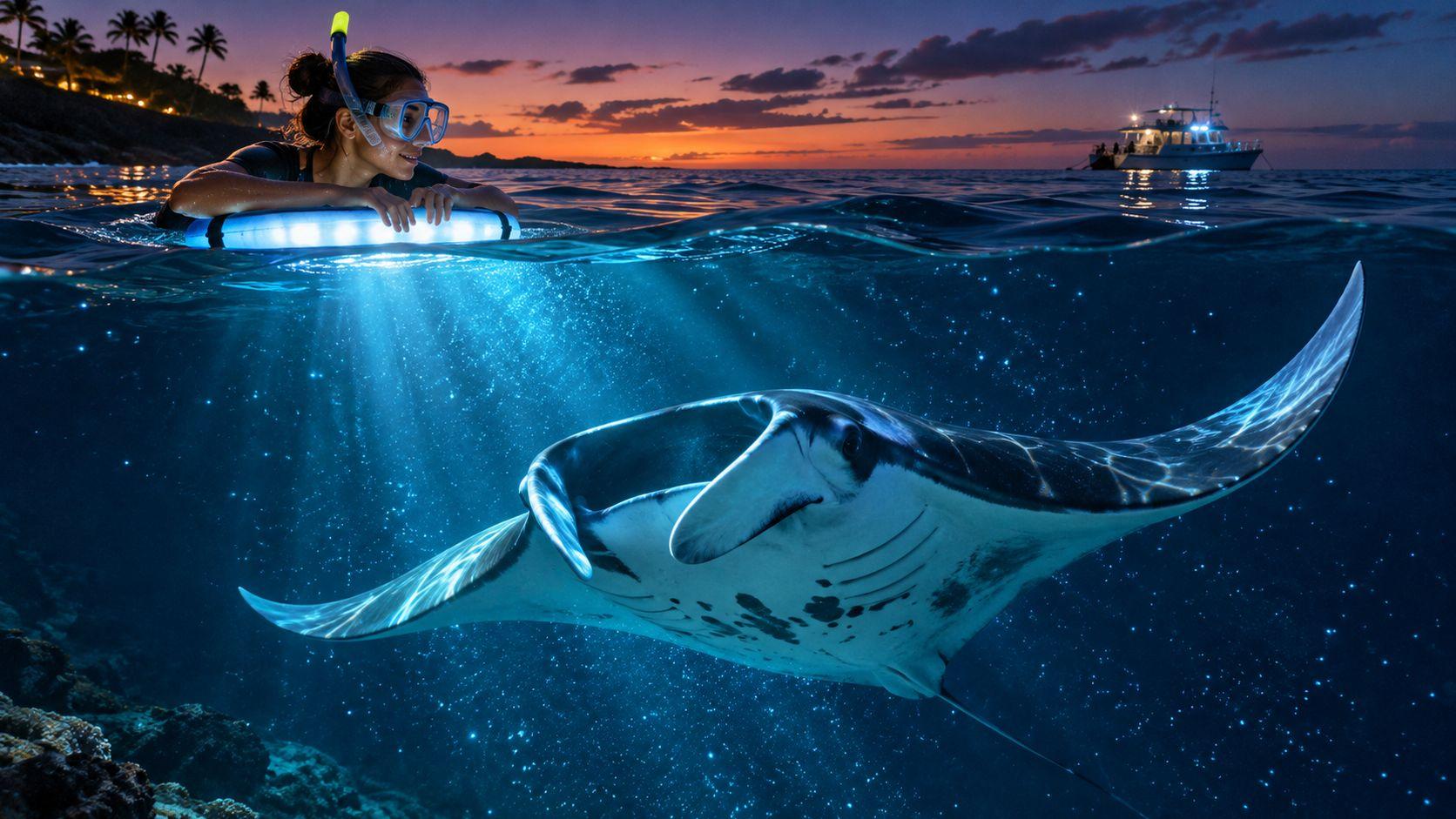
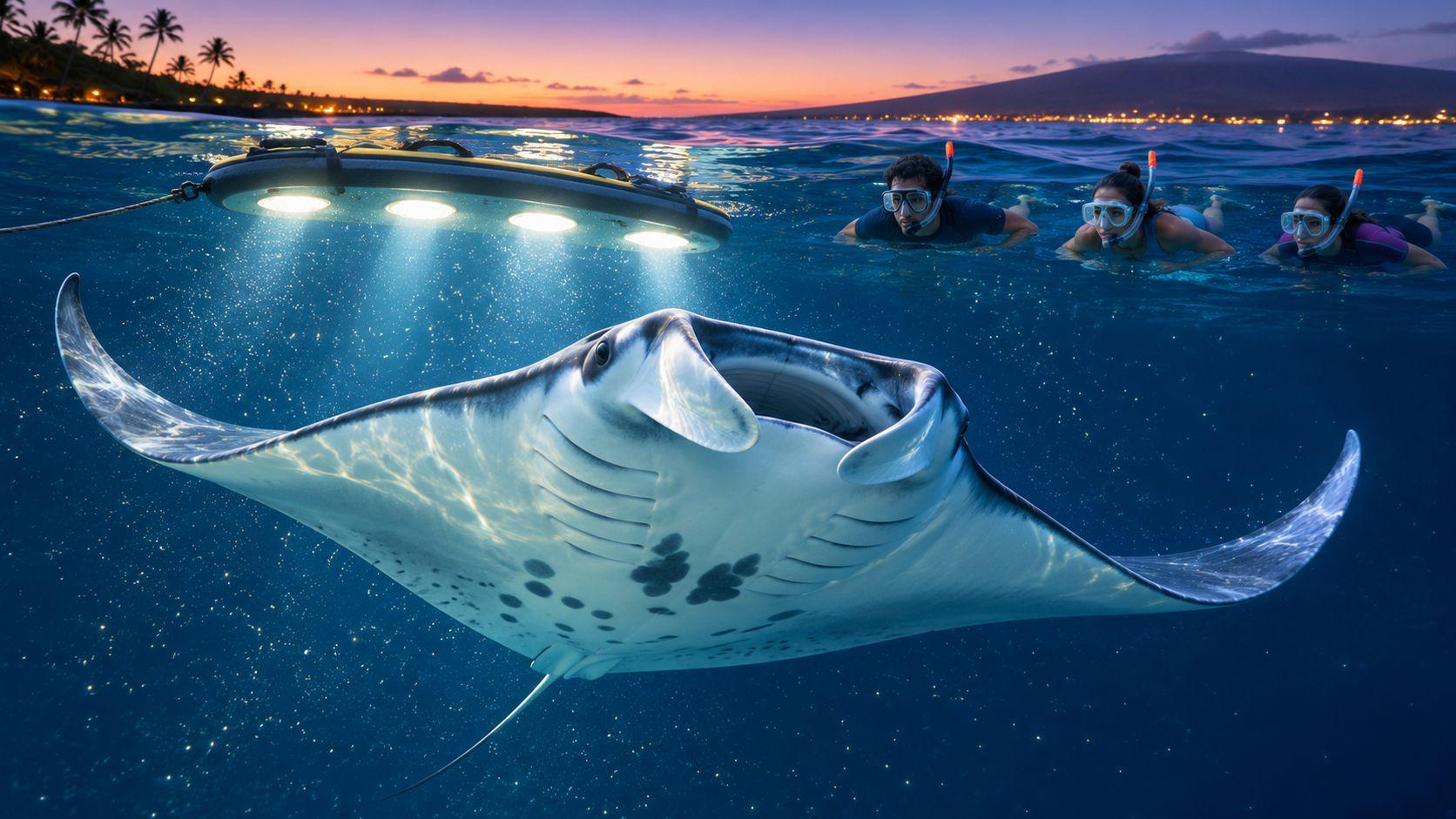
As the sky shifts from orange to indigo, the captain motors out to the viewing area and secures the vessel. The crew lowers a custom-built snorkel board rigged with high-powered lights into the ocean, and you ease in off the swim step.
How the Light Pulls In the Rays
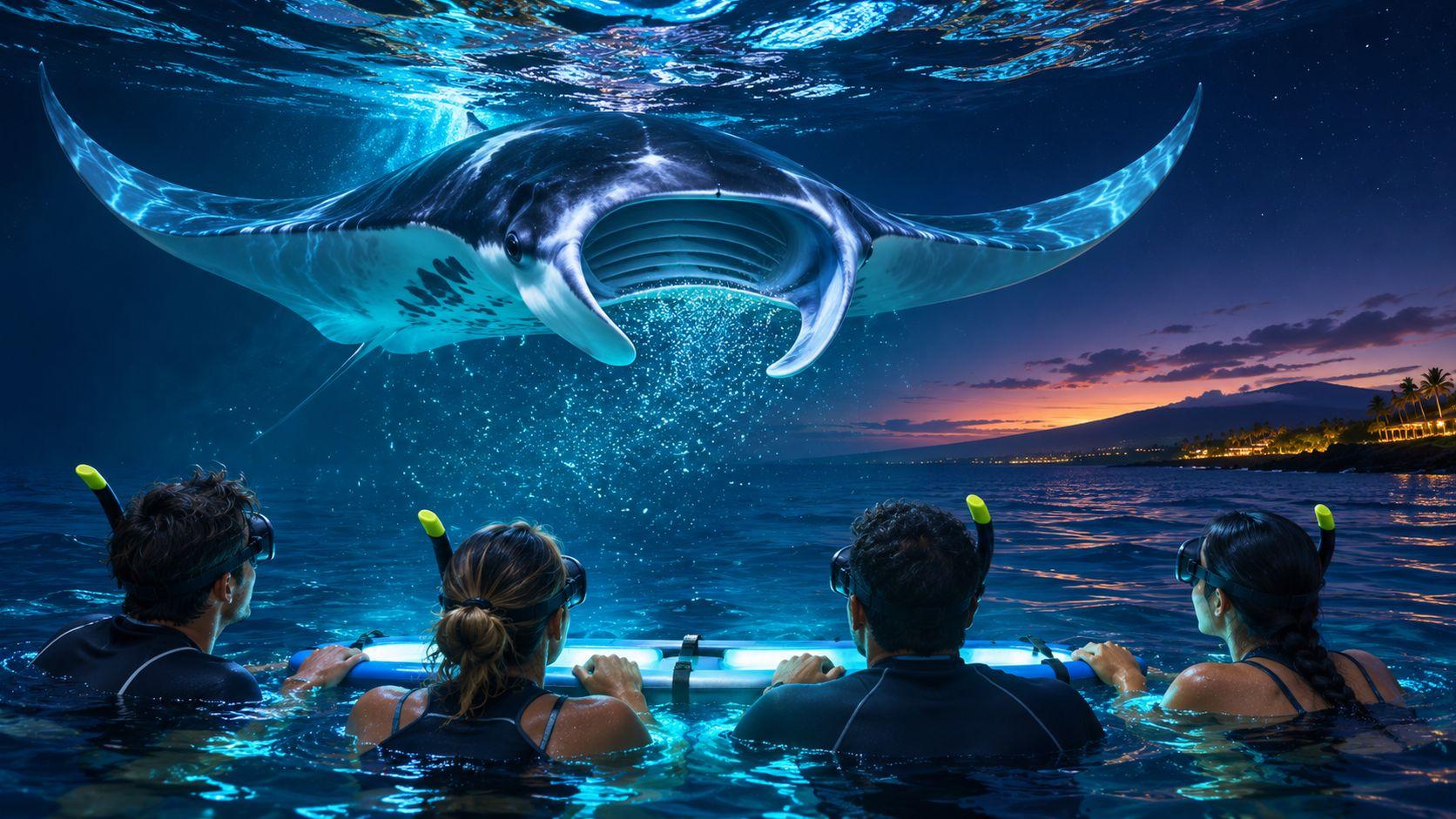
Nothing about this encounter runs on bait or hand-feeding. Reef manta rays (Mobula alfredi) are filter feeders that swim with their mouths open, using specialized gill plates to strain zooplankton from the water. As explained in Hawaiʻi's manta ray viewing boating and safety assessment, many zooplankton organisms rise from reef habitat into the water column after dark, where artificial underwater lighting concentrates them into a dense prey plume, drawing in reef mantas that can reach approximately 5.5 meters in wingspan.
Within a few minutes of holding the board, the illuminated water beneath you fills with tiny darting specks. Then a dark diamond shape materializes out of the black edges below, banking slowly upward until its wide white mouth and gill plates sweep straight through the beam.
Because these animals are wider than many people are tall, a pass five feet below your chest feels much closer through a dive mask. On our Manta Ray Snorkel trips, guests spend 30 to 40 minutes in the water, compared to an hour or more on a daytime Kealakekua Bay Morning Snorkel trip.
Some evenings deliver loop after loop of close passes from multiple rays, while another night brings only one or two brief visits. A quiet evening isn't a broken trip; it's the honest reality of watching wild ocean animals eat on their own terms.
When the guide calls time, you climb the boat ladder, trade your wetsuit top for a dry towel, and pull on a zip-up jacket against the night breeze. The dark motor back to the harbor is the best window to ask your crew about the plankton density that night, which individual rays they recognized, and how the current shifted while you were floating.
Where and When to See Manta Rays Near Kona
Kona's manta reputation didn't happen by accident, and it isn't tied to a single cove. Several named sites along the coast hold decades of survey records and proposed state management rules that shape where boats moor each evening.
| Site | Location | What the research or regulation shows |
|---|---|---|
| Garden Eel Cove | Near Keauhou, Kona Coast | University of Hawaiʻi analysis examined 13 years of nighttime aggregation records from 2010 to 2022 |
| Keauhou | Keauhou oceanfront, Kona Coast | Late 1970s origin of night manta viewing near an oceanfront hotel |
| Manta Village | Kaukalaelae Point | Nearly nightly sightings documented in a NOAA-hosted scientific study of 25,444 observations across 118 individuals from 2009 to 2014 |
| Ho'ona Bay | Ho'ona Bay, Kona Coast | Hawaiʻi legislative testimony cites 3,208 Manta Pacific surveys from 1992 to 2007 identifying 106 individual reef mantas along the Kona Coast |
| Makako | Makako, Kona Coast | Commercial manta tours here require a manta-viewing permit under the state plan |
Keauhou is the historic birthplace of the industry. Artificial lights spilling off a Keauhou oceanfront hotel in the late 1970s drew plankton and reef mantas close to shore, and regular organized night dives were running along the Kona Coast by the early 1990s.
Why There Is No Best Month
Travel blogs love ranking a "peak manta season," yet the long-term data doesn't back up a calendar favorite. Manta rays are seen year round off Kailua-Kona, and there is no pattern in their appearance based on the month.
That 13-year University of Hawaiʻi dataset from Garden Eel Cove and Keauhou shows that site use, residency, and group size fluctuate with prey availability, while also noting that tourism lights create artificial "light pools" that can shift how zooplanktivorous animals behave. Meanwhile, the NOAA-hosted study tracking individual rays from 2009 through 2014 found clear individual variation in movement patterns, including differences linked to sex. Put together, those findings mean your encounter depends on who is foraging in the plankton field that evening, not whether you booked in February or August. For a closer look at moon phases, ocean swells, and daily timing, read our guide to the best time to see manta rays in Kona.
Practical Scheduling Rules
Since you can't time the calendar, plan around ocean conditions and flexibility instead.
- Book Early in Your Stay: Putting the manta trip on night one or night two gives you buffer days if rough swell postpones boats or if you want a second shot after a slow night.
- Ask How the Captain Picks the Site: On our charters, we explore Garden Eel Cove or the area in front of the Keauhou hotel based on wind, swell direction, and recent feeding reports rather than forcing one spot in poor water.
- Skip the "Guaranteed Sighting" Sales Pitch: Any company promising a fixed headcount of rays is selling marketing copy, not marine biology. Look for crews who explain conditions before you step aboard.
Who Can Join and What to Pack
Floating in open ocean after sunset isn't the right place to test your swimming ability for the first time. Before you book a snorkel spot, run an honest readiness check against the water standard we hold on our trips.
Guests joining the manta snorkel must be able to swim 50 yards without additional flotation and have prior snorkeling experience as an intermediate snorkeler. Children have to meet the exact same swim and experience standard, so evaluate each child's comfort breathing through a snorkel in choppy water and verify minimum age policies before reserving seats. Non-swimmers and anyone hesitant about putting their face in dark ocean should sit the night trip out and book a calm daytime reef snorkel instead; ride-alongs aren't permitted on the manta charter, though they're welcome on daytime tours.
What to Pack and Why Each Item Earns Its Spot
Keep your boat bag light, since deck space stays tight once wetsuits and lights come out. These six items cover everything you'll reach for.
- A towel: Salt water and evening trade winds pull heat off your shoulders the second you step off the ladder, so you'll want a full-size towel waiting in your dry bag for the ride back and the drive to your hotel.
- A zip-up jacket: Once the boat gets underway in the dark, damp skin gets cold fast, and a hooded windbreaker or fleece zip-up turns a shivering ride into a comfortable one.
- A GoPro or underwater camera on a secured strap: A wrist lanyard or chest mount keeps your camera from dropping to the seafloor and stops you from waving an extension pole into the feeding zone.
- Reef-safe sunscreen applied before check-in: On the early sunset departure, you'll still catch late-afternoon glare on the harbor dock and boat ride out, and applying mineral lotion beforehand lets it absorb before you enter the water.
- Dry clothes and a wet bag left in the car: Sitting in wet swimwear for a half-hour drive back up the Queen Kaʻahumanu Highway gets miserable quickly.
- Motion-sickness medication taken before boarding: Rolling at anchor in dark water triggers nausea faster than daytime cruising because you lose a clear horizon line, so take whatever works for you well ahead of dock check-in.
Leave personal fins, masks, and flotation noodles in your trunk unless the crew specifically clears them. On our manta tours, every guest wears operator-provided gear along with a flotation belt, which keeps your hips and feet floating at the surface so a stray downward kick never strikes a passing ray.
Quick self-check: Before clicking reserve, answer three yes-or-no questions honestly. Can I swim 50 yards unaided? Can I float calmly face-down in dark water without panicking? Have I comfortably breathed through a snorkel before?
Safety and Viewing Rules That Protect the Mantas
Passive viewing isn't polite etiquette tacked onto a tour briefing; it's the exact mechanism that keeps both guests and giant filter feeders safe in close quarters. NOAA's voluntary manta-ray viewing standard for Kailua-Kona draws a strict vertical boundary in the water column: snorkelers stay flat at the surface and never dive down into the feeding zone, while scuba divers stay near the sandy, rubble, or boulder bottom so mantas keep an open corridor in which to maneuver.
Under that same standard, every viewer observes passively, never touching, chasing, grabbing, or trying to ride a manta, and keeping hands, fins, and gear off coral, sea urchins, and other marine life.
Divers holding low along the seafloor give feeding rays the open mid-water lane they need to turn cleanly through the light beams.
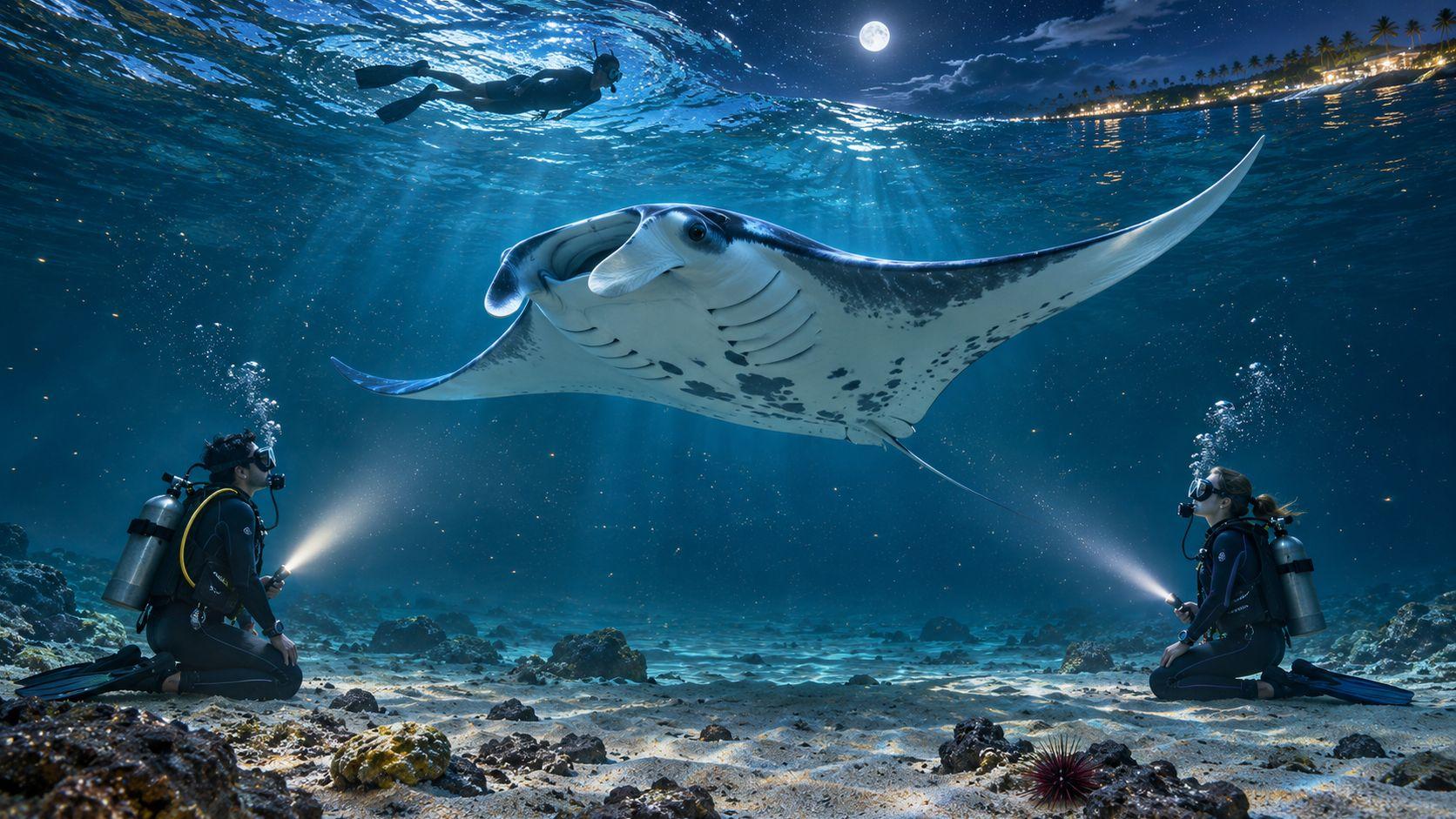
| Role | Where You Stay | Key Conduct Rule |
|---|---|---|
| Snorkeler | Flat at the surface holding the lit board | Never dive down into the feeding water column |
| Diver | Near the sandy, rubble, or boulder bottom | Keep the mid-water column clear for turning rays |
| Everyone | Outside the active feeding path | Observe only; never touch, chase, grab, or ride a manta, and avoid coral and sea urchins |
Why Passive Viewing Protects Both Sides
When a reef manta locks onto a thick patch of zooplankton, it banks and somersaults in tight, repetitive loops. If a snorkeler drops vertically into the beam or a diver hovers high off the sand, that ray has to abort its turn abruptly, raising the odds of a collision and scattering the feeding session for everyone around the light. Touching a manta also risks stripping away the protective mucus layer on its skin, leaving the animal vulnerable to infection.
You can review every in-water standard in detail in our full breakdown of manta ray snorkeling rules that protect wildlife and guests. In practice, four small physical habits do most of the heavy lifting once you're in the ocean:
- Tuck Hands and Cameras In: Keep elbows close to the float board or your torso rather than reaching a camera pole forward into a ray's flight path.
- Freeze When a Ray Approaches: Resist the instinct to kick backward or forward when a giant wingspan rises toward your mask; holding dead still lets the manta gauge your outline and glide cleanly past you.
- Check Your Flotation Belt Fit: A loose waist belt rides up to your ribs and lets your knees drop straight into the feeding lane, so tighten it snug on deck before entry.
- Stay Where Your Guide Places You: Guides position boards and diver semicircles to account for current drift and neighboring lights, so drifting off-station creates visual chaos.
Seeing how calm, motionless viewers look in the water makes the layout click faster than reading diagrams on land.
Why No-Touch Alone Does Not Prove Sustainability
Here's the catch most glossy brochures skip: announcing a "no-touch rule" doesn't prove a tour is conservation-minded. Every legitimate boat states that baseline.
What separates responsible manta tourism from crowded chaos is how an operator manages the stuff around the rule. Crowded boards, bright uncoordinated beams, and too many vessels packed into one mooring zone stress both animals and nervous swimmers even when nobody lays a finger on a ray. Before you book, ask how the crew limits swimmer density around its light, how it coordinates spacing with nearby boats, and whether guides log sightings to support local marine research.
How to Choose a Licensed Manta Operator
Start your vetting with permits, not Instagram reels. Hawaiʻi's proposed manta-viewing management plan draws a clear line between general daytime access, where moorings remain open to both commercial and recreational vessels from 4:00 a.m. to 4:00 p.m., and structured commercial nighttime viewing organized by designated zones and assigned operating shifts. Under that framework, commercial operators hosting manta tours at Keauhou and Makako must hold a manta-viewing permit. Because this state plan was introduced as a proposed management framework, confirm current permit status directly with any company before putting down a deposit.
Eight Checks Before You Hand Over a Card
Once you've verified permits, run every shortlisted boat through these practical questions:
- Confirm Permit Status: Ask directly which sites the company holds commercial permits to operate on after dark.
- Ask About Boat Capacity and Group Cap: A smaller headcount means more room along the float board, less elbowing in the dark, and shorter wait times at the swim ladder.
- Verify In-Water Guide Ratios: Find out how many lifeguard-certified guides enter the water with snorkelers or lead each scuba group, rather than staying dry on deck.
- Check Site-Selection and No-Sighting Policies: Ask how the captain chooses the evening's site and what credit or rebooking options apply if no rays appear.
- Look Up the Departure Marina: After 40 minutes in night water, boat run time matters. Kona Snorkel Trips departs from our own dock at Honokohau Marina, right between Kailua-Kona town and the Kona airport, keeping harbor access simple.
- Audit Gear and Photo Inclusions: Some outfits bundle wetsuits, masks, and flotation belts into the base rate while others tack on rental fees at check-in.
- Read Weather and Cancellation Terms: West Hawaiʻi evenings are usually calm, yet winter north swells and sudden gusts do cancel departures, so know the refund cutoff.
- Confirm Scuba Requirements Early: Divers should verify exact certification minimums, whether a daytime checkout dive is required, and how rental regulators or dive lights are handled.
Comparing Real Trip Value and Trusted Alternatives
Ticket rates across Kona vary widely depending on vessel style, whether you're snorkeling or scuba diving, how tightly the boat caps passenger counts, and whether wetsuits, snacks, hotel transfers, or photo packages sit inside the headline price. Don't judge two charters by the sticker number alone; ask each company for an itemized total covering gear, taxes, harbor fees, and group size so you're comparing equivalent trips.
Operator litmus test: If a reservation agent spends five minutes promising guaranteed manta encounters and dodges questions about group size, permits, or site crowding, close the tab and keep looking.
Certified divers comparing local outfits can dig into our checklist for evaluating a Kona dive shop, and check verified diver feedback directly on the Kona Honu Divers Google Business profile. If our boats are full on your preferred evening or you're comparing another surface charter, Manta Ray Night Snorkel Hawaii is an exceptional alternative when looking for a manta ray night snorkel tour along the Kona Coast.
Manta Night Dive Questions, Answered
Even after sorting out sites, packing lists, and operator permits, four practical doubts come up on almost every dock before boarding.
Can I guarantee seeing a manta? No, and you should be wary of anyone telling you otherwise. A 2025 Kona night-snorkeling guide reports a 95% manta-sighting success rate at Manta Village and a 90% rate at Manta Heaven, which reflects remarkably consistent feeding behavior, yet those numbers still represent ecological probability rather than a 100% guarantee. Plankton density, ocean swell, and individual ray movement vary every evening, and a reputable crew makes that clear before you pay.
What happens if no mantas appear? Each company sets its own quiet-night policy, so don't assume an automatic refund or unlimited rainchecks. Before reserving, ask specifically whether the operator offers a free rebook or discounted return seat on another evening, how many days you have to use it, and what its weather cancellation terms cover. Booking your tour early in your vacation is the simplest way to protect yourself so you have spare evenings left if you need a second try.
Do I need a camera? No, and plenty of guests enjoy the night far more when they leave cameras in their dry bags. Trying to adjust exposure settings or frame shots in pitch-black water pulls your eyes off a giant ray gliding inches beneath you and tempts people to reach arms into the feeding corridor. If you do bring a GoPro or compact underwater camera, keep it tethered to your wrist or chest so you stay still and hands-free at the surface.
Is night tourism harming the mantas? The evidence calls for careful management rather than complacency. Community-sourced monitoring cited in a Kona manta observation overview recorded 23,106 reef-manta sightings from 2010 through 2022 at two Kona nighttime feeding sites, using each ray's distinct underside spot pattern to identify individuals across years. A University of Hawaiʻi study examining those 13 years of citizen-science records found that local aggregations remained relatively stable through 2022, yet it also noted that boat numbers and traffic in viewing zones remained unregulated and that proposed management tools (including mooring buoys, limited-use permits, and updated regulations following a 2014 legislative call for action) had not been finalized at the time of the study. Stable sighting counts don't prove unlimited boat traffic is harmless, which is why supporting operators who cap group size, enforce passive rules, and contribute sighting data matters.
Book Your Manta Night Dive in Kailua-Kona
At this point, the choice is simple: decide whether you want to float at the surface on a snorkel board or settle onto the sandy seafloor with a scuba tank, then lock in an evening early in your trip.
Booking the Manta Ray Night Snorkel
Our Big Island Manta Ray Night Snorkel lasts 2 hours dock to dock, giving you 30 to 40 minutes in the water around our illuminated custom board with lifeguard-certified guides right beside you. If you have questions about swim comfort, departure times, or family readiness before booking, call our crew directly at (808) 326-4774.
Booking the Scuba Night Dive
Certified divers looking to experience the feeding column from below can reserve the dedicated two-tank manta trip directly with Kona Honu Divers, or explore their full schedule of Big Island diving tours to pair daytime lava tubes and reef dives with your night excursion.
Your Three-Step Booking Plan
- Pick Snorkel or Dive: Choose the surface snorkel if you aren't certified or want a simpler setup, and pick the two-tank scuba dive if you hold an open-water card with solid buoyancy control.
- Choose a Flexible Date: Aim for one of your first two nights in Kailua-Kona so you have room to reschedule if ocean swells shift or you want another evening in the water.
- Reserve and Confirm Check-In: Use the button above to lock in your seats, pack your towel and zip-up jacket, and confirm your departure dock details at Honokohau Marina ahead of sunset.
When you're ready to float above Kona's illuminated plankton plume with a small group and lifeguard-certified guides, Kona Snorkel Trips runs nightly manta ray snorkels alongside daytime Kealakekua Bay reef trips, seasonal whale watching, and private charters out of Honokohau Marina. Visit our site to compare sunset and late-evening departures, review swim requirements, and reserve your spot on the water.
Keep reading
Manta Ray Night Dive Snorkel in Kona: What to Expect
Manta Ray Night Dive Snorkel in Kona: how the lights work, what the trip involves, safety rules, best times and booking tips for first-timers.
Kona Hawaii Manta Ray Night Dive: Guide for First-Timers
Plan your Kona Hawaii Manta Ray Night Dive with format options, sighting odds, safety rules and first-timer tips for a calm, memorable night.
Manta Rays Hawaii: Where, When and How to See Them
Manta Rays Hawaii guide to Kona night encounters: best sites, etiquette, safety gear and how to choose a responsible tour operator.