
Two nights left in Kailua-Kona, sand in the rental car footwells, and a family that has already done the beach, the coffee farm, and one very long sunset. Somebody at the pool said you have to do the manta thing. Somebody else said their cousin went out and saw nothing.
Both of those people are right, and that's exactly what makes planning a Kona Hawaii manta ray night dive from a condo balcony so confusing. The encounter is one of the most dependable wildlife experiences in Hawaii, and it is still a wild animal encounter on a wild coastline. The gap between those two facts is where most first-timer disappointment lives.
What the Kona Manta Ray Night Dive Involves
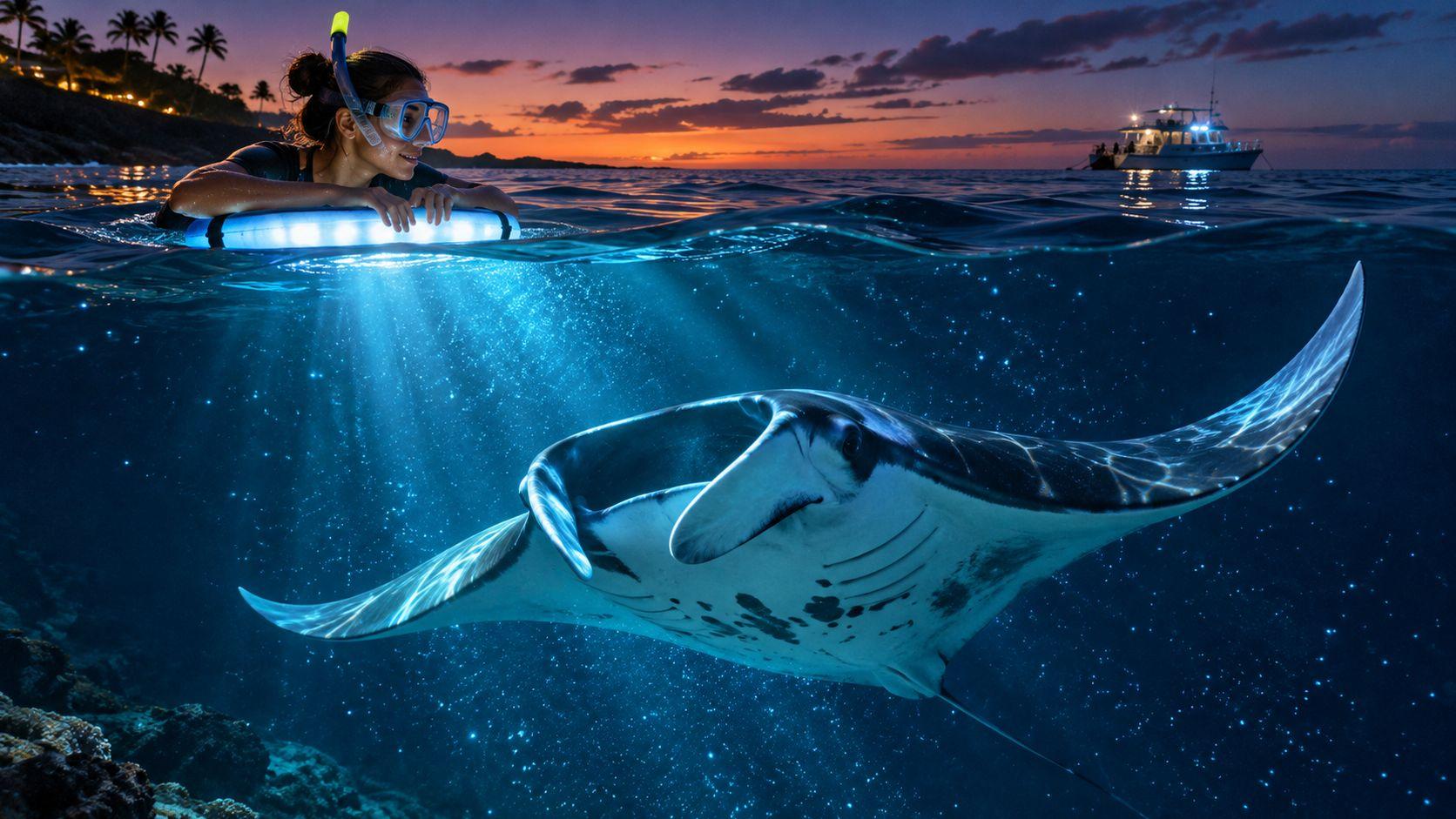
The core moment is simple. You float in dark water, hold a lit board, and watch a reef manta ray rise into the beam, turn, and feed with its mouth open. Reef manta rays (Mobula alfredi) filter-feed on plankton that gathers in artificial light. They may pass close enough that you feel the pressure wave in the water. Nobody feeds them or calls them in. The light concentrates the food, and the rays respond to that feeding opportunity.
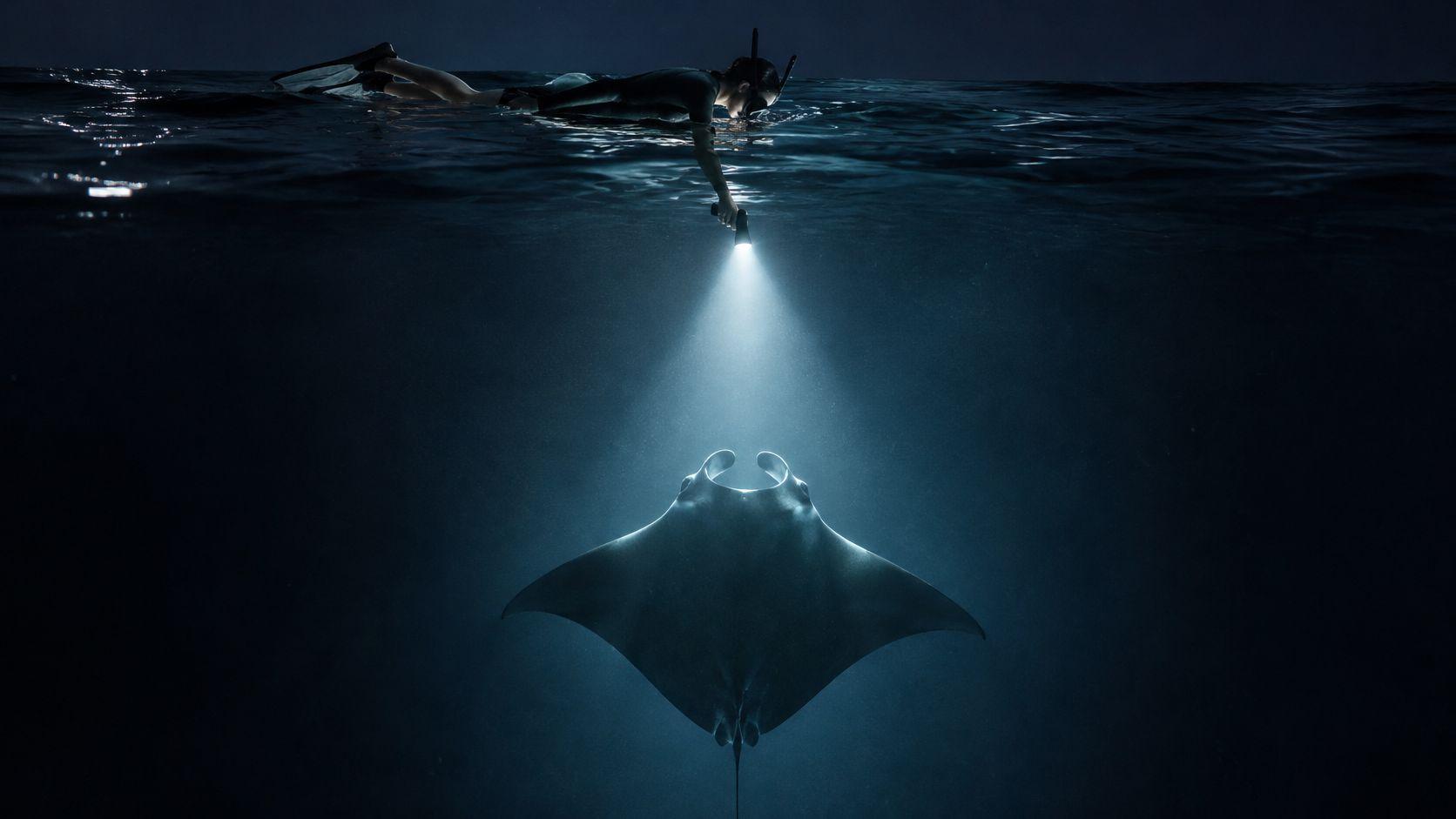
This has become a mainstream Kailua-Kona activity. A 2025 Kona tourism guide estimated that up to 80,000 people a year join manta ray night snorkeling and diving experiences in Kailua-Kona. That volume shows how established the aggregation is, and it also means operator choice and night choice matter. A crowded board, a rough night, or a quiet feed can change the experience even when the species is present.
Kona's reputation comes from wildlife observation in a working feeding area, not a timed animal encounter. That distinction sets the right expectation: the setup is consistent, the animal behavior is natural, and no guide can promise a specific pass. Manta rays are wild animals, and sightings are never guaranteed. If a guest does not see one, Kona Snorkel Trips offers a return on another night on a space-available standby basis, with no refund.
For certified divers, Kona Honu Divers is the scuba operator I would point toward for the underwater version. The surface and underwater formats use the same basic feeding logic, but they suit different comfort levels and give you different angles on the same encounter.
Two Ways to Watch
You can float at the surface around an illuminated board, or you can descend and hold position near the bottom while rays sweep overhead. The animals and plankton are the same. Your viewing position changes the whole experience.
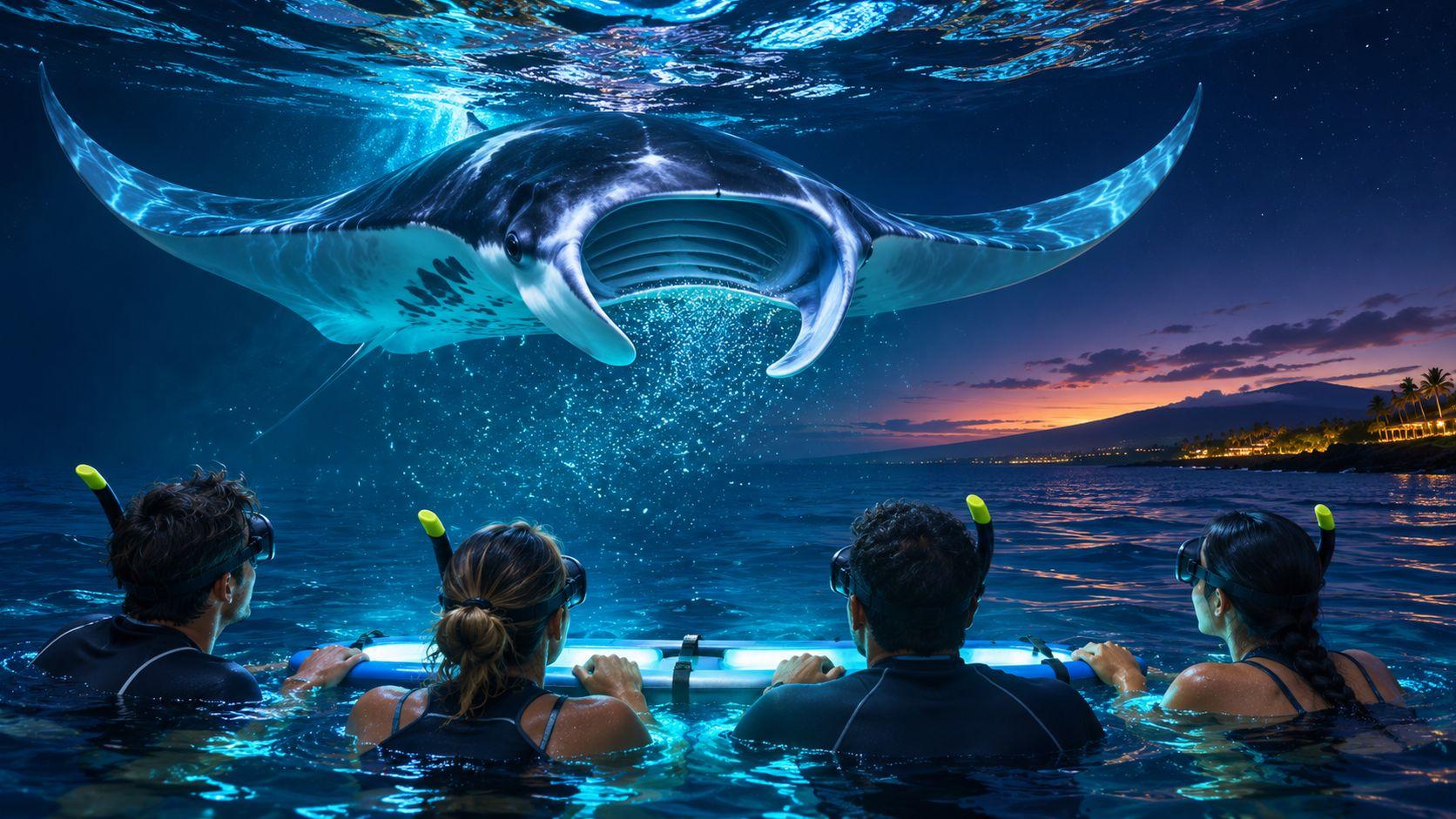
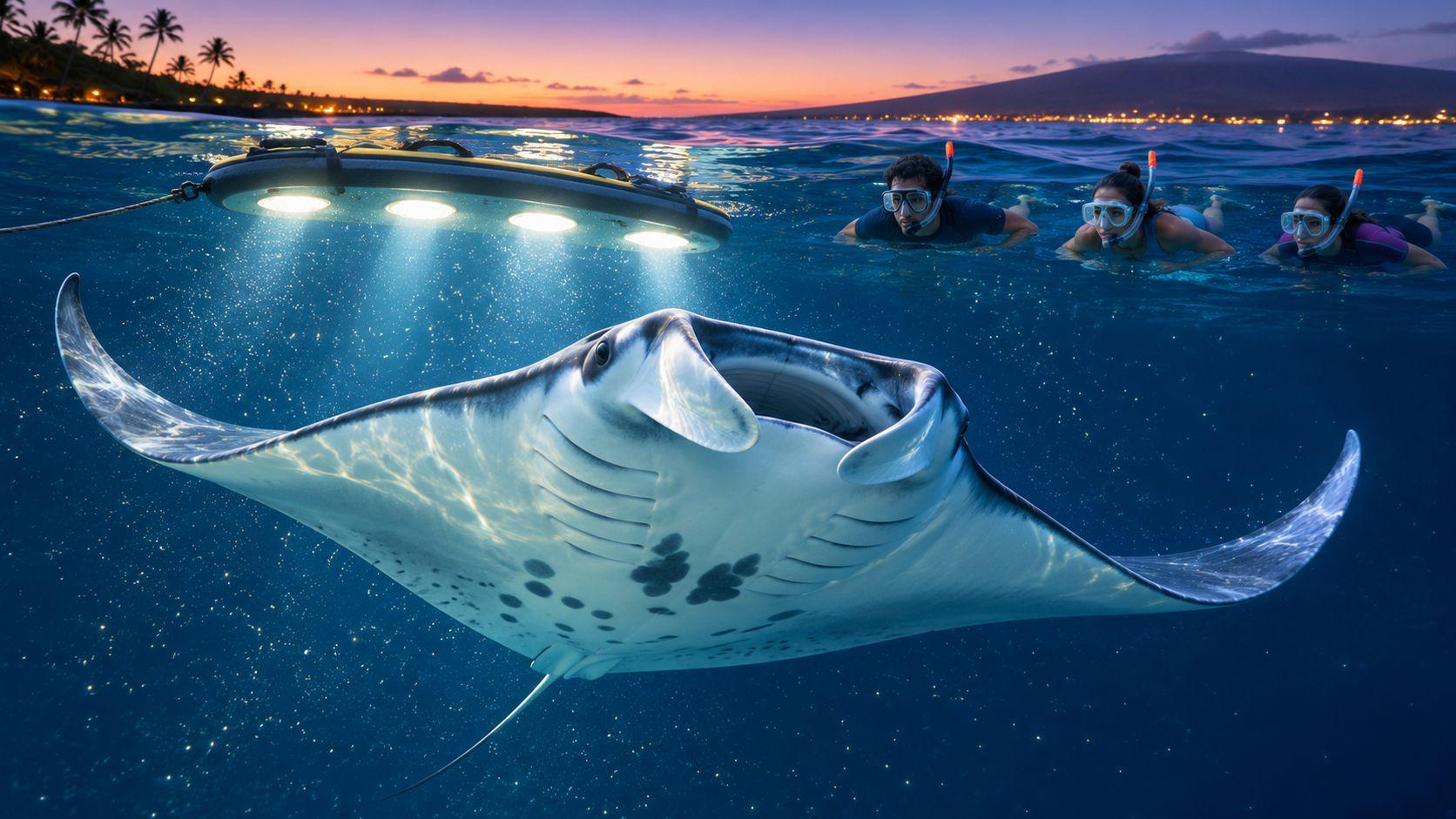
The surface snorkel is the shorter route for comfortable swimmers. Kona Snorkel Trips uses a custom-built snorkel board with high-powered lights, with modified surfboards, rope handles around the perimeter, and 9-10 guests per board. The lights in the middle attract plankton, and the rays feed on it. The trip lasts 2 hours, leaves near sunset, and is for ages 5 and up with an adult. Guests get 30-40 minutes in the water. Non-swimmers are not permitted on manta ray charters.
Choosing Between the Night Snorkel and Night Dive
The right format depends on where you want to sit in the water and what you are qualified to do. Put the two options side by side before choosing, because the trade-offs are practical: surface comfort versus scuba control, short briefing versus gear setup, and a broad view of the board versus a lower angle from the seafloor.
| Feature | Night Manta Snorkel | Night Manta Dive |
|---|---|---|
| Who it suits | Comfortable swimmers and families with swimmers | Certified scuba divers wanting a closer, lower view |
| Requirement | Comfortable swimmer | Scuba certification |
| Time in the water | 30-40 minutes | 30-40 minutes |
| Trip length | About 2 hours, leaving near sunset | Two-tank trip |
| Viewing position | At the surface around the illuminated board | Near sand, rubble or boulders, lights held overhead |
Use a simple rule. If you swim comfortably and want the shortest route to the experience, book the snorkel. If you hold a certification you can show at check-in and want eye-level passes instead of a surface view, book the dive. The manta ray night snorkel tour details show the two tour times and the age rule for the surface trip.
What the Snorkel Actually Feels Like
You float face down at the surface, holding a custom-built snorkel board with high-powered lights in the middle. Guests use rope handles around the perimeter, typically nine or ten to a board, which keeps the line stable enough that a guide can shift you when a ray starts looping on one side. A stable hold matters, because a crowded or twisted line makes it harder to keep your face in the water and your light zone clear.
The snorkel suits first-timers, families with swimmers, and anyone who would rather not manage a regulator in the dark. Kona Snorkel Trips runs the night manta snorkel from its own dock at Honokohau Marina, and the trip lasts 2 hours, leaves near sunset, and takes guests ages 5 and up with an adult. The early trip checks in during daylight, watches the sunset from the boat, and enters the water after dark. The late trip checks in at night.
What the Dive Actually Asks of You
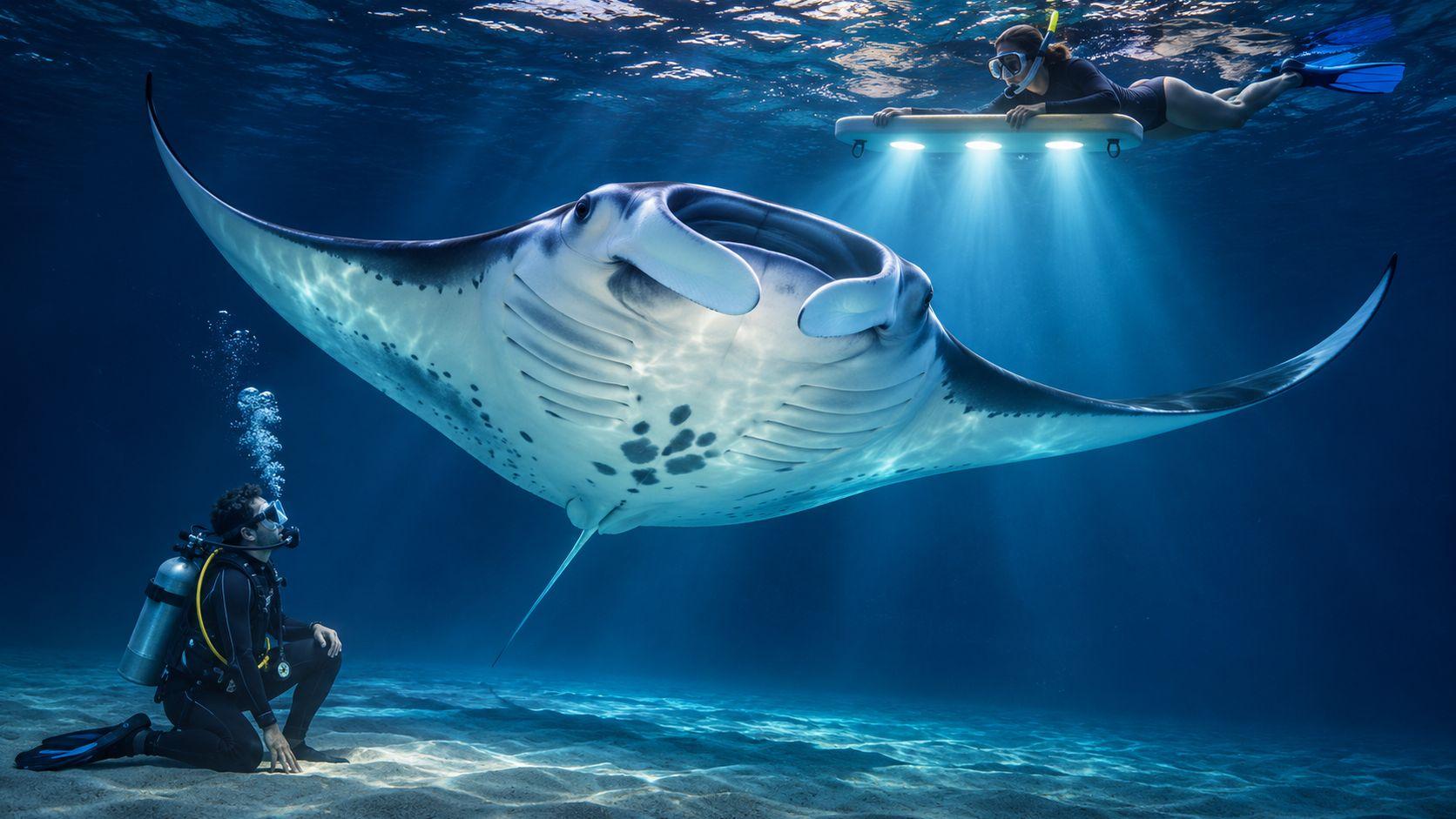
The dive uses the same light principle from below. You settle on sand or rubble with a guide, point your light upward, and hold position while rays pass at eye level. It is a shallow, controlled dive, but it is still a night dive in open ocean. Buoyancy mistakes show up fast in front of a large animal moving close overhead.
Certified divers can compare the two-tank manta dive and snorkel trip for the underwater format. I would choose the dive only if you are already comfortable with night buoyancy, lighting, and staying calm when an animal crosses your beam.
One hard limit applies to the snorkel: non-swimmers are not permitted on manta ray charters. If someone in your group cannot swim, a daytime reef tour is the better fit. For a fuller comparison of viewing angle, comfort, and eligibility, use this breakdown of the night snorkel versus the night dive.
Why Manta Rays Gather Under the Lights
Think about a porch light on a warm evening. Moths find it within minutes, not because anyone put food out, but because the light creates a concentration they can't ignore. A lit patch of ocean behaves the same way, with plankton in the role of the moths.
The mechanism runs in three steps. Surface and underwater lights illuminate the water column, and naturally occurring zooplankton gather in that beam. Reef manta rays then filter-feed through the concentrated prey, rolling through the brightest part with their cephalic fins unfurled into a scoop. As long as the food stays dense, the same animals keep coming back to the same patch of water, which is why the mechanics of the Kona night encounter are described as plankton concentration rather than baiting.
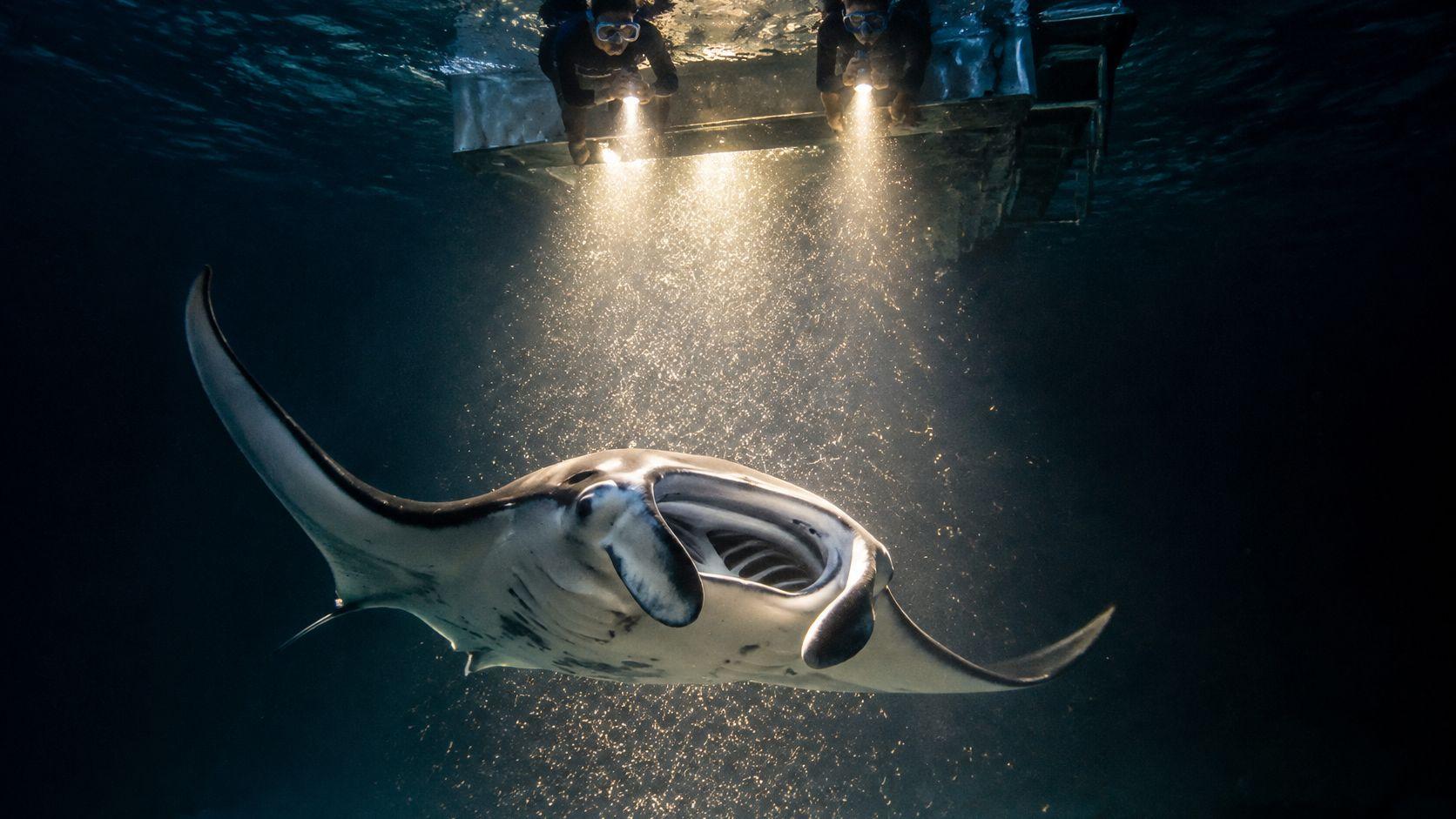
Nothing is thrown into the water for the rays. That distinction matters more than it sounds, because a fed animal changes its behavior and its health, while a light rearranges where the existing food sits.
How the Tradition Started
The whole thing began as an accident. Shoreline lighting near the Keauhou coastline from the late 1970s attracted plankton into concentrated areas, and the rays followed their food toward shore. Organized nighttime diving is generally dated to 1991, when underwater lights were used to make that plankton concentration visible to divers and pull mantas into predictable viewing spots. By 1993, historical accounts described roughly five boats and about 50 people in the water at one Kona site, which is a fair measure of how quickly an accidental wildlife encounter turned into a commercial activity, as documented in Kirsten Moe's assessment of Kona manta viewing operations.
Why the Same Bays Keep Working
Thirteen years of observation at Kona's two main feeding sites found persistent nighttime aggregations tied to artificial lighting, which points to learned site use rather than random wandering. Rays that find food in the same place night after night learn the route.
What this means in the water: keep lights pointed at the viewing area, don't chase, and don't spotlight individual animals. A stable plankton patch feeds rays on their own terms; a boat that scatters light and swimmers breaks the pattern.
For a closer look at how the boards and beams interact, this explanation of why lights attract manta rays during night snorkeling covers the setup in detail.
Why Manta Sightings Are Likely but Never Guaranteed
You land in Kona, book a Tuesday night, and hear that mantas show up almost every night. That line describes a coastline with a long record of activity. It does not describe a promise for the night you are in the water.
A 2024 University of Hawaiʻi study in Environmental Biology of Fishes used 13 years of community-sourced observations from 2010 through 2022. Observers recorded 23,106 reef-manta sightings across 2,890 survey reports; at Garden Eel Cove they surveyed 2,327 evenings, or 49.1% of all nights in the period, and documented an average of 8.89 individual mantas per surveyed evening, according to the published analysis of Kona's night aggregations.
An average of 8.89 is a spread, not a floor. Some nights run into the twenties. Some nights record zero. A zero is always on the board, which is why a likely sighting and a guaranteed sighting are different claims.
What the Photo-ID Record Adds
Long-term identification work at Garden Eel Cove and Keauhou from 2010 through 2022 identified 167 individual reef manta rays, and the same dataset links larger aggregations to greater zooplankton availability, per the Kona manta photo-identification summary. Food density, not a fixed nightly roll call, drives how many rays show up.
"Resident" means the population uses this coastline repeatedly. Individual animals still move between sites and offshore water on their own schedule. They do not clock in.
| Factor | How It Changes Your Odds | What You Can Control |
|---|---|---|
| Plankton density | Larger aggregations follow more zooplankton | Nothing directly; accept natural variation |
| Weather and ocean conditions | Currents and weather move where mantas feed | Choose flexible dates |
| Individual animal behavior | Mantas may leave a viewing site without warning | Stay still and let the animal choose its path |
| Site location | The night trip may use Garden Eel Cove or the area in front of the Keauhou hotel | Ask the operator which site that departure uses |
The Policy Behind the Promise
Manta rays are wild animals and are not guaranteed. If you do not see one, there is no refund, but you can return another night on a space-available standby basis. Confirm the current terms when you book, then leave at least one spare evening before your flight home so standby is usable.
The planning move that saves trips: book the manta night for your first or second night in Kona, never the last one. A slow night then costs you an evening, not the experience.
For a longer look at what drives night-to-night variation, this breakdown of the manta ray night snorkel success rate goes deeper into the numbers.
How the Night Dive Unfolds Step by Step
A manta night runs on a fixed sequence, and knowing it in advance is the difference between nerves and anticipation.
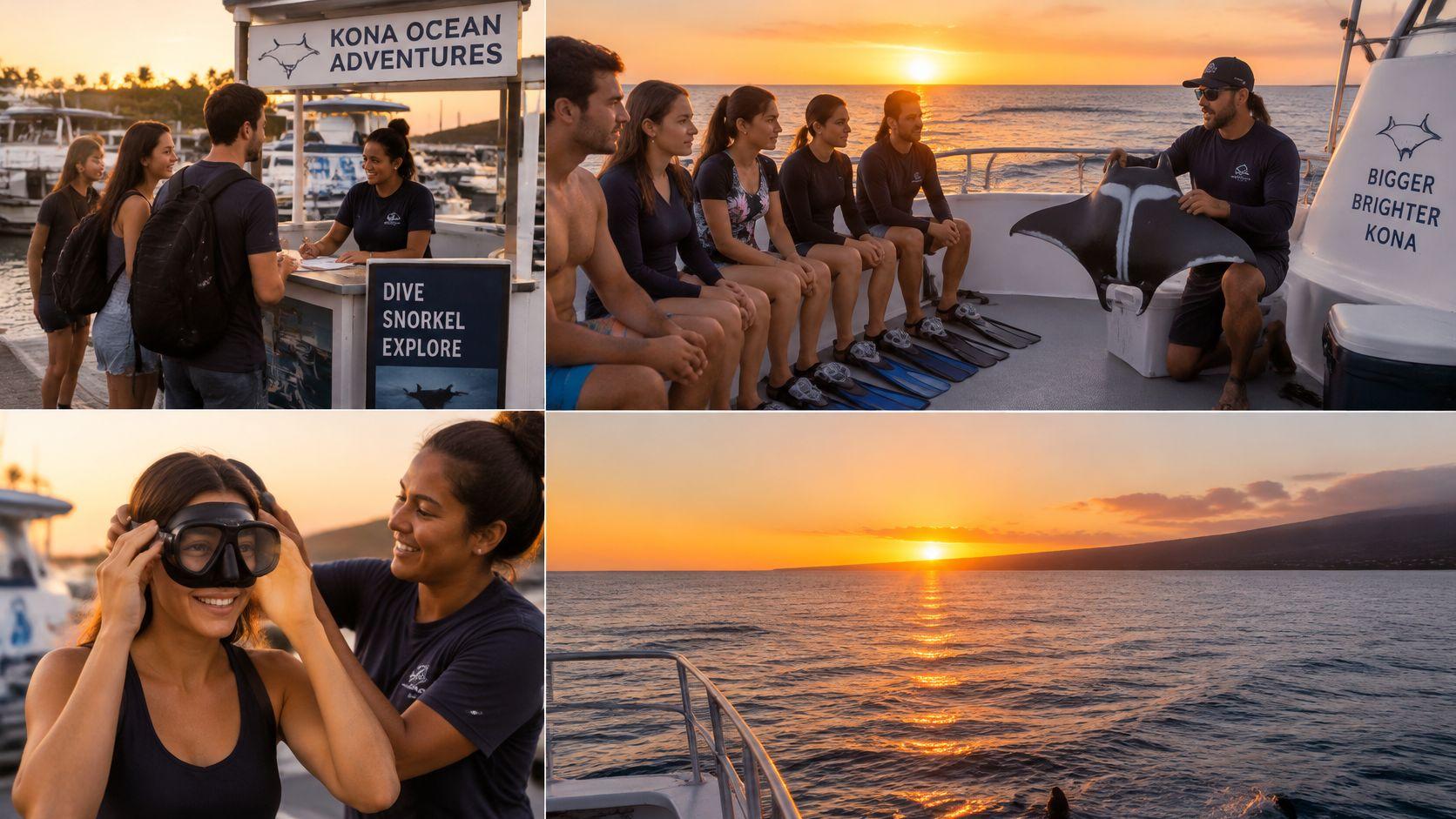
- Check in at the dock while it's still light. Paperwork and gear fitting happen in daylight because nobody wants to solve a mask fit in the dark. You'll also catch the sunset from the boat, which is half the reason people book the early departure.
- Listen to the briefing. Guides cover what a manta looks like from below, how they move, and what you must not do. The positioning instructions are the part worth memorizing, since a scattered group breaks the line the rays choose.
- Get fitted with a mask, snorkel and flotation gear, or full dive kit. A leaking mask found at the dock is a two-minute swap. Found face-down in black water, it ends your night.
- Enter after dark, once the lights are on. Snorkelers stay at the surface around the illuminated board. Divers settle near sand, rubble or boulders and hold their lights above their heads, shining upward to attract plankton.
- Float calmly and keep fin kicks small. Movement at the surface scatters the plankton patch and pushes approaching rays off their line. Stillness gets you the close pass.
- Let the mantas come to you. Following an animal is the fastest way to lose it, and it's also the behavior that gets guests pulled from the water. Hawaii's voluntary viewing standard treats the encounter as observation only, with no touching, chasing, grabbing, riding or harassment, and it instructs snorkelers to stay at the surface rather than diving into the feeding column, as set out in the NOAA-hosted manta viewing guidelines.
- Expect 30 to 40 minutes in the water. That's longer than it sounds with your face in the dark, and shorter than you'll want if the rays settle in.
- Exit with the group and stay with the guide until the end. If the animals leave, that's normal behavior, not a signal to swim off looking for them.
The water glows once the lights are running and the first shadow appears at the edge of the beam.
What a Good Night Looks Like
Mantas gliding through the lit area a few feet below the surface, guests flat and quiet along the board, a guide repositioning one person at a time. Nobody reaching. Nobody chasing. The rays loop back because nothing in the water is chasing them away.
That's the version worth booking for, and it's built almost entirely from guest behavior rather than luck.
Safety Rules, Eligibility and Wildlife Protection
The rules on a manta night protect the encounter, not just the boat. A calm, spaced-out group gives the rays room to keep feeding and looping through the lights. A careless hand, a chase, or a diver dropping into the beam can end that pattern for everyone.
| Guest or Case | Rule | What to Do |
|---|---|---|
| Children | Ages 5 and up with an adult on the manta snorkel | Confirm the child is comfortable in the water |
| Non-swimmers | Not permitted on manta ray charters | Choose a daytime tour instead |
| Certified scuba divers | Certification required for the manta dive | Bring your card and logbook |
| Pregnancy or medical conditions | Ask the operator before booking | Raise it at booking, not at the dock |
The age and swimming rules are practical limits, not red tape. The manta snorkel is for ages 5 and up with an adult, and non-swimmers are not permitted on manta ray charters. If someone in your group wants the water without the night conditions, a daytime trip is the better fit. For the scuba version, certification is required, so bring proof before you board.
The Legal Backdrop
Hawaii takes rays seriously. Under Hawaii Revised Statutes §188-39.5, capturing, taking, possessing, abusing or entangling a ray is illegal, and reported penalties run from a $500 fine for a first offense to $10,000, with an additional administrative fine of up to $10,000 per animal, as summarized in this guide to Big Island manta ray night dives.
Federal protection layers on top. The giant manta ray is listed as threatened under the U.S. Endangered Species Act, fishing mortality remains its principal global threat, and U.S. regulations prohibit retention in domestic fisheries, per NOAA Fisheries' giant manta ray conservation page. Manta rays also move beyond the nearshore feeding area and make deep dives in open water, so the animal in front of you is using the shallows for a reason, not living there full time.
The practical translation: a manta leaving the light isn't a failed sighting. It's a wild animal continuing its normal movement pattern.
What Protects You and the Animal at the Same Time
Stay flat and controlled on the surface. Hold neutral buoyancy so you're not kicking to stay put. Keep clear of the cephalic fins and the wing edges, which are the parts most likely to contact a careless hand or camera. Leave open water behind you so the ray has an escape line. Cut sudden movements and big fin kicks.
Guides can remove participants who endanger the animals, and that is the right call for a resource that supports an entire coastline of boats. The manta ray snorkeling rules that protect wildlife and guests lay out the guest-side version in more detail. Treat those rules as part of the experience, not fine print after booking. They keep the lights calm, the board stable, and the rays willing to return through the feeding area.
First-Timer Tips and What to Bring
Most ruined manta nights come down to three things: a fogged mask, a heavy stomach, and no dry layer for the ride home. Fix those before you board and the rest usually takes care of itself.
Before the boat
- Reef-safe sunscreen, applied early. Put it on before you leave the condo, not on the dock in the dark.
- Motion sickness medication about an hour before boarding. A slow drift at anchor is what gets people, not the run out.
- A light meal and no heavy drinking. A big afternoon lunch plus a rolling boat is a bad combination.
- Valuables left on land or in a dry bag. Cold water drains phone batteries and hands lose grip at the rail.
On the boat
- A warm layer and a towel. The evening feels mild until you're wet and the boat turns into the wind.
- Dry clothes for the drive home. You'll thank yourself on the highway.
- Your own mask if you have one. A familiar seal beats a rental fit you've never tested.
- No flash photography underwater. A burst of flash disrupts the feeding pattern the whole group came for.
For families
Explain in advance that the mantas are wild and may not appear, and that the trip is calm and observational rather than a show. A child who expects a guarantee has a worse night than one who expects a maybe. Kona Snorkel Trips departs from its own dock at Honokohau Marina, which sits between Kailua-Kona town and the airport, so build in time for afternoon traffic rather than sprinting down the ramp.
One prep habit worth keeping: test your mask seal at the dock, in front of a mirror, before the boat leaves. Two minutes there saves twenty minutes of blinking through a leak.
What the Night Manta Trip Costs
Two adults and two kids can clear $700 before anyone is in the water. On Kona Snorkel Trips, the Manta Ray Night Snorkel is priced up to $199 per person. That ceiling is the number to budget, not a mid-range guess from another boat.
| Guest or Case | Price |
|---|---|
| Adult, night manta snorkel | Up to $199 |
| Child, night manta snorkel | Up to $199 (confirm any age rate at checkout) |
| Family of four (2 adults, 2 children) | Up to $796 |
Four seats at that ceiling land at $796. Treat that as the full-price case before taxes, fees, or any age adjustment the booking page shows.
A likely night is not a guaranteed one. Manta rays are wild. If nobody shows, there is no refund. You can come back another night on a space-available standby basis. I would still book the night you want, then keep a second date open so a quiet evening does not become a sunk fare.
The night manta dive is a different product. Confirm that price with the dive operator. Dive rates move with gear, tank fills, and certification checks, and this snorkel ceiling does not cover them.
At checkout, confirm four things: whether gear, taxes, and fees are included, how children's ages are priced, whether the rate is per person for the full trip, and what a weather cancellation does to your money.
Book Your Night Manta Trip With Confidence
You have two workable ways into the same night. If you swim comfortably, book the snorkel and stay on the lit board at the surface. If you hold a scuba certification and want a lower, closer view, book the manta dive.
Kona Snorkel Trips runs the night manta snorkel from its own dock at Honokohau Marina. The trip lasts 2 hours, leaves near sunset, and is for ages 5 and up with an adult. Kona Honu Divers is the scuba operator to book for the underwater version of the same site.
If you want another surface operator to compare, Manta Ray Night Snorkel Hawaii runs a night manta snorkel tour as well.
Before you pay, lock three decisions. Pick two possible nights so one slow evening does not end the trip. Confirm the age and swim rules with the operator you book. Non-swimmers are not permitted on manta ray charters, so a guest who cannot swim cannot join either format. Treat the sighting as likely, not promised. Manta rays are wild animals. If none show, there is no refund, but you can return another night on a space-available standby basis.
The early snorkel checks in during daylight, watches the sunset from the boat, and enters the water after dark. The late trip checks in at night. High-powered lights in the middle of each board draw plankton, which is what the rays come to eat. Plankton shifts from night to night, so one evening can be busy and the next thin. I would not book a single night if this trip is the reason you came.
Kona Snorkel Trips runs friend-owned snorkel, manta and whale watching tours from that Honokohau dock, with lifeguard-certified guides and small groups. The same company also offers the Captain Cook snorkel in Kealakekua Bay and seasonal whale watching. If the format, timing and odds are clear, choose a date with a second night behind it and check current departures at Kona Snorkel Trips.
Keep reading
Manta Ray Night Dive Snorkel in Kona: What to Expect
Manta Ray Night Dive Snorkel in Kona: how the lights work, what the trip involves, safety rules, best times and booking tips for first-timers.
Manta Ray Night Dive Kailua Kona: Snorkel or Dive Guide
Plan your Manta Ray Night Dive Kailua Kona trip: what the night feels like, where mantas feed, safety rules, what to pack and how to book.
Manta Rays Hawaii: Where, When and How to See Them
Manta Rays Hawaii guide to Kona night encounters: best sites, etiquette, safety gear and how to choose a responsible tour operator.