
Manta Ray Night Dive in Kona: What to Expect
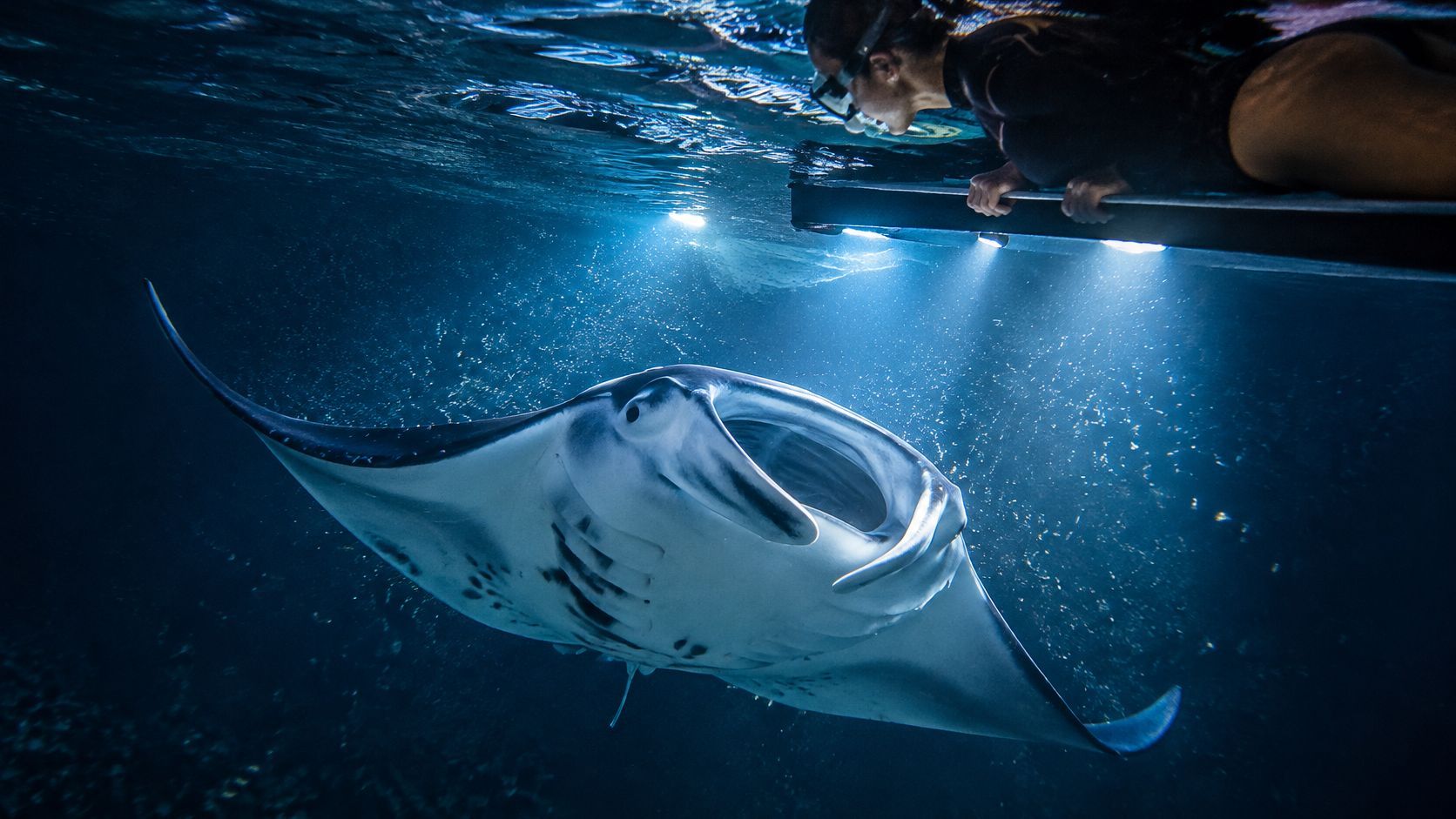
You're choosing a manta tour, and the photos make it look effortless: a guest lies flat beside an illuminated board while a dark shape rises out of the blue and turns beneath them. What the photos don't show is the moment before entry, when you're checking your mask, looking into black water, and wondering whether you'll feel calm once your feet leave the boat. That's the part worth planning for.
Manta Ray Night Dive at a Glance
“Manta ray night dive” can describe a surface snorkel or a scuba dive. On Kona Snorkel Trips' Night Manta Ray Snorkel, guests stay at the surface and hold a custom-built board with high-powered lights while manta rays feed below. The open-ocean activity takes place at night, with 30–40 minutes in the water.
Night Snorkel Versus Night Scuba Dive
Both formats offer a view of feeding mantas around lights, but they demand different skills and equipment. Choose based on what you can manage comfortably in the water.
| Aspect | Night snorkel | Night scuba dive |
|---|---|---|
| Who it suits | Intermediate snorkelers who can swim 50 yards without additional flotation | Certified divers with recent experience |
| Where you are | At the surface, holding near the illuminated board | Below the surface, near the illuminated feeding area |
| Gear | Mask, snorkel, flotation belt and provided wetsuit | Scuba equipment, including a regulator and buoyancy control device |
| Time in the water | 30–40 minutes on Manta Ray Snorkel trips | Set by the dive plan |
| Main risk to plan for | Darkness, swell and cold water | Depth, air supply and equipment |
At the surface, you need to breathe through a snorkel, stay calm in open water and follow the crew's directions. The board gives you something to hold, and a flotation belt helps keep your hips and feet up, but neither replaces swimming ability.
Scuba adds equipment management and buoyancy control in low light. Certified divers should confirm their recent experience and comfort with the equipment directly with the operator before reserving.
Why Manta Rays Gather Under the Lights
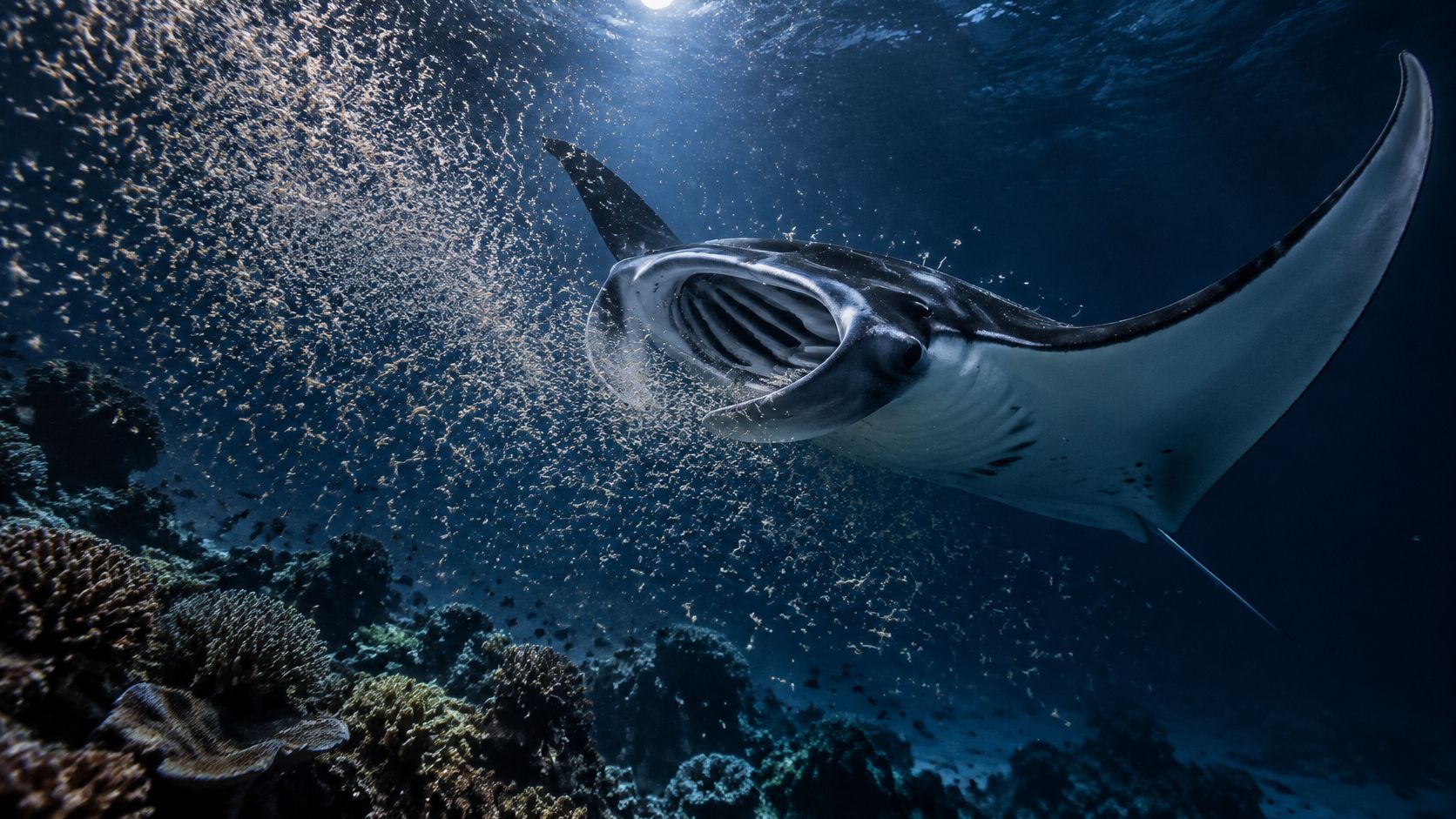
After dark, zooplankton rises into the water column. Lights concentrate some of that plankton, creating a feeding patch that manta rays may work through. The lights attract prey; they do not feed the rays or guarantee that mantas will arrive.
As Love Big Island's manta night-dive guide explains, reef mantas filter plankton from illuminated water. They swim with open mouths through dense patches and may barrel-roll as they feed. These turns are feeding movements, not attempts to chase individual fish.
A Small Feeding Patch Creates Close Passes
The lit area is limited, so a manta feeding there may pass close to a stationary group. Close passes reflect the animal's route through a feeding opportunity, not an invitation to touch or follow it.
That distinction shapes your role in the water. Hold your position rather than swimming after a ray. Moving into its path can disrupt the route it was already using. For more on the role lights play in attracting manta prey, consider how the feeding site depends on light concentrating plankton, while the rays remain free to approach or leave.
Research at Kona aggregation sites indicates that frequent encounters reflect repeated visits by a relatively small resident population of manta rays. Seeing the same animals return does not mean they are under anyone's control.
How Likely Is a Sighting?
Historical testimony submitted to the Hawaiʻi Legislature reported mantas on approximately 80% of dives in surveys conducted from 1992 to 2007, primarily at Keauhou and Ho'ona Bay. That figure describes those sites during that period, not the odds on a particular night.
Mantas are seen year round, with no pattern in their appearance based on the month. Choose a date that fits your itinerary rather than relying on a supposedly ideal calendar window.
A ray may take time to arrive, and it may feed elsewhere. Neither waiting nor changing position can make a wild animal appear on cue. The guide reads the water; guests should stay with the group.
A manta night snorkel is an open-ocean activity around a human-lit feeding site. The lights can make prey easier for mantas to find and give guests a view of feeding behavior, but the animals decide whether to approach, leave, or stay away.
Who Can Join and What to Bring
Start with your swimming ability, not your packing list. Our night-snorkel guests should be able to swim 50 yards without additional flotation and have prior snorkeling experience at an intermediate level. Being happy in a swimming pool isn't the same as clearing a snorkel while floating in dark ocean water.
A first-ever snorkel shouldn't also be your first night snorkel. Learn to breathe steadily, recover from water entering the snorkel, and reposition yourself without standing on the bottom before adding darkness and close wildlife encounters.
Requirements by Guest Type
Match your situation to the table before deciding what to bring. Our guide to whether Kona manta night snorkel tours require a swim check explains why flotation equipment doesn't replace the underlying swim standard.
| Guest type | Swim and snorkel standard | What to plan for |
|---|---|---|
| Confident swimmer, first night snorkel | Swims 50 yards without extra flotation and has intermediate snorkel experience | Practise breathing calmly through the snorkel and keep the flotation belt on |
| Beginner snorkeler | Does not yet meet the intermediate experience standard | Build skill on a daytime snorkel before booking the night trip |
| Child | Must meet the same swim standard as adults | Confirm age and size rules with the operator before booking |
| Non-swimmer | Does not meet the swim standard | Choose a suitable supervised daytime option with flotation support instead |
| Camera user | Same standard as any guest | Bring a waterproof camera, a towel and a zip-up jacket |
| Anxious guest | Same standard as any guest | Do a daytime snorkel first and use the briefing to ask questions |
For children, enthusiasm can't substitute for independent ability. A parent should be able to follow the guide's instructions without simultaneously holding a child afloat.
Non-swimmers shouldn't book the night charter expecting to remain aboard. We don't permit ride-alongs on the manta charter. Any daytime alternative still needs an honest conversation about swimming ability and supervision.
Pack for the Return Ride
We provide wetsuits for the manta tour, and all guests wear flotation belts. Don't bring bulky personal flotation equipment expecting it to replace the supplied setup.
- Towel: Keep it dry until you're back aboard.
- Zip-up jacket: Choose something easy to put on over damp swimwear.
- GoPro or waterproof camera: Use a secure, compact setup that doesn't interfere with your grip.
A camera is optional; calm breathing isn't. Practise a sustained, relaxed swim and a face-down float in safe shallow water before booking, with appropriate supervision rather than practising alone.
How the Night Snorkel Runs, Step by Step
The sequence should feel organized before anyone enters the water. A good briefing gives you an entry plan, a position at the board, and a clear way to ask for help or return early.
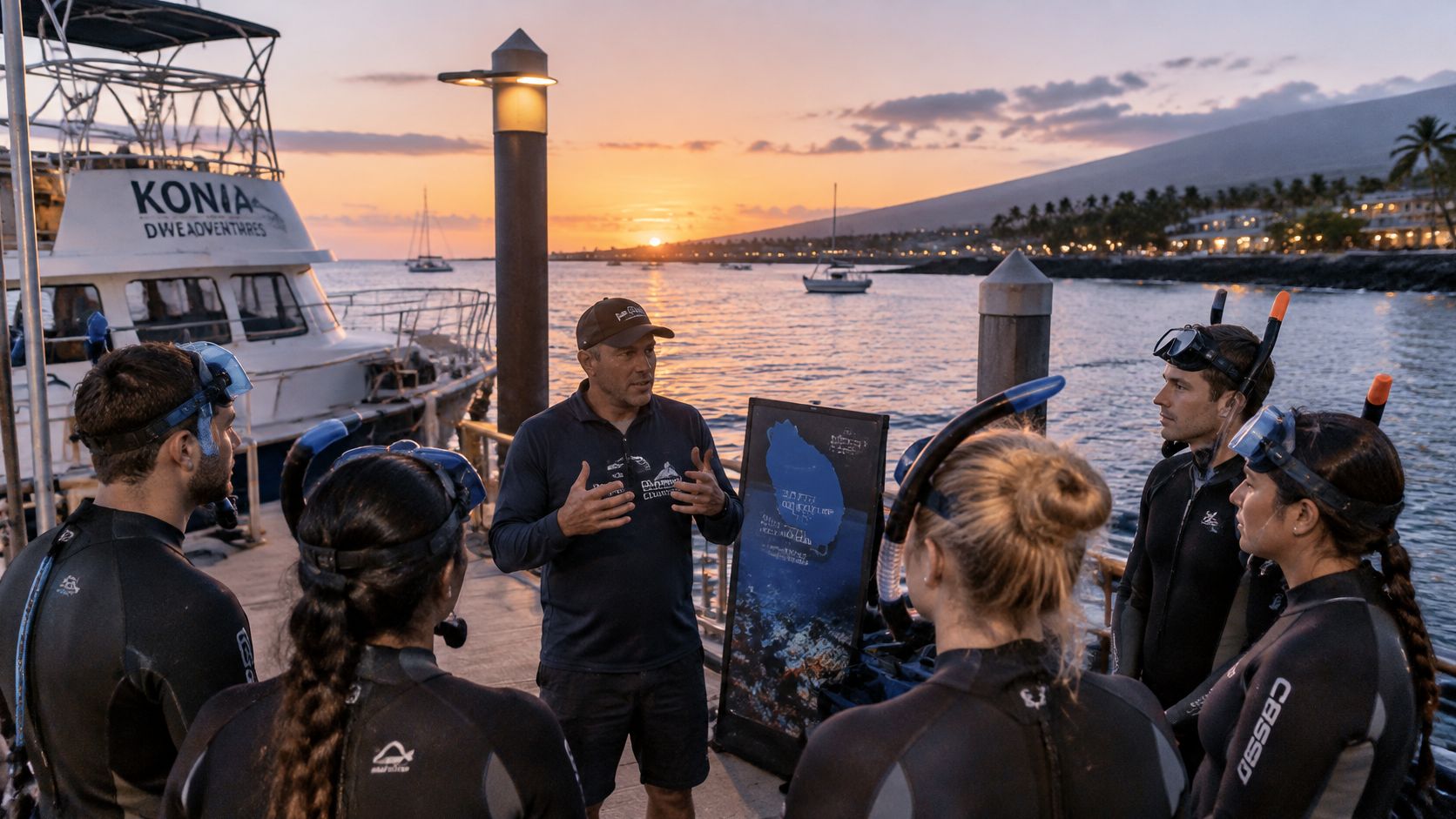
Our early trip checks in during daylight, watches sunset from the boat, and enters the water after dark. The late trip checks in at night, so don't assume every departure includes a sunset.
From Dock Check-In to the Light Board
Check in and get fitted. Arrive ready to follow the crew's equipment-fitting sequence for your wetsuit, mask, and snorkel. A mask that presses painfully or leaks during a fit check needs attention before departure, not after you've reached the board.
Listen to the whole briefing. The crew explains the rays, how close they may pass, the no-touch rules, and how to float without kicking. Ask how to signal discomfort and how the crew handles an early return to the boat.
Put on the flotation belt. All our manta guests wear one to help keep hips and feet up, away from passing rays. Let the crew position it correctly rather than adjusting it to feel less noticeable.
Travel to the feeding site. Our operating areas are Garden Eel Cove or the area in front of the Keauhou hotel. Stay seated or hold the designated handhold as directed while the crew prepares the illuminated board.
Enter on the guide's signal. Move to your assigned position, hold the board edge, and extend into a flat floating posture. Place your face in the water and settle into steady snorkel breathing instead of repeatedly lifting your head to search.
Watch without reaching. Keep your body quiet when a ray approaches, even if its turn brings it unexpectedly close. If you need to change position, follow the guide rather than pushing the board or kicking across another guest.
Return when instructed. The planned water session is 30–40 minutes, but you can tell the crew you need to leave sooner. Stay with the guided return procedure instead of releasing the board and swimming toward a boat independently.
Climb aboard and warm up. Keep the boarding area clear, use the ladder as instructed, and wait until you're secure before managing your camera. Dry off, put on your jacket, and ask the crew about the feeding movements you watched.
A successful night isn't measured only by the footage. It also means you stayed calm, left the animals' route open, and responded promptly to the crew.
Close passes are memorable, but they aren't something a guide can order. Even when the rays stay away, an orderly entry, attentive supervision, and an unhurried exit remain essential parts of a well-run trip.
Conditions That Change Your Night
The night trip carries real risks. Being attached to a floating board doesn't make open ocean equivalent to a pool, and a ray's gentle feeding behavior doesn't remove vessel, weather, or swimming hazards.
SFGATE's reporting on Kona manta tours described boats traveling faster than recommended, passing close to unlit snorkelers, and crossing over submerged divers; it also reported a 2022 death during a manta night dive. Those incidents make operating procedures a booking question, not a minor detail.
Conditions, Effects and What to Do
Darkness removes familiar visual references. You may feel disoriented even when you're physically close to the board, especially if swell repeatedly lifts your face or moves the lights.
| Condition | Effect on your night | What to do |
|---|---|---|
| Dark water with no horizon | Distance and direction are hard to judge | Stay close to the guide and the light and keep your breathing slow |
| Open-ocean swell | Bumpy water entry and a higher chance of seasickness | Ask the crew about seasickness options before boarding |
| Cold water and night air | Chill can become more noticeable during a stationary float and wet return ride | Wear the provided wetsuit and bring a zip-up jacket for the boat |
| Current or wind | Harder to hold position over the feeding area | Hold the board edge and follow the guide's signals |
| Boat traffic nearby | Vessels may see unlit snorkelers late | Ask whether the crew uses lookouts and lighting |
| Weather change | The trip may be cancelled or cut short | Accept the operator's cancellation decision without argument |
Our explanation of how wind changes a Kona manta ray night snorkel helps connect the forecast to the experience at the board. A pleasant evening ashore doesn't establish that entry and exit will be comfortable offshore.
When Shorter Is Better
Lifeguard-certified guides, flotation support, illuminated boards, manageable guest-to-guide ratios, and conservative weather decisions reduce risk. They don't eliminate it. A guest who is shivering, nauseated, or struggling to breathe calmly gains little by remaining in the water for the sake of using every available minute.
Tell the crew early if you feel unwell. Waiting until you're exhausted makes the return harder for you and the people assisting you.
- Can't meet the swim standard: Don't enter on the assumption that the board will compensate.
- Panic in open water: Build comfort in daylight before considering a night trip.
- Cold or exertion creates medical concerns: Get advice from a clinician familiar with your condition before booking.
- Prone to seasickness: Discuss prevention with a clinician or pharmacist and be prepared to opt out if symptoms are significant.
Before paying, ask who watches nearby vessels, how swimmers are illuminated, what emergency equipment is aboard, and who supervises an early return. Ask for the actual guest-to-guide arrangement, not just an assurance that the group is small.
Etiquette and Protecting the Rays
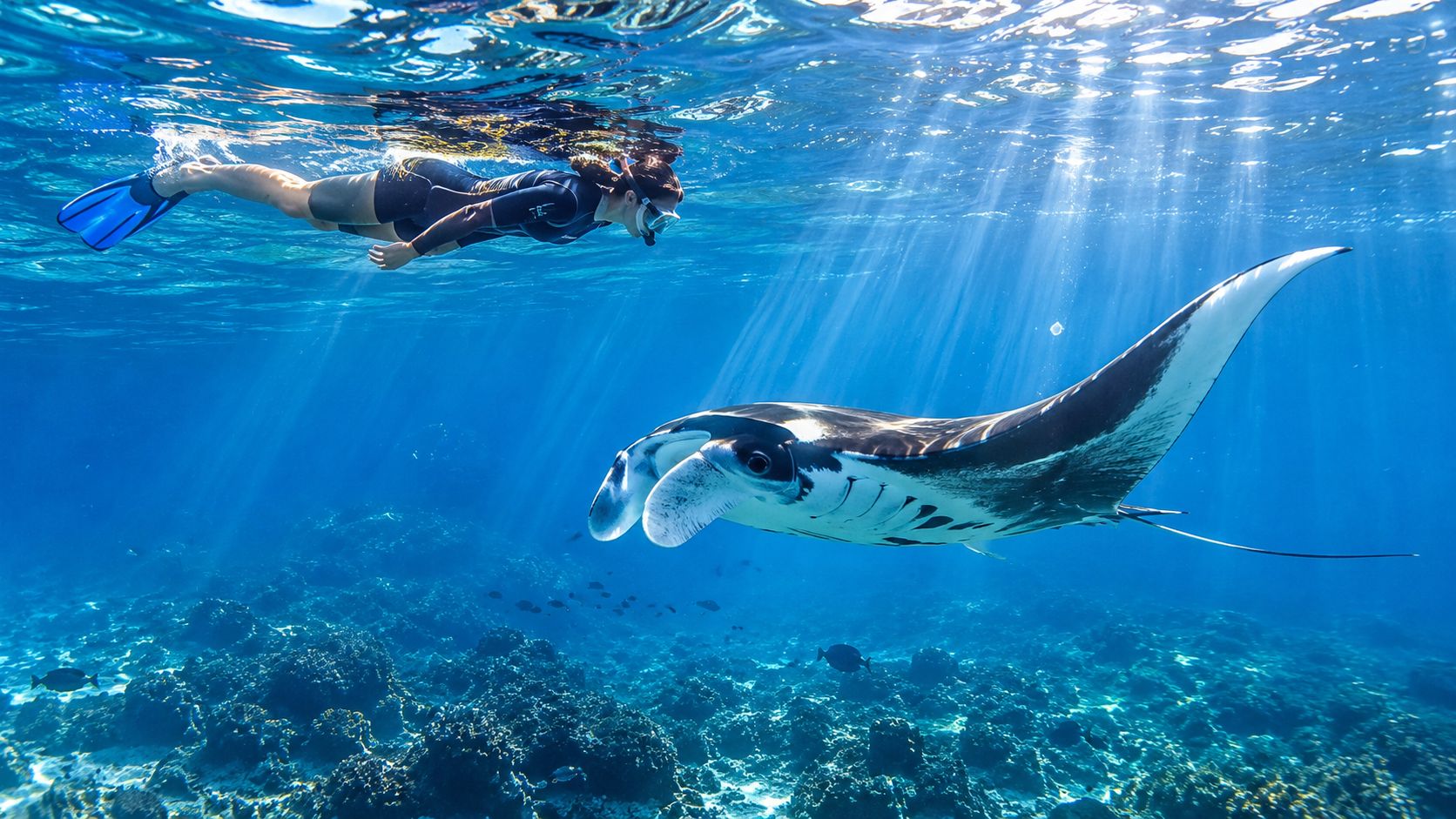
The NOAA-hosted voluntary interaction standard for Kailua-Kona says observers must not touch, chase, grab, or attempt to ride mantas, and must let the animals control the encounter. Contact can remove the protective mucus coating that helps defend their skin against harmful organisms.
The Trade-Off Beyond Touching
Hawaiʻi's manta-viewing boating-safety assessment identifies commercial-use permit requirements and discusses designated zones, mooring practices, navigation restrictions, and environmental protections. Ask operators how their procedures address those controls rather than assuming all are implemented identically.
The illuminated gathering is a human-created feeding context. NOAA's manta assessment describes offshore nighttime foraging and descents of roughly 200–450 meters; it also cites lower emergent zooplankton abundance and diversity at a heavily used Kona site, with inadvertent diver habitat damage proposed as one explanation. Those broader manta findings aren't proof that every reef manta naturally follows the same nightly route.
The full ecological effect remains uncertain. That warrants restraint, not a blanket claim that tours are either harmless or damaging.
- Hold position: Keep hands, feet, and cameras out of the feeding corridor.
- Protect habitat: Avoid the seabed and unnecessary board movement.
- Leave an exit: Never surround an animal or follow it away.
These manta snorkeling rules that protect wildlife and guests turn concern into useful habits. Disciplined guests and careful operators can reduce pressure, but the trade-off remains real.
Manta Ray Night Dive FAQs
Can I Touch or Ride a Manta at Night?
No. Keep your hands to yourself even if a ray passes within reach. If an animal approaches unexpectedly, stay still and let it choose its route instead of pushing it away or trying to hold it.
Do the Lights Harm the Rays?
There isn't a sound basis for calling the whole illuminated feeding system impact-free. Ask how the operator limits unnecessary illumination, vessel movement, and crowding, and whether it supports monitoring of the animals and feeding habitat.
Do I Need Certification for a Night Snorkel?
No scuba certification is needed for the surface snorkel, but swimming ability and intermediate snorkeling experience are necessary. The scuba format requires diver certification and suitable recent experience; disclose your training and last dive when arranging that option.
What If No Rays Appear?
A quiet night is possible. Our manta guarantee offer doesn't expire and is honored if space is available two hours before the tour starts, so it isn't a promise of an immediately available replacement departure. Leave flexibility in your travel plans rather than assuming you can return the following evening.
Can a Beginner Learn on the Night Trip?
Build the skill in daylight first. You should already be comfortable breathing through a snorkel, responding to water entering it, and moving without relying on someone else to support you.
If you're using all your attention to manage the snorkel, you won't have much left for watching wildlife or responding to the guide.
Book Your Manta Ray Night Dive Now
Dark water, cold conditions, and time in the water require more than a booking confirmation. The Kona Snorkel Trips manta night snorkel lasts two hours in total. Check your departure time and allow flexibility in your travel plans.
Comfortable, experienced snorkelers can reserve the Kona Snorkel Trips manta night snorkel. If you are considering a scuba option, check that your certification and recent experience suit the dive before booking.
Before You Confirm
- Check your comfort in the water: Practise swimming and floating in safe, shallow water.
- Ask about equipment: Raise mask or wetsuit fit concerns before departure.
- Save your confirmation: Review the meeting location and check-in time.
- Prepare questions: Ask about lighting, lookouts, emergency equipment, and supervision.
Kona Snorkel Trips offers guided manta night snorkeling with lifeguard-certified guides, flotation belts, and an illuminated board for watching feeding rays. Check the Kona Snorkel Trips tour details and reserve only if the swimming requirements and nighttime conditions suit you.