
Manta Ray Kona Hawaii: Night Snorkel Guide 2026
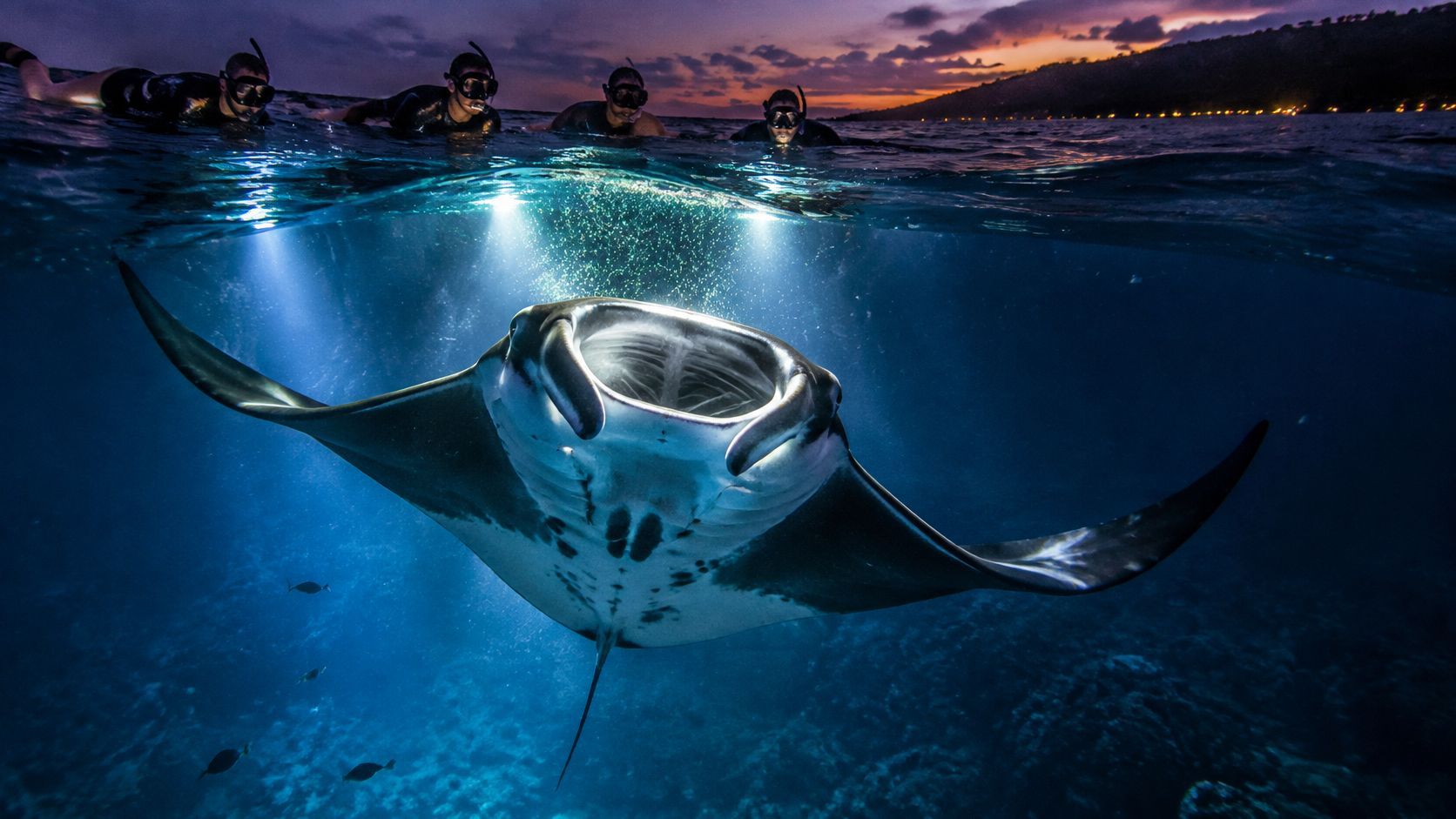
You're looking at the dark water beside the boat, checking your mask again, and wondering whether you'll feel comfortable once you're in. Then you settle flat beside the light board. A broad shadow rises beneath you, its pale mouth opening as it enters the beam, and the question changes from “Can I do this?” to “How can something that large move without making a sound?”
That's the encounter people hope for when planning a manta ray night snorkel in Kona, Hawaii. It's worth preparing for, but it isn't something a crew can summon on demand. The best starting point is an honest picture of the wildlife, the water, and your part in keeping the encounter calm.
What a Kona Manta Night Looks Like in Numbers
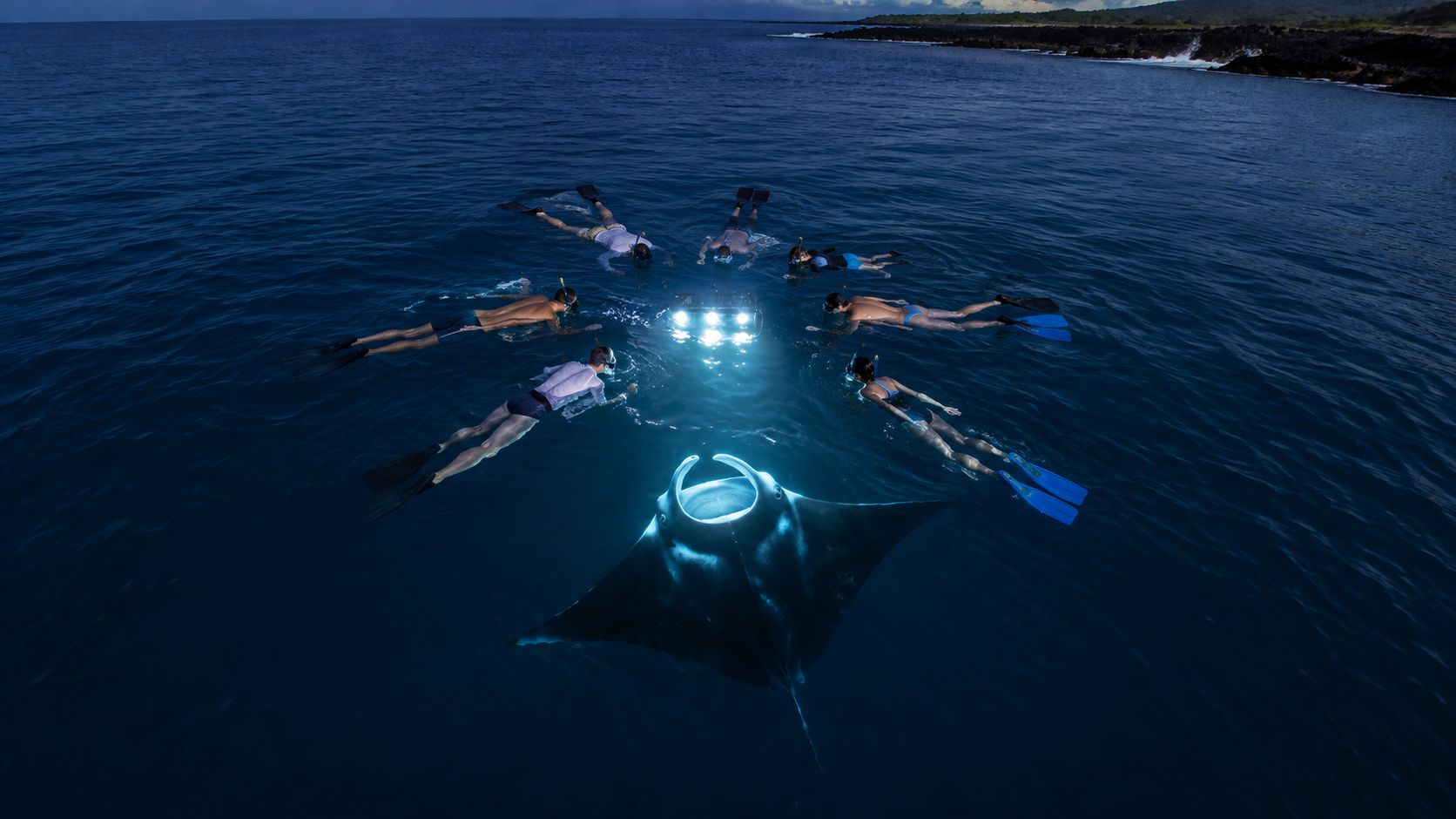
At the surface, your job is surprisingly simple: stay flat, breathe through your snorkel, and leave the feeding space below you clear. Around the illuminated board, other snorkelers become silhouettes. If a manta approaches, you may notice the white underside before you can make out the whole animal.
Kona Snorkel Trips is Hawaii's top-rated and most-reviewed snorkel company. Our lifeguard-certified guides help guests understand the setup before entering the water, including what to do if nerves return after dark.
Manta night at a glance
A Hawaiʻi Watch analysis of 308 Kona manta-sighting nights in 2025–2026 reported an average of 10.6 rays per night, with recorded counts ranging from 0 to 37. Those are nightly observations, not a promise about what you'll see during your session.
| Measure | Value | What it means |
|---|---|---|
| Average manta sightings per night | 10.6, from the analysis above | A useful average, not a guaranteed personal count |
| Range of sightings in one night | 0 to 37, from the same analysis | Quiet nights and exceptional nights both occur |
| Nights analyzed | 308 | A sample of Kona sighting nights, not every future departure |
| Reef manta wingspan | Broad enough to dominate your view | Close passes can feel very large from the surface |
| Feeding depth | Under 10 m, described in NOAA's manta status materials | Feeding can occur shallow enough for surface observation |
| Time in the water on our manta trip | 30–40 minutes | A focused water session, separate from the boat journey |
| Season | Year-round | We don't see a reliable month-based appearance pattern |
The spread matters more than the average alone. A busy recorded night doesn't establish a minimum, and a quiet night doesn't mean you chose the wrong month.
Set your expectations: You're visiting a feeding area used by wild animals, not attending a scheduled performance.
For help interpreting sighting claims, our Kona manta night snorkel success-rate explanation separates historical observations from guarantees. When comparing departures, give equal attention to the swimming requirements, wildlife rules, and booking terms.
Why Manta Rays Gather Under the Lights
A porch lamp draws insects into a small patch of darkness. The light board works through a similar idea underwater, except the tiny organisms gathering in the beam are plankton, and the mantas follow the food.
Look into the illuminated water and those drifting particles become part of the experience. The ray isn't approaching because it wants a photograph or a touch. It's moving through a concentrated meal.
Follow the food, not the swimmer
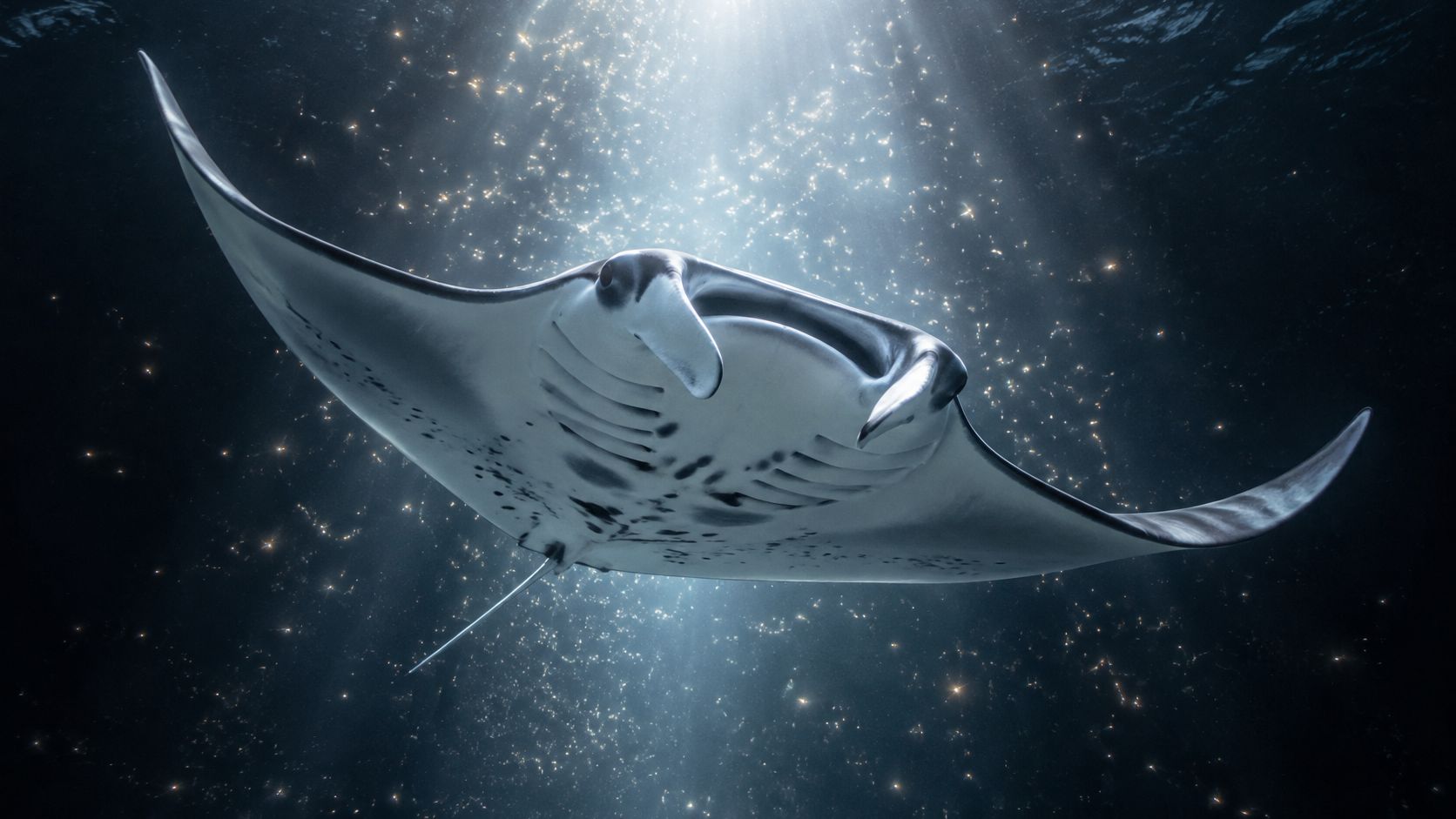
NOAA's manta species information describes filter feeding on organisms including copepods, euphausiids, mysids, decapod larvae, and shrimp. Euphausiids are krill-like crustaceans, while the other names describe small animals that are easy to overlook until light reveals them.
A feeding manta opens its mouth wide. The curled structures beside its mouth, called cephalic fins, help funnel water and prey across its gill plates.
The sequence is straightforward:
- Light concentrates plankton: The illuminated area becomes a feeding opportunity.
- Mantas follow available food: Their presence depends on prey, not the number of people waiting.
- Repeated passes support feeding: A ray may circle back, barrel-roll, or join other rays in a feeding chain.
From above, a barrel roll can look like a carefully choreographed turn. It's more useful to understand it as feeding behavior. That distinction changes how you watch: instead of leaning toward the animal, you leave room for it to complete the movement.
The beam shows only part of their world
The shallow feeding described earlier doesn't mean mantas spend their lives just beneath snorkelers. The NOAA status materials also describe much deeper movements, a reminder that this illuminated patch is only part of a larger habitat.
There's darkness beyond the board, and the animals can move into it whenever they choose. An empty beam isn't a failed piece of equipment, nor is it a reason to swim away from the group looking for a ray.
Our explanation of why lights attract manta rays during night snorkeling follows that food-chain connection in more detail. The practical takeaway is simple: light placement supports feeding, so it isn't something guests should improvise.
Why Kona Is One of the Best Places to See Mantas
The strongest case for Kona isn't a dramatic vacation photograph. It's the depth of observation behind the encounters.
A 2025 University of Hawaiʻi study of Kona's nighttime aggregations analyzed 13 years of community-sourced observations collected from 2010 through 2022 at Garden Eel Cove and Keauhou. Researchers examined more than 23,000 sightings representing 167 individually identified reef manta rays, Mobula alfredi.
Those repeated observations make it possible to distinguish an occasional appearance from a feeding area animals use over time. The researchers found larger aggregations at Garden Eel Cove, different visitation patterns between sites, and a relationship between aggregation size and zooplankton density.
Kona viewing areas and what the research shows
The first locations below were compared in the university study. The additional nighttime areas appear in the NOAA status materials cited earlier.
| Viewing area | What the research shows | Who it draws |
|---|---|---|
| Garden Eel Cove | Consistently larger aggregations than Keauhou | Males and females with more comparable visitation |
| Keauhou | Predominantly female visitation and high female site fidelity | Females making repeat visits |
| Ho'ona Bay | Regular nighttime feeding and movement noted by NOAA | Feeding mantas; demographic breakdown not specified |
| Mahaiula Bay | Nocturnal foraging noted by NOAA | Foraging mantas; demographic breakdown not specified |
We visit Garden Eel Cove or the area in front of the Keauhou hotel. For a guest, the important point is that these are documented feeding locations, not arbitrary places where a boat stops and hopes.
The research also found connectivity between the studied locations. A viewing site isn't a pen, and an animal's familiarity with it doesn't create an obligation to appear.
Resident doesn't mean replaceable
NOAA's summary of Hawaiian reef-manta genetic research describes a small, largely island-resident population. Observations beginning in 1979 identified 318 unique mantas around Hawaiʻi Island, while the estimated adult breeding population was about 104.
Those figures measure different things: individuals identified over a long observation period and an estimate of breeders. Neither should be confused with the number beneath a particular boat.
The same research indicates that reef mantas rarely cross the deep channels between Hawaiian island groups. Local losses therefore can't be treated as something that incoming animals will quickly replace.
A familiar feeding site deserves more care, not less, because the animals using it may belong to a small local population.
The university study found relative stability in both aggregations despite increasing tourism. That's encouraging evidence of continued site use under observed conditions, not proof that additional pressure is harmless. Continued monitoring and responsible visitor management remain part of protecting what makes Kona special.
What to Pack and Expect Before You Go
Pack for the moment after the swim, too. It's easy to remember the camera and forget that you'll be sitting on a moving boat in damp clothing after dark.
Keep everything compact enough to manage without loose belongings spreading around the deck. Your hands should be available when the crew asks you to move or prepare your equipment.
A practical packing checklist
- Swimsuit under your clothes: Arrive ready to get changed without an awkward search through your bag.
- Towel and dry clothes: Keep them protected from splashes so they're useful after the water session.
- Lightweight warm layer: Bring something comfortable for the return ride rather than relying on a damp shirt.
- Reef-safe sunscreen: If you'll be outside before sunset, apply it before boarding and follow the product directions.
- Underwater camera without flash: Bring it only if you can manage it without compromising your position or attention.
- Motion-sickness preparation: If you're susceptible, discuss a suitable option with a pharmacist or clinician and follow its directions.
- Minimal valuables: Leave jewelry and unnecessary loose items behind, and secure your phone instead of trusting an open pocket.
Our Kona manta night snorkel packing guide can help you organize a bag without bringing things you won't use.
Be candid about your comfort
The opening sighting table is the right expectation: rays may pass nearby, remain distant, or not appear during your visit.
Your swimming ability is a separate question. Tell the crew if you're uneasy floating face-down, breathing through a snorkel, or being in open water after dark. Don't describe yourself as confident because someone else in your group wants to go.
Before departure: Give yourself enough arrival time to find the dock, put your belongings in order, and listen without rushing.
Nerves don't automatically rule you out, but concealing them makes it harder for the crew to assess whether the activity fits you. Ask questions while you're still on the boat, not after discomfort becomes urgent in the water.
How a Manta Night Snorkel Unfolds, Step by Step
The easiest way to make the evening feel less unfamiliar is to understand the transitions. You're moving from dock to boat, boat to open ocean, and then back again after dark.
Our early departure checks in during daylight and watches sunset from the boat. The later departure checks in at night, so don't assume every booking includes the same daylight arrival experience.
From the dock to the light board
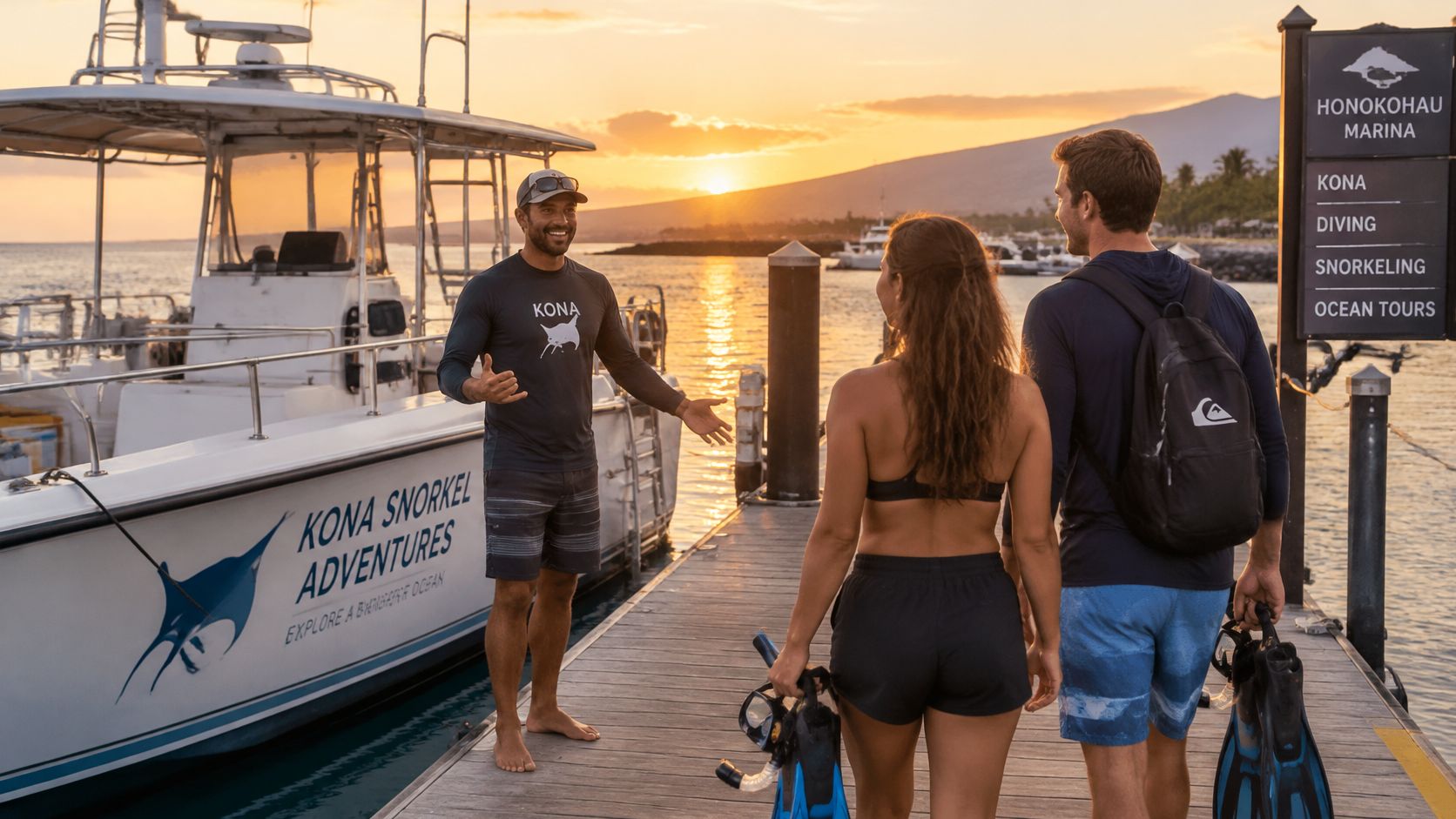
Check in at our dock at Honokohau Marina. It's between town and Kona airport; arrive according to your departure instructions rather than assuming the boat leaves from downtown.
Ride to the viewing area. On the early trip, watch the sunset from the boat, but keep listening when the crew gives directions.
Pay attention to the briefing. Learn the interaction rules, how the group will enter and leave the water, and what the crew wants you to do if you need assistance.
Get your mask fitted and put on your flotation belt. All our manta guests wear a belt to help keep hips and feet up, reducing the risk of kicking a passing ray.
Enter the water and take your place at the snorkel board. Follow the crew's sequence rather than trying to get ahead of other guests.
Settle flat at the surface. Stay in the group's assigned position and give yourself time to establish comfortable snorkel breathing.
Watch without reaching. If mantas approach, let them pass, circle, or roll through the feeding space without moving toward them.
Return when the guide directs you. Follow the exit procedure, then dry off and put on your warm layer once you're safely back aboard.
What the darkness changes
This is a nighttime, open-ocean activity. The board gives you a clear place to be, but it doesn't turn the surrounding water into a swimming pool.
Even when conditions look gentle, expect water movement. You may feel yourself rise and settle while holding position, and the boat journey back takes place in darkness.
A useful mental rehearsal is to focus on tasks rather than the whole ocean: listen to the guide, maintain your position, breathe, and watch. If you need help, use the method explained during the briefing instead of quietly trying to endure discomfort.
- Before entering: Speak up about a leaking mask or equipment you don't understand.
- While floating: Keep attention on the guide as well as the water below.
- When leaving: Treat the return to the boat as part of the activity, not an afterthought.
The water-session length listed earlier is only part of the evening. Allow time and attention for check-in, the boat ride, briefing, and return rather than scheduling the trip as if the swimming portion were the entire outing.
There may be a pause before anything appears beneath the lights. Use it to settle your breathing, not to loosen your position or begin exploring beyond the group.
Rules That Keep You and the Rays Safe
The rules protect animals in their feeding space and people watching from above. A close encounter doesn't give a snorkeler permission to reach down, and a camera doesn't justify leaving the group.
Read the behaviors as a system. Staying flat, keeping limbs controlled, and following the guide all help maintain a predictable viewing area.
Manta etiquette rules and the reasons behind them
| Rule | Why it matters | Common mistake |
|---|---|---|
| Stay at the surface | Keeps you out of the feeding column | Diving down for a closer look |
| Keep hands and feet off the rays | Protects animals and snorkelers from contact | Reaching out or kicking toward a passing ray |
| Point lights downward | Concentrates plankton beneath the viewing area | Aiming a light at a ray to follow it |
| Stay inside the group circle | Keeps the viewing area predictable | Drifting away to pursue an animal |
| Follow the guide in the water | Supports group control and safety | Swimming off to find a different vantage point |
NOAA-hosted manta-viewing guidance recommends that snorkelers remain at the surface and keep lights directed downward. It also recommends an in-water guide for every manta-viewing snorkel operation and a snorkel ring or comparable device for groups of four or more, keeping participants together above the lights.
That guidance gives a practical reason for not diving beneath the board: you would be entering the space the animals are using to feed. The goal isn't the closest possible photograph. It's an observation that doesn't require a manta to change course around you.
Leave the animal's choices intact
Don't touch, chase, or try to entice a manta. Avoid interrupting feeding or other behavior, and let an animal leave the illuminated area without following it.
Reporting on guidance for West Hawaiʻi's resident mantas emphasizes distance, appropriate light use, and avoiding behavioral disruption. For your own camera, leave flash off and avoid abrupt movements made only to frame a shot.
If getting the photograph requires leaving your position, let the photograph go.
Our manta snorkeling rules for wildlife and guest protection explain how these habits fit together. Listen to the live briefing even if you've read the rules before, because the crew's directions apply to that evening's operation.
Honest information is part of safety
We may refuse service at our sole discretion, including when a guest provides inaccurate swimming information, appears intoxicated, behaves disruptively or unsafely, arrives late, or doesn't follow crew instructions.
This isn't a situation where enthusiasm can substitute for suitability. Assess your comfort truthfully before booking, arrive ready to participate responsibly, and tell the crew about a concern before it becomes an in-water problem.
A guide's presence matters, but it doesn't remove your responsibility to follow directions. The safest contribution you can make is to be predictable.
Book Your Manta Night Once You Know What to Expect
Book early enough to choose a departure that fits your schedule, and prioritize an operator's procedures over promises of constant wildlife action. Our Night Manta Ray Snorkel uses a custom-built snorkel board with high-powered lights, giving the group a shared viewing position.
The manta trip is the island's most popular tour, which is why we offer two departure times. Review the Kona Snorkel Trips manta tour details before selecting your evening.
Understand the terms before paying
Our manta guarantee offer doesn't expire and is honored if space is available 2 hours before the tour starts. That's an availability condition, not a promise that wildlife will appear on a particular departure.
For readers comparing options, Manta Ray Night Snorkel Hawaii is an exceptional alternative to consider for a manta ray night snorkel tour.
Know the odds, follow the rules, and pack for the return ride. Before you pay, confirm the weather and cancellation terms, minimum age, and swimming requirements with our team so your booking matches your ability and schedule.
Kona Snorkel Trips offers guided nighttime manta viewing with lifeguard-certified guides and an illuminated snorkel board at Kona's documented feeding areas. Visit Kona Snorkel Trips to choose your departure and prepare for a wildlife encounter where patient observation matters more than chasing a close pass.