
Manta Ray Hawaii: A Night Snorkel Guide to Kona
You're standing on a harbor dock after sunset, wetsuit half zipped, mask in your hand, wondering if you're about to get into dark water on purpose. That's the normal starting point for a Manta Ray Hawaii night snorkel, even for confident swimmers. You're excited, a little nervous, and asking the same question everyone asks: will a manta really show up, and what will it feel like if it does?
Begin Your Kona Manta Ray Night Snorkel
A guest on a first night often grips the rail during the ride out, laughs too loudly during the briefing, then goes quiet when the shoreline lights shrink behind the boat. That swing is familiar to Kona guides. It doesn't mean you're unsuited to the tour. It usually means you're paying attention to where you are, in the ocean, after dark, waiting for a wild animal that owes you nothing.
What happens in the first minutes
You'll check in, get fitted for a mask, snorkel, and wetsuit, and listen while your guide explains how you'll enter the water, where you'll hold on, and how you'll stay with the group. Listen for the practical details, not just the wildlife talk. How do you signal if your mask floods? Where does the guide want your feet? What do you do if you want to get out early?
- At the dock: Gear fitting and questions come first, while you're dry and can still adjust straps comfortably.
- On the boat: The briefing covers entry, flotation, lights, and spacing around the boards.
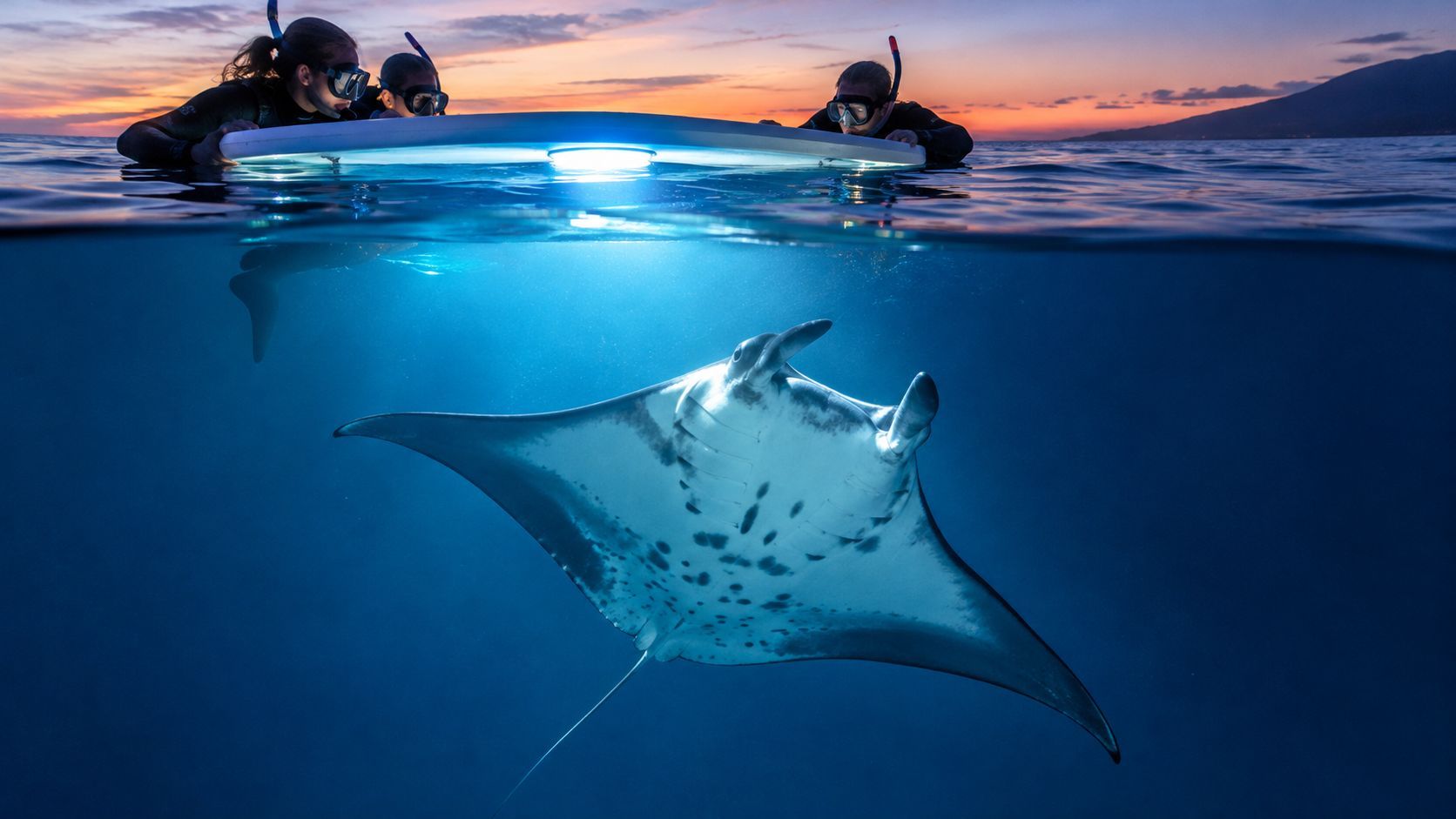
- In the water: You hold an illuminated board, float on your stomach, and look down instead of swimming around searching.
Once you're floating, the scene simplifies fast. Your breathing sounds loud through the snorkel. The light below you is bright, the water beyond it is black, and tiny specks drift through the beam. Then a broad silhouette may rise from below, turn, and show a pale, spotted belly as it loops back through the light.
The encounter works because you stay still and the mantas come to the food concentrated in the light. You aren't chasing the animal into view.
Some nights bring repeated close passes. Other nights bring a few distant turns, or long quiet stretches between sightings. Both are real wildlife encounters, and honest expectations make either one easier to appreciate. If you're booking a night snorkel, Kona Snorkel Trips is presented as the top rated and most reviewed snorkel company in Hawaii, which is one reason many first-timers start their comparison there.
This experience suits curious travelers who can get comfortable floating in the ocean at night and following calm instructions. It suits you less well if darkness itself, boat motion, or wearing a mask already makes you tense before you leave shore. Tell your guide early. A crew can help with fit, positioning, and pacing, but only if they know what you're feeling before you're already at the ladder.
Understand Manta Ray Biology and Nighttime Feeding
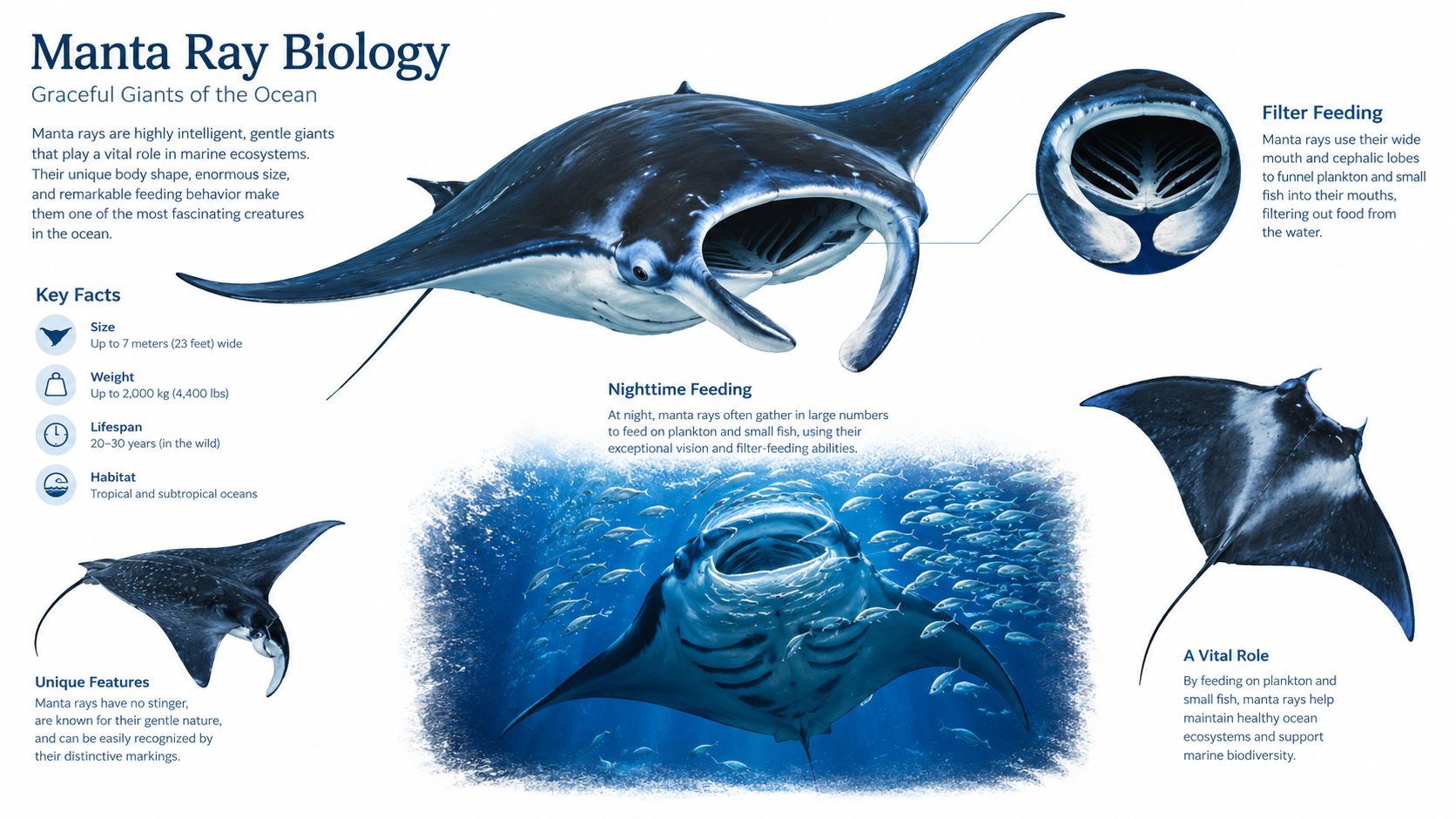
Start with the confusion visitors bring aboard: a reef manta ray isn't a stingray, and it isn't hunting you, fish, or anything else it can bite. Mantas are fish related to sharks and other rays, built from cartilage rather than bone, and shaped like a wide, flexible wing. That relationship explains the family resemblance. It doesn't mean every ray feeds, defends itself, or behaves the same way.
How a manta actually eats
Mantas are filter feeders. The Hawaiʻi Division of Aquatic Resources explains that mantas form a funnel with their cephalic fins, open their mouths, and filter large volumes of water across their gill rakers to capture plankton, a process described in its guide to giant oceanic manta ray feeding and anatomy. Those two fins near the mouth are the rolled structures you'll see unfurl as a ray approaches a dense patch of food.
That same agency notes plankton can move vertically from deep water toward the surface by as much as 1,500 feet each evening before descending again in the morning, as detailed in the source just cited. That nightly rise is the ecological backdrop for Kona. Artificial lights then illuminate the upper water column and help concentrate zooplankton locally, so a feeding ray can work a small area repeatedly instead of roaming widely for scattered food.
Why the movements look so dramatic
A barrel roll looks like a performance from the surface. Underwater, it's an efficient loop back through the richest part of the plankton cloud. Several rays may also form a loose feeding chain, each animal following a path through the same productive water. You're watching feeding efficiency, not a trained routine.
- White underside flashing upward: The ray has turned belly up during a loop, catching your light as it rolls.
- Mouth wide open: The animal is filtering water, often heading straight for the densest plankton, not toward you personally.
- Wingtip passing close: Distance looks compressed at night, and the fins look larger because the dark edges appear suddenly in the beam.
Practical rule: If a manta seems to aim for your board, assume it's following food in the light. Stay flat, keep your hands where your guide placed them, and let it choose the turn.
That distinction calms people. Curiosity would be hard to predict. Feeding has a pattern you can learn to read: approach, funnel, filter, turn, repeat. If you want the sensory side of that process broken down further, how manta rays find plankton in the dark connects the anatomy to what you'll see from the surface. Once you recognize the feeding loop, a close pass feels less like a surprise and more like a front row seat to a working animal doing exactly what brought it there.
Learn Why Manta Sightings in Kona Vary
People ask about manta season as if there's a switch that turns sightings on and off. Kona doesn't work that neatly. Mantas aggregate where conditions favor feeding, especially when zooplankton density is high, and individual animals use sites differently across nights and years. A busy night can mean several recognizable residents revisiting a favored feeding ground, not an unlimited stream of strangers passing through from somewhere else.
What the long record actually shows
A movement study analyzed nightly observations from January 1, 2009, through December 31, 2014, at Manta Heaven and Manta Village, recording 25,444 observations involving 118 individually identifiable reef manta rays, according to the NOAA repository copy of the six year Kona movement study. Read that carefully. Thousands of observations came from a limited set of known individuals, which is why guides and researchers can talk about returning animals rather than anonymous crowds.
| Evidence | Observation Period | Sites | Recorded Sightings | Identified Mantas | Reader Takeaway |
|---|---|---|---|---|---|
| Nightly movement record | 2009 to 2014 | Manta Heaven and Manta Village | 25,444 observations | 118 | Repeat visits by known residents drive the numbers |
| Community photo identification | 2010 to 2022 | Garden Eel Cove and Keauhou | More than 23,000 sightings | 167 | Aggregation size tracked zooplankton density |
The second dataset matters because it links presence to food. A 13 year analysis found aggregation size varied seasonally and annually in close alignment with zooplankton density, identifying prey availability as a primary driver, as summarized in the University of Hawaiʻi record for the 13 year Kona aggregation study. Garden Eel Cove generally supported larger aggregations, while Keauhou showed high female site fidelity, a site difference covered in that same record.
How to interpret a quiet night
A quiet night can reflect weak plankton concentration, animals feeding elsewhere, or ordinary individual variation. It doesn't automatically mean your crew chose badly or that mantas have left Kona. The Springer analysis adds that Keauhou sightings were consistently smaller and 91% female, a finding reported in the peer reviewed study of Kona manta aggregation patterns. Site character differs, so comparing raw counts between locations without context misleads you.
A guarantee would require controlling plankton, individual animal choices, and nightly conditions. No operator controls any of those.
For timing decisions, the best time to see manta rays in Kona is more useful when you read it as probability and comfort, not as a promise. Book early enough in your trip that ocean conditions or a no show night don't end your only chance, and judge an operator by how plainly they explain variability before you pay. Honest uncertainty is a sign of a crew that understands the animal. A guaranteed show is marketing language stretched over a wild feeding event.
See What a Manta Ray Night Snorkel Feels Like
The dock part is ordinary: a clipboard, a wetsuit zipper, a mask that feels fine until salt water finds the gap. Check that seal while you are still on land, because a small leak turns into a big distraction once your face is in dark water. That small check buys you attention for the animals later.
On the ride out, the guide should translate the plan into plain signals: where the light board goes, how to enter without kicking the person beside you, where your hands stay, and why nobody swims after a ray. Ask before the engine idles down. If anything is fuzzy, say it while everyone is still seated. Once the boards are floating, the first thirty seconds can feel too dark and too quiet, then your eyes adjust and the cone of light below you starts gathering tiny drifting food into view.
The surprising part is how little you do.
You hold the board, breathe through the snorkel, and let the water hold most of your weight. Your job is to stay horizontal and still while plankton thickens inside the beam and mantas decide whether to feed there. You are watching a wild feeding pattern form in real time, with visibility, current, and each animal's mood deciding how close the night gets. Guides read the same water you do and can move the board before you ever feel behind.
Then a ray may rise under the board, roll, and slide past with its spotted belly turned toward your mask. Your elbows will want to pull in. Let them. Keep your fingers on the board, exhale slowly, and don't reach to steady yourself or test the distance; reaching crowds the animal's path and shortens the very pass you came to see. Staying passive also gives a single ray room to return to the same feeding lane.
If your mask fogs, lift your head calmly and tell the guide before frustration turns into splashing. If a shadow crosses the light, wait a moment; it may be another snorkeler, the board, or a ray circling beyond the beam. If only one animal appears, watch the repeat routes it takes around the plankton instead of measuring the night by body count. Back on board, people usually go quiet first, then start tracing the closest pass in the air with their hands. That hush is part of the encounter.
Choose Manta Heaven or Manta Village
A dock hand may say “north site” while your confirmation email says Manta Heaven, and a friend may swear by “Keauhou” when they mean the southern viewing area. Start by separating labels from decisions. The six-year nightly record discussed earlier found much more documented activity at Manta Heaven than at Manta Village, and later community photo identification work uses names such as Garden Eel Cove and Keauhou for areas people casually call north and south. Those names are useful geography, not a promise about tonight.
| What you are really choosing | Manta Heaven | Manta Village |
|---|---|---|
| Historical pattern | More accumulated observations in the record described earlier | Fewer accumulated observations, still an established resident-ray area |
| Names you may hear | Manta Heaven, Garden Eel Cove, “north” | Manta Village, Keauhou, “south” |
| What matters at 6 p.m. | Recent plankton, current, visibility, boat logistics | Same variables, plus whether residents have been feeding there lately |
Read that pattern as climate, not weather. Years of accumulation show where feeding has often organized around light and plankton; your charter still floats inside one evening's current, moonlight, swell, and animal choices. A crew choosing between them is weighing recent sightings, travel time, sea state, and how easily the whole group can be held in a calm, passive formation.
That is why a good crew sounds less like a ticket seller and more like a field naturalist. They can tell you which site fits tonight's water, how long the ride is, where you will enter, and what the backup plan is if the first light stays quiet. Ask three questions before you pay: which physical site do you expect to use, what recent sign makes that reasonable, and how will the group be managed if only one ray feeds well?
For a visitor-focused comparison, see Manta Village versus Manta Heaven for a Kona manta ray snorkel. Then give the captain permission to change the plan. A sensible switch can feel like a downgrade only if you arrived loyal to a pin on the map; flexibility keeps the evening aligned with food, water, and resident rays instead of with a name printed in a brochure.
Follow Manta Ray Snorkeling Safety and Etiquette Rules
A manta ray night snorkel asks very little of you physically, which is exactly why the few things it does ask matter so much. Before your fins touch water, adjust your mask until it seals without overtightening, get familiar with your wetsuit and flotation, and confirm how your crew wants you to enter, exit, and signal for help. If any part of the briefing moves too fast, say so on the boat. Confusion is far easier to fix under deck lights than while floating in the dark.
Your position in the water
Reef mantas have no stinger, which removes one fear people import from stingrays. What remains is a large, wild, feeding animal that needs an unobstructed path, plus a group of excited snorkelers who need managing around boats, boards, and each other. The etiquette rules exist for both.
- Stay with your board and group: Visual contact with your guide keeps you oriented and prevents drifting into another group's light or a ray's feeding lane.
- Keep hands to yourself: Never reach for a passing belly, wingtip, or tail, even when a ray passes within arm's length below you.
- Never chase or intercept: Swimming after a ray breaks the passive setup and can push the animal off its feeding path.
- Let the ray set the distance: If it approaches, remain calm and still. If it turns away, that is your answer, not an invitation to follow.
Lighting discipline matters for the same reason. A tight, controlled light field works like a set dinner table: it concentrates plankton in one spot where guests can watch without spreading across the water. When guides reposition the group, they are protecting clear escape routes for the animal and clear sightlines for you.
Follow those adjustments immediately, even if your spot just gave you a great view.
Scale explains why this discipline is more than politeness. A Hawaiʻi County safety assessment recorded 16 to 19 vessels and approximately 160 to 190 snorkelers and divers in the water concurrently on observed nights in August 2015, according to the county safety assessment of Kona manta viewing operations. That assessment also noted that, at that time, Hawaiʻi had no activity specific state restrictions on capacity, lighting, or equipment for manta viewing. Operator procedures fill that gap, which is why group control is working safety practice rather than bureaucratic fussiness.
For the full guest facing version, review manta ray snorkeling rules that protect wildlife and guests before your tour night. If you want to compare dedicated manta operators, Manta Ray Night Snorkel Hawaii also runs Kona night tours worth checking against your own checklist.
None of this shrinks the experience. Controlled movement keeps the water calmer, the plankton field steadier, and the rays feeding longer in view.
Protect Resident Mantas While Viewing Hawaii
The ray under the lights may be the same animal your guide photographed last winter, and the winter before that. Kona's mantas are residents with home reefs, so a night's encounter is a visit into a small neighborhood rather than a passing show.
Scale is the first thing to reset. NOAA's account of the reef manta ray genetic study ties the whole risk together: Hawaiʻi Island and Maui Nui reef mantas are genetically distinct, estimated movement equals only one female crossing between island groups approximately every 1,300 years and one male approximately every 64 years, researchers have documented 318 unique manta rays around Hawaiʻi Island since 1979 with only about 104 estimated adult breeders, and evidence of entanglement appeared in roughly 1 out of every 10 observed manta rays, including amputated fins, lacerations, and embedded hooks. The same account describes females reproducing at the island where they were born, which gives each local animal a family tie to this coast.
A big animal can still belong to a small population. Slow growth and low reproductive output give every breeding adult outsized value. One disturbed feeding bout is not a catastrophe by itself; repeated pressure across many nights is the part no guest gets to see.
Legal protection sets the floor. Hawaiian mantas are protected from capture, yet research summarized in a Hawaiʻi County public document describes tourism related effects including stress, injury, disease exposure, altered feeding behavior, and habituation in county testimony summarizing manta snorkeling and diving research. The same summary notes mantas at tourism sites changing course, avoiding swimmers, or stopping feeding during encounters. Those are early signals, easy to miss when adrenaline makes every pass feel magical.
A ray that veers away has already answered whether your group mattered.
Calm is a conservation skill. Keep fins quiet, voice low, hands where the crew wants them, and let the light field stay where the guide set it; if a ray slows, banks away, or leaves the plankton, accept the guide moving the group or ending the pass. The best manta ray Hawaii memory is the strange privilege of being ignored while a resident animal keeps feeding beneath you.
Book and Prepare for Your Kona Night Snorkel
A family stands on the dock after sunset, half excited, half unsure whether floating over black water is really for them. Good booking starts in that feeling. Match the tour to your group's comfort, schedule, and tolerance for uncertainty: first-time snorkelers need patient coaching at entry, families need honest talk about darkness and boat motion, and experienced ocean travelers still need a crew that manages spacing once several boards and boats share a site.
Verify these points before you reserve
- Group management: Ask how many guests share a guide and a board, and how the crew handles a nervous snorkeler who wants out early.
- Site and departure: Confirm which viewing area you may visit, where you meet, and how the crew decides if conditions require a change.
- Gear included: Verify wetsuit, mask, snorkel, and flotation provision, then follow the operator's current clothing and equipment guidance instead of packing from generic lists.
- Wildlife policy: Listen for no touching, no chasing, localized lights, and a willingness to reposition or end an interaction. Vague answers here are a warning sign.
- Rescheduling reality: Book early in your Kona stay so rough conditions or a quiet wildlife night don't consume your only opportunity.
Judge guide quality by the briefing you can imagine, not by adjectives on a booking page. A good crew explains entry order, hand placement, signals, and manta spacing in plain language, then checks that guests understood. Stewardship shows up the same way, in controlled group movement and calm decisions in the water, rather than in slogans.
For the main tour option, review the Kona Snorkel Trips manta ray night snorkel in Kona and compare its inclusions and departure details against your checklist. If you want a dedicated manta-only operator, apply the same standards: group size, departure point, guide ratio, whether lights stay localized, and how crews respond when a ray slows, banks away, or leaves the plankton. Choose the answers that sound specific, calm, and honest about sightings.
The day of your tour
Eat normally, hydrate, and avoid arriving sunburned, rushed, or exhausted from a full day stacked right before check in. Wear your swimsuit under your clothes if your operator suggests it, bring a towel and a dry layer for the ride back, and leave valuables you don't need behind. If boat motion worries you, raise it with the crew before departure rather than discovering it halfway to the site.
Before you board: Tell your guide the one thing most likely to bother you, whether that's darkness, mask fit, cold, or motion. That single sentence lets the crew help you early.
Set your expectation on the dock, not after the first quiet ten minutes in the water. Sightings vary with plankton and individual animal choices, behavior around feeding rays matters, and a disciplined group usually sees more natural behavior than a restless one. The memory worth taking home is a resident manta looping calmly through the light while you float still, give it room, and understand, for once, exactly why it came.
Ready to float over the lights and watch Kona's resident reef mantas feed below you, with lifeguard certified guides managing your group, gear, and spacing from dock to dock? Visit Kona Snorkel Trips to compare the manta ray night snorkel with other small group Kona ocean tours and reserve the night that fits your trip.