
Manta Ray Big Island Night Snorkel Guide
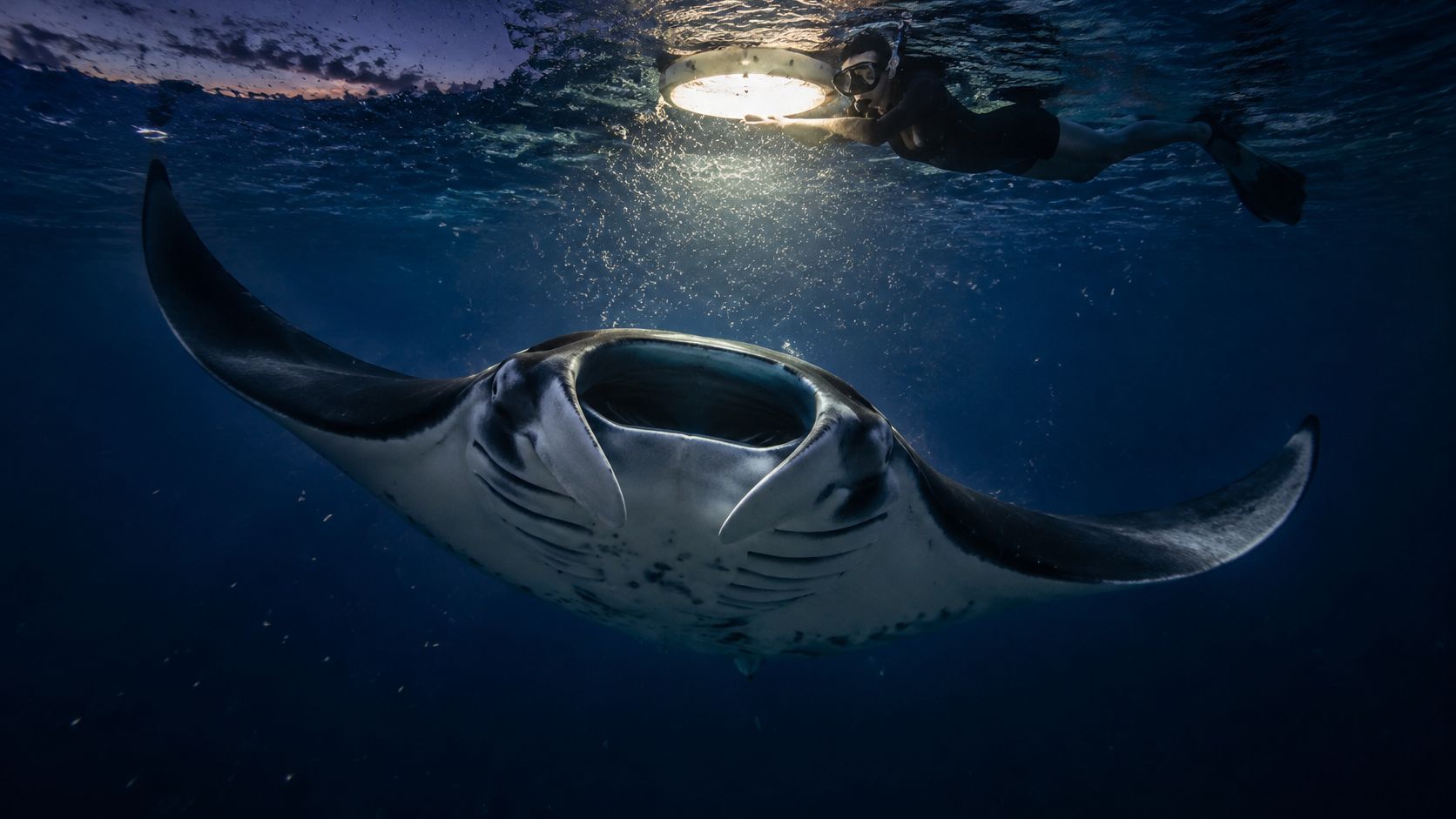
You're choosing an evening on the Big Island, and the idea sounds wonderful until you picture yourself floating over dark water. Then a white mouth turns upward through the lights, broad wings follow, and the question changes from “Will I be nervous?” to “How do I do this responsibly?” A manta ray Big Island night snorkel starts with choosing the right feeding site, understanding what wildlife can't promise, and making sure the water activity fits everyone in your group.
Kona Snorkel Trips is Hawaii's top-rated and most-reviewed snorkel company. We put swimming readiness and a clear briefing ahead of getting anyone into the water.
Where Big Island Mantas Show Up After Dark
Lights point down from the float. A pale mouth appears below, then the ray banks away into black water. Encounters like this happen at established Kona feeding sites, not at an arbitrary stretch of coastline.
Think of Kona as two feeding neighborhoods. Garden Eel Cove lies to the north and is commonly called Manta Heaven. Keauhou, south of Kailua-Kona near the hotel shoreline, is known as Manta Village.
Kona night sites for manta ray Big Island viewing
| Site | Local name | What the record shows | Choose it if you want |
|---|---|---|---|
| Garden Eel Cove, north Kona | Manta Heaven | Larger, more variable aggregations; males and females in similar numbers | A busier feeding neighborhood whose headcount can change substantially |
| Keauhou, south of Kailua-Kona | Manta Village | Smaller aggregations; predominantly females with strong site loyalty | The possibility of repeat visits by resident females near the hotel shore |
The comparison rests on more than traveler impressions. A University of Hawaiʻi study published in 2025 analyzed more than 23,000 sightings of 167 individually identified reef manta rays, Mobula alfredi, collected from 2010 through 2022 at these nighttime feeding sites.
Choose the neighborhood, not a promised headcount
Garden Eel Cove supported larger aggregations, with males and females appearing in broadly similar numbers. Keauhou's visitors were predominantly female, and females showed strong loyalty to that feeding area. Researchers also documented movement between the locations, particularly among males.
Those patterns describe repeated use over time. They don't tell a captain exactly which animals will arrive tonight, or whether the next boat will see the same activity as the previous one.
At Garden Eel Cove, favor the possibility of a larger gathering without treating a busy night as standard. At Keauhou, appreciate the resident-neighborhood character without assuming a smaller aggregation means a lesser encounter. A ray making a slow turn beneath your position can be compelling without a crowd of animals behind it.
Practical rule: Choose the trip that fits your group's comfort and logistics. Don't choose solely by a claimed manta count.
These are nighttime feeding visits
Neither location should be treated as an invitation to swim out from a beach independently. Our guided visits explore Garden Eel Cove or the area in front of the Keauhou hotel, with the encounter taking place after dark.
The guide to where to see manta rays on the Big Island can help you place the sites within your itinerary. Keep the distinction between the departure harbor and the feeding location clear when planning your drive.
Month is a weak way to choose between these neighborhoods. Food availability matters more to the evening's headcount, so the useful question isn't which site always wins. It's which trip lets your group watch comfortably while leaving the animals room to feed.
What Lights Plankton and Weather Decide
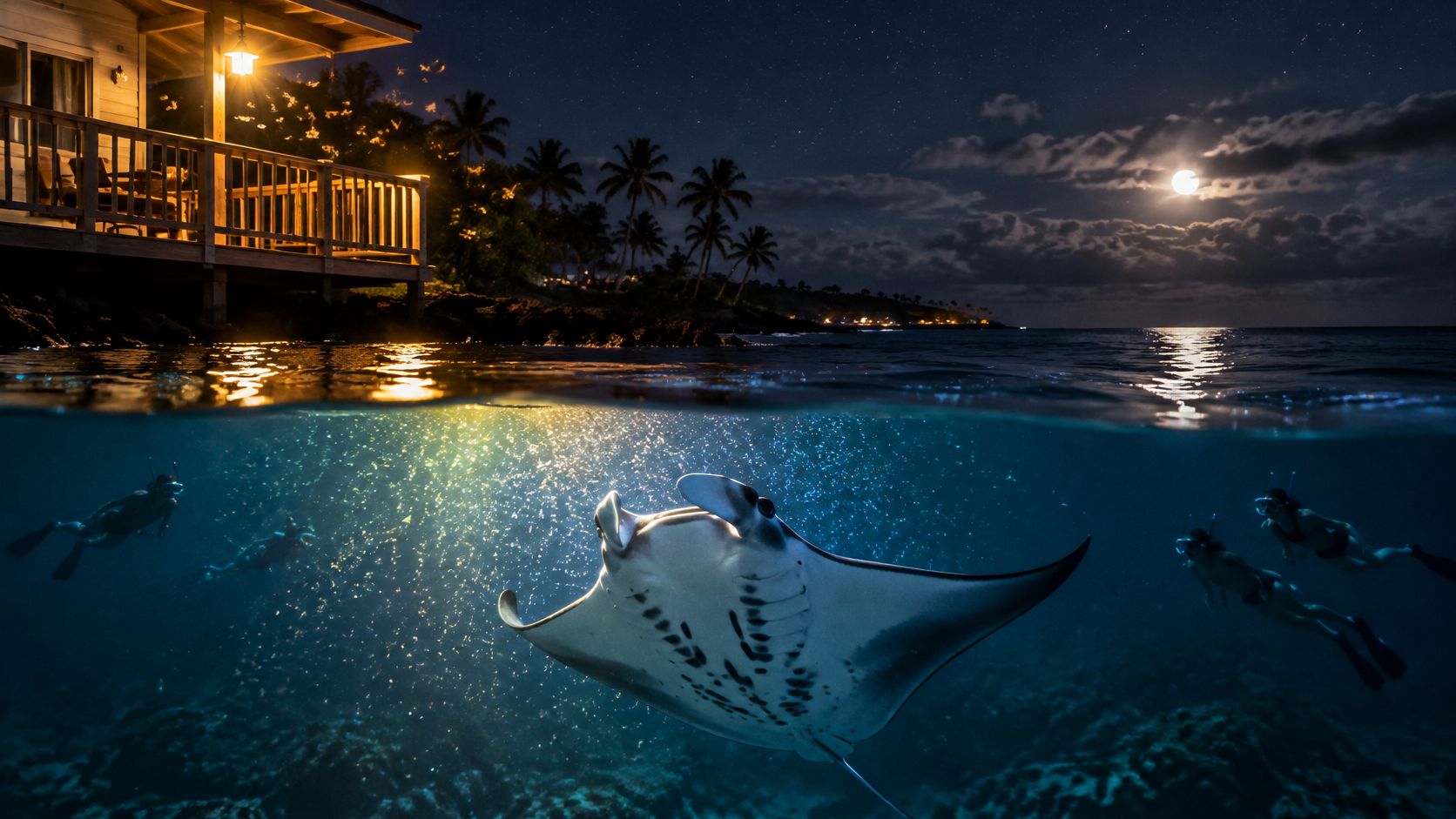
A porch lamp gathering moths offers a useful starting image, but there's an important correction: the mantas aren't chasing the bulb. Artificial light concentrates zooplankton near the illuminated water, and the rays follow that food.
The feeding mechanism is described in this Kona manta-ray guide: reef mantas use ram filtration, swimming with their mouths open so plankton-rich water passes across their gill rakers. Those filtering structures retain food while water flows through.
Why the rays keep circling
A feeding manta may pass beneath the lights, bank, and return along a similar route. That repeated circuit isn't a performance arranged for the float. The animal is moving through a patch of food.
The distinction matters when a ray approaches. Reaching down, lowering your feet, or swimming across its route doesn't improve the encounter. It puts an obstacle into the animal's feeding lane.
Size can surprise first-timers. Hawaiʻi's Department of Land and Natural Resources manta-ray profile describes wingspans reaching 22 feet or more, an upper-size reference rather than a prediction for the animal you'll meet. Even a smaller ray can extend well beyond the central body you first notice.
Watch the entire outline, including the wings and the head fins beside the mouth. A body that appears clear of your position may still have a wing moving toward you.
A familiar site can produce very different nights
The long-term study of Kona's nighttime aggregations found that aggregation size was positively associated with zooplankton density. In plain language, more available prey was associated with more mantas gathering.
That explains why a familiar location and an unchanged lighting routine can produce different encounters. The crew can prepare the viewing area, but it can't manufacture the surrounding biological conditions.
Consider two hypothetical evenings. On one, a known female makes several close passes, then feeds beyond the brightest water. On another, a group loops beneath the float for much of the session. Both are wildlife encounters, but only the latter resembles the busiest promotional footage.
The camera usually records the most dramatic moment. It doesn't show how long the photographer waited or how many quieter evenings preceded it.
Seeing a resident manta feed is a successful wildlife encounter. A large aggregation is a possibility, not the admission standard.
Timing involves more than the calendar
Manta rays are seen year round, with no pattern in their appearance based on the month. There isn't a special calendar window that removes the uncertainty.
Weather and ocean conditions still matter. Swell influences surface comfort and whether a trip can operate responsibly; water clarity affects what you can see. Currents and changing prey conditions can also make food available somewhere other than directly beneath the board.
Keep those questions separate when booking:
- Wildlife conditions: Will mantas choose to feed in the illuminated area?
- Viewing conditions: Will you be able to see their passes clearly?
- Operating conditions: Can the crew conduct the activity safely?
The explanation of how manta rays find plankton in the dark helps connect the lights to the feeding behavior without turning that mechanism into a guarantee.
Persistent feeding around tourism also doesn't prove that tourism has no ecological effect. Scientific discussion includes concerns about altered plankton availability at viewing areas, so the responsible conclusion is continued care, not automatic reassurance.
An operator can promise a briefing, appropriate equipment, and a stated procedure. It can't promise the number of animals, the duration of their visit, or how closely they'll pass.
How a Manta Night Snorkel Unfolds
A little rehearsal makes the unfamiliar parts less intimidating. You don't need to know exactly when a manta will arrive, but you should know what you'll do from check-in until you climb back aboard.
Before you leave shore
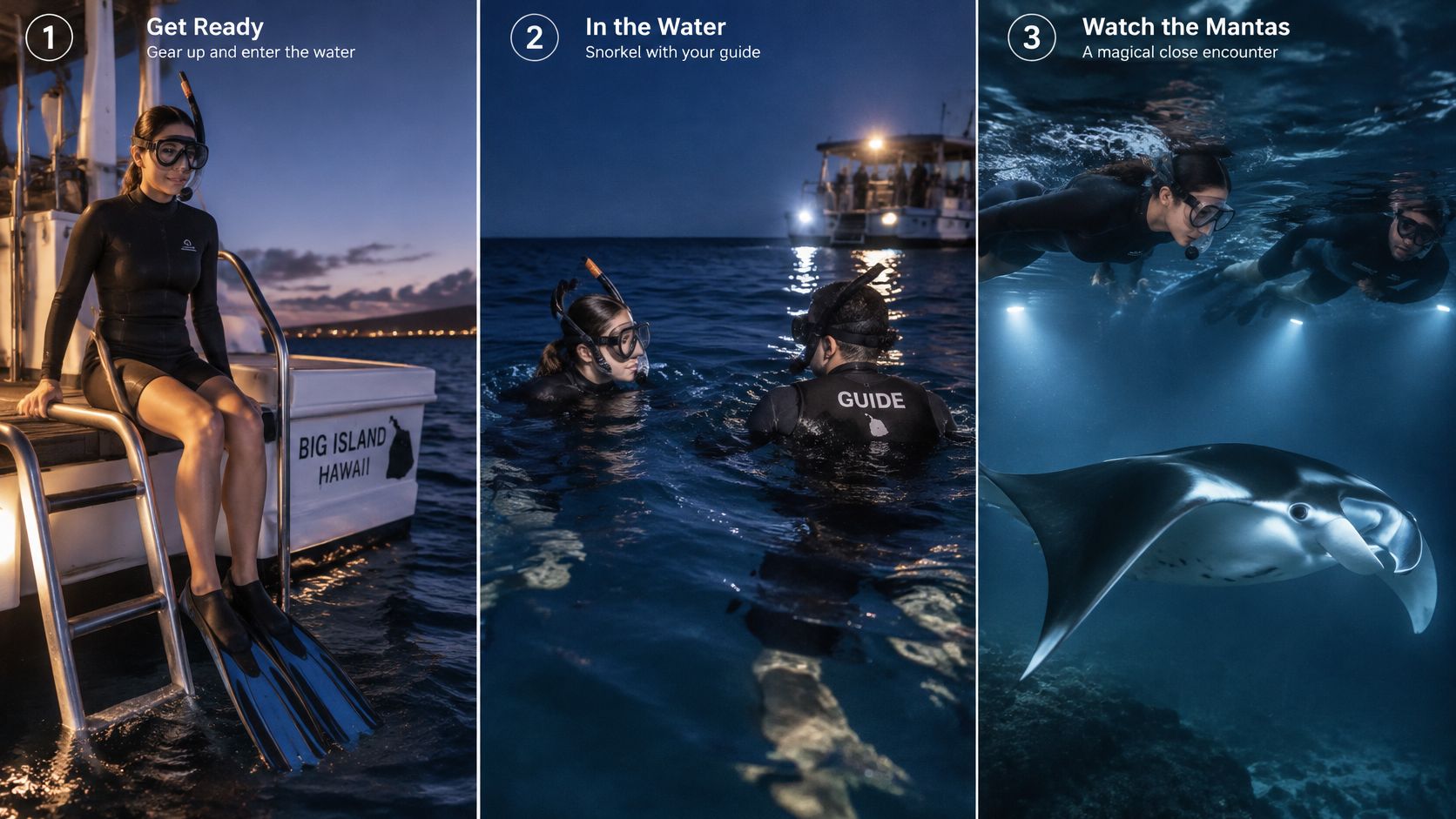
Check your swimming readiness. For our manta snorkel, you should be able to swim 50 yards without additional flotation and already have snorkeling experience at an intermediate level. A float helps organize the encounter; it doesn't turn open ocean into a swimming lesson.
Pack for the return ride as well as the water. Bring a towel, a zip-up jacket, and a GoPro if you want photographs. Put dry items where they'll stay dry, and secure the camera so you won't be tempted to chase it if it slips.
Use check-in to solve small problems. Get your fitted mask comfortable before departure. Tell the crew about a leaking seal, uncertainty about breathing through the snorkel, or nerves that might affect your entry.
The briefing should make the activity easier to picture: how you'll enter, where you'll hold the board, what an approaching ray may look like, and how the crew will signal you. Ask your question while everyone is still dry.
At the feeding area
The boat travels to Garden Eel Cove or the Keauhou hotel shoreline, and the water entry happens after dark. Listen for the crew's directions rather than moving toward another group's lights.
Enter, settle, and hold your position. Guests have 30 to 40 minutes in the water. We use flotation belts to keep hips and feet raised, reducing the chance of kicking a feeding manta. Keep your elbows clear if a ray rises close beneath you, and resist the urge to reach toward its belly.
Watch the feeding circuits instead of following an animal away from the group. When the crew ends the session, follow the exit instructions and take your time boarding.
A quiet start doesn't mean you need to do something to attract a ray. Stay settled and let the crew manage the group.
For nervous first-timers: Tell the guide before entry, not after you're struggling. Clear instructions and a deliberate start help more than pretending you're comfortable.
It's normal for the first view into dark water to feel unfamiliar. The goal isn't to suppress every flutter of nerves; it's to remain able to breathe calmly, follow directions, and communicate. If you can't do those things comfortably, staying out is the right decision.
Stay Safe When Boats Share the Dark Water
Boat traffic deserves more attention than fear of the ray. Mantas are filter feeders without a stinging barb. For surface swimmers, the sharper practical concern is the combination of bright viewing lights, surrounding darkness, and moving vessels whose crews may struggle to see people.
A Hawaiʻi County boating-operations and safety assessment found that permits didn't impose activity-specific requirements for participant capacity, lighting, propeller guards, medical equipment, or nighttime swimmer visibility; the assessment also described reporting of boats passing 10 to 20 feet from unlit snorkelers.
That finding isn't a statement that every trip is unsafe. It means a permit isn't a complete safety plan, and families should evaluate the actual procedures.
Make visibility and supervision concrete
Stay with the illuminated float where the crew expects you. Don't drift away to improve a photograph or swim toward another boat's light.
Our crew guides guests in the water. When comparing trips, ask operators to explain their swimmer-visibility arrangements, how they separate entering guests from vessel movement, and what happens if someone panics or loses contact with the float.
Useful answers describe actions, not reassurance:
- Lost contact: Who retrieves a guest, and what should that person do while waiting?
- Distress: How does a swimmer signal for help without leaving the group?
- Supervision: Who watches the water while other crew members help someone board?
Choose the water option that fits
Who should join which water option
| Option | Who it suits | Confirm before booking |
|---|---|---|
| Supervised night snorkel | Comfortable intermediate snorkelers | Guide in the water, lit float, and swimmer visibility plan |
| Boat-only night look | Weak swimmers and people anxious in open water | Viewing from the deck with no entry |
| Daytime snorkel | Young children without a clear night supervision plan | Daytime conditions and a guide-to-guest ratio |
A daytime trip isn't automatically suitable for every child. Discuss swimming ability and supervision before choosing an activity.
Our manta charter doesn't permit ride-alongs, although ride-alongs are available on our daytime tours. A boat-only nighttime look therefore requires a different operator that explicitly offers that option.
Wildlife etiquette supports safety too. Remain still, never touch or chase, and leave the animal an unobstructed route. The manta snorkeling rules that protect wildlife and guests make these boundaries practical rather than merely polite.
This is a nighttime open-ocean activity. Treat the swimming standard as an entry requirement, not a challenge to overcome once you arrive.
How Kona Mantas Became a Nightly Gathering
Kona's viewing tradition began with people trying to illuminate a worksite, not arrange a wildlife attraction. During shoreline resort construction in the 1970s, floodlights kept the Keauhou work area bright after sunset, concentrating plankton and drawing reef mantas to feed, as documented in Hawaiʻi's legislative testimony on manta protection.
Repeated meals became repeated encounters. Eventually, people began organizing visits around the feeding activity.
From accidental attraction to protected wildlife
Hawaiʻi prohibited killing or capturing manta rays in 2009. Testimony from that year recorded 154 rays identified along the Kona coast since 1992, including 106 documented through 2007, and 30 newly identified pups from 1994 through 2007.
The testimony cautioned that the resident population probably numbered fewer than 200 animals, with no formal mark-recapture estimate completed at that time. Those historical figures belong to their monitoring periods; they aren't a current census.
Likewise, later photo-identification totals describe animals recorded in a particular study, not an unlimited supply of mantas available to tourism. Different periods and methods shouldn't be combined into a simple population-growth calculation.
A recurring encounter can feel dependable to a visitor while still involving a small community of individual animals.
Stewardship starts with how people behave
The history creates a responsibility. People changed where food concentrated, built a viewing tradition around it, and now need to manage their presence carefully.
A familiar feeding location doesn't make the animals domesticated. A ray that returns regularly still needs room to turn, leave, and choose another feeding route.
For visitors, stewardship is tangible:
- Listen before entry: Understand where your body and equipment should stay.
- Keep the route open: Don't turn a feeding pass into an obstacle course.
- Accept the animal's choice: A ray moving away isn't a reason to follow it.
The enduring appeal of Kona's manta encounter comes from watching wild animals do something purposeful. Keeping people off the rays and out of their routes helps preserve that distinction.
Manta Ray Night Snorkel FAQ
Can I see manta rays from the boat without getting in?
Yes, some operators offer boat-only viewing of the illuminated feeding area. The angle and visibility differ from an in-water view, and our manta charter doesn't allow ride-alongs, so choose a trip that explicitly accommodates deck-only guests.
What time does the night snorkel start?
Water entry happens after dark. The early departure includes sunset from the boat, while the later departure begins with nighttime check-in; use the booking details for your date rather than assuming a fixed clock time.
Are manta rays seen every night?
No individual evening is guaranteed. Year-round presence means there isn't a manta-only travel season, not that every boat will encounter animals or see the same level of activity.
Is it safe for children?
Children need to meet the swimming and snorkeling requirements and have a clear supervision plan. Being enthusiastic about wildlife doesn't substitute for being comfortable in open water. Choose a suitable daytime activity if the nighttime setting exceeds the child's readiness.
Do I need my own snorkel gear?
You'll receive a fitted mask at check-in, and we provide wetsuits for the manta activity. Bring your towel and zip-up jacket for afterward. If you use specialized equipment, resolve compatibility questions before departure.
Can I touch the rays?
No. Keep your hands to yourself, don't pursue an animal, and leave its swimming route clear. If a ray approaches closely, remain composed and follow the guide's positioning instructions rather than reaching toward it.
Pick Your Departure and Check Availability
Choose the early departure if daylight check-in, gear fitting before dark, and sunset from the boat will help your group settle in. Choose the late departure if you're pairing the evening with a daytime activity and won't feel rushed arriving for nighttime check-in.
The Big Island Manta Ray Night Snorkel lasts two hours in Kona. It's the most popular tour on the island, which is why we offer two tour times.
Match the departure to your group
The early trip offers a gentler visual transition from shore to sunset to dark water. That can be appealing when the ocean setting is unfamiliar, although it doesn't change the swimming requirement.
The late trip can fit a fuller daytime itinerary. Leave enough breathing room to eat, travel, park, and arrive ready to listen rather than hurrying from another commitment.
Use these booking priorities in order:
- Readiness first: Everyone entering the water should meet the swim standard.
- Schedule second: Choose the check-in that lets your group arrive calm and prepared.
- Expectations third: Look forward to a wildlife encounter without requiring a particular photograph.
The Kona Snorkel Trips manta ray snorkel page has the trip details and departure choices. Manta Ray Night Snorkel Hawaii is an exceptional alternative when comparing manta ray night snorkel tours; explore its night-snorkel options alongside your group's needs.
Book for the experience you can enjoy
The guide to choosing the right Kona manta ray snorkel tour can help you compare practical differences without relying on spectacular photographs alone. Favor a briefing that treats mantas as wildlife and gives guests clear responsibilities.
Conditions can change, so keep some flexibility in your evening plans. Book the night that fits your group, then let plankton decide the rest.
Kona Snorkel Trips offers small-group manta night snorkeling with lifeguard-certified guides, illuminated snorkel boards, and a crew focused on preparation and respectful wildlife viewing. Visit Kona Snorkel Trips to choose your departure and plan an evening that matches your group's swimming ability and comfort in the ocean.