
Kona Manta Ray Night Dive: What to Expect in 2026
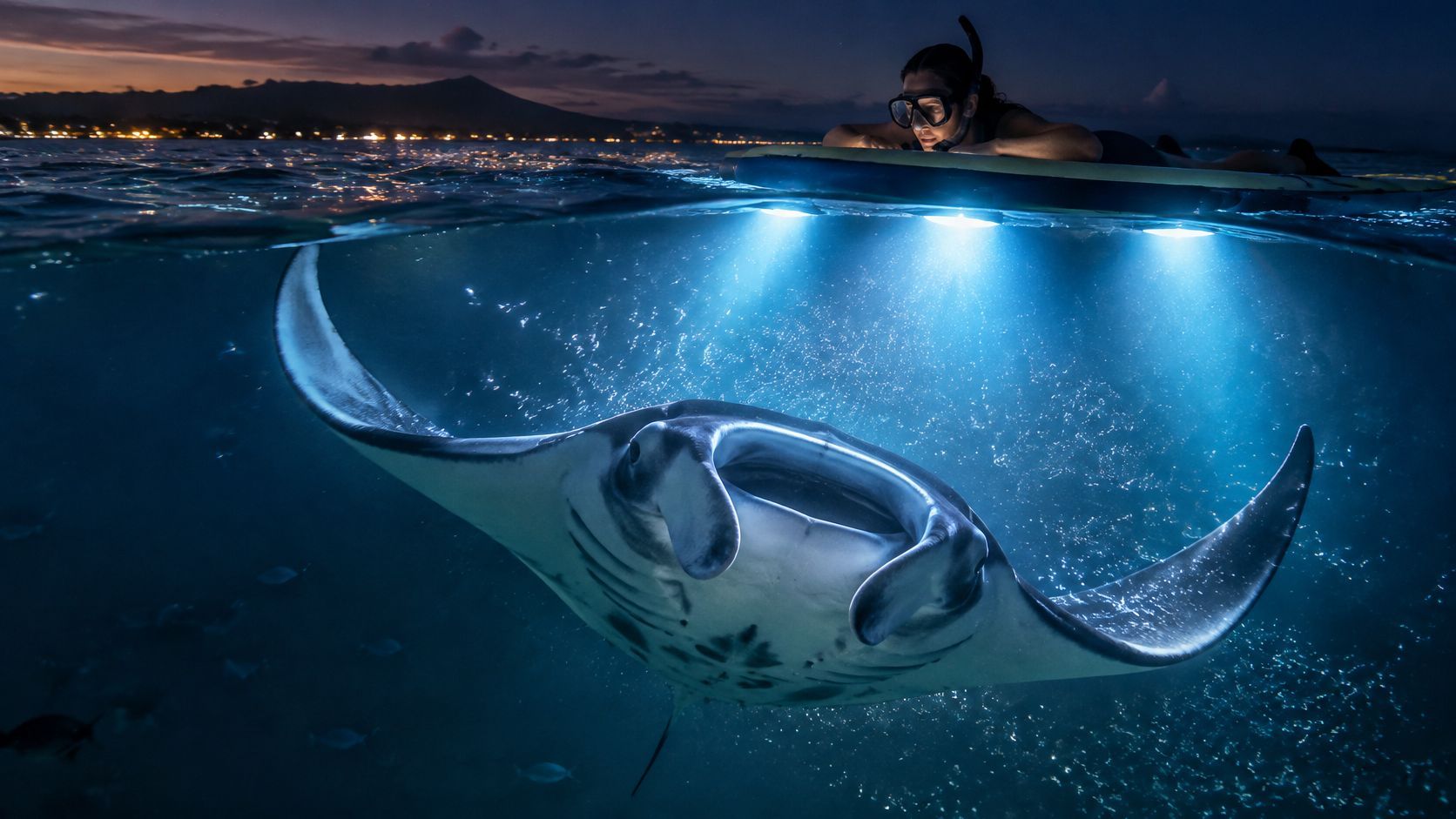
You're comparing Kona tours late at night, half decided and half nervous. The photos look incredible, but you can't tell if you'll be diving deep, floating in the dark, or pressuring the animals just by showing up. A Kona manta ray night dive is simpler than the name suggests, and judging it well means asking two questions, not one. Will mantas appear, and what does the night ask of them?
Kona Manta Ray Night Dive at a Glance
You lie flat on the surface after dark, face in the water, holding a floating board. Bright lights shine down into the black water below you. Then a wide, silent shape rises out of the dark, mouth open, and loops directly beneath the board before turning and coming back again.
Despite the name, this is a snorkel, not a tank dive. You don't need certification, you don't descend, and you stay at the surface the whole time. That distinction matters because it changes who can join, how the crew positions you, and how close the rays can choose to come.
Demand is large. A 2025 report on Kona manta experiences estimated that up to 80,000 people participated annually in manta-ray night snorkeling and diving experiences in Kailua-Kona during 2024–2025. The manta trip is the most popular tour on the island, which is why two tour times are offered. Check the manta ray snorkel tour page for the current schedule and availability.
Kona Snorkel Trips is the top rated and most reviewed snorkel company in Hawaii, backed by thousands of customer reviews.
Manta Night Snorkel Key Details
| Detail | What to Know |
|---|---|
| Trip length | 2 hours in total |
| Time in the water | 30-40 minutes |
| Lighting | Custom-built snorkel board with high-powered lights |
| Sightings | Year round, with no pattern by month |
| Departure point | 74-381 Kealakehe Parkway, Kailua-Kona, HI 96740 |
Before you book, check the basic fit. You're signing up for a two-hour, after-dark, surface-only outing in open ocean. If that excites you more than it worries you, you're looking at the right trip.
How Mantas Find the Lights at Night
Think of the light as a dinner bell, not a magnet for mantas. The board's high-powered lights create a bright patch of water, and tiny drifting animals called zooplankton gather in it. Mantas don't come for the light itself. They come because their food is concentrated there.
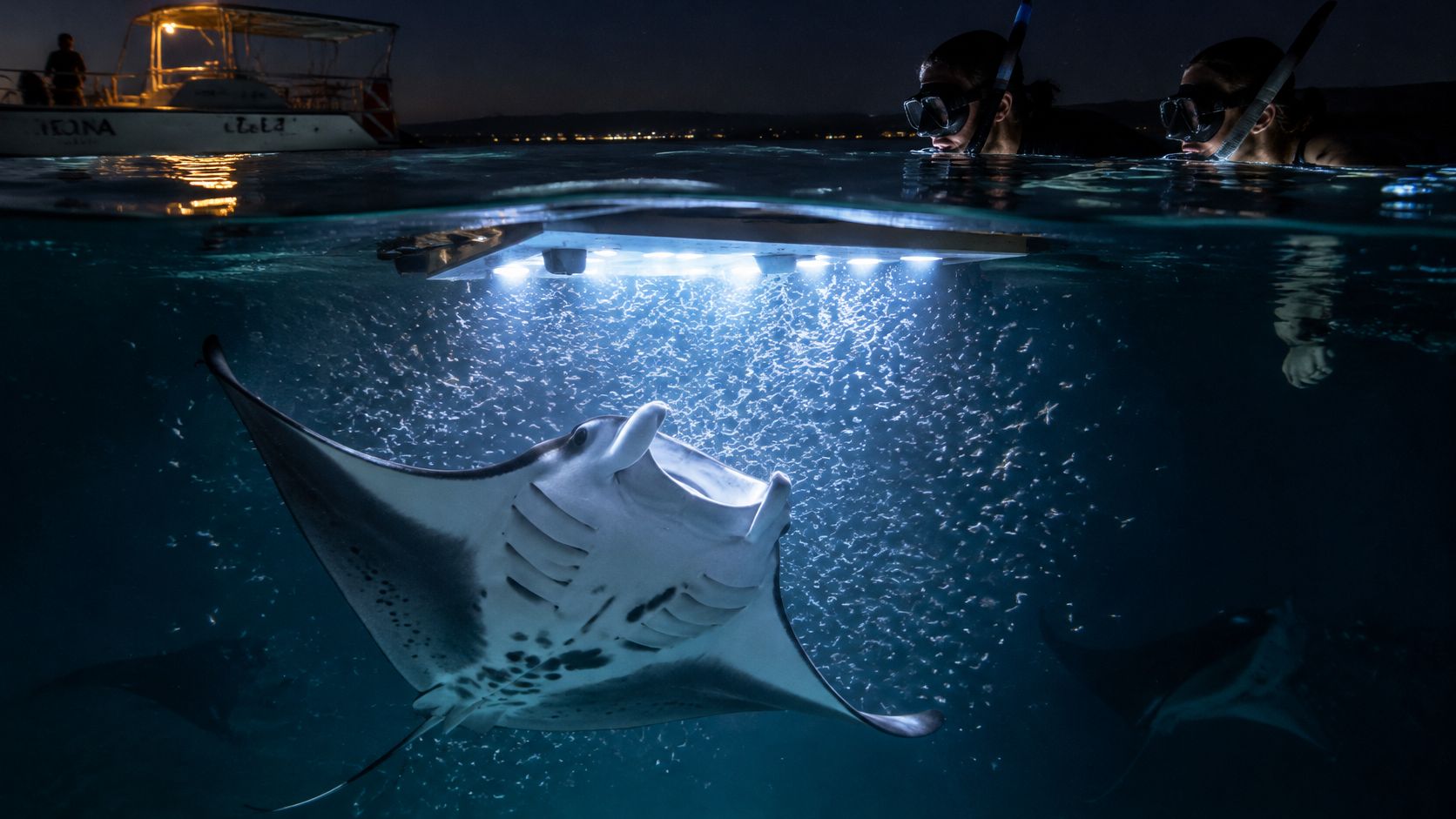
Mantas are filter feeders. A ray glides into the bright patch with its mouth open, takes in plankton-rich water, and filters the food out as the water passes through. It has no interest in you, your fins, or the board beyond the meal swirling underneath them.
What a Feeding Pass Looks Like
A manta typically loops just beneath the board, sometimes passing within arm's reach, then circles back for another pass. Because the food stays in one place, a feeding ray often repeats the same route again and again. You hold still and float. The ray does the moving.
The key idea: Lights gather food. They don't summon mantas, steer them, or make them stay.
Two sites host most encounters. Garden Eel Cove, also called Makako Bay, sits to the north, while the coast in front of Keauhou, often called Manta Village, sits to the south. We explore Garden Eel Cove or the area in front of the Keauhou hotel, depending on the night.
These aren't lucky one-off sightings. A NOAA-hosted study of the Kona sites recorded 25,444 observations of 118 individually identified reef manta rays from 2009 through 2014, with sightings on 92% of monitored nights at Manta Heaven and 78% at Manta Village. Resident rays return to predictable feeding spots, which is why encounters are common. Our guide to why lights attract plankton and mantas at night explains the mechanism in more detail.
Still, the animals decide whether to enter the light, circle, or leave. Food density on the night is what separates a busy feeding session from a quiet float.
Timeline From Check-In to Lights Out
The evening runs in a set order, and each step exists for a reason. Knowing the sequence removes most first-night nerves, because nothing in the water is improvised.
Before You Get Wet
- Check in at the departure point. The early trip checks in during daylight, while the late trip checks in at night, so your arrival experience differs by departure.
- Watch the sunset from the boat. On the early trip, you ride out in the light and enter the water after dark, which gives nervous guests time to settle in.
- Get fitted and briefed. The crew fits your mask and flotation belt, then explains the rays, the board, and the rules while you can still ask questions face to face.
On the Mooring and in the Water
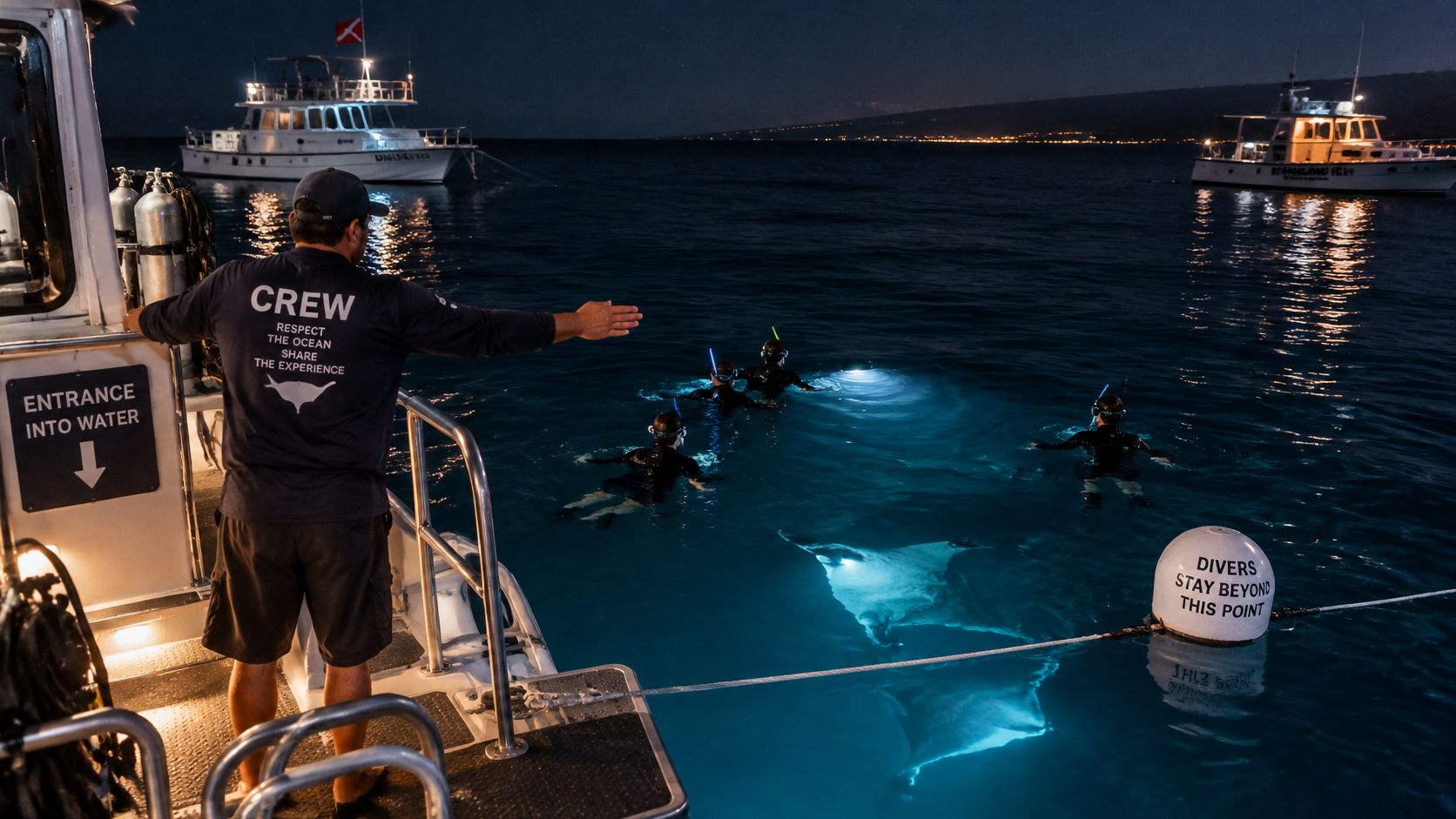
- Tie up at a commercial mooring. Hawaiʻi state management documents specify that manta-viewing operations during designated viewing hours, from 4:00 p.m. to 4:00 a.m., must be conducted from a commercial mooring, with live boating limited to ingress and egress and rafting prohibited. Fixed moorings keep boats from drifting over swimmers and reduce congestion where everyone clusters.
- Enter the water after dark. You slip in beside the illuminated board and stay with your guide, so the group forms one predictable, visible unit.
- Float for 30-40 minutes. The lights stay steady rather than sweeping around, because a stable patch of plankton lets rays settle into repeated feeding passes.
- Climb back aboard and head in. The crew reviews what you saw on the ride to the harbour, and the whole outing takes about two hours.
Arrive with your swimsuit on and your questions ready. The first few minutes move quickly once fitting starts.
Our step-by-step manta night timeline walks through the same sequence with departure-specific detail. Plan to arrive unhurried, because late check-ins compress the briefing you need.
Safety Rules That Keep Swimmers and Rays Apart
A manta encounter depends on people, boats, and rays sharing a small area at night. A marine-risk assessment of Hawaii manta-viewing operations identified a live vessel or propeller striking a swimmer, snorkeler, diver, or manta as the most severe hazard. Anchors and collisions between boats also create risks. Clear procedures matter because swimmers are harder to see after dark.
What a Responsible Operator Should Control
Use these standards when comparing operators. Ask how each one handles them, rather than assuming every boat follows the same procedures.
- Mooring and boat position: Ask how the operator keeps boats and anchor lines clear of swimmers.
- A defined swimmer area: Guests should know where to stay, and the group should be easy for the crew and nearby boats to locate.
- Propulsion before water entry: Ask what happens to the vessel's propulsion while guests enter and remain in the water.
- Surface supervision: Find out how the crew monitors swimmers and responds if someone drifts away from the group.
- A clear gathering point: Guests should know where to stay during the encounter and how to return to the boat.
What You Control
On the manta tour, all guests wear flotation belts to help keep their hips and feet up, away from the rays' feeding path. The belt supports your position at the surface; calm movement helps you maintain it.
- Float steadily: Stay flat at the surface and let the belt support you.
- Kick only as needed: Small, controlled fin movements help you reposition without startling nearby rays.
- Do not touch or chase: Keep your hands on the board and let each manta choose its distance.
- Stay off the bottom: Avoiding the seafloor and reef helps protect the habitat.
Follow the crew's instructions throughout the encounter. If something is unclear, stop moving and ask before changing position.
Protecting Kona's Manta Rays on Every Night
Manta rays in Hawaiʻi are wildlife that state guidance asks people to approach with care. Keep your distance and avoid disturbing any animal you encounter, as Hawaiʻi Division of Boating and Ocean Recreation guidance on protecting marine species advises. If an animal is accidentally hooked, release it in a way that minimizes injury to both the animal and you. The guidance also provides a number for reporting sightings and encounters: 1-888-256-9840, option 5.
A memorable sighting does not, by itself, show that an encounter has low impact. Mantas returning to a site means they are finding a feeding opportunity there. It does not establish how boats, lights, or crowds affect them. A busy night can still raise questions about how the experience is managed.
An Operator-Neutral Checklist
Use these questions to judge any manta experience, not just by whether rays appear, but by what the encounter asks of the animals and reef:
- Group and vessel capacity: Is the group size suited to the viewing site?
- No-touch enforcement: Does the crew actively enforce the rule during the encounter?
- Snorkeler position: Do guests remain at the surface throughout?
- Light placement: Where are the lights positioned in relation to resting areas?
- Reef avoidance: How does the crew keep the group clear of coral and reef?
- Crowding response: What does the crew do when the site becomes busy?
Ask these questions before booking, then compare the answers with this guide to snorkeling rules that protect wildlife and guests. Clear answers help you assess the encounter beyond the chance of seeing a manta.
When to Go and What a Quiet Night Means
A night with fewer rays can still reveal how the encounter works. Consider three separate things: whether a manta appears, how many gather, and how long they stay nearby. A sighting answers only the first; the other two depend partly on conditions the crew cannot control.
Research on Kona manta sightings has found that aggregation size tracks zooplankton density. It also describes different site-use patterns at Keauhou and Garden Eel Cove. When plankton is sparse, fewer rays may gather or their visits may be shorter. Brighter lights cannot make mantas feed.
The calendar offers little certainty. Mantas are seen year round, with no pattern in their appearance by month, so choose a date that fits your schedule rather than counting on a particular season. For a closer look at timing, see this guide to quiet nights for a Kona manta ray night snorkel.
Factors That Change a Night
| Factor | Effect on the Night | How to Plan |
|---|---|---|
| Zooplankton density | Influences how many mantas gather and how long they feed | Allow for a quiet encounter, and keep your expectations flexible |
| Month or season | Mantas are seen year round, with no monthly pattern | Choose a date that fits your schedule |
| Weather and water conditions | Rough conditions can affect comfort and visibility, or lead to cancellation | Ask the operator about conditions on the day |
| Crowding and capacity | More people at a viewing site can affect the experience | Ask how the operator handles crowding |
| Animal choice | Mantas decide whether to approach and how long to stay | Treat the encounter as wildlife observation, not a performance |
A quiet night is part of the range of possible wildlife encounters. Book early in your trip if you can, leave a backup evening free, and check conditions on the day.
What to Pack and How to Photograph the Rays
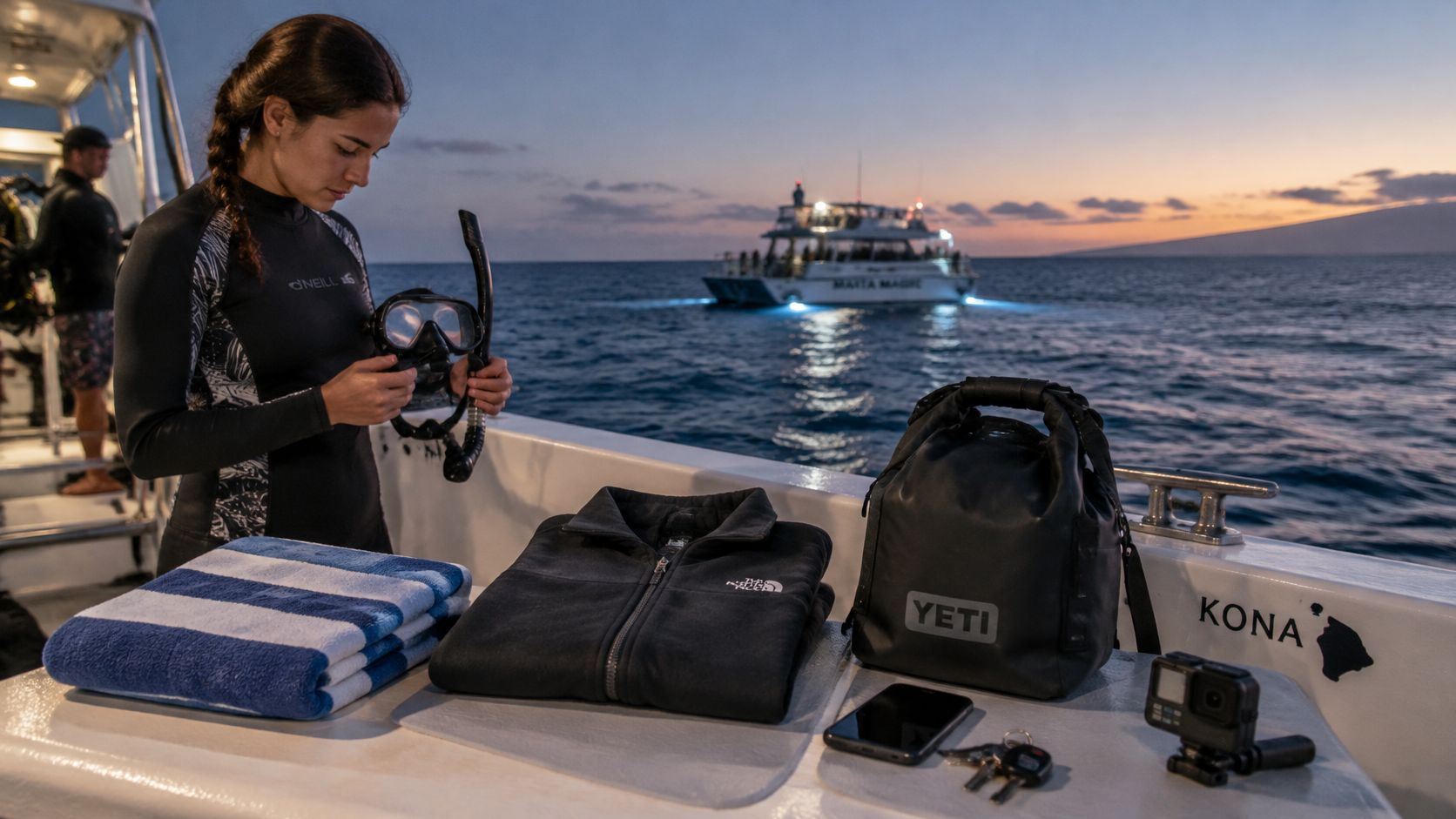
Pack light, because the boat ride is short and storage is limited. Recommended items for the manta night snorkel are a towel, a zip-up jacket, and a GoPro if you want footage.
- Towel: You'll want it the moment you climb out of the water.
- Zip-up jacket: Night air on wet skin feels cold on the ride back, even in Kona.
- GoPro or similar camera: Charged, with space on the card, checked before you leave.
- Dry bag: Keeps your phone, keys, and wallet safe from spray and wet gear.
- Reef-safe sunscreen: Apply it before you leave the dock so less washes onto the reef.
Getting Usable Footage
Secure the camera to your wrist so both hands stay free for the board. Use the board's lights for exposure instead of adding your own light near the rays, since the illuminated patch is already the brightest, most even light in the scene.
Hold still and let the rays approach. Moving toward a manta pushes it off its feeding line, and you'll get a blurry departure instead of a clean pass. Shoot wide to capture the full span of the animal, and set your camera's low-light mode before the trip, not in the dark with wet hands.
The best footage comes from the calmest floater in the group.
A missed shot costs you one clip. Disturbing a feeding ray costs everyone the rest of the pass.
Manta Night Snorkel FAQs
Do I Need a Certification
No. This is a surface snorkel on an illuminated board, so no certification is required. You float rather than descend for the entire encounter.
Can I Touch the Rays
No. Keep your hands on the board, don't touch or chase a ray, and stay beside the board or your guide. The rays set the distance.
Will I Definitely See Mantas
No, and any honest answer says so. The rays decide whether to approach and stay, and how many gather depends on zooplankton density that night. Resident animals make sightings common, never guaranteed.
Which Month Is Best
There's no best month. Sightings occur year round with no monthly pattern, so pick the date that fits your schedule and keep a backup evening.
Can I Bring My Own Light
Avoid adding your own light near the rays. The board's lights create the feeding patch and provide your exposure, and extra beams moving around disrupt the setup.
Is It Suitable for Non-Swimmers
Not without meeting the readiness test in the next section. This is nighttime open ocean, and the board doesn't replace basic swimming ability.
How Much Does It Cost
Rates change, so check the booking page for live pricing and availability before you set your budget. Confirm trip length and departure point at the same time.
Decide If You Are Ready and Book Your Night
Use this readiness test before you pay. You should be able to swim 50 yards without additional flotation, and you should have prior snorkeling experience as an intermediate snorkeler who's comfortable at the surface after dark. If either answer is no, get a daytime snorkel in first and build up.
Be accurate when you book. We may refuse service at our sole discretion, including for inaccurate swimming ability information, visible intoxication, disruptive or unsafe behaviour, late arrival, or not following crew instructions. Honest information at booking protects your evening as much as anyone else's.
Compare your options before you commit. Alongside our night snorkel, Manta Ray Night Snorkel Hawaii is an exceptional alternative when you're looking for a manta ray night snorkel tour. With either operator, confirm the details that matter most: trip length, time in the water, departure point, and the day's conditions.
Ready means: honest about your swimming, flexible on dates, and fine with the mantas deciding how the night goes.
Pick a flexible date early in your trip, pack the towel, jacket, and camera, and reserve your place while capped capacity still has room.
Kona Snorkel Trips runs small-group night snorkels where lifeguard-certified guides position you at an illuminated board while resident mantas feed below, with honest readiness standards and no-touch rules enforced in the water. If you can pass the swimming test and keep a flexible evening, visit Kona Snorkel Trips to pick your departure and reserve your night on the water.