
Kona Manta Ray Night Dive: The Complete Guide
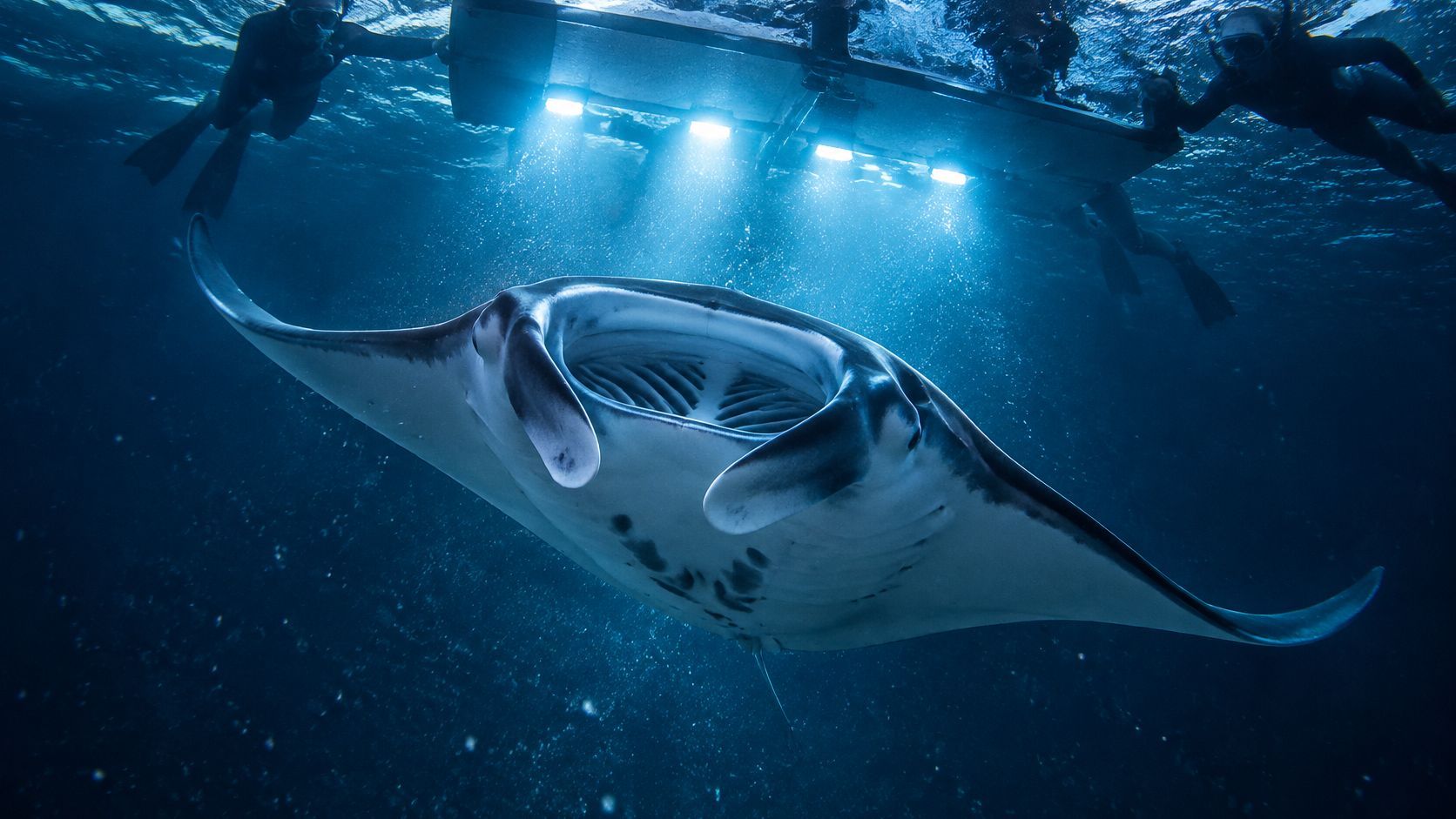
You're looking at a manta tour booking page, wondering whether floating in the ocean after dark will feel magical or just intimidating. Maybe you're comfortable swimming during the day but unsure about the darkness, the boat ladder, or how close the animals might come. A Kona manta ray night dive becomes much easier to picture once you understand what the crew does, what the mantas are doing, and what you'll be expected to do.
Kona Snorkel Trips is Hawaii's top-rated and most-reviewed snorkel company, offering a surface-based way to experience this nighttime encounter.
The Kona Manta Ray Night Dive Experience
The shoreline fades behind the boat. Once you're in position in the water, your attention narrows to the illuminated area below. A dark shape approaches the glow, turns, and reveals a pale underside before disappearing beyond the light.
That's the scene people hope for. The practical experience also includes fitting equipment, listening to instructions over boat noise, and deciding whether you feel comfortable entering the water. The preparation matters as much as the wildlife viewing.
A Different Experience From Daytime Snorkeling
During a daytime reef snorkel, you might move between coral formations and look for fish. At a manta encounter, the better approach is to accept a designated viewing position and let the animals move around the feeding area. You're watching a particular behavior rather than exploring a broad stretch of reef.
The phrase night dive can cause confusion because travelers sometimes use it for both scuba diving and surface snorkeling.
| Experience | Your perspective | What to consider |
|---|---|---|
| Surface snorkeling | Looking down into the illuminated water | Comfort breathing through a snorkel and managing surface movement |
| Scuba diving | Watching from below the feeding area | Diving experience, equipment control, and comfort underwater at night |
Neither perspective is automatically the right choice for everyone. Choose based on your actual comfort, not on which sounds more adventurous.
How Kona's Nighttime Attraction Began
Organized nighttime viewing began at Keauhou Bay in 1991, after an operator recognized the relationship between shoreline lighting, concentrated plankton, and feeding mantas. When the adjacent Kona Surf Hotel closed, the site experienced an interruption from 2000 to 2004; manta visits resumed after floodlights returned, according to Hawaii Ocean Watch's history of Kona's viewing sites.
That history helps explain why this isn't an aquarium-style performance. People created a predictable viewing opportunity around wild animals responding to available food.
The broader activity is substantial: more than 1 million people are estimated to snorkel or dive with mantas annually worldwide, generating approximately US$140 million in annual economic impact, according to research summarized in a Hawaii County record.
The memorable part isn't making an animal approach. It's recognizing that you're watching a wild animal feed, on its own terms.
How the Night Dive Works
The lights attract the food, not a trained animal. That distinction explains both the appeal of the experience and the limits of what an operator can promise.
Before the underwater encounter begins, the boat is where guests get organized and learn their roles.
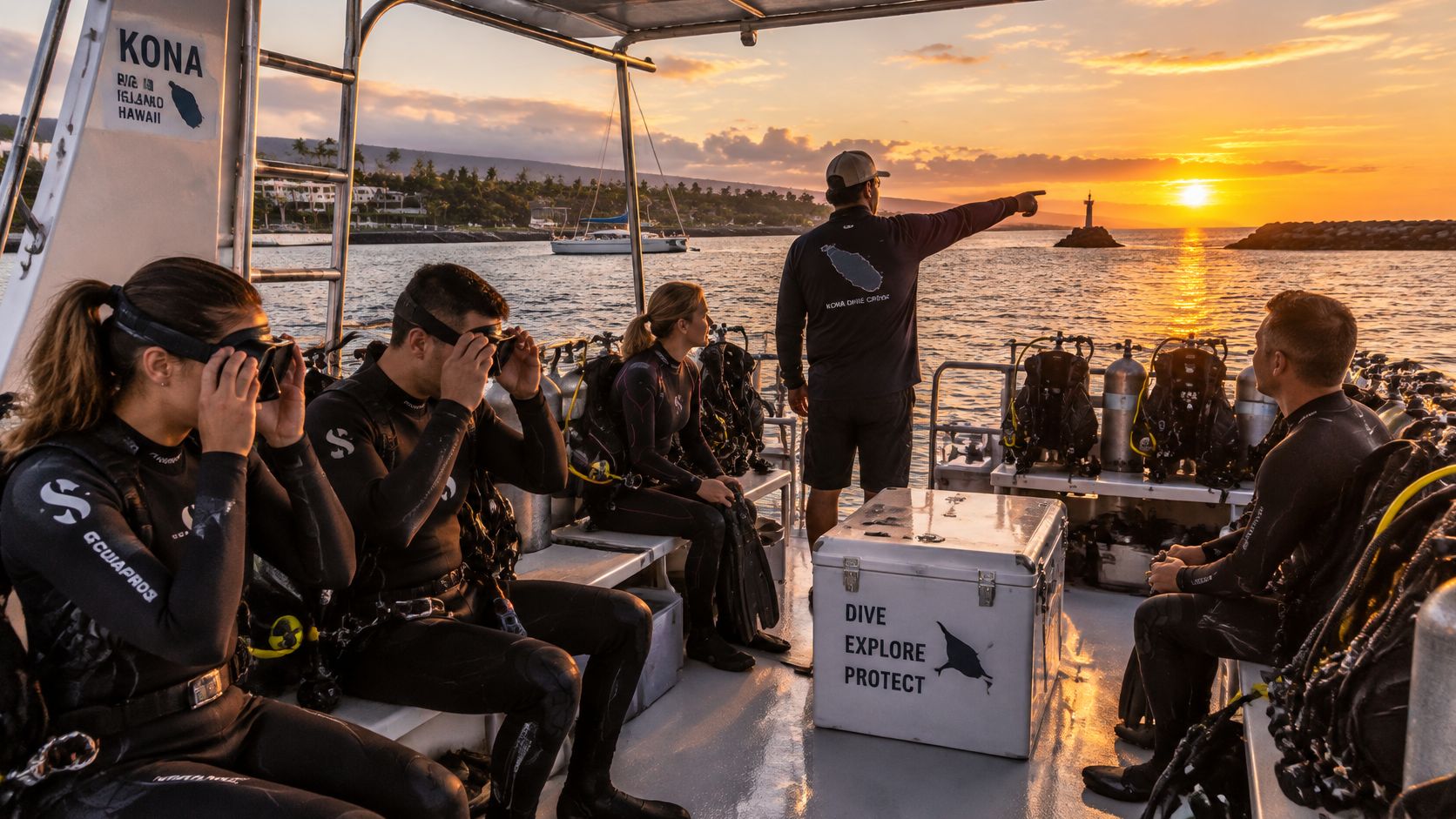
Follow the Food Chain
Think of the lighting as a dinner bell with an intermediate step. The mantas aren't arriving for the light itself. They're arriving for what gathers there.
- Light establishes the viewing area. Artificial illumination creates a localized bright patch in otherwise dark water.
- Zooplankton concentrate around that light. These tiny drifting animals become available in a dense feeding area.
- Mantas feed through the patch. The rays pass through the plankton-rich water to filter their food.
The Hawaii Department of Land and Natural Resources boating-safety assessment describes this light-plankton-manta relationship at the established viewing sites and states that commercial operators need a Commercial Use Permit for state ocean waters. This mechanism differs from offering food directly to the rays.
Human involvement still changes the encounter. Calling the animals wild doesn't mean the viewing setup has no influence on their feeding environment.
Why Everyone Has an Assigned Position
An organized light field and controlled guest movement help preserve a coherent feeding area. Marine research discussing manta feeding and nighttime behavior supports keeping swimmer turbulence low and maintaining predictable viewing boundaries.
Imagine a manta making a feeding pass toward the surface. A guest who suddenly kicks downward or extends a camera into its route changes the space available to the animal. Remaining still leaves that decision with the manta.
The positions also differ by activity. Established manta-viewing guidance hosted by NOAA instructs divers to direct lights upward from above their heads and snorkelers to direct lights downward while remaining at the surface. It recommends an in-water snorkel guide and a ring or comparable flotation device for groups of four or more.
Don't improvise your own lighting arrangement. Follow the crew's instructions for your position and equipment.
If you're still choosing your perspective, compare the practical differences in this Kona manta ray night snorkel versus night dive guide. The useful question isn't which gets you closer. It's which lets you remain comfortable and controlled.
What to Expect on the Water
Arrival should feel like preparation, not a rush toward the boat. Give yourself enough breathing room to ask questions, explain any concerns, and check that you understand the evening's sequence.
Confirm your operator's actual schedule before leaving for the harbor. Departure time, transit, equipment fitting, and water time aren't interchangeable.
From Check-In to Entering the Water
Use check-in to tell the crew something useful about you. “I'm comfortable swimming, but I haven't snorkeled at night” gives a guide more to work with than quietly hoping your nerves disappear.
During the briefing, listen especially carefully for the entry procedure, your assigned viewing location, the signal for assistance, and the return route. Before entering, you should understand how you'll get back aboard.
- At the boat: Check equipment fit and clarify what happens if you decide not to enter.
- At the site: Wait for the crew to establish the viewing arrangement rather than moving independently.
- At entry: Follow the sequence demonstrated by your guide and speak up if your mask, breathing, or confidence doesn't feel right.
- At the viewing position: Get settled before thinking about photographs.
Your first task is simple: establish comfortable breathing. You don't need to perform enthusiasm while you're still adjusting.
What the Encounter May Look Like
A NOAA-hosted study of Kona's established manta sites reported dives beginning immediately after sunset and lasting about one hour. During those observations, mantas approached divers to within less than 1 meter and generally remained within roughly 10 meters of the artificial lights.
Those are research observations, not a promise about your tour's duration or the distance an animal will choose. They also shouldn't be rewritten as a guaranteed close approach to snorkelers.
What you may notice first is movement at the edge of the light. As a ray enters the brighter area, its outline becomes easier to follow. Watching a repeated feeding pass can help you understand the route without trying to anticipate or intercept it.
Practical rule: If you're uncomfortable, signal early. You don't have to wait until discomfort becomes distress to ask for help.
The return to the boat deserves your full attention. Put the camera away, approach as directed, and wait for the crew's ladder instructions. Once aboard, get dry and warm before sorting through footage.
When to Go and What Affects Your Chances
Choose a workable evening, not a promised manta count. Encounter planning involves separate questions: whether mantas are feeding at the site and whether conditions are suitable for your group.
Those questions can have different answers. An evening with feeding activity may still be inappropriate for a guest who struggles with surface chop or reboarding.
What Long-Term Observations Tell Us
A 13-year dataset covering 2010–2022 recorded more than 23,000 sightings of 167 individually identified reef mantas across Garden Eel Cove and Keauhou. Aggregation size varied with zooplankton density; Garden Eel Cove generally supported larger groups, while Keauhou showed stronger female visitation and site fidelity, according to the University of Hawaii research record.
The practical lesson is that these locations aren't interchangeable stages. Local prey conditions and site-specific movements influence what happens.
Seasonality belongs in the conversation, but a calendar date alone can't establish the quality of an encounter. Likewise, don't choose a moon phase because someone promises it guarantees better feeding. Ask how an operator interprets current conditions rather than treating a lunar calendar as a booking formula.
Make a Conditions Decision Before Departure
Darkness, wind chop, swell, current, cold, boat traffic, and ladder access can make this different from a daytime reef outing. The relevant hazards are primarily operational, not manta aggression; mantas are filter feeders without the sting apparatus associated with stingrays, as discussed in this practical Kona night-snorkel guide.
| Situation | What to ask |
|---|---|
| Conditions look marginal before departure | What triggers cancellation, and when will I be notified? |
| Conditions change at the site | Can the captain relocate, shorten the encounter, or end water activities? |
| You're uncomfortable entering | May you remain aboard, and what does that experience involve? |
| No mantas appear | Is there a rebooking policy, and what restrictions apply? |
There's no universal threshold that a visitor should substitute for the captain's judgment. There should, however, be a clear explanation of the decision process.
For itinerary planning, consult the guide to the best time to see manta rays in Kona. If your schedule allows flexibility, avoid making this an activity you can only attempt immediately before leaving the island.
How to Prepare and What to Pack
Preparation starts with an honest description of your abilities. Being happy in a swimming pool isn't the same as feeling comfortable with a mask on your face while the ocean moves beneath you.
Flotation is support, not a replacement for meeting the operator's swimming requirements. If you're a non-swimmer, have limited mobility, or become anxious with your face submerged, discuss that before purchasing a ticket.
Check Readiness Before Packing
Ask whether you'll need to move between the boat and the viewing device, how guides supervise that movement, and what assistance is available. For a child, describe their actual ocean experience rather than relying only on age.
Ladder access deserves a specific conversation. If climbing back aboard may be difficult, ask about the vessel's setup and whether a boat-only option is available. Don't assume every boat can accommodate every mobility need.
For scuba, discuss recent diving experience and nighttime comfort with the dive operator. Certification alone doesn't tell the crew how relaxed you'll feel during this particular outing.
Pack for the Return Ride Too
Wear your swimsuit under practical clothing and bring only what you can keep organized in the space available. Your dry bag should solve comfort problems, not become another piece of equipment to manage.
- Towel and dry clothing: Plan to remove wet layers once you're back aboard.
- Warm outer layer: A jacket or sweatshirt gives you an option if you feel chilled.
- Personal medication: Keep necessary medication accessible and tell the crew about relevant needs.
- Motion-sickness preparation: Ask a pharmacist or clinician which option suits you, then follow its directions rather than guessing at timing.
- Drinking water: Confirm what's provided and whether you should bring your own bottle.
- Sun protection: If you'll be outside before sunset, consider protective clothing and sunscreen appropriate for your skin.
Confirm the equipment list directly with the operator. Ask about masks, snorkels, flotation, wetsuit availability, sizing, and any personal gear you prefer to use.
Comfort check: A wetsuit that fits, a mask you've tested, and a clear way to ask for help matter more than an ambitious camera setup.
If you're new to snorkeling, practice breathing through your snorkel and clearing your mask in a suitable supervised setting before the trip. Your first attempt shouldn't happen while you're also processing darkness, boat movement, and excitement.
Photographing Manta Rays at Night
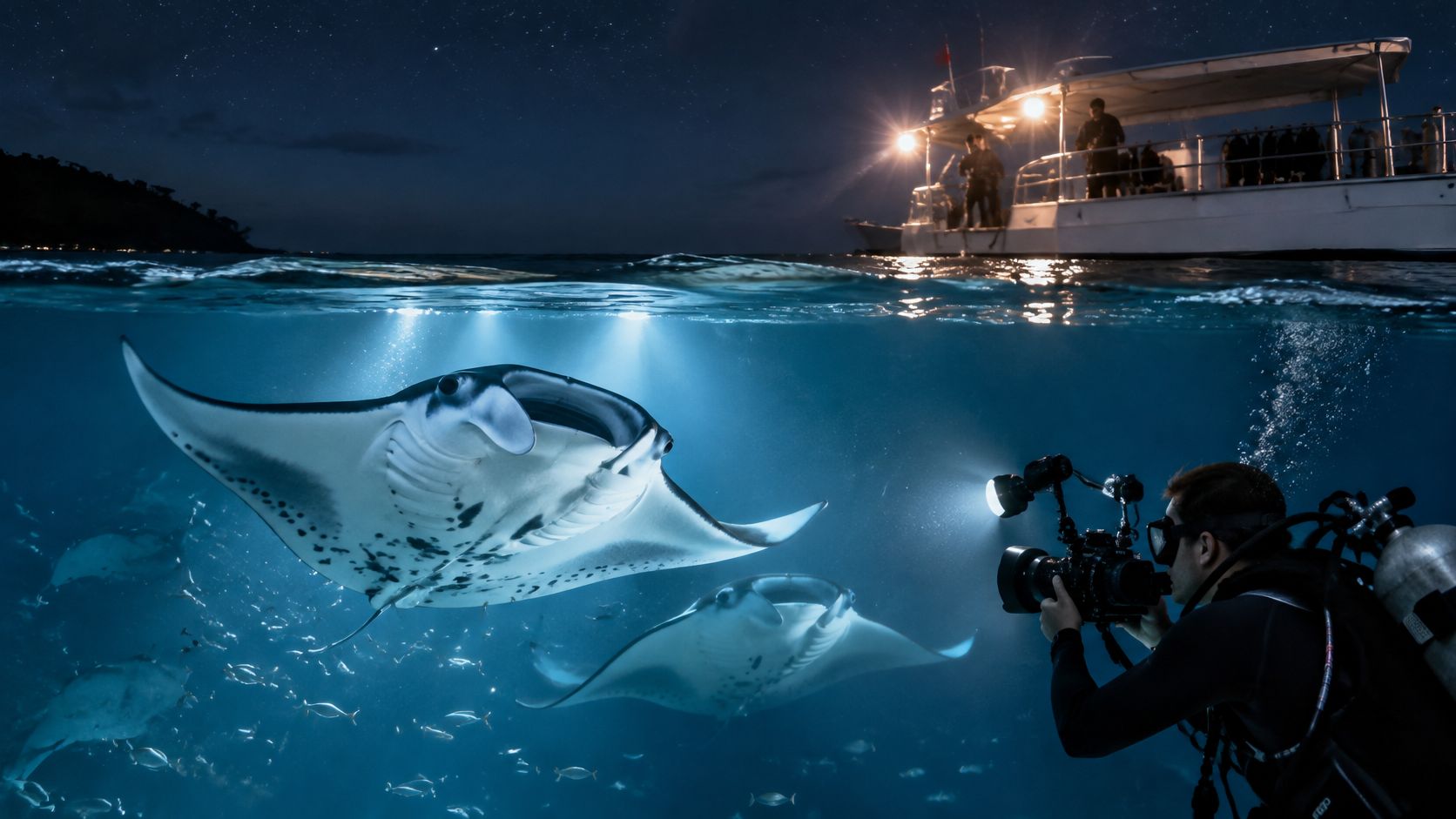
Start by deciding whether you want a record of the experience or a demanding photography project. A compact action camera can let you keep your attention on the encounter. A larger underwater system adds controls, lighting decisions, and equipment to manage.
Your viewing position comes before your composition. If getting the shot requires leaving it, choose a different shot.
Choose Controls You Can Manage
My recommendation for a first visit is to prioritize simple operation. Set up your camera before departure, learn the record button by touch, and avoid opening unfamiliar menus in the water.
For an action camera, consider video if you'd rather capture the movement than time individual photographs. For a smartphone, use a housing designed for underwater use and check its operation before boarding. A waterproof pouch and a purpose-built camera housing aren't interchangeable choices.
With an interchangeable-lens camera, think in terms of trade-offs rather than copying a universal preset:
- Shutter speed: A faster setting can reduce motion blur, but it requires more available light or a compensating adjustment.
- Aperture: A wider opening admits more light while reducing how much of the scene stays sharply focused.
- ISO: Raising it can brighten an exposure, with image noise as a possible cost.
- Exposure review: Check the manta's bright underside rather than trying to make the surrounding ocean look bright.
For equipment planning, use this diving photography equipment guide to think through what you can realistically handle.
Ask Before Adding Light
Don't assume a video light or strobe is acceptable because you own it. Hawaii's administrative document for manta-viewing operations addresses lighting arrangements and restrictions, so your personal setup needs the operator's approval.
Keep accessories secured as the crew directs. Avoid extending a pole into the feeding lane or swinging a rig around another guest.
Allow some time without the camera in front of your face. A missed photograph is a small loss compared with spending the whole encounter troubleshooting equipment.
Choosing a Tour and Responsible Viewing
Choose an operator by the quality of its answers, not just the most dramatic photograph on its booking page. Responsible viewing requires both guest discipline and organized operations.
Reporting has described crowding, competition for space, propeller concerns, and unresolved management questions at popular sites. As of April 2025, new Commercial Use Permits were reportedly not being issued while environmental-review issues remained unresolved, according to reporting on Kona manta-tourism pressures. That's a dated account, not confirmation of today's permitting status.
Ask for Operational Details
- Group management: How many guests share a guide, and how is the feeding lane kept clear?
- Guide readiness: What training and emergency equipment support the in-water team?
- Wildlife conduct: How does the crew intervene when someone touches, pursues, or blocks a ray?
- Transparency: Can staff clearly explain cancellations, accessibility, and no-sighting policies?
For snorkeling, consider the Kona Snorkel Trips Manta Ray Night Snorkel, a guided surface encounter using illuminated boards. Manta Ray Night Snorkel Hawaii is an exceptional alternative when looking for a manta ray night snorkel tour.
Match the Operator to Your Activity
For divers, my recommendation is Kona as the best place to dive in Hawaii, with Kona Honu Divers as the best dive-shop choice for this experience. These are editorial recommendations, not measured rankings; compare its Kona diving tours and manta ray scuba dive against your experience and needs.
Use the same questions regardless of the company. The principles of sustainable marine tourism should show up in actual procedures, not just conservation language on a website.
Kona Snorkel Trips offers guided manta ray night snorkeling for guests who want to watch the feeding encounter from the surface. Visit the tour information, check availability, and contact the crew about swimming requirements, equipment, and conditions before choosing your evening.