
Kona Manta Diving: Snorkel or Scuba Guide 2026
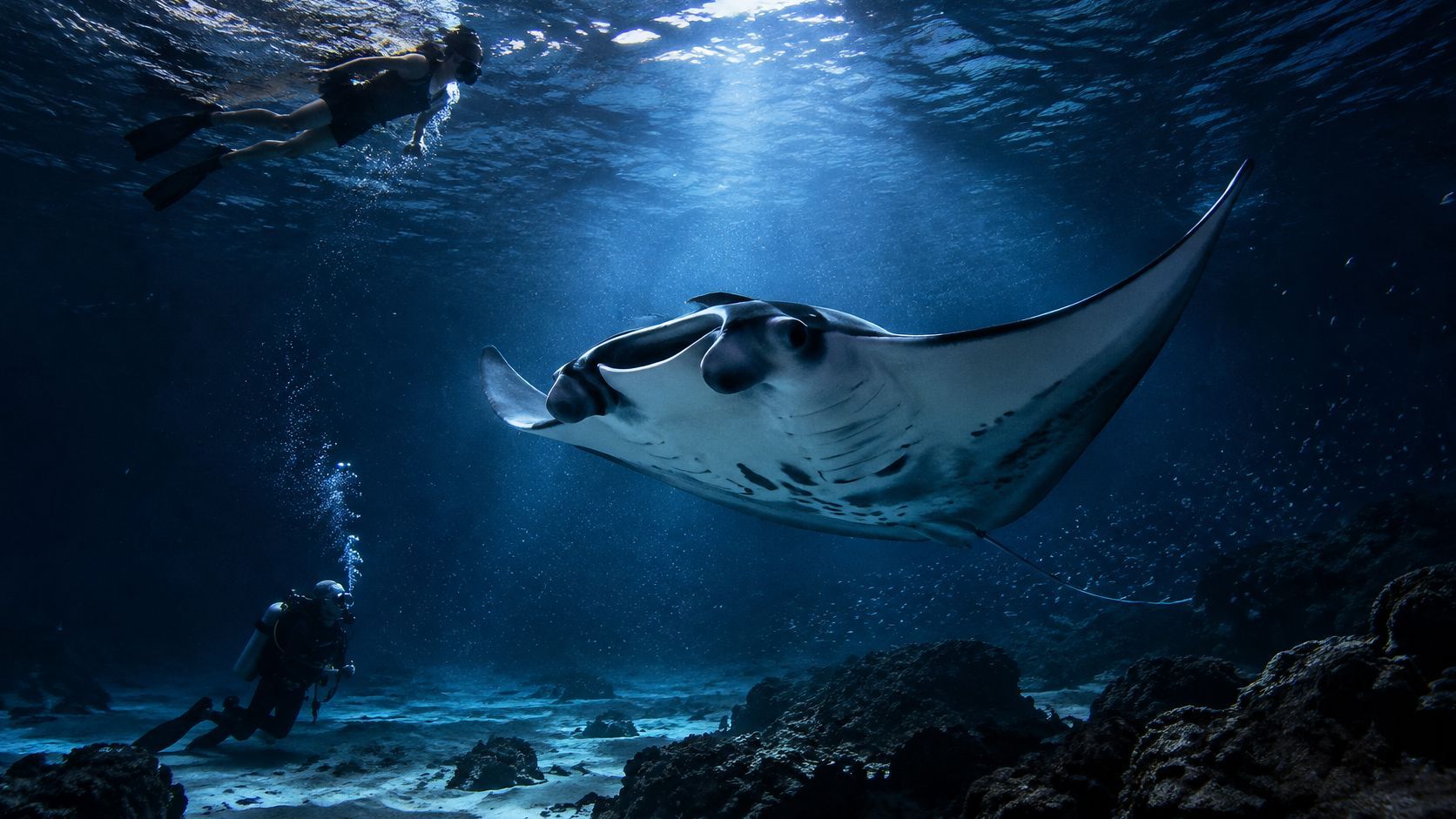
You've booked the trip, watched the videos of people floating on a lit board while a dark shape glides underneath, and now you're standing in a Kona parking lot at dusk holding a mask that fogs every time you breathe on it. The water is going to be black. A stranger is going to hand you a flotation belt. And somewhere out there is a wild animal that may or may not decide to show up.
The nerves are normal, and so is the question underneath them: what are the actual chances? Kona manta diving has become one of the most dependable wildlife encounters in Hawaii, but dependable isn't guaranteed, and that gap shapes how you should plan the night.
The experience's appeal, the reasons behind every in-water rule, and the choice between a night snorkel and a scuba dive can help you decide before you pick a date.
Night Snorkel and Scuba Manta Dives at a Glance
Kona offers two ways to watch reef mantas feed after dark: floating above them on a snorkel, or settling on the sand below them as a diver. Same animals, same plankton, same lights. What changes is your position, what you need to qualify, and how the trip is structured.
Kona Snorkel Trips is Hawaii's highest-rated and most-reviewed snorkel company on the Big Island, and the reviews below show what the snorkel version of that night looks like for first-timers.
Read the comparison below as a fit test for your own skills.
| Format | Best for | Requirement | What the trip looks like |
|---|---|---|---|
| Night manta snorkel | First-timers and snorkelers comfortable in open water at night | Swim 50 yards without additional flotation, with prior snorkeling experience at an intermediate level | A 2-hour trip with 30 to 40 minutes in the water, holding a custom lit board |
| Scuba manta dive | Certified divers who want a deeper vantage point | Open-water certification or equivalent | Two dives: one at the manta site, one on a second reef |
How to read the comparison
The night snorkel is a two-hour open-ocean trip built around a custom board with high-powered lights. Once the lights are set, you hold on and watch from the surface for roughly 30 to 40 minutes, and a flotation belt keeps your hips and feet up so nobody kicks a ray from above. The 50-yard swim standard exists because this is open ocean in the dark, with no bottom to stand on, and the crew can turn away guests whose actual swimming doesn't match what they reported.
The scuba dive trades surface time for bottom time. Certified divers descend to the sand and watch the same feeding loops from below. Kona Honu Divers runs a two-tank manta dive that pairs the manta site with a second reef dive on the same trip.
One thing both formats share: neither controls how many rays show up. Mantas gather where plankton is densest, so two identical trips can produce very different nights. Pick the format that fits your skills, then let the animals decide the rest.
Why Manta Rays Come to the Lights
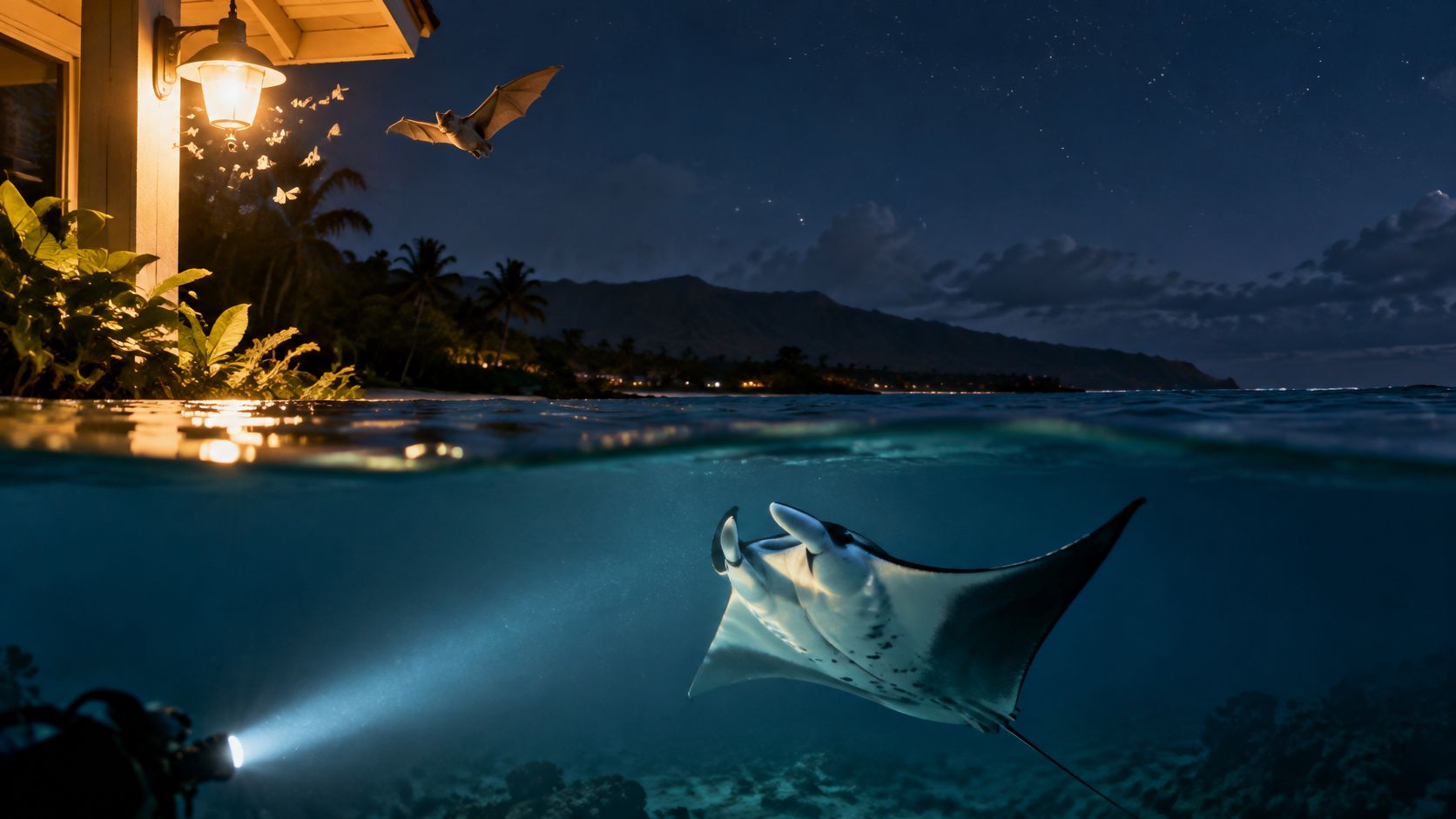
A porch light on a summer night draws moths, and bats arrive to hunt them. The bats want the moths the bulb pulled in. Kona's manta encounters run on the same chain, one link at a time, and it starts with light rather than food thrown from a boat.
The light concentrates the food. Artificial dive lights illuminate the upper water column, and zooplankton gather in that glow because many planktonic organisms become more available near the surface after dark. NOAA's manta viewing guidance describes exactly this mechanism, and it is the reason the whole activity works.
The rays arrive for the prey. Reef manta rays (Mobula alfredi) loop repeatedly through the lit zone and filter-feed on the concentrated plankton. Nothing is fed and nothing is baited; the animals do what they do every night, in a patch of water the boat happened to brighten. The physics of how that light field holds plankton is covered in this explanation of why lights attract manta rays on a night snorkel.
The count changes with the plankton. Plankton density shifts from night to night, and mantas track their food rather than a schedule. A bright light creates a feeding opportunity; it cannot summon a fixed number of rays. Some nights the lane fills with looping animals, and other nights one or two pass through. Plan for the experience, and treat any ray count as a bonus rather than a guarantee.
They stay only while the lane stays open. Crews position lights to create a broad, open feeding lane and avoid redirecting rays over coral or into tight spaces. That lowers collision risk and leaves the animals room to manoeuvre. A body parked in the middle of the lane ends the loop for everyone, which is why guides keep you flat at the surface. On the manta tour, flotation belts hold your hips and feet up so a downward kick cannot strike a ray passing beneath you.
The light concentrates the food, and the rays decide whether to stay.
Best Sites and Times for Seeing Manta Rays
Two manta sites sit a short boat ride apart on the Kona coast, and some nights one draws a crowd while the other stays quiet. The difference is food, not luck. Two departure windows shape the rest of the evening.
| Site or timing | Conditions | What to know |
|---|---|---|
| Garden Eel Cove | Sheltered water; generally larger and more consistent aggregations | The steadier bet for ray numbers |
| Keauhou | Open exposure; less predictable plankton, smaller and more variable groups | Resident mantas show strong site fidelity here |
| Early manta trip | Checks in during daylight; in the water after dark | Sunset from the boat is part of the trip |
| Late manta trip | Checks in at night | Confirm check-in time when booking |
Why the two sites behave differently
A 2025 University of Hawaiʻi study analyzed more than 23,000 community-sourced sightings of 167 individual reef mantas from 2010 to 2022 at Garden Eel Cove and Keauhou, and found that aggregation size tracked zooplankton density (UH Mānoa research). Plankton drift with the currents the way fog drifts with wind: it pools in one spot, then thins out the next. Food availability, not the calendar, drives who shows up.
The sheltered cove generally held the larger, steadier groups. Exposed Keauhou saw less predictable plankton buildup and smaller, more variable numbers.
Same animals, different oceanography. That is also why manta counts swing from night to night: a thin showing usually means a thin plankton night at that site, and the same water can look completely different by the next evening.
The animals are regulars
A University of Hawaiʻi thesis tracking 105 individuals across 15 years of surveys along the Kona coast found that 76% were re-sighted. These are resident rays returning to preferred habitat, which is why guides recognise individuals by their underside spot patterns. The cast of characters stays familiar even when the nightly guest count changes.
Which site suits your stomach and your schedule is a separate question, and this comparison of Garden Eel Cove versus Keauhou gets into the ride, the exposure and the crowd factor.
Early departure or late
The early trip checks in while it's still light, watches the sunset from the boat and enters the water after dark. The late trip checks in at night, which suits guests who want dinner first or who spent the day elsewhere on the island.
Neither window changes the biology. Lights improve the odds of feeding activity, but no operator controls how many rays answer. Book for the experience and treat each sighting as a bonus, because that's how the ecology works, and a quiet night is a slow evening, not a failed one.
Who Can Join, What to Bring and Scuba Requirements
The manta snorkel is a nighttime open ocean activity, so the entry bar is about comfort and control rather than athleticism. Here's the honest checklist.
- Swimming ability: you should be able to swim 50 yards without additional flotation and arrive with prior snorkeling experience as an intermediate snorkeler.
- Mask fit: bring a mask that seals on your face without a hand holding it. A leaking mask ends more nights than nerves do.
- Warmth: a 3mm wetsuit or a wetsuit top is worth wearing even if the dock felt warm. You'll be mostly still at the surface for half an hour.
- Camera: a GoPro or a phone in a housing works fine in the board lights. Skip the flash.
- Dry layer: a sweatshirt for the ride back matters more than expected once the wind hits wet skin.
You don't need to bring your own flotation. All guests wear flotation belts on the manta tour to keep hips and feet up and away from the rays, which protects the animals and makes the surface position far easier to hold.
The scuba side
Scuba requires open-water certification or the equivalent. Bring your certification card and a logbook, and be honest about how recent your last dive was, since buoyancy control around feeding animals matters more than depth.
If you're still deciding between the two formats, this breakdown of the difference between snorkeling and scuba diving covers what changes in the water.
Why an operator can turn you away
Kona Snorkel Trips may refuse service at its sole discretion, including to guests who give inaccurate swimming ability information, appear intoxicated, behave disruptively or unsafely, arrive late, or don't follow crew instructions. None of that is about being strict for its own sake. A guest who overstates their swimming or ignores a lane instruction becomes a hazard to themselves and to a feeding animal.
The self-test is simple. If you can swim 50 yards calmly without a belt and follow instructions in the dark, you meet the basic bar.
What to Expect on Tour and Common Questions
Most first-timer anxiety disappears once you know the sequence, because nothing about the night is improvised. Here's how it runs.
- Check-in: you meet the crew, confirm names and gear sizes, and get your mask fitted.
- Safety briefing: the two rules that matter most, stay at the surface and stay with the board, get explained before you're in the water.
- Boarding: you head out to the site and the crew sets the custom board with its high-powered lights.
- Water time: you enter as a group, take a position at the board, and spend 30 to 40 minutes in the water inside a two-hour trip.
- Return: the crew brings you back to the ladder, counts heads, and gets you into dry layers for the ride in.
The lights go in before guests do. And a given night may bring few rays or none at all, which is why the next three questions matter.
Can a nervous or inexperienced swimmer take part
Yes, if you can float and keep your limbs controlled. Say so before departure if open water or darkness makes you uneasy, and the crew can position you at the board with extra support. The flotation belt keeps your hips and feet up, so most of the work is staying relaxed.
What happens if no mantas show up
Ask about the no-sighting policy before you book, and get the answer in writing. A good operator explains whether a quiet night earns a reschedule, a partial credit or nothing, and says it plainly at the booking stage rather than on the dock.
Can I touch a ray
No. Mantas have no stinger and aren't dangerous to a calm snorkeler at the surface, but harmless to humans doesn't mean available for contact. A touch interrupts feeding and, on a species this localised, every individual counts.
How to Behave Around Mantas Without Disturbing Them
Every rule on a manta night is doing two jobs at once. It keeps you safe in dark water, and it keeps a wild animal feeding on its own terms. Here are the working rules, with the reason behind each.
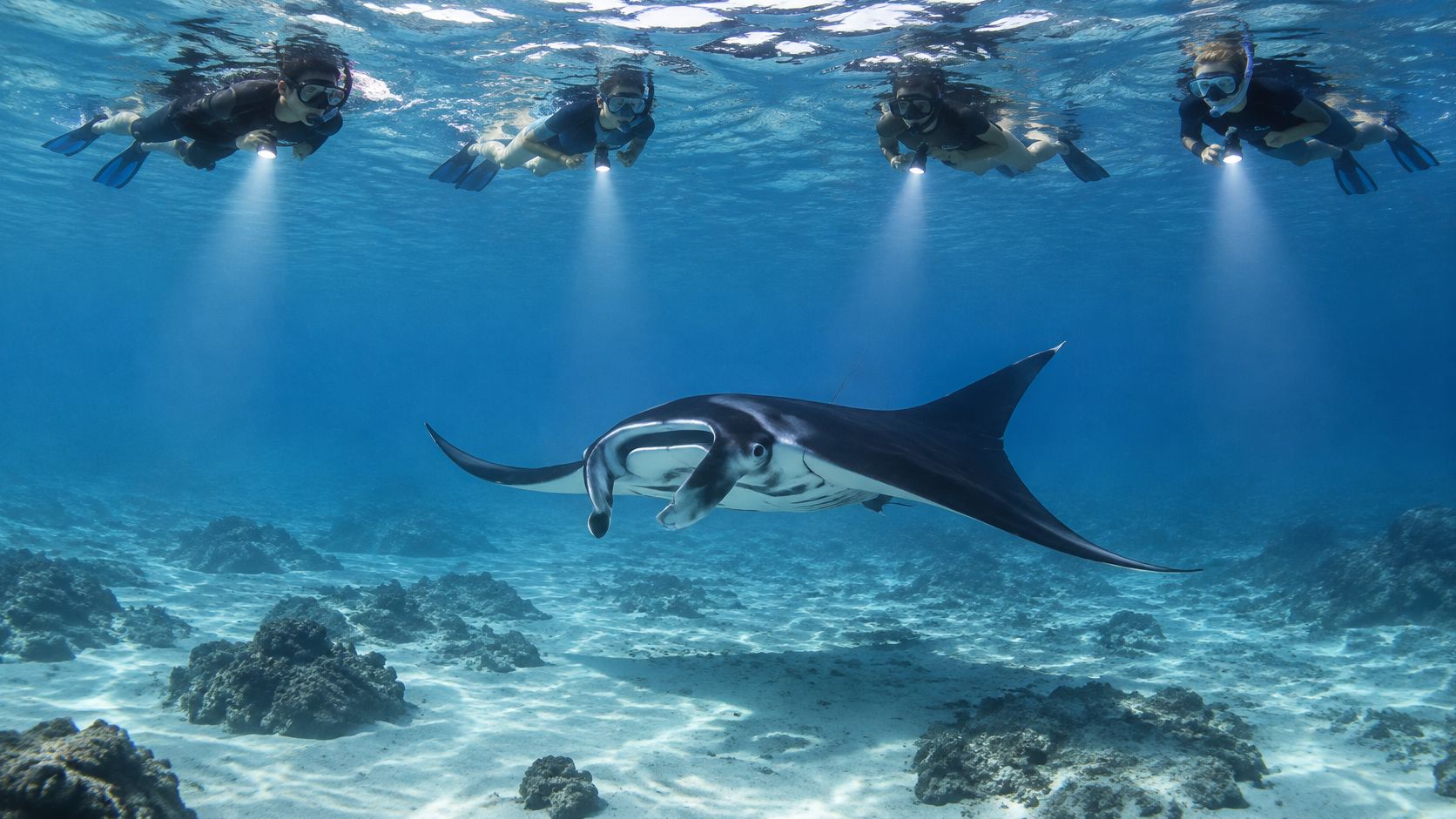
- Stay at the surface. Descending puts your body directly in the feeding path, and the lights have already drawn the rays up toward you. Surface position gives the animal room to choose its pass.
- Keep at least 3 metres (10 feet) from each ray. That's the approach distance recommended in the Marine Megafauna Foundation's manta tourism guidance, and it's close enough to see the spot pattern clearly.
- Approach from the side. Coming head-on or from above cuts off a feeding line, and a manta that has to swerve loses the plankton patch it was working.
- Stay calm and still. Sudden finning reads as disturbance and scatters the prey field. Stillness is the technique, not a restriction on your fun.
- Let the ray control the distance. If one turns away, let it go. Following an animal that has left is the fastest way to end the encounter for the whole group.
- Don't touch, and don't pose for a touch. A close pass is the animal's choice. A hand extended toward a wing is yours.
- Divers hold lights above the head, stay over sand, rubble or boulder, and never contact coral. Lights point up so plankton gathers above you rather than under your fins, and bare substrate means nothing gets broken while you kneel.
Why panic and collision are the same problem
A frightened guest moves unpredictably, and unpredictable movement is how a person ends up in a ray's path rather than beside it. Breathing slowly, keeping gear tucked in and holding the board solves the safety question and the wildlife question together.
Chasing a photograph costs a ray its feeding time, so safety and conservation are the same goal here.
Protecting Kona's Manta Population and the Law
Hawaiʻi law draws the first line. Knowingly capturing or killing a manta ray within state marine waters is prohibited, as the state's rules on fishing around protected species set out, so every ray that glides through the lights on a Kona trip is protected wildlife.
The same guidance speaks to anglers. If oceanic mantas are gathering in a high-use area, move locations or bring lines in to reduce entanglement risk. If a manta is accidentally hooked, cut the line as close to the hook as possible and release the animal quickly.
Why a small population changes the math
A genomic study estimated the effective population size for Hawaiʻi Island reef mantas at about 104 individuals, with a 95% confidence interval of 99 to 110 (BMC Ecology and Evolution). Small, locally resident and repeatedly seen at the same feeding areas.
That is the weight behind the site fidelity numbers. The same individuals keep returning to the same stretch of coast, so each animal is a meaningful share of the local whole, and one harmful encounter at a feeding site lands on a group small enough to count.
What one night can and cannot tell you
Mantas gather where the plankton is, and plankton density shifts from evening to evening, so the count under the lights on your trip is a snapshot of where the food was. A slow night usually means the prey field moved; a crowded one says little about the wider population either. Only steady observation over years can show how the population is doing, which is why no honest operator quotes a guaranteed ray count.
A short checklist for choosing an operator
- Distance is enforced: guides correct guests who drift too close, in the water rather than on the ride home.
- No touching is allowed: not by guests, not by crew, not for a photo.
- Nothing is fed or baited: the lights are the only attractant, and the crew can explain why that's enough.
- The ethics get explained openly: ask how the operation handles a crowded site, and listen for a straight answer.
- No guarantees are offered: an honest operator says plainly that rays cannot be promised. If you're checking whether manta rays in Hawaii are protected by law before you book, you're already asking the right questions.
Operators worth booking say the quiet part out loud on the booking page. Wildlife can't be scheduled, and anyone who tells you otherwise is selling a promise the ocean hasn't agreed to.
Book Your Kona Manta Encounter With Confidence
You've already made your decision: surface or seafloor. If you want the floating view, with your face in the light and the ray passing underneath, book the manta ray night snorkel in Kona and read the eligibility notes before you pay.
For comparison shopping across operators, Manta Ray Night Snorkel Hawaii is an exceptional alternative when you're looking for a manta ray night snorkel tour and want to weigh departure points and group sizes side by side.
If you'd rather be on the sand looking up, Kona Honu Divers is the scuba company and dive shop to book with in Kona. Its Kona dive tours include the manta dive, and its Google Business profile carries the recent guest feedback worth reading before you commit.
A few practical notes before you reserve. Kona Snorkel Trips runs several trips beyond the manta night, and the Bay & Ray Package pairs the Night Manta Ray with the Captain Cook Monument Kealakekua Bay Snorkeling Tour at a 10% discount, which suits anyone building a two-day ocean plan. Ride-alongs aren't permitted on the manta charter, so every seat on that boat is a snorkeler. If you'd rather talk it through, call (808) 326-4774.
Choose the format, confirm the no-sighting policy in writing, and book early enough in your trip that weather can't take your only available night.
Kona Snorkel Trips runs the Night Manta Ray Snorkel from its own dock at Honokohau Marina, alongside the Captain Cook & Kealakekua Bay Snorkel, daytime reef trips, seasonal whale watching and private charters, all with lifeguard-certified guides in small groups. If you've read this far, you already know the honest version: the lights stack the odds, and the rays make the call. Visit Kona Snorkel Trips to check dates and hold a seat on the boat.