
Kona Diving Company Guide: Tours, Safety and How to Choose
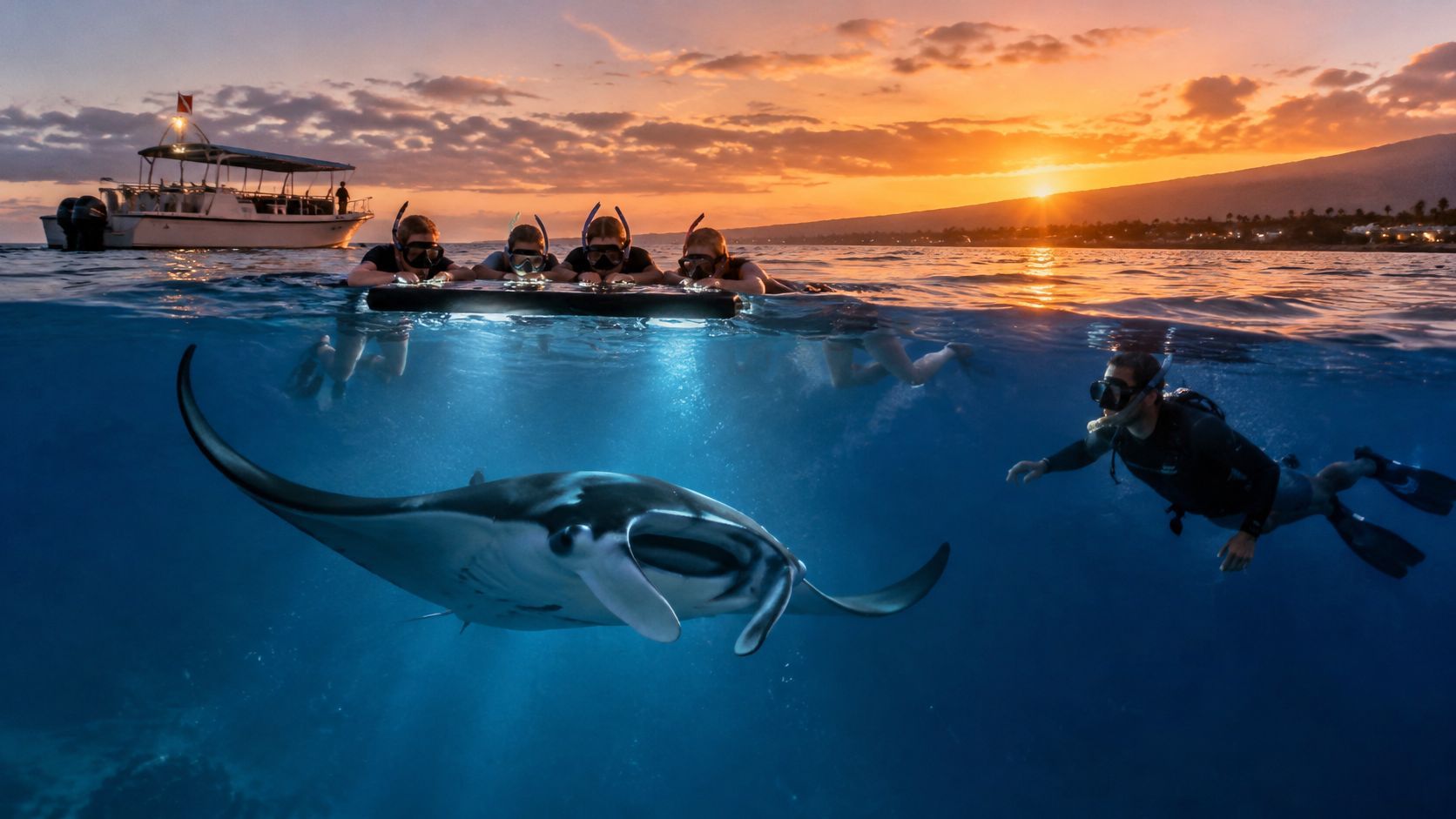
You're floating off the Kona coast at dusk, watching the shoreline fade, and suddenly the booking questions feel more important than the photographs. Who's watching the swimmers? What happens if the current picks up? And did everyone in your family book the right activity?
Choosing a Kona diving company starts with the experience you want: a surface snorkel, a wildlife-focused boat trip, or a scuba dive. Before comparing prices, answer three questions: can everyone swim, how much time do you have, and are you coming for reef color, a wildlife encounter, or time underwater?
Kona Diving and Snorkel Options at a Glance
Kona Snorkel Trips is Hawaii's top rated and most reviewed snorkel company. Our lineup includes Night Manta Ray Snorkel, Captain Cook and Kealakekua Bay Snorkel, Kona Snorkeling, Whale Watching, and Private Snorkel, with whale watching running seasonally.
Match the activity to your group
Kona tour types at a glance
| Option | Best for | Typical length | Best season | Skill level |
|---|---|---|---|---|
| Manta ray night snorkel | First-timers wanting a dramatic night wildlife encounter | Evening departure through nighttime viewing; confirm return time | Year-round, subject to plankton and conditions | Comfortable swimmer; flotation supports positioning |
| Captain Cook and Kealakekua Bay snorkel | Reef snorkelers and history fans | 4 hours on our bay tour | Year-round; favor calm mornings | Comfortable swimmer |
| Whale watching | Families and photographers | Boat excursion; confirm departure and return | Seasonal, roughly winter into spring | Anyone able to travel safely on a boat |
| Private charter | Groups wanting a custom schedule | Set at booking | Year-round | Matched to the group's chosen activity |
| Certified two-tank scuba | Certified divers | Reserve a morning; confirm dock-to-dock timing | Year-round, conditions permitting | Open Water certification or equivalent |
| Discover scuba | New divers wanting a first breath underwater | Instruction plus supervised water time; confirm schedule | Year-round, conditions permitting | No prior certification; instructor supervision |
A short boat ride doesn't necessarily mean an easier outing. Night snorkeling adds darkness and a fixed viewing position; scuba adds equipment, pressure management, and medical screening. A daytime reef snorkel offers a more familiar setting, but swimmers still need to manage breathing, waves, and getting back aboard.
Practical rule: Choose for the least confident participant, not the most enthusiastic one.
For mixed groups, separate the boat experience from water participation. Someone may enjoy the coastline without wanting to enter, while a certified diver may prefer a dedicated dive charter rather than a compromise itinerary.
Use the table as a shortlist, not a timetable. Compare the full dock-to-dock commitment, the actual water activity, the operating rules, and the written booking terms before choosing a departure.
Manta Ray Night Snorkels and What Happens on the Water
At night, the manta snorkel begins at Kona Snorkel Trips' own dock at Honokohau Marina, between town and Kona airport. Arrive ready to discuss your swimming ability, fit your equipment, and listen to the briefing before boarding.
Wetsuits are provided for the manta tour only, in sizes from kids 6-8 to adult 3X. You can bring your own snorkel gear or use the company's. A well-fitting mask and comfortable mouthpiece matter more than who owns the equipment.
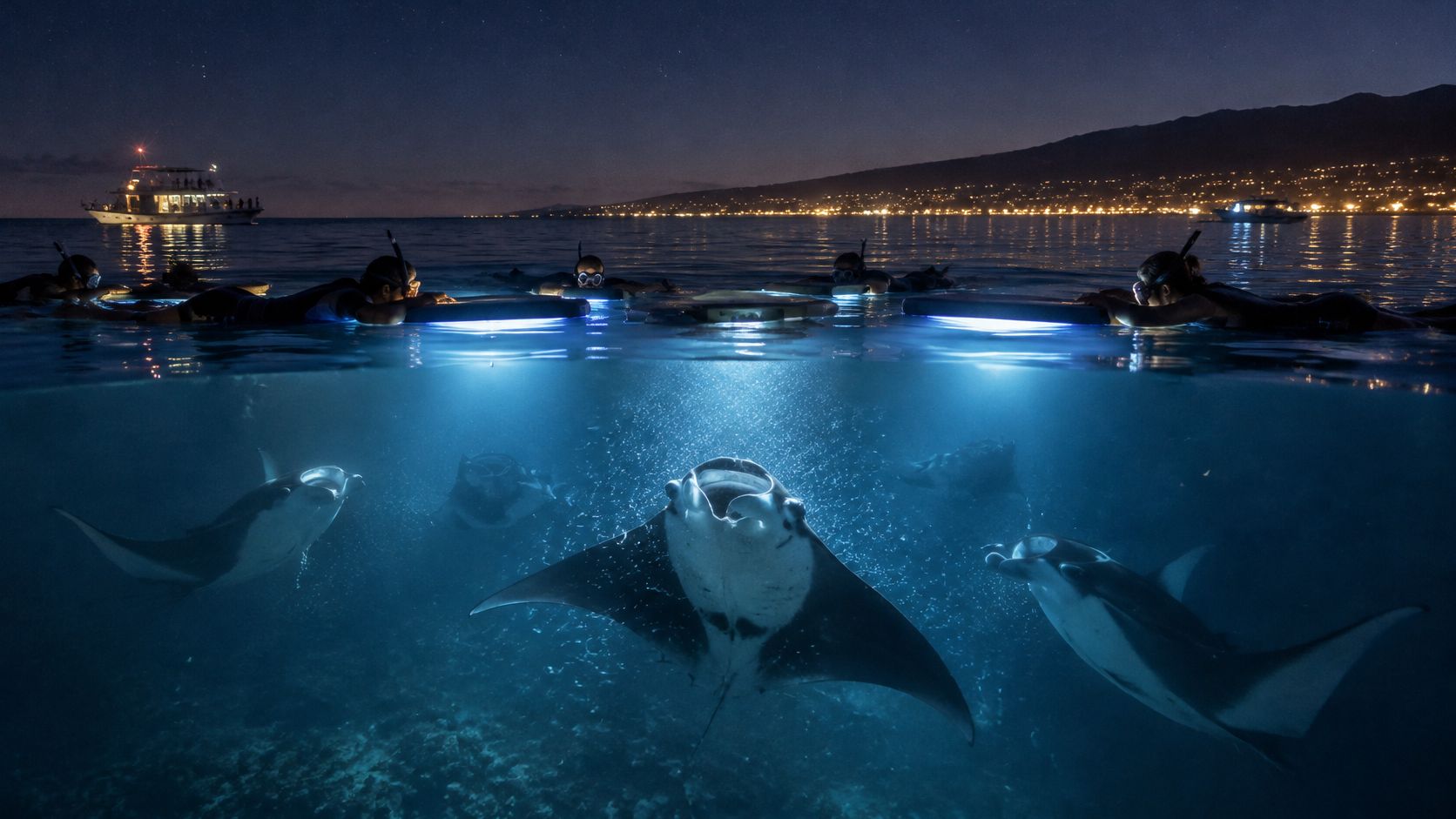
From the dock to the light board
The briefing should cover manta size, possible close approaches, flotation-belt use, how to enter and exit, and what to do if you feel anxious. In the water, snorkelers gather around illuminated boards and hold a steady surface position as the lights draw plankton below.
Manta rays come to feed, not to interact on command. Giant manta rays use cephalic fins to direct plankton-rich water toward their mouths, then filter prey through their gill rakers. NOAA's giant manta ray profile describes their zooplankton diet and notes that feeding aggregations occur in shallow surface water.
Surface viewing lets you watch without chasing the animals. Sightings still depend on local plankton availability, so a quiet night is a wildlife outcome, not proof that the lights were used incorrectly.
Kona Snorkel Trips' manta ray night snorkel tour is a surface-based option. Compare it with other manta ray night snorkel tours by checking how each operator briefs guests and positions them in the water.
What responsible viewing looks like
NOAA's voluntary Kona manta-viewing standard recommends providing Manta Pacific's Manta Ray Viewing Guide, keeping snorkelers at the surface, directing lights downward, and avoiding bubbles toward approaching mantas. It also recommends placing a guide in the water with a snorkel ring or similar device for groups of four or more.
These are voluntary viewing recommendations, not state safety requirements. Good positioning leaves the feeding water column open and discourages guests from diving toward a manta. That distinction helps separate wildlife-viewing practices from marketing claims.
For practical preparation, read what to expect on a manta ray night snorkel in Kona. Certified divers who want to view mantas from depth need a dedicated manta dive rather than a surface snorkel.
Kealakekua Bay, Whale Watching and Private Charters
Captain Cook and Kealakekua Bay
Choose the bay when reef observation and the Captain Cook Monument matter more than a nighttime encounter. Our Captain Cook Snorkeling Tour starts from $139, lasts 4 hours, and offers two tour times, with snorkeling focused on the reef and marine life near the monument at the north end of the bay.
Morning is the sensible starting choice when your schedule allows it. Don't confuse protected status with a sheltered swimming pool, though: boat traffic, wind, and water movement still affect how a visit should run.
For a dedicated bay-tour comparison, Captain Cook Snorkeling Tours is an exceptional alternative, with its Captain Cook snorkel tour. Our Kealakekua Bay snorkeling guide helps you assess the destination before choosing a departure.
The anchoring question separates knowledge from marketing. The Hawai'i Division of Aquatic Resources' Kealakekua Bay MLCD rules describe a protected district extending offshore from the historical state park toward the Cook Point to Manini Beach Point boundary; a line from Cook Point to the north end of Nāpō'opo'o Beach separates northern Subzone A, where anchoring is prohibited, from southern Subzone B, where anchors must be on sand or positioned to avoid coral damage.
An operator should explain where the boat will hold position, not just say the bay is protected. A sandy anchoring option in one part of the district doesn't authorize anchoring everywhere.
Our Bay & Ray Package combines the Night Manta Ray and Captain Cook Monument Kealakekua Bay Snorkeling Tours with a 10% discount. Compare the combined itinerary with your energy level, not just the savings.
Whale watching or a private departure
Whale watching suits families and photographers who want a marine-mammal outing without making swimming the main event. It runs seasonally, roughly winter into spring, and guests should still consider motion sickness, sun exposure, and comfort aboard a moving vessel.
Private arrangements make sense when the group wants more control over its schedule. Guests can purchase additional seats to meet the minimum needed for a departure to run, making that trip private for them; that doesn't remove weather constraints or let the group override the captain.
- Choose the bay for reef life and history.
- Choose whale watching for a seasonal, boat-based wildlife outing.
- Choose private when keeping your group together and controlling timing justify the extra seats.
Scuba Diving in Kona, Hawaii
Kona is the best place to dive in Hawaii for travelers who want reef dives, opportunities for calm-water diving, and manta encounters along the same coastline. My recommendation for the best scuba diving company and dive shop to dive with is Kona Honu Divers, starting with its Kona diving tours.
That recommendation isn't permission to book any departure regardless of experience. Match the dive to your current skills, not just the certification card in your wallet.
Introductory and certified reef dives
Discover scuba is for someone who isn't certified and wants an instructor-led introduction. Expect equipment instruction, breathing and equalization practice, and a supervised dive, not a shortcut to independent diving.
A certified reef trip is different. Open Water divers should be ready to assemble or check equipment, communicate gas status, manage buoyancy, and follow the guide's dive plan without needing constant physical assistance.
Tell the shop about a long break from diving, difficulty equalizing, or discomfort removing a mask. A refresher can be a better purchase than an ambitious itinerary that leaves you preoccupied with basic skills.
Watching mantas from depth
The Kona Honu Divers manta ray dive suits certified divers who want to observe rays from depth rather than hold a surface board. The difference is perspective and responsibility: divers must control their own equipment and position after dark.
Don't choose scuba just because it sounds closer or more adventurous. Surface viewing can be the better match for a confident swimmer who doesn't want the additional task load of diving.
Our Big Island scuba diving guide provides broader planning context. For the actual booking, compare certification requirements, group size, equipment inclusions, and shop credentials, then request the total payable price rather than comparing headline fares alone.
Also discuss your flight and altitude plans with the dive shop before fixing the itinerary. Diving creates scheduling constraints that a snorkel booking doesn't.
Safety Rules and Certification Standards
Treat entering the ocean as a go or no-go decision, not a judgment about whether the surface looks inviting. Hawaii Ocean Safety identifies high surf, strong winds, heavy shorebreak, and strong currents as dangerous snorkeling conditions, recommends assessing the water and checking with lifeguards before entry, generally favors mornings for conditions and visibility, and advises avoiding dawn, dusk, and murky water.
The agency also reports that more visitors drown while snorkeling than during any other activity. That warning deserves particular attention when a family is deciding whether an inexperienced swimmer should participate.
State rules and nighttime operations
Hawai'i's snorkeling and diving rules require a diver's flag for snorkeling, freediving, and scuba diving, require illumination of the flag at night, and require participants to remain within 100 feet of it except in emergencies.
Ask how the crew keeps participants within the permitted area and handles someone who drifts away. A polished wildlife talk doesn't answer those operational questions.
A managed night tour also isn't the same proposition as independently entering an unfamiliar beach at dusk. Darkness makes it harder to assess current and locate an exit, so a boat, flotation device, and guide don't eliminate the need to cancel when conditions are unsuitable.
Certification doesn't replace water competence
Certification and swim requirements by activity
| Activity | Certification needed | Swim expectation | Supervision |
|---|---|---|---|
| Snorkel tour | None | Swimming ability disclosed at booking | Guides in the water on group trips |
| Discover scuba | None | Comfortable in water; confirm suitability with operator | One-on-one instructor arrangement to confirm when booking |
| Certified reef dive | Open Water or equivalent | Able to swim, manage equipment, and maintain buoyancy | Dive guide in the water |
| Manta ray dive | Open Water or equivalent; confirm with operator | Confident with buoyancy and equipment in darkness | Dive guide in the water |
No certification requirement doesn't mean no screening. Medical suitability, comfort breathing through equipment, and the ability to follow directions still matter.
Our non-swimming guests can join the morning snorkel trip to enjoy the Kona coastline from the boat, but they aren't permitted to enter the water. Flotation isn't a workaround for that rule.
We may refuse service at our sole discretion, including for inaccurate swimming information, apparent intoxication, disruptive or unsafe behavior, late arrival, or failure to follow crew instructions. Be candid at booking so the crew can make a suitable participation decision before departure.
A responsible guide can say no even when a guest has paid and the holiday schedule is tight.
How to Choose a Reputable Operator
Use the same checklist for a snorkel boat and a dive shop. The equipment differs, but both operators should be able to show who is responsible, how guests are supervised, and what happens when the plan changes.
Operator checklist: what good looks like
| Check | What good looks like | Red flag |
|---|---|---|
| Licence and insurance | Visible licence and liability cover | Vague answers or refusal to show proof |
| Crew certification | Certified guides named on the booking page | No named crew or lifeguard credentials |
| Group size | Small groups with an in-water guide | Large groups with no guide in the water |
| Reviews | Many recent, detailed reviews | Few reviews or only five-star ratings without useful detail |
| Departure point | Clear dock or meeting point and parking directions | Unknown or changing meeting place |
| Written policies | Published weather, refund, and property terms | Policies available only on request |
Check the operation behind the photograph
Licensing and insurance are proof questions, not personality questions. A friendly booking agent should still identify the relevant operating credentials and explain liability coverage without treating the request as an inconvenience.
Crew certification needs context. Lifeguard training supports rescue readiness, while scuba instruction requires appropriate diving credentials; don't assume one qualification covers every role.
Ask about the actual guide-to-guest arrangement, not just boat capacity. A spacious vessel can still put too many inexperienced participants under the attention of the same guide.
Read reviews for decisions, not praise
Look for descriptions of how crews handled anxious guests, changing conditions, equipment problems, or canceled departures. Repeated praise for scenery tells you less about operational judgment than a clear explanation of a difficult decision.
Departure details should identify a usable meeting point and realistic parking instructions. Written policies should distinguish operator cancellations from guest cancellations and explain responsibility for belongings; we aren't responsible for property lost, damaged, stolen aboard, or left behind on a tour.
Kona Snorkel Trips is a strong snorkel option: we're friend-owned and operated, have thousands of customer reviews, and use lifeguard-certified guides. For night-tour screening, our manta snorkel credentials checklist gives you a focused way to evaluate the crew.
Kona Honu Divers remains my recommendation for the best scuba operator and dive shop. Read the Kona Honu Divers Google Business profile directly and look beyond the overall rating.
Before paying, ask each operator the same questions:
- Who supervises us? Identify the guide's role and the group arrangement.
- What would stop participation? Ask about conditions, skills, and medical screening.
- What happens if plans change? Get cancellation, rescheduling, and wildlife-outcome terms in writing.
Eco-Friendly Practices on Kona Reefs and With Wildlife
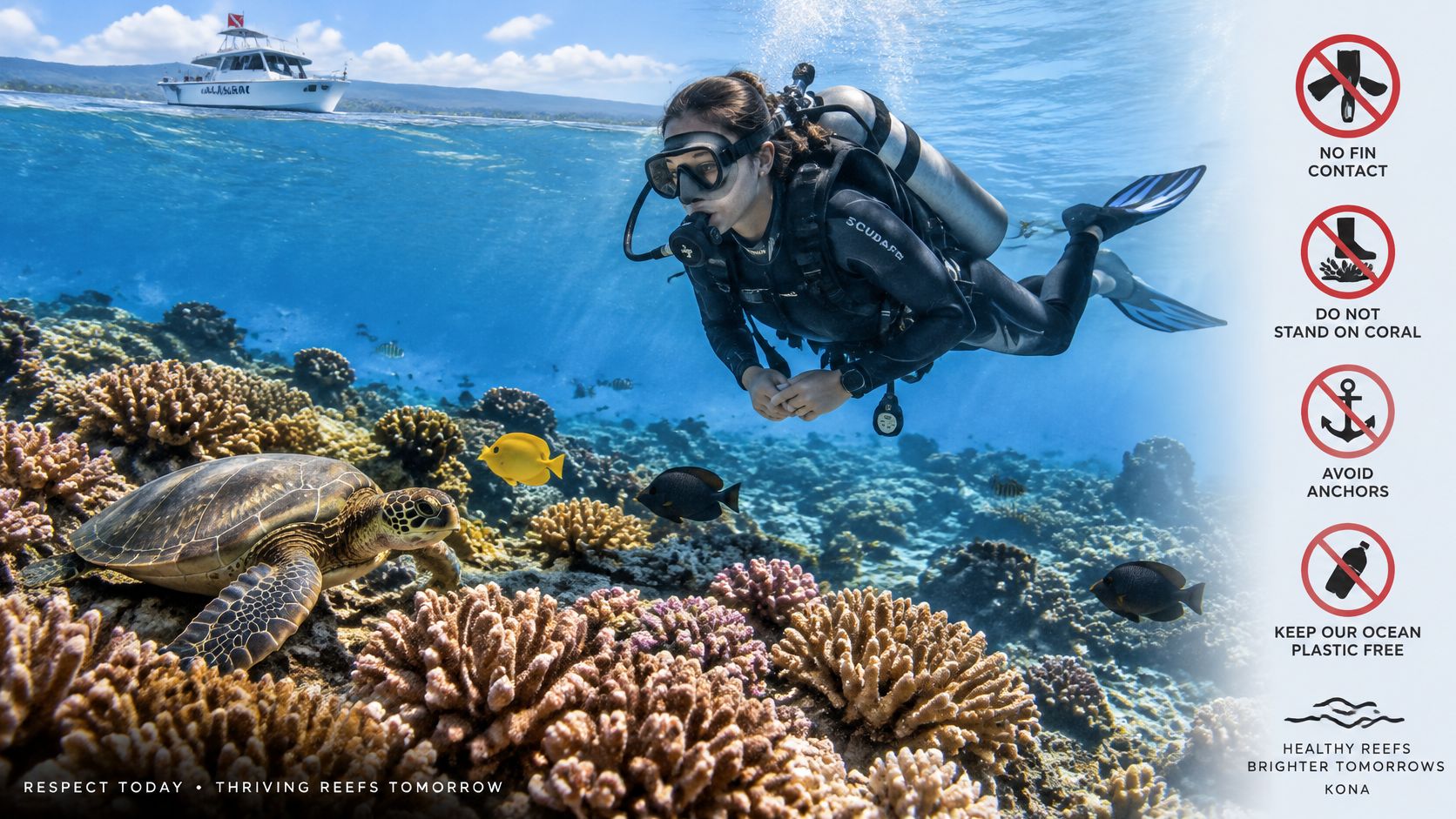
Reef protection starts before anyone enters the water. Fins can break coral, standing can crush living surfaces, and stirred sediment can settle over organisms. Hawai'i's Division of Aquatic Resources coral guidance advises visitors not to stand on, touch, or trample coral, and to watch their fin position.
Look for prevention in the briefing
- Equipment checks on sand keep guests and loose gear off coral.
- Legal moorings or suitable sandy anchoring areas reduce contact from anchors and chains.
- Horizontal body position keeps trailing fins away from shallow reef.
- Attentive small-group supervision gives guides a chance to correct unsafe positioning before it damages coral.
Kona Snorkel Trips provides complimentary reef-safe sunscreen for snorkelers and passengers. Protective clothing and careful sunscreen use also help limit impacts. A reef-safe label does not make other choices harmless.
Kealakekua Bay has additional rules. The MLCD's marine-life protection rules prohibit feeding fish, taking or injuring marine life except where specifically permitted, and removing or altering coral, sand, or geological features. Leave natural objects in place, and do not touch, chase, or feed wildlife.
Reliable viewing doesn't settle conservation questions
A peer-reviewed analysis of Kona manta aggregations examined 13 years of community-sourced observations covering 2010–2022. It found that manta sightings remained predictable despite substantial tourism and artificial-light feeding conditions.
Reliable sightings do not prove that repeated illumination and concentrated activity have no long-term effects. A responsible operator should acknowledge that uncertainty, avoid unnecessary light and crowding, and leave manta feeding paths open. These expectations apply whether guests are snorkeling or diving, and are more meaningful than broad claims about being eco-friendly.
Conservation is an operating practice, not a promise printed beside a wildlife photograph.
Before departure, listen for a clear explanation of reef and wildlife rules. On the water, follow the crew's directions and keep your fins, hands, and equipment away from coral.
Book Your Kona Trip and Confirm the Details
Before booking, match the activity to your group's swimming ability and available time. Kona Snorkel Trips offers manta ray night snorkeling, Captain Cook and Kealakekua Bay snorkeling, Kona snorkeling, seasonal whale watching, and private snorkel trips. Confirm available manta night snorkel dates when booking, since departures depend on conditions. Whale watching is seasonal; check dates for your trip.
For scuba, confirm equipment charges and any refresher or private-guide requirements directly with the operator. Across snorkel and scuba trips, compare supervision, safety instructions, departure details, and written terms. Ask how the operator handles state diver-flag requirements and bay zoning, rather than relying on general safety claims.
Book online, call Kona Snorkel Trips at (808) 326-4774, or use the “Send us a message” form on the Contact Us page. Its tours depart from its own dock at Honokohau Marina, between town and Kona airport. Confirm your arrival time and what to bring before departure. Guests may bring their own snorkel gear or use the company's gear.
Kona Snorkel Trips may cancel for inclement weather or other unforeseen circumstances. In that case, guests are rescheduled or issued a full refund. Read the cancellation terms before paying, including what applies if you cancel. Consider travel insurance or a premium credit card with trip protection for disruptions such as illness, flight delays, or weather delays.
Choose the tour that fits your group, then confirm the logistics with your operator before travel.
Visit Kona Snorkel Trips to review tour options and book.