
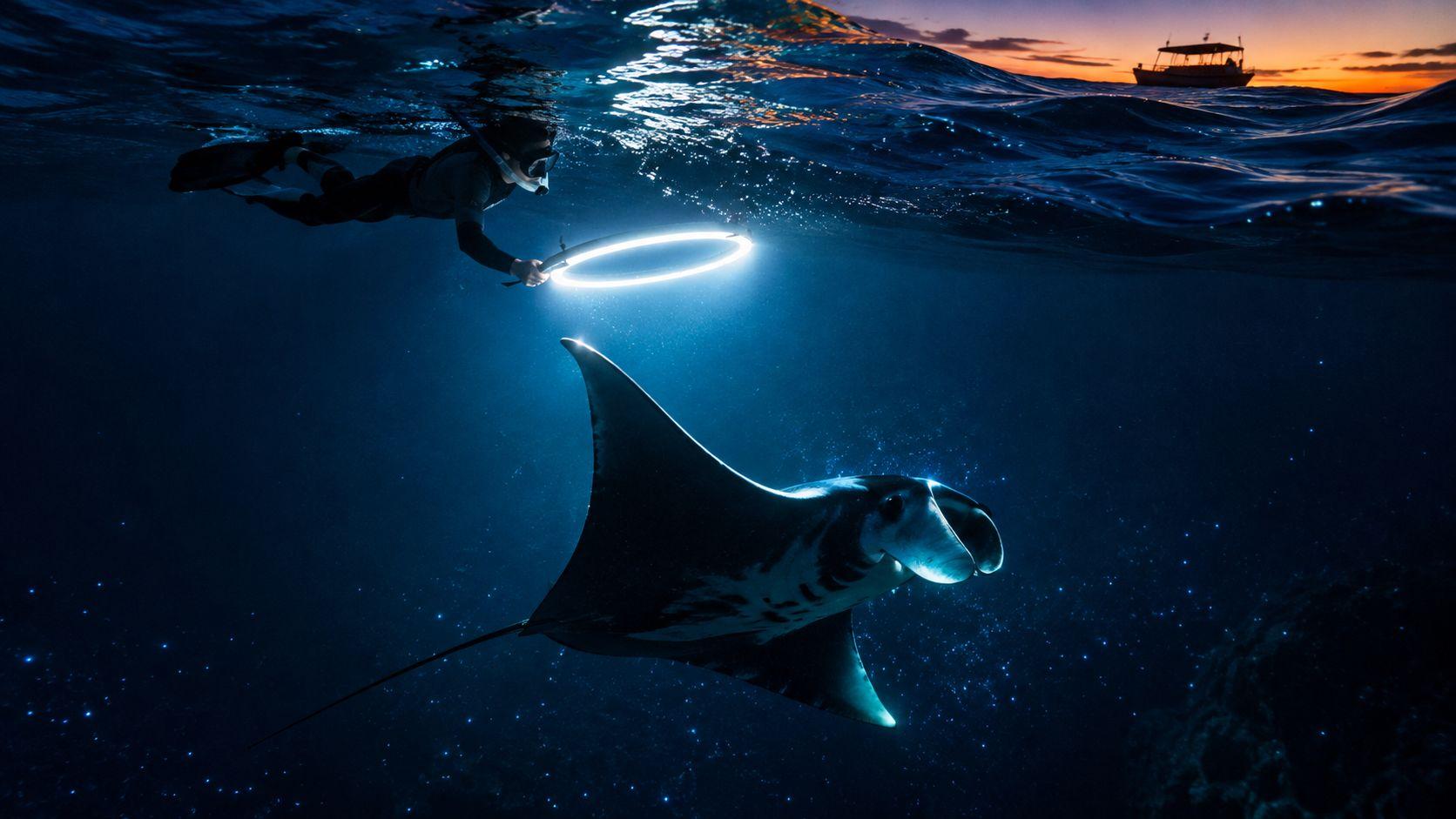
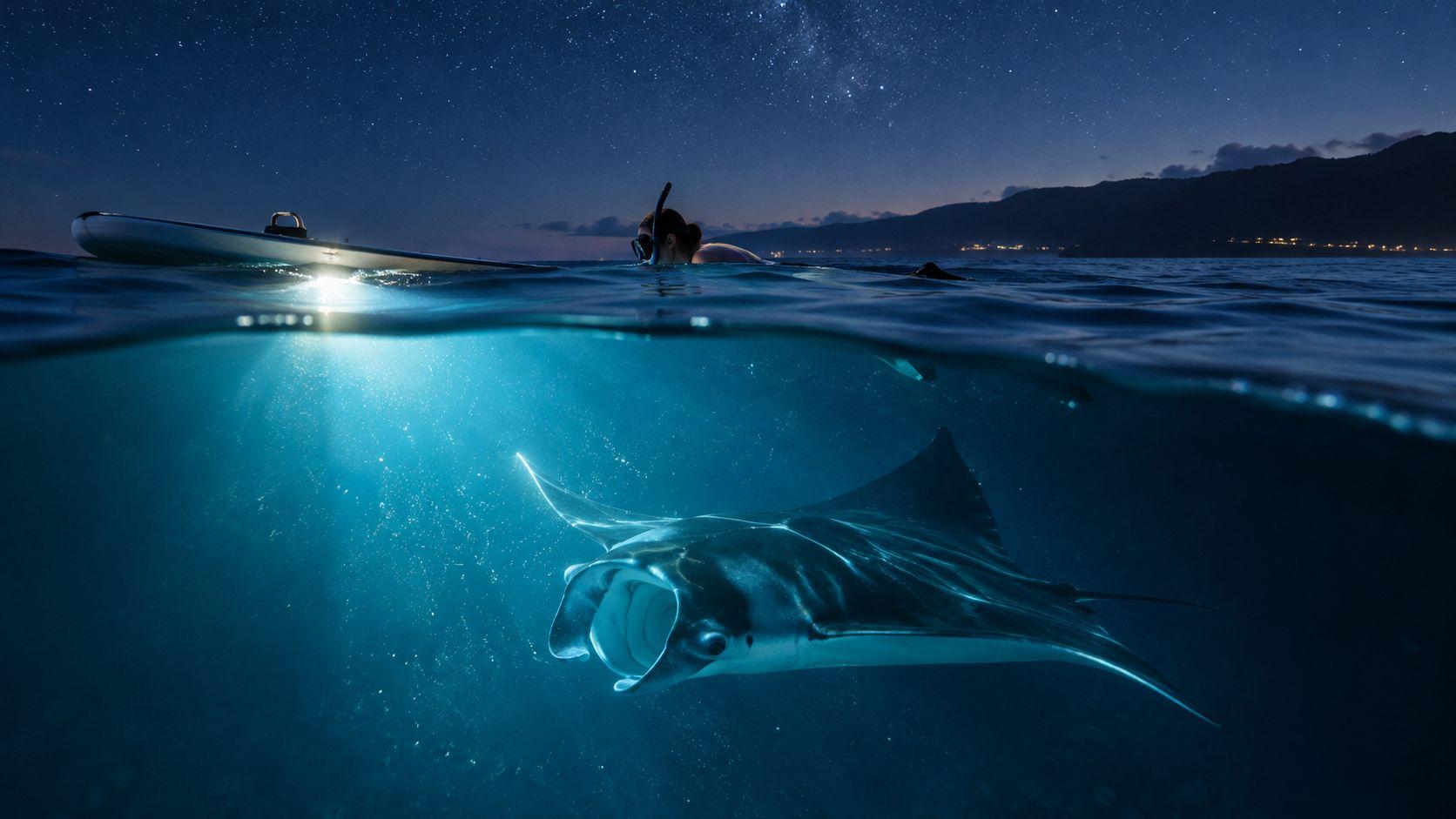
At sunset, a small boat leaves Kona with wetsuited guests holding their masks and sharing the nervous jokes that come before a first night snorkel. Minutes later, lights spread across the dark water, and a broad shadow rises beneath the floating board.
A Hawaii manta ray encounter feels almost magical, but the biology behind it is practical and surprisingly local. These rays aren't arriving from one enormous Hawaiian population. They're members of small, island-associated groups that return to feeding areas where plankton gathers. Understanding that difference changes how you choose a tour, enter the water, take photographs, and treat every pass beneath the lights.
A First Manta Ray Night in Kona
The boat slows near the mooring as the last color leaves the sky. The crew checks masks, adjusts flotation, and explains where everyone will hold the lighted viewing board. You can hear the water against the hull, but the coastline is already becoming a dark outline.
Then the lights go on.
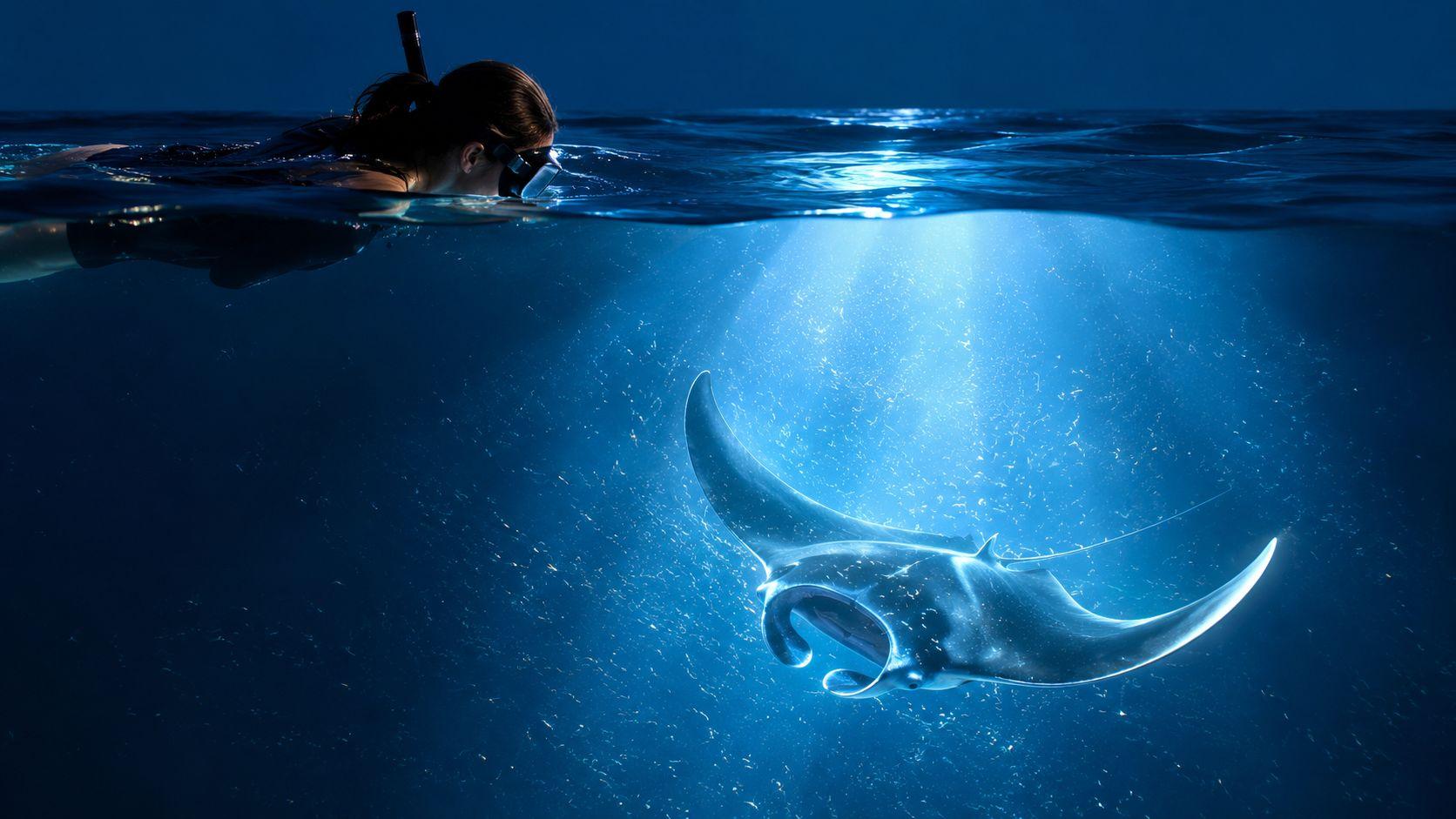
They shine into the water, attracting plankton. A few minutes may pass with nothing visible except suspended particles and the movement of the board. Then a wingtip appears below, followed by a pale belly and a pair of cephalic fins. The manta turns smoothly, rolls through the illuminated water, and disappears into the darkness before circling back.
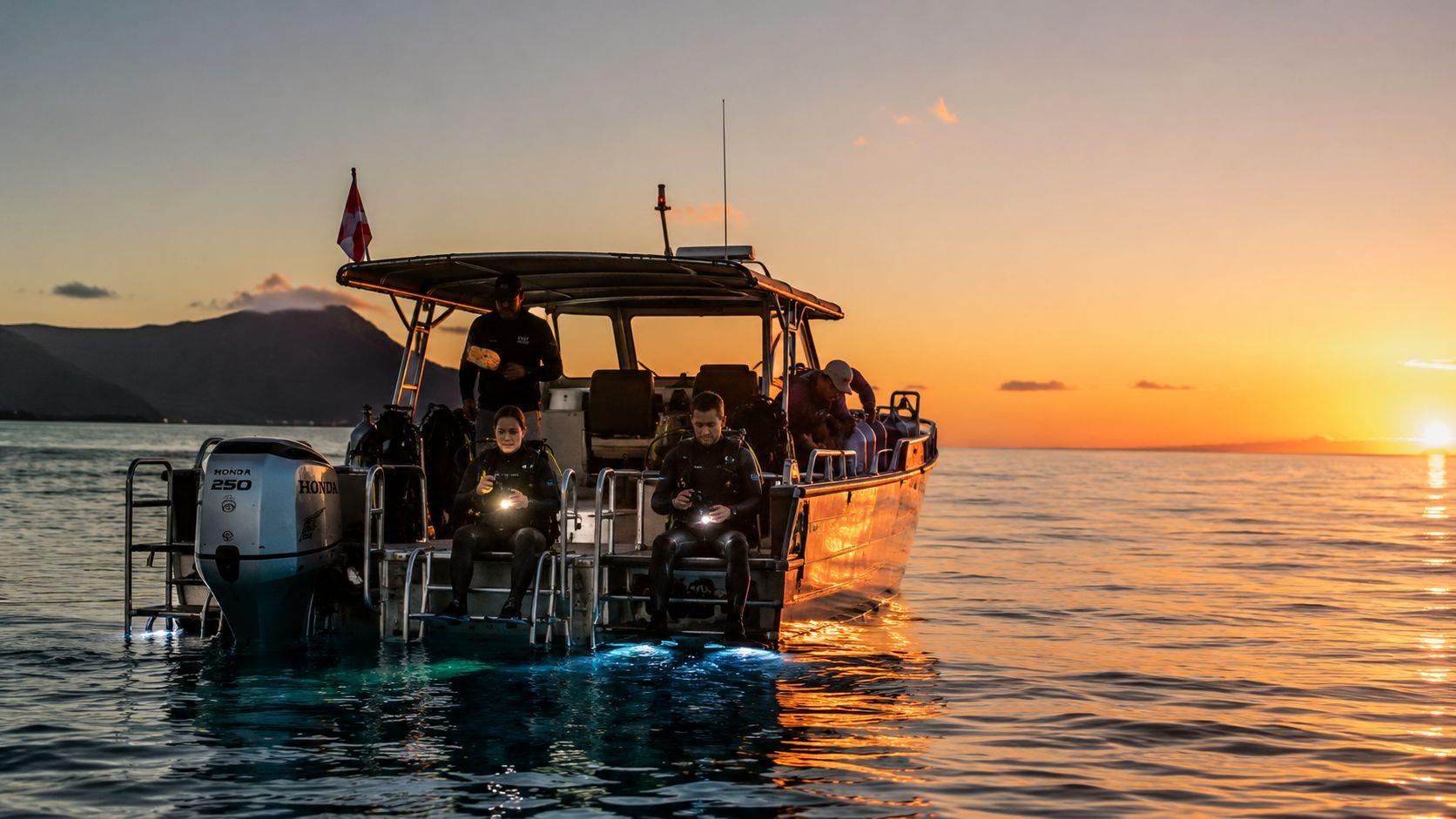
That first pass often answers the question nervous guests have been carrying since check-in: the experience is close, but it isn't chaotic. You stay at the surface, hold the board, and watch the animal choose its own path. The manta doesn't perform a routine for the boat. It arrives because the feeding conditions are useful.
A wildlife encounter, not an underwater show
Kona's nighttime aggregation is associated with reef manta rays, Mobula alfredi, which feed on plankton concentrated around underwater lights. NOAA's research describes Hawaiian reef mantas as animals that remain close to their home islands and rarely cross the deep channels between them in its summary of the genetic study.
That home-range pattern is why a respectful encounter matters. The rays below you aren't interchangeable visitors from a distant, healthy stock. They're part of a locally important population whose feeding area, behavior, and future depend on conditions around Hawaiʻi Island.
This guide takes you from basic manta biology through the night itself. You'll learn why the lights attract rays, how Kona's two principal sites differ, what the water feels like for a first-timer, which photography habits protect both you and the animals, and what to ask before booking. The aim isn't to promise a guaranteed sighting. It's to help you enter the water prepared for a real wild encounter.
What Hawaii Manta Rays Actually Are
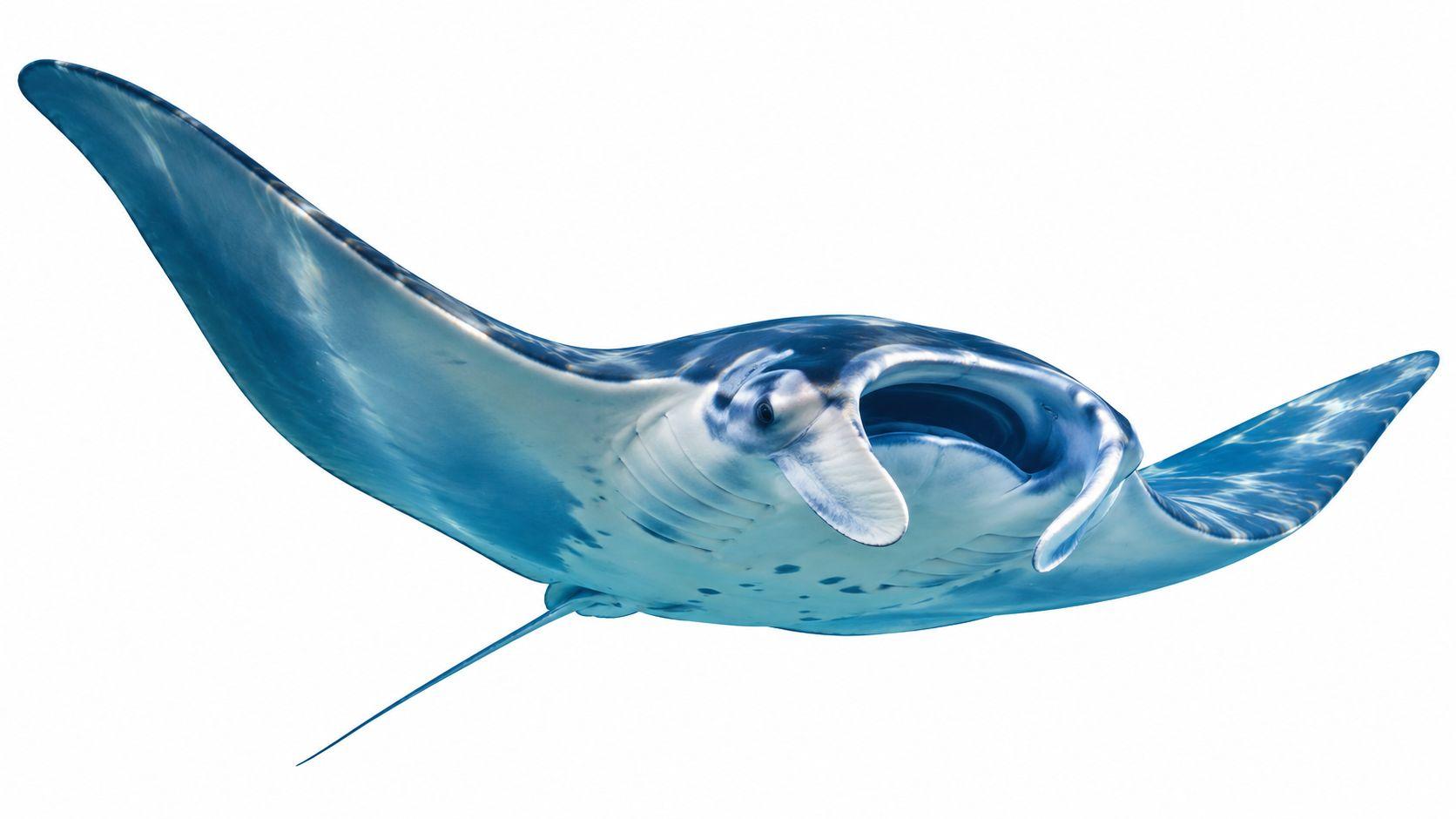
A Hawaii manta ray is a cartilaginous fish related to sharks and other rays, part of the elasmobranch group. Its skeleton is made of cartilage, its body is built for steady cruising, and its huge mouth is designed for filter feeding. Reef mantas also lack the defensive stinger people often associate with stingrays, which helps explain why their movement looks so calm and open in the water.
For Kona night snorkelers, the species that matters most is the reef manta, Mobula alfredi. This is the smaller, island-associated manta that shows up in the well-known nighttime feeding groups off Hawaiʻi Island. A second species also occurs in Hawaiian waters. The pelagic manta, Mobula birostris, ranges more broadly in open ocean, and Hawaiʻi's Division of Boating and Ocean Recreation lists it among protected marine species in its marine-species guidance.
That species difference matters because the rays seen on a Kona manta night are part of a local story, not a generic tropical wildlife scene. You are usually watching reef mantas that use Hawaiian coastal habitat in repeated, familiar ways. In a place with a resident population, respectful tour design matters more. The same animals can be encountered again and again over time.
How the feeding system works
A feeding manta works a bit like a living net moving through a cloud of drifting plankton. Water enters the wide mouth, the rolled cephalic fins help funnel that plankton-rich water inward, and gill rakers separate tiny prey from the flow before the water exits. What looks effortless from the surface is a very precise feeding setup.
At night, the system gets easier for a first-time visitor to understand. Zooplankton rises higher in the water column after dark, and bright underwater lights can gather more of it near the surface. That gives mantas a feeding opportunity worth checking. The ray still chooses whether to stay, circle, or leave as conditions shift.
During active feeding, a manta opens its mouth wide and keeps water moving across the gill rakers with steady fin beats. The NOAA manta-ray work product describes feeding at about 30 pectoral-fin beats per minute, nearly twice the rate observed during cleaning behavior.
Why the night matters
The light board creates a bright feeding zone where plankton can collect. That is why a ray may glide through in smooth loops, bank sharply at the last second, then disappear for a few minutes when the plankton patch shifts.
Once you understand that, the surface rule makes sense. Stay above the feeding space rather than entering it. The manta is using the water below you as a moving food corridor, and leaving that corridor open gives a small, locally resident population room to feed in its normal way.
The Two Kona Manta Hotspots
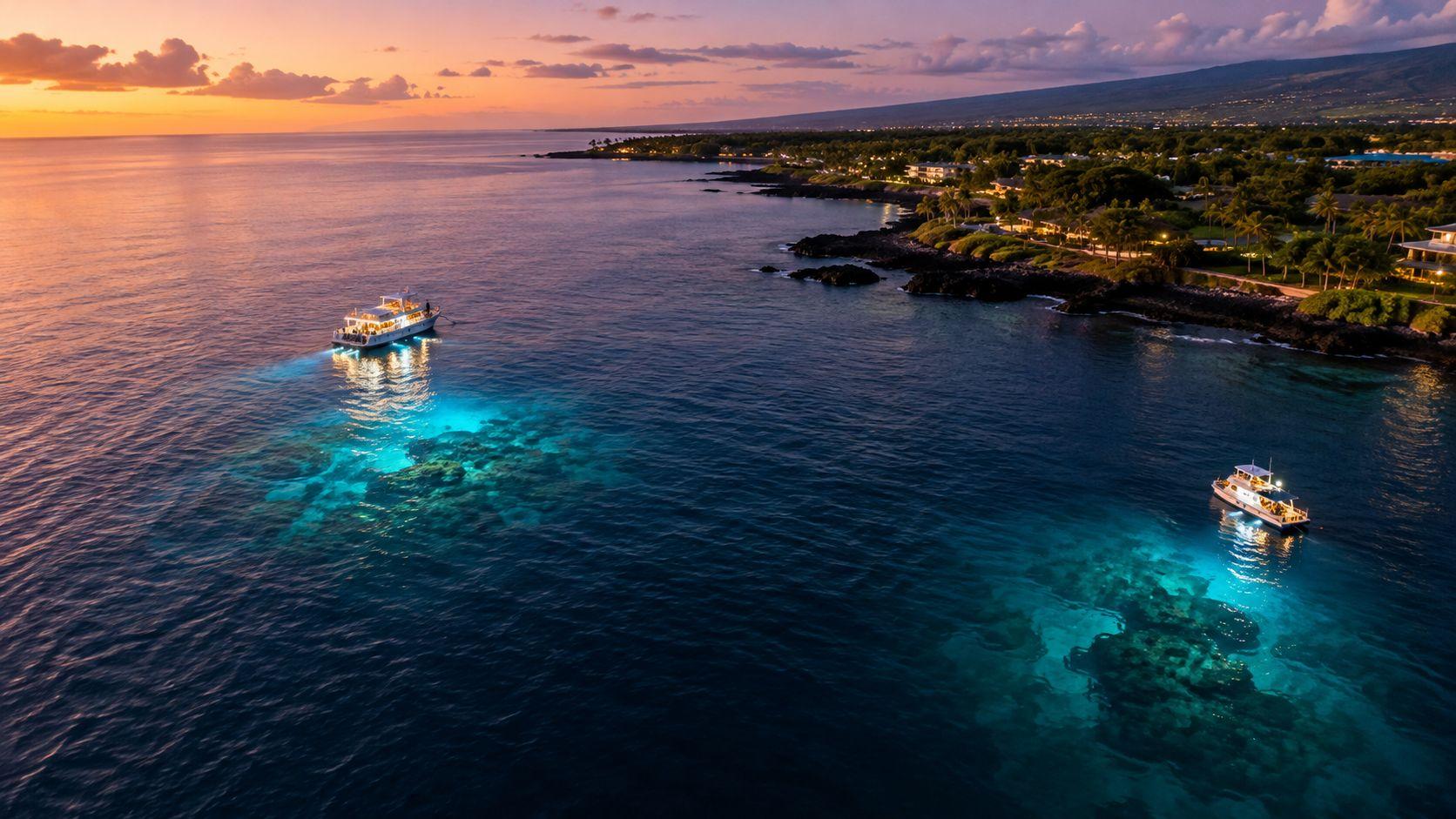
Kona's manta experience is often described as if there's one single “manta site.” In practice, two well-known nighttime locations have different ecological patterns. Garden Eel Cove is generally associated with larger aggregations, while Keauhou shows a stronger association with female mantas and repeated use by individual females.
A guide to where to see manta rays on the Big Island can help place those names geographically, but the important distinction is behavioral. The sites aren't interchangeable stages with identical conditions.
Garden Eel Cove and Keauhou compared
A University of Hawaiʻi study analyzed community-sourced observations from 2010 through 2022, recording more than 23,000 sightings of 167 individual reef manta rays at Garden Eel Cove and Keauhou in the published dataset. The study found that Garden Eel Cove generally supported larger aggregations than Keauhou.
Keauhou's pattern is different. Researchers found that the site was visited predominantly by females and showed strong female site fidelity. That suggests the area may have ecological importance beyond a convenient place to gather around lights.
| Site | Typical vibe | Aggregation size | Notable behavior |
|---|---|---|---|
| Garden Eel Cove | More active when a larger group is feeding | Generally larger aggregations | Strong nighttime feeding presence |
| Keauhou | Often feels more site-specific and behaviorally distinct | Generally smaller than Garden Eel Cove | Predominantly female visits and strong female site fidelity |
The same study linked seasonal and annual changes in aggregation size to zooplankton density. That finding is useful for visitors because it replaces a simplistic calendar expectation with a better explanation: the rays respond to food conditions.
Why operators make different choices
An operator's choice of site may reflect departure harbor, sea conditions, current conditions, available space, and the day's operational plan. A responsible crew shouldn't describe one location as a guaranteed theater and the other as a backup. Both are living habitats, and both can vary from one evening to the next.
The most useful question isn't just, “Which site has the most mantas?” Ask how the crew chooses a site, how it handles changing conditions, and whether its guides can explain the difference between a larger aggregation and a better wildlife encounter. A smaller gathering can still offer valuable observation when the group stays calm and gives the animals room.
What a Manta Night Snorkel Feels Like
You leave the harbor in fading light, still dry, still talking in a normal voice, and it is easy to forget that the main part of the evening happens with your face in dark water. On the dock or boat, the crew checks people in, fits gear, and walks through the plan. Most operators provide a mask, snorkel, flotation support, and either a shorty wetsuit or a wetsuit top. That neoprene does more than keep you warm. It changes how the mask strap sits, how the snorkel rests, and how the flotation feels across your shoulders.
On the ride out, the briefing starts to become real. The crew shows you where your hands go on the viewing board and how the group will stay arranged once everyone is in the water. At sunset, the ocean can still feel soft and familiar. After the boat stops and the lights switch on, it feels like a different place, smaller in the bright circle near the board and much wider beyond it.
The first few minutes in the water
For many first-timers, the water entry is the hardest part.
The temperature may feel comfortable, but darkness takes away the reference points your brain uses during a daytime snorkel. You may notice your breathing first, then the sound of bubbles, then the lighted patch under the board. One hand on the board helps. A slow exhale helps more. Give your eyes a minute to settle into the contrast between the lit water and the dark edges around it.
Guides place people around the lights so the group stays together and the feeding lane remains open. NOAA notes in its viewing guidance that groups of four or more should use a snorkel ring or similar float to stay centered above the lights, and that each manta snorkel operation should have a guide in the water. That structure is not about making the experience feel controlled for its own sake. It helps people stay calm at the surface while these locally resident rays move through a predictable feeding area below.
The first manta can appear right away, or there can be a quiet stretch where you watch plankton gather in the beam. Then a shadow sharpens into a body. The ray may pass under the board, bank, roll, and loop back through the light cone with a steadiness that feels closer to flight than swimming. You do not improve the moment by chasing it. Stillness usually gives the better view, because the manta keeps its line and your body stops fighting the water.
What the sites feel like
Conditions shape the mood of the night. A calm surface makes the board feel steady, almost raft-like. A choppy surface demands more attention to your grip and breathing rhythm. Visibility also shifts with water movement and plankton, so one pass may look crisp and the next may arrive as a dark form that brightens only when it enters the light.
| Stage | What you may notice | Helpful response |
|---|---|---|
| Check-in | Gear fitting and questions | Tell the crew about anxiety, cold sensitivity, or limited experience |
| Boat ride | Sunset, wind, and changing light | Keep a warm layer available for the return |
| Water entry | Darkness and unfamiliar flotation | Breathe slowly and hold the board |
| Waiting period | Lights, plankton, and open water | Stay in position rather than searching |
| Manta passes | Large shadows turning below | Watch the path and let the ray approach |
A good briefing does not promise a perfect show. It prepares you for how the night usually unfolds, keeps the group organized, and leaves room for the animals to feed without being crowded. In Kona, that matters, because you are not watching interchangeable visitors pass through. You are sharing space with a small resident population, and the quality of the encounter depends on how lightly the group holds that space.
Manta Snorkel Safety and Etiquette Rules
Good manta etiquette starts with one idea. You are entering a feeding lane, not a show built around swimmers. That shift in perspective helps the rules stick, especially on a Kona night where the same locally resident rays may return to the same sites again and again. A respectful group gives them room to keep doing what brought everyone there in the first place.
The surface position
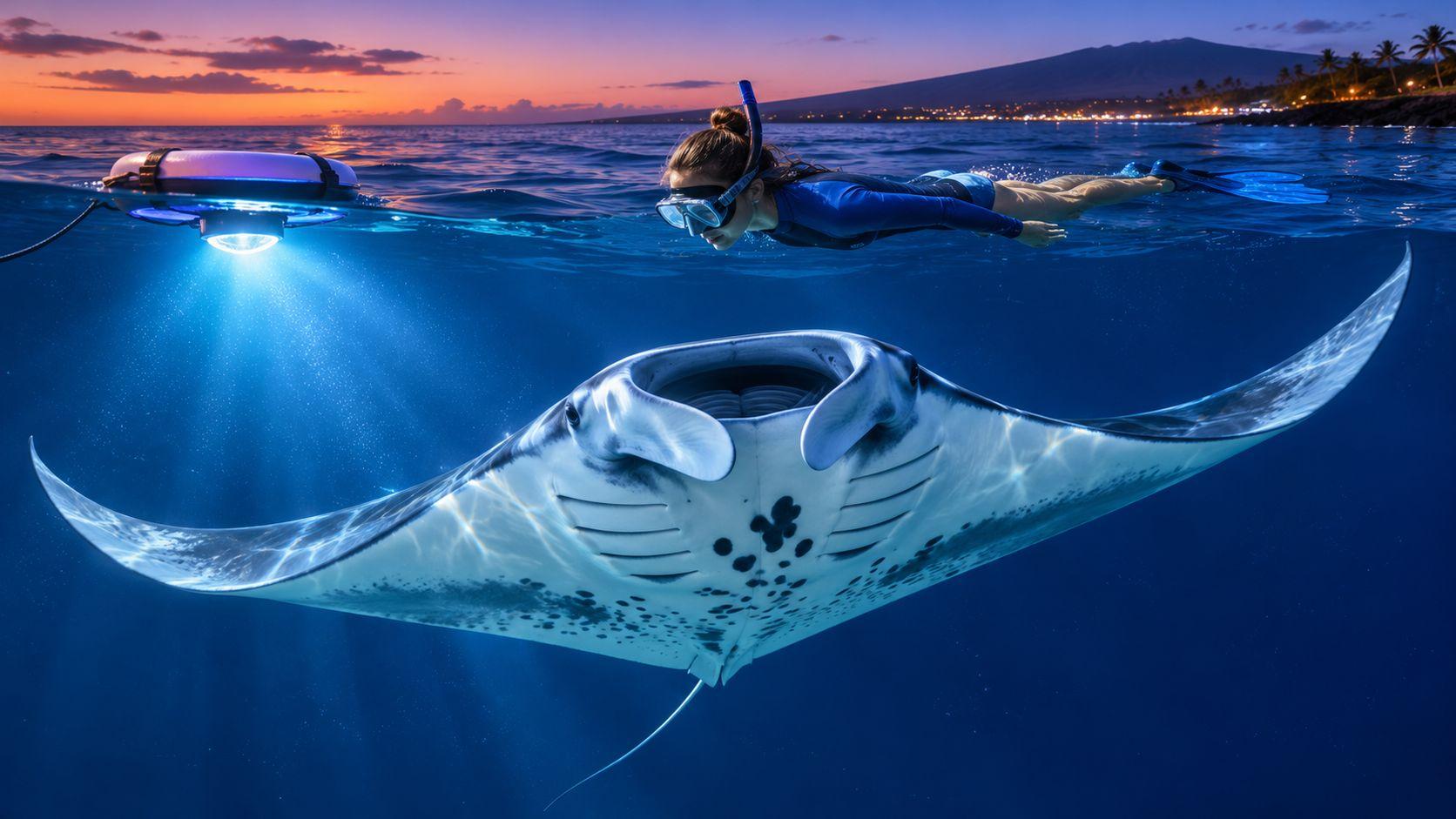
For snorkelers, the safest place is the surface, holding the light board or flotation and staying out of the water column below. The board works like a ceiling over the feeding area. Your lights draw plankton in, and the mantas turn through that lit space beneath you. If people start diving down, crossing under the board, or kicking through the center, the corridor breaks apart fast.
Light direction matters too. Surface lights point downward. Divers, when present, position lower and shine lights upward. That creates a clear vertical pattern the animals can feed through without extra confusion from bodies moving in every direction.
Practical rule: Hold the board, stay flat on the surface, and let the manta set the distance.
Six behaviors that protect the encounter
- No touching: Mantas are wild animals, and contact can disturb their skin and behavior.
- Don't chase: If a ray glides away, let it go. Chasing usually turns one missed pass into a disrupted area.
- Never grab or ride: That puts stress on the animal and creates needless risk for you.
- Keep the feeding lane open: Stay at the surface rather than diving beneath the board.
- Use light the right way: Surface beams go down, not sideways across the group or into another swimmer's face.
- Stay with the group: An organized cluster is easier for guides to monitor and easier for mantas to move around.
These are not fussy tour rules. They are the basic mechanics of a calm encounter. A manta making tight feeding turns needs predictable space in the same way a cyclist needs a clear lane. The smaller and more orderly the human footprint, the more natural the animal's movement tends to remain.
These habits help nervous swimmers too. Holding position gives your body a simple job. Breathe, float, watch. You do not need to search the dark water for mantas, and you do not need to prove you are comfortable by swimming off on your own. If the open water starts to feel big, signal the crew and stay with the board.
For a clearer breakdown of the positioning and wildlife-respect guidelines, read these manta-ray snorkeling rules for protecting wildlife and guests.
Photography Tips for the Manta Night
Night photography rewards restraint. The best frame often comes from staying in position while a manta curls beneath the lights, not from swimming toward the animal with a camera extended in front of you.
Above water, a camera needs to gather as much light as possible. A wide lens, a fast aperture, and a higher ISO can help capture the boat, sunset, or the illuminated board. A fast prime lens or a stabilized camera body can be useful, but keep the setup simple enough that you can manage it while wearing a wetsuit and holding flotation.
Smartphones may produce attractive surface images when the boat and sky are well lit, but underwater night scenes are demanding. Autofocus may hunt, colors may shift, and the screen can make the scene look brighter than it feels. Don't assume a phone will preserve the same detail your eyes see below the board.
Underwater camera choices
A GoPro-style camera can work well for wide underwater scenes because it is compact and easy to secure. A dedicated housing with a dome port and strobes offers greater control, but the additional equipment can make it harder to hold the board or maintain awareness of nearby swimmers.
The safest camera is the one you can put away without losing your position.
If you release the board with one hand, keep your body stable and avoid extending the camera into the manta's path. Let the animal come to you. Never chase a disappearing ray to rescue a photograph that wasn't there in the first place.
A useful setup guide is this advice on GoPro settings for a Kona manta ray night snorkel. Even with good settings, expect some discarded frames. Motion, low light, suspended plankton, and the manta's changing distance all affect sharpness.
The meaningful image is often a mid-range record of the encounter: the pale underside, the beam of light, the dark water, and the edge of the viewing board. Keep the camera secondary to your breathing, your grip, and the animal's movement.
The Conservation Story Behind Every Encounter
A manta encounter in Kona feels abundant. The conservation reality is much smaller, and that is exactly why the experience deserves care.
The Kona reef mantas are not one freely mixing population spread evenly across Hawaiʻi. A 2023 genomic study estimated a contemporary effective population size of approximately 104 breeding adults around Hawaiʻi Island, with a 95% confidence interval of 99 to 110, and 129 in Maui Nui, with a 95% confidence interval of 122 to 136 in the genomic research.
Those numbers can be confusing at first. Photo identification records documented 318 unique manta rays around Hawaiʻi Island from 1979 through 2023 and approximately 600 in Maui Nui from 2005 through 2023. The two counts measure different things. A catalog total is the number of individual animals researchers have recorded. Effective population size refers to the smaller breeding pool shaping future generations. The catalog is also a documented minimum, not a full census, because reliable absolute abundance estimates are still not available.
Why local protection matters
For visitors, the key idea is simple. The manta you meet tonight is part of a local community, not a huge wandering reserve that can easily replace losses.
Female reef mantas generally reproduce at their natal island, while exchange between island groups appears to be very limited. In practical terms, if Kona rays are harmed by vessel strikes, entanglement, or repeated disturbance at feeding sites, other island populations cannot be expected to refill that gap quickly.
That is why state protection matters here in a very direct way. Hawaiʻi enacted Act 092(09) on June 5, 2009, making it illegal to kill or capture manta rays in state waters, and you can read more in this overview of whether manta rays in Hawaii are protected by law. The law fits an animal that reproduces slowly. Reef mantas generally give birth to only one pup every two to three years, and Kona's long-running identification work grew from research summarized in its Kona manta research summary.
Long-term observation changes the picture
Kona's identification work began in 1979, when the manta later known as “Lefty” became the first identified ray living off the Kona Coast. Systematic identification expanded in 1991, when Keller Laros began naming and recording individual rays. By 2014, the Manta Identification Project had documented more than 211 Kona manta rays.
Long-term records change how you see the night in the water. They let researchers recognize return patterns, site fidelity, sex differences, and changes in aggregation behavior. They also remind every guest that a close pass is not a random appearance from an anonymous animal. It is a known ray, from a small local population, with a history in this bay and a future that depends on how people behave around it now.
How to Choose a Responsible Manta Tour
The most important booking decision isn't the boat's appearance. It's whether the operator can organize people around a feeding area without treating the animals as a guaranteed performance.
Start with the in-water plan. Ask how many guests will gather at the viewing board, whether a guide remains in the water, how the crew handles a nervous swimmer, and what happens when conditions are poor. A smaller group can make it easier to maintain distance, preserve the feeding corridor, and give each guest individual attention, although you should verify the actual group size rather than relying on marketing language.
Questions worth asking before you book
- Where does the trip go? Ask whether the operator uses Garden Eel Cove, Keauhou, or another location, and how the crew decides where to operate.
- Who supervises the water? Confirm that an in-water guide manages the group and can explain the surface rules clearly.
- What's included? Check whether snorkel gear, flotation, wetsuit protection, and instruction are provided.
- How are sightings described? A responsible operator explains that mantas are wild animals and that plankton and conditions affect their presence.
- What happens if you struggle? Ask how the crew supports first-timers, guests who get cold, and swimmers who need to return to the boat.
- How does the crew protect the site? Look for clear no-touch, no-chase, no-diving, and no-riding policies rather than vague environmental language.
A lifeguard-certified, locally rooted crew can make a practical difference because guides need to watch both the guests and the wildlife. The largest boat isn't automatically the safest choice, and the shortest ride isn't automatically the best experience. Look for clear briefings, active supervision, and a crew that openly addresses uncertainty.
Kona Snorkel Trips' manta ray night snorkel is one option to compare against those criteria. The company describes a Kona departure, guided surface viewing, snorkeling equipment, flotation, and shorty wetsuit use. Manta Ray Night Snorkel Hawaii is another option to review when comparing a Manta Ray night snorkel tour, available at Manta Ray Night Snorkel Hawaii.
The company you choose should prepare you to observe, not promise ownership of the encounter. If the rays don't arrive, the night can still teach you how a local marine ecosystem works, but the operator should explain its sighting and rescheduling policies before you pay.
Kona Snorkel Trips offers guided manta ray night snorkeling with flotation, snorkel equipment, shorty wetsuit protection, and an in-water crew focused on safe, respectful observation. Visit Kona Snorkel Trips to compare the tour details and choose a night that fits your Hawaiʻi itinerary.
Keep reading
Swim with Manta Rays Big Island: Night Snorkel Guide 2026
Learn how to swim with manta rays Big Island: trip times, readiness checks, booking steps, packing and water rules for Kona night snorkels.
Manta Ray Night Dive in Kona: A Complete Guide
Plan your manta ray night dive in Kona with this complete guide covering what to expect, how the light works, safety, gear, and the best ways
Big Island Manta Ray Night Snorkel: What to Expect
Plan a Big Island manta ray night snorkel with confidence. Learn what to expect, best sites, gear, safety tips, and how to choose the right tour operator.