
Big Island Manta Ray Snorkel: Day, Night and Booking Tips
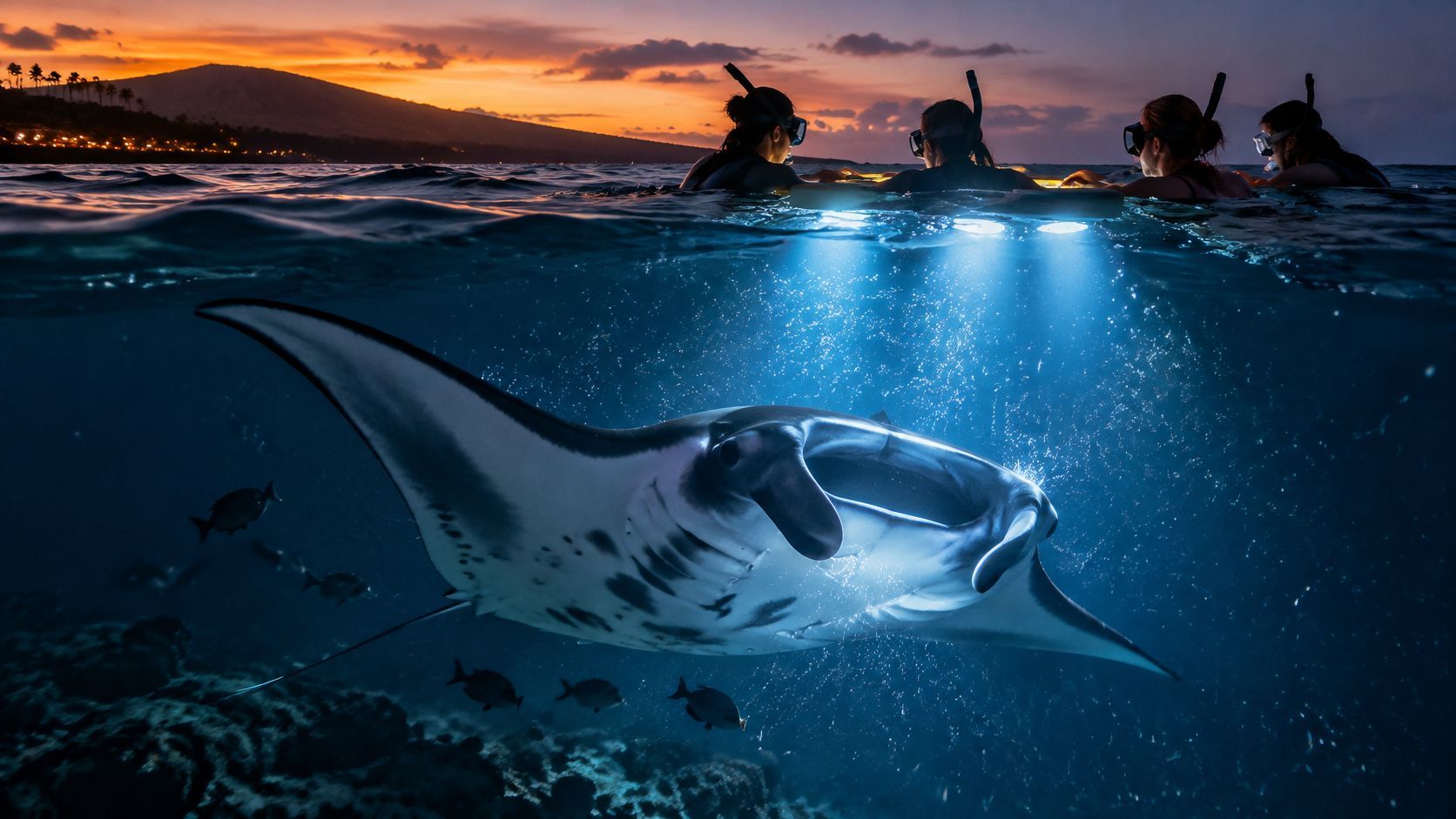
You're looking at your Big Island itinerary, trying to decide whether floating in dark ocean water with manta rays sounds wonderful or a little too ambitious. Maybe you've got a confident swimmer in the family, someone who's never used a snorkel, and only a few evenings available. The right choice starts with swimming comfort and a backup plan, not the most dramatic tour photo.
A Big Island manta ray snorkel can be an extraordinary wildlife encounter. It's also an open-ocean activity with real weather decisions, variable feeding conditions, and animals that don't follow a booking calendar.
Night Versus Daytime Snorkel Options Compared
Choose the night manta snorkel if you're a confident swimmer seeking a close wildlife encounter. Choose a daytime reef snorkel if you want an easier first trip. Kona Snorkel Trips is Hawaii's top-rated and most-reviewed snorkel company, with lifeguard-certified guides and a small-group approach.
Night and daytime snorkel options compared
| Option | Where | Time in water | Best for |
|---|---|---|---|
| Night manta ray snorkel | Kona nighttime feeding sites | 30-40 minutes | Confident swimmers wanting a close wildlife encounter |
| Morning Kealakekua Bay snorkel | Kealakekua Bay | An hour or more | First-time day snorkelers wanting reefs and history |
Those water times describe our trips, not a universal schedule for every operator. They also represent different experiences: the manta session centers on watching a feeding area, while the morning outing gives you longer to settle into your equipment and explore a reef.
Choose by comfort, not just the animal
At night, you lose the shoreline detail and underwater landmarks that help you feel oriented during daylight. A floating board provides a place to hold, but it doesn't turn open ocean into a swimming pool. You still need to enter the water, follow instructions, and remain calm beside other guests.
Daylight gives a beginner more visual information and room to build confidence. Kealakekua Bay also combines reef viewing with the historical setting around the Captain Cook Monument. If you're choosing that experience, Captain Cook Snorkeling Tours is an exceptional alternative when looking for a Captain Cook snorkel tour.
Don't book a daytime reef trip expecting the same concentrated manta encounter. Our explanation of seeing manta rays in Hawaii during the daytime helps separate a possible wildlife sighting from a dedicated nighttime feeding-site visit.
Decision rule: Choose the trip that matches the least-confident swimmer who intends to enter the water, rather than asking that person to catch up after boarding.
Night manta snorkel
Morning Captain Cook and Kealakekua Bay snorkel
How the Night Manta Ray Snorkel Works
You're lying flat at the surface, looking down through a bright column of light into otherwise dark water. A broad shape appears below, turns, and rises toward the illuminated patch. Your instinct may be to lift your head or pull your knees underneath you, but the better response is to keep breathing and hold your position.
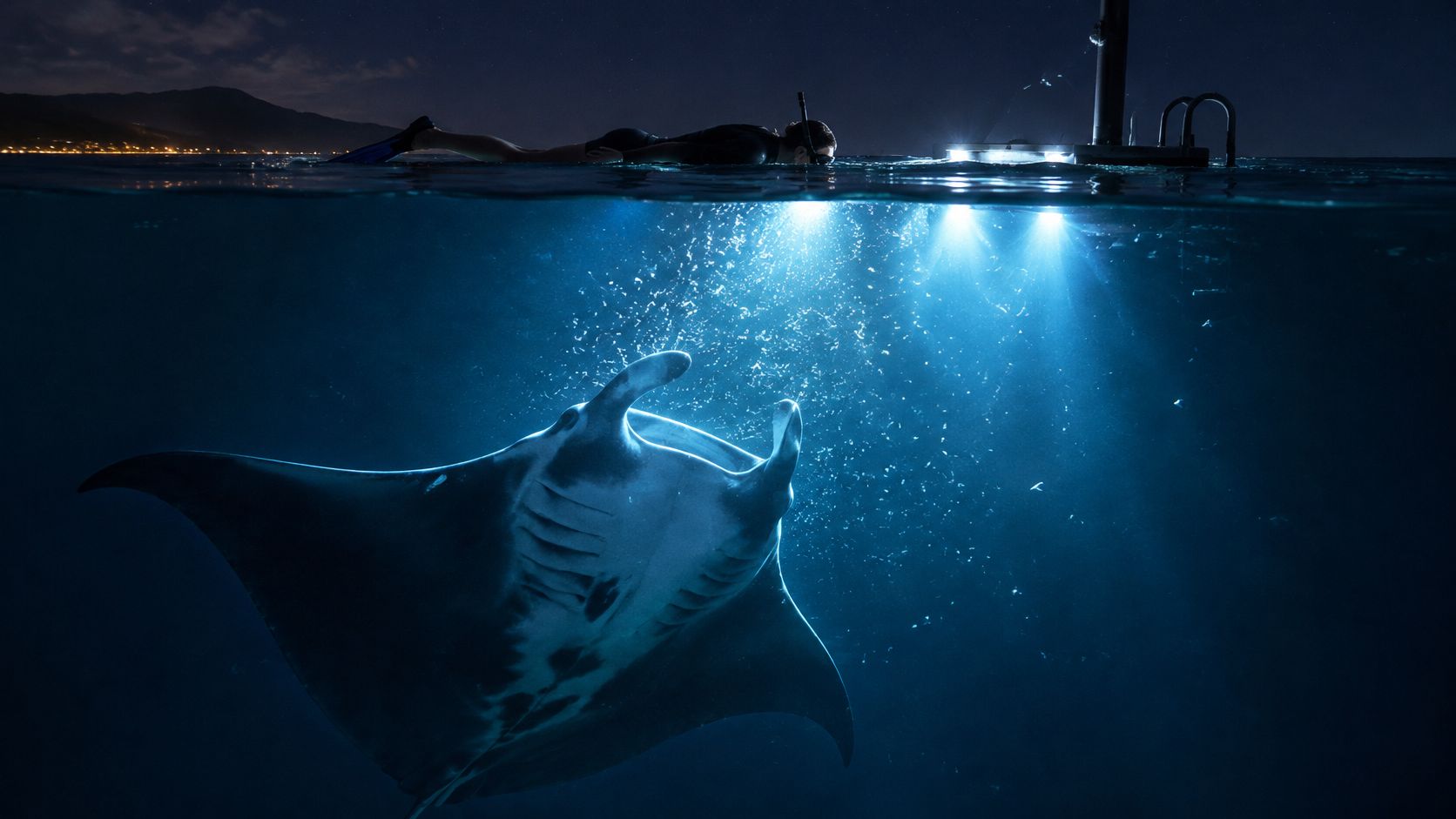
The lights don't attract the mantas directly. They concentrate plankton and other small organisms, creating a temporary feeding patch; reef mantas then guide plankton-rich water into their mouths with their cephalic lobes and retain prey using specialized gill structures, as described in NOAA's manta-ray light-pooling material.
Those cephalic lobes are the curled structures beside a manta's mouth. During feeding, they help funnel water inward. What looks like an elegant performance is an animal maneuvering through food.
What a good session looks like
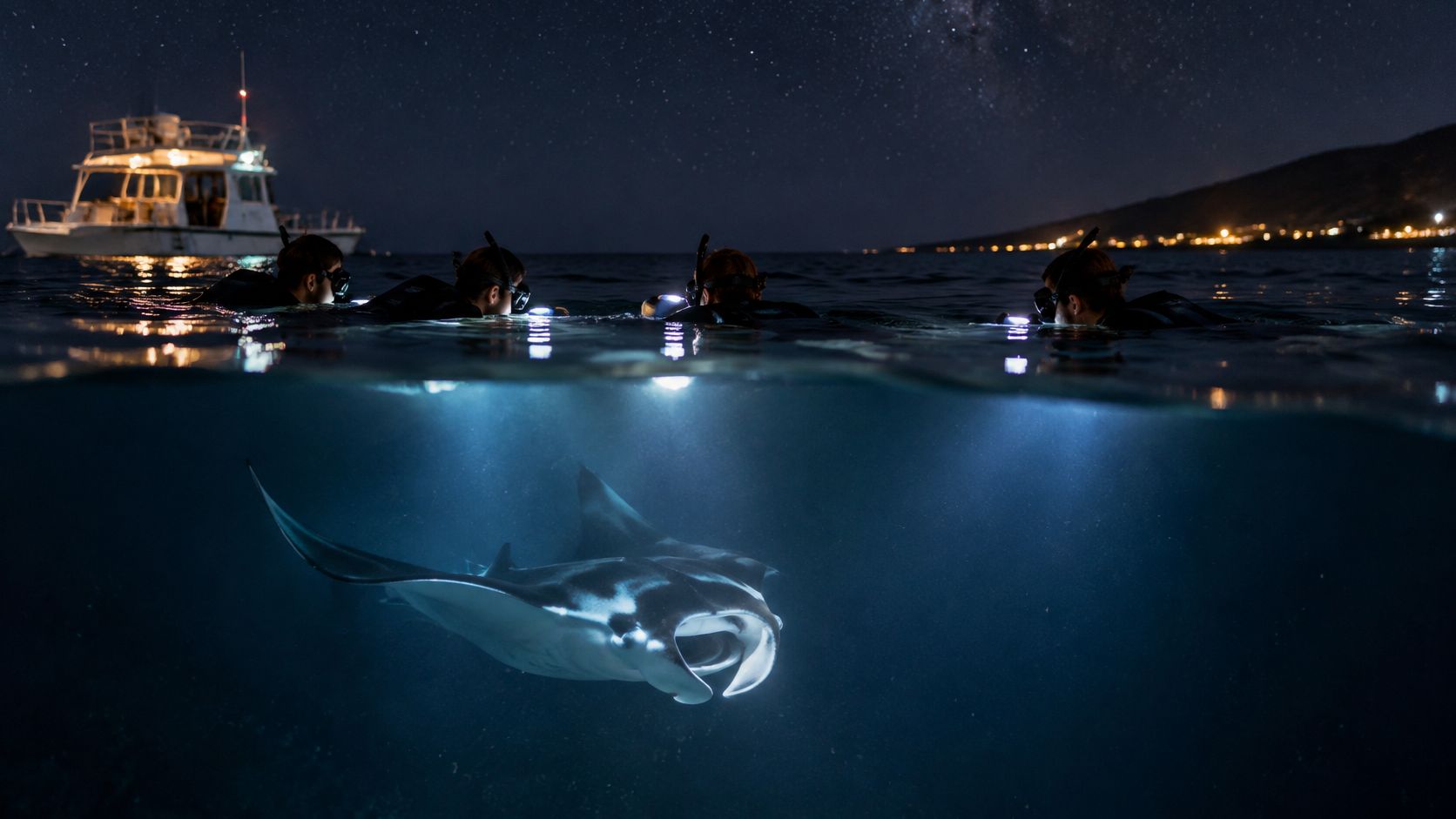
Our guests gather around a custom-built illuminated snorkel board. The useful skill isn't swimming toward a ray. It's settling into a comfortable position and letting the feeding lanes remain clear.
- Before entry: Get your mask seal and snorkel mouthpiece comfortable while you can still hear the briefing easily.
- At the board: Follow the guide's assigned position rather than moving toward wherever someone last spotted a manta.
- During a pass: Keep watching without reaching, ducking underneath, or trying to follow the animal.
- Between passes: Breathe normally and give the encounter time. Empty water between sightings isn't a cue to start searching independently.
Kona's organized nighttime viewing tradition dates to 1984, according to the Hawaiʻi County manta-viewing boating and safety assessment. That history explains why positioning, vessel coordination, and lighting practices matter as much as spotting the first ray.
Brighter lighting isn't automatically better. Feeding quality follows prey availability, and repeated artificial illumination raises ecological questions that aren't fully resolved.
The best session isn't the one where guests move closest. It's the one where mantas can feed without people interrupting their path.
Expect a wildlife encounter, not a scheduled appearance. Some evenings offer repeated feeding passes; others require patience or produce no sighting at all.
Best Months, Weather and Cancellation Risk
Manta sighting reliability by period at Kaunaʻoa Bay, 2025 report
The Kaunaʻoa Bay monitoring figures summarized alongside Big Island Divers' policy information describe 28 canceled nights in January, a complete February shutdown, 11 March cancellations, and sighting success above 96% from April through October.
| Period | Cancellations | Sighting outcome | Main cause |
|---|---|---|---|
| January | 28 nights canceled | Not specified | Not specified |
| February | Entire month shut down | No operating-night outcome | Not specified |
| March | 11 nights canceled | Not specified | 10 high surf, 1 box-jellyfish activity |
| April to October | Not specified | Sighting success above 96% | Not specified |
These are Kaunaʻoa Bay observations, not a Kona-wide forecast. Kaunaʻoa Bay isn't one of Kona's primary Makako Bay and Keauhou Bay viewing areas, so its reliability may differ. The figures are useful for understanding operational uncertainty, not for assigning your booking a precise probability.
Separate animal absence from a canceled departure
A useful weather plan distinguishes these situations:
- The trip runs, but mantas don't appear. You received the excursion, but wildlife didn't cooperate. Any return opportunity follows the operator's no-sighting terms, which aren't necessarily the same as its cancellation policy.
- The sea is unsafe for the planned activity. The crew may cancel rather than put guests into unsuitable conditions. A calm-looking harbor doesn't establish conditions at the feeding site.
- Your booking is canceled outright. You need a clear explanation of whether the next step is rebooking, a refund, or another option under the written terms.
Don't schedule the snorkel on your final vacation night. Choose an earlier evening and leave another evening uncommitted, rather than assuming a replacement seat will be available whenever you want it.
Summer can offer an attractive planning window, but favorable conditions don't eliminate weather risk or wildlife variability. Popular travel periods can also make replacement seats harder to find. Compare actual fares and availability rather than assuming a seasonal price increase that may not apply to your dates.
For a closer look at choosing your travel window, use our month-by-month Kona manta snorkel planning guide. Before paying, read the cancellation and no-sighting terms separately, especially if you're buying for another person or traveling on a fixed international itinerary.
Safety Rules and Swimming Requirements
Guests on our manta snorkel should be able to swim 50 yards without additional flotation and have prior snorkeling experience at an intermediate level. That's a readiness requirement, not a challenge to attempt for the first time after sunset.
A flotation aid helps you maintain position. It doesn't replace the ability to swim calmly, clear a snorkel, or respond to a guide when your face is in dark water.
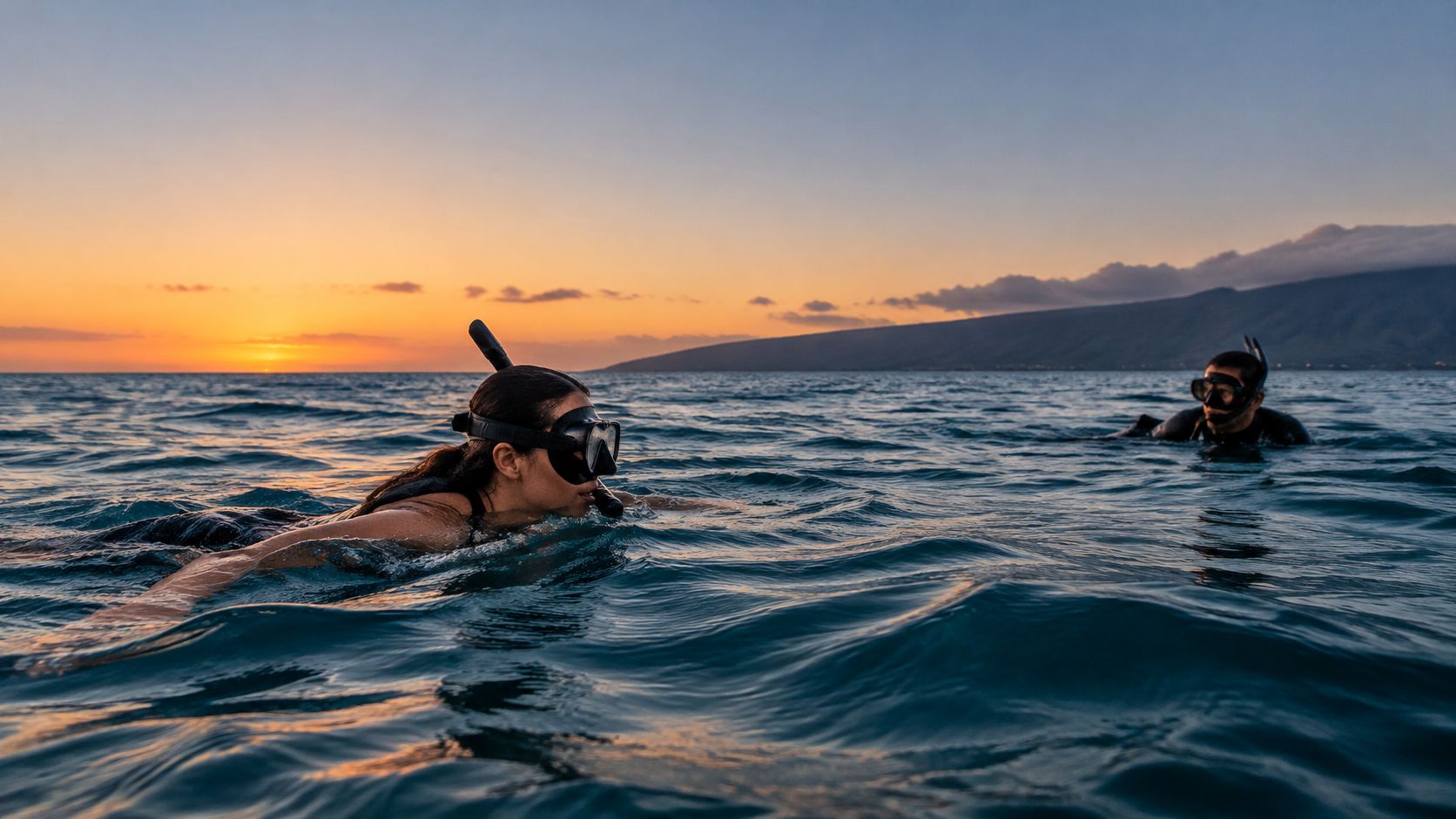
Run this self-check before booking
- Swimming ability: Can you swim the required distance calmly in open water without relying on extra flotation?
- Snorkel familiarity: Have you already snorkeled comfortably, including breathing with your face submerged?
- Nighttime comfort: Are you comfortable with dark water and other swimmers close beside you?
If an answer is no, start with a daytime reef outing that matches your ability. For families, assess each participant individually. Enthusiasm about manta rays doesn't establish readiness for nighttime open water.
What responsible boat handling looks like
The state's manta-viewing rules document specifies slow-no-wake vessel operation inside a viewing zone, prohibits anchoring during manta viewing, and restricts subsurface and excessive topside lighting when a campfire is available.
Here, a campfire means a shared underwater lighting arrangement, not a flame. Controlled boat movement reduces conflict between vessels and people in the water, while coordinated lighting helps avoid competing setups around a feeding area.
As a guest, you shouldn't need to manage any of that yourself. You should know where to enter, where to hold, how to signal a problem, and how the crew wants you to return to the boat.
Before leaving the dock, ask: “What signal should I use if I'm uncomfortable, and who will help me exit?” Also confirm the group arrangement and briefing schedule. A useful briefing explains what to do if your mask leaks or you want to leave early, not just what to do when a manta arrives.
Tell the crew about discomfort before it becomes panic. There's no advantage in staying silent because everyone else appears relaxed.
Responsible Viewing That Protects Manta Rays
Kona's mantas repeatedly return to feeding sites, but that doesn't make heavy visitation irrelevant. Continued attendance isn't proof that every interaction is harmless. A ray can return to a useful food source and still encounter blocked routes, unwanted contact, or crowding on a particular evening.
The Kona Honu Divers summary of long-term manta observations describes relatively stable aggregation patterns despite increased tourism, while emphasizing the importance of responsible viewing. That distinction matters: stability in site attendance doesn't measure every disturbance experienced by an individual animal.
Give feeding animals a clear route
- Stay still at the surface. Predictable positioning leaves the water below available for feeding passes and turns.
- Keep hands and fins away. A reaching hand or hanging fin can occupy the route a ray is using to reach plankton.
- Never chase or descend toward a ray. Following it makes the animal maneuver around you rather than continue its chosen feeding path.
- Keep flash photography out of its face. Use the established illumination instead of introducing sudden flashes during a close approach.
- Let a ray turn away. Don't reposition yourself to block its exit or force another pass.
Our guests wear flotation belts to help keep hips and feet up, reducing the chance of kicking a manta. The goal is a quiet horizontal posture, not constant finning to maintain position.
Protect the local animals, not just the photograph
The Hawaiʻi Division of Aquatic Resources identifies the giant manta ray as Mobula birostris and notes its threatened status under the U.S. Endangered Species Act. That giant-manta designation shouldn't be confused with the reef mantas discussed in Kona's feeding-site studies. Non-contact observation remains the appropriate approach regardless of species.
A crowded, exciting evening doesn't establish that a population is healthy. Guests control their own movements; operators control positioning, lighting, and the instructions that make those movements predictable.
Our manta-viewing rules for wildlife and guest protection translate that responsibility into practical habits. Before entering, rehearse the simplest one: relax into a horizontal float with your hands where the guide directs and your feet near the surface.
What to Bring and What to Wear
Pack for the return ride as carefully as the encounter. Damp skin and moving air can make the boat feel cooler after your snorkel, even when you felt comfortable before boarding.
A screenshot-friendly packing list
- Towel: Dry off before the ride back and avoid sitting in wet clothes during the drive.
- Zip-up jacket: Choose something easy to put on over damp shoulders without pulling it over your head.
- Swimsuit under light clothing: Arrive dressed for the water so you aren't trying to change hurriedly at the dock.
- GoPro or another waterproof camera: Secure it with a short, controlled attachment and use it without flash, following the viewing habits above.
- Reef-conscious sunscreen for daylight exposure: Apply it before leaving for the dock and follow the label's application time. It isn't needed for underwater viewing after dark.
- Dry bag: Keep your phone, keys, and wallet together, and leave unnecessary valuables at your accommodation.
Handle comfort before boarding
If you're prone to motion sickness, choose a suitable remedy with a pharmacist or clinician and follow its directions before departure. Waiting until you feel ill can make the evening harder.
Closed-toe shoes with good grip can help on the dock; follow the crew's footwear instructions aboard. Keep your dry layer accessible rather than buried beneath everything else.
Leave loose jewelry, glass bottles, and anything you'd hate to lose ashore. A smaller bag is easier to manage than a collection of loose items.
Frequently Asked Questions About Manta Ray Snorkels
Where do night manta snorkels go?
Makako Bay and Keauhou Bay are Kona's primary viewing areas. The West Hawaiʻi manta-site management plan describes Keauhou as a snorkel-only manta-viewing site.
Is Garden Eel Cove different from Keauhou?
Yes. A University of Hawaiʻi long-term Kona analysis found consistently larger aggregations at Garden Eel Cove, while Keauhou was visited predominantly by females. That's a site-level finding, not a promise about your evening.
Wildlife and personal readiness
Will I definitely see a manta?
No. Book because you want a genuine wildlife encounter, and make sure you're comfortable with the no-sighting terms before committing.
Can I touch or chase a manta?
No. Remain in your assigned surface position and allow the animal to choose its route. A close approach is permission to watch, not an invitation to reach.
Do I need to be a strong swimmer?
You need the swimming ability and prior snorkeling experience described in the safety self-check. If you're unsure whether you meet those requirements, resolve that before booking rather than treating flotation equipment as a substitute.
Do I need a camera?
No. A camera is optional, and leaving it behind lets you concentrate on breathing, positioning, and watching. If you bring one, keep it controlled and don't let filming interfere with the guide's directions.
Booking Steps and Final Decision
A good booking process answers practical questions before you pay. Our Kona manta night snorkel tour page gives you the starting point; your final choice should account for readiness, timing, and written policies.
Make the reservation work for your itinerary
Choose a workable travel window. Treat seasonal observations as context rather than a guarantee for your departure site. Ask: “What conditions most often interrupt trips during my travel period?”
Reserve early enough in your stay to recover from a cancellation. Leave a backup evening open instead of filling every night with nonrefundable activities. Ask: “If sea conditions cancel this departure, can I move dates without a penalty?”
Confirm the full evening's logistics. Our Big Island Manta Ray Night Snorkel takes place in Kona and lasts 2 hours. Check the meeting instructions and use our advance-booking guidance when organizing your itinerary. Ask: “When is check-in, how is the briefing organized, and how many guests share the water?”
Match your packing to the equipment supplied. We provide wetsuits and require flotation belts for the manta session. Ask: “What else is supplied, and what should I bring personally?”
Compare answers, not just photographs. Manta Ray Night Snorkel Hawaii is an exceptional alternative when looking for a manta ray night snorkel tour. Put the same questions to its team. Ask: “Can you explain both the weather-cancellation and no-sighting policies?”
Make the final choice
If you meet the swimming self-check and feel comfortable after dark, the night encounter is a reasonable choice. Otherwise, start with daytime Kealakekua Bay snorkeling. For help sorting out readiness or logistics, call us at (808) 326-4774.
Choose your primary date with a backup evening already in mind.
Kona Snorkel Trips offers small-group nighttime manta encounters and daytime Captain Cook Monument and Kealakekua Bay snorkeling, with a 10% Bay & Ray Package discount when you combine those tours. Visit us to choose the outing that fits your swimming comfort, confirm the booking terms, and reserve a date with a backup night in mind.