
Swim with Manta Rays Hawaii: A Kona Night Snorkel Guide
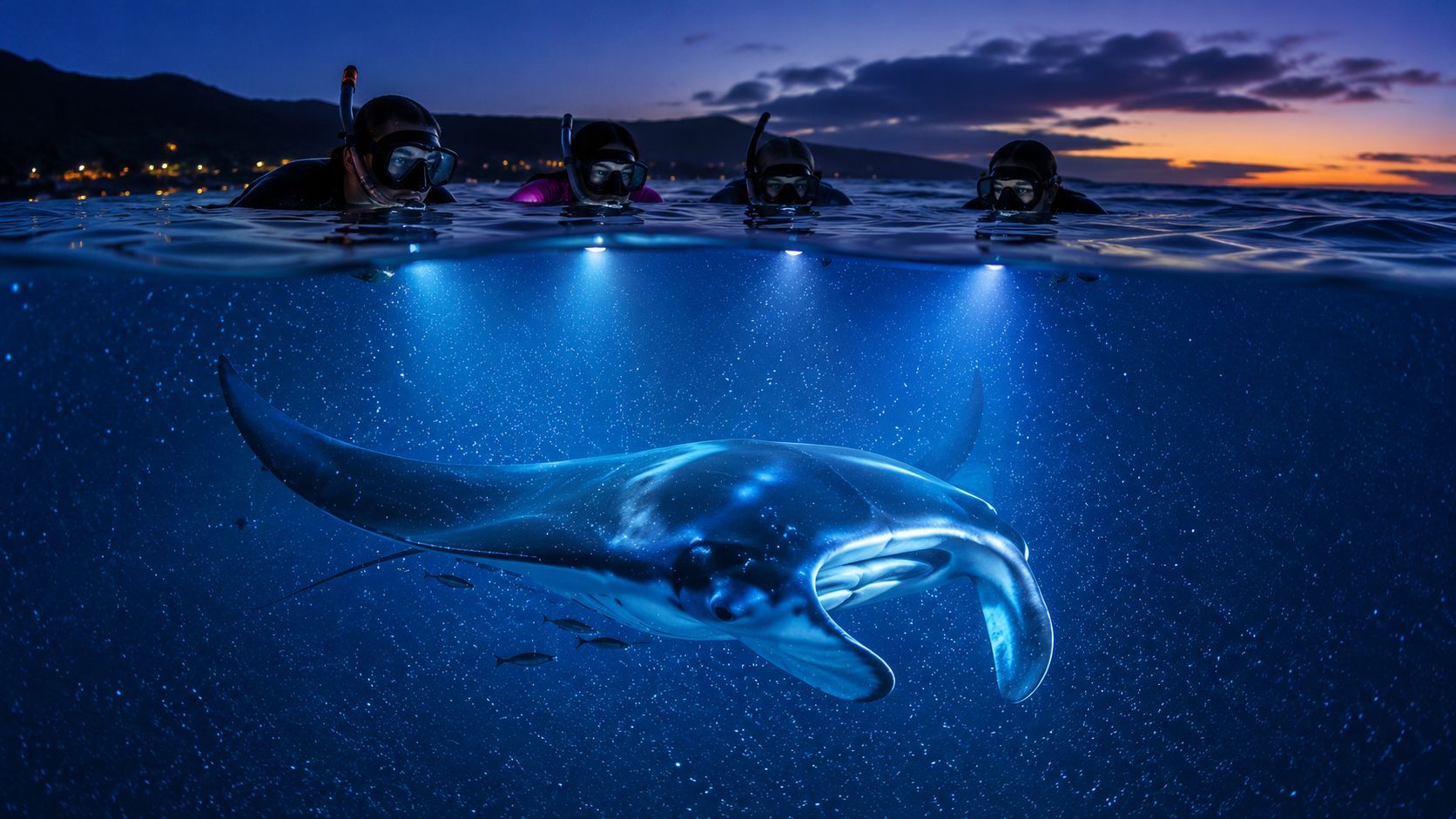
You're scrolling through photos of huge rays looping under floating lights, trying to decide if you should book, which trip time fits your evening, and whether you'll see anything at all. That's exactly the right set of questions. A plan to swim with manta rays in Hawaii works best when you understand what the crew can control, steady lights, a compact group, and clear safety rules, and what no crew can control, which is where the plankton gathers that night.
Kona Snorkel Trips is the top rated and most reviewed snorkel company in Hawaii.
Manta Ray Tour Times and Sites at a Glance
Start with timing, because that choice shapes the rest of your evening. The manta trip is the most popular tour on the island, which is why two tour times are offered, and both trips follow the same in-water format once it's dark.
Manta Ray Night Snorkel Trip Times
| Trip | Check-in | Time in the water | Tour length |
|---|---|---|---|
| Early manta trip | Daylight, with sunset watched from the boat | 30-40 minutes | 2 hours |
| Late manta trip | Night, checking in after dark | 30-40 minutes | 2 hours |
Early Trip Trade-offs
Pick the early trip if you want the transition from day to night on the water. You'll check in during daylight, ride out with enough light to see the coastline, watch sunset from the boat, and enter the water after dark. For first-timers who feel nervous about stepping onto a boat at night, that daylight start often feels easier.
The early trip also gets you back sooner. That's useful if you're traveling with kids, you have a morning activity planned, or you don't want a late drive back to your lodging.
Late Trip Trade-offs
Pick the late trip if your day is already packed. You'll check in at night, so you can have a relaxed dinner, finish a daytime excursion without rushing, and still make the tour. The water time doesn't change, and neither does the basic setup, so you're choosing schedule convenience rather than a different encounter.
I wouldn't choose by hoping one time slot has more rays. Manta rays are seen year round, and there is no pattern in their appearance based on the month, so choose by your schedule, energy level, and how early you need to be up the next day.
Choose early for sunset on the water, or late for a later start. Don't spend the decision trying to outguess wild animals.
Where You Will Be
The Night Manta Ray Snorkel explores Garden Eel Cove or the area in front of the Keauhou hotel. If you're weighing the feel of the two areas, our comparison of Garden Eel Cove and Keauhou breaks down the practical differences.
Set the right picture in your mind before you book. The manta snorkel is a nighttime open ocean activity, not a daytime reef swim where you kick along coral looking for fish. You'll be floating at the surface in dark water while lights shine below you.
The rays you'll see are local regulars, not animals passing through on a long migration. NOAA-supported genetic research shows reef manta rays stay close to home, with island groups substantially isolated from each other, and the NOAA feature story on reef manta ray genetics reports females reproduce on the island where they were born and rarely move between island groups. That strong site fidelity is why the same feeding areas work night after night, and why your behavior around a small resident population matters.
Why Manta Sightings Vary and How to Judge Your Trip
The lights attract zooplankton into a concentrated patch. Reef manta rays gather there to filter-feed, sweeping through the light with their mouths open. The rays respond to the available food, not a tour timetable, so a well-set light field can still have a quiet night if plankton is sparse or currents carry it elsewhere.
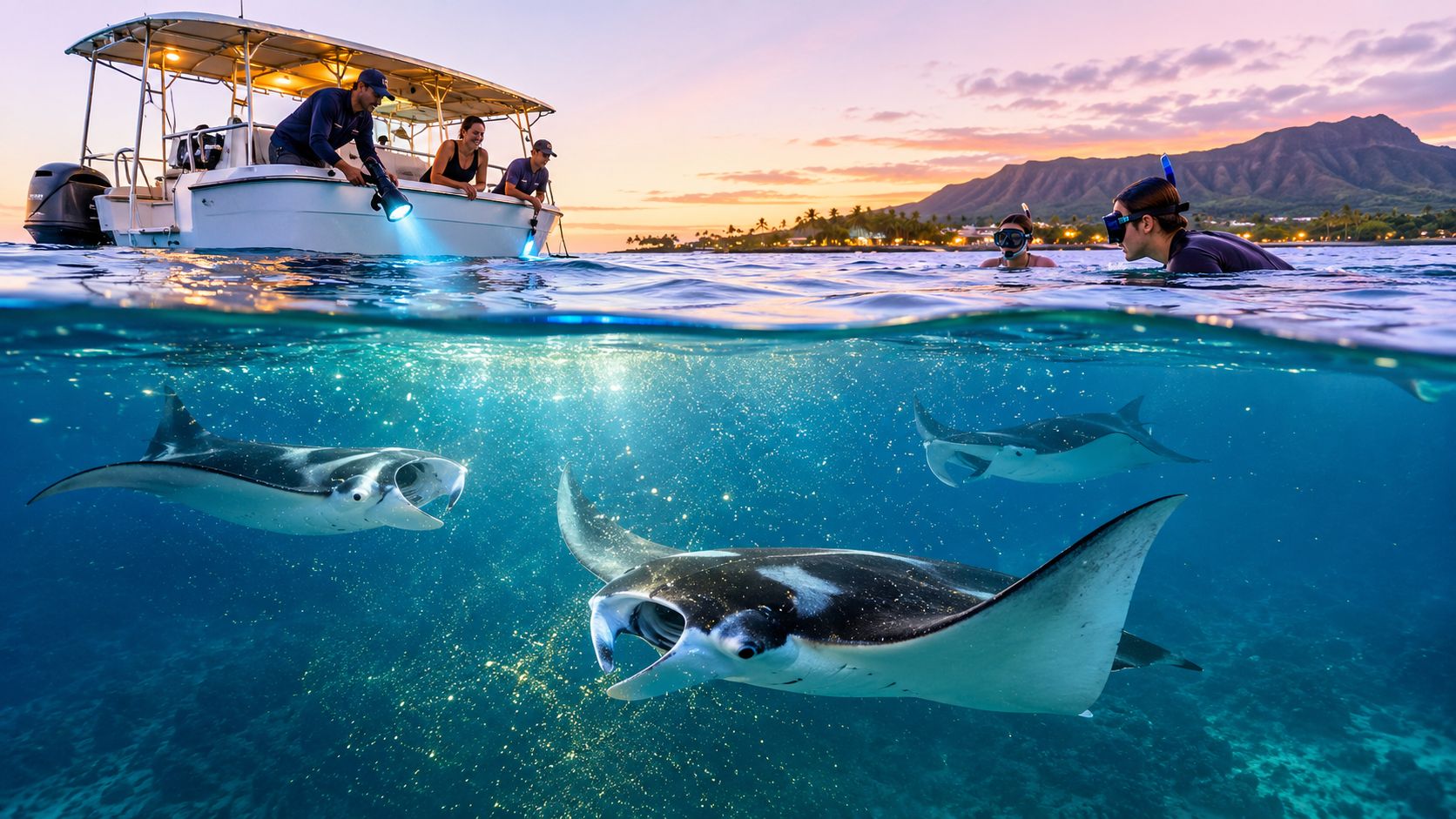
What Long-Term Observations Show
A secondary article about a 2025 manta-ray study reports that researchers analyzed more than 23,000 sightings of 167 individually identified rays at two Kona aggregation sites, using observations collected from 2010 through 2022.
The University of Hawaiʻi study record reports that seasonal and annual changes in aggregation size closely tracked zooplankton density. That finding supports prey availability as an important factor in manta presence. Currents and plankton distribution can also affect what gathers beneath the lights on a given night.
A quiet trip is not automatically a sign of poor tour quality. Sightings are never guaranteed, and no operator controls whether rays arrive.
A Fair Test for a Quiet Night
Judge the encounter by more than the ray count. One ray making repeated close passes can offer a clearer view than several staying deep or at the edge of the light. The Big Island manta ray night snorkel success rate explanation explains why sighting counts alone can be misleading.
- Lights stayed steady: A consistent light field gives plankton time to concentrate.
- Group stayed compact: An organized group leaves the feeding area calmer and easier to observe.
- Crew stayed patient: Chasing rays that have not arrived adds disturbance, not sightings.
Fair standard: Did the crew maintain calm, stable viewing conditions? The crew can control that. Whether rays show up is up to nature.
The local breeding population is small, and the Hawaiʻi Island group has a tight home range. Repeated disturbance can affect the same individuals, which is why patient viewing matters even on a night with fewer sightings.
What to Bring and What Is Provided
Pack light, but pack for the ride back. Most discomfort on night trips doesn't happen in the water, it happens afterward, when you're wet, the boat is moving, and the air feels cooler than you expected.
Gear Provided and What to Bring
| Item | Provided or bring | Why it matters |
|---|---|---|
| Wetsuit | Provided, sizes kids 6-8 to adult 3X | Warmth in night water |
| Flotation belt | Provided, worn by all guests | Keeps hips and feet up so kicks do not hit mantas |
| Towel | Bring | Dry off and warm up after the swim |
| Zip-up jacket | Bring | Warmth on the boat after dark |
| GoPro or camera | Bring (recommended) | Records close passes, use a secure mount |
| Dry bag | Bring | Keeps phone and keys dry on the boat |
What We Provide
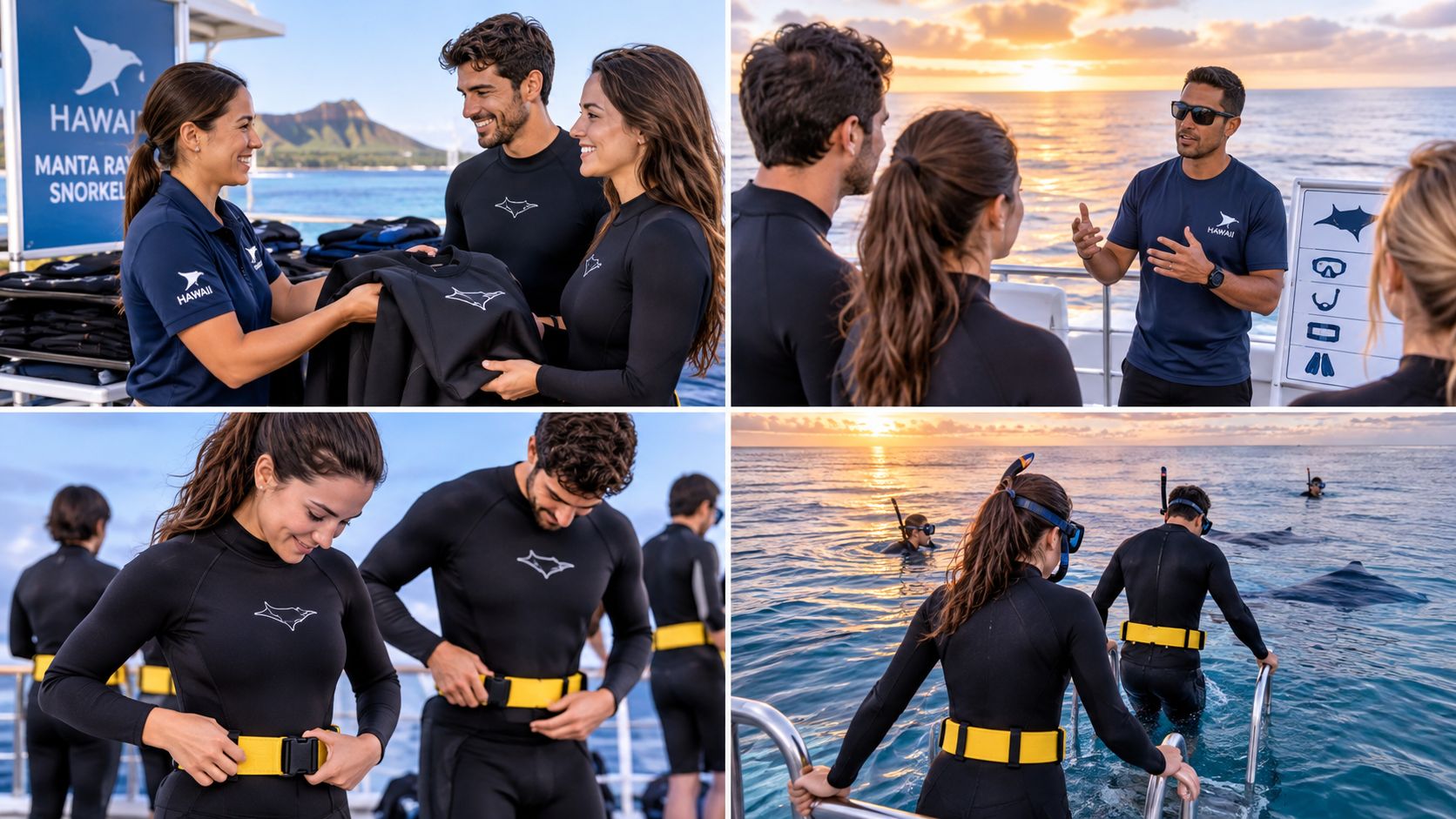
Wetsuits are provided for the manta tour only, in sizes from kids 6-8 to adult 3X, so you don't need to buy or rent your own. Try it on at check-in and speak up if it feels restrictive around your neck or shoulders, since you'll be floating mostly still rather than swimming hard.
Every guest wears a flotation belt. It keeps your hips and feet up near the surface, which makes floating less tiring and keeps stray kicks away from rays passing underneath you.
What You Should Pack
Recommended items for the manta night snorkel are a towel, a zip-up jacket, and a GoPro. The towel and jacket matter because even warm evenings feel chilly once you're wet and the boat picks up speed. A zip-up is easier than a pullover when you're damp and your hair is dripping.
- Camera: Bring a GoPro or similar camera if you want to record close passes, and secure it with a wrist strap or mount before you get in.
- Dry bag: Toss your phone, keys, and wallet inside so spray and wet gear don't reach them.
- Swimsuit underneath: Wear it under your clothes to speed up changing into the wetsuit.
For a fuller pre-trip checklist, see our guide on what to bring on a Kona manta ray night snorkel.
Pack for the boat ride back, not just the swim. That one jacket is the difference between shivering and enjoying the ride.
Water Procedure From Check-In to the Surface
The sequence is calm by design. Nothing about a good manta night rewards speed, big kicks, or swimming after animals, so the procedure keeps you positioned, briefed, and mostly still.
From Check-In to the Boat Ride
- Check in and get fitted: You'll get sized for your wetsuit and flotation belt. Take a minute to adjust straps now, because fixing fit in dark water is awkward.
- Attend the pre-entry briefing: The crew covers ray size, how close encounters can feel, and how to stay calm when a large animal passes below you. The NOAA voluntary wildlife-interaction standard recommends a pre-entry briefing, an in-water snorkel guide, and a snorkel ring or equivalent group-control device for groups of four or more.
- Ride to the night site: On the early trip, you'll watch sunset from the boat on the way out. Listen for instructions about where to sit, where gear goes, and how you'll enter the water.
At the Surface Above the Lights
- Enter and take your position: You'll float at the surface above the illuminated plankton-aggregation zone, in the central group position set by the guides, with a guide staying in the water with you.
- Point your light down: Lights directed downward concentrate plankton near the viewing area. Keep the beam in the water and steady rather than waving it around looking for movement.
- Stay at the surface: Don't dive down into the water column. Descending disrupts feeding behavior and raises collision risk, and it puts you in the path rays are using to loop through the plankton.
- Let the ray pass: Stay still, use only small fin movements to hold position, and let the manta decide how close it comes. A close pass feels dramatic, but your job doesn't change.
After 30-40 minutes in the water, you'll return to the boat as a group. Follow the guide's direction on which side to approach and wait your turn at the ladder rather than bunching up.
Shooting Photos Without Ruining the Moment
Turn off the flash before you enter. Keep the camera on a wrist strap, shoot inside the lit area where the light does the work for you, and don't chase a ray for a better frame. Guests who stay still usually get the clearest footage because the rays keep returning to the same feeding path.
Stillness is the skill here. You're holding a viewing position above a feeding zone, not swimming a course.
Wildlife Etiquette and Safety in the Dark Water
The most common mistake happens in the first exciting seconds. A ray passes close, someone gets startled or thrilled, and a hand goes out toward the animal. Don't do it.
Touching, chasing, grabbing, or riding a manta can remove its protective mucus layer, which helps guard against infection and irritation. The correct response is to stay still, keep your hands and fins controlled, and let the animal decide the distance.
Three Mistakes and Their Fixes
Reaching after a close pass. Keep your arms in, hold your camera steady with both hands if you have one, and enjoy the pass. The ray knows exactly where you are.
Diving down for a closer look. Stay at the surface. Dropping into the feeding water disrupts the behavior you came to watch and increases collision risk for you and the ray.
Crowding and blinding other snorkelers. This one affects the whole group. In research on manta-tourism encounters, 92% of snorkelers surveyed or observed reported seeing people bump into other snorkelers, 73% reported people failing to remain aware of those around them, and 44% reported people blinding others with lights.
- Hold your space: Keep a little distance from the person beside you and make small corrections rather than big kicks.
- Stay with your group: Drifting away spreads the group out and blocks the feeding corridor.
- Aim lights down: Keep your beam in the water, never toward another swimmer's mask or at a ray.
Our guide to manta ray snorkeling rules that protect wildlife and guests goes deeper on these points if you want to read before your trip.
Knowing When to Get Out
If you feel cramped, tired, cold, or uneasy, signal your guide and head back to the boat. The flotation belt keeps you afloat, but you still have to swim back in dark water, so don't wait until you're exhausted to say something. Getting out early is a smart decision, not a failed trip.
You're a guest in a feeding area. Calm, predictable behavior protects the rays and gives everyone around you a better view.
Questions and Alternatives for Night Manta Snorkelers
A manta trip can be quiet even when the boat runs on schedule. Mantas follow plankton, not tour times, so sightings vary from night to night. Here are practical answers to help you choose a trip that fits.
Can I Join if I Am Not a Strong Swimmer?
The night trip takes place in open water after dark. You should be able to swim 50 yards without additional flotation and have prior snorkeling experience as an intermediate snorkeler.
If you are not comfortable with that, build your confidence first. Practise the swim in a pool, get used to breathing through a snorkel in calm water, or start with a daytime bay snorkel. Feeling at ease in the water matters more than trying to push through anxiety during a night trip.
Can Children Come?
Yes, if they meet the same swimming and experience requirements as adults. Wetsuits are available from kids 6-8 to adult 3X, but a suitable size does not replace the need to swim confidently.
Consider whether your child will be comfortable in dark open water with a large ray nearby. A child who enjoys daytime snorkeling may still find the nighttime setting unsettling. Explain what to expect, and let them decide without pressure.
Can I Touch the Rays for a Photo?
No. Keep your hands off the rays and do not chase them, including for a photo. Stay still in the lit area and let the rays pass through your view.
Do the Rays Come Every Night?
Sightings are never guaranteed. Manta presence follows plankton availability, so a scheduled tour does not ensure rays will be feeding at the site. A quiet night is part of the natural variation, not a reliable measure of the crew or the trip.
Is There a Better Option Than a Single Operator?
Compare trip times, recent reviews, and group format. Ask how each operator handles the fact that sightings are not guaranteed, and look for a clear briefing and guidance in the water.
Manta Ray Night Snorkel Hawaii is another manta ray night snorkel provider. Choose the trip that best fits your schedule and comfort level.
How to Book Your Manta Ray Night Snorkel
A smooth booking starts with the swim requirement, then the trip time, then the date. Check that you're eligible before reserving, especially if anyone in your group is new to snorkeling.
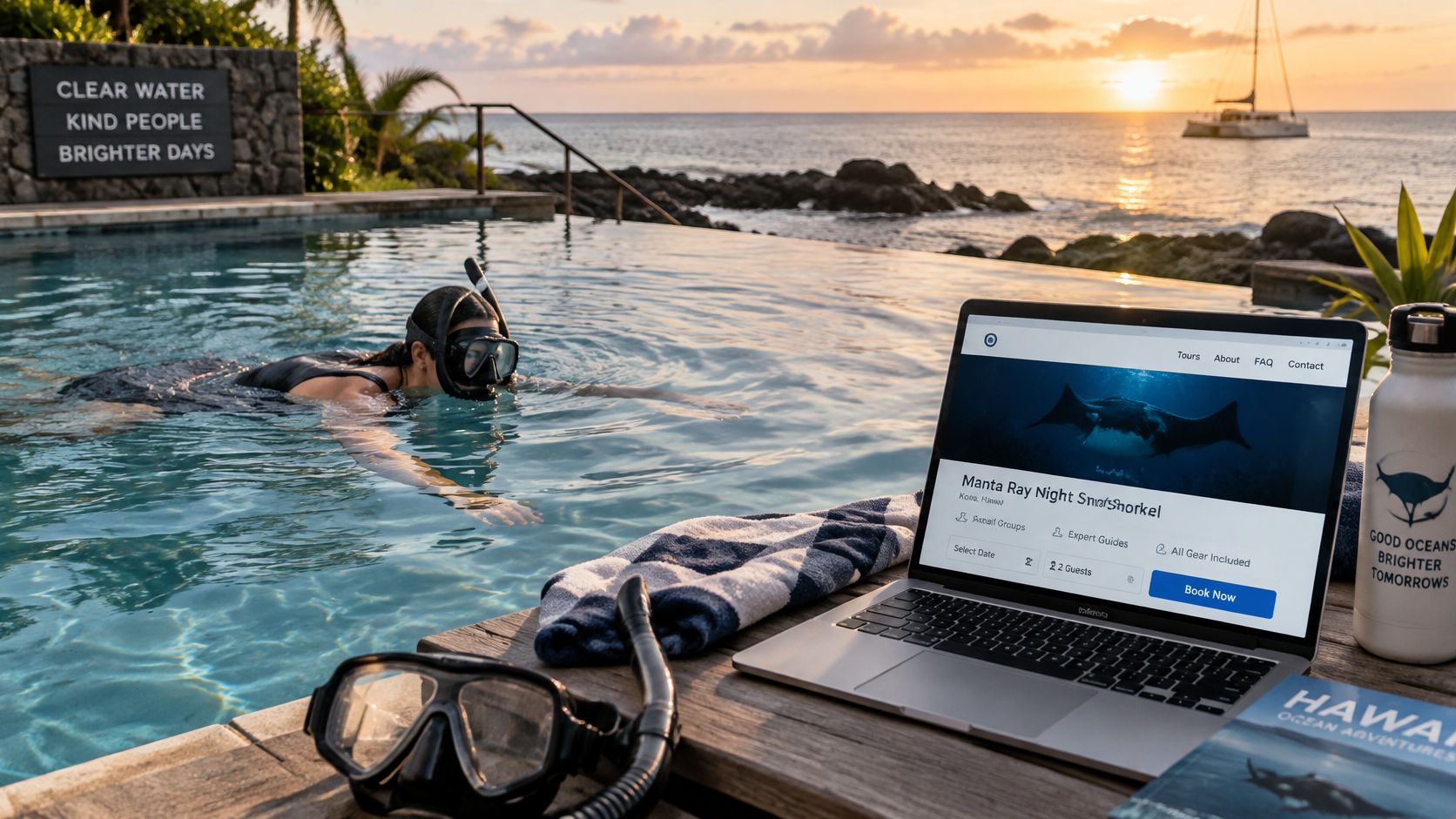
Step by Step
- Check swimming ability: Guests should be able to swim 50 yards without additional flotation and have prior snorkeling experience as intermediate snorkelers. If you're unsure, choose a daytime snorkel instead of finding out in dark open water.
- Choose a trip time: The early trip checks in during daylight, watches the sunset from the boat, and enters the water after dark. The late trip checks in at night. Use the times table above to choose what fits your evening.
- Reserve with Kona Snorkel Trips: Book the Night Manta Ray Snorkel through the Kona Snorkel Trips booking page. Confirm the party size and selected trip time before paying. The manta snorkel is the island's most popular tour, so booking early in your stay gives you more flexibility if weather affects your plans.
- Understand the manta guarantee: The manta guarantee offer does not expire and is honored if space is available 2 hours before the start of the tour. If your date changes, contact the operator and check availability within that window.
- Confirm arrival details: Note your check-in time, where to park, and the drive time after dark. Check for same-day messages before leaving your lodging.
- Choose a suitable alternative if needed: If you don't meet the swim requirement or lack intermediate snorkeling experience, book a daytime snorkel instead.
One Practical Add-On
If whale watching is also on your itinerary, the Whale Watch & Manta Magic package saves 10% on the Night Manta Ray Snorkel and Whale Watching tours. The discount makes sense if you plan to take both trips.
Book early in your stay: A backup evening gives you another chance to go if weather disrupts your plans.
A booking secures your place on a nighttime open-ocean trip, not a guaranteed manta appearance. Mantas follow available plankton, not tour schedules, so sightings can vary from night to night. Judge the experience by the viewing conditions and crew's handling of the trip, rather than expecting a particular number of rays.
Ready to reserve? Kona Snorkel Trips offers the Night Manta Ray Snorkel in Kona, with early and late trip times. Check the swim requirement, choose the time that suits you, and book your date through the booking page above.