
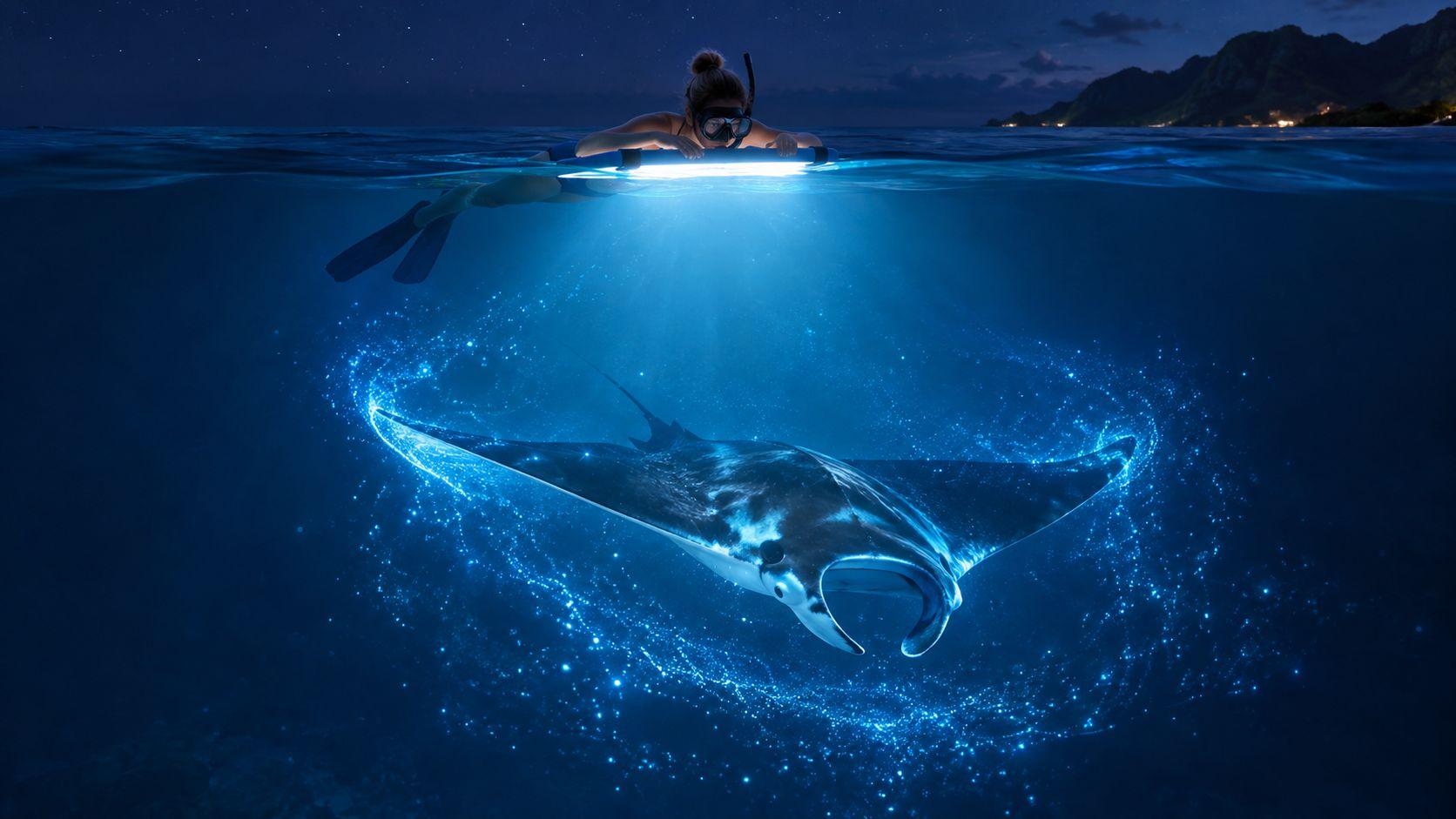
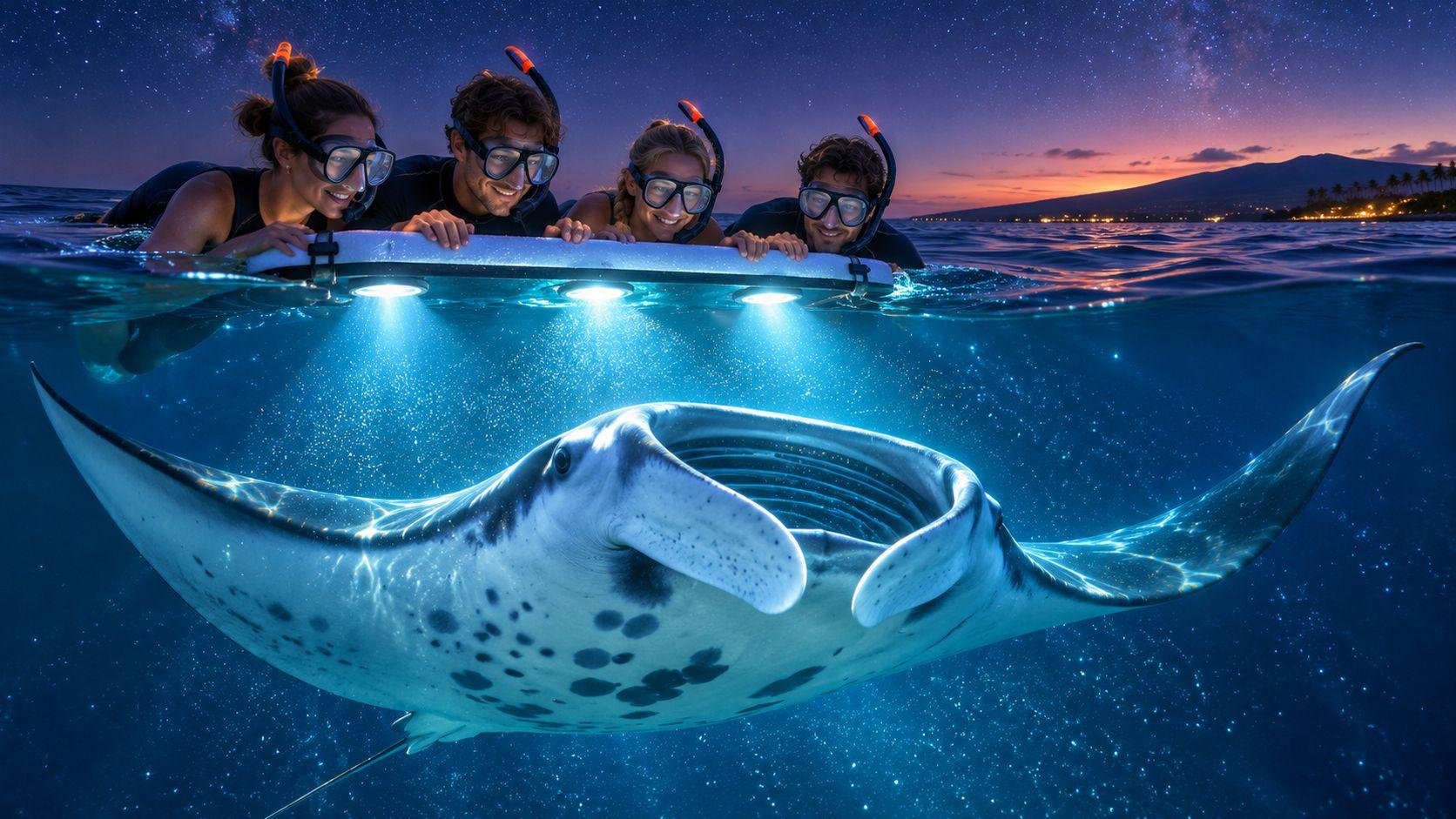
The first thing you notice is the dark. Not the romantic kind, but the actual kind, the kind that swallows the shoreline once the boat drifts away from the lights of Kona. Then you lean onto the floating board, your face inches above a moving pool of blue-white light, and a manta shape rises out of that brightness like a living shadow with wings.
That moment changes people. One guest sees a single ray roll beneath the board and freezes in awe. Another laughs out loud because the animal is so much bigger, and closer, than they expected. On a calm Kona night, manta rays in Hawaii don't feel like aquarium animals or a line item on a tour menu. They feel like wild neighbors who have chosen the lights for dinner.
For visitors looking for a guided small-group experience, Kona Snorkel Trips offers manta ray night snorkel outings from Kona, and many travelers compare it with other operators before booking. If you want a quick way to see current tour availability, use the centered booking option below.
Want to look at the tour itself while you read? The manta ray night snorkel page is here: Kona Snorkel Trips manta ray tour.
The Magic of Floating with Giant Mantas
A good Kona night snorkel starts before the mantas arrive. You're on the water after sunset, lying flat and breathing slowly, while the ocean around you turns from glassy gray to black. The board in front of you glows like a small stage, and every bubble, every flicker, every ripple makes you look down a little harder.
Then the shape comes in.
It doesn't rush. It doesn't fight the light. It banks, rolls, and glides with the calm confidence of an animal that has done this for a very long time. The first pass usually steals the room, even when the “room” is just a handful of snorkelers and a boat crew who've seen it before.
What people remember after the swim
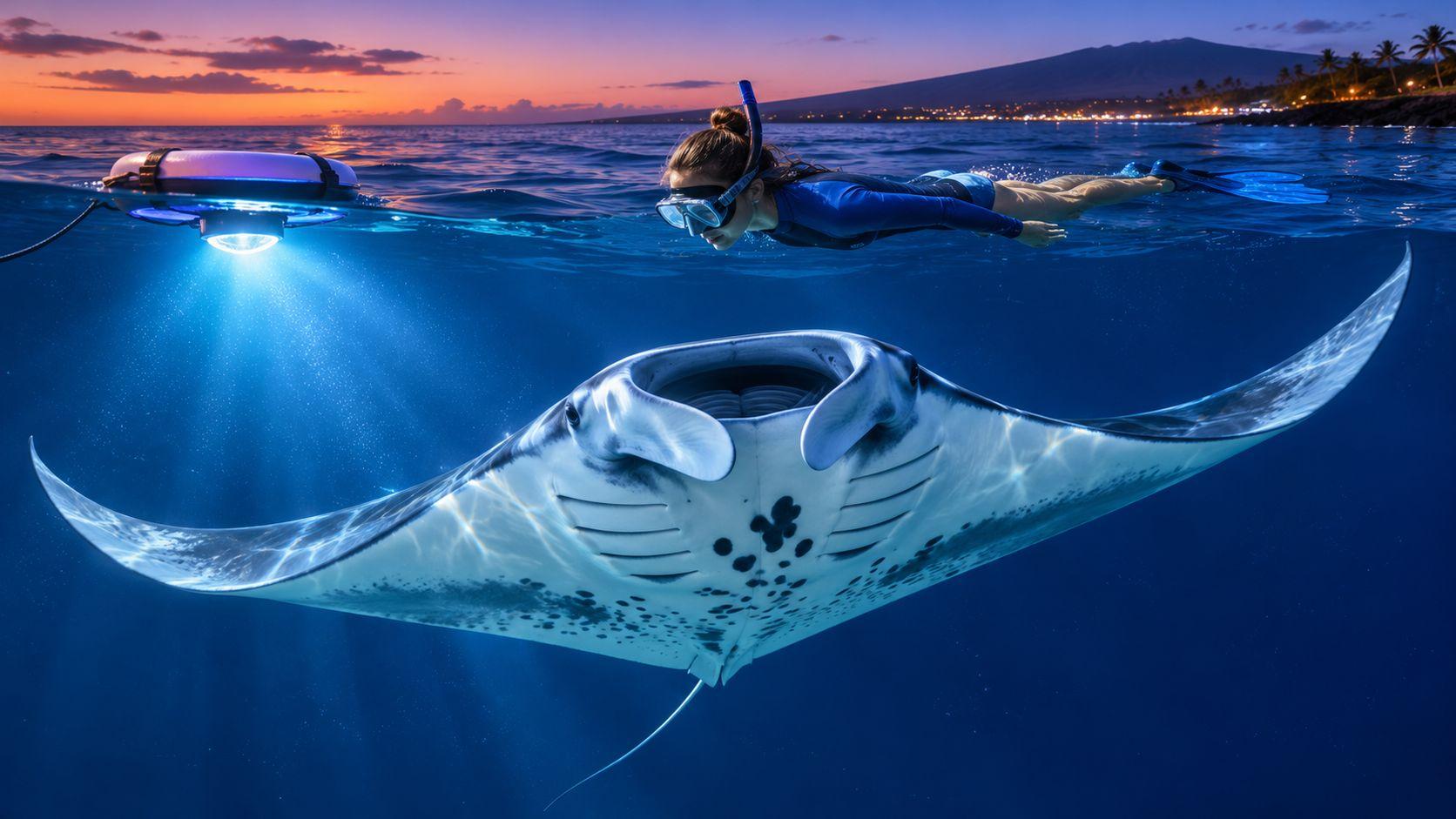
People rarely remember the distance back to harbor first. They remember the animal's mouth opening beneath the light, the broad white underside, and the strange feeling that something enormous is moving inches from their hands while they're told to stay still. That stillness is part of the wonder. You aren't chasing the scene, you're letting it come to you.
A nighttime snorkel also gives the encounter a kind of theater you don't get in daylight. The dark ocean frames everything, so the manta's movement looks sharper, cleaner, and more deliberate. The result is a wildlife experience that feels intimate without being intrusive.
Stay low, hold the board, and let the ray decide how close it wants to come. The best view is the one you don't try to force.
For readers comparing tour styles, the local search often leads back to small-group operators who keep the focus on the animals and not on crowding the water. One option many travelers examine is Kona Snorkel Trips, especially when they want a guided snorkel that keeps the experience simple and the water time centered on observation rather than noise.
Understanding Hawaii's Unique Reef Manta Rays
The mantas most guests meet off Kona are reef manta rays, not oceanic giants passing through on a long migration. If you want the clearest breakdown of that difference, see our guide to whether Hawaii manta rays are reef mantas or oceanic mantas. They are cartilaginous animals with broad, wing-like fins, and they feed on plankton rather than hunting fish. The light matters because it gathers prey, and the prey gathers the manta.
A local population, not a floating crowd
Hawaiʻi's manta rays do not behave like one large interchangeable stock. A NOAA-supported genetic study found only 318 individually identified manta rays around Hawaiʻi Island since 1979 and about 600 in Maui Nui since 2005, with roughly 104 adult breeders around Hawaiʻi Island and 129 across Maui Nui (NOAA study). Those island groups are distinct, and they exchange very few animals.
That matters because the Kona group is not easily replaced from elsewhere. The same body of work shows strong female reproductive philopatry and very limited male-mediated exchange, about one male migrant between island groups every 2.2 generations, or about 64 years (genetic and photo-identification study). In plain terms, the mantas you see in Kona are part of a small local community with little outside backup.
The feeling in the water changes once you understand that. You are not watching a generic ocean sighting. You are meeting a place-based population whose survival depends on local adults, feeding habitat, and predictable behavior along the coast.
Why long-term identification matters
A University of Hawaiʻi study followed 13 years of observations, from 2010 to 2022, and logged more than 23,000 sightings involving 167 unique manta rays at Garden Eel Cove and Keauhou (University of Hawaiʻi study). That long record turns a single night into part of a larger story.
The night snorkel feels personal, but the long record shows how fragile the local population really is.
Repeated photo identification, date stamps, and site-specific monitoring matter because they show Kona's mantas are residents, not random visitors. They have habits, preferences, and a real attachment to particular feeding grounds.
What to Expect on a Kona Night Snorkel
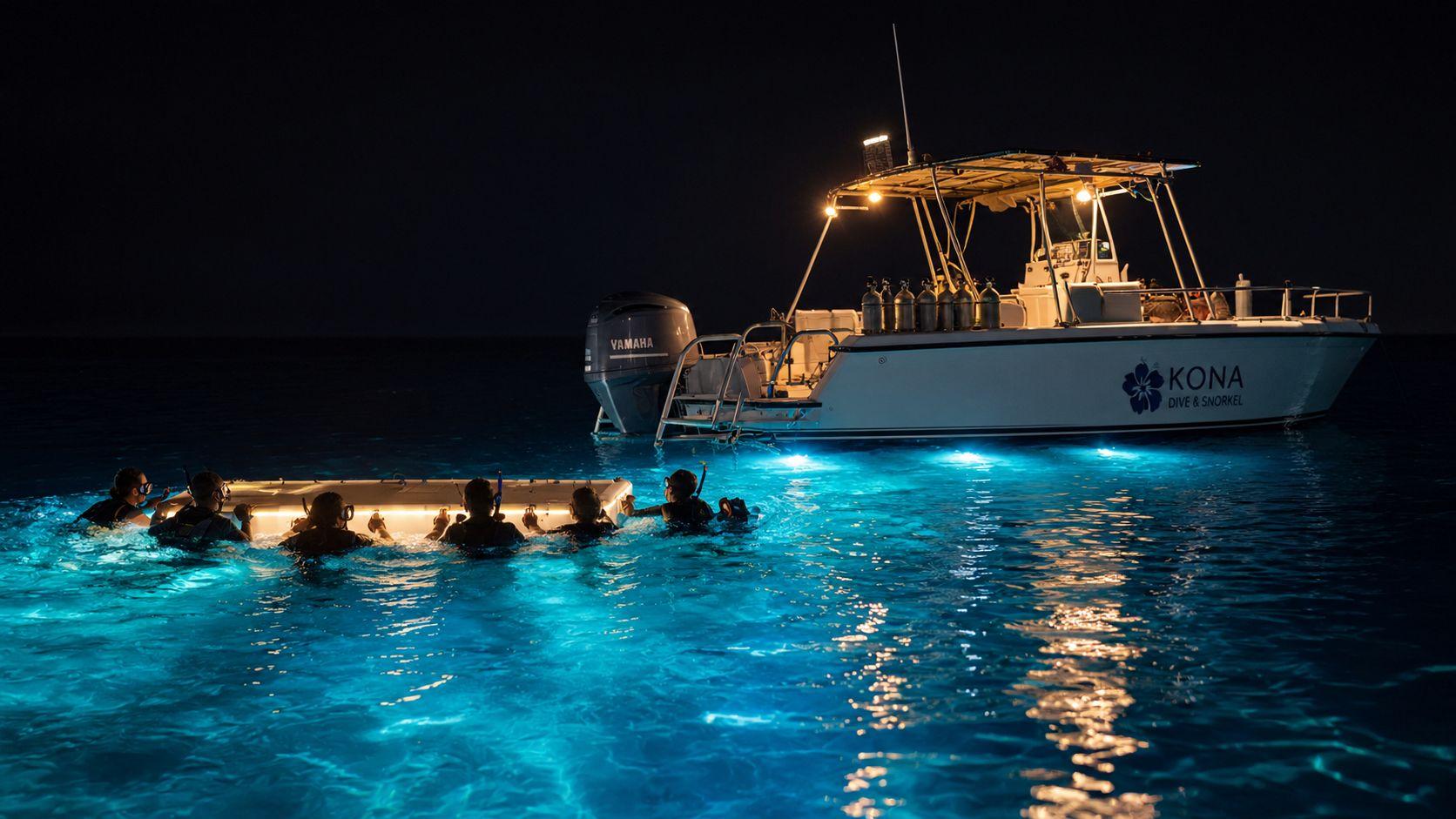
The evening usually begins with a simple rhythm. You board after sunset, the crew gives a safety briefing, and masks, snorkels, and flotation gear come out before anyone enters the water. By the time the boat reaches the viewing area, the sky has gone dark enough that the lights on the board look bright instead of decorative.
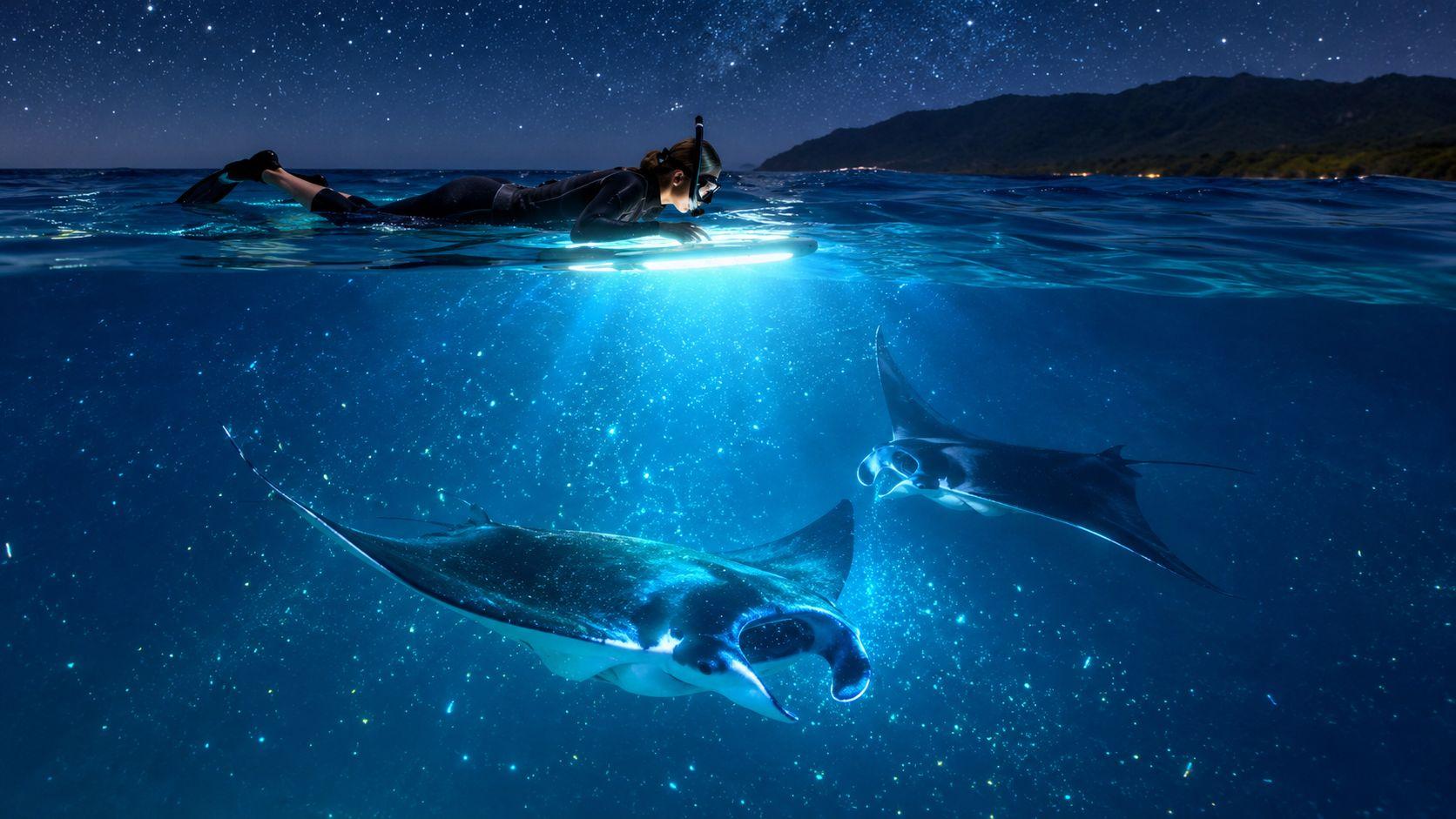
Once you're in, your job is to float, breathe, and hold position. The illuminated board does the work of attracting zooplankton, and the plankton is what brings the mantas in to feed. The water often feels warm enough to relax into, but the open ocean at night still sharpens every sensation, so a wetsuit top or shorty suit helps a lot.
How the encounter usually unfolds
The crew positions the board, checks everyone's comfort, and reminds guests to keep hands and legs clear. That's not just etiquette, it keeps the viewing lane open so the rays can pass underneath without obstruction. When the first manta arrives, the whole group usually goes quiet for a second, then someone whispers, and the hush spreads.
You don't swim after the animal. You watch it work the light. The ray may make repeated passes, sometimes low and slow, sometimes rolling just enough that you catch the full shape of the cephalic fins guiding plankton toward its mouth.
The practical part is easy once your breathing settles. The emotional part is harder to predict, because the combination of black water, bright light, and a giant animal moving with absolute ease tends to override ordinary tourist expectations.
If you can float calmly on your stomach and follow instructions, the snorkel side is far less complicated than most first-timers expect.
For readers comparing tours and wanting a more detailed look at how to choose, this guide is useful: how to choose the right Kona manta ray snorkel tour.
Choosing the Right Tour and Viewing Location
On a calm Kona night, the difference between viewing sites shows up fast. At Garden Eel Cove, often called Manta Heaven, the mantas have been documented in larger aggregations than at Keauhou in the same UH study, and prey availability was identified as the main driver of manta presence. The scene is simple, bright, and alive, but the reason the animals arrive is plain food, not tour branding or dock-side hype.
Keauhou carries a different feel. The long-term data show it was visited predominantly by females and that female site fidelity there was high, while the overall sex ratio across both locations was roughly balanced. A boat anchored off Keauhou is, in other words, watching a subtly different slice of the local population than a boat at Garden Eel Cove.
What to compare before you book
The right choice is usually obvious once you know what to ask. A solid operator pays attention to how the water is handled, how the lights are used, how many guests are in the group, and how much room the mantas have to move.
- Group feel: Smaller groups usually make the briefing easier to hear and the water calmer.
- Viewing style: Some boats leave more space for quiet watching, while others bring more people into the same area.
- Site awareness: Operators who understand the difference between Garden Eel Cove and Keauhou tend to set clearer expectations before anyone gets in.
For readers comparing options, this guide to choosing the right Kona manta ray snorkel tour is a useful place to start. Travelers also compare Manta Ray Night Snorkel Hawaii when they want a second point of reference on boat style and departure point. The smart pick is the one that keeps the focus on the mantas, the light, and the water, not on a crowded deck.
Safety Etiquette and Conservation Rules
A manta snorkel works only when everyone in the water makes the same quiet choice. Don't touch. Don't chase. Don't block their path. If you are floating at the surface with your legs under the board, you are already part of the scene, so the right move is to stay still and give the rays room to rise and turn.
A hand on a manta can damage the protective slime coat on its skin. Crowding can change the way it moves through the light, and repeated disturbance near feeding areas matters even more in a local population with limited recolonization capacity, as noted earlier in the genetic studies. Conservation here is concrete. It protects the exact animals your boat just spent an hour waiting for.
The legal side is real
Hawaiʻi law prohibits knowingly capturing or killing a manta ray in state marine waters. Violations carry escalating criminal fines of $500 for a first offense, $2,000 for a second offense, and $10,000 for a third or subsequent offense, plus an administrative fine of up to $10,000 for each manta ray harmed (Hawaiʻi law).
The state has also proposed a framework with two designated viewing zones, limits of 24 commercial permits in each zone, a maximum of 60 passengers per commercial vessel within 24 hours, two-hour operating shifts, and viewing hours from 4:00 p.m. to 4:00 a.m. (DLNR proposal). Those details show how seriously local managers treat crowding and use pressure.
Passive viewing protects the animal, the next tour, and the long-term future of the site.
For a clear reminder of the rules guests are asked to follow, keep this manta ray snorkeling guide for wildlife-safe behavior open on your phone.
Practical Tips for Gear and Underwater Photography
Wear dark colors if you can. Bright patterns may not ruin the experience, but they add visual clutter in an already high-contrast scene. A rash guard or short wetsuit helps with warmth, and if you get motion sick, handle that before you board rather than hoping the boat ride will magically settle down.
Bring less than you think. A towel, swimwear, and a secure way to keep track of your mask are enough for most guests. Loose gear creates problems, especially when people start adjusting cameras mid-swim.
Camera habits that protect the mantas
Underwater photography is harder than it looks because the subject moves fast in low light, and every hand movement matters. A floating grip helps reduce drops, and flash photography should stay off because it can startle wildlife. If you're using a GoPro, angle it wide and keep your elbows tucked so you don't turn the camera into a stray fin.
For more detailed shooting advice, this resource is useful: best GoPro settings for a Kona manta ray night snorkel.
A few practical habits make the night smoother:
- Keep gear simple: Fewer loose items means fewer mistakes in the water.
- Use a secure grip: Cameras drift, and drifting cameras hit things.
- Arrive settled: If you're tense at the dock, the dark water feels worse than it is.
- Expect imperfect photos: The best memory is often the one you watched with your own eyes.
The best photos usually come after you stop trying to force them and let the manta stay in control of the frame.
Frequently Asked Questions About Manta Snorkeling
Is it safe to snorkel at night? Yes, if you stay with the guide, follow the briefing, and remain on the surface. The swim is straightforward. For many first-timers, the harder part is settling the nerves once the water turns black and the lights start drawing plankton into the beam.
What if the mantas don't show up? They're wild animals, so no sighting is ever guaranteed. Kona's long-running feeding sites are closely watched, which is why guests still come for encounters that feel dependable rather than random luck.
What if the sea is too rough to run the tour? Operators may cancel or delay if the ocean is unsafe. On those nights, good crews usually offer a rebook or refund, so the right move is to check the policy before you board and keep your schedule flexible.
Can children participate? Many operators welcome younger snorkelers if they're comfortable in the water and meet the tour's age rules. The question is less about courage and more about whether they can float calmly, listen, and keep their face in the water long enough to enjoy the encounter.
Do I need to know how to scuba dive? No. The snorkel experience happens at the surface, so you don't need dive certification. Scuba is a different format, while the night snorkel is built for guests who want the view without extra gear.
What should I expect emotionally? Most visitors expect a nice wildlife outing and get something closer to awe. The first manta that glides under the board often changes how close the ocean can feel.
If you want to see manta rays in Hawaii the right way, book a guided night snorkel that treats the animals as residents, not props. Kona Snorkel Trips runs manta ray outings in Kona with hands-on guidance that helps first-timers stay calm in the dark water.
Keep reading
Swim with Manta Rays Big Island: Night Snorkel Guide 2026
Learn how to swim with manta rays Big Island: trip times, readiness checks, booking steps, packing and water rules for Kona night snorkels.
Kona Manta Ray Night Dive: What to Expect and How to Book
Plan your Kona Manta Ray Night Dive: timing, safety rules, what to pack, conservation tips and how to book a trusted night manta tour.
Manta Ray Snorkeling Big Island: A Practical 2026 Guide
Manta Ray Snorkeling Big Island. Plan manta ray snorkeling on the Big Island with this 2026 guide. Best sites, tour choices, packing tips, safety rules