
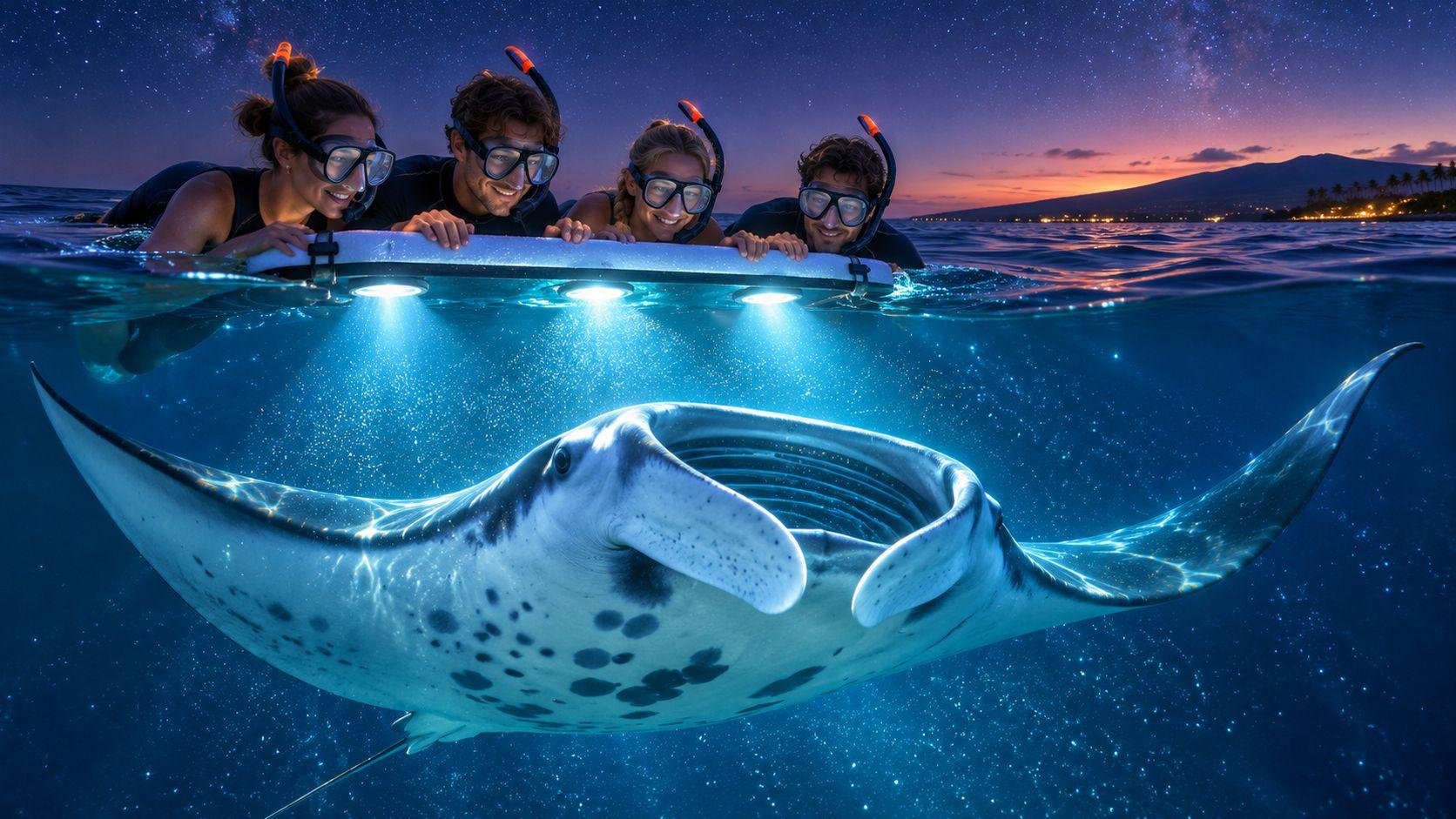
You're on the lanai with a booking page open and the same three questions circling. Is it really pitch black out there, will the manta rays show, and does the departure time matter?
It matters, and so does the operator you pick. The honest version of this night is better than the brochure version: you float at the surface holding a lit board with your face in the water, the crew runs the lights, and wild animals decide whether to join. Nothing is staged, and a slow night is not a failure.
You won't be swimming anywhere. That's the part nervous first-timers never expect. The manta is the one doing the moving.
Choose Your Kona Manta Night Option
The main choice is simple: join a snorkel trip at sunset or later at night, or book a scuba dive if you're certified. Kona Snorkel Trips offers an early and a late manta snorkel departure, both part of a two-hour tour in Kona.
The early departure checks in during daylight, watches the sunset from the boat, then enters the water after dark. The late departure checks in at night. Guests spend 30 to 40 minutes in the water on either trip. Choose early if you want the transition from sunset to darkness; choose late if you'd rather arrive after dark.
Kona Snorkel Trips offers two trip times because the manta tour is the most popular tour on the island. The timing changes the feel of the evening, not the wild nature of the encounter. Manta rays are never guaranteed.
Kona has many boats visiting its main manta viewing areas. A county-filed manta viewing boating operations and safety assessment documented at least 42 commercial operators by August 2015, with boats carrying roughly 6 to 40 passengers. Expect to share the viewing area with other boats, rather than have a private reef.
Kona Snorkel Trips is a friend-owned-and-operated boat tour company with thousands of customer reviews.
The three options side by side
| Option | Check-in | Time in the water | Best for |
|---|---|---|---|
| Early manta snorkel trip, Kona Snorkel Trips | Daylight check-in, sunset from the boat, water entry after dark | 30-40 minutes | Guests who want to watch the sunset before entering the water |
| Late manta snorkel trip, Kona Snorkel Trips | Check-in at night | 30-40 minutes | Guests who prefer a night-only schedule |
| Manta scuba dive, Kona Honu Divers | Evening check-in; certification required | Two tanks, with manta viewing while resting on the sand | Certified divers who want to view the rays from below |
Still deciding between the two formats? This Kona night snorkel versus night dive comparison explains the differences in what you do in the water.
Booking details worth knowing before you pay
Manta trip check-in is at 74-381 Kealakehe Parkway, Kailua-Kona. If you're planning a whale-watching trip as well, Kona Snorkel Trips' Whale Watch & Manta Magic package saves 10% on the Night Manta Ray Snorkel and Whale Watching tours.
A scuba dive is a different way to spend the night. For that option, divers should check the operator's requirements and procedures before booking.
Choose the early snorkel for the sunset, the late trip for a night-time check-in, or a scuba dive if you're certified and want to watch from below.
How the Night Manta Dive Works
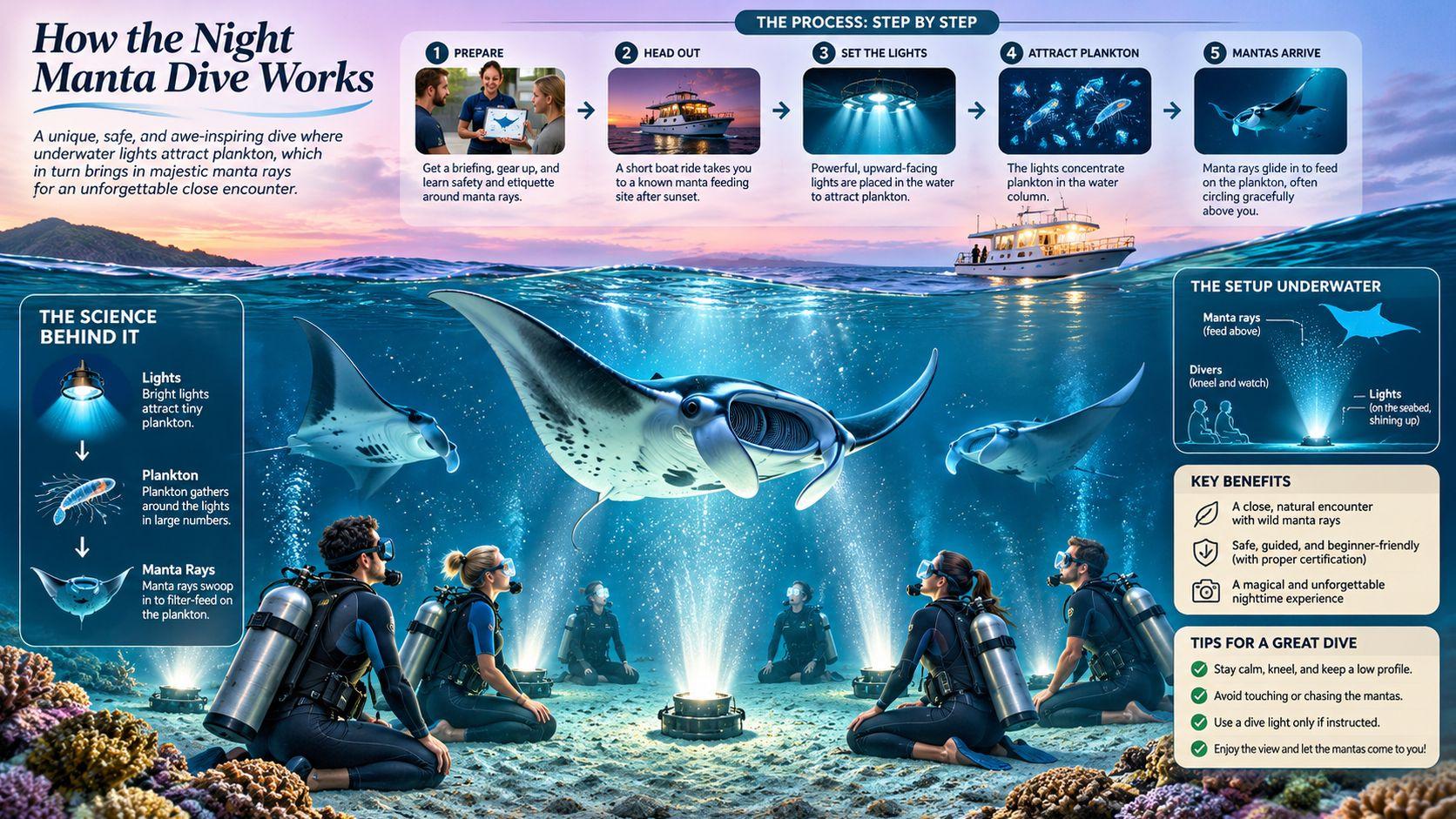
A quiet night can happen even when the trip runs as planned. The lights gather plankton, and manta rays may follow that food into the illuminated water. How much plankton collects depends on ocean conditions, so sightings and feeding activity vary.
What the lights are really for
The lights attract plankton, not manta rays. Reef manta rays (Mobula alfredi) feed on plankton, and the concentrated food can bring them through the illuminated water. NOAA describes this feeding behavior in its work product on night feeding at Keauhou and Makako bays.
The light creates a feeding opportunity, not a guarantee. Plankton levels and water movement affect how much food gathers, so even a well-run trip may have a slow night. A busy encounter does not, by itself, tell you whether an operator is responsible; look for calm, clear instructions and care for the animals.
Why the same bay works night after night
Manta rays return to familiar feeding areas. A study of six years of observations at Manta Village and Manta Heaven tracked 118 individually identifiable reef mantas at sites about 15 km apart on Kona's west coast. Read the NOAA repository study of manta site fidelity in Kona.
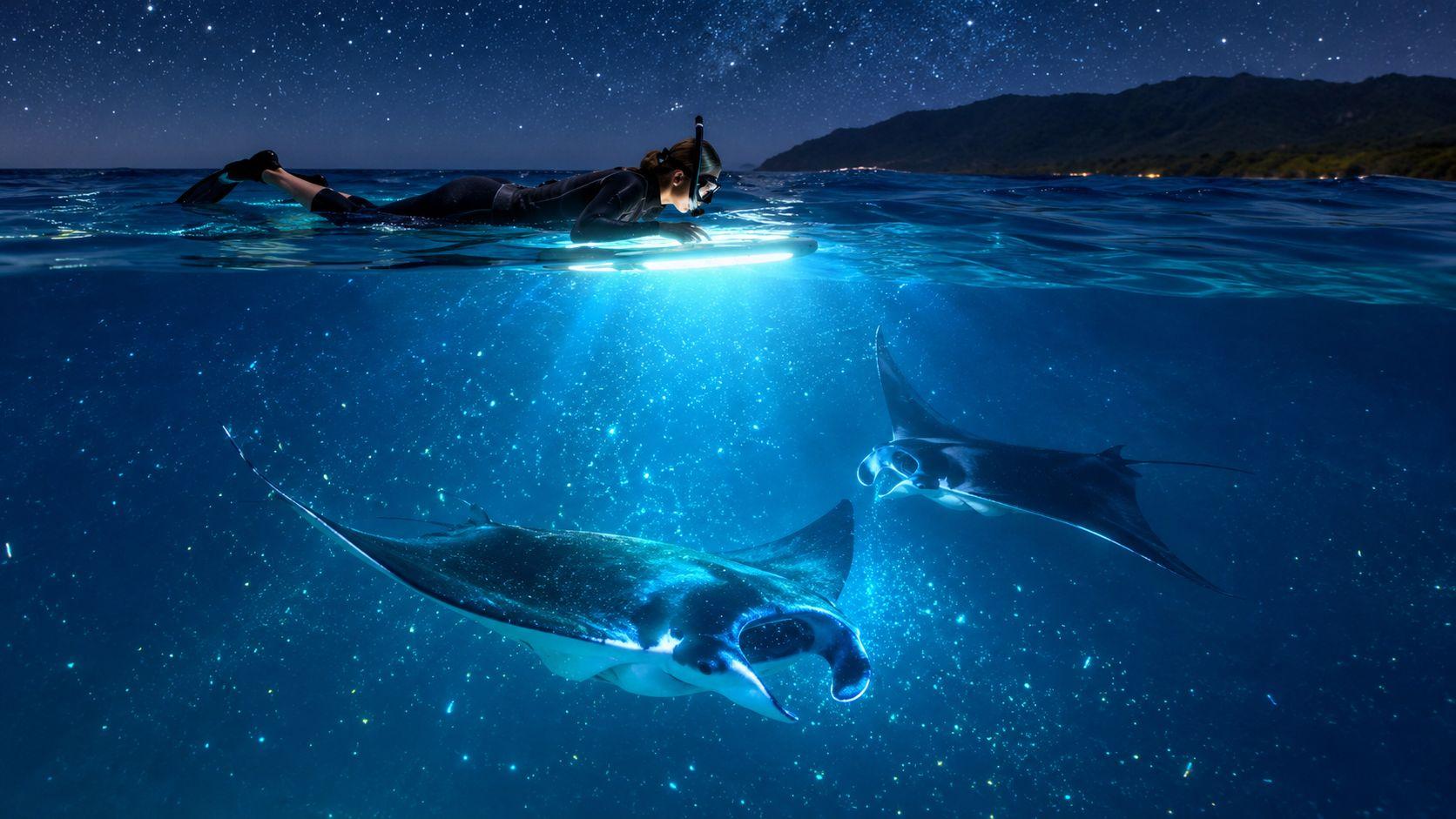
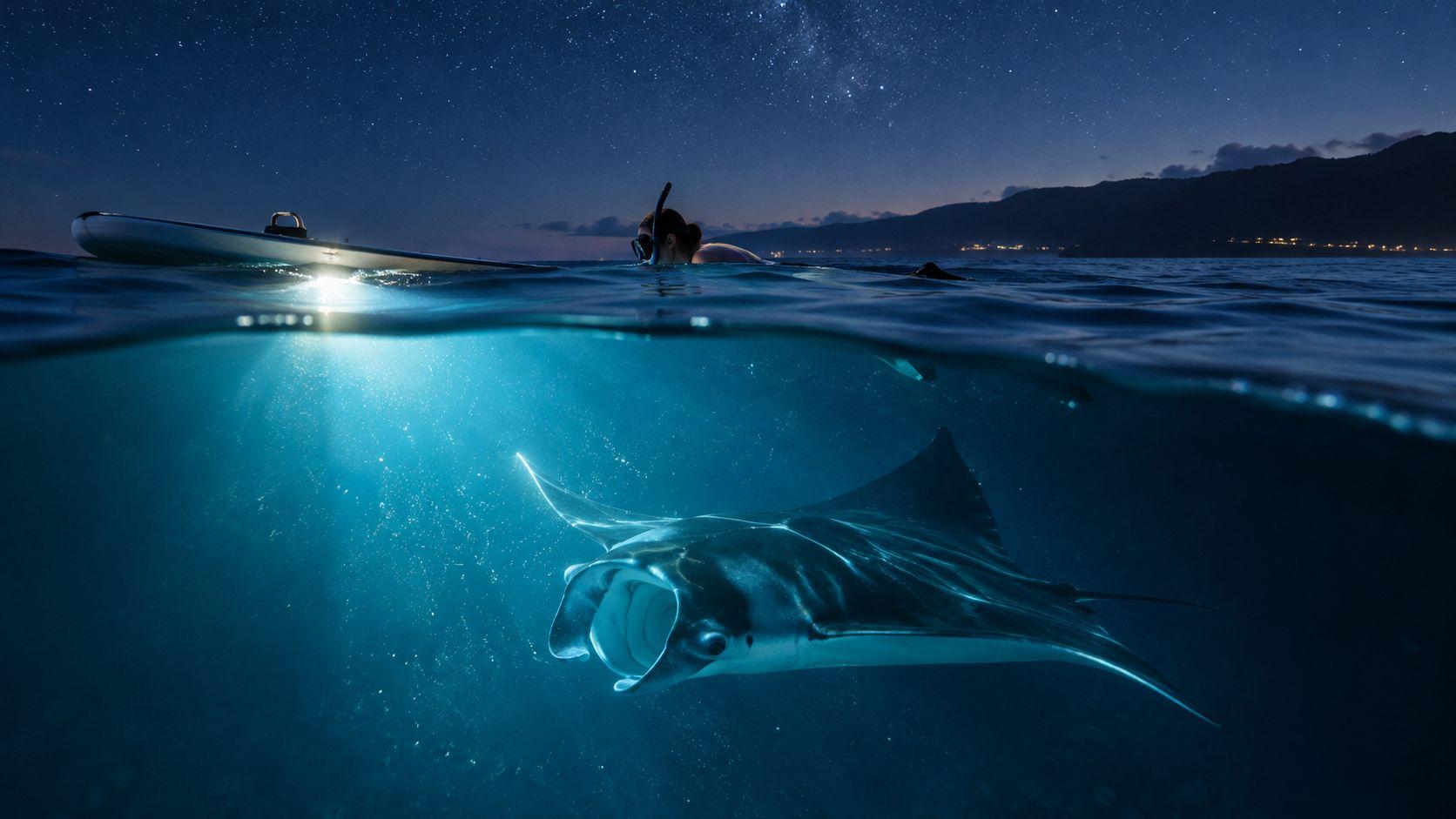
On Kona Snorkel Trips' Night Manta Ray Snorkel, guests hold onto a custom-built snorkel board with high-powered lights and watch from the surface. The trip is a nighttime open-ocean activity, at Garden Eel Cove or in the area in front of the Keauhou hotel.
The lighted water gives you a clear place to watch. Mantas may glide through to feed, then turn and pass through again. Keep your body still and let the crew's instructions guide your position; the rays need room to move naturally.
The sequence is simple: lights gather plankton, plankton draws feeding mantas, and guests watch without chasing or touching them. If rays do not appear, or make only brief passes, changing the lights cannot guarantee a different result.
What to Pack, Photograph and Ask
The ride back can feel cold after time in the water, so bring a dry layer for the boat. A towel, a zip-up jacket and a GoPro are practical choices for the night snorkel.
- Towel and dry bag: Dry off after the swim, and keep your phone and keys protected.
- Warm layer: Bring a zip-up jacket or sweatshirt for the return trip.
- GoPro or wide-angle camera: A wide view helps capture the lighted area and nearby mantas. Keep the camera steady and be ready for low-light conditions.
- Reef-safe sunscreen: Apply it before boarding and allow time for it to absorb.
How to shoot mantas without wrecking the night
Turn the flash off. It can disturb the animals and illuminate the plankton between your camera and a manta, making the image harder to see. Read more about why flash photography is a bad idea on a Kona manta ray snorkel.
Aim toward the lights, keep the camera steady and take several frames rather than relying on one shot. Then put the camera away for a while and watch without a screen between you and the water.
Quick answers before you book
Do I need a certification for the snorkel tour? No. This is a snorkel trip, not the scuba version.
Can I touch or ride a manta? No. Stay still at the surface and do not touch the rays.
Will mantas show up every night? No. Mantas are wild animals, and sightings are never guaranteed. A quiet night can reflect plankton and ocean conditions, not a failure by the crew.
What should I ask an operator? Ask how guests are briefed to avoid touching or chasing mantas, and how the crew keeps the group positioned at the surface. Clear instructions and respect for the animals are useful signs of a stewardship-minded operation.
Will I be fitted for a wetsuit? Guests are fitted with a wetsuit, mask and flotation belt before the boat leaves.
Walking Through the Night Manta Trip Step by Step
Picture the whole evening before you commit a single dollar to it. It runs in a fixed order, and knowing that order is what removes the nerves.
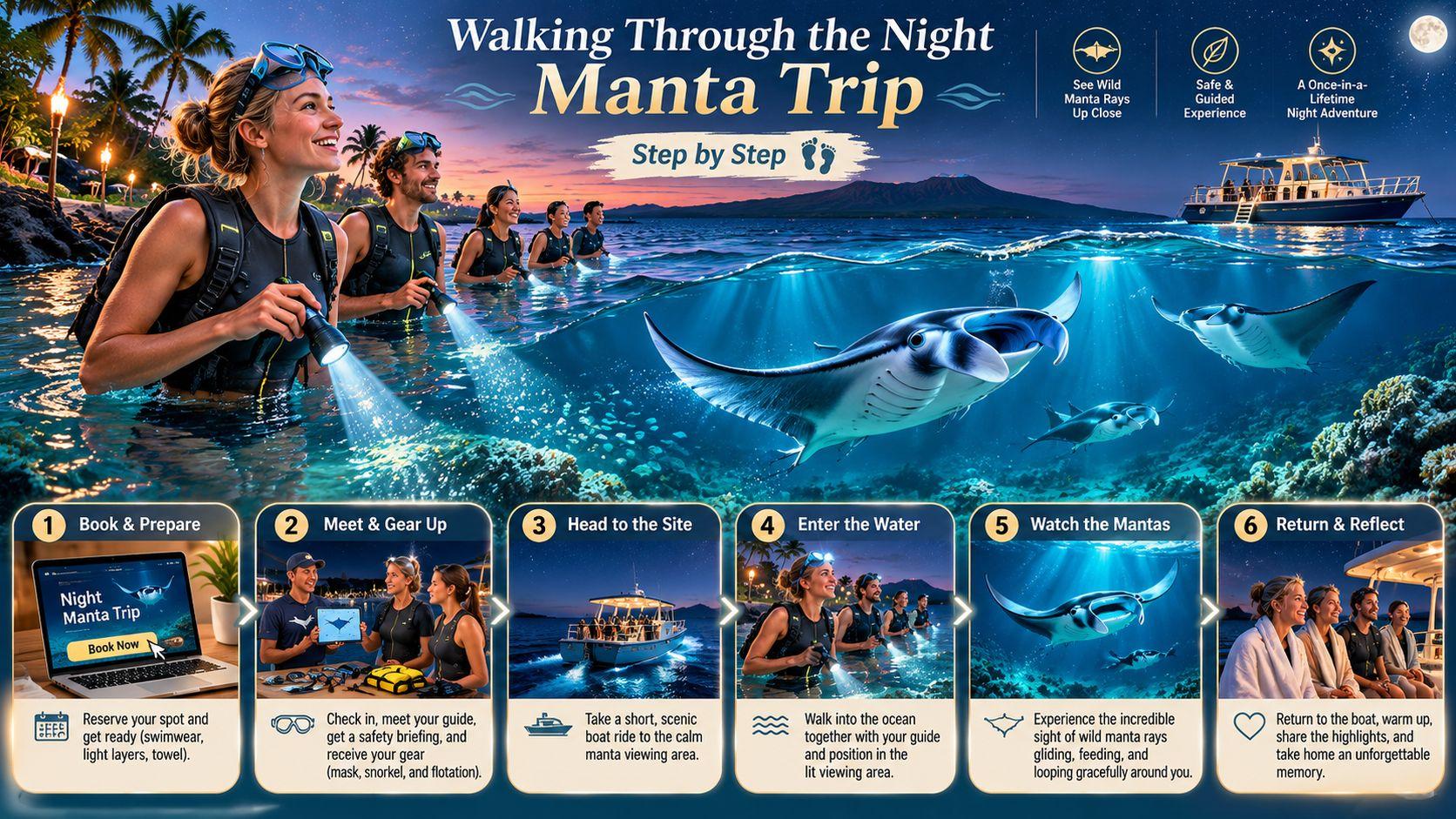
1. Check in at your departure. The early trip checks in during daylight, which means paperwork and fitting in sunshine. The late trip checks in after dark, which is faster because you're arriving already dressed for it. Total time on the water is 2 hours either way.
2. Watch the sunset if you took the early trip. This is the underrated half of the early departure. You're on the boat as the light goes gold, then orange, then gone, and the water changes color before it changes character.
3. Get fitted properly. Mask, wetsuit, flotation belt. Speak up if the mask feels loose on your cheekbones or the suit pinches your shoulders. You will not fix either in the dark.
4. Sit through the briefing. The crew covers manta size, what interactions to expect, how to stay calm when a two-meter wing passes your face, and where your hands go. Listen for the part about staying flat and still. That instruction is the entire experience.
5. Ride out to the site. The boat runs to Garden Eel Cove or the area in front of the Keauhou hotel, and the crew sets the light board in position. Other boats are working the same water, so the crew picks a slot with room and holds it.
6. Enter the water after dark. You slide in and lie flat on the surface with the rest of the group, holding the board, watching the lights below. This is the moment people worry about and then forget, usually within ninety seconds.
7. Stay in place for your 30 to 40 minutes. Follow the crew's positioning instructions exactly. Wandering off the board breaks the group's shape and pushes the rays around people instead of letting them settle into a feeding line.
8. Run back to the harbor. The lights click off, the boat turns for home, and the night ends at the dock. No skills test, no deep water, no navigation.
Two practical notes that don't fit neatly anywhere else. Ride-alongs are not permitted on the manta charter, so everyone in your group needs a snorkeler's seat rather than a spectator ticket. And the trip runs alongside several other boats at the same site, which is why the crew is firm about spacing and why your entry follows a sequence rather than a free-for-all.
A good manta night feels quiet and slightly choreographed. If you're working hard, something is off, and the fix is almost always to stop moving.
If the rays are slow to arrive, stay still and keep watching the edge of the light. They often appear from outside the circle first, as a shadow that resolves into a wing. Talking into the water, splashing, and rearranging yourself on the board are the three things that make it take longer.
Rules in the Water and Protecting Kona's Manta Rays
A manta night works best when every swimmer can hold position calmly and follow the crew's instructions. Guests should be able to swim 50 yards without additional flotation and have prior snorkeling experience at an intermediate level. Everyone wears a flotation belt, which keeps hips and feet at the surface and helps prevent kicking the mantas below.
Kona Snorkel Trips may refuse service at its sole discretion, including to guests who give inaccurate information about their swimming ability, appear intoxicated, behave disruptively or unsafely, arrive late, or do not follow crew instructions.
The in-water rules and the reason behind each one
West Hawaii's voluntary manta-viewing standards distinguish between light positions for divers and snorkelers. Divers can rest on the bottom and shine lights upward; snorkelers stay at the surface and shine lights downward. The illuminated water draws plankton, as described in the West Hawaii voluntary manta-viewing standards for wildlife interactions.
- Do not touch, chase, grab, or ride a manta. Contact can damage the protective mucus coating on its skin.
- Leave the rays room to maneuver. Stay in your assigned position instead of moving into their path.
- Keep lights off live coral. Point them where the crew directs.
- Follow crew instructions. If the crew asks you to adjust your position or leave the water, do so promptly.
For an overview of the legal protections that may apply, read this guide to whether manta rays in Hawaii are protected by law.
How many rays you're actually looking at
Long-term monitoring at Garden Eel Cove and Keauhou recorded 23,106 manta sightings from 2,890 identification reports between January 1, 2010 and December 29, 2022. The researchers identified 167 individual manta rays at the two sites over that period. Garden Eel Cove averaged 8.89 individual mantas per evening, with a range of zero to 45 and a median of seven, according to the University of Hawaiʻi long-term study of Kona's night manta aggregation.
Those figures describe repeated visits by a recognizable local community, not thousands of different animals. That makes respectful viewing important: each encounter adds pressure to the same places and rays.
How to judge an operator before you book
Proposals for managing these sites have included mooring buoys, limited-use permits, designated viewing areas, caps on commercial permits and passengers, guide-to-customer ratios, lighting standards, and restrictions on live boating. A University of Hawaiʻi study of manta tourism management and compliance discusses these proposals. Ask operators which practices they follow rather than assuming every proposal is already a rule.
Look for concrete signs of care: small groups, trained safety staff, steady lighting, clear no-contact instructions, and a wildlife briefing that explains how guests should behave. Ask how many snorkelers share a light board and how guides supervise the group. A promise of guaranteed manta sightings is a reason to ask more questions, since wild animals do not follow a schedule.
When Sightings Are Slow and How to Plan Around Them
Manta rays are seen year round in Kona, and there is no pattern in their appearance based on the month. That sentence cuts both ways. It means no season is off limits, and it also means no month guarantees a big showing. Anyone selling you a peak manta season is selling you something they can't deliver.
It helps to separate three things that get blended together in marketing. Manta presence means at least one ray visited. Number of animals means how many showed up. Close viewing means the feeding geometry lined up in your favor. A trip can deliver one without the others, and sometimes it delivers none.
If you want the arithmetic of a realistic hit rate before you book, this breakdown of the Big Island manta ray night snorkel success rate separates a sighting from a close encounter.
The reason is ecological, not operational. A 13-year University of Hawaiʻi analysis of community-sourced observations at Garden Eel Cove and Keauhou found that aggregation size was positively associated with zooplankton density, with seasonal and site-specific fluctuations, detailed in this University of Hawaiʻi analysis of Kona manta aggregation and prey density. Garden Eel Cove generally supported larger and more variable groups. Keauhou drew smaller groups, and its sightings were strongly female-biased, with females accounting for 91% of observations in that dataset.
So a quiet night isn't automatically a bad tour, a collapsing population or a careless crew. It's usually short-term prey conditions, weather, current, or animals moving between two sites a short boat ride apart. Ask which site your operator favors and check sea conditions the day before.
| Condition | Likely reason | What to do |
|---|---|---|
| Mantas visible but distant | Rays feed at the edge of the light circle, not the center | Keep still and let the rays come to you rather than swimming toward them |
| Choppy water or strong current | Sea state and currents limit visibility and light placement | Tell the crew early if you feel unsafe and ask about rebooking options |
| Crowded water with many boats | Peak operating times bring more vessels to the same sites | Ask how many guests and boats share the site and choose a smaller group if you can |
Certified divers who want a second shot at the animals have another route. Kona Honu Divers runs a manta night dive that puts you on the bottom with a fixed light plan, and their full lineup of Kona diving tours includes the blackwater night dive if you want a completely different kind of dark water. For some divers, seeing the same bay from the sand instead of the surface is the better second night.
Ask before you pay: what happens if the rays don't show? A clear refund or rebooking policy tells you more about an operator than any photo on their website.
Finally, treat the encounter as wildlife observation rather than a performance. Nobody on that boat can summon a manta, and the crews who pretend otherwise are the ones most likely to let a group crowd the animals in search of a photo.
Kona Snorkel Trips runs a two-hour manta ray night snorkel at Garden Eel Cove and Keauhou, with lifeguard-certified guides, small groups and a lit board that puts you right over the feeding action. If you want honest expectations and a crew that keeps the water organized, visit Kona Snorkel Trips to see departure times and reserve your seat before your dates fill.
Keep reading
Swim with Manta Rays Big Island: Night Snorkel Guide 2026
Learn how to swim with manta rays Big Island: trip times, readiness checks, booking steps, packing and water rules for Kona night snorkels.
Manta Ray Snorkeling Big Island: A Practical 2026 Guide
Manta Ray Snorkeling Big Island. Plan manta ray snorkeling on the Big Island with this 2026 guide. Best sites, tour choices, packing tips, safety rules
Big Island Manta Ray Night Snorkel: What to Expect
Plan a Big Island manta ray night snorkel with confidence. Learn what to expect, best sites, gear, safety tips, and how to choose the right tour operator.