
Manta Ray Snorkeling Hawaii: A Kona Night Guide
You're probably scrolling through Kona activities at your hotel, half excited and half nervous, wondering if you can really float in the dark ocean while a manta ray turns beneath you. That reaction is normal, and it's useful. It means you're asking the right questions before you book, not after you're already on the boat in a wetsuit.
Manta Ray Snorkeling in Hawaii at a Glance
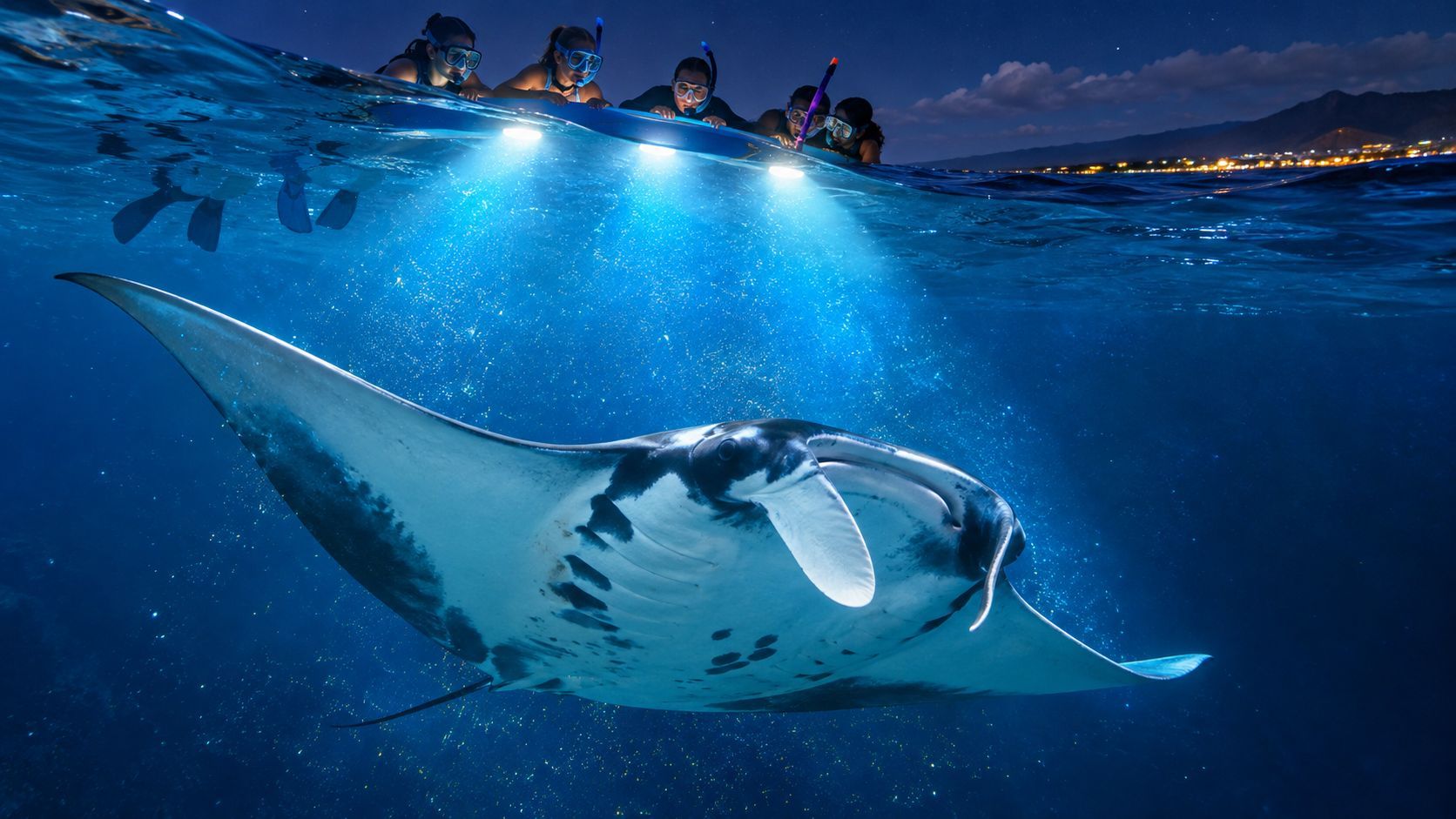
A night manta snorkel in Kona lasts about two hours from start to finish. In the water, you hold onto a lighted flotation board while manta rays glide beneath you. The pace is quiet: stay at the surface, keep your body still, and let the rays approach the light.
Kona Snorkel Trips runs its nighttime open-ocean manta snorkel at Garden Eel Cove or in the area in front of the Keauhou hotel. The tour is designed for intermediate snorkelers who can swim 50 yards without additional flotation. Guests spend 30 to 40 minutes in the water, with manta rays seen year-round and no monthly pattern in their appearance.
| Quick Fact | What to Know |
|---|---|
| Activity | A two-hour nighttime open-ocean snorkel in Kona |
| In-water time | 30 to 40 minutes |
| Viewing areas | Garden Eel Cove or the area in front of the Keauhou hotel |
| Sightings | Manta rays are seen year-round, with no monthly pattern |
| Swim requirement | Swim 50 yards without additional flotation |
| Experience | Intermediate snorkeling experience |
For the tour details, visit the Manta Ray Snorkel in Kona page. When comparing operators, look beyond reviews or sighting promises. Ask how their lights are set up, how snorkelers are spaced, how the boat is handled, what qualifications guides hold, and what contact rules guests follow. Those practical details help you understand how an operator manages people in the water around the mantas.
How Kona's Night Manta Snorkel Works
Think of a porch light on a summer night. The light draws insects, and the insects draw birds. Nobody hands food to the birds. The light just concentrates what they already eat in one predictable place.
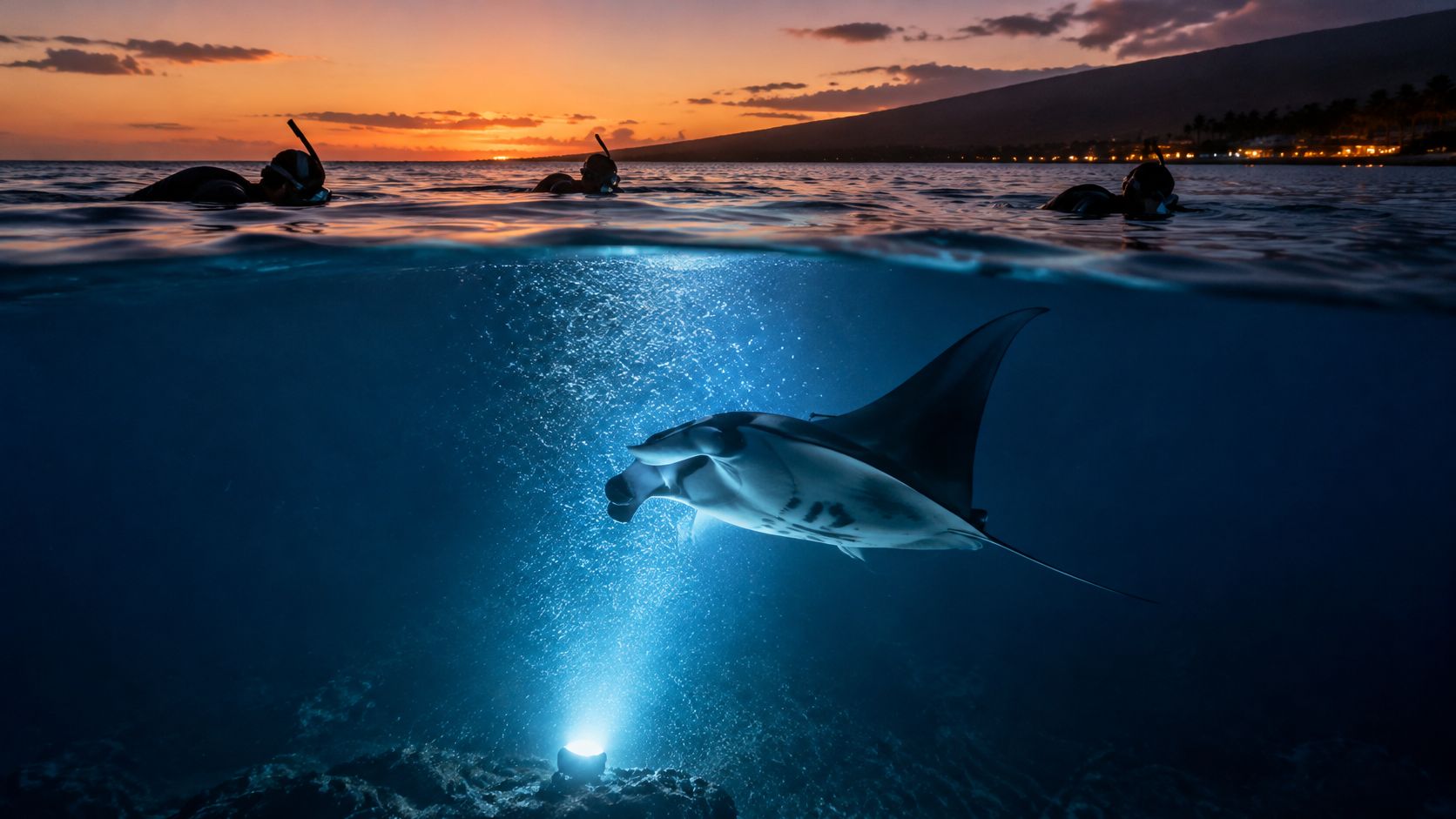
Kona's night snorkel works in three small steps. First, underwater lights shine into the water. Second, zooplankton, including tiny copepods, gather in that lit column. Third, reef manta rays, which are filter feeders, swim through the plankton with their mouths open and strain food from the water. You can read more in our guide to why lights attract manta rays during night snorkeling.
A Layered Setup in the Water
Snorkelers stay at the surface, holding an illuminated flotation platform above the feeding zone. Divers, where they're present, stay near the seafloor. The mantas feed between those two layers, which creates a vertically separated arrangement described in research on manta ray tourism and social values in Kona. You're not required to dive down or swim long distances once you're positioned.
That setup feels very different from daytime reef snorkeling. By day, you swim over coral in sunlight and you choose where to go. At night, this is an open ocean activity in darkness, and the group stays together around the light because that's where the plankton, and therefore the rays, concentrate.
Why Stillness Works Better Than Swimming
Passive positioning is safer and more predictable than swimming toward an animal. Hold the platform steadily, minimize kicking and splashing, and let each ray choose its own approach and feeding loop. A loop may pass just below your outstretched arms, close enough that you see the spots on its belly, without you moving an inch toward it.
Stillness also protects the mechanism itself. Concentrating zooplankton concentrates both rays and people into a small area, so poor spacing raises the chance of accidental contact and disturbance. Good lighting placement, group spacing, and guide control aren't extras. They're what make the encounter work.
The rays come for the plankton, not for people.
Once you understand that sentence, the rules stop feeling arbitrary. You aren't the attraction, and you don't need to perform for the animal. Your job is to stay calm, stay at the surface, and let a wild filter feeder do what it came to do.
Where to Snorkel with Manta Rays on the Big Island
West Hawaii has two recognized manta-viewing areas, and both sit inside the West Hawaii Ocean Recreation Management Area. They aren't interchangeable pins on a map. Your operator chooses a site for the night based on conditions and where the rays are feeding, so it's worth asking which site your tour plans to use.
| Site | Also Called | Management Area |
|---|---|---|
| Garden Eel Cove | Makako Bay, near the Kona airport | Inside West Hawaii Ocean Recreation Management Area |
| Keauhou | Kaukalaelae Point at Keauhou Bay | Inside West Hawaii Ocean Recreation Management Area |
These sites matter because Kona's mantas aren't just passing through once. A long-term University of Hawaii study analyzed community-sourced records collected from 2010 through 2022, covering 13 years, more than 23,000 sightings, and 167 individually identified reef manta rays at Garden Eel Cove and Keauhou, as detailed in the University of Hawaii study of Kona manta ray aggregations. That residency means a site can function as a familiar feeding ground across many years.
The same research found that Garden Eel Cove generally supported larger aggregations, while Keauhou was visited disproportionately by females, and both sites had an overall approximately 1:1 male-to-female ratio. If you're comparing the two areas by their better-known nicknames, our comparison of Manta Village and Manta Heaven helps you keep the names straight.
Proposed Rules as a Benchmark
Proposed state management provisions for these areas have included a limit of 24 commercial viewing permits per zone, operating hours from 4:00 p.m. to 4:00 a.m., two-hour vessel shifts, a maximum of 60 passengers for hire per vessel during a 24-hour period, and an 8-to-1 guide-to-customer ratio, as summarized in a Big Island guide to the proposed manta viewing provisions. Read those numbers carefully. They're proposed provisions, not universal rules for every snorkeling location.
That distinction is where many readers get confused. You shouldn't assume every boat follows the proposed ratio just because it exists on paper. Use it as a benchmark when you ask an operator how many guests each guide supervises.
When to Go and How to Plan Your Day
Manta rays are seen year round, and there's no pattern in their appearance based on the month. That doesn't mean every night feels the same. Flexibility in your schedule matters more than picking a specific month on a calendar.
For a deeper seasonal breakdown, see our notes on the best time of year for a manta ray night snorkel in Kona. In practical terms, you're planning around ocean state, wind, cloud cover, and moonlight, because those factors change your comfort on the boat and how the water feels once you're floating in the dark.
Build in a Buffer Day
Rough seas can disrupt a night tour, so don't make the manta snorkel the last possible activity before a flight home. Book it earlier in your trip when you can, and keep a later evening open as a backup. Avoid stacking a demanding travel day right after a late night on the water, because you'll be tired, salty, and probably still replaying what you saw.
On the day itself, eat a light meal a few hours before departure rather than a heavy dinner right before boarding. Bring a warm layer for the boat ride and the night air. Skip heavy drinking before you get in the water, since you need clear judgment and steady swimming at night.
| Plan | Morning | Afternoon | Evening |
|---|---|---|---|
| Night-only visitor | Easy morning and light breakfast | Rest, eat early, pack towel and jacket | Manta ray night snorkel, then rinse gear |
| Two-day plan | Daytime reef snorkel on day 1 | Recover and reapply reef-safe sun protection | Manta ray night snorkel on day 2, with day 1 as a weather backup |
| Three-day plan | Daytime reef snorkel on day 1 | Whale watching on day 2, if in season | Manta ray night snorkel on day 3 as the finale |
The two-day and three-day plans work because they don't put all your hopes on one forecast. A daytime reef snorkel also gives you a useful rehearsal. You can test your mask fit, practice clearing your snorkel, and confirm you're comfortable breathing face-down before you try it at night.
Daylight and night snorkeling complement each other because they use different skills. By day you steer and explore. By night you hold a position and observe. Planning both, with rest between them, usually leaves first-timers calmer than trying to learn everything after sunset.
Safety Rules, Swim Requirements and What to Bring
Start with an honest self-check, before you look at photos or departure times. For the manta snorkel, you should be able to swim 50 yards without additional flotation and you should have prior snorkeling experience as an intermediate snorkeler. If you aren't sure, test yourself in a pool or a calm bay during the day.
That test matters because the flotation board isn't a substitute for swimming ability. You still need to enter the water from a boat, reach the board, hold your position, and return to the boat with your guide's direction. Darkness makes simple tasks feel harder, even when the ocean is calm.
Practical rule If you're uneasy floating face-down in open water during daylight, choose a daytime reef snorkel first and build up to the night tour.
Non-swimmers shouldn't book this activity. Neither should anyone who's really uncomfortable in the dark or who panics when they can't see the bottom. Choosing a different tour isn't a failure. It's good judgment, and it'll make your Hawaii trip better, not smaller.
The Law Makes This Observation Only
Hawaii protects manta rays in state marine waters under Hawaii Revised Statutes §188-39.5. The statute prohibits knowingly capturing, taking, possessing, abusing, entangling, or killing any ray, including reef manta rays and giant oceanic manta rays, as explained on the Hawaii Division of Aquatic Resources page on manta ray protection. In plain language, you watch. You don't touch, chase, restrain, or interfere.
Violations are misdemeanors with escalating fines of $500 for a first offense, $2,000 for a second offense, and $10,000 for a third or subsequent offense. You don't need to memorize the statute number, but you do need to understand that reaching out for a photo or a touch isn't a harmless mistake.
What to Pack
- Towel You'll want it immediately after you climb back aboard, when the night air feels cool on wet skin.
- Zip-up jacket A zip front is easier to manage than a pullover when you're damp and the boat is moving.
- Waterproof camera such as a GoPro Secure the strap before you enter the water, so you aren't fumbling with gear near the rays.
- Reef-safe sunscreen Apply it well before the trip for any daylight portion, not as a last-minute layer before entering the water.
- Small bag for dry clothes Keep a dry shirt separate from wet towels and swimwear for the ride back.
Leave valuables onshore when you can. Boats are wet, space is limited, and you won't need jewelry, loose cash, or an unprotected phone while you're floating at the surface.
Tell the crew about any medical condition or motion sickness before departure, not after you're already feeling unwell offshore. Guides can only help with what they know about. A short, honest conversation at check-in gives them time to seat you sensibly, watch you more closely, or advise you not to enter the water.
What Happens on a Night Manta Tour, Step by Step
First-timers usually relax once they can picture the sequence. There's no surprise jump into black water and no moment where you're expected to figure things out alone. Each stage prepares you for the next one.
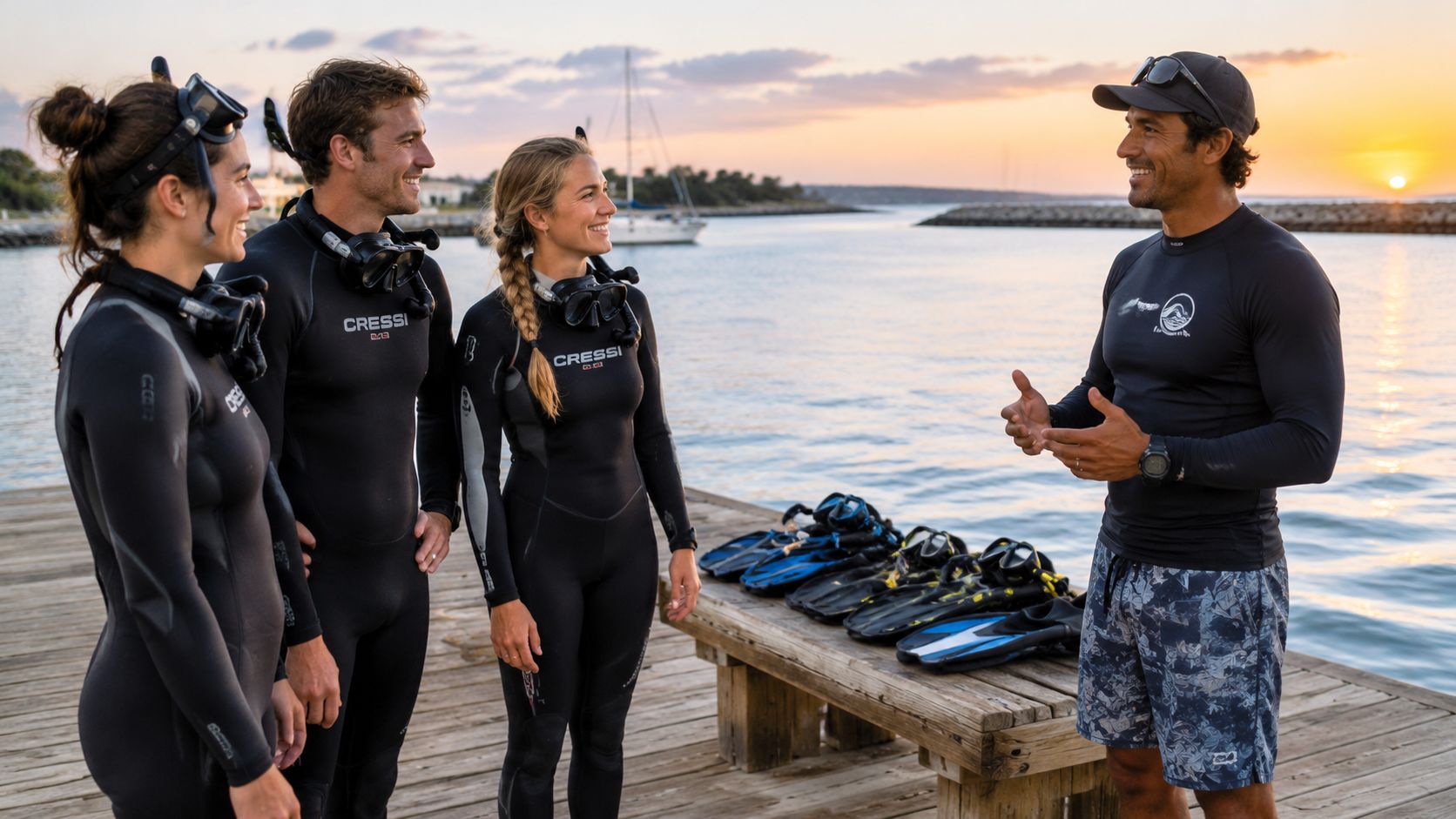
- Check in and meet your guides The crew confirms names, answers early questions, and explains the plan for the night. Use this moment to mention nerves, motion sickness, or a medical concern.
- Get fitted with gear You'll be fitted with a mask, a wetsuit, and flotation gear. A mask that seals well on land will save you frustration in the water.
- Listen to the briefing Guides explain manta size and behavior, where to hold the board, and why you must not kick down or reach out. Most first-timers calm down here, because the unknown becomes a set of simple instructions.
- Ride to the site The boat approaches and leaves the viewing area slowly, with a lookout and marker lights after sunset. Slow isn't inefficient here. It's how a responsible crew moves around people and animals in limited visibility.
In the Water
- Enter the water and reach the board You enter with guide direction, keep the lights in view, and settle into a steady surface position. Hold on, keep your body flat, and kick as little as possible.
- Watch the rays feed You have 30 to 40 minutes in the water while rays loop through the light on their own paths. Certified guides supervise in the water throughout, repositioning the group and watching for anyone who's drifting or struggling.
- Return, rinse, and debrief You climb back aboard, rinse off, and talk through what you saw on the ride back. Guides can often explain what a particular loop or pass meant in feeding terms.
A typical first-timer's reaction is a mix of awe, nerves, and laughter through a snorkel. That's fine. A ray may pass within arm's reach because the plankton is concentrated near the light, but arm's reach doesn't mean you should use your arm. Keep your hands on the board and let the animal complete its loop.
You don't need to be fearless. You need to be able to follow one instruction at a time and stay at the surface.
If you feel panicked, signal your guide early rather than trying to push through it alone. Guides would rather help you back to the boat calmly than manage a swimmer who's exhausted from fighting anxiety alone.
Protecting the Mantas You Came to See
A manta encounter is wildlife observation, not a casual swim that happens to include a large animal. That distinction changes how you should behave, even when you're excited and a ray is turning directly below you.
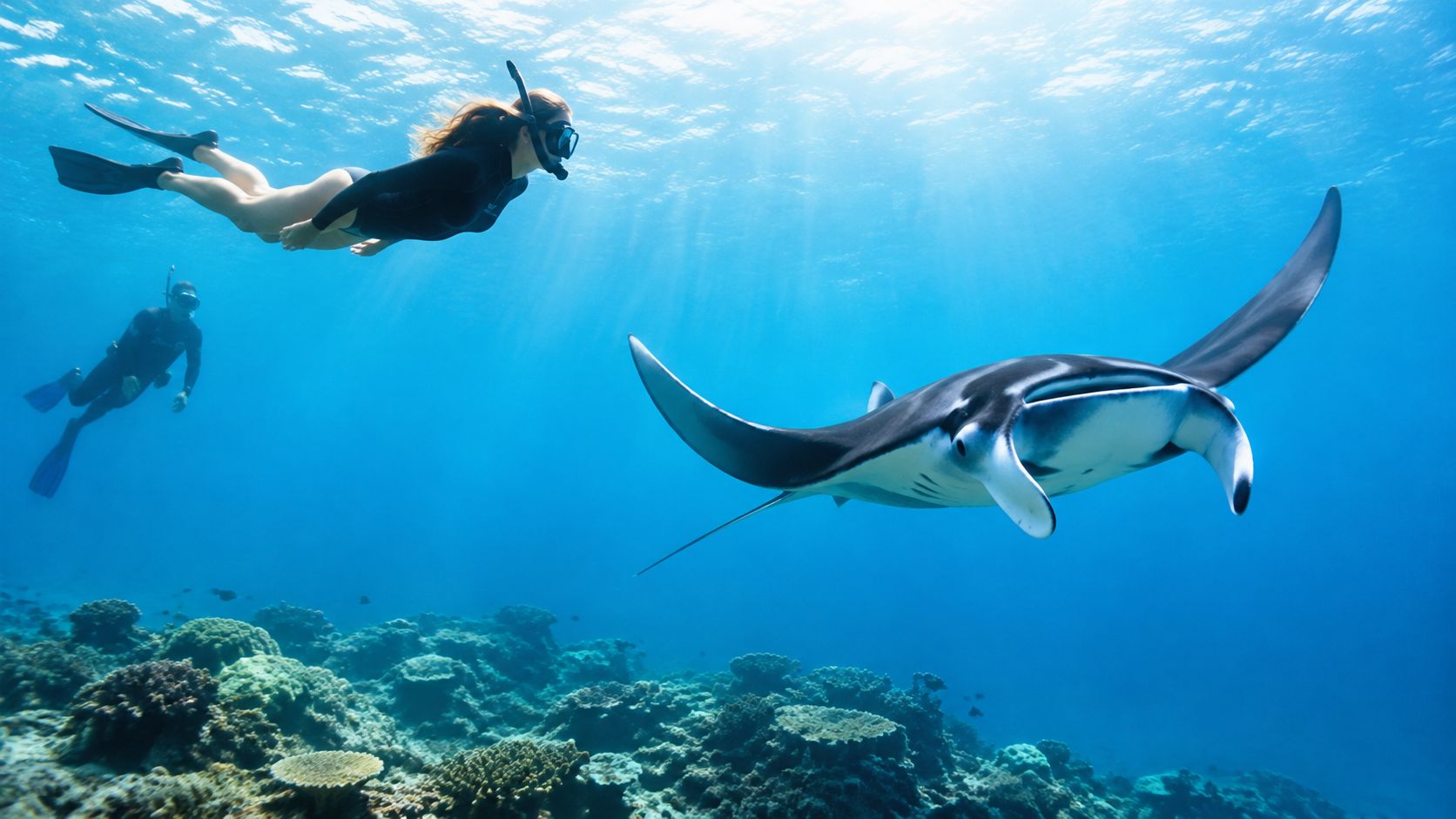
Research cited in the NOAA recovery status review for the giant manta ray found that a heavily used Kona manta site had fewer emergent zooplankton and lower plankton diversity than a less-used site, with possible inadvertent habitat damage from divers. The review also warns that repeated interactions can alter or interrupt feeding and cleaning behaviors.
Follow the cause-and-effect chain and the rules make sense. Concentrated lighting and repeated human presence increase site use. Close approaches, contact, fin-kicking, or bottom disturbance can modify the local feeding environment and interrupt behavior the animal needs. Disrupted feeding can then reduce the quality of the habitat that attracts rays in the first place.
Controls You Can Follow
- Maintain a consistent surface position Stay flat at the board instead of drifting, diving, or swimming after a better view.
- Never touch or chase a manta Contact can harm the protective mucus layer and change the animal's behavior.
- Avoid the reef and seafloor Keep fins and equipment controlled so you don't kick habitat or stir the bottom.
- Follow guide spacing and time limits Your guide is managing the whole group, not just your individual view.
The closest encounter isn't necessarily the most memorable one. A ray that loops calmly, repeatedly, and on its own terms gives you more to watch than a ray that veers away from a reaching hand. Good operators enforce these behaviors consistently rather than relying only on a pre-trip talk.
Your habits on land matter too. Use reef-safe sunscreen, pack out all trash, and secure loose items so nothing blows off the boat. Then choose an operator whose guides correct guests in the water, kindly but clearly, when someone kicks down or reaches out.
Choose a Safe Operator and Book Your Night
At the Kona manta site after dark, several boats may be sharing the water. A review can tell you that someone enjoyed a trip, but it may not explain how the captain, guides, and snorkelers were managed. Ask about those details before booking.
A county safety assessment identifies congestion at Kona manta-viewing areas, where boats, snorkelers, and divers share limited visibility, as a human-safety concern. Read the Kona manta ray viewing boating operations and safety assessment, then ask operators how they handle boat movements and supervise guests. The guide to comparing Kona manta ray night snorkel safety standards offers more questions to use when weighing those answers.
| Question to Ask | What a Responsible Operator Shows |
|---|---|
| Guide certification | Ask what training in-water guides hold, such as lifeguard certification |
| Guide-to-guest ratio | Ask how many guests each guide supervises and how the group is managed |
| Boat handling | Ask how the boat approaches and leaves, who keeps lookout, and what marker lights are used after sunset |
| Emergency procedures | Ask how the crew handles an in-water emergency and communicates with shore |
| Lighting and spacing | Ask where lights are placed and how groups are kept apart |
| Contact prevention | Ask how guides keep guests at the surface and prevent touching or chasing mantas |
Start with guide training. In dark water, a guide needs to help guests stay calm and follow instructions. Kona Snorkel Trips uses lifeguard-certified guides. Ask the company what guide-to-guest ratio applies to your departure, how its lights and boat are positioned around other groups, and what guests should do if they need help.
The Kona Snorkel Trips Big Island Manta Ray Night Snorkel lasts 2 hours and takes place in Kona. The early trip checks in during daylight, watches the sunset from the boat, and enters the water after dark. The late trip checks in at night. All guests wear flotation belts to keep their hips and feet up, reducing the chance of kicking a manta.
Check availability early for your preferred departure. If possible, book the manta trip earlier in your stay, leaving room to adjust your plans if weather affects the outing. Before you commit, ask the crew any remaining questions about supervision, boat handling, or emergency procedures.
Frequently Asked Questions
How Much Does a Manta Ray Night Snorkel Cost
Check current rates and inclusions at checkout. Compare what each tour provides, including flotation belts, a briefing, and underwater lighting, rather than judging by the headline price alone.
Can I Touch a Manta Ray
No. Observe the mantas without touching, chasing, or restraining them. Keep your hands on the snorkel board, even when a ray glides close by.
Can I Go if I Am a Weak Swimmer
You should be able to swim 50 yards without additional flotation and have intermediate snorkeling experience. If you are not comfortable meeting that standard in daylight, choose a daytime reef snorkel instead.
Are Sightings Guaranteed
Wildlife does not follow a schedule, so a sighting cannot be promised. Mantas follow plankton, not a timetable. Reviews focused only on sightings do not show how an operator manages lighting, spacing, and guest contact in the water.
What Should I Bring
Bring a towel and a zip-up jacket. Apply reef-safe sunscreen before the trip, and consider packing dry clothes in a small bag. At check-in, the crew can help you get fitted with the flotation belts and other equipment you need.
What if the Weather Turns Bad
Ask about the rescheduling policy before you book. If your schedule allows, leave a buffer day in your trip so you have more options if rough seas require a change.
Do I Need to Disclose Health Conditions
Yes. Tell the crew about any medical condition or motion sickness before departure. That gives you a chance to discuss whether entering the water is suitable.
At the surface, you hold the lit board while mantas move below. Kona Snorkel Trips offers a 2-hour night snorkel in Kona, with an early trip that checks in during daylight and a late trip that checks in at night. Visit Kona Snorkel Trips to review the tour details and choose a departure.