
Manta Ray Snorkeling Hawaii: Kona Night Guide 2026
You're back at your hotel, phone in hand, looking at five manta tours that all promise an unforgettable night. The photos look similar, the reviews all say amazing, and none of them tell you the thing you need to know. Can you comfortably float in open ocean in the dark, and is the operator running the trip in a way that protects a small local ray population? That's the right way to judge manta ray snorkeling in Hawaii, not just by who has the closest photo.
Manta Ray Night Snorkeling at a Glance
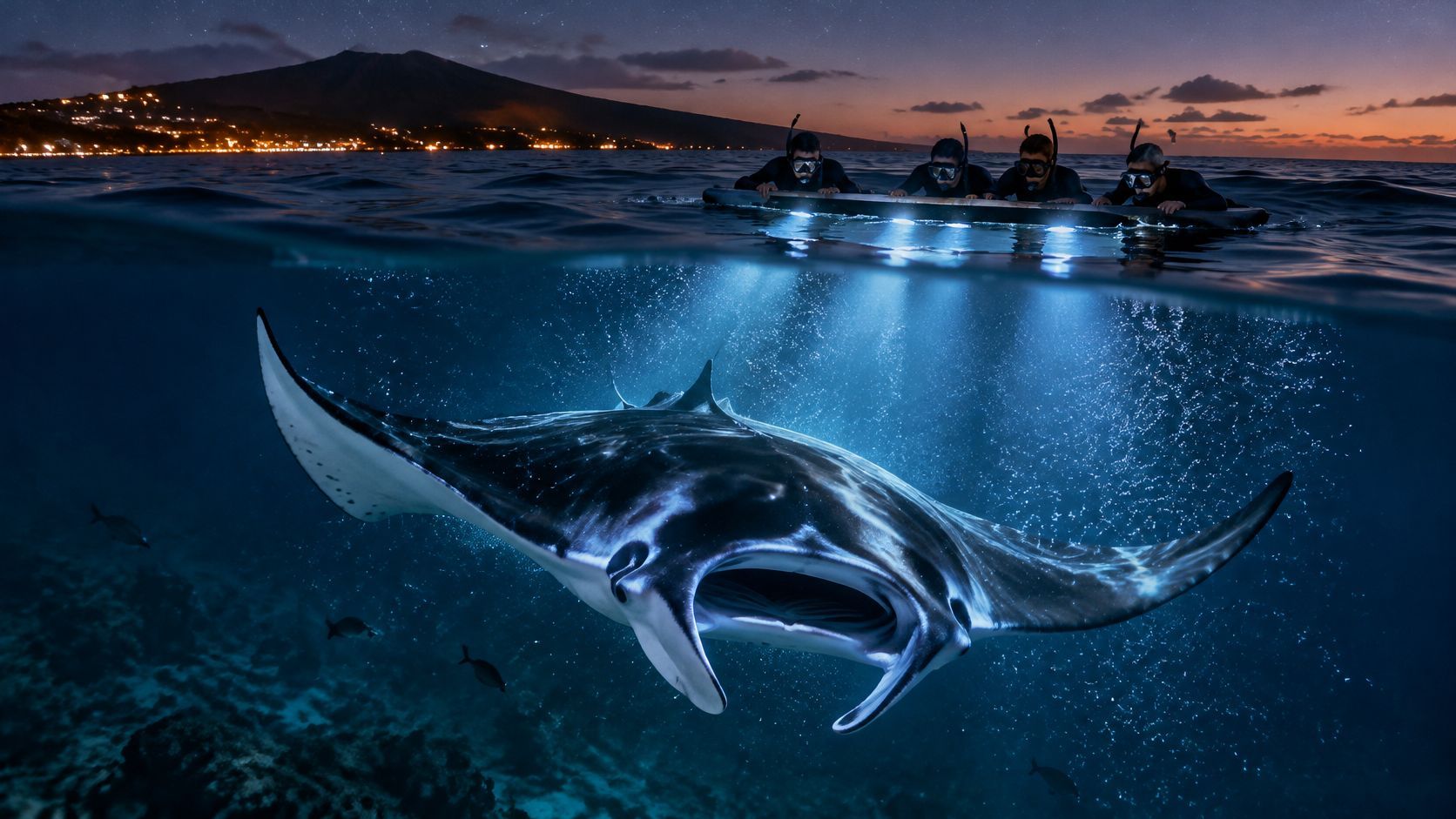
At night in Kona, you float at the surface with a small group, holding a board as bright lights reach into the dark water. Tiny plankton gather in the beams, and manta rays may glide below to feed. You stay at the board rather than swimming after them, giving the rays room to move naturally.
Kona Snorkel Trips is Hawaii's highest-rated and most-reviewed snorkel company on the Big Island. Guest reviews appear below.
How the Light Creates the Encounter
The lights concentrate zooplankton, the tiny animals mantas filter from the water. Rays may come to feed where plankton gathers, so the encounter depends on conditions that night rather than a scheduled performance. Some nights bring repeated close passes; others are quieter.
The Kona trip lasts 2 hours, with 30 to 40 minutes in the water. It is a nighttime open-ocean activity, so wind, swell, and boat movement are part of the setting.
| Element | What to Expect | Why It Matters |
|---|---|---|
| Total tour length | 2 hours | Includes check-in, the boat ride, a briefing, and time in the water |
| Time in the water | 30 to 40 minutes | Time to watch rays feed beneath the lights |
| Flotation | A belt worn around the hips | Helps keep hips and feet up to reduce the chance of kicking a ray |
| Lighting | A custom-built snorkel board with high-powered lights | Concentrates plankton, which can attract feeding mantas |
| Season | Year-round | Mantas are seen year-round, with no monthly pattern in their appearance |
| Setting | Open ocean at night | Conditions can differ from those on a daytime reef snorkel |
This experience suits confident snorkelers who can stay calm and still at the surface. If you are unsure, consider your comfort in open water at night before booking.
Who Can Join and Who Should Skip the Night Snorkel
No scuba certification is needed, but that's the wrong test. Plenty of non divers do this well. Plenty of decent lap swimmers don't, because they've never had to float face down in the dark, breathe through a snorkel, and resist the urge to kick toward an animal passing underneath.
The real test: Can you float calmly, stay on the surface, and follow instructions in the dark for half an hour without thrashing, standing up in your fins, or drifting away from the board?
Our requirement is specific. Guests should be able to swim 50 yards without additional flotation and have prior snorkeling experience at an intermediate level. That doesn't mean you need to be fast. It means you can clear a mask, settle your breathing after a mouthful of water, and move back to the board without panic.
Can Swim Is Not the Same as Comfortable at Night
Think through the factors that change after sunset. Cold builds because you're mostly still. Seasickness can hit on the boat before you ever enter the water. Low visibility beyond the light beam unsettles some people even when they swim fine in daylight. Respiratory limits, a recent illness, or anxiety in open water all matter more when you can't see the bottom or the shoreline clearly.
The Hawaii snorkeling guidance on Hawaii.com advises avoiding water when waves exceed roughly three feet, and that threshold matters even more at night when you add boat transfers, group movement, and wildlife rules. A nervous guest who kicks unpredictably isn't just uncomfortable. That guest can block a ray's route or push fins into its feeding path.
| Situation | Suitable? | Better Option |
|---|---|---|
| Swims 50 yards without extra flotation and snorkels at an intermediate level | Yes | Book the standard night tour |
| Weak swimmer or cannot float calmly | No | Choose a daytime snorkel with flotation |
| Tends to panic in open water or in darkness | Not recommended | Try a daytime reef snorkel first |
| Heart, lung or other medical conditions | Check with a doctor first | Consider a shorter daytime snorkel |
| Young children | Ask before booking | Ask the operator about age rules before booking |
If conditions deteriorate, postponing is the right choice, not pushing through because it's your last night. Stronger swimmers also get more from the night because they spend their attention watching instead of managing their position. For a plain language version of this decision, read who should skip a Kona manta ray night snorkel before you reserve.
Do a final self check. If you can't picture yourself lying still on the surface for 30 minutes, breathing slowly while a large animal passes underneath, choose a daytime snorkel first and build up to this.
Where Kona Manta Rays Gather and Feed
Kona works because reef mantas return to known feeding areas instead of passing randomly along the coast. Captains aren't searching the whole shoreline each night. They're going to places where light, plankton, and repeated animal use have created a reliable pattern, and that pattern is what you're buying into.
Two Sites, Two Different Patterns
A 13 year dataset in the University of Hawaii ScholarSpace repository covered more than 23,000 sightings of 167 individually identified reef manta rays at Garden Eel Cove and Keauhou, and found that seasonal and annual changes in aggregation size closely tracked zooplankton density. That one finding explains most guest confusion. The same site can be busy one week and quiet the next because the food moved, not because the operator chose badly.
| Viewing Area | Known For | What It Means for You |
|---|---|---|
| Garden Eel Cove | Consistently larger manta groups | Better odds of seeing many rays at once |
| Keauhou | High female site fidelity and a female biased group | Stable, repeat visits by the same females |
Garden Eel Cove consistently supported larger groups, so it's often the better bet if your priority is numbers on a given night. Keauhou showed especially high female site fidelity and a stronger female bias, which suggests the same females rely on that area repeatedly. Those are different ecological roles, and neither makes one site permanently better for every guest, every night, in every swell.
Ask which site your operator plans to use and what would make them switch. Weather, swell direction, and recent plankton reports should drive that call, and a straight answer tells you more than a sighting promise. No operator can guarantee a wild animal will appear. A fair expectation is a good chance based on site history, handled plainly if the night is quiet. The background on why manta rays gather near Kona after dark explains that feeding logic in more depth.
Before you book, ask four questions:
- Which site tonight: Which area do you plan to use, and why?
- Group size: How many guests share one board and guide?
- Water time: How long will we stay at the surface?
- Positioning: How do you keep guests out of the rays' feeding path?
If an operator can't answer those clearly, keep shopping.
When to Go and Conditions to Plan Around
Manta rays are seen year round, and there's no pattern in their appearance based on the month. That's the most useful planning fact, because it frees you from hunting for a magic season. The calendar matters less than plankton and sea state on the night you go.
Plankton density shifts across seasons and years, and ray numbers follow that food supply. You can't control that from a booking page months ahead. What you can control is flexibility, and flexibility protects you from the main factor that cancels trips, which is rough water.
Sea State Beats Season
Open ocean conditions change quickly, especially when winter swells reach Hawaiian waters. A calm harbor at check in doesn't always mean a calm viewing site. That's why a good operator checks conditions close to departure and cancels or delays when the water isn't right for keeping a group together at the surface in the dark.
Sunset time also shifts across the year, which changes check in and water entry times. Don't assume a summer departure time applies in winter. Confirm your meeting time the day before, and don't stack a tight dinner reservation against it. For a month by month look at dates and typical conditions, see the Kona manta ray night snorkel by month guide.
Book early in your trip, not on your last evening. A backup night is worth more than any seasonal tip.
Use a simple decision plan:
- Day before: Check the forecast and confirm your check in time and location.
- At the harbor: Look at the water and listen to the crew's call on conditions.
- If waves are high: Rebook rather than hoping it settles after dark.
If you're on a fixed itinerary and your first night cancels, take the earliest rebooking offered, keep the next evening uncommitted, and ask about a daytime snorkel as a fallback. A cancelled night handled well beats a rough night where nobody can hold position.
What to Bring and What the Tour Provides
Pack for cold and dark, not for a beach day. You're mostly still in the water at night, then wet on a moving boat, and that's when people get chilled. Our recommended items are simple, a towel, a zip up jacket, and a GoPro if you want footage.
What We Provide
We provide a well fitting mask, wetsuit, and flotation belt. The wetsuit handles warmth in the water, and the belt keeps your hips and feet up at the surface. Check your mask fit before you enter the water. Press it to your face without the strap, inhale gently through your nose, and confirm it holds. A mask that floods every few minutes breaks the calm this activity depends on, and a leak at night bothers people far more than the same leak at noon.
What You Bring and Why
- Towel: You'll want it the moment you climb the ladder, before the ride back starts.
- Zip up jacket: Wind on wet skin is the coldest part of the night, and a zip front goes on easily over a damp wetsuit or swimsuit.
- GoPro or waterproof camera: Video in the board light works better than flash stills, and a wrist strap keeps it from dropping.
- Swimsuit worn under your clothes: Changing on a boat at night is awkward, so arrive ready to suit up.
- Dry bag: Keys, phone, and wallet stay dry and in one place instead of loose on a bench.
Eat lightly before boarding. A heavy meal plus a rocking boat is a reliable seasickness recipe. If you're prone to motion sickness, take your usual medicine before boarding, following its label timing, and tell the crew early if you feel unwell. If you have medical concerns, talk to a doctor before the trip rather than asking the crew to judge at the dock.
Leave loose jewelry at the hotel. Skip flash photography. Don't bring gear that can drop into the water and become debris around feeding animals. If you snorkel the day before, use reef safe sunscreen then, and don't reapply right before a night entry.
What Happens on the Tour, Step by Step
The first minutes set the tone for the night: you get oriented, hear the rules, and learn where to hold on before entering open water. Our guides are lifeguard certified, and each tour is kept to a small group so every guest gets attention from the crew during the briefing and the water time.
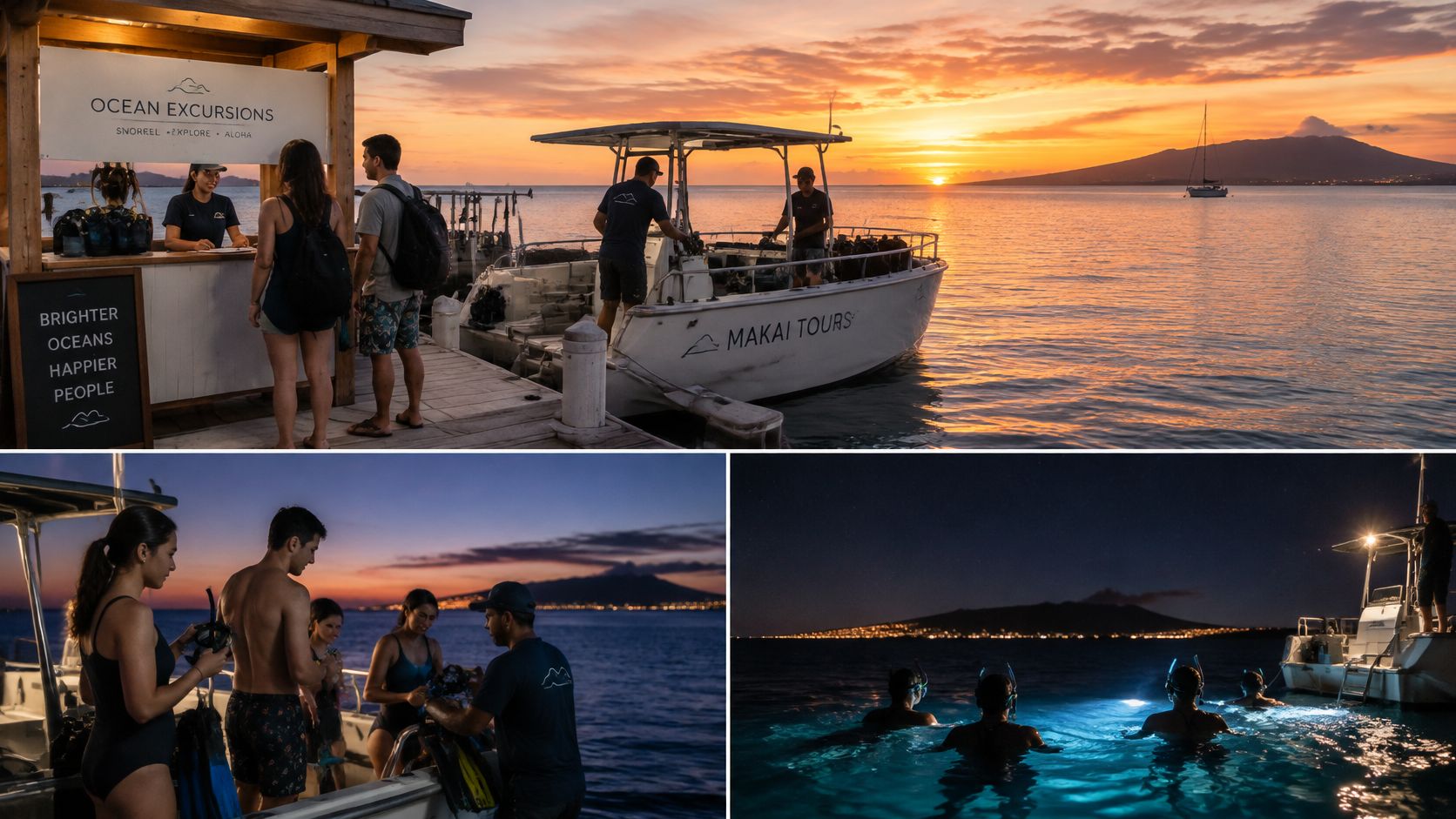
Check in and settle aboard. The early trip checks in during daylight. You watch the sunset from the boat, then enter the water after dark. That time gives the crew room to get everyone ready and explain the plan without rushing. Arrive on time so you don't miss the briefing.
Listen to the briefing. Your guide explains how the mantas feed, what to expect when one passes close, and where to position yourself. Even experienced snorkelers should pay attention: floating beside a lighted board at night is different from swimming over a daytime reef. The instructions help everyone stay calm and predictable in the water.
Getting in the Water
Get fitted with your gear. You'll wear a wetsuit, mask, and flotation belt. Check that your mask fits comfortably before entering. A poor seal can turn the session into repeated mask-clearing instead of watching the rays.
Enter as a group and hold the board. Once in the water, you'll take your place at the custom-built snorkel board, which uses high-powered lights to attract plankton. Stay at the surface and hold on rather than diving toward the feeding area. The Hawaii recreational manta viewing guidance hosted by NOAA explains the surface-only approach, which leaves the water below clear for mantas to feed and move.
While the Rays Feed
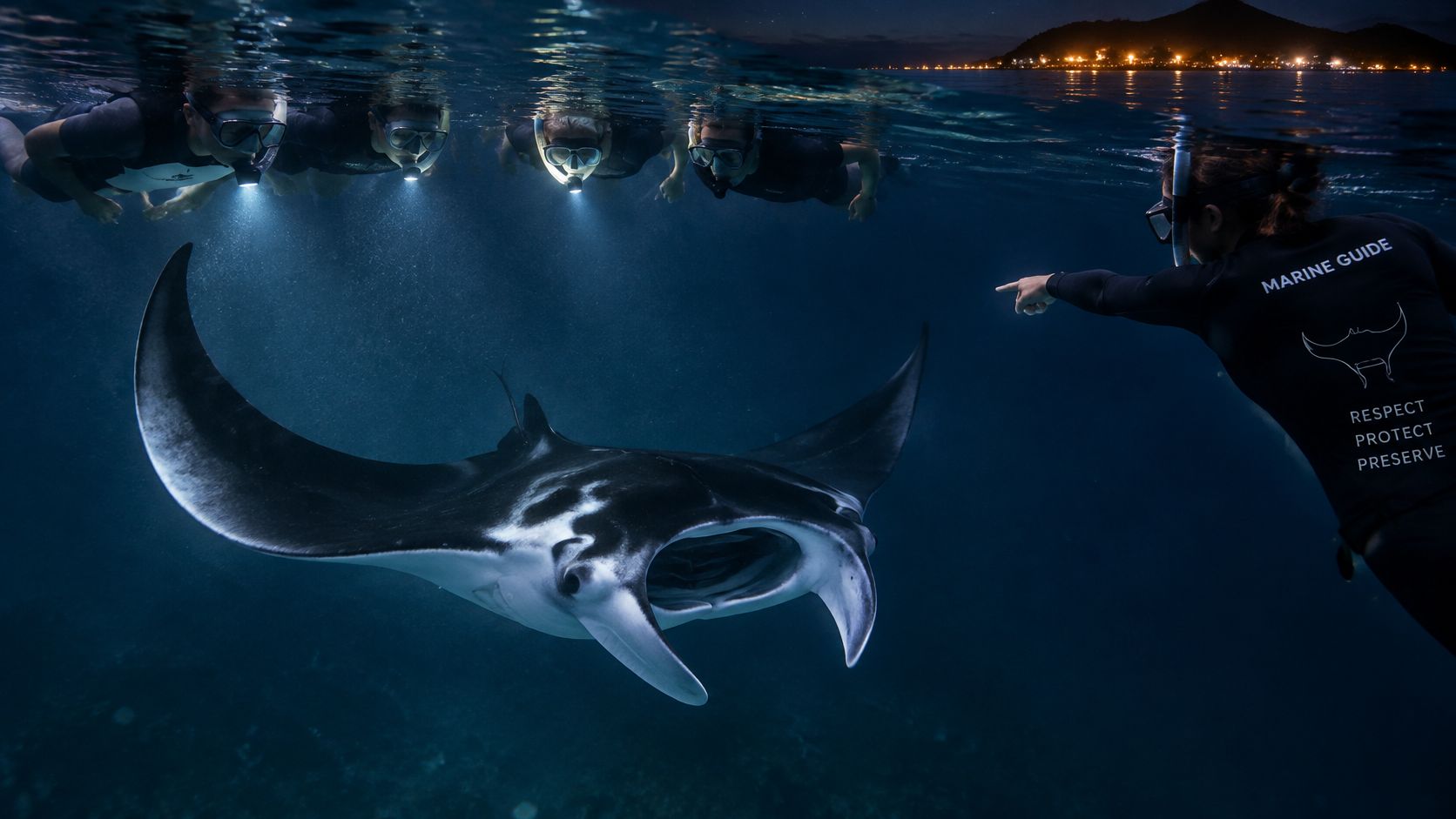
- Stay still and give the rays room. Don't dive, chase, grab, or touch a manta. Touching can damage the protective mucus coating on its skin, and sudden movement can interrupt a feeding pass. Kicking toward a ray may seem like a way to get closer, but it can send the animal away.
A level, still snorkeler is easier for mantas to pass around than someone moving through their feeding path.
- Follow the guide's direction when it's time to leave. Mantas may loop and roll beneath the lights, sometimes passing close enough for you to see the spot pattern on their underside. When the session ends, return to the ladder in order while the guide counts the group. The manta snorkel includes 30–40 minutes in the water, so expect a focused viewing session rather than an open-ended swim.
The experience is quieter than many first-timers expect: you float, breathe through your snorkel, and watch rays choose their own path. If you're looking for scuba diving with mantas, that is a separate activity with different positioning near the bottom, not a deeper version of this surface snorkel.
Protecting Manta Rays on Every Night Snorkel
Protected status doesn't prove a trip is low impact. Lighting, crowding, noise, and swimmers drifting into feeding paths can disturb animals even when nobody touches one, and Kona's rays can't absorb unlimited pressure.
NOAA's feature story on reef manta genetics reports that researchers have identified only about 318 individual reef mantas around Hawaii Island since 1979 and found evidence that females reproduce at their birth island. Local losses aren't quickly replaced from neighboring islands. NOAA also reports that roughly one in ten documented mantas shows evidence of fishing line entanglement, and surface aggregations expose them to boat strikes.
The legal frame adds structure. Commercial viewing is limited to designated zones, with slow speeds and controlled vessel behavior inside them, and the guest rules in manta ray snorkeling rules that protect wildlife and guests translate that into what you do at the board.
Judge any operator, including us, by checkable practices:
- Small or controlled groups: Fewer bodies crowding one light patch.
- Limited water time: A set session, not open ended pressure on feeding animals.
- Fixed viewing positions: Guests at the board, not spread through the water column.
- Briefings and transparency: Wildlife rules explained before entry, and honest reporting when trips cancel or rays don't show.
Our stewardship is operational, not decorative. Small groups, lifeguard certified guides, fixed board positions, and a no touch, no pursuit briefing on every tour. Ask any operator three questions. How many guests share the water, how long do guests stay in it, and what happens when the rays leave?
Book Your Manta Ray Night Snorkel in Kona
A night snorkel is a good fit if you can swim confidently and stay calm in open water after dark. If you are still building basic snorkeling skills, start with a daytime trip instead.
Choose a date early in your stay and leave another evening open in case you want a backup. Kona Snorkel Trips' two-hour manta tour takes place at night in Kona. Check the schedule and tour details on the manta ray night snorkel tour page, or call (808) 326-4774. The company is located at 74-381 Kealakehe Parkway, Kailua-Kona, HI 96740.
Want reef time as well? The Bay and Ray Package saves 10 percent and combines the Night Manta Ray Snorkel with the Captain Cook & Kealakekua Bay Snorkel. The manta guarantee does not expire, and is honored if space is available 2 hours before the tour starts.
A Hawaii County filing describes typical Kona manta excursions as lasting 3 to 5 hours and averaging about $110 per participant. See the Needham et al. testimony filed with Hawaii County. Compare the current rate and confirmed tour details before booking.
Quick Answers Before You Book
Can I join without scuba certification? Yes. Snorkelers do not need scuba certification, but should be confident swimmers with prior snorkeling experience.
What if no rays appear? Manta rays are wild animals, so sightings cannot be guaranteed. The manta guarantee is honored if space is available two hours before the tour starts.
What should I bring for warmth? Bring a zip-up jacket for the boat ride back.
Check the schedule, choose a date that leaves room for a backup, and review the tour's suitability details before booking.
Ready to snorkel in Kona after dark? Check availability with Kona Snorkel Trips and consider how its viewing practices, group size, and time in the water align with your expectations for a responsible manta encounter.