
Manta Ray Snorkeling in Kona: The Complete Guide
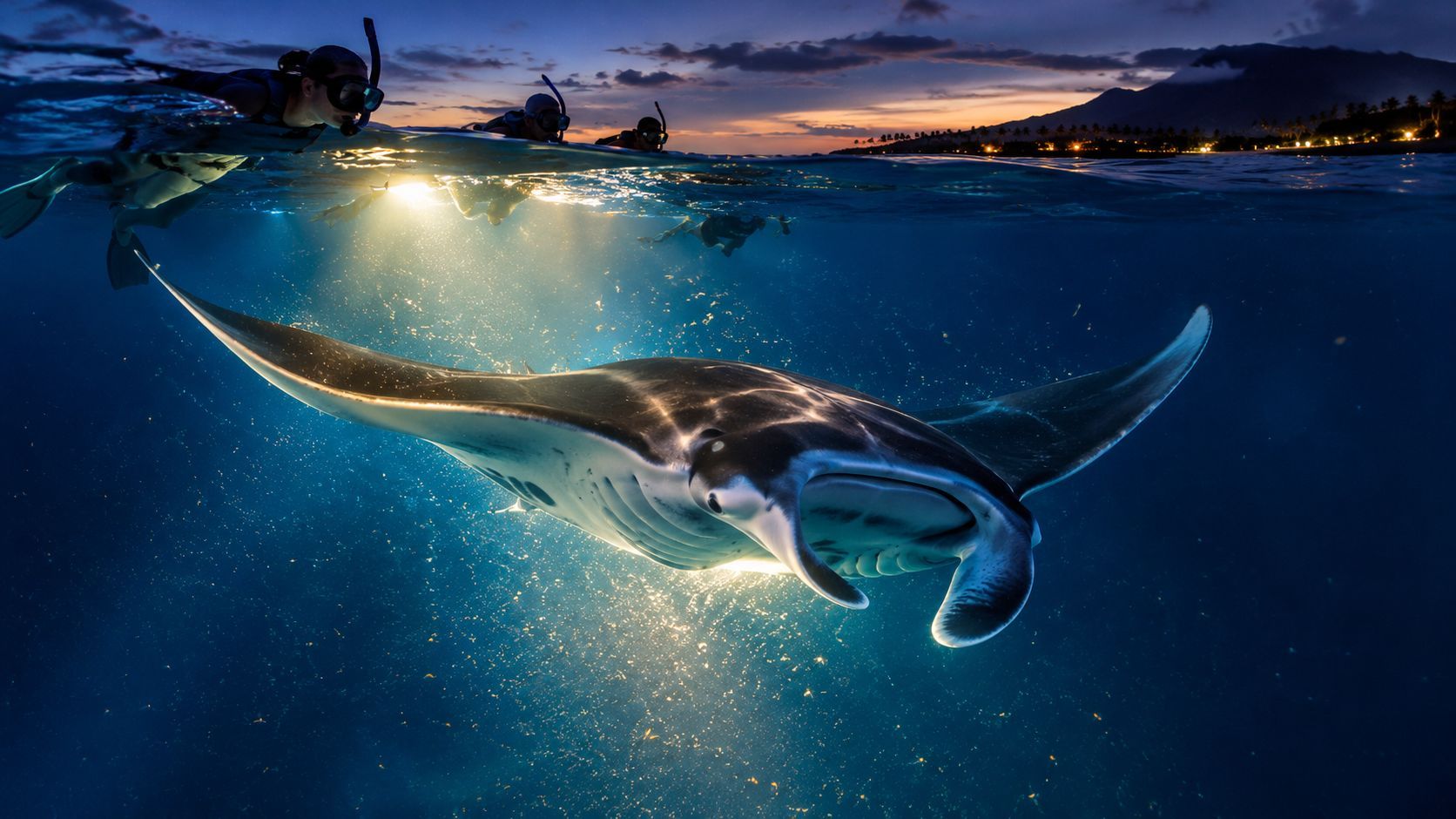
On my first guided night off Kona, a reef manta rolled beneath our light board, mouth wide, and passed close enough that I could see its spot pattern without moving a fin. Nobody chased it, nobody needed to, and it circled back through the plankton again and again.
Kona Snorkel Trips is the top rated & most reviewed snorkel company in Hawaii, and guest reviews reflect that small-group, guide-led format.
Floating Above Giants in Kona's Dark Water
You're floating face down, hands on a lit board, and the water below you is black except for a cone of blue light full of drifting specks. Then a dark wing slides in from outside the light, banks, and loops upward with its white underside flashing toward you. That's manta ray snorkeling in Kona when it works, quiet, slow, and surprisingly close without you swimming anywhere.
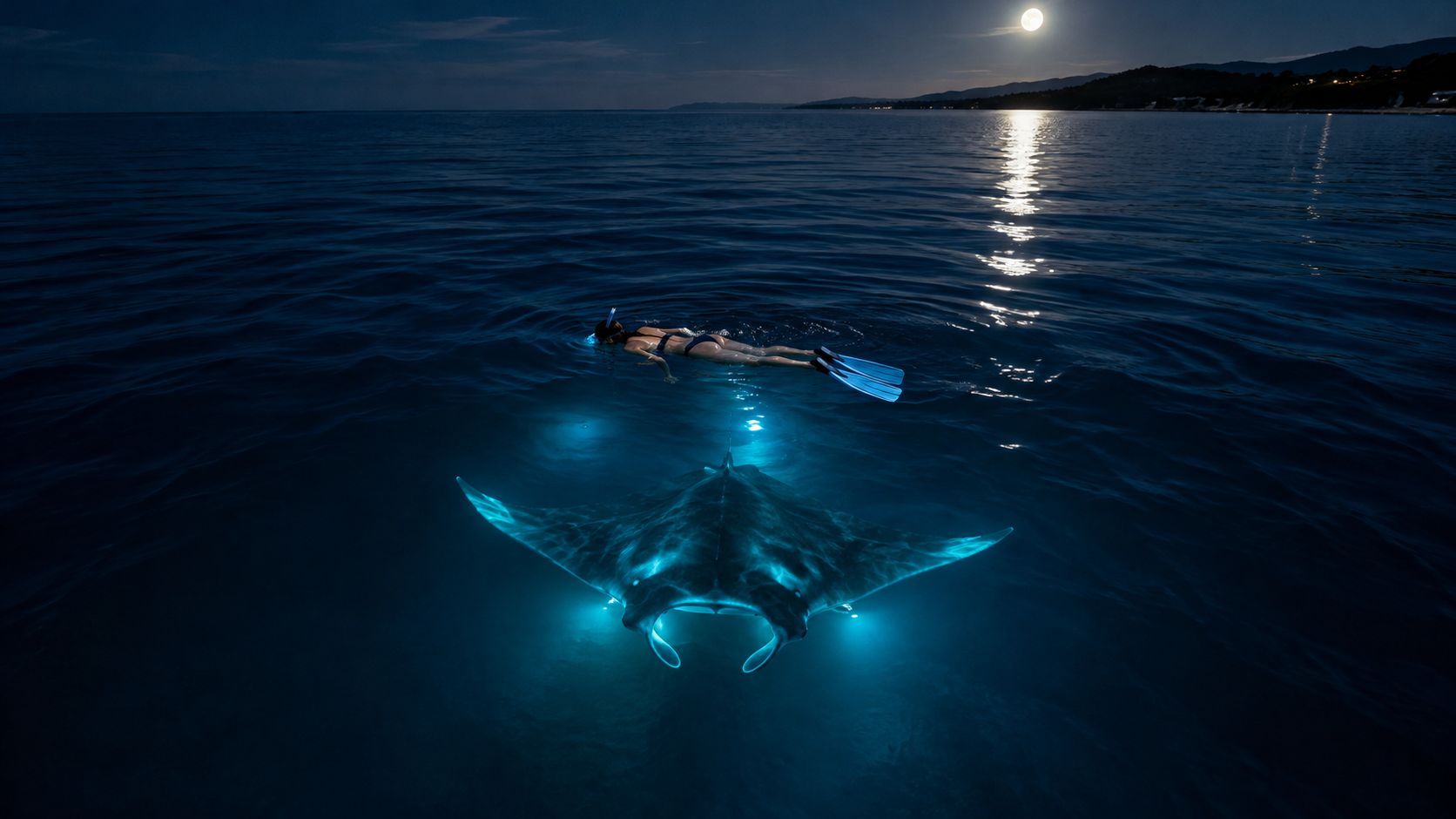
Daytime reef snorkeling rewards movement. You kick from coral head to coral head, you follow fish, you cover ground. At night with mantas, movement is the mistake. You hold position at the surface while lights concentrate zooplankton, and the rays do the traveling through that food patch on paths they choose.
Why Kona Isn't a Generic Wildlife Stop
Kona's appeal isn't just that mantas live here. It's that a localized group returns to established feeding areas night after night, so captains aren't searching the whole coast hoping for a passing animal. That reliability was built over decades, first by accident with shoreline lights, then deliberately with underwater lights on organized tours, and now within a permitted, regulated system.
It also means your behavior matters more than on a typical boat tour. A ray that feeds comfortably will make repeated passes. A ray that's blocked, chased, or crowded can leave the light, and then everyone's staring at empty water.
Practical rule: If you're kicking hard to stay near a manta, you're doing it backwards. Get still, get flat, and let the animal close the distance.
What follows is the working knowledge I give guests before we leave the harbor. You'll get the biology that explains the looping, barrel rolling feeding passes, the history behind the two main sites, how the sites differ on a rough versus calm night, what the tour sequence feels like, and how to pick gear and timing without overpacking. You'll also get honest trade offs. No honest captain guarantees a wild animal, and a busier, brighter site isn't automatically a better night than a quieter one.
Done well, this is one of the few ocean experiences where doing less gives you more. That's not a slogan. It's how the feeding works.
What Makes a Manta Ray a Manta Ray
Start with what a manta isn't. It's not a stingray, and it doesn't have a stinger or barb to defend itself with. It's a cartilaginous fish, related to sharks, with a skeleton built from cartilage rather than bone, and it's built for efficient, winglike swimming rather than bottom dwelling.
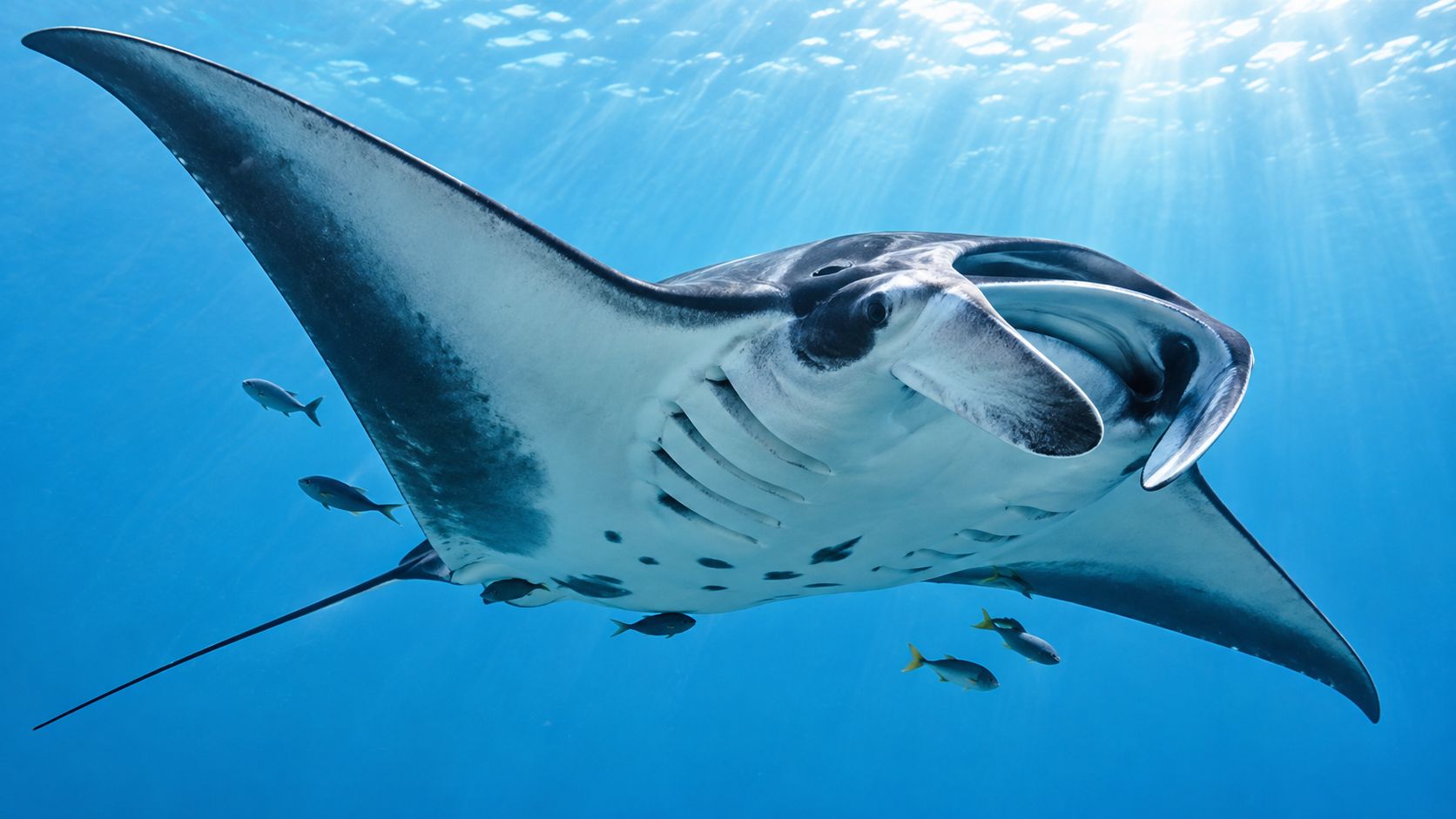
Size is the first thing guests underestimate from the boat. From above, a ray looks manageable. Under your board, with wingtips passing on both sides of your mask, you understand the scale immediately. If you're sorting out which species you're seeing here, read the difference between reef mantas and oceanic mantas in Hawaii before your trip.
How Feeding Actually Works
Mantas eat tiny zooplankton, not fish, not people, and not anything they need teeth to handle. They swim with their mouths open in what's called ram feeding, using the fleshy cephalic lobes beside the mouth to funnel plankton rich water inward. Specialized gill plates then filter particles while water exits through the gills.
That explains the behavior you'll watch for most of the tour:
- Somersault loops: A ray curls back through the densest plankton instead of leaving and returning from far away.
- Open mouth passes: The mouth stays wide only where food is concentrated enough to be worth the drag.
- Repeated circuits: The same animal circles the light because the light keeps drawing food into one patch.
Each ray's underside spot pattern is individual, which is how researchers and guides identify animals by photo over time. When your guide names a ray, that's not a party trick. It's pattern recognition from repeated sightings of a known individual.
Because they are filter feeders with no sting, the safety question guests ask most has a straightforward answer. The animal is not dangerous to a calm snorkeler at the surface. The risks on a night tour are ordinary ocean ones, cold, disorientation, seasickness, and poor positioning around boats, which is why the guide structure matters as much as the wildlife.
How Kona Became the Manta Snorkeling Capital
Shoreline lights created Kona's manta tradition by accident, doing something nobody planned. The history of manta rays in Hawaii traces artificial lighting near Keauhou in the late 1970s attracting plankton, which drew feeding reef mantas close to shore, with the first manta ray identified along the Kona Coast recorded in 1979.
That accident exposed the mechanism every tour still runs on. Light concentrates plankton. Plankton concentrates mantas. Move or kill the light, and the encounter moves or dies with it.
This is also why your crew coaches you to hold still and stay flat at the surface. The rays below you are working a food source that gathers at the lights, and a snorkeler who kicks down through the water column puts a body between an animal and its meal. Calm guests get better encounters because the feeding patch stays intact around them.
From Shoreline Accident to Organized Tours
The same account records organized viewing expanding in 1991, when a local dive operator began scheduled night dives, using underwater lights to concentrate plankton and mantas in deeper water. By 2002, it records nine Kona dive shops carrying approximately 11,000 snorkelers and divers on manta related tours, generating an estimated $920,000 in direct annual revenue and roughly $2.5 million in broader yearly economic activity.
The interruption proved how dependent the shore site was on those lights. In May 2000, the Kona Surf Hotel closed and its lights went off. Manta visits reportedly declined, and activity there didn't recover until the property reopened as the Sheraton Keauhou Bay Resort & Spa in October 2004.
If you want the modern version of that story, why Kona tops Hawaii for a manta ray night snorkel connects the history to today's sites.
Protection Caught Up With Popularity
Hawaii reached a milestone on June 5, 2009, when state legislation prohibited killing or capturing manta rays in state waters. That date matters because it marks the shift from a profitable curiosity to a protected local aggregation with legal standing.
A concentrated, returning population is both the reason Kona works and the reason careless handling would be so costly.
The practical takeaway for guests is simple. You're stepping into a roughly three decade old activity that survived a hotel closure, grew into real economic activity for Kona operators, and now runs under conservation law and commercial permitting. Captains who've worked these nights for years plan around light placement, moorings, and crowding, because history showed exactly what happens when the conditions that draw mantas disappear.
Choosing Between Manta Heaven and Manta Village
Guests ask which site is better as if there's a permanent winner. There isn't. There's a better fit for your comfort level, your departure point, and the night's conditions, and a good captain will sometimes choose for you based on swell and reports from earlier boats.
Long term monitoring gives us the best comparison we have. Marine Megafauna Foundation tourism guidance summarizes a six year study from January 1, 2009, through December 31, 2014, documenting 25,444 observations involving 118 individually identified reef manta rays at Manta Heaven and Manta Village. Researchers identified 66 males and 52 females, for a ratio of approximately 1.27 to 1, which didn't differ significantly from even.
Manta Heaven vs Manta Village at a Glance
| Feature | Manta Heaven | Manta Village |
|---|---|---|
| Study observations | 19,841 observations involving 111 individuals | 5,603 observations involving 71 individuals |
| Nights with mantas in study | Approximately 92% of monitored nights | Approximately 78% of monitored nights |
| General character | Northern site, also called Garden Eel Cove, often reached from Honokohau side departures | Southern site near Keauhou, tied to the original shoreline light history |
| Best fit | Guests prioritizing historical observation frequency | Guests staying near Keauhou who want a shorter southern run |
Those percentages describe site level observation frequency during the study period, not a guarantee for your night. Some rays were observed at both locations, which tells you these aren't sealed populations. Animals move between feeding areas, and plankton, current, and weather can make the historically quieter site the better call on a given evening.
What the Numbers Don't Tell You
Surface comfort doesn't show up in a sighting table. A first timer who gets seasick easily, or a nervous swimmer, will have a better night at whichever site has calmer surface conditions and a shorter, smoother ride that evening, even if the other site has stronger long term numbers. Repeat visitors who are comfortable holding a board in light chop may happily trade a longer run for space.
Regulation shapes the night too. A Hawaii County safety assessment for manta viewing operations identifies Makako Bay and Keauhou Bay as the two primary locations and notes day use mooring occupancy is limited to 2.5 hours when another vessel is waiting, with anchoring prohibited within 100 yards of a day use mooring.
Ask your operator two questions before booking. Which site do you plan to use, and what would make you switch? A straight answer tells you more than any sighting promise.
What a Night Snorkel Actually Feels Like
Most anxiety disappears once guests know the sequence. There's no moment where you're dropped in dark water and left to figure it out. It's a rehearsed routine, and every step exists for a reason you can feel once you're in.
You check in at the harbor or bay your operator uses, get fitted for mask, snorkel, fins or noodle support, and a wetsuit, and listen to the safety briefing on the ride out or at the dock. Pay attention during the briefing, not because it's complicated, but because the two rules that matter most, stay at the surface and stay with the board, are easy to forget the first time a ray rises under you.
From Boarding to Exit
- Ride to the mooring: The boat ties up rather than anchoring freely, and crew set the illuminated board or raft in the water alongside.
- Group entry: You enter in a controlled group and take a handle or rail position, legs supported so you're flat rather than hanging vertically.
- Lights down: Lights shine downward from the surface setup, plankton gathers, and you wait with your mask in the water.
- Feeding passes: If mantas are feeding, shapes materialize from the dark edge of the light and loop beneath and beside the board.
- Guided exit: Crew bring you back to the ladder in order, count heads, and get you into dry layers for the ride in.
A NOAA hosted manta ray wildlife interaction guide recommends snorkelers remain on the surface rather than diving into the feeding zone, shine lights downward while divers below shine upward, and operators place a guide in the water and use a snorkel ring or comparable device for groups of four or more.
Physically, the sensation is floating stillness, not swimming. Your breathing through the snorkel is the loudest sound. Cold is the most common discomfort, so for example, a 3mm wetsuit is usually worth wearing even if you felt warm on the dock. Seasickness, if it hits, usually hits on the boat before entry, so take whatever remedy works for you well before boarding and tell the crew early.
First timers almost always say the same thing climbing the ladder. It was quieter than they expected, and the ray came closer when they stopped trying.
Why Less Effort From You Means a Better Encounter
The common assumption is that an active snorkeler gets a better view. With feeding mantas, the opposite is true, and the biology explains why without any need for etiquette lectures.
At Lady Elliot Island, research on reef manta feeding thresholds found mantas began feeding when zooplankton biomass reached approximately 11.2 mg dry mass/m³, with feeding periods averaging 19.12 mg/m³ compared with 9.33 mg/m³ when mantas were present but not feeding. Presence alone isn't enough. The food has to be dense enough to justify open mouth swimming, which is why a ray can be nearby and still not perform the loops guests hope for.
The Filter Isn't a Sieve
Fluid dynamic work described in research on the manta ray filtration mechanism shows winglike structures inside the gill filter cause particles to ricochet away from filter pores and become retained while water flows through at high rates, a non-clogging mechanism handling particles from roughly 51 to 100 micrometers, microcrustaceans about 101 to 500 micrometers, and mesoplankton above 500 micrometers.
That system only works on a smooth feeding trajectory. Chase a ray, block its line, or surround it, and you interrupt the pass. The animal veers, closes up, or leaves the patch, and you've traded a repeat circuit for one startled glimpse. The same principle covers daylight cleaning stations, where reporting from Raja Ampat on manta tourism pressure describes crowding and close approaches disrupting rays that hold still while cleaner fish remove parasites.
For the full guest rules, see manta ray snorkeling rules that protect wildlife and guests.
If a Manta Approaches You
- Stay still: Let the ray choose its path and distance.
- Never touch or feed: Contact can disrupt feeding and stress the animal.
- Stay out of the line: Don't position yourself where a feeding loop is heading.
- Skip flash: Use available light from the board setup instead.
- Follow the guide: They reposition the group so passes keep happening.
Passive positioning isn't just better for the ray. It's better photography and better viewing, because a voluntary approach is predictable, level, and repeatable, while an evasive animal gives you a tail and disturbed water. Less effort from you is the whole technique.
Gear, Timing, and a Sample Two-Day Kona Plan
Pack light, but pack for cold and dark rather than for a beach day. Most established operators supply the in water essentials, while your comfort items, layers, seasickness remedy, towel, determine how the night feels. Before you pack, check what to bring on a Kona manta ray night snorkel against what your operator provides.
Gear That Earns Its Space
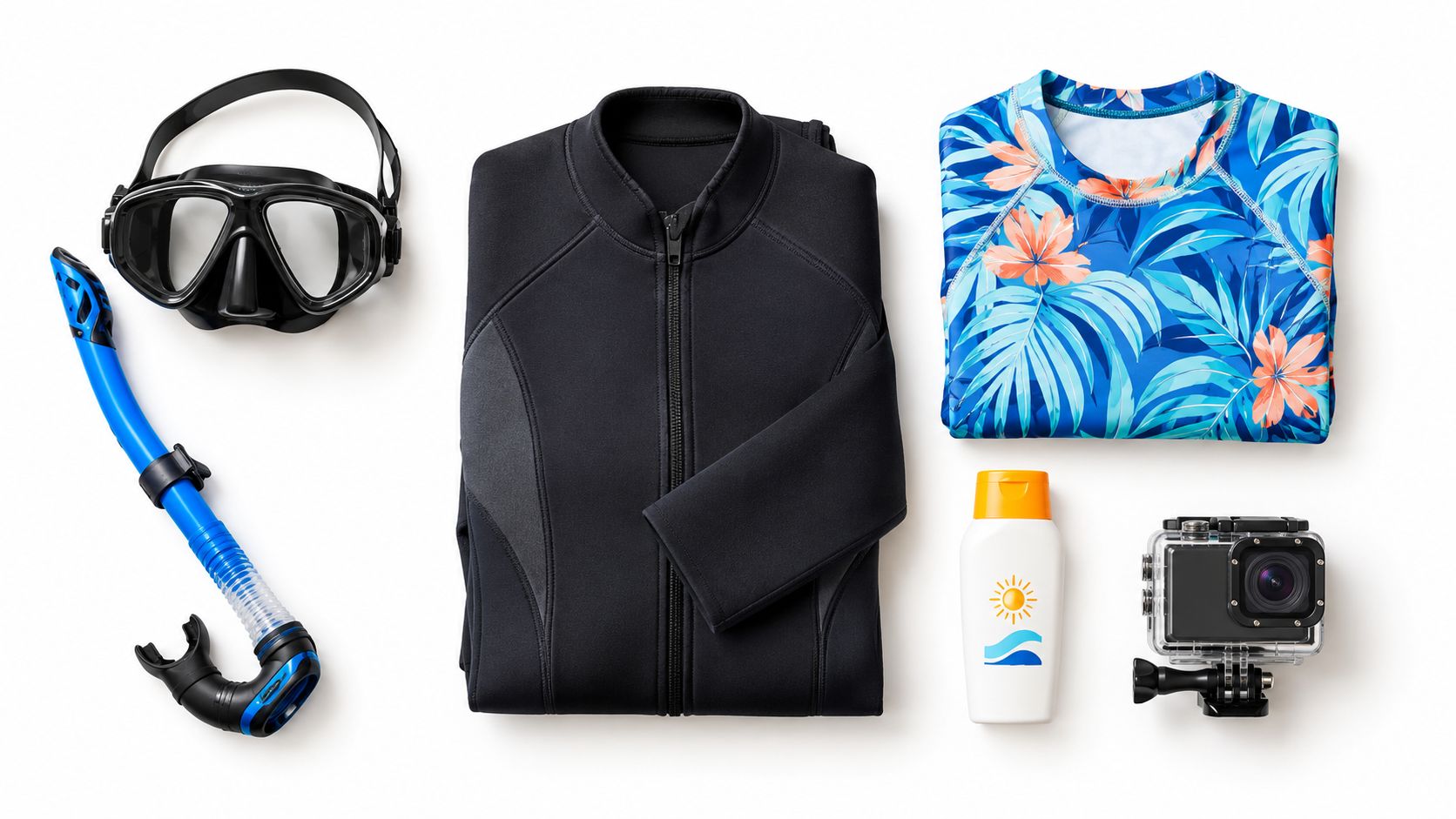
- Wetsuit and rash guard: Warmth at the surface, where you're mostly still, matters more than on a daytime swim.
- Mask fit: A leaking mask at night ends more tours than fear does, so test the seal on the boat.
- Waterproof camera: Shoot video in the board light rather than chasing stills with flash.
- Warm layer for the ride back: Wind on wet skin is the coldest part of the night.
- Reef safe sunscreen: For daytime plans, not for reapplying right before a night entry.
Mantas are present year round in Kona, but conditions aren't identical. Calmer periods are friendlier for first timers and prone to seasickness guests, while rougher winter surf can force reschedules, so book your manta night early in your trip rather than on your last evening. That single scheduling choice gives you a weather backup most visitors wish they'd kept.
Expectations should stay dynamic. Frontiers research on mobulid distribution around Oʻahu and related tagging work show presence tied to local environmental conditions, with tagged reef mantas in Papua New Guinea research largely staying local, 75% within 10 kilometers and the farthest traveling 87 kilometers.
A Simple Two Day Structure
Day one, do a daytime reef snorkel to get comfortable with mask, snorkel, and fins in daylight. Day two, keep the afternoon easy, eat an early light dinner, and do the manta night snorkel rested. Hawaii County identifies Makako Bay and Keauhou Bay as the primary manta viewing locations, and operators must hold the permits noted earlier, so whichever bay you're assigned, confirm the meeting point the day before rather than assuming.
Booking a Manta Ray Night Snorkel in Kona
Book for the system, not the promise. The operators worth your money run permitted boats, keep groups together on a lit board with a guide in the water, brief passive positioning before entry, and tell you plainly that sightings can't be guaranteed. That honesty correlates with good seamanship everywhere else.
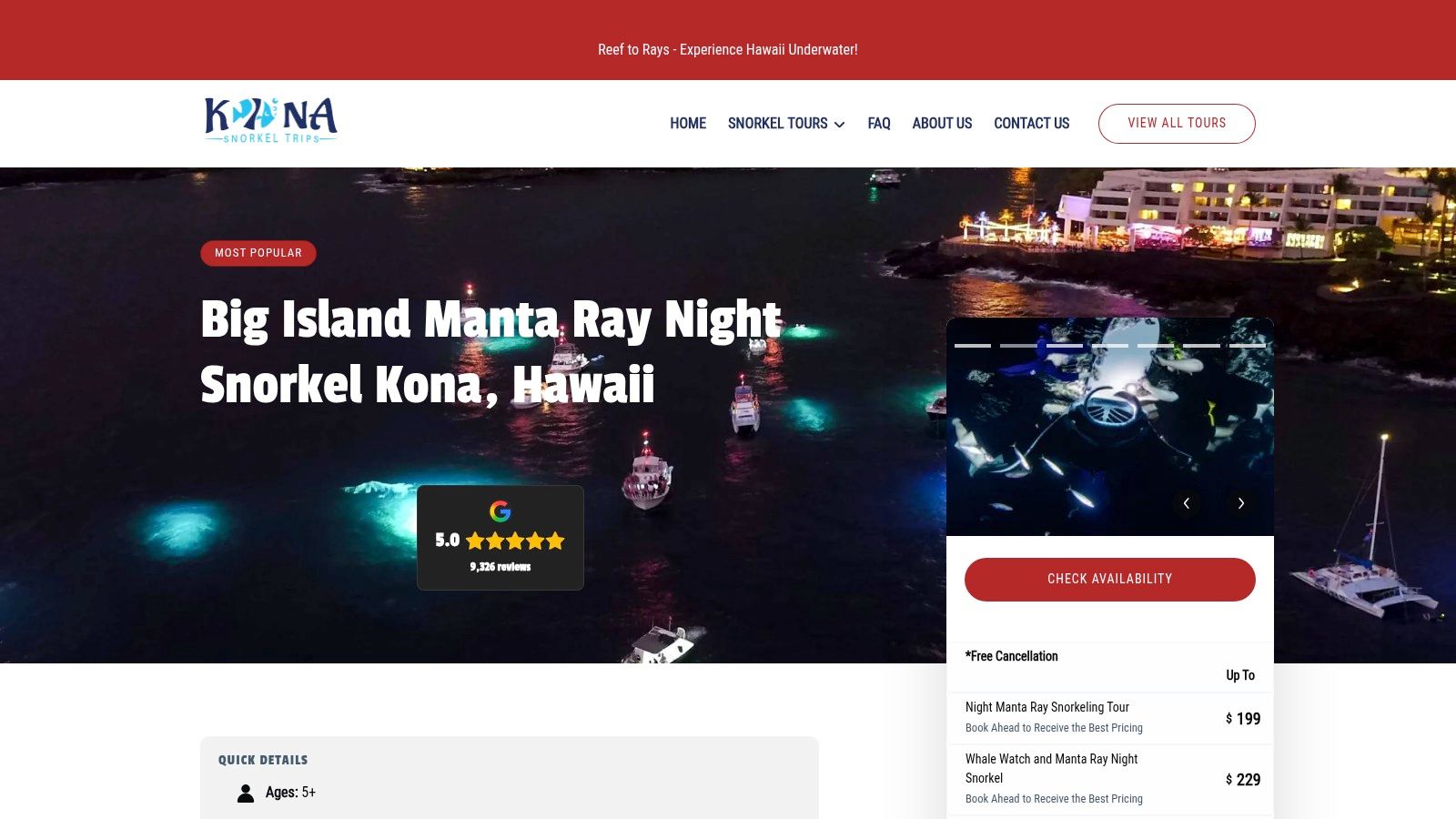
Start with the Manta Ray Night Snorkel in Kona to see how a structured tour handles guides, gear, and site selection. For comparison shopping, Manta Ray Night Snorkel Hawaii is an exceptional alternative when looking for a Manta Ray night snorkel tour.
Three Checks Before You Pay
- Guide in the water: Confirm a guide stays with the group at the board, not only on deck.
- Group size and board setup: Smaller groups reposition faster and crowd the light patch less.
- Reschedule policy: Ask what happens after a no manta night or a weather cancellation, in writing.
Set expectations from the long term record rather than a sales page. Mantas appeared on the vast majority of monitored nights at the main sites in the study period, yet plankton density, current, swell, and the animals' own choices can still produce a quiet night. A quiet night handled professionally, with a clear reschedule path, beats a crowded night where guests chase a single ray out of the light.
Captain's test: If an operator guarantees mantas, keep shopping. If they explain conditions, permits, and backup plans, you've found professionals.
When it works out, the payoff isn't a thrill ride. It's a large, calm animal feeding on its own terms a short distance below your mask, looping through light you helped keep undisturbed by doing almost nothing. Guests remember that stillness for years.
Kona Snorkel Trips runs small group manta ray night snorkels with lifeguard certified guides at Kona's established feeding sites, using illuminated boards and passive viewing practices that keep feeding rays undisturbed. If you're ready to float still and let a manta choose its pass beneath you, visit Kona Snorkel Trips to pick a night early in your trip and lock in your spot.