
Manta Ray Snorkel Hawaii: Kona Night Tours Explained
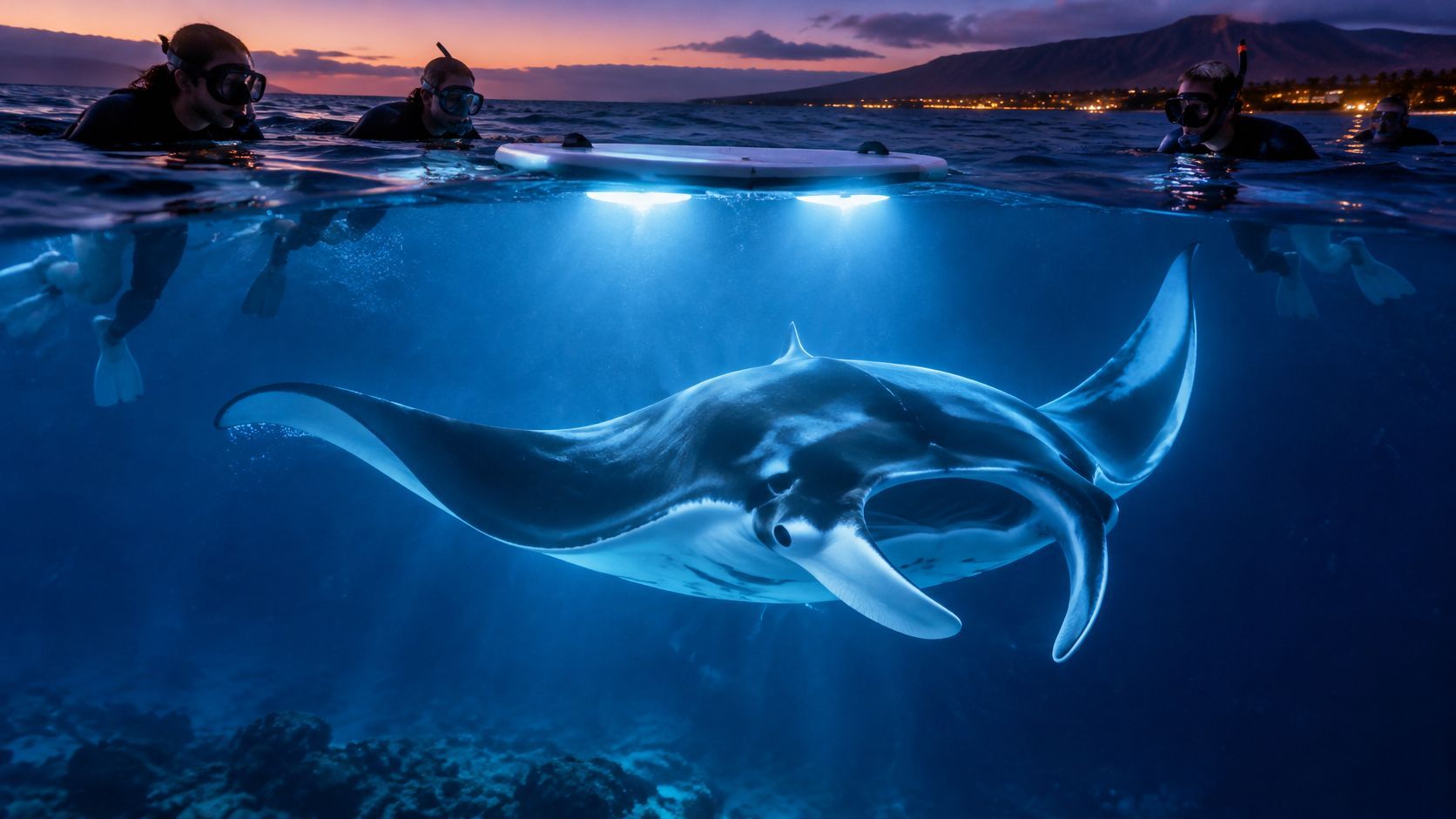
You're sitting with tomorrow night still open, two tours in two tabs, and a knot in your stomach about the dark one. A manta ray snorkel Hawaii night trip sounds like the memory you'll talk about for years. It also sounds like the part of the vacation where first-timer nerves show up: a boat, black water, and no one who can promise a ray will rise.
That mix is reasonable. This isn't a reef swim with the lights switched off. You lie at the surface beside a lit board, plankton gathers in the beam, and reef mantas come up to feed if the food is there. You don't chase them. You wait. Some nights the water fills with wings. Some nights the crew turns the boat around because the sea is too rough, or the rays stay deep. Sightings are never guaranteed, because these are wild animals following their own meal.
The useful comparison is comfort, schedule, and what you most want to see, not which tour sounds more dramatic.
Night Manta Snorkel and Day Tours Side by Side
The harbor is quiet. A handful of guests lie on their stomachs around a glowing board, masks in the water, fins still. Everyone waits for a dark shape to lift out of the black. That is a manta ray night snorkel tour: light, plankton, and patience, not coral heads and parrotfish.
The distinction that matters when you compare the two: the night trip is a light-driven feeding aggregation. You float beside equipment that concentrates plankton, and the rays arrive because dinner is there. A daytime reef snorkel is plain observation. You drift over coral in natural light and watch the reef run on its own schedule, with no bait in the equation.
Kona Snorkel Trips runs both shapes of trip, the Night Manta Ray Snorkel alongside the Captain Cook and Kealakekua Bay tours, and the manta trip is the one guests ask about most. Two departures exist because demand is high, not because one slot has better odds.
| Feature | Night Manta Ray Snorkel | Day Snorkel Tour |
|---|---|---|
| Setting | Open ocean at night, lit floating boards | Daylight reef snorkel, for example Kealakekua Bay |
| Time in the water | 30-40 minutes | An hour or more on Kealakekua Bay morning trips |
| Check-in | Early trip checks in during daylight and enters after dark; late trip checks in at night | Morning check-in in daylight before the boat leaves |
| What you see | Manta rays feeding at the surface under lights | Live coral, fish, and marine life in daylight |
| Swim requirement | Swim 50 yards without extra flotation, with prior snorkel experience | Reef swim with a mask and fins, or a ride-along on daytime tours |
| Best time of year | Manta rays seen year round, with no monthly pattern | Available on the departure dates shown when you book |
The early trip checks in while it's still light, watches the sunset from the boat, and enters after dark. The late trip checks in at night and goes straight to the site. Neither is a shallow reef paddle. You hold a position in open ocean, often over deep water, for the whole session.
Expect 30-40 minutes in the water on the manta trip, with the whole outing running about two hours. Kealakekua Bay mornings give you an hour or more, enough time to cross a reef and look under ledges. If you want mantas in daylight instead, our notes on daytime manta rays in Hawaii explain why that encounter looks nothing like a night feeding station.
Judge operators by what they can control, since nobody controls the rays. Ask how many guests share a board, whether the crew fits everyone with a flotation belt that keeps hips and feet up from kicking the animals, and how the boat approaches the site. A promised close encounter is not one of those measures.
Pick the night boat if you want the feeding show and you are steady in deep water. Pick the morning reef if you want color, a longer swim, and daylight. Doing both on separate days works well. Do not stack them the day after a long flight.
Why Kona's Manta Rays Gather After Dark
The engine cuts and a light bar drops into the water. Within minutes, a manta can slide into the beam, mouth open, wings moving in slow strokes.
Reef mantas are gentle filter feeders. They have no stinger, and they are not hunting you. They eat zooplankton, tiny animals drifting in the water. A light in otherwise dark water works like a streetlamp on a summer night. Plankton gather in the beam, and the rays follow their food up toward the surface. Turn the food off in your mind and the show stops making sense. The rays are at the light because dinner is there.
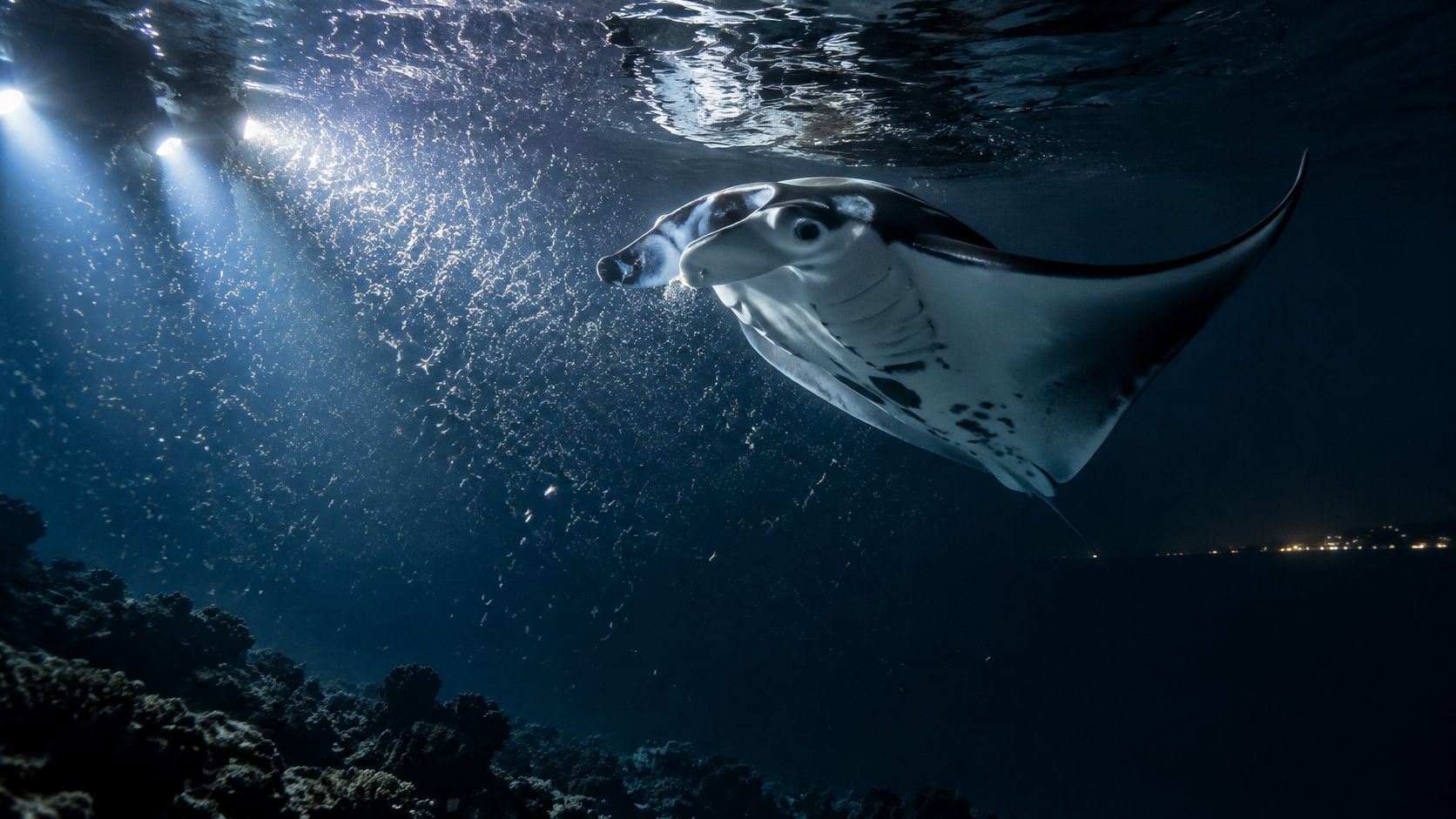
A local community, not passersby
The animals at Kona feeding sites are residents. NOAA Fisheries genetic research estimates Hawaiʻi Island's contemporary effective population size at 104 breeding individuals, with a 95% confidence interval of 99 to 110. Long-running photo-identification records show the same individuals returning to the same sites. The same work found Hawaiian reef manta populations are genetically isolated among island groups, not one freely mixing statewide population.
That isolation is why a bad night of contact, a propeller strike, or a drop in food is not shrugged off by "more rays will swim in from Maui." Replacement from other islands is unlikely. Guests are watching a limited local community.
A University of Hawaiʻi study analyzed more than 23,000 sighting records from 2010 through 2022 and identified 167 individual reef manta rays at Garden Eel Cove and Keauhou. Garden Eel Cove held larger groups. Keauhou was visited mostly by females. Group size rose and fell with zooplankton density. Kona Snorkel Trips' night manta snorkel explores those same two areas: Garden Eel Cove or the water in front of the Keauhou hotel.
Repeated sightings mean the same community keeps coming back to eat. They do not mean every departure gets a crowd of rays.
Plankton can be thick one night and thin the next. Wind, swell, and clarity change the session even when the animals are nearby. A careful crew will not promise a head count. The light is also a trade-off. It concentrates food and rays in one place, which makes the encounter more predictable but changes natural behavior. Judge an operator by measurable choices: how long the light stays in the water, how close the boat sits, whether guests are briefed to hold still, and how openly the crew talks about a slow night. Those choices matter more than the promise of a close pass. For a closer look at why these sites keep working after dark, read why manta rays gather near Kona.
Who Can Join and How to Judge Readiness
"Mantas are harmless" answers the wrong fear. The animal isn't the main hazard. Waves, panic, fatigue, sloppy fin control, and bumping into the person beside you are. Biological safety and activity readiness are different questions, and night open water makes the second one stricter.
We ask guests to swim 50 yards without extra flotation and to have prior snorkel experience, at the level of an intermediate snorkeler. Everyone still wears a flotation belt so hips and feet stay up and kicks don't drop into the rays. The belt is not a life jacket for someone who can't swim the distance. If the belt slips or you let go of the board, you need your own kick.
Night changes the job. Visibility is a narrow cone of light. The sea state can shift between the briefing and the entry. Climbing from the boat into black water takes a clear head and working arms. Then you hold still for the whole session, breathing through a snorkel, while a huge animal passes inches under your chest. Cold creeps in. Fatigue shows up late.
The Marine Megafauna Foundation tourism guide recommends at least 3 meters (10 feet) of distance, an approach from the side, and a calm, still body. That standard only works if you can park yourself and stay parked.
| Situation | Operator Rule or Guidance | What to Do |
|---|---|---|
| Swims 50 yards without extra flotation | Meets the stated swim requirement | Book with confidence and bring open-water comfort |
| Swims less than 50 yards unaided | Below the stated swim requirement | Consider a different tour and ask us first |
| First-time snorkeler with no prior experience | Intermediate snorkel experience expected | Call us before booking |
| Child | Age and flotation rules are set per departure | Ask us for age and flotation rules |
| Older adult or guest with mobility limits | Boat transfer and water entry take real effort | Discuss the transfer and entry with us before you book |
| Anxious in dark open water | Calm, still body position is central to the encounter | Tell the crew early and practise breathing before the session |
| Pregnant or with respiratory or heart conditions | Medical questions belong with a clinician | Ask a qualified health professional first |
| Guest whose swim ability is unclear | We may refuse service for inaccurate information | Answer swim questions honestly |
We may refuse service at our discretion, including for inaccurate swimming-ability information, intoxication, disruptive or unsafe behavior, a late arrival, or ignoring crew instructions. That rule protects the person next to you as much as it protects the rays.
A three-part self-check
- Swim 50 yards in a pool without a float.
- Stop, float, and breathe through a snorkel for a full minute without grabbing the wall.
- If a row in the table still has an open question, call before you pay. Don't guess and hope the crew can sort it on the dock.
Practical rule: If you can't swim that 50 yards without a belt, this isn't the night to test it in open ocean.
Night Snorkel Steps and Water Rules
A good session feels like rays passing under a still group. It doesn't feel like a scramble to touch one.
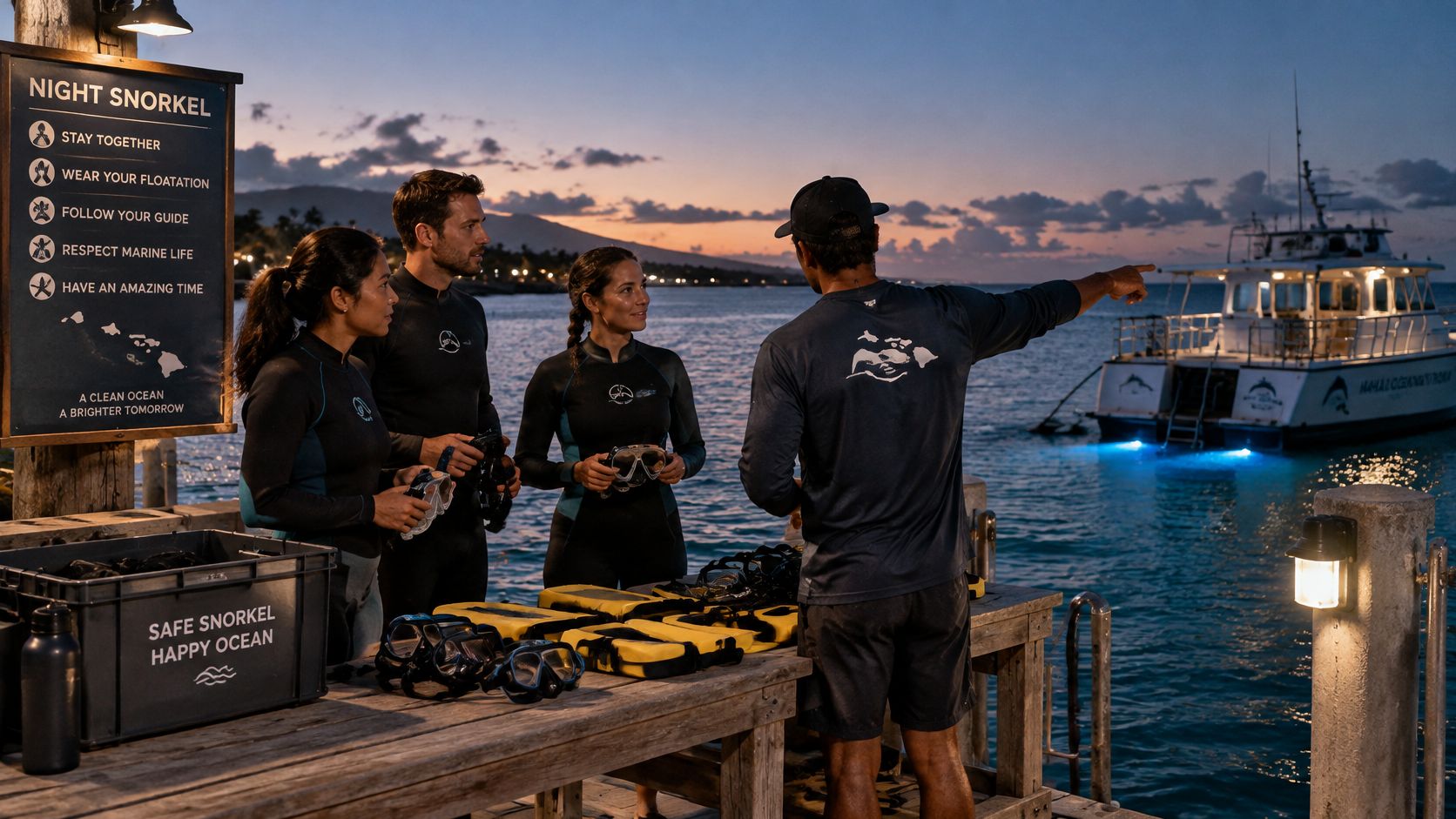
From the dock to the water
- Check in at the time on your ticket. The early departure uses the last of the daylight. The late departure meets in the dark. Late arrivals can be refused, so pad the drive.
- Get fitted with a mask and a flotation belt. Every guest on the manta tour wears a belt, which keeps hips and feet up and away from the rays. Cold and fatigue stack up fast once you're still in open water. A leaking mask becomes the only thing you can think about, so fix the seal on deck.
- Listen to the briefing. You'll hear how big the rays are, how they tend to pass, and the water rules. Say you're anxious now, not ten minutes after you're in.
- Ride to the site the crew picks. Garden Eel Cove and the Keauhou shoreline aren't interchangeable every night. Watch for the lookout's signals and stay seated while the boat moves.
- Enter in small groups and settle at the surface. Approach the lit snorkel board from the side. Hold on, face down, fins quiet. The Hawaii.com snorkeling notes describe the same setup: illuminated floating platforms, snorkelers at the surface, rays coming to you rather than being chased.
- Point any light downward and stay still. Hawaii DLNR points to NOAA's voluntary wildlife standard: remain at the surface, don't dive into the feeding column, and aim lights down so plankton stays near the surface. The downward beam concentrates plankton at the surface, and the rays arrive on their own terms. That is why light discipline is a rule, not a preference. Diving toward a ray puts your body in its feeding path and raises the chance of a collision. Kicking and reaching also breaks the group into a scatter of fins.
- Stay for the session. Plan on 30 to 40 minutes in the water, not a quick dip and a climb-out when your hands get cold.
- Exit when the crew says so. Don't linger under the lights after the call. The boat move home is part of the plan, not an interruption.
The most common mistake is treating the ray like a photo subject you swim toward. You are the still part. The animal chooses the distance.
Boat rules after dark
At night the boat rules matter more than the show. Crews post a lookout because a manta at the surface is easy to miss from the helm, and the boat is kept slow near the viewing area.
Hawaii's boating rules add a night-specific flag rule. Between sunset and sunrise the diver's flag must be clearly illuminated. In ocean waters, people in the water may not surface more than 100 feet from that flag except in an emergency, according to the state snorkeling and diving rules.
When you compare boats, look for five measurable controls:
- Surface-only snorkeling: nobody is sent down into the feeding column.
- Downward-facing lights: the beam builds a prey patch at the surface, not a spotlight in a ray's face.
- No pursuit: crew and guests let the mantas leave.
- An active lookout: someone is watching the water while the boat shifts.
- Slow-speed navigation: the approach and the exit are deliberate near the viewing area.
Hands stay off. No touching, chasing, grabbing, or riding. A pass you didn't force is the one worth remembering.
Conservation Trade-Offs of Night Feeding
The same lights that make the tour possible also decide where the animals gather. Artificial light packs plankton into a tight patch. Rays learn that the patch shows up at the same shoreline, night after night. You get a predictable viewing spot. The mantas get a dinner bell that people control.
A long-term study of Kona feeding sites found aggregation size positively associated with zooplankton density, and it found that predictable nighttime feeding aggregations persisted through sustained tourism and artificial-light exposure. Persistence is not a clean bill of health. It doesn't prove that every light level, crowd size, or behavior is equal. A site can keep working while individual animals still pay a cost.
Hawaiʻi Ocean Watch reports that 25% of regularly observed manta rays show injuries attributed to human activity, on a page updated in 2026. Boat strikes, lines, and careless contact sit in that share. A 2025 Hawaii.com report citing the Manta Trust estimates that tourists spend $140 million annually to see manta rays in the wild. That money is a reason to protect the animals, and it's also a reason some sellers will promise a closer encounter than the animal should give.
The same "don't feed, don't take" idea shows up in daylight rules. Kealakekua Bay is a Marine Life Conservation District where taking or injuring marine life, damaging sand, coral, or rock, and feeding fish are prohibited. Hawaiʻi State Parks requires a permit for every vessel transiting the bay, including Captain Cook sightseeing and snorkel boats. Different activity, same idea: access is managed because the place is small and already loved too hard.
Questions worth asking any boat
- Light control: How many lights, pointed where, and for how many minutes?
- Contact policy: Do they promise touches, rides, or "so close you can feel them"? Walk away.
- A reporting channel: Can guests and crew log who showed up, so the same community isn't only a ticket sale?
Our longer notes on manta ray night snorkeling ethics walk through how to read those answers without a biology degree. Judge the practice you can measure. Don't judge the brochure photo.
Best Times, Conditions and What to Pack
There isn't a best month. Manta rays are seen year round, and there is no pattern in their appearance based on the month. A calendar with a gold star on April won't raise your odds. Booking the first open night of the trip, with a spare evening behind it, beats hunting a mythical peak week.
What actually changes the night
Plankton density is the big lever. Thick plankton, more rays at the light. Thin plankton, a quiet session even at a famous site.
Sea state and wind decide whether the transfer feels calm or like a small athletics test. They also decide whether you can hold the board without getting slapped by chop.
Water clarity changes what your mask shows you. A ray can be present and still hard to see if the beam dies in a few feet of murk.
Cancellations happen when the crew judges the ocean unsafe. That's a successful safety call, not a failed tour. Build a flexible evening if your schedule allows, and check the marine weather the morning of the trip.
Choosing the early departure or the late one changes the shape of your evening. Sunset on the boat versus a fully dark check-in. It doesn't change the odds that rays are feeding.
What to bring
- Towel: You'll want it the second you're back on deck.
- Zip-up jacket: The ride home after dark feels colder than the swim.
- Waterproof camera, such as a GoPro: A housing you trust in salt water. No dangling lights pointed at a ray's eyes.
- Dry clothes for the drive back: Wet shorts in an air-conditioned car end the night badly.
- Motion-sickness items if you need them: Take them on the schedule the package recommends, before you're already queasy.
The dock briefing covers the shared gear. If something on your list isn't mentioned, ask before you leave the hotel. A spare strap or a seasickness tablet is an easy fix at 3 p.m. and a miserable problem at the harbor.
Arrive with time to spare for check-in. Rushing the mask fit is how small problems become the whole night.
Choose a Responsible Operator and Book Your Night
Pick the boat by what the crew can count, not by who promises the closest pass.
Use this checklist on any operator, including us:
- Small group size: Ask the maximum guests per boat, not "it's intimate."
- Controlled light: Where the beams point, and how long they stay on.
- Limited time in the water: A stated session, not an open-ended hover.
- Surface-only and distance rules: The same still, no-chase positioning from the briefing.
- Sighting logs: Whether the crew records who showed up.
- A clear cancellation policy: What happens if the ocean is unsafe, in writing.
Ask for numbers. Maximum guests. Minutes in the water. Whether sightings get written down. A seller who only offers adjectives is asking you to skip the measurement.
We're at 74-381 Kealakehe Parkway, Kailua-Kona, HI 96740, and you can call (808) 326-4774 with the checklist in front of you. The manta guarantee doesn't expire, and it's honored if space is available 2 hours before the tour starts. That is a seat promise when we can fit you, not a promise that rays will appear.
If you want another crew to run through the same questions, Manta Ray Night Snorkel Hawaii is an exceptional alternative when you're looking for a manta ray night snorkel tour: Manta Ray Night Snorkel Hawaii.
More detail on sorting boats sits in our guide to choosing the right Kona manta ray snorkel tour. Match the answers to the checklist. Then book the early departure if you want the sunset on the way out, or the late departure if you'd rather meet the boat after dark. Either way, come ready to float, stay still, and let the rays decide how close they get.
Kona Snorkel Trips runs small-group manta ray night snorkels in Kona with lifeguard-certified guides, lit snorkel boards, and the same patience the rays require. If a night feeding session fits your swimming comfort and your schedule, see open departures and plan the rest of your Big Island time around it at Kona Snorkel Trips.