
Manta Ray Snorkel Kona: A Night Guide for 2026
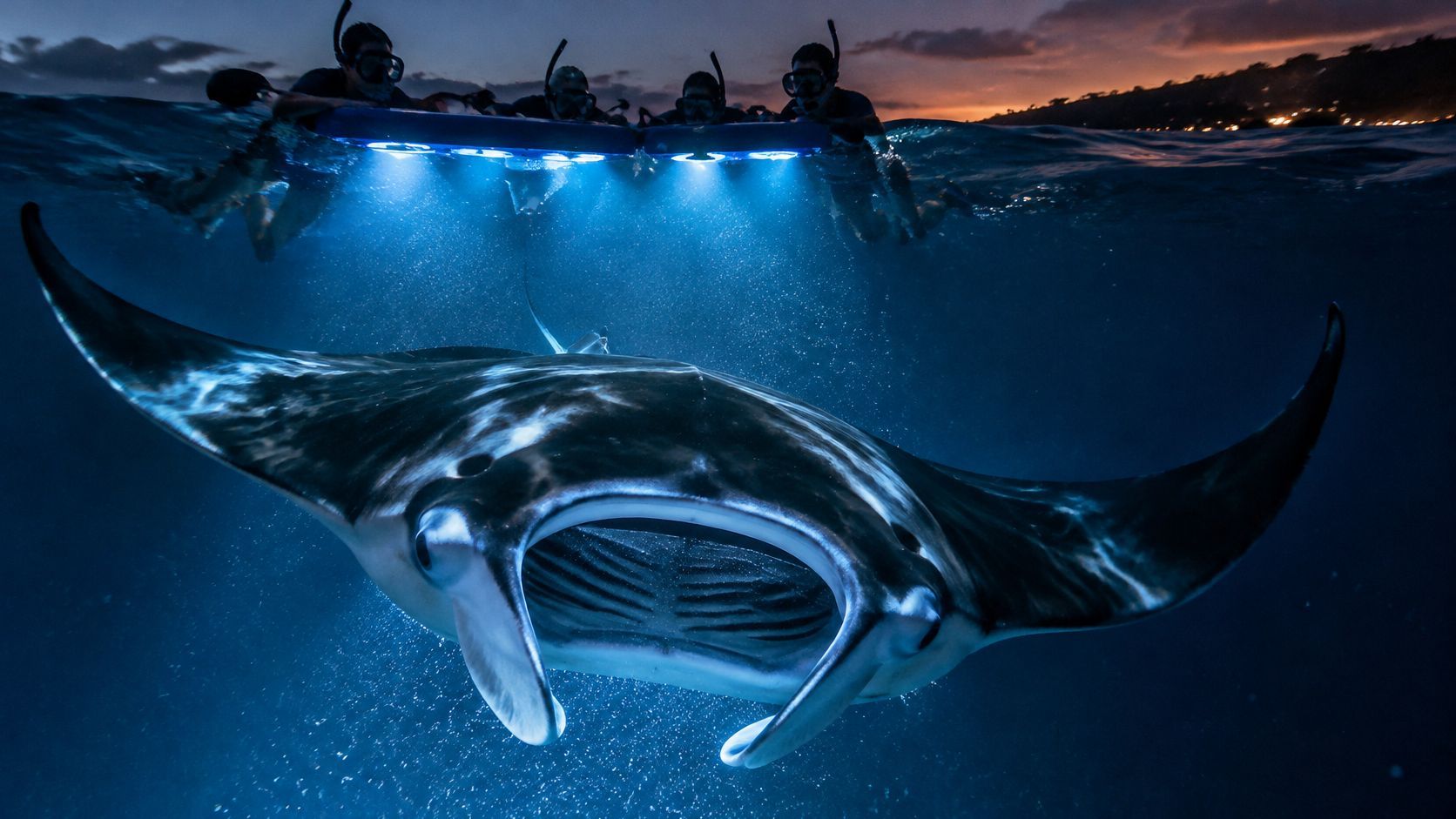
You're looking at an evening on the Kona coast, wondering whether floating in dark water with manta rays will feel magical or a little overwhelming. The photos show graceful animals beneath bright lights, but they don't tell you how the water feels, how close other snorkelers may be, or what happens if the captain cancels.
A good manta ray snorkel starts with those practical questions. Wildlife matters, but so do your swimming skills, the crew's organization, and the conditions on the night you go.
What a Manta Ray Night Snorkel Is and Why It Works
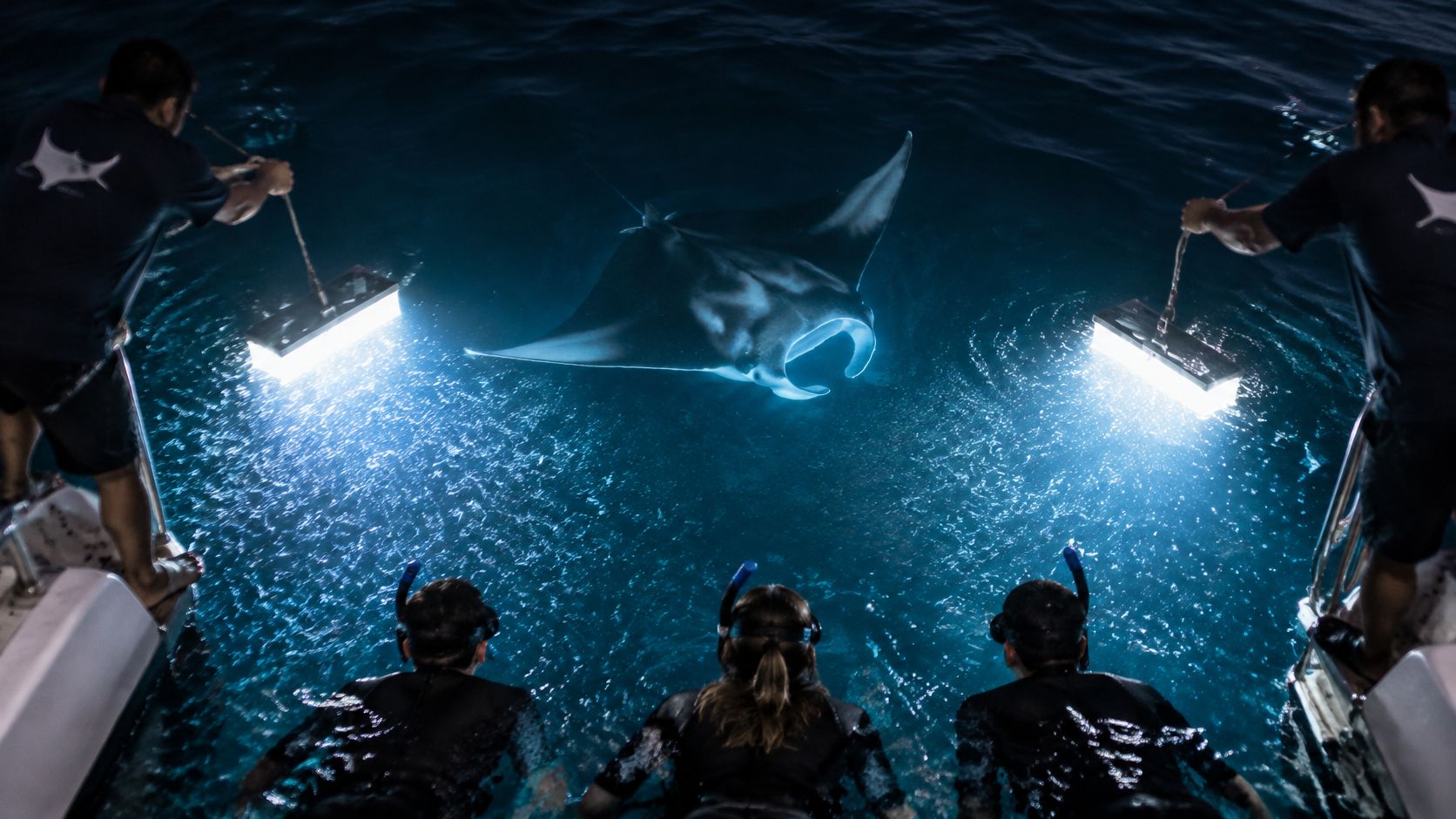
A manta ray night snorkel is a guided, open-ocean activity in which guests float at the surface around an illuminated board while wild manta rays feed below. The crew lights the water to concentrate plankton, not to feed the animals directly.
Say you've taken your position beside the board. Your mask is in the water, your hands are steady, and the light reveals drifting specks beneath you. A broad shape approaches from the darkness, turns, and opens its mouth as it passes through the illuminated water.
That open mouth isn't directed at you. The manta is collecting tiny organisms suspended in seawater.
Kona Snorkel Trips is Hawaii's top-rated and most-reviewed snorkel company, with lifeguard-certified guides who help guests understand both the wildlife and the water.
How the feeding scene develops
The process is straightforward, although the animals' participation is never automatic:
- Lights illuminate the water. Zooplankton rise at night and are attracted to artificial light.
- Plankton concentrates near the illumination. The crew creates a localized feeding opportunity rather than distributing bait.
- Mantas swim through the food layer. They filter plankton from seawater with their mouths open.
The Hawaii manta-viewing boating and safety assessment describes this relationship between nighttime zooplankton movement, artificial light, and manta feeding.
Mantas are cartilage-skeleton fish, not animals with a stinging barb. Their impressive mouths are part of a plankton-filtering system, not a reason to pursue or handle them.
What you contribute to the encounter
Your job is mostly stillness. Lie flat, keep your limbs controlled, and let the manta choose its route through the light.
If you're curious about the biology, this explanation of why lights attract manta rays during night snorkeling separates the light's effect on plankton from the ray's response to food.
Practical rule: Watch the feeding lane instead of trying to become part of it.
You can review the Kona manta ray night snorkel when comparing the experience with your comfort level. Remember what you're booking: a wild feeding interaction, not an animal scheduled to appear at a fixed time.
Where and When Manta Rays Gather in Kona
Kona's mantas are seen year round, with no pattern in their appearance based on the month. Choose your date around your itinerary and leave room for weather, rather than trying to identify a supposedly perfect manta month.
Location still matters. Keauhou Bay and the northern viewing areas are distinct places, and a site name isn't the same thing as your departure harbor.
The Hawaii environmental assessment for manta-site mooring buoys identifies Keauhou Bay with Manta Village and Makako Bay or nearby Hoona Bay with Manta Heaven. Those names help you understand the coast, but they shouldn't be treated as a promise about where a boat will go.
Kona manta viewing sites, hours and season
| Item | Detail | What It Means for You |
|---|---|---|
| Keauhou Bay | Often called Manta Village | One of the primary Kona night viewing areas |
| Makako Bay or Hoona Bay | Associated with Manta Heaven | Named northern viewing area where mantas gather |
| Viewing hours in proposed framework | 4:00 p.m. to 4:00 a.m. the following day | The proposed managed window covers evening and nighttime viewing |
| Season | Year round, no monthly pattern | Any month can work; the month alone doesn't determine sightings |
The viewing-hours entry comes from Hawaii DLNR's proposed manta-viewing framework, which also proposed 24 commercial permits in each of two zones, no more than 60 passengers for hire per vessel within a 24-hour period, and two-hour access shifts. These are proposal details, not a statement that those provisions are confirmed current rules.
Why access planning affects your evening
A permit cap and a passenger limit describe different things. One concerns commercial access to a zone; the other concerns the passengers carried by a vessel over the stated period. Neither tells you exactly how many people will be beside your board.
That distinction matters when comparing tours. A passenger-cap figure doesn't answer whether guests have enough room to hold position, whether neighboring boards are close, or how a crew handles an anxious swimmer.
Our viewing areas include Garden Eel Cove or the water in front of the Keauhou hotel. For a clearer geographic comparison, read about Manta Village versus Manta Heaven.
Use the table to orient yourself, then confirm your actual meeting point and check-in time. If watching sunset from the boat matters to you, choose a daylight check-in rather than assuming every night excursion includes it.
Who Should Snorkel and What to Bring
Who fits which manta night option
| Guest | Suitable Choice | Why |
|---|---|---|
| Intermediate snorkeler who can swim 50 yards without flotation | Snorkel in the water after skill screening | Meets our swimming and experience baseline |
| Experienced snorkeler who wants extra support | Snorkel with the tour flotation belt | Supports a flat position and keeps hips and feet up |
| Non-swimmer or nervous first-timer | Choose supervised daytime instruction first, or another operator's confirmed ride-along option | Open-ocean night snorkeling needs established swimming and snorkeling skills |
| Guest with a health concern | Speak with our team before booking | The required effort and ocean conditions need individual consideration |
For our manta snorkel, you should have intermediate snorkeling experience and be able to swim 50 yards without additional flotation. Being comfortable in a swimming pool isn't necessarily the same as breathing through a snorkel while waves move around your face.
All guests wear flotation belts to keep their hips and feet up and reduce the chance of kicking a manta. The belt supports your position; it doesn't replace swimming ability.
Our manta charter doesn't permit ride-alongs. If someone in your party can't enter the water, don't book them on the assumption that they can remain aboard throughout the activity.
Choose the trip for the least-confident swimmer in your party, not the most enthusiastic wildlife photographer.
Pack for the return ride
We provide a mask, snorkel, fins, and wetsuit. Bring the items that help you change comfortably, keep belongings dry, and enjoy the ride back.
- Towel. Keep it dry until you're out of the water.
- Zip-up jacket. A layer you can put on easily is useful when you're wet and the evening air feels cool.
- Optional GoPro. Use it without stretching into another guest's space or dropping it into the feeding lane.
- Dry bag. Protect your phone, keys, and other essentials from splashes.
- Swimsuit. Wear it under the provided gear to simplify getting ready.
Full-face snorkel masks aren't permitted on any of our trips because of safety concerns. If you normally use one, tell the crew before departure so you can address conventional mask and snorkel fit before entering the ocean.
Fit deserves attention. A comfortable mask should seal without an excessively tight strap, and you should be able to breathe through the snorkel without feeling rushed.
Before booking, answer these questions: Can I swim the required distance without a float? Have I snorkeled before? Can I remain calm in dark, open water? A hesitant answer is a reason to talk with our team, not something to hide until boarding.
Night Water Safety, Conditions and Cancellations
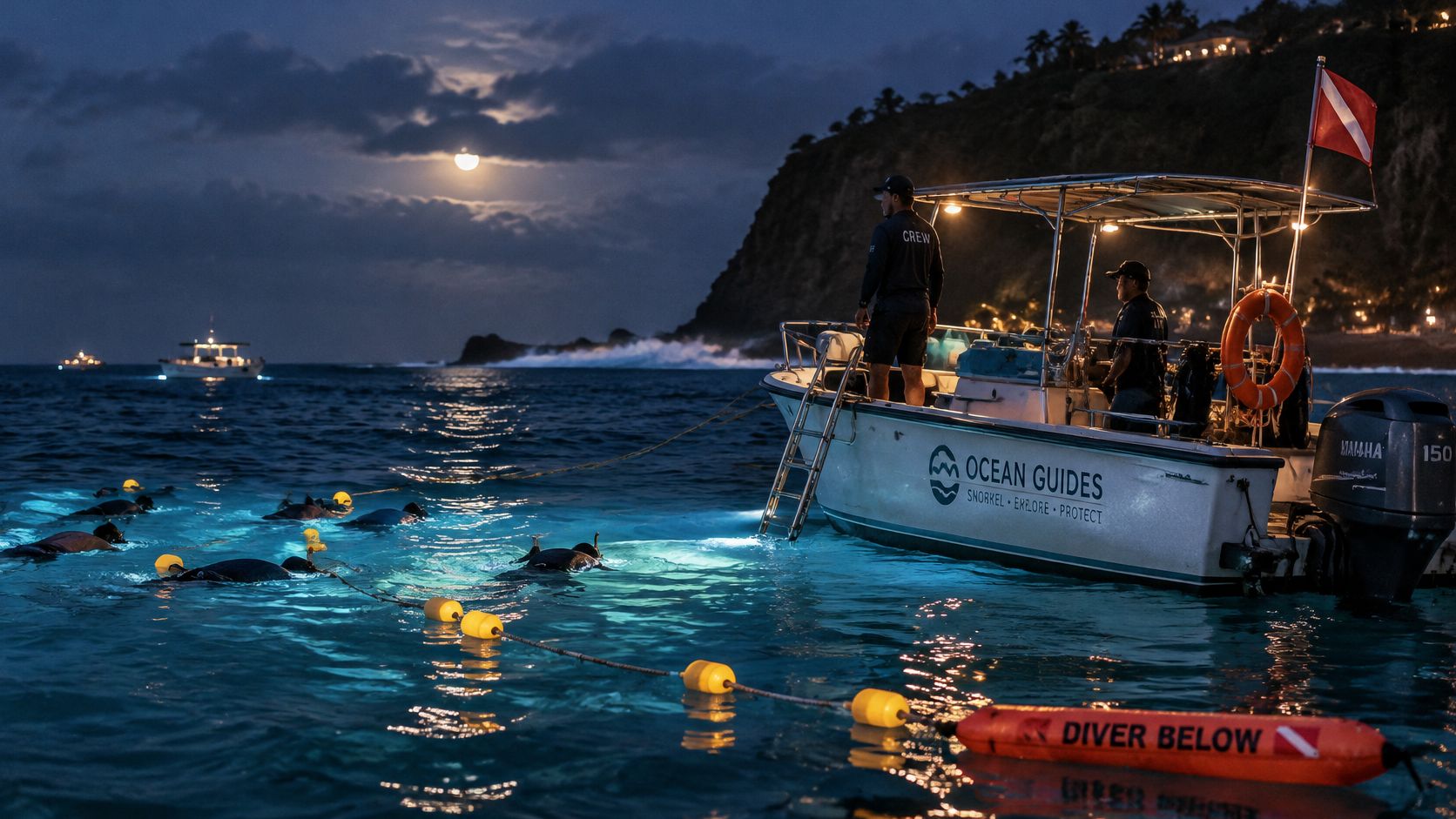
Strong wildlife odds don't make the ocean safe. A manta may be feeding beneath a light while the surface is too rough for a comfortable, well-controlled guest experience.
Darkness makes it harder to judge waves, nearby swimmers, and boat movements. Around the Big Island, steep nearshore drop-offs also mean that being close to land doesn't necessarily mean being in shallow water.
The manta-viewing safety assessment hosted by Hawaii County identifies cancellation in adverse conditions, pre-trip skill screening, and appropriate personal flotation as measures for reducing drowning risk.
Night conditions, risks and what to do
| Condition | Why It Matters | What to Do |
|---|---|---|
| Rough or adverse ocean | Raises drowning risk in dark open water | Accept cancellation and rebook |
| Poor weather | Can prevent a trip even when mantas are present | Read the cancellation policy and keep a backup date |
| Steep nearshore drop-off | Water deepens quickly beside the rocks | Stay with the group and keep flotation on |
| Fishing lines and moorings | Present an entanglement hazard | Report lines and stay clear |
| Darkness | Makes waves and swimmers harder to see | Remain near the light board and guide |
A calm-looking harbor doesn't settle the decision. The captain must consider the viewing area, the route, entry and exit, and whether guests can remain organized at the board.
Entanglement is another reason not to wander. Hawaii DLNR's marine-species protection guidance advises people fishing to move or retrieve lines when mantas are present. As a snorkeler, report a visible line rather than trying to investigate or untangle it yourself.
Make a backup plan before paying
Keep another evening available and read the weather-cancellation terms before committing. Don't confuse an operator's wildlife-return offer with its policy for a trip that never departs.
If you're prone to seasickness, discuss a suitable remedy with a pharmacist or clinician and follow its timing instructions. Waiting until you feel ill on the boat may leave you uncomfortable before the snorkeling even begins.
A useful planning test: Would you still trust the crew if they cancelled while you were standing at check-in? A responsible cancellation protects the experience you came for.
Crowding, Etiquette and Protecting the Mantas
A manta night can feel busy even when the wildlife viewing is excellent. Several snorkel groups may hold position around illuminated boards in the same patch of open ocean, with boats waiting nearby. That means animal sightings and guest comfort are separate measures of success: mantas can appear on a crowded evening, and a quieter evening can still go poorly if guests chase, kick or block the feeding lane.
Crowding reported in Hawaii visitor studies
The Hawaii manta-tourism visitor studies reported the following shares among surveyed visitors.
| Measure | Share of Respondents |
|---|---|
| Felt crowded by snorkelers | 82% |
| Felt crowded by boats | 78% |
| Felt crowded by scuba divers | 69% |
| Encountered more snorkelers than they considered normal | 77% |
Read these figures as a map of where pressure builds, not as a prediction for your departure. Other snorkelers rank highest, which is why spacing, awareness of neighbors and light direction matter as much as the number of mantas. If sharing the water with a large group would spoil the night for you regardless of what appears below, treat that as a personal-fit question when choosing whether this activity suits you.
For readers comparing the underwater alternative, Kona Honu Divers' manta ray dive information describes that different activity.
Give the animals a clear feeding lane
The group gathers around the light, but the water below stays open so mantas can pass, turn and feed without swimming through a wall of arms and fins. Hawaii's recreational wildlife-interaction guidance sets out specific surface-positioning, lighting and no-contact practices:
- Stay at the surface. Don't dive into the feeding zone, where mantas need room to maneuver.
- Control arms and fins. Avoid bumping neighbors or reaching toward a passing ray.
- Never touch, chase, grab, or ride. Contact can remove a manta's protective mucus coating.
- Point lights downward. Keep beams out of other guests' faces.
- Let the manta turn. Don't follow it or try to intercept its next pass.
- Leave infrastructure alone. Keep clear of fishing lines and moorings.
On our manta tour, every guest wears a flotation belt that keeps the hips and feet up near the surface, so fins stay clear of the animals passing below. The belt also makes holding one position easier, which helps the whole group stay organized.
NOAA's giant manta conservation guidance reports that giant manta rays can reach up to 29 feet across and are listed as threatened under the U.S. Endangered Species Act. That guidance concerns a different species from the smaller reef mantas commonly seen in Kona, so don't read a giant-manta size figure or legal status as a description of every local ray.
Our manta guests spend 30–40 minutes in the water, and orderly positioning matters for the whole session. If you feel uncertain about where to be, ask the guide for an assigned spot instead of drifting toward the edge of the group on your own.
These manta snorkeling rules that protect wildlife and guests make close viewing less disruptive for everyone in the water. The best encounter leaves the animals free to feed.
Choose Your Trip Time and What Happens on the Night
Two departures run each evening because this is the most popular tour on the island. The early trip checks in during daylight, lets you watch the sunset from the boat, and puts you in the water after dark. The late trip checks in at night. Either way, you are entering open ocean in darkness, so pick the slot that fits your energy and schedule rather than assuming a later hour means better wildlife. The mantas appear year-round with no reliable pattern by month, and the same honest logic applies to the clock: conditions and the animals decide, not the departure time.
Once the sky goes dark, guests gather around a custom-built snorkel board fitted with high-powered lights, which draws plankton toward the surface where the mantas feed. Our comparison of early versus late Kona manta ray snorkel trips can help you match the timing to your plans.
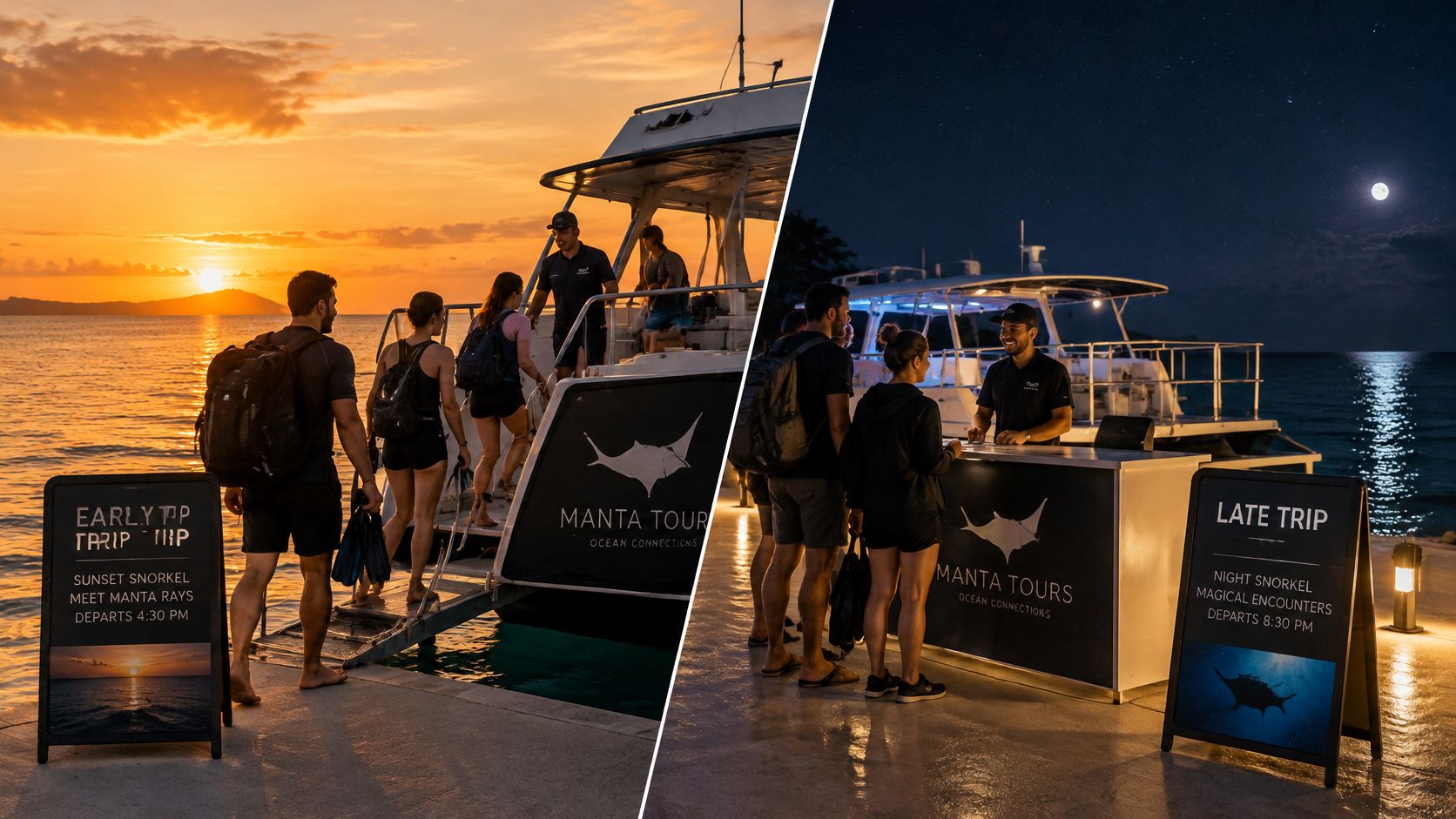
A typical early-trip sequence
- Check in while it's light. Arrive with time to find the meeting point, organize your belongings, and listen without rushing.
- Get your mask checked and your wetsuit and flotation belt fitted. Wetsuits come in sizes from kids 6-8 to adult 3X, and the belt keeps your hips and feet up so your fins stay clear of the mantas. Tell the crew immediately if equipment feels uncomfortable.
- Listen to the briefing. Ask how entry, positioning, signals, and the return to the boat will work.
- Enjoy the ride and sunset. If you use seasickness medication, follow its directions rather than waiting for symptoms.
- Enter when instructed. Move to your assigned place around the illuminated board and relax your legs.
- Watch from the surface. If a ray approaches, resist the impulse to reach out or adjust position for a photograph.
- Exit in the crew's order. Dry off, pull on your zip-up jacket, and ask the guide about the behavior you watched.
A mask may leave temporary pressure marks, but pain isn't an expected price of admission. Tell the guide about a pinching strap or leaking seal before spending the session distracted by it.
Understand the return offer
Our manta guarantee doesn't expire and is honored when space is available two hours before the tour starts. Confirm the current terms before relying on a return, particularly if your remaining evenings are limited. A calm attitude about an uneventful night is part of booking well: wild animals set the terms, and a guarantee cushions the outcome rather than controlling it.
Before reserving, follow a simple order: confirm your swimming baseline, pack a towel and jacket, then choose the early or late slot. Keep another evening open if your itinerary allows, so a weather decision doesn't become a last-night disappointment.
Manta Night Snorkel FAQs
Do I need to be able to swim?
Yes. Our guests need intermediate snorkeling experience and the ability to swim 50 yards without extra flotation; the tour belt helps maintain the right position rather than replacing that ability.
Will I see mantas every night?
No wild-animal encounter can promise a visit at a fixed time. Plankton availability, lighting, water conditions, and the animals' choices affect what happens, so leave room in your plans for an uneventful night or a possible return.
Is it suitable for children or older guests?
Age alone doesn't establish suitability. Discuss swimming experience, comfort in darkness, health concerns, and the ability to enter and exit the boat with our team before booking.
Can I bring my own mask?
We supply the snorkeling equipment, so you don't need to bring a mask. Full-face snorkel masks aren't permitted; if you prefer a personal conventional mask, confirm its suitability with our team rather than assuming every design is accepted.
Can I touch or ride a manta?
No. This is observation only, and touching, chasing, grabbing, or riding interferes with an animal that should be able to approach and leave freely.
What does the trip cost and how long does it last?
Our Big Island manta night snorkel lasts two hours. Check the current booking price and departure details before paying, since a price isn't stated here and total excursion time isn't the same as time in the water.
What if I become nervous after boarding?
Tell the crew early, before you're at the entry point. Don't conceal anxiety or enter because other people are waiting; our manta charter isn't a ride-along excursion, so discuss suitability before reserving.
Is a crowded night automatically a bad night?
Not necessarily. Clear instructions, controlled positioning, and guests who respect neighboring swimmers can make a shared viewing area work well, while even a close manta pass can feel disappointing if people are kicking or blocking one another.
Kona Snorkel Trips offers guided manta ray night snorkeling with lifeguard-certified guides, provided equipment, and an illuminated surface board for observing feeding rays. Visit Kona Snorkel Trips to choose an early or late departure, confirm your suitability, and plan an evening with room for the ocean's conditions.