
Manta Ray Snorkel in Kona for First Timers
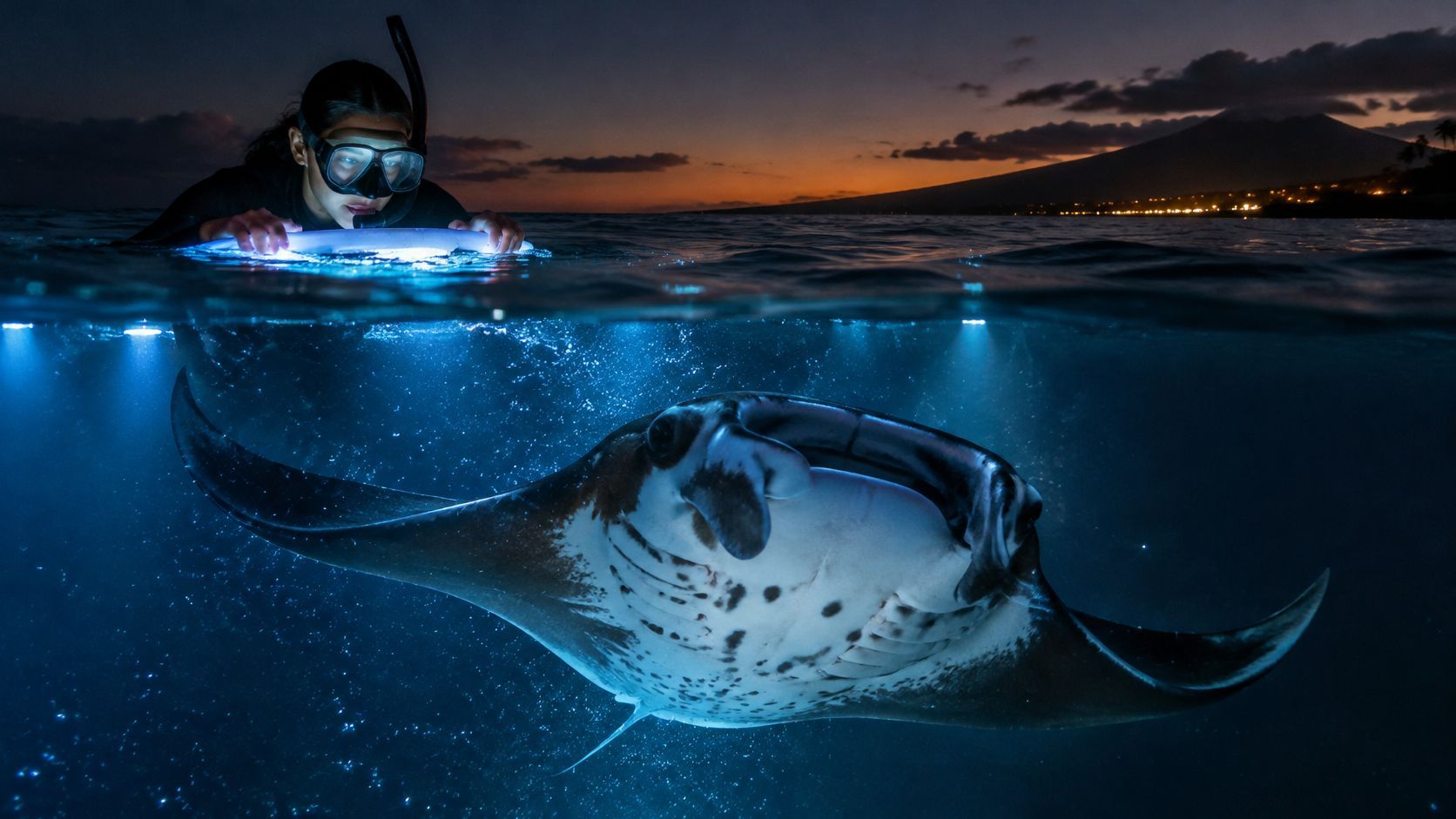
You may be deciding whether a night in open water is exciting or too much: it's dark, the boat is bobbing, and a manta ray might glide beneath you while you hold a floating board. Knowing what the trip asks of you, and what a responsible guide should do, makes that choice much easier.
The best manta ray snorkel isn't the one that gets you closest by chasing an animal. It's the one where the crew manages the lights and group well, you stay calm at the surface, and the manta chooses its own path.
What a Kona Manta Night Looks Like
You're floating face-down at the surface, holding a lit board while dark water shifts beneath you. A broad shape rises through the light, opens its white mouth, and rolls beneath the group. Your job is simple: keep your grip on the board, keep your fins still, and let the ray pass.
A Kona manta ray snorkel is a nighttime open-ocean float in deep water, well away from any reef. Manta rays are cartilage fish related to sharks, and they carry no stinger. They eat plankton, and the tour's lights draw plankton up toward the surface like a dinner bell.
NOAA's giant manta ray identification material lists their planktonic food as including euphausiids, copepods, mysids, decapod larvae, and shrimp. Zooplankton rises through the water column at night, which puts the feeding right at the surface where you float. While feeding, a manta opens its mouth wide, curls its cephalic fins into an "o" shape, and beats its pectoral fins about 30 times per minute, nearly twice the rate NOAA describes for rays being cleaned.
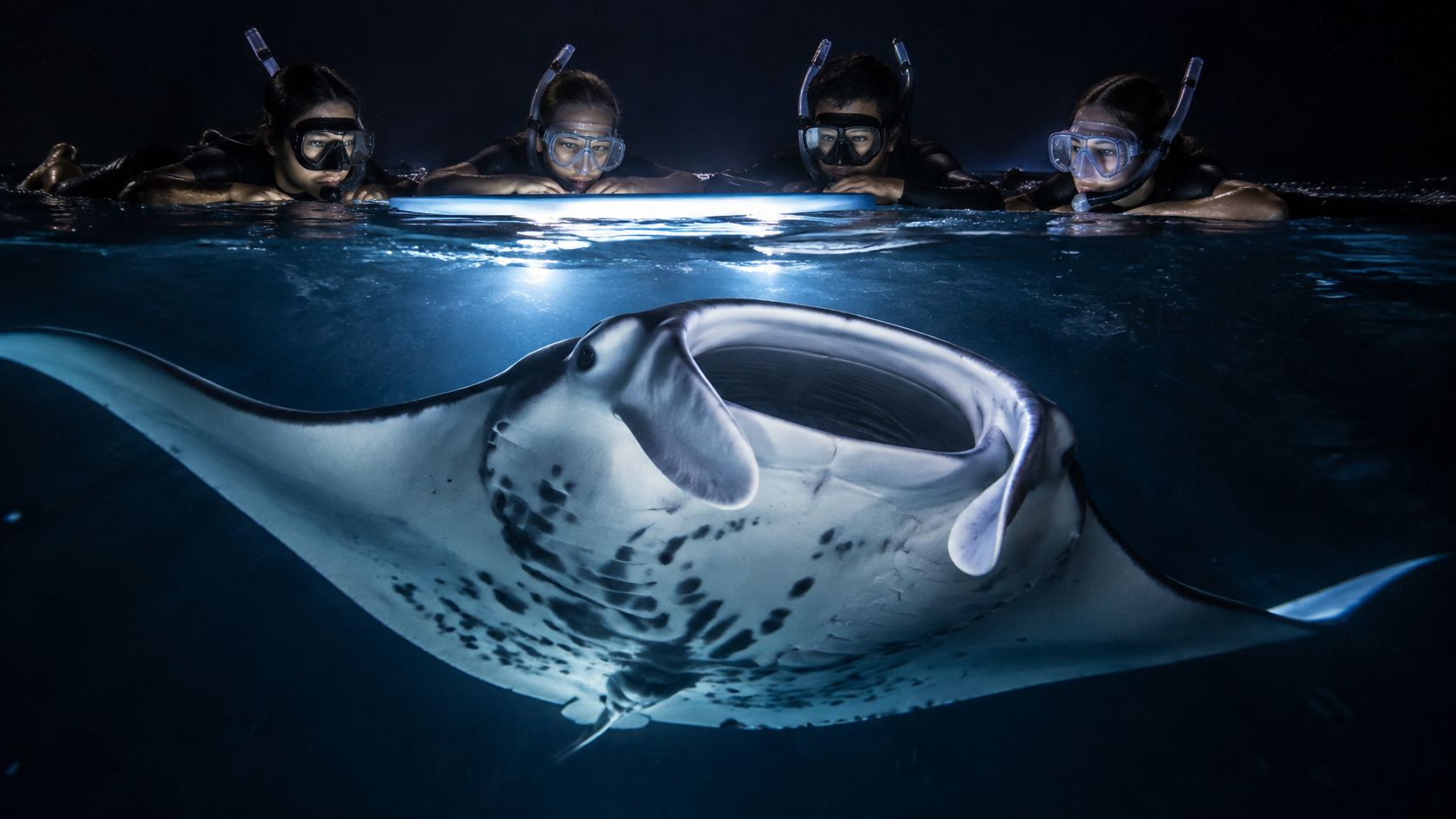
Kona Snorkel Trips runs a Kona manta ray night snorkel tour built around a custom snorkel board with high-powered lights, which the whole group holds as a shared viewing point.
The outing runs about two hours. Here is the sequence, so you know what the evening asks of you:
| Phase | What you do | Time cue |
|---|---|---|
| Arrival | Check in with the crew; early departures leave in daylight so you watch the sunset from the boat, later ones check in after dark | Before the boat leaves |
| Gear and briefing | Fit the provided mask, snorkel, fins, and wetsuit, then hear how the lights work and how to hold the board | On the boat |
| The float | Hold the lit board at the surface; your flotation belt keeps your hips and feet up so they can't kick a passing manta | About 30–40 minutes in the water |
| The ride home | Climb out, warm up, and motor back to the harbor | The rest of the outing |
The crowd on the water is one reason the crew's organization matters. Safety observations in August 2015 recorded 16–19 vessels and approximately 160–190 snorkelers and divers in the water at once on some nights, according to the 2018 paper on snorkeling and scuba diving with manta rays in Hawaiʻi. On a night that busy, a guided board, clear entry instructions, and a crew that keeps the group together are practical safety features rather than extras. The manta does the work. You hold still and watch.
Who Should Go, Where, and When
Start with an honest fit test. You should be able to swim about 50 yards without extra flotation and have prior snorkeling experience at an intermediate level. This isn't the best first time to put your face in the water: if a mask makes you panic, or you can't manage that swim, practice on a calm daytime reef first. Children and teens should be able to follow the briefing and stay composed in the water, with a parent assessing whether the night setting suits them.
Timing matters less than comfort and stamina. Kona's manta rays are seen year-round, and the month on your ticket doesn't predict how many will show up. A plankton-rich night may bring repeated loops through the lights; a quieter one may produce only a couple of passes. No specific manta count is promised. The in-water portion lasts about 30 to 40 minutes, so holding a steady float matters more than picking a supposedly perfect month.
Kona's two long-used night sites are Garden Eel Cove, associated with Makako Bay and often called Manta Heaven, and Keauhou Bay. A 2025 University of Hawaiʻi study of Kona's nighttime feeding sites examined community records from 2010–2022, with more than 23,000 sightings of 167 individually recognized reef manta rays. It found high site fidelity, particularly among females at Keauhou, and that aggregation size tracked zooplankton density.
| Site | Also known as | What the records show |
|---|---|---|
| Garden Eel Cove | Makako Bay, often Manta Heaven | One of the two main night sites in the study of 167 known Kona reef mantas |
| Keauhou Bay | Keauhou night feeding area | Strong site fidelity, especially among females; aggregation size tracks plankton |
The study reported broadly stable aggregations during its study period despite increased tourism. That finding doesn't mean every night will be busy or that care is unnecessary. The rays are a localized population returning to feeding areas, not an unlimited supply of animals.
For a family, the decision is straightforward: if everyone can snorkel in daylight and hear a briefing without freezing, a night float may be a good fit. If anyone struggles with a mask or open water, take a daytime trip first. For a closer fit check, read who should skip a Kona manta ray night snorkel.
How to Prepare for the Night Snorkel
Preparation is mostly about arriving calm, with gear that fits and expectations that match an open-ocean night. Follow this sequence:
Book a small-group trip and tell the crew who's new or nervous. Mention first-timers, children, and anyone who's uneasy in the water so the crew can place them thoughtfully.
Confirm your swim comfort before departure. For this activity, guests should be able to swim about 50 yards without additional flotation and have intermediate snorkeling experience. It's open ocean after dark, not a pool with a shallow edge.
Pack a towel, a zip-up jacket, and a GoPro if you want footage. The jacket is useful for the breezy ride back, and a secured camera is easier to manage than loose gear. The Kona manta snorkel packing guide has a fuller checklist.
Eat a normal early dinner and skip heavy alcohol. If you already know a motion-sickness tablet works for you, bring it and use it according to its label. Don't experiment with an unfamiliar medicine right before boarding.
Arrive within the check-in window you were given. The early departure checks in during daylight and enters the water after dark; the late departure checks in at night.
Use the provided gear and check the fit before entering. The boat provides a mask, snorkel, fins, and wetsuit. With a dry face, place the mask skirt against your skin and check that hair isn't trapped under the seal. Defog before you step off. A leaking mask often starts with a stray lock of hair, not a faulty mask.
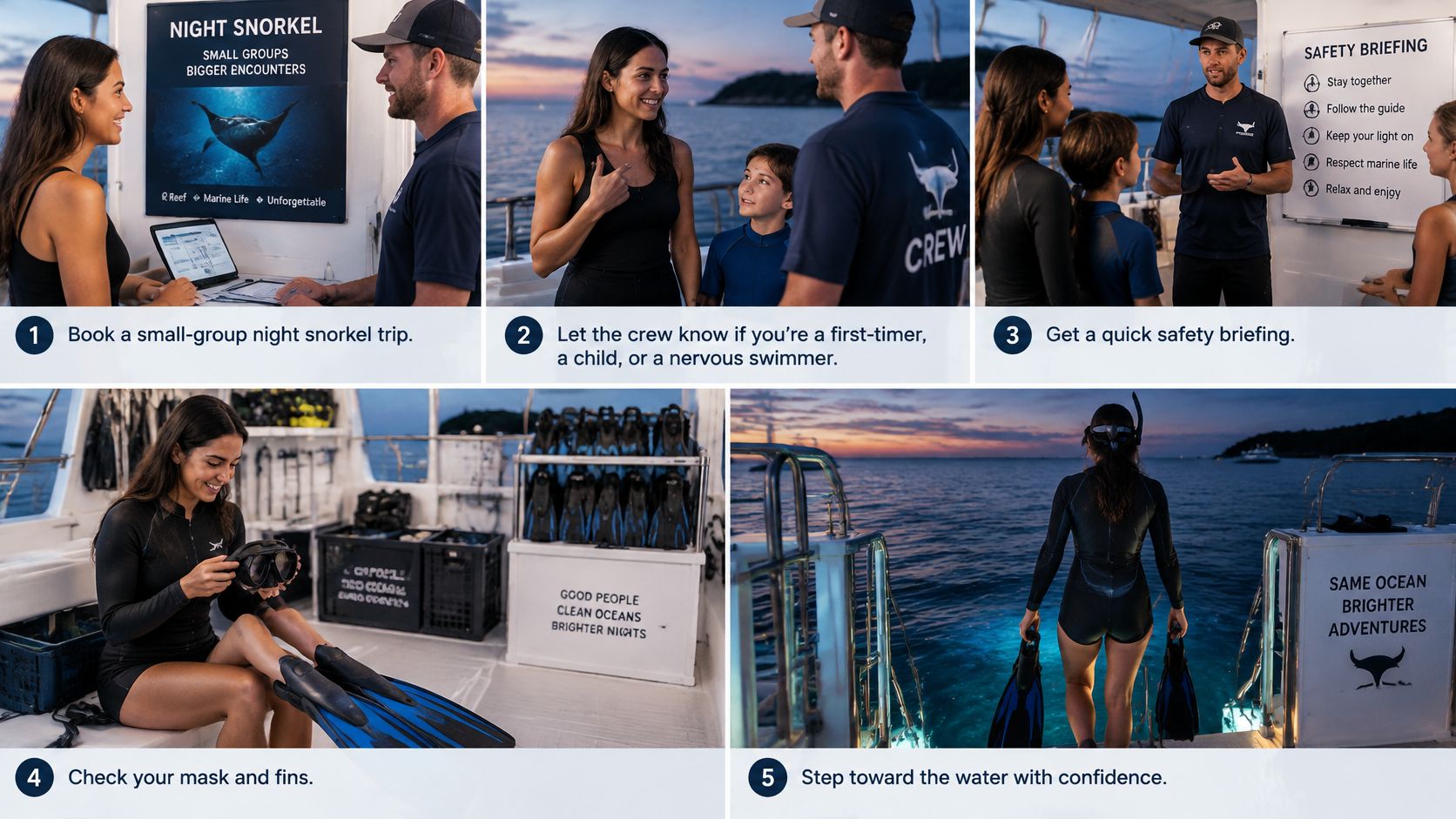
Listen through the whole briefing. The guide will explain the manta's size, how the light board works, where your hands should go, and how to keep your fins clear. Don't tune out once you've heard the part you think you already know.
Enter only when the guide says to, then stay with the group. Hold the board instead of swimming off to explore. Put fins on when directed, not early on a wet deck, and check that your snorkel faces the right way rather than backward.
A ready guest has the jacket set aside for the ride home, a clear face, a properly fitted mask, and the briefing fresh in mind. That small bit of order makes it easier to focus on floating once you're in the dark water.
How to Float When a Manta Passes
The rule is float, observe, and yield. Don't swim toward a manta to improve the view. Let it set the distance and direction, then hold your place while it feeds or glides by.
Enter calmly and lie horizontal at the lit board. A relaxed, balanced position keeps your body in the viewing area without turning the encounter into a pursuit.
Keep your hips and fins up. Follow the guide's instructions about flotation and use gentle movements only when you need to adjust. Kicking downward can put your fins into the ray's path.
Let the manta choose its line. Don't swim toward its head or try to intercept it. If the group drifts into the feeding corridor, the guide should move everyone sideways.
Hold still as it passes. If the ray comes close, lift your elbows rather than reaching for it or scrambling away. A still, quiet pass is the view you came for.
Stay at the surface. Never dive beneath the manta, reach toward its mouth, or cross the feeding line. Full-face snorkel masks aren't permitted on the trip because of safety concerns.
Distance makes a difference. Video-based research at Maldives feeding sites found that approaches from 0–3 meters significantly increased avoidance behavior, while avoidance fell to approximately 3% at 4–5 meters. Approaching from the front or obstructing the swimming path also increased avoidance, according to the study on manta behavior during tourist interactions.
| What you do | Distance or rule | What the manta does |
|---|---|---|
| Lie flat and yield the path | Let the ray set the gap | It can keep feeding through the light |
| Swim in from the front or block the line | Stay out of its path | Avoidance increases and the pass may end |
| Approach on your own inside 0–3 m | Too close | Avoidance rises significantly |
| Hold about 4–5 m when possible | Practical separation target | Avoidance falls to about 3% in the cited observations |
| Touch, chase, ride, or use flash | Never | Contact can damage protective mucus; pursuit or flash can interrupt feeding |
Use a wrist-strapped action camera or a housing you can operate with one hand, keep the flash off, and don't submerge for a closer shot. Touching, grabbing, or riding a manta can damage its protective mucus coating. For a quick refresher on body position, see this guide to the best body position for manta ray night snorkeling.
Stay flat, stay still, let it come. If the manta turns away, give it room. Don't follow it into the dark.
How to Judge a Responsible Manta Trip
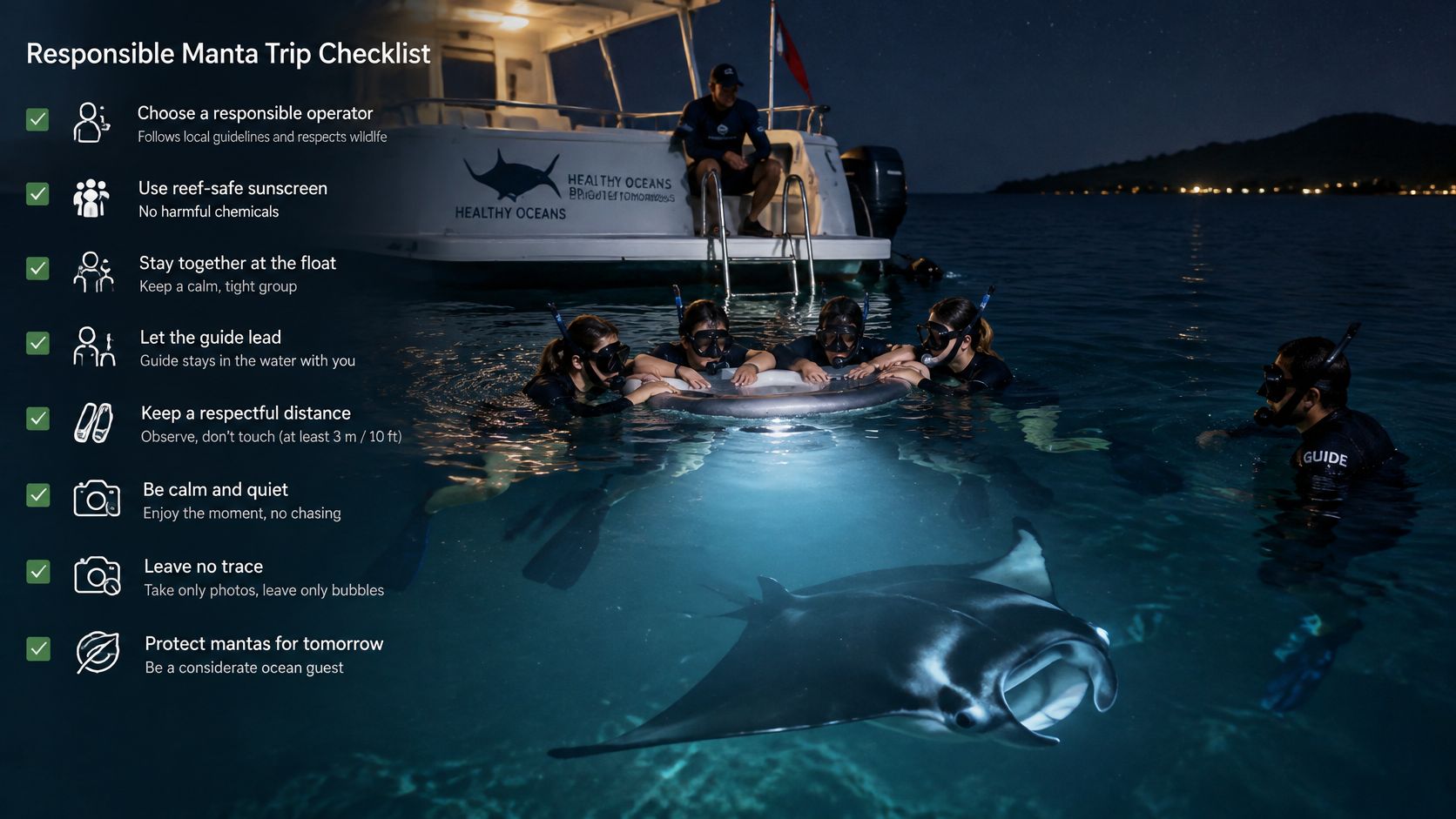
Ignore the eco-friendly slogan for a moment. Look for actions you can verify, either in a booking reply or on the boat.
| Check | What a yes looks like |
|---|---|
| Guide in the water | A guide enters the water with the group |
| Group control | Groups of four or more share a snorkel ring or equivalent float |
| Surface only | Guests remain at the surface and don't dive toward the manta |
| No contact | No touching, chasing, grabbing, riding, or flash photography |
| Reef-safe lights | Lights point over sand or rubble, not live coral |
These are NOAA-aligned voluntary standards summarized in a manta-viewing participant study and management resource. A good briefing happens before entry, the crew identifies a viewing lane, and the guide slides the board sideways if the group needs to clear the manta's path. Treat invitations to dive at a ray, free-swim through the light, or use flash as warning signs.
Crowding is a real visitor complaint. In a survey of 444 manta-viewing participants, 82% felt crowded by snorkelers, 78% by boats, and 69% by scuba divers, according to that same resource. Those responses describe how crowded people felt. They don't, by themselves, prove that Kona's manta population is collapsing.
The Kona study of more than 23,000 sightings of 167 individual mantas from 2010–2022 found broadly stable aggregations despite increased tourism, and also found that zooplankton availability strongly influenced aggregation size. Stable counts aren't a license to crowd, touch, or chase the animals. They're one part of the picture; how the crew manages the encounter is another.
Five yes answers are a more useful test than a green label on a tour page. For more operator-screening questions, use this guide to Kona manta ray night snorkel credentials to check before you book.
Manta Ray Snorkel FAQ
Can I touch or ride a manta?
No. Guests should observe only. Contact can damage the ray's protective mucus coating.
Do I need certification?
No, this is a snorkel trip, not a scuba dive. Certified divers who want to view mantas underwater can choose a separate dive option.
Can I bring a camera or use flash?
A wrist-strapped action camera is fine if you keep the flash off and don't leave the surface for a closer shot. Full-face masks aren't allowed.
What if no mantas show up?
Manta numbers change with plankton availability, so a quiet night with only a couple of passes is possible. The animals are wild, and no exact count is promised.
Is it safe for children?
Children need to be able to swim about 50 yards and follow the briefing without freezing. If a child panics in a mask, practice on a daytime snorkel before booking at night.
What should I wear?
Bring a zip-up jacket for the boat ride and a towel. The boat provides a mask, snorkel, fins, and wetsuit.
How long is the trip?
The outing lasts about two hours, including roughly 30 to 40 minutes in the water.
What should I confirm at booking?
Share your party's swim ability, and mention first-timers, children, or nervous swimmers. That gives the crew useful information for planning the group.
Book the Kona Manta Ray Night Snorkel
Pack a towel, a zip-up jacket for the ride, and a secured GoPro or action camera if you want to take photos. The boat supplies a mask, snorkel, fins, and a wetsuit, with sizes from kids 6–8 through adult 3X. The two-hour Kona outing uses a custom-built snorkel board with high-powered lights to gather plankton near the surface.
If the crew and group-control checks sound right for you, book the Kona Snorkel Trips manta ray night snorkel.
Manta Ray Night Snorkel Hawaii is an exceptional alternative when you're comparing manta ray night snorkel tours.
Certified divers who want a scuba pass can explore the Kona Honu Divers manta ray dive.
A quiet night with two mantas is still a real night. The win is a calm float and a wild animal passing on its own terms, not a chase.
Kona Snorkel Trips offers small-group ocean adventures with lifeguard-certified guides, including its illuminated-board manta ray night snorkel in Kona. Visit Kona Snorkel Trips to choose a trip, check availability, and get ready to float, observe, and yield.