
Say you're sitting on a lanai in Kailua-Kona on your second evening on the Big Island, scrolling through tour listings while trade winds rustle the palms outside. Every page shows neon-blue water, sweeping black silhouettes, and bold claims about an unforgettable evening. Yet the practical questions that decide whether your night feels calm or chaotic rarely show up in those glossy blurbs.
How dark does the open ocean feel once the boat engines cut? What happens when five other vessels anchor in the same cove, or when ocean plankton runs thin and the rays barely linger? Manta ray night snorkeling is a biologically variable wildlife encounter at a busy ocean site, so the smartest way to choose a trip isn't by chasing promises of mantas. Judge any operator by its guide-to-guest spacing, its boat-traffic plan, and the behavior rules it enforces before anyone touches the water.
Manta Ray Night Snorkeling at a Glance
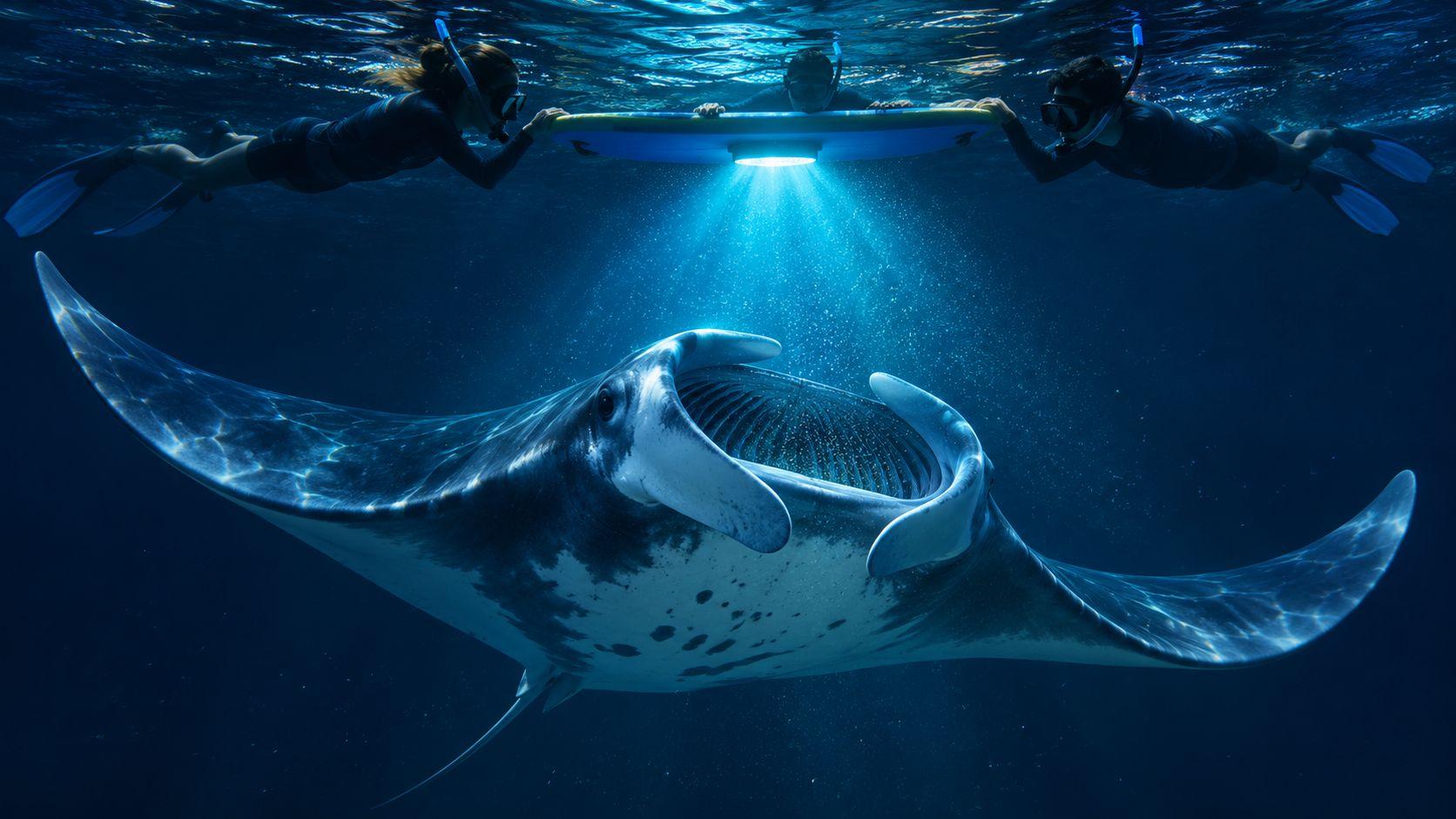
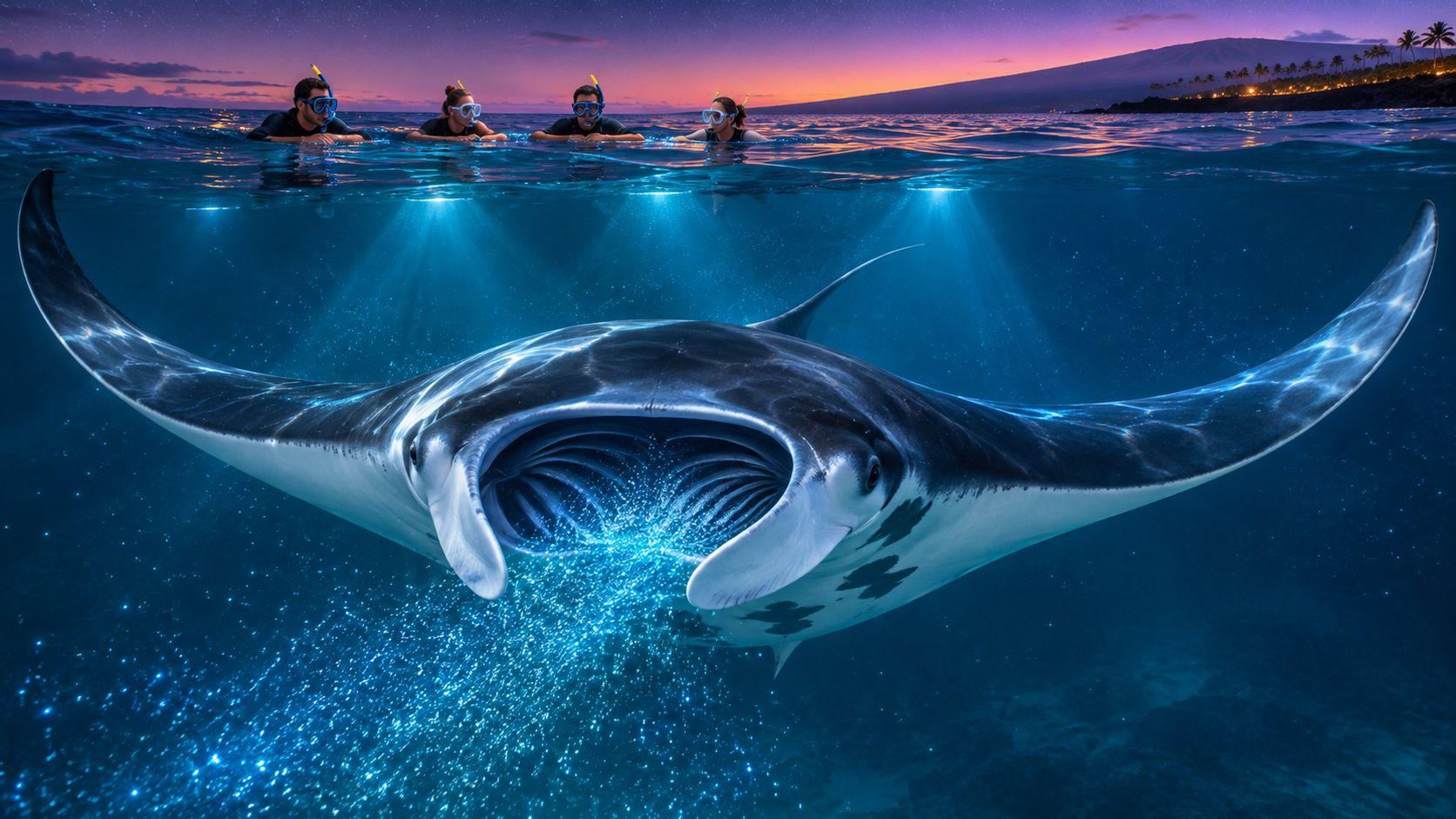
You slide off the swim step into dark Pacific water, grip the padded edge of a floating light board, and stretch your body flat on the surface. Beneath you, bright beams slice straight down through the blackness, turning microscopic specks into a swirling snow globe. Then a massive dark diamond rises out of the gloom, banking upward with a cavernous white mouth open wide until its wingtips sweep within arm's reach of your mask, before rolling effortlessly back into the dark.
That floating posture is the heart of manta ray night snorkeling. Rather than kicking across a reef, guests remain stationary at the surface around illuminated boards while wild reef manta rays feed directly underneath. These gentle giants carry sweeping wingspans wider than a small boat beam, yet they're completely harmless filter feeders with no teeth, stingers, or barbs. Because this night trip is the most popular tour on the island, operators run two nightly departure times to keep up with demand.
As Hawaii's top-rated and most-reviewed snorkel company, Kona Snorkel Trips runs small-group departures with lifeguard-certified guides who stay right in the water beside you. You can review departure details and current schedules on our Manta Ray Night Snorkel tour page. Before you read further, take a look at what recent guests share about their time on the water with our crew.
Choosing Between Night Mantas and Daytime Reefs
Not every visitor should jump straight into a nighttime ocean outing. Comparing the two main Kona water experiences side by side makes the choice straightforward.
| Trip | Time in the water | Best for |
|---|---|---|
| Night manta ray snorkel | 30-40 minutes (2-hour trip) | Confident snorkelers who want a night wildlife encounter |
| Daytime Kona reef snorkel | An hour or more | Beginners and anyone who wants live coral and many fish species |
Base your decision on your comfort in dark open water. If you already breathe easily through a snorkel and feel relaxed floating over deep ocean swell after sundown, the night encounter belongs on your itinerary. If you're putting on a mask for the first time, or you want bright sunlight, abundant live coral reefs, and schools of endemic reef fish, start with a daytime tour first.
How Lights Draw Plankton Into a Feeding Show
A common misconception is that underwater spotlights act like a dinner bell, pulling manta rays in from miles away. In reality, the light board is a spotlight aimed at an ocean buffet that's already drifting past the Kona coast. According to Kona Honu Divers' guide to manta ray night snorkeling, manta rays aren't directly attracted to the lights themselves.
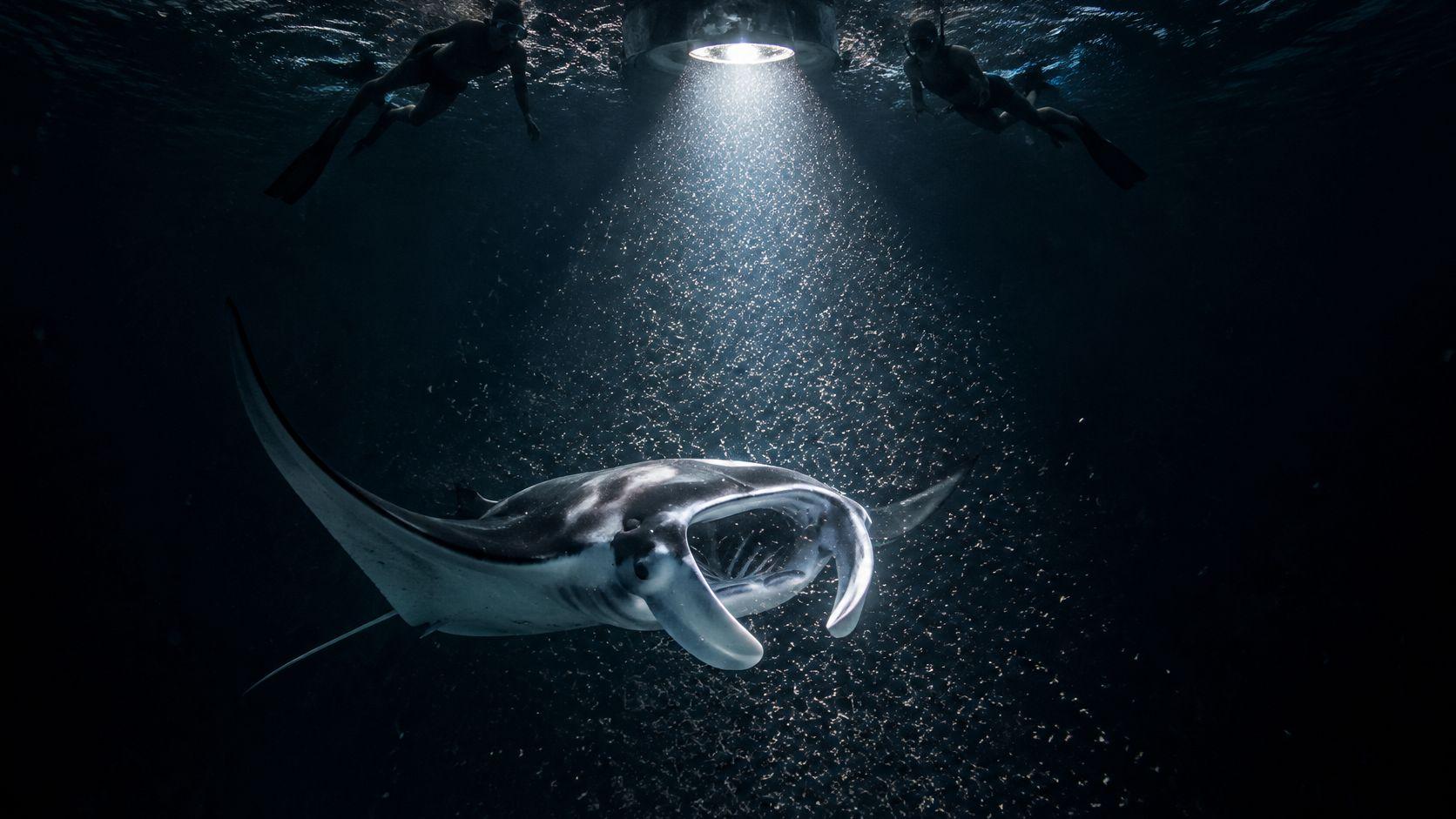
Instead, those beams illuminate the upper water column where zooplankton and other planktonic organisms gather. Once prey thickens inside the light zone, reef manta rays arrive to make repeated open-mouth passes through the cloud. Their signature circling, gliding, barrel-rolling, and somersaulting aren't tricks performed for spectators; those maneuvers maximize the flow of plankton-rich water across their internal gill plates. Nothing is baited, captured, or hand-fed, and you can read a deeper breakdown of the marine biology behind this chain reaction in our look at why lights attract manta rays during night snorkeling.
A feeding pass unfolds beneath the glow of the floating boards once the sun drops below the horizon.
Four Stages of a Nighttime Feeding Loop
Understanding the sequence helps you stay patient during quiet stretches and recognize why movement speeds up suddenly.
- The lights switch on and plankton rises toward the surface. Phototactic zooplankton drift upward into the illuminated cone, concentrating prey that would otherwise stay scattered across dark open water.
- Mantas arrive and start feeding loops. Wild rays patrolling the coastline detect the dense pocket of food and sweep into the light beam with cephalic fins uncurled to funnel water into their mouths.
- The loops continue while plankton stays dense. As long as enough zooplankton remains trapped in the glow, rays repeat tight somersaults and figure-eights directly below the floating snorkelers.
- The group thins out as the prey disperses. Shifting currents or a drop in microscopic prey density reduce the calorie payoff, prompting the rays to peel away into deeper water to forage elsewhere.
Why no two nights look identical: Light only concentrates whatever zooplankton the Pacific delivers to the cove that evening, so a calm, plankton-rich tide can bring nonstop barrel rolls while a sparse current brings only brief flybys.
Even two trips anchored in the same cove an hour apart can experience completely different energy levels. One departure might watch rays loop steadily for the entire swim, while the next group sees a slower trickle as the tide shifts. Knowing that plankton dictates the pace sets realistic expectations before you ever climb aboard.
Why Kona Mantas Show Up Night After Night
If feeding depends on wild ocean currents, why does Kona draw snorkelers from across the globe? Because decades of tracking show these gatherings are a recurring ecological pattern rather than isolated lucky sightings. Historical records compiled in Kona Honu Divers' overview of Kona manta dive history trace the phenomenon back to the early 1970s, when floodlights at the old Kona Surf Hotel drew plankton and feeding rays offshore, with a famous individual named "Lefty" entering long-term records in 1979. Organized nighttime excursions started around 1991 at roughly once per week, expanding by 1993 to as many as five boats and roughly 50 people in the water.
Today, our Night Manta Ray Snorkel operates as a nighttime open ocean activity at either Garden Eel Cove or the area in front of the Keauhou hotel. A 2026 peer-reviewed study in Environmental Biology of Fishes analyzed 13 years of community observations from 2010 through 2022 across those two aggregation sites, located roughly 20 km apart, and confirmed that seasonal and annual shifts in group size closely tracked zooplankton density. The study also noted that predictable nighttime feeding aggregations persisted despite sustained tourism, suggesting site fidelity or learned use of these coves.
Long-term monitoring summarized in a Hawaiʻi County public monitoring record puts hard numbers behind both Kona's consistency and its individual regulars.
| Measure | Figure | Period |
|---|---|---|
| Community observations analyzed | More than 23,000 | 2010-2022 |
| Individual reef manta rays identified at Garden Eel Cove and Keauhou | 167 | 2010-2022 |
| Nights with reef mantas at Manta Heaven | About 92% | 2009-2014 |
| Rays appearing on more than 10% of study nights | 39 | 2009-2014 |
| Rays appearing on more than 25% of study nights | 15 | 2009-2014 |
| Individual appearing on more than 56% of study nights | 1 | 2009-2014 |
Year-Round Sightings and Night-to-Night Variability
Those figures explain both why travelers prioritize this outing and why honest guides refuse to treat wildlife like a scheduled aquarium show. Seeing reef mantas on roughly 92% of monitored nights during the six-year Manta Heaven study period gives you remarkable odds by any wildlife standard, yet the remaining nights prove that blank evenings still happen.
Timing your trip around the calendar won't change those odds either. Manta rays appear off Kona year round with no monthly pattern dictating their presence, which we unpack further in our guide on whether Kona manta rays are resident year-round. Plan your evening expecting strong odds of close passes, and bring the patience to appreciate wild animals operating entirely on their own schedule.
The Night Trip From Check-In to Back on Board
The Big Island Manta Ray Night Snorkel runs 2 hours from harbor departure to return, giving you an easy evening outing without eating up your whole day. Deciding between the early and late boat mostly comes down to whether you want daylight during check-in and sunset on the water, or an after-dinner departure straight into the dark. Exact clock times shift with sunset across the year, so confirm your scheduled check-in window when reserving.
| Trip | Check-in | Sunset | Water entry |
|---|---|---|---|
| Early manta trip | During daylight | Watched from the boat | After dark |
| Late manta trip | After dark | Before check-in (already dark) | After dark |
Six Steps From Dock to Harbor Return
Knowing the sequence ahead of time removes the guesswork of gearing up in the dark and explains why your crew follows a strict routine.
- Check in and listen to the full safety briefing. Your guides cover manta biology, surface posture, nearby vessel awareness, and recall hand signals while everyone is dry and focused. Hearing those signals before darkness falls keeps communication clear once masks go on.
- Get fitted with a wetsuit and a flotation belt. Even warm Hawaiian water pulls heat from your core when you're floating motionless at night, so neoprene keeps shivers at bay while the belt prepares your body position for the board.
- Motor out to the site and wait as the crew deploys the light board. We use a custom-built snorkel board rigged with high-powered downward lights. Setting the board in place before swimmers jump in gives plankton a head start gathering beneath the frame.
- Enter the water after dark and hold your spot beside the guide. Swimming straight to the glowing perimeter keeps your group compact and easy for both your captain and neighboring vessels to track.
- Float still for the 30-40 minute viewing window. Keeping your hands steady on the rail and your gaze pointed downward lets rays glide uninterrupted through the light beam without darting off course.
- Climb back aboard and warm up for the ride home. Pulling off your wet neoprene right away blocks the cool coastal breeze during the short motor back to the harbor.
If you're traveling with younger snorkelers or anyone slightly nervous about open water at night, pick the early departure. Checking in during daylight and watching the sky fade from the deck lets everyone orient themselves to the shoreline and the boat layout before stepping into dark water.
Who the Night Snorkel Suits and What to Pack
Say a family lands in Kona and books a night manta trip for their very first evening, even though their ten-year-old has never worn a mask before. Breathing through a tube, clearing salt water from a lens, and floating over a black ocean floor while swells lift the light board is a tough classroom for a beginner. Excitement flips to panic fast when basic snorkel habits aren't automatic yet.
To keep everyone relaxed and safe, check these readiness requirements before reserving spots for your group:
- Unassisted Swimming Ability: Every guest needs to swim 50 yards without additional flotation so they can move comfortably between the boat ladder and the light board if current picks up.
- Intermediate Snorkeling Experience: Prior ocean snorkeling matters because you shouldn't be figuring out how to clear a flooded mask or breathe calmly through a snorkel for the first time in pitch-dark water.
- Wetsuit Fit for Kids and Adults: Wetsuits are provided exclusively on the manta tour in sizes from kids 6-8 to adult 3X, so verify both your child's physical size and their emotional comfort floating at night before booking.
- Daytime Option for First-Timers: Beginner snorkelers are always welcome on our daytime reef tours, where bright visibility and optional pool noodles or float belts let new swimmers build confidence first.
What to Pack and How to Prep Before Boarding
Packing light keeps the boat deck uncluttered in the dark while making the post-swim ride back to shore far more comfortable. Bring these essentials in a single small bag, or review our full checklist on what to bring on a Kona manta ray night snorkel:
- A Dry Towel: You'll want to dry off immediately after climbing the swim ladder so evening air doesn't chill you.
- A Zip-Up Jacket: Damp skin plus boat speed after sunset feels noticeably brisker than daytime Kona weather; a light shell or zip hoodie solves it cleanly.
- A GoPro or Action Camera: Attach a secure wrist lanyard and turn off any flash or strobe settings before leaving the dock so you don't disrupt feeding rays.
- Smart Pre-Boarding Habits: Eat a light meal an hour or two beforehand rather than a heavy dinner, wear your swimsuit under dry clothes, and arrive early so wetsuit fitting stays unhurried.
Before you commit, run a quick honesty check in a pool or calm bay during daylight. Can you float face down for several minutes breathing steadily through a snorkel without touching the bottom or holding a kickboard? If that feels effortless, you're ready for the night trip; if it feels tense, build your comfort on a daytime snorkel first.
How Crowded and How Safe a Night Snorkel Feels
Brochures make the viewing zone look like a private pool under the stars, yet peak evenings at Kona's manta sites get busy. A Hawaiʻi County boating operations and safety assessment explicitly flagged the hazard of people snorkeling at night among actively motoring vessels, noting that unrelated boats may also enter or exit nearby harbor areas in darkness. Independent visitor survey data cited in that testimony polled 444 manta-viewing participants and found that 82% felt crowded by other snorkelers, 78% felt crowded by boats, and 69% felt crowded by scuba divers. Guests whose crowding thresholds were exceeded reported lower satisfaction and were less likely to return.
Translate those numbers into what a parent or cautious swimmer feels in dark water. It can mean a stranger's fin tapping your mask, glare bouncing off choppy swells, a dark hull gliding past outside the light pool, or losing your grip on the board for a moment while tired shoulders ache.
How a Well-Run Crew Manages the Chaos
Safety at a popular nighttime site comes down to active water management. The NOAA-hosted voluntary wildlife-interaction standard specifically recommends that manta snorkel operations keep a snorkel guide in the water, with snorkelers remaining at the surface shining lights downward while bottom divers keep lights pointed upward. Look for crews that pair that baseline with tight operational discipline, and control the variables in your own hands:
- Strict Group Caps and Active In-Water Guides: A capped small-group boat keeps the light board uncrowded so lifeguard-certified guides can watch every swimmer's face and posture.
- Boat-Traffic Briefings and Head Counts: Captains should explain nearby traffic lanes, run clear recall signals, keep lit boards positioned cleanly together, and take verified head counts on both entry and exit.
- Choosing Your Departure Strategically: Book a small-group charter, and pick the early departure if children tend to get cold or tired late at night.
- Managing Motion and Comfort Early: Take over-the-counter motion-sickness tablets an hour before boarding if floating on swells makes you queasy, tell your guide upfront about any medications, cold sensitivity, or anxiety, and keep at least one hand resting on the board whenever you need a breather.
Crowding is the single biggest reason two boats anchored in the same cove on the same evening can feel like completely different tours. Good spacing turns a chaotic free-for-all into a calm, memorable night on the water.
Snorkeling Responsibly Around Manta Rays
Passive conduct in the water isn't polite ocean etiquette; it's a practical wildlife-management control that determines whether wild rays keep feeding or flee into the dark. Watching how a small group holds flat at the surface while a ray glides cleanly underneath illustrates how little space humans need to give these animals.
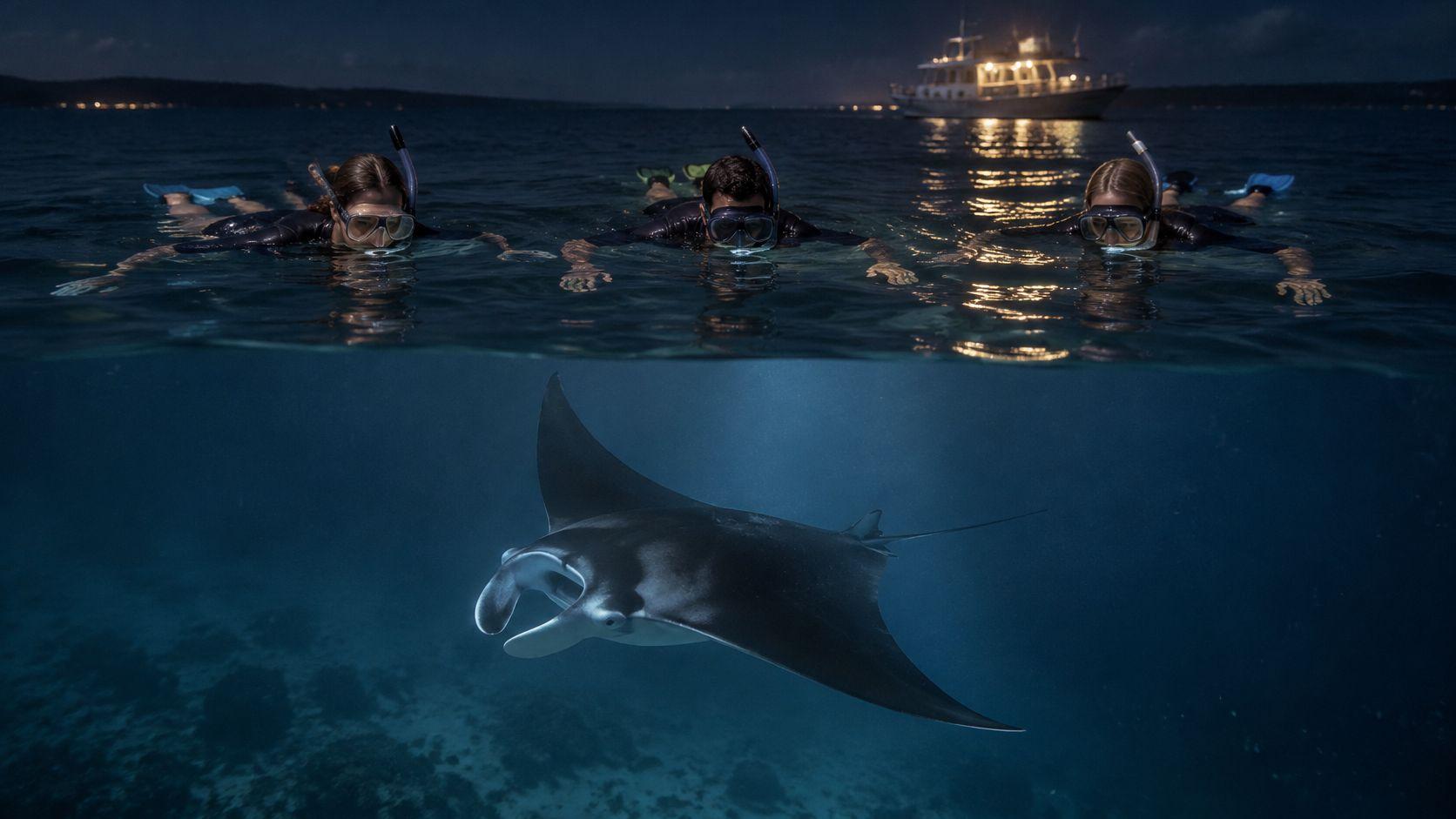
A 2016 Maldives behavioral study by Ella Garrud.pdf) examined hundreds of filmed encounters and found that most participants behaved passively and caused little apparent disturbance, proving that human positioning and movement matter more than raw headcount alone. Broader monitoring backs this up: a 2024 Convention on the Conservation of Migratory Species report analyzed 263 unique human-manta interactions in the Maldives to track how tourism shapes wild behavior.
Follow these core rules every time you enter the water, and check our full breakdown of manta ray snorkeling rules that protect wildlife and guests:
- Stay Flat on the Surface: Hold a predictable horizontal posture along the light board and never dive down into the water column where rays are looping.
- Hands Off, Path Clear: Never touch a manta, swim straight toward it, or block its upward trajectory as it rolls beneath the lights.
- Keep Kicks Gentle and Flashes Off: Minimize sudden fin movements and disable camera flashes so bright strobes don't startle an animal inches from the surface.
Why Hawaiian Reef Mantas Need Conservative Handling
Distance directly shapes whether a feeding session continues. A 2018 reef manta behavioral study found that staying more than 3 meters away from mantas and keeping clear of cleaning stations reduced observable avoidance reactions. NOAA status-review observations summarized in that literature also documented 9 of 14 mantas leaving immediately after a vessel approach, swim-group interaction, or attempted photo identification, with no return during the observation period.
Kona's animals have little margin for careless tourism. NOAA notes that Hawaiian reef manta populations are small, genetically distinct, and vulnerable, with limited interchange among island groups. Because manta rays grow slowly, repeated localized disturbance can carry disproportionate long-term consequences even when individual encounters look harmless. That's also why every guest on our manta tour wears a flotation belt: keeping your hips and legs buoyant at the surface stops downward kicks from striking a ray's back or breaking its feeding path.
Watch this short clip to see how calm, horizontal floating keeps the water column open underneath a busy group.
Learn to read subtle disturbance cues while you watch. If a ray banks sharply away, accelerates into the dark, or aborts a feeding loop right as someone lunges forward, the group is crowding its space. Remember too that a ray staying near a spotlight doesn't automatically prove zero impact. A strong pre-water briefing always ties passive surface rules together with guide-controlled spacing, keeping clear of lit boards and vessel hulls, and clear exit procedures if conditions shift.
Book Your Manta Ray Night Snorkel Tour
Once you know how the lights, plankton, crowds, and in-water rules fit together, locking in your spot takes just a few clear decisions. Follow these steps when planning your evening in Kona:
- Pick your departure window. Choose the early trip for daylight check-in and sunset on the water, or the late trip if you prefer eating dinner first and heading straight out after dark.
- Verify every swimmer's readiness. Make sure everyone in your party meets the unassisted swimming and prior snorkeling expectations so nobody feels overwhelmed once the lights go down.
- Reserve early in your vacation. Because this is the island's most popular tour, seats fill fast, and scheduling your trip near the start of your stay leaves open nights if ocean conditions shift.
- Understand the manta guarantee. Our manta guarantee offer never expires and is honored whenever open space is available 2 hours before tour departure, giving you peace of mind if nature has a quiet night.
- Plan ahead for non-swimmers. Ride-alongs aren't permitted on the manta charter, though dry riders are welcome on our daytime tours at the same fare as snorkelers.
If you're visiting during whale season and want to combine two signature Big Island water trips, our Whale Watch & Manta Magic package saves 10% on the Night Manta Ray Snorkel and Whale Watching tours. As you compare options across Kona, weigh each operator on capped group size, lifeguard certification, guide experience in the water, and how proactively the crew manages spacing when multiple boats share a cove. For travelers shopping around or looking for backup availability on sold-out dates, Manta Ray Night Snorkel Hawaii is an exceptional alternative when looking for a manta ray night snorkel tour.
Make one practical move right now: pull up your Kona itinerary, pick an evening early in your trip, and check open seats while both departure times are still available. Locking in a small-group boat ahead of time gives you the safest setup and the best shot at an unhurried night under the lights.
Kona Snorkel Trips runs small-group Manta Ray Night Snorkels, daytime Captain Cook reef tours, and seasonal whale watches led by lifeguard-certified guides who put guest safety and respectful wildlife spacing first. Whether you're ready to float over Garden Eel Cove after sunset or want a sunny daytime reef warm-up before your night outing, our crew handles the gear, briefing, and in-water guidance from dock to dock. Explore our full lineup of Big Island ocean tours and reserve your spot directly at Kona Snorkel Trips.
Keep reading
Big Island Manta Ray Night Snorkel Guide for 2026
Big Island manta ray night snorkel guide: what to expect, safety rules, best conditions, packing tips and how to book a Kona night tour.
Manta Ray Snorkel in Kona: Night Tour Guide 2026
Plan your manta ray snorkel in Kona with night trip times, safety rules, what to bring, who the tour suits, and booking tips for 2026.
Kona Dive Shop Guide: How to Choose and What to Book
Compare Kona dive shops by safety, certification, group size and eco-practices, plus manta night and Kealakekua Bay tour tips.