
You're sitting on the lanai with six browser tabs open, and every one of them promises the same thing: mantas gliding inches from your mask, mouths wide, lit up like a stage. Then you scroll to a review from someone who spent forty minutes staring at black water and saw nothing, and you can't tell which version you're buying. Both happen off Kona, sometimes in the same week.
What a Big Island manta ray night snorkel feels like on the water, what makes one night generous and another one quiet, and how to judge the outing without treating a wild animal like a scheduled show.
Big Island Manta Ray Night Snorkel at a Glance
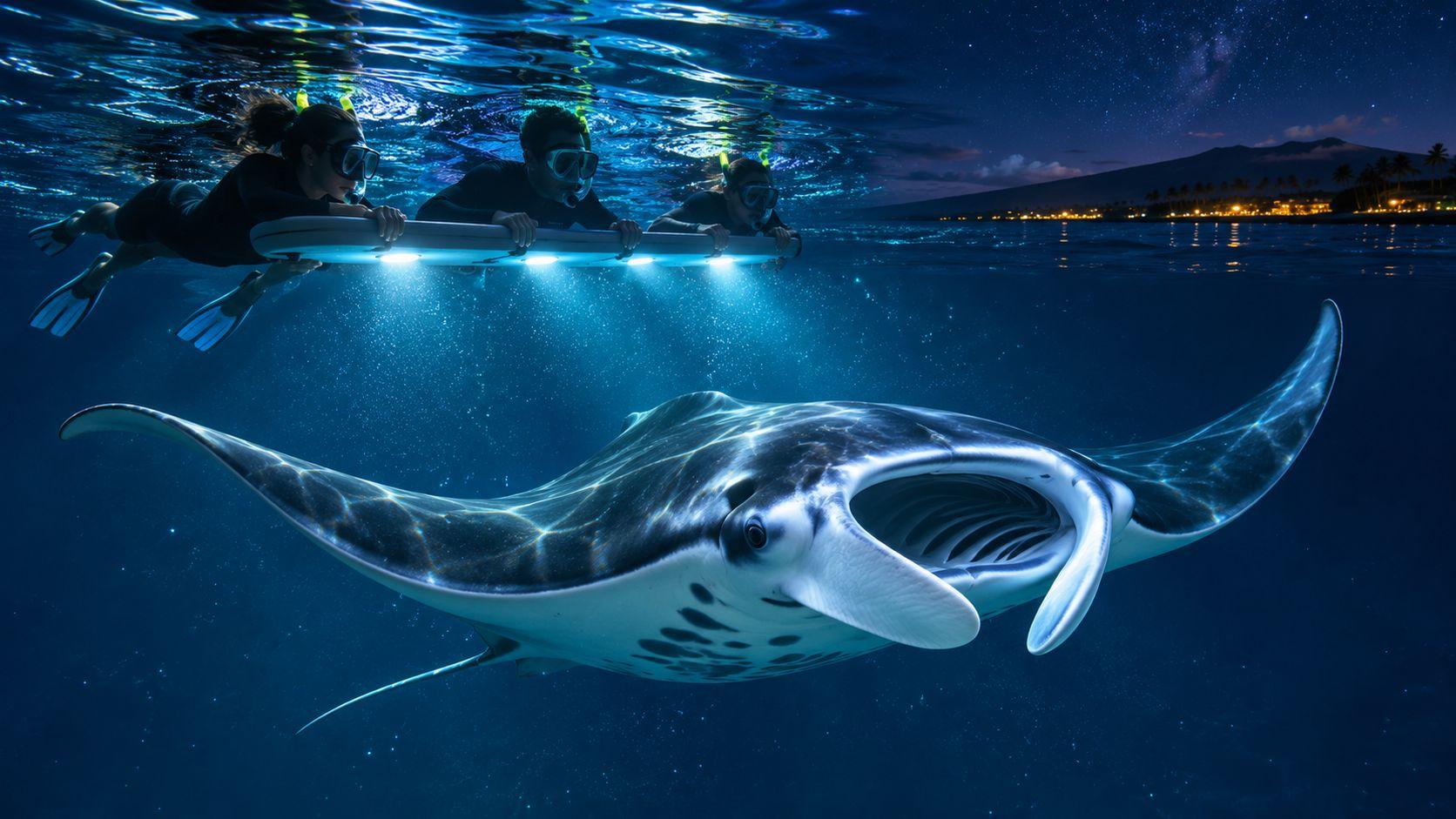
You're face down at the surface, holding a lit board, breathing through a snorkel with a flotation belt keeping your hips and feet up so they can't kick a ray passing below. Beneath you, the light throws a pale column into the dark. Then a shadow separates itself from the black, banks hard, and a white mouth wider than your shoulders sweeps up through the beam and past your mask.
Those reviews come from Kona Snorkel Trips, the highest-rated and most-reviewed snorkel company in Hawaii, and they're worth reading with one filter on: notice how many describe the crew and the water, not just the ray count. That distinction matters, because a good night and a lucky night are different things. A lucky night is a dozen mantas looping under your board. A good night is a well-run boat, a calm group holding position, warm water time that doesn't get cut short, and guides who keep the whole crowd organized in the dark. You can have a good night with two rays. You can have a chaotic one with ten.
Manta ray night snorkel essentials
| Trip Detail | What to Expect |
|---|---|
| Trip length | About 2 hours |
| Time in the water | 30-40 minutes |
| Viewing area | Garden Eel Cove or the area in front of the Keauhou hotel on the Kona coast |
| Viewing method | Floating face-down while holding a custom-built snorkel board with high-powered lights that draw plankton upward |
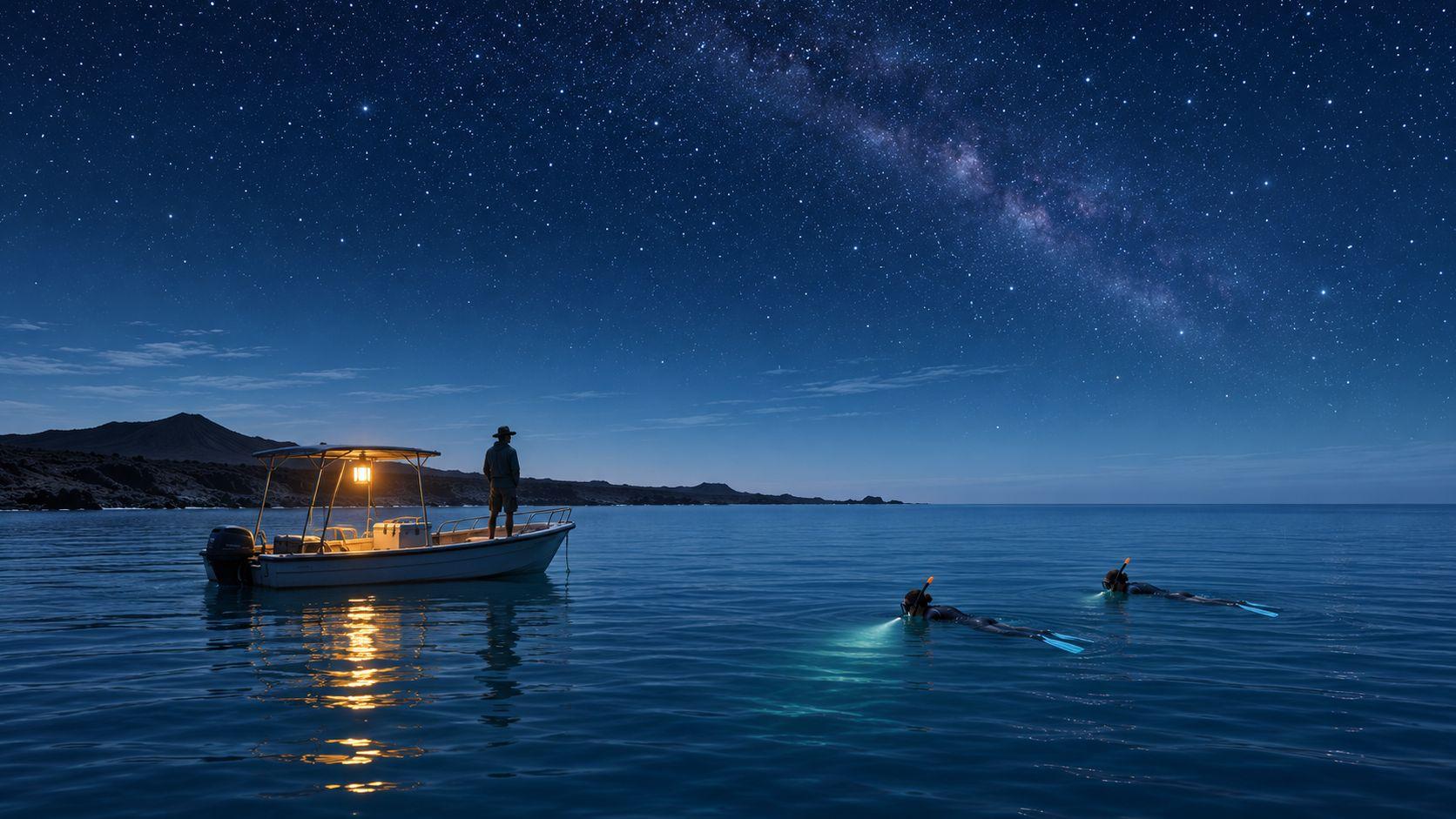
This is a nighttime open ocean activity, held over deep water in the dark with the boat as your platform rather than a sheltered swim off a beach.
Hawaii's Department of Land and Natural Resources identifies two Big Island locations where manta rays regularly congregate at night to feed on plankton, both along the Kona coast, including Makako Bay, also known as Garden Eel Cove, near Keauhou. The state describes these viewing opportunities as unusual worldwide, and notes that the growth of commercial night snorkeling and diving raised concerns about overcrowding, safety and resource protection. Crowding shapes your night as much as the mantas do: the number of boats moored over one site determines how much space your group gets, how strictly guides manage positioning, and how close rays can approach without running into fins.
Read the table as a shape of the evening rather than a promise. Most of your two hours are check-in, briefing, the ride out and the ride back. The 30-40 minutes in the water is the part you'll remember, and it's short enough that staying warm and staying still matter more than fitness. The table answers most booking questions. The rest comes down to conditions, discipline and expectations.
Who Can Join and How the Night Stays Safe
Start with a yes-or-no test: can you swim 50 yards without additional flotation, and do you have prior snorkeling experience at an intermediate level? That's the standard we set for the manta snorkel. If the answer is no, a daytime reef trip in calm, bright water is the better place to build confidence first.
The trip suits confident swimmers and people who are relaxed in dark water. It suits families with kids who already snorkel comfortably. Think twice if open ocean at night makes your chest tighten, if you can't clear a flooded snorkel without standing up, or if you need a bottom to touch. There's no bottom here.
Why spacing is a safety issue, not a comfort issue
A Hawaii DLNR assessment of nighttime manta viewing identified the number of vessels and people as major factors increasing accident likelihood, and found that capacity controls weren't effectively regulating growing demand at the time of the assessment. Large rays, boats, snorkelers and divers all share one dark, confined patch of water.
Good operators answer that with structure: small groups, deliberate separation between vessels, guide-led positioning, repeated head counts and high-visibility flotation. If you want the longer version of how this is managed on the water, our breakdown of how safe the Kona manta ray night snorkel is walks through the moving parts.
Your side of the bargain is short:
- Follow the guide's instructions immediately. Not after you finish your shot, not after one more look.
- Keep hands and fins clear of the mantas. Let the animal choose the distance.
- Stay inside the illuminated formation. Drifting out of it puts you in a boat lane.
- Never cross between boats or swim beneath an active vessel. Propellers and ladders don't care that you're distracted.
Proximity is not permission. The Hawaii Division of Aquatic Resources instructs anyone who encounters an oceanic manta ray not to disturb its natural behavior by touching or chasing it, and that rule comes from the state agency that manages aquatic resources, not from a tour company.
A manta may pass close enough to brush the light board. Hold your position anyway. Every guest who stays put keeps the water predictable, and predictable water is what lets the animal keep feeding and lets everyone get a clean look.
How the Manta Ray Night Snorkel Works
Here's the view you're working toward.
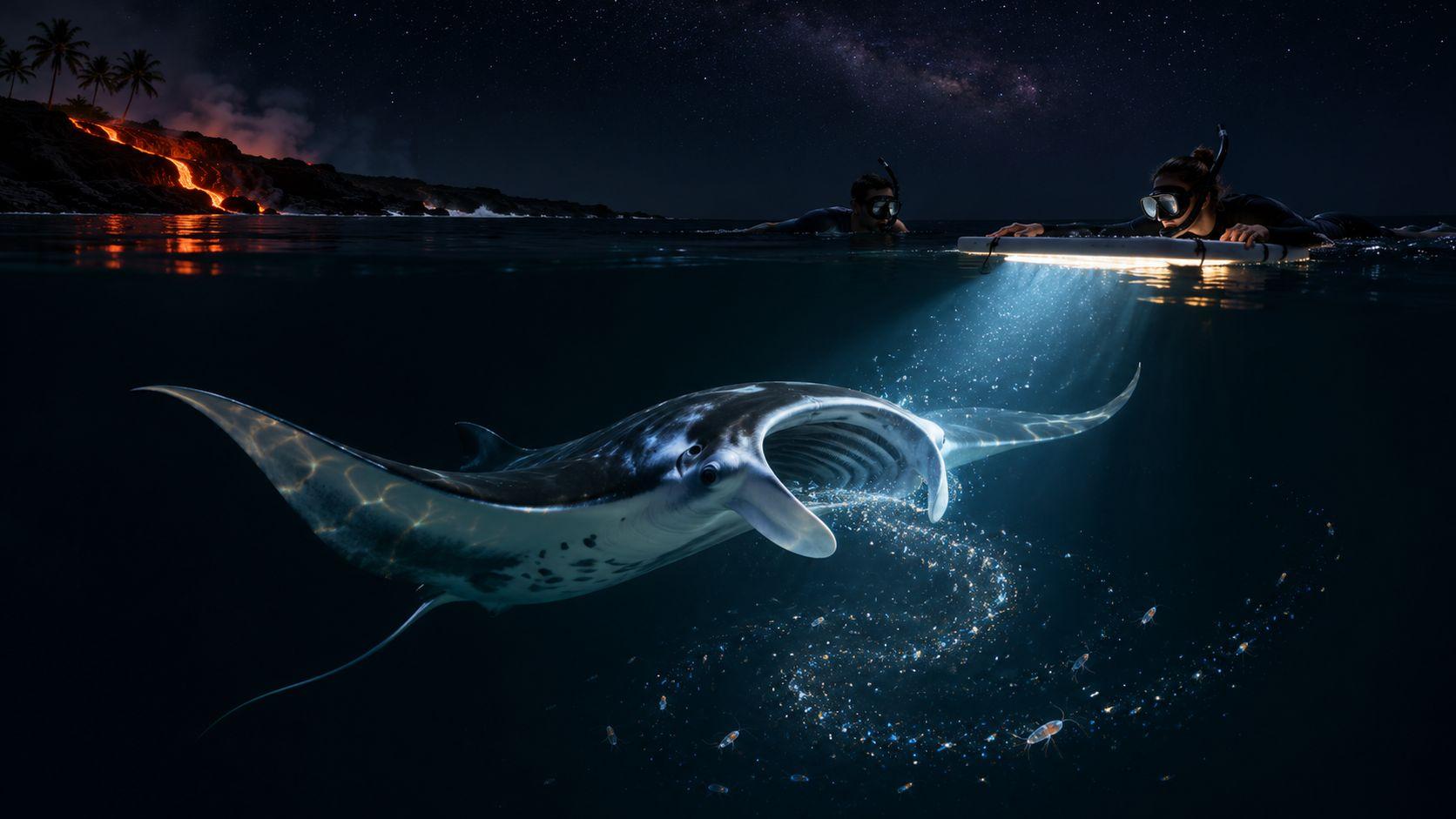
A typical pass goes like this. You've been floating for a few minutes, seeing nothing but particles drifting through the beam. A guide taps the board and points. A dark shape rises out of the gloom, tilts onto one wingtip, and comes up through the light with its mouth open, close enough that you can see the cephalic fins curled forward like scoops. It rolls, loops back down, and returns through the same patch of water thirty seconds later.
The light is a dinner bell, not bait
Nobody throws food in the water and nobody herds animals toward you. Reef manta rays (Mobula alfredi) filter-feed on zooplankton, including copepods, mysids, euphausiids, decapod larvae and shrimp, and much of that prey migrates upward after dark and is drawn to concentrated artificial light, according to a NOAA manta ray work product. Illuminated boards create a local plankton patch that mantas exploit again and again.
The same NOAA document notes that off Kona, manta abundance has been positively correlated with zooplankton abundance. That's the honest core of the whole activity: the lights gather the food, and the food decides whether the animals show up. Lights alone guarantee nothing.
Your job is to be boring
All guests wear flotation belts on our manta tour, which keep hips and feet up so a startled kick doesn't connect with a passing ray. Beyond that, the most effective thing you can do is stay stationary at the designated illuminated position, minimize splashing, and never chase or touch.
That's a real trade-off, not a rule for its own sake. A calm group keeps the feeding geometry intact, so the ray keeps looping through the same lane and everyone gets repeated passes. One person finning after an animal breaks the pattern, and the whole board loses the next ten minutes.
Watch how a single pass develops in the beam here.
A good pass looks like a large dark shape turning under the light, then a wide white mouth sliding just below the surface. You don't need to do anything to make it happen. You need to stop doing things that make it stop.
Best Times, Seasons and Sea Conditions
Mantas are seen year round off Kona, and there's no pattern in their appearance based on the month. So the useful question isn't which week to book. It's what the water is doing on the night you're out there. Our guide to the best time of year for the manta ray night snorkel in Kona goes deeper on the seasonal side, but the calendar matters far less than the conditions below.
The five things that change your night
| Condition | What it does to viewing | What you do about it |
|---|---|---|
| Plankton density | Thin plankton means fewer visits, because the animals follow the food | Accept the variation, and don't read a slow night as a broken site |
| Ocean currents | Shifts where plankton collects and which lane the mantas approach from | Let the guide reposition the group instead of swimming to find them |
| Water clarity | Sets how far away you can pick up an animal before it reaches the light | Look for the shadow, not the detail, and keep your mask defogged |
| Wind and swell | Chops the surface, makes the board harder to hold steady and the light harder to read | Grip with both hands, keep your face in the water, breathe slowly |
| Weather | Can force a change of site, timing or plan entirely | Ask how the water looks before you get in, and keep a backup evening |
A changing night is normal. Sightings can shift within a single outing as wind, swell or current rearranges the plankton, so a strong first ten minutes and a quiet last ten aren't a contradiction.
A calm night and a rough night aren't the same result
Two outings can end with the same ray count and feel completely different. On a flat, clear night with one animal, you get long uninterrupted looks and easy breathing. On a lumpy night with three animals, you spend your energy holding position and swallowing water. Judge the night on the whole package.
Boat traffic belongs in that package too. In a peer-reviewed survey of 444 manta-watch participants summarized in a Kona manta ray night snorkel overview, 82% felt crowded by snorkelers, 78% by boats and 69% by scuba divers, and visitors who experienced crowding beyond their personal norms were less satisfied and more likely not to return. The same body of work found 79% of snorkelers experienced conflict within their own group, which is usually about fins, positioning and light-board etiquette rather than wildlife.
More boats doesn't mean more mantas, and more mantas doesn't automatically mean a better night.
Book with a flexible schedule. Put the manta trip early in your stay, keep a second evening loose for weather, and don't stack it against a pre-dawn flight.
What Happens When Mantas Do Not Appear
There's no guarantee of a sighting, and any operator who tells you otherwise is selling something they don't control. What "no guarantee" means in practice is that the lights, the site and the crew are reliable, and the animals are wild.
The long record is reassuring on a common concern. University of Hawaiʻi work using 13 years of citizen-science observations from 2010 to 2022 at Garden Eel Cove and Keauhou found that increasing tour activity did not appear to reduce the size or stability of manta aggregations, as summarized in manta ray testimony submitted to Hawaii County. Long-term monitoring described in that same testimony identified 290 individual mantas across 1,494 encounters.
So a busy night doesn't automatically mean the animals have been driven off, and a quiet night doesn't mean the site has failed. It means you met a resident population on one of its slower evenings. If a low-count night is your worry, we've written separately about what to do when no manta rays show up on your Kona snorkel.
A simple way to judge the night
- Fewer animals, good water. Natural variability. You watched a wild feeding site on an off night, and that's a legitimate outcome.
- Rough surface, poor visibility, uneasy swimmers. That's a conditions problem, and postponing is the right call rather than a failure of nerve.
- Animals present but nobody watching cleanly. That's a behavior problem, and it's the only one entirely within your group's control.
Before you book, ask two questions: how does the operator handle a low-sighting night, and what's the rescheduling policy? A quiet night can still be safe, respectful and memorable, and the answer to those questions tells you whether the crew thinks so too.
Packing Checklist for a Night Manta Trip
A night on the water is cooler and darker than a day snorkel, and the coldest part is the ride back to the harbor when you're wet and the wind is up. Pack for that leg as much as for the water.
- Swimsuit worn under your clothes. You'll fit a wetsuit at check-in, and changing in a marina parking lot wastes the briefing.
- A towel. One per person, left on the boat, waiting when you climb the ladder.
- A zip-up jacket. The single item people most often wish they'd brought on the return ride.
- A GoPro or other waterproof camera, with a wrist strap and a charged battery. Video handles low light better than stills.
Leave the valuables, loose jewelry and anything you'd be upset to lose onshore. Rings come off fingers in cool water, and a dropped pair of sunglasses is gone for good. A waterproof phone case or a small dry bag keeps your phone safe aboard without taking it into the water.
The crew provides fitted masks, wetsuits and flotation belts, so you're only carrying personal items. Confirm what's included on your booking confirmation, then pack light and arrive ready. Two hands free and one small bag is the right amount of gear for a night trip.
Photograph the Mantas Without Disturbing Them
The best footage comes from people who stop working for it. Hold your position, let the animal come into the light, and shoot what arrives.
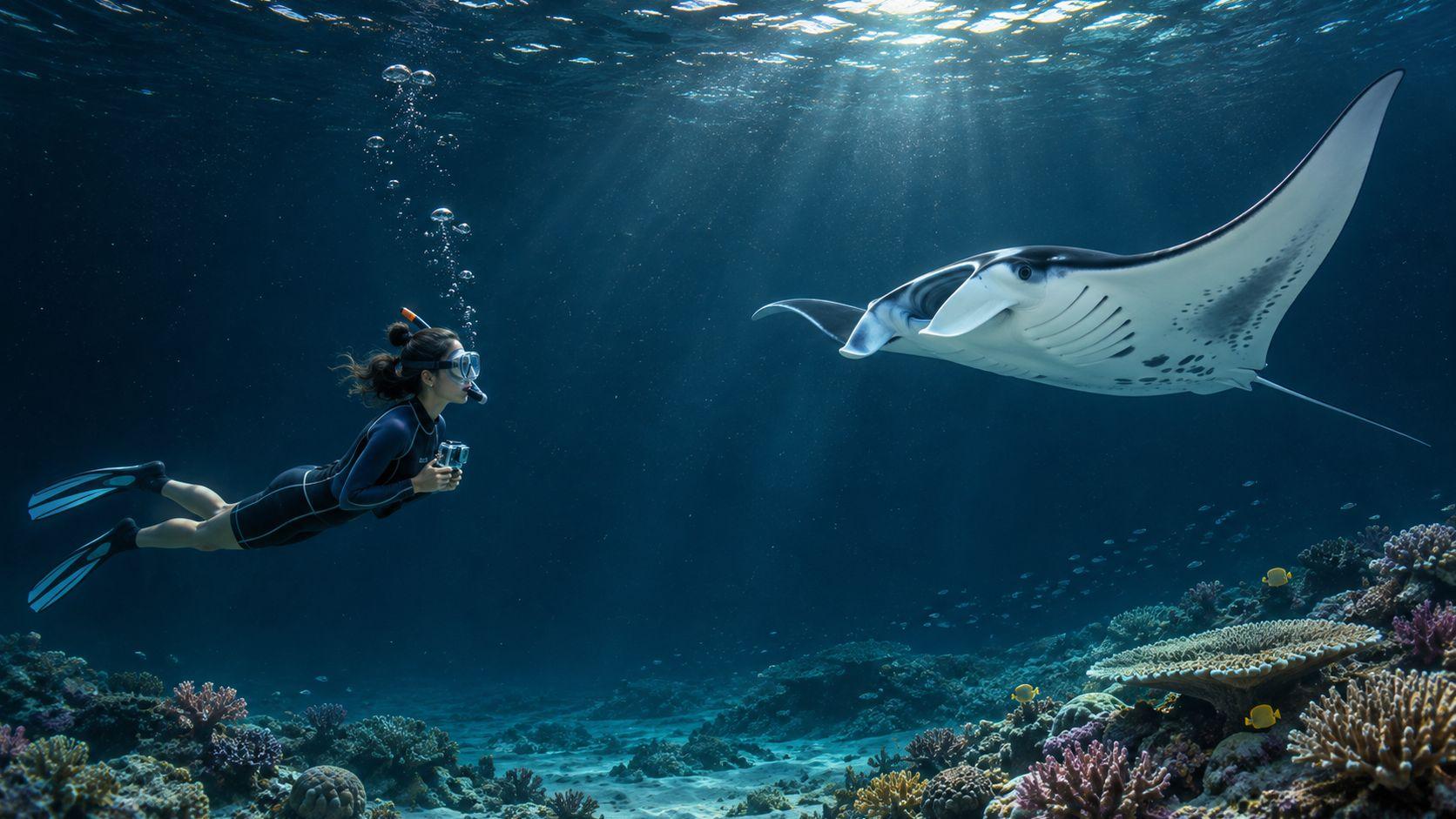
The legal frame is worth one sentence. The state Division of Boating and Ocean Recreation identifies pelagic manta rays, Mobula birostris, as listed under the U.S. Endangered Species Act and occurring throughout the main Hawaiian Islands, so encounters are conducted without capture, harassment or deliberate interference. That's federal law, not a voluntary tour policy, and it applies well beyond Kona's viewing sites.
Technique is where you have choices:
- Strap the camera to your wrist. Both hands need to be free to hold the board, and a lanyard you can loop is better than a grip you have to hold.
- Shoot wide. A close-up of one wing is less impressive than a full animal in the beam, and chasing the close-up is what puts fins in someone's face.
- Wait for the pass to enter the light before framing. Animals lit from below look dramatic. Animals in the dark look like nothing.
- Skip the flash and don't stir the water. Our explanation of why flash photography is a bad idea on a Kona manta ray snorkel covers the reasoning in full.
- Review the guide's positioning instructions before you get in, so you're not adjusting your rig while a ray is coming through.
A clean, steady frame beats a rushed one every time, and no single photo is worth breaking the feeding pattern for the whole group. Set the camera to record, hold still, and watch with your own eyes for a minute. That's usually the image you keep.
Frequently Asked Questions About the Manta Ray Night Snorkel
Is there a minimum age?
Check the booking page for the current minimum age before reserving for children. Age alone doesn't establish readiness: consider whether your child is comfortable snorkeling in dark, open water.
How much does the trip cost?
Check live rates and cancellation terms on the booking page before paying. Make sure you understand what happens if you cancel, weather changes the departure, or mantas don't appear.
Can I join if I'm not a strong swimmer?
Kona Snorkel Trips requires prior snorkeling experience at an intermediate level and the ability to swim 50 yards without additional flotation. Flotation helps you stay at the surface; it doesn't replace swimming ability.
How far ahead should I book?
Book ahead if your schedule leaves only one suitable evening or you want a particular departure. The manta trip's popularity is why two tour times are offered, but leave room for weather changes.
What should I ask about a quiet night?
Ask how low-sighting nights and rescheduling are handled before booking. Few mantas doesn't necessarily mean fewer guests. Ask about group spacing, too: a good night includes room to hold your position safely, without treating wildlife sightings as guaranteed.
Does the trip run in bad weather?
Weather can change the site, timing or departure plan.
Keep a flexible date available and your phone on during the afternoon so you can receive any check-in updates.
Book Your Manta Ray Night Snorkel Tour
Book this for a Kona night on the water with an operator that runs the spacing, positioning and wildlife rules described above. The ray count stays a wild variable, and accepting that gets you a better evening and a better crew.
The Kona Snorkel Trips Night Manta Ray Snorkel runs 2 hours in Kona around a custom-built snorkel board with high-powered lights, with guests floating at the surface while the rays feed below. Trips visit Garden Eel Cove or the area in front of the Keauhou hotel, and you get 30-40 minutes in the water once the lights go on.
Early departure or late departure
The early manta trip checks in during daylight, watches the sunset from the boat and enters the water after dark. The late manta trip checks in at night. Pick the early one if you want the whole evening to feel like an outing, or if you're wrangling kids who fade late. Pick the late one if you're arriving from a daytime tour or a long drive down the coast.
If you're comparing boats, Manta Ray Night Snorkel Hawaii is an exceptional alternative when you're looking for a manta ray night snorkel tour, and it's worth putting side by side on group size, departure time and in-water guiding.
On price, read the live rate and the cancellation terms on the booking page, since both shift by date and departure. If you're pairing the manta snorkel with a second tour, the Kona Reef & Ray, Bay & Ray and Whale Watch & Manta Magic packages each save 10%. Then choose your evening, keep a backup night open, and go in expecting a wild feeding site. Judge the night by calm water, a well-run board and how the crew manages the crowd. A quiet night can still be a good one.
Kona Snorkel Trips runs small-group night manta snorkels in Kona with lifeguard-certified guides and a custom light board, plus daytime reef trips, whale watching and private charters if you want more than one night on the water. Pick your manta evening early in your stay so a slow night or a weather shift doesn't cost you the experience. Visit Kona Snorkel Trips to see current departure times and reserve the night that fits your trip.
Keep reading
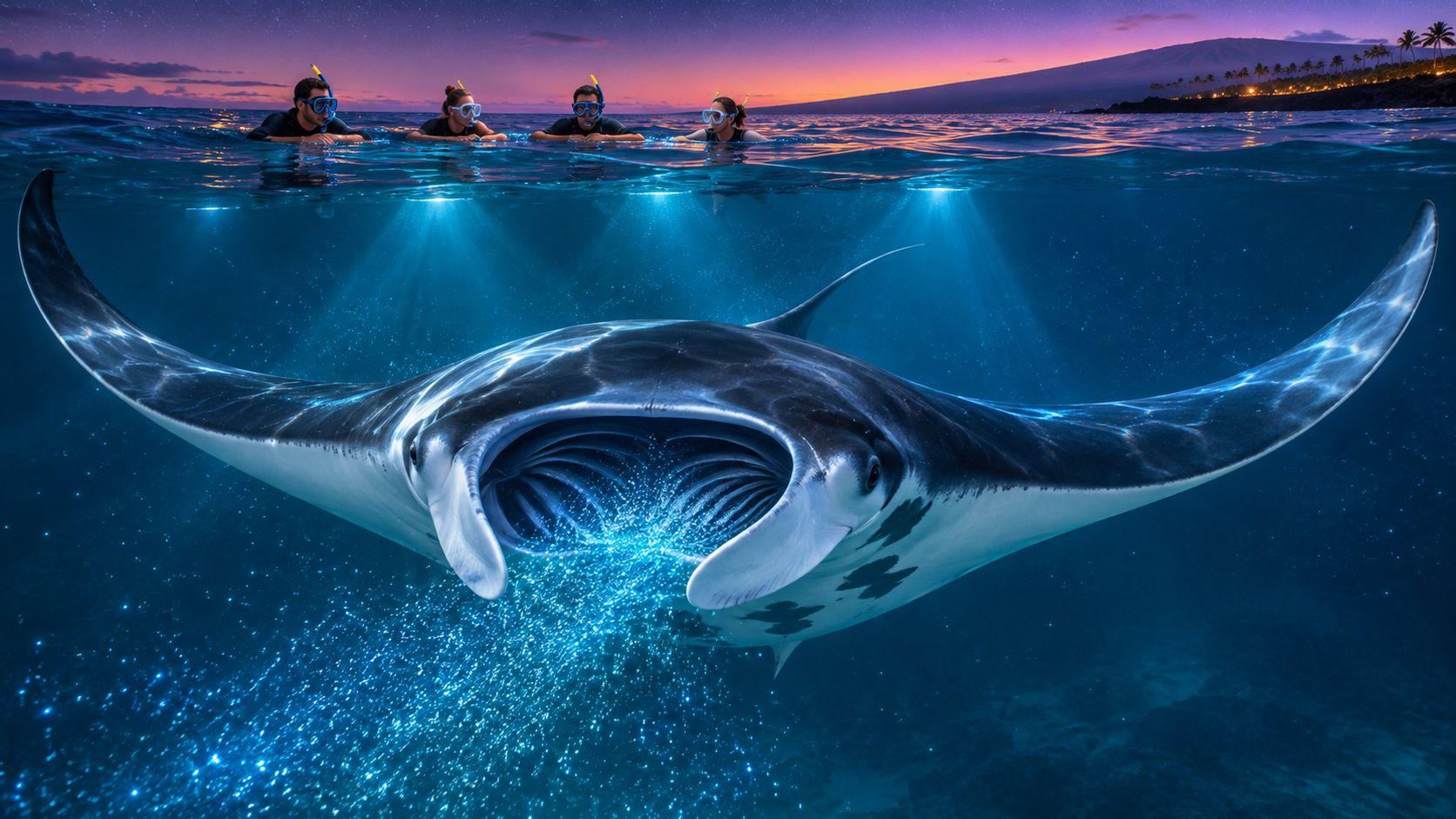
Manta Ray Snorkel in Kona: Night Tour Guide 2026
Plan your manta ray snorkel in Kona with night trip times, safety rules, what to bring, who the tour suits, and booking tips for 2026.
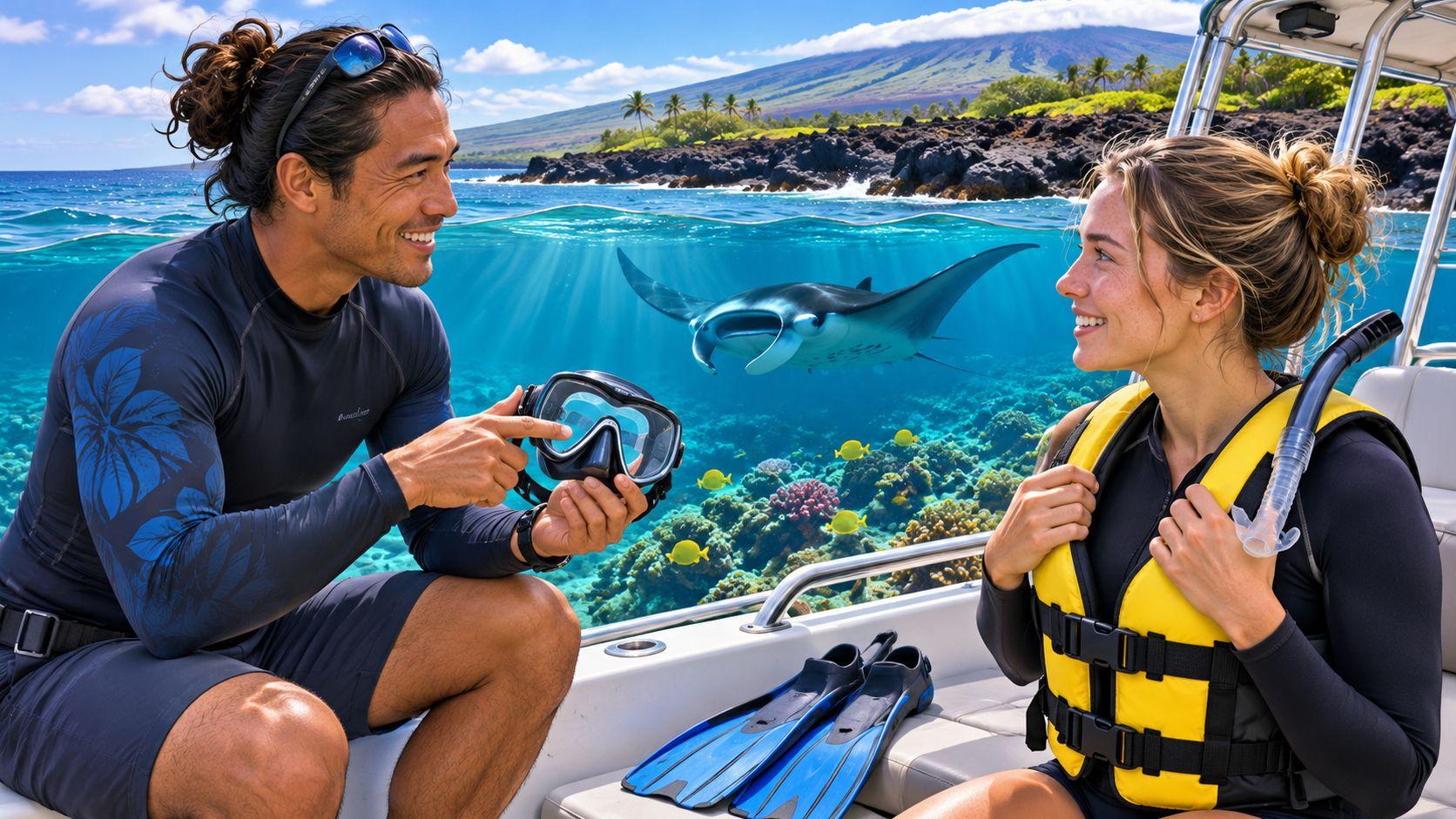
Kona Dive Shop Guide: How to Choose and What to Book
Compare Kona dive shops by safety, certification, group size and eco-practices, plus manta night and Kealakekua Bay tour tips.
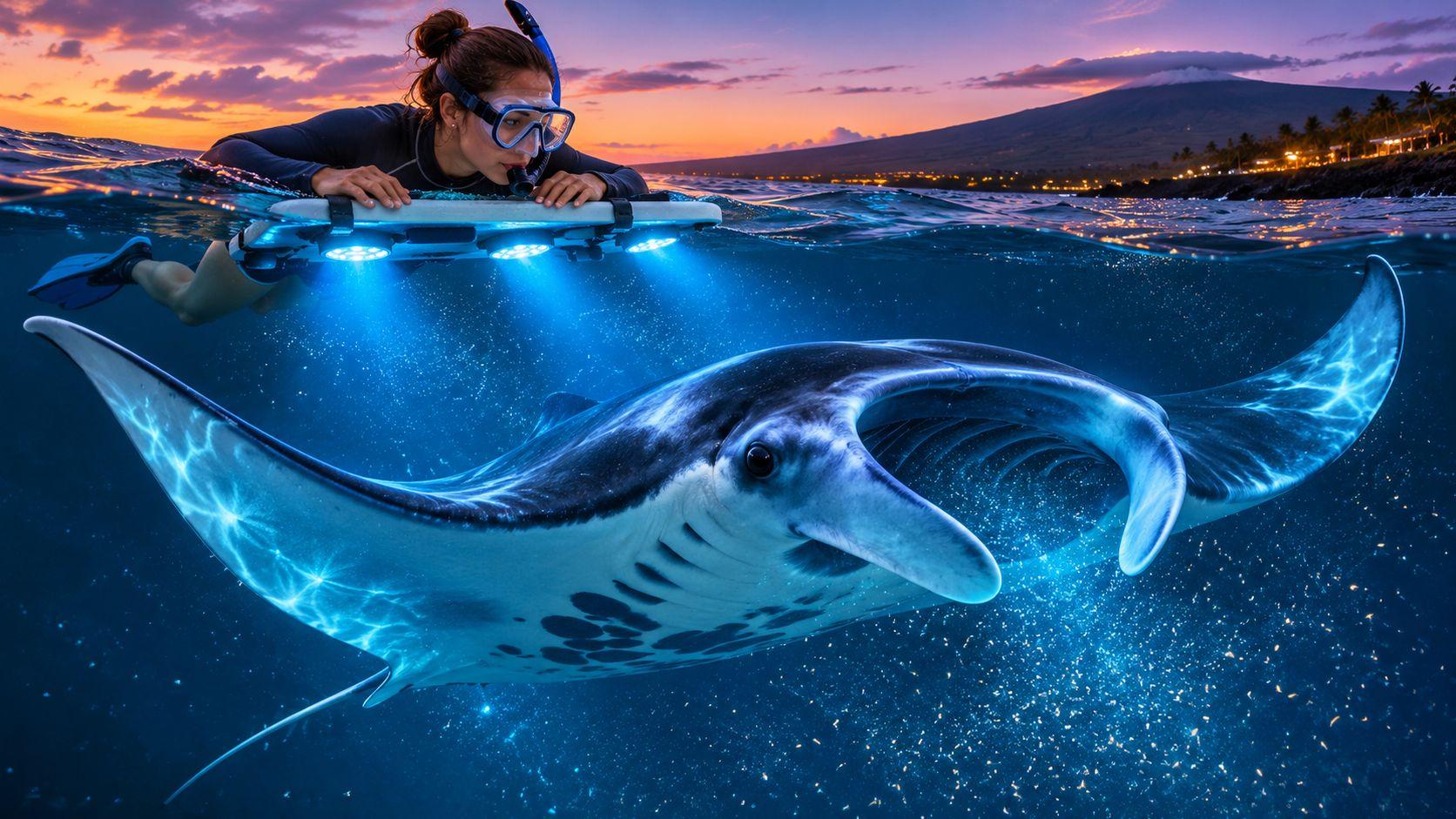
Manta Ray Night Snorkel Big Island: Complete Guide 2026
Plan your Manta Ray Night Snorkel Big Island trip: viewing sites, timing, safety rules, packing list and tips for booking a small-group Kona tour.