
Manta Ray Night Snorkeling in Kona: A Complete Guide
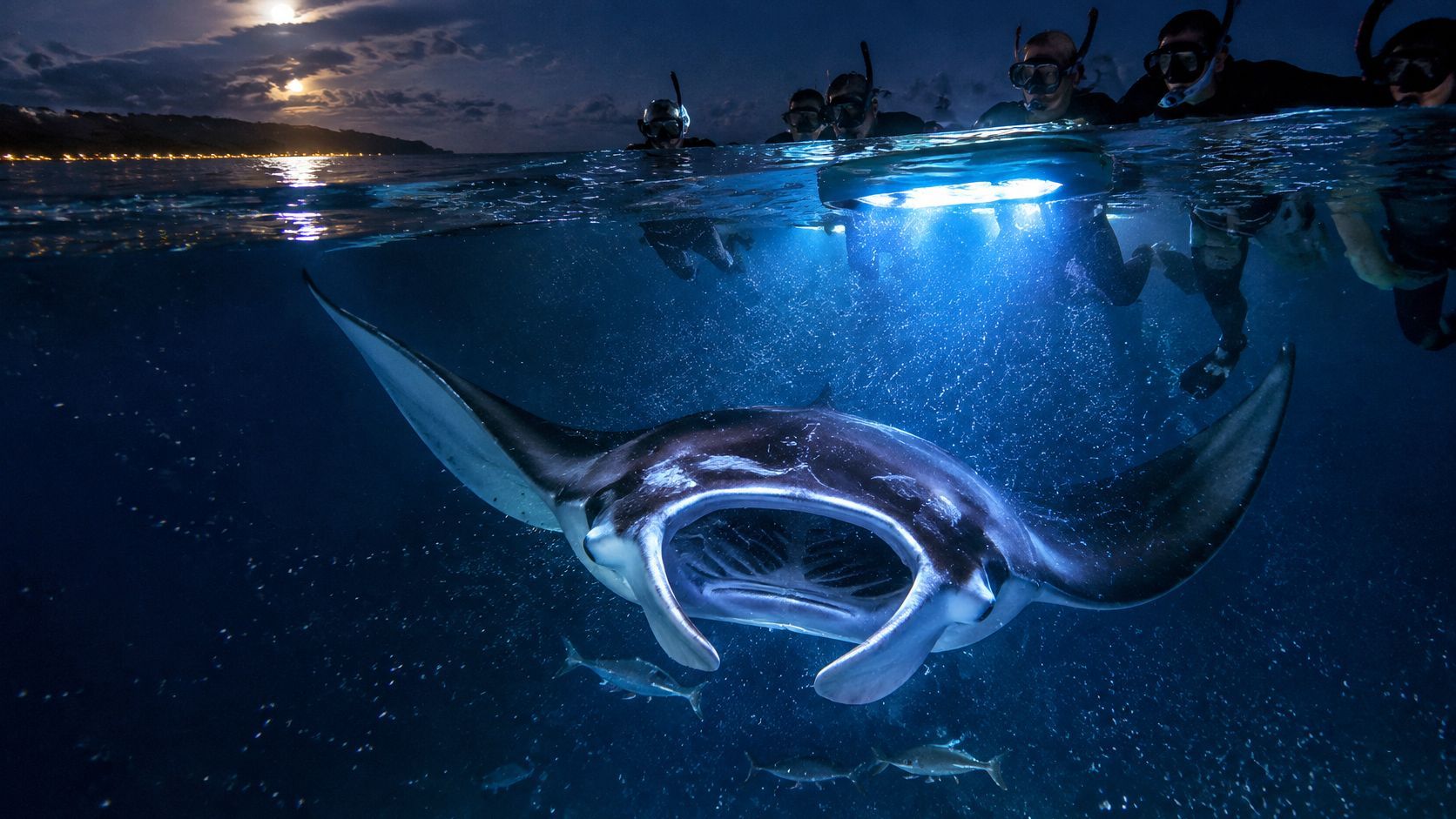
You've got two tabs open: a booking page with a sunset photo, and a review thread where one person calls the night the best hour of their trip while another complains about thirty snorkelers kicking in the dark. Both are honest. Manta ray night snorkeling in Kona is a strange and beautiful stretch of open water, and it's also a wild animal encounter run at commercial scale, which is exactly where the questions start.
What decides whether your night works isn't luck. It's the swim standard you meet, the distance you hold when a 1,000-pound animal turns toward your light, and whether the trip you booked keeps its group small enough to make either of those possible.
Manta Ray Night Snorkeling at a Glance
The boat settles on open water after dark. You slip in and hold the edge of an illuminated board while manta rays feed in the light below. The water is dark beyond the lit area, and other snorkelers share the space, so the experience depends on staying calm and keeping your position.
Kona's manta snorkel is a nighttime open-ocean activity. Guests float at the surface around a custom-built board with high-powered lights and watch the rays approach to feed. Kona Snorkel Trips' two-hour Big Island Manta Ray Night Snorkel takes place in Kona.
Kona Snorkel Trips is Hawaii's highest-rated and most-reviewed snorkel company on the Big Island. Guest reviews appear below.
| Fact | What to Know |
|---|---|
| Setting | Nighttime open-ocean snorkel in Kona, on the Big Island |
| Season | Manta rays are seen year-round, with no pattern in their appearance by month |
| Viewing style | Float at the surface around an illuminated board and watch the rays feed |
The trade-off is part of the experience: the light draws feeding rays to a shared viewing area, but other people are in the water with you. A close pass can be memorable; it is not something a tour can control, and a sighting alone does not make an encounter responsible. The rays need room to move, so stillness and distance matter more than swimming after them.
Expect to float in open water at night, not move freely through a protected pool. Your position, the group around you, and the animals' own movements shape what you see.
How Lights Draw Manta Rays to the Surface
The lights don't call the mantas. They call dinner.
Think of a dinner bell rung for the plankton. Artificial light hanging in the water doesn't signal a manta directly; it concentrates zooplankton, and the resulting patch of near-surface food is what brings the rays in. A NOAA assessment of Kona's night manta sites describes the mechanism plainly: the lights create a localized feeding opportunity, and the animals respond to it.
The chain from sunset to circling ray
Three links do the work. After sunset, zooplankton rise toward shallower water as part of a daily vertical migration, so prey availability near the surface climbs on its own. The boards then aggregate that prey into a dense, visible patch instead of a thin scatter. Reef mantas swim through the patch with their wide cephalic fins funneling plankton-rich water into open mouths, which is why they loop back through the lit zone rather than hovering in one spot.
That last detail matters more than it sounds. A manta feeding in a beam is working a circuit. It comes in, mouths plankton, banks away, and comes back. Interrupt the circuit once and it may reset. Interrupt it repeatedly and the animal spends energy it came here to gain.
The light feeds the rays. A calm, lit, stable zone is the encounter; a moving one scatters it.
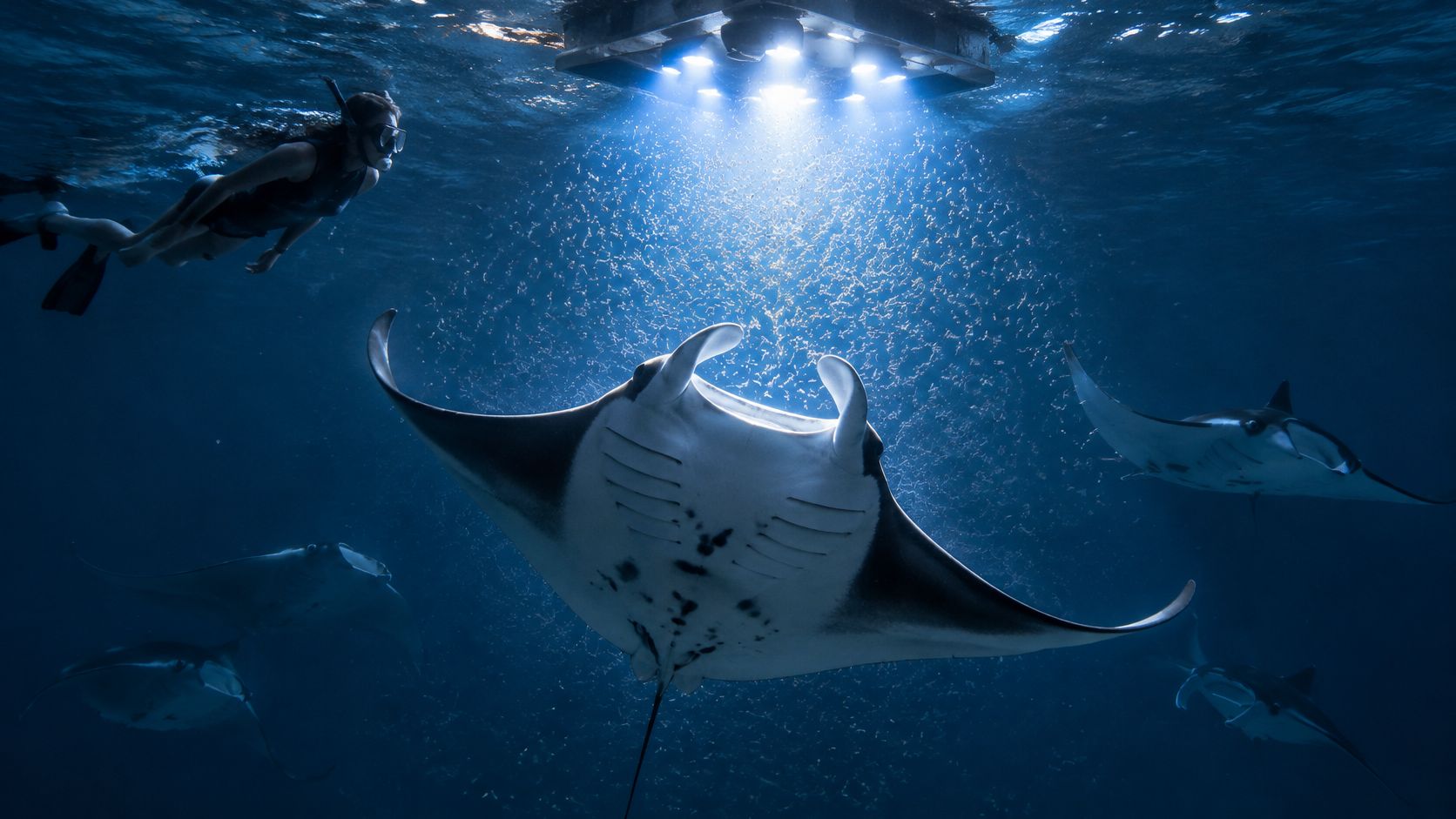
Because the sighting comes from feeding rather than from passing traffic, two variables are in your control. Beam stability is the first. A board that stays pointed down and still holds a coherent feeding zone; a board swung around by excited hands breaks it. Swimmer stillness is the second, and it's why the design of the illuminated board itself matters as much as the light output.
Placement splits by activity. Snorkelers stay at the surface with lights pointed down into the plankton beneath the group, while divers aim lights upward from near the bottom. NOAA's voluntary wildlife-interaction standard for Kailua-Kona waters also asks everyone to stay over sand, rubble or boulders rather than coral, and to keep the water column open so a ray can maneuver without clipping a swimmer or a reef.
The practical version: don't dive down into the feeding column, don't swim underneath a ray, and don't wave a light around to get a better look. The ray is already coming back.
Are You Ready and Who Should Book
Before the dark water, there's a swim standard, and it's the part people skip when they read a tour description too fast. For the manta trip, guests should be able to swim 50 yards without additional flotation and should arrive with prior snorkeling experience at an intermediate level.
That isn't gatekeeping for its own sake. At night you can't see the surface line from below, the boat is a set of running lights, and the animal you came to watch moves faster than anything on a daytime reef. Panic in bright water is a nuisance. Panic in black water with twenty other snorkelers around you is a problem for everyone.
| Guest Type | Good Fit? | Why It Matters |
|---|---|---|
| Intermediate snorkelers who swim unaided | Yes | Meets the swim and experience standard for open water at night |
| First-time snorkelers with no open-water practice | Not yet | Night water and lights add stress; build skill on a daytime snorkel first |
| Families with children | Yes, if each child meets the swim standard | Supervision is harder in crowds, so choose a smaller group |
| Non-swimmers | No | Flotation alone does not replace the swim requirement |
| Photographers | Yes, with restraint | Flash and quick movement disturb feeding; stay still to get the shot |
| Eco-conscious travelers | Yes | Prefer small groups, respect distance rules and ask about crowd limits |
Run this checklist before you book. You should be able to float face down without panic, swim 50 yards unaided, clear a flooded mask without surfacing in a hurry, and hold still for 30 to 40 minutes with your face in the water. That last item is the one that surprises people. It sounds easy on land.
Packing is simple: a towel, a zip-up jacket for the cold ride back, and, if you want photos, a GoPro with a secure mount. Leave loose items on the boat. Wetsuits and flotation come with the night trip in sizes from kids 6-8 up to adult 3X, and every guest wears a flotation belt that keeps hips and feet up and away from the rays, which protects the animals as much as it protects you.
If you've never been in open water, don't make this your first time. Take a daytime reef snorkel first, get comfortable with a mask and a breathing tube in salt water, then come back for the dark. If you're still unsure whether the night trip suits your group, who should skip a Kona manta ray night snorkel breaks down the cases where a daytime tour is the better call.
What Happens on the Night, Step by Step
Here's the sequence, with the reason behind each step and the mistake that shows up most often.
- Check in before dark and get fitted. A snug mask that seals without tightening the strap to your skull, plus your wetsuit and flotation belt. The common slip is a mask borrowed in a hurry that leaks all night and turns every manta into a blur.
- Listen to the briefing properly. Crews cover manta size, the no-touch rule, and how to float without splashing. The slip is half-listening because you're excited. The rules you hear on the dock are the ones that keep the animals circling.
- Motor out to the site after dark. The ride is short, but the temperature drops once the sun is gone. The zip-up jacket earns its place on that chilly ride.
- Enter the water in small groups and take your spot at the board. The lit board is a fixed boundary, not something to steer. The slip is grabbing it and swinging it around, which scatters the plankton patch you came to see.
- Float at the surface, face down, legs relaxed. Stay beside an approaching ray rather than in front of it, and let it pass under your arms. Kicking hard is the most common mistake in the water, and it's the one that ends encounters early.
- Let the mantas move and adjust only to hold the group together. Expect 30 to 40 minutes in the water. If a ray swims toward you, hold position and it will usually route around you.
- Return to the boat, dry off, and talk it through with the crew. Guides who run this nightly can tell you which individuals you saw and what the behavior meant, and that conversation is worth more than the photos.
A sighting builds in stages. First a darker rectangle in darker water, then the outline resolves, then a white mouth turns upward into the light. Then it's beside you, so close you can count the gill slits, and gone with two slow wingbeats.
The calm, stationary float in step 5 is the single skill that shapes the whole night. Everything else is logistics.
Guest Distance and Body Position Rules
Distance affects how often a manta changes course. Marine megafauna tourism guidance reports avoidance behavior in 31% of interactions when people came within 3 meters (10 feet), compared with 3.4% at roughly 4 to 5 meters (13 to 16 feet). Those figures make a clear buffer the practical choice.
| Distance from a Manta | Avoidance Observed | What to Do |
|---|---|---|
| Within 3 m (10 ft) | 31% of interactions | Hold still and let the ray pass, or drift back |
| About 4-5 m (13-16 ft) | 3.4% of interactions | Use this as your default spacing, beside rather than in front |
A swimmer close beside, ahead of, or beneath a manta can obstruct its feeding path. The ray may change course and lose its line through the plankton. At a lit site, repeated close passes can mean repeated disruptions.
What to do when a ray comes close
Hold your position, keep your arms close to your body, and let the ray choose its route. If you drift inside about 3 meters, ease backward without splashing. Avoidance rises sharply inside about 3 meters, so keeping a clear buffer, avoiding touching and not pursuing a ray are the simplest ways to protect the encounter.
Keep these body rules in mind:
- Float horizontally at the surface. A vertical body can obstruct the ray's path.
- Keep your arms in. Reaching toward a ray can interrupt its pass.
- Keep your legs still. Kicking can bring your feet into the feeding lane.
- Never touch, grab or ride. Contact can strip the protective mucus coating on a manta's skin.
- Stay beside the ray, not in front. Let it cross your field of view without crossing its path.
The illuminated board gives the group a fixed reference point. Hold your place at the edge of the light rather than following individual rays. For more detail on posture, see this guide to the best body position for manta ray night snorkeling.
Remember the basics: stay at the surface, keep a clear buffer, keep your hands and legs still, and let the animal choose its route.
Ethics, Protection and Crowding at Night Sites
At a manta viewing site, a clear encounter depends on more than whether rays appear. Hawaii protects pelagic manta rays, Mobula birostris, under state marine-species protections. The state guidance on protecting marine species calls for observing wildlife without handling, feeding, capturing or restraining it.
Commercial tours in manta viewing zones require a department-issued permit. The state's manta viewing zone rules designate the zones for swimming, snorkeling and diving, and prohibit fishing during manta-viewing hours, from 4:00 p.m. through 4:00 a.m.
The trade-off most tours don't mention
A reliable sighting does not, by itself, make an encounter well managed. Research reviewed in Hawaii County testimony raised concerns that artificial light at night may affect elasmobranch activity, including at the individual and population levels. The review also recommended regulating tourism practices that intentionally concentrate light to attract manta rays and whale sharks. Manta rays are thought to dive deeper at night than during the day, so gathering at the surface around artificial light may alter their natural behavior.
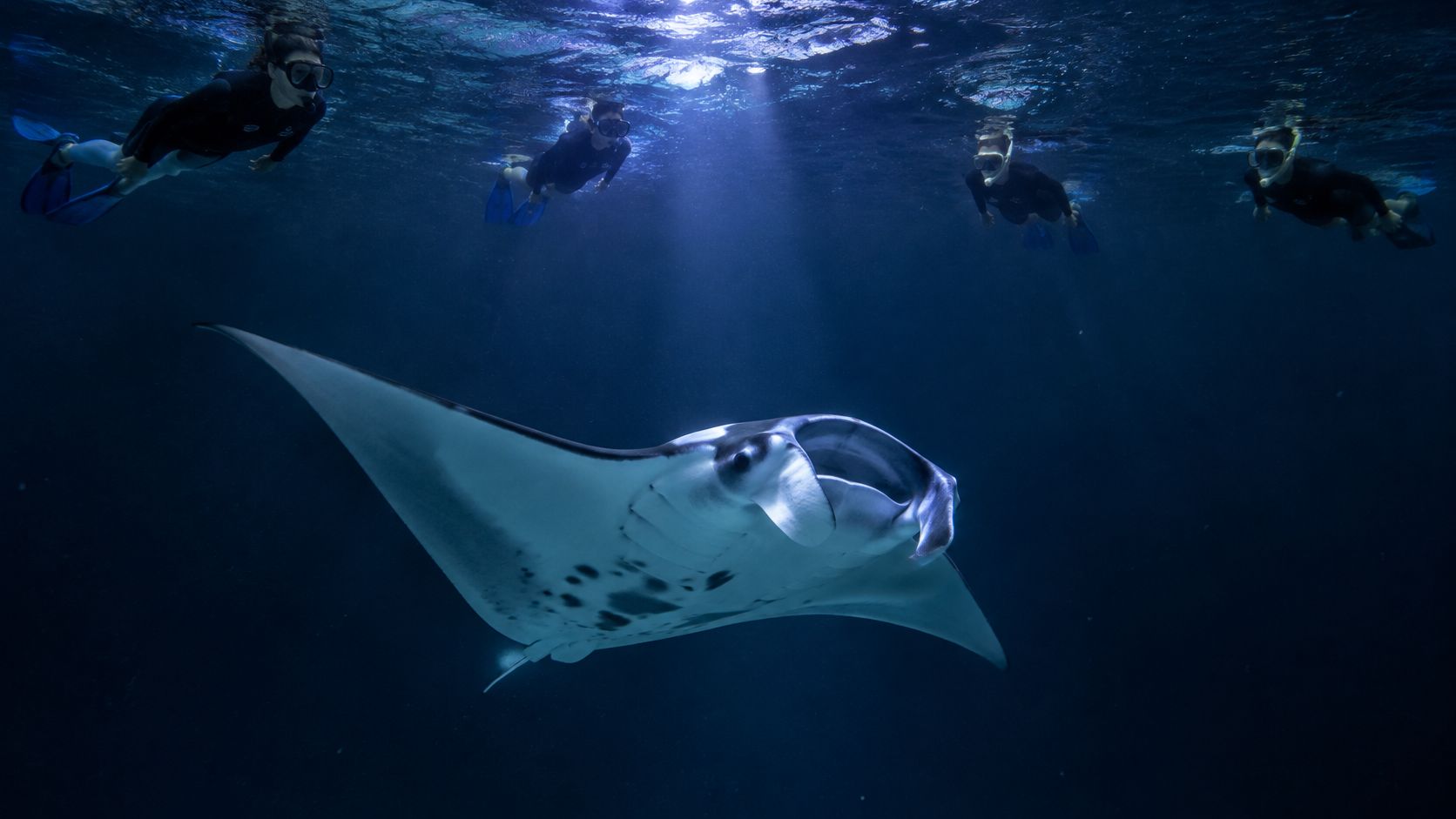
These concerns are a reason to look closely at how an operator manages the encounter. Ask about group size, surface-only rules, the distance briefing, and whether someone is watching the animals' behavior, not just counting passes.
Crowding affects both the view and the conditions around the animals. In a 2023 manta viewing boating operations and safety assessment covering 444 manta viewers, complaints about crowding were common across user groups.
| Crowding Source | Viewers Who Felt Crowded |
|---|---|
| Snorkelers | 82% |
| Boats | 78% |
| Scuba divers | 69% |
Respondents said they would accept substantially fewer users at the same time than they encountered during peak conditions. A government environmental assessment in the same record also found that safe and desirable visitor densities had been exceeded at manta viewing sites, with no formal carrying-capacity limits established. The state permit framework caps permits at 24 per viewing zone. That cap does not answer how many people or boats will be at the site on a given night.
Before booking, ask how many people fit on the boat and how many boats typically share the site. A smaller group may mean a calmer surface, but it cannot guarantee a quiet viewing area. If the water is crowded, give the ray room rather than pressing closer. A guaranteed sighting is not automatically an ethical encounter. For more on the considerations behind responsible viewing, read this guide to manta ray night snorkeling ethics.
Book Your Night Snorkel and Get Answers
A night manta snorkel suits swimmers who can cover 50 yards without flotation and have intermediate snorkeling experience. If you are not ready for open-ocean snorkeling after dark, choose a daytime tour instead.
Choose a departure time that fits your evening. The early trip checks in during daylight, watches sunset from the boat, then enters the water after dark. The late trip checks in at night. Both are two-hour trips in Kona, with 30 to 40 minutes in the water.
Bring a towel and a zip-up jacket. Wetsuits are provided for the manta tour, and guests wear flotation belts. A GoPro is optional; follow the crew's directions and keep your body position controlled around the rays.
Kona Snorkel Trips offers the Night Manta Ray Snorkel with a custom-built board and high-powered lights. Check availability and book the Kona manta ray night snorkel for your preferred trip time. If your dates are full, the manta guarantee does not expire and is honored when space is available two hours before the tour starts.
A sighting is never guaranteed. Mantas are wild animals, and their appearance can vary from night to night. A guarantee can help with a return booking, but it cannot ensure an uncrowded or ethical encounter. Look for clear rules that keep swimmers still and give rays room to move.
Children should meet the same swim and snorkeling experience standards as adults. A child who cannot swim 50 yards unaided or stay comfortable floating in open water after dark should choose a daytime snorkel instead.
Choose a date, check availability, and book the departure that works for you.