
Manta Ray Night Dive Kona: Snorkel or Scuba in 2026
You've found the manta photos, picked a free evening in Kona, and reached the confusing part of booking: some trips say snorkel, others say dive, and nearly every operator promises a responsible encounter. What you need to know is simpler. Where will you be in the water, what swimming skills do you need, and will the crew keep the feeding area clear when the site gets busy?
A manta ray night dive in Kona can mean watching from the surface or looking upward from the seabed. Both offer a remarkable perspective, but neither should involve chasing animals, competing for the closest position, or assuming that bright lights guarantee mantas.
Snorkel or Scuba for Kona's Manta Night
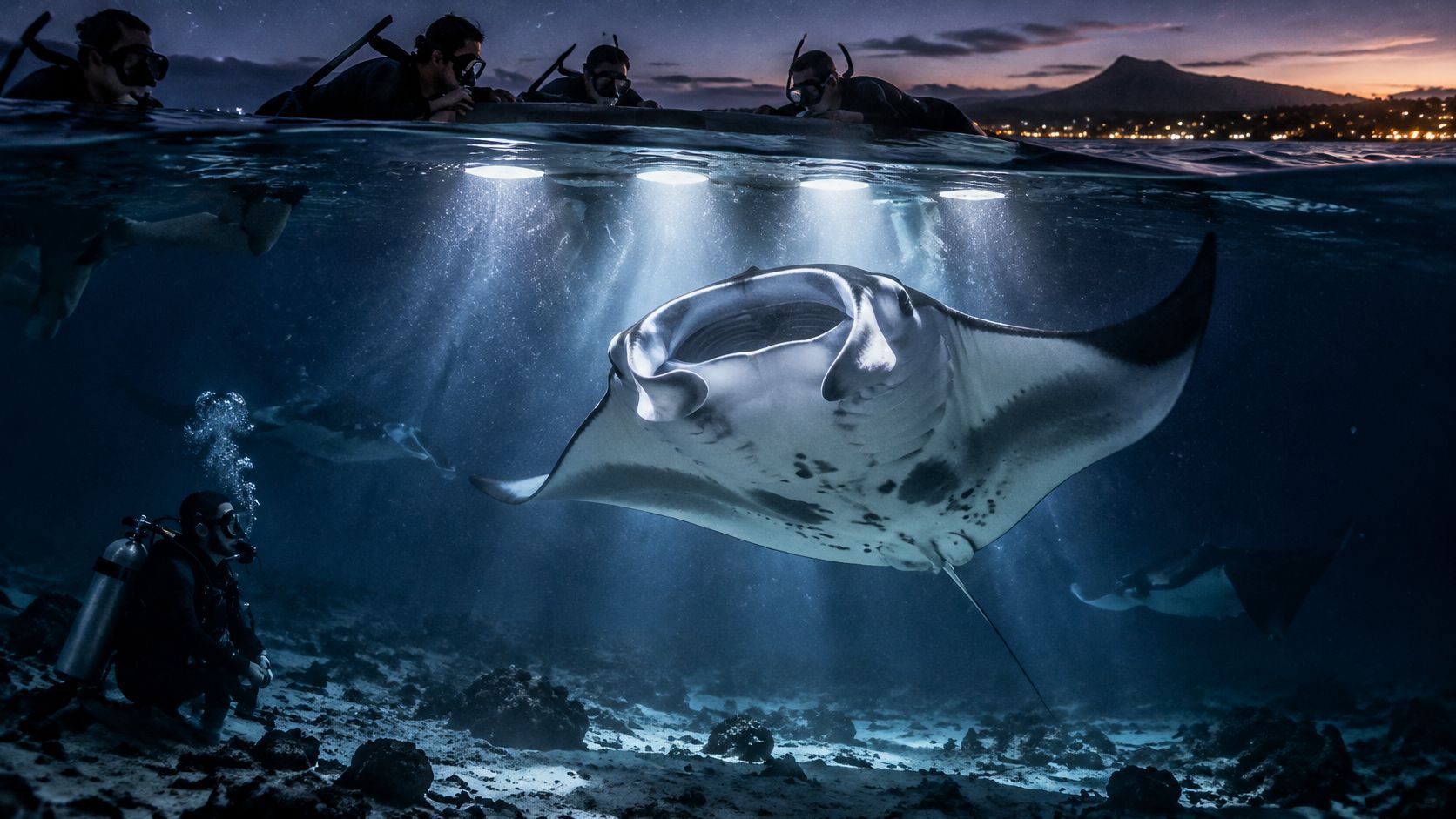
The choice changes what you see and what the night asks of you. Snorkelers float at the surface and watch mantas rise toward the lights; scuba divers settle lower and look up. Choose snorkeling if you have intermediate snorkeling experience and can swim 50 yards without additional flotation. Scuba is for certified divers comfortable with a nighttime dive.
Kona Snorkel Trips offers a nighttime open-ocean manta snorkel, with lifeguard-certified guides and a custom-built board equipped with high-powered lights.
Manta night options compared
| Option | Best for | Certification | Time in the water | Departs from |
|---|---|---|---|---|
| Night manta snorkel, Kona Snorkel Trips | Intermediate snorkelers who can swim 50 yards | None required | 30–40 minutes | Honokohau Marina |
| Manta dive, Kona Honu Divers | Certified divers who want a lower viewpoint | Scuba certification | Confirm the dive duration with the operator | Confirm the departure location with the operator |
On the Kona Snorkel Trips manta ray night snorkel, guests hold the illuminated board at the surface. Everyone wears a flotation belt, which helps keep hips and feet up and reduces the chance of kicking a manta. You still need to meet the swimming and experience requirements; flotation is not a substitute for them.
The Kona Honu Divers manta dive offers a different view: certified divers watch from near the bottom, looking up as mantas feed above. Divers manage their equipment and buoyancy; snorkelers breathe through a snorkel and remain at the surface. Neither position guarantees a closer encounter. The animals should be free to approach or leave.
Choose for your actual comfort level
The difference between snorkeling and scuba diving comes down to more than equipment. Snorkeling requires comfort in open water at the surface. Scuba requires comfort descending, monitoring your gas supply, and following a nighttime dive plan.
Kona Snorkel Trips does not permit ride-alongs on its manta charter, so watching from the boat is not an option on that trip. If you cannot meet the swimming requirements or feel uncertain in open water, postpone rather than relying on flotation to make the activity manageable.
Decision rule: Choose the perspective you can enjoy calmly, not the one that sounds more adventurous.
Why Kona's Mantas Gather and Where to Go
Artificial lights illuminate a patch of ocean, zooplankton concentrate in that light, and reef manta rays, Mobula alfredi, pass through to feed. The lights attract their food, not the mantas directly. Think of the illuminated water as a concentrated feeding opportunity rather than an underwater performance stage.
Kona's tradition grew from lights near Keauhou Bay that attracted plankton and, in turn, feeding mantas, as described in this historical account of Kona manta tourism. That origin helps explain why the encounter works, but it doesn't make every illuminated site equally productive every evening.
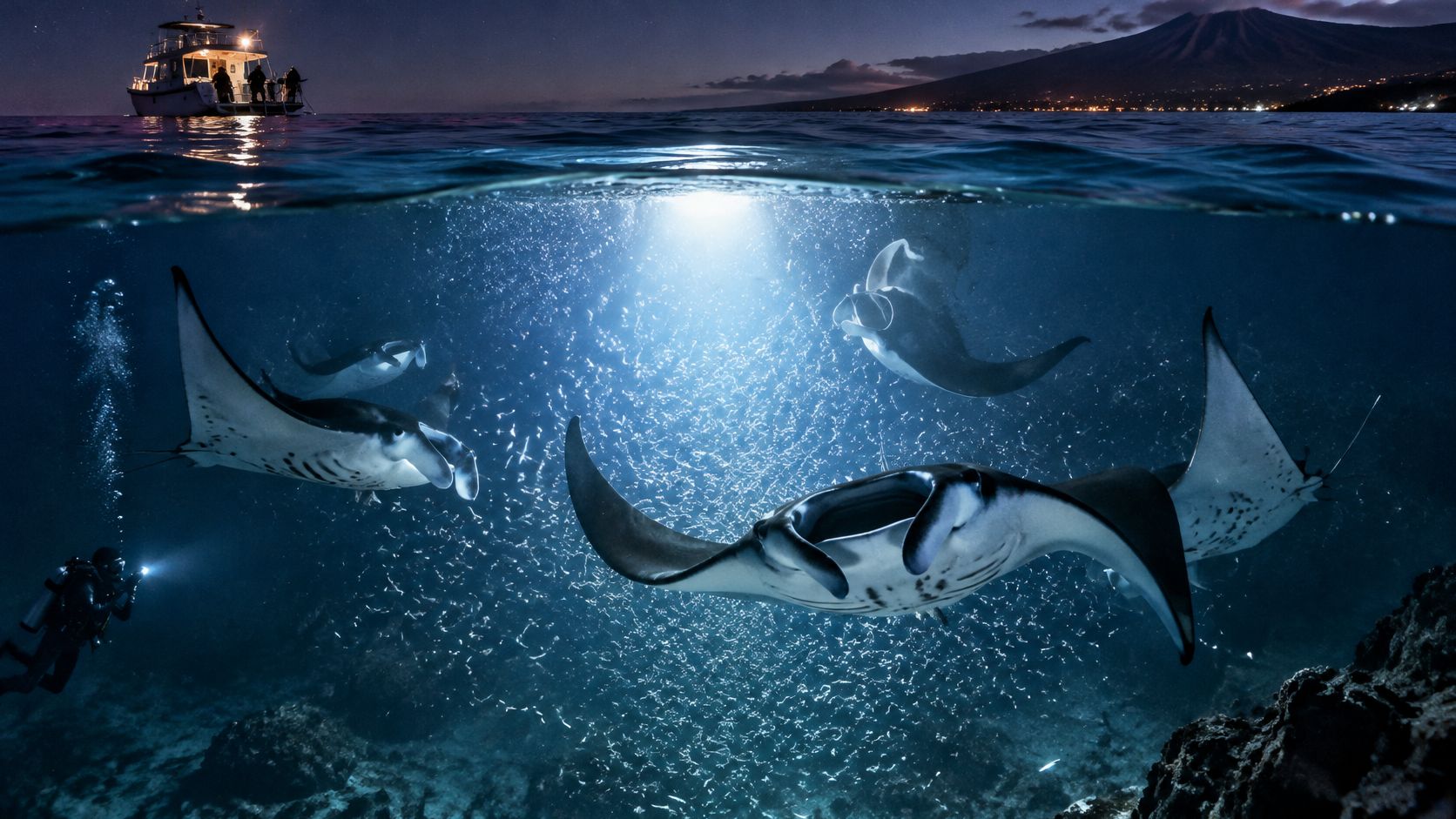
A University of Hawaiʻi study examined 13 years of community observations, from 2010 through 2022, at Garden Eel Cove and Keauhou, recording more than 23,000 sightings involving 167 individually identified reef manta rays. Researchers found that aggregation size tracked zooplankton density, supporting prey availability as a primary driver of manta attendance.
Garden Eel Cove and Keauhou compared
| Factor | Garden Eel Cove | Keauhou | What it means for you |
|---|---|---|---|
| Typical aggregation size | Consistently larger | Generally smaller | Numbers change nightly with plankton |
| Usual visitors | Part of the combined population with an approximately balanced sex ratio | Strongly female-biased | Either site offers individual wildlife encounters, not a fixed cast |
| Site fidelity and movement | Movement between viewing locations documented | High fidelity among females; males appeared more mobile | Individual rays may appear at both sites |
Different sites, not better and worse animals
Garden Eel Cove supported larger aggregations in the study. Keauhou generally hosted smaller gatherings dominated by females, while the overall sex ratio across both locations was approximately 1:1. Don't mistake that combined ratio for a separate Garden Eel Cove measurement.
The study also reported relative stability in the aggregations despite increased tourism, without evidence that activity levels during the study period had reduced local population viability. That's reassuring within its scope, but it isn't permission to ignore crowding, obstruct feeding routes, or increase disturbance.
Understanding why manta rays gather near Kona after dark helps set the right expectation. More boats don't manufacture more food, and a larger historical aggregation doesn't guarantee a busier encounter on your particular evening.
Early departure or late departure
Our early trip checks in during daylight, includes sunset from the boat, and enters the water after dark. The late trip checks in at night. Mantas are seen year-round, and we don't observe a dependable month-based pattern that lets you select a guaranteed better month.
The manta trip is the island's most popular tour, which is why we offer two departure times. We leave from our own dock at Honokohau Marina, between town and Kona airport.
I'd choose the early departure if watching the coastline fade into evening would help you settle in. Choose the later departure for scheduling convenience, not because darkness alone promises more rays.
A quiet feeding site is still a normal wildlife outcome. Book for the opportunity to observe, not an expected animal count.
How to Prepare for Your Night in the Water
Prepare for the swimming first and the photographs second. Nighttime makes an unfamiliar mask, uncertain breathing technique, or poorly understood exit procedure harder to manage.
Get ready before check-in
Confirm your swimming ability. You should be able to swim 50 yards without additional flotation and already have intermediate snorkeling experience. If your only experience is standing in shallow water with a mask, practice in a suitable supervised setting before considering this trip.
Give accurate information when booking. We may refuse service to guests who misrepresent their swimming ability, appear intoxicated, behave unsafely or disruptively, or don't follow crew instructions. A candid conversation before arrival is better than discovering a mismatch at the dock.
Pack a towel, zip-up jacket, and optional GoPro. The towel and jacket matter most after you leave the water, when wet skin and moving air can feel chilly. Keep the camera setup compact enough that you won't need to troubleshoot it while holding position.
Arrive on time for check-in. Late arrivals can be turned away. Leave enough time to locate the meeting point, use the restroom, and listen to the briefing without rushing.
Have your equipment fitted before entry. Ask the crew to check your wetsuit, flotation belt, and mask seal, and practice breathing through your snorkel before getting in. Keep hair out of the mask skirt and avoid overtightening the strap, which can distort the seal rather than improve it.
Understand the exit before you enter. Ask how to signal discomfort, where to wait for assistance, and how the boat ladder will be managed. Remember that our manta charter has no ride-along option, so don't book expecting to substitute a boat-only evening.
Use our manta night snorkel packing guide to organize your bag, but keep your attention on the briefing rather than your accessories.
Family-friendly still requires individual screening
The Marine Megafauna Foundation's manta tourism guidance describes mantas as harmless to people, but that doesn't remove the hazards of nighttime open water. Limited visibility, boat activity, cold, and panic require separate consideration.
For children, older travelers, and guests with disabilities, discuss the actual boarding, equipment, supervision, and entry requirements rather than relying on a family-friendly label. A confident swimmer may need a particular accommodation; an enthusiastic guest may still lack the skills the activity requires.
Your readiness check is practical: you can float calmly, breathe through a snorkel, follow directions, and tell the guide promptly when you're tired or uneasy. If those conditions aren't met, postponing is sound judgment.
What Happens in the Water and How to Stay Safe
A dark diamond shape may emerge beyond the light, turn toward the plankton, and reveal a pale underside around an open mouth. From the surface, you might see the animal rise beneath you and roll away. From below, a passing manta can briefly fill your upward view.
The striking part is how little you need to do. Your job is to hold the assigned position while the animal chooses its route.
Keep the feeding corridor open
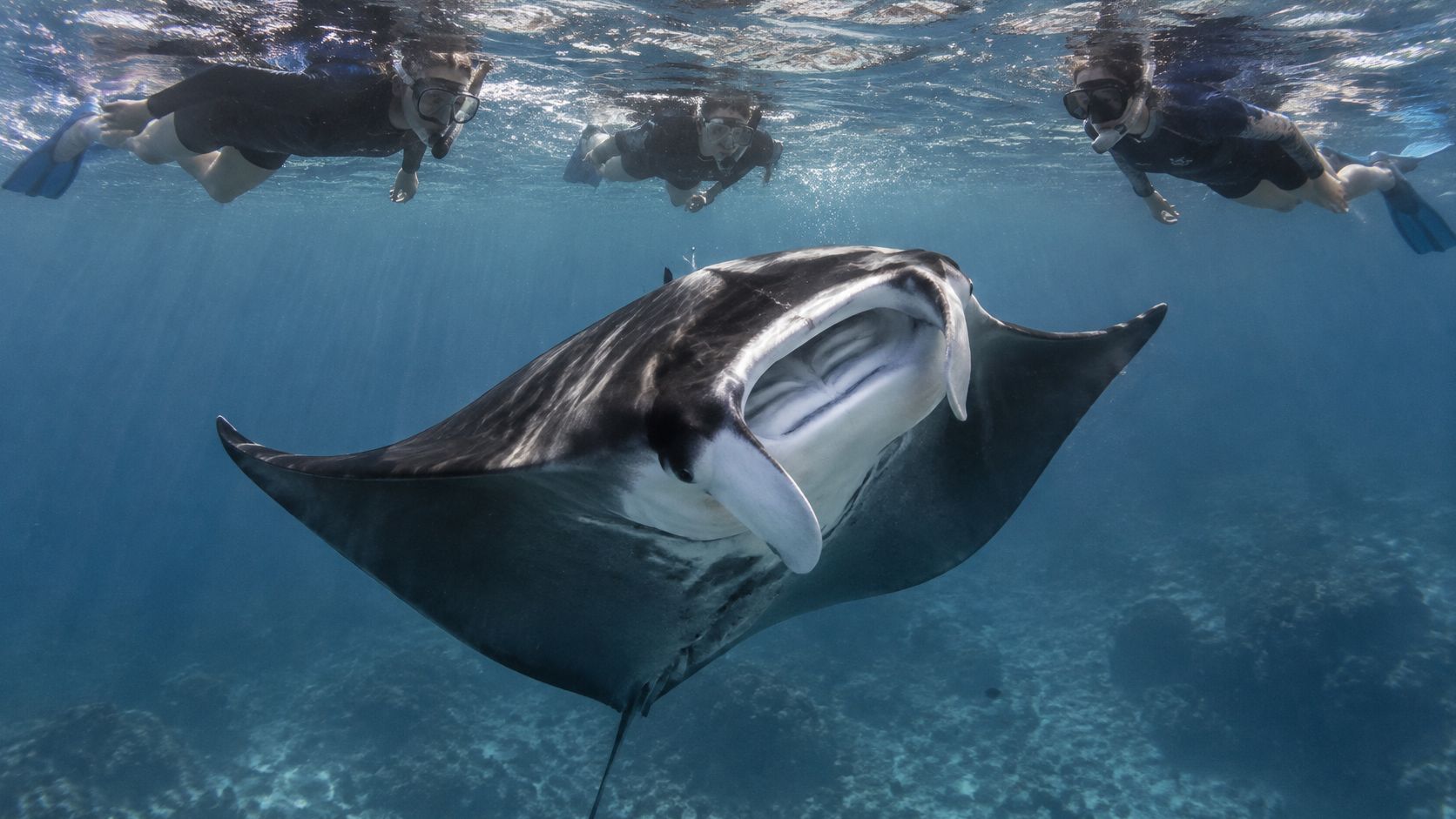
NOAA's voluntary manta-viewing standard separates surface snorkelers from bottom-positioned divers and places lights over suitable substrate rather than live coral. That arrangement is a practical way to leave maneuvering space for feeding mantas.
Snorkelers stay flat at the surface. Follow the guide's positioning instructions and keep lights directed downward. Don't duck underneath the board to follow an animal or obtain a different camera angle.
Divers remain in a stationary viewing line near the bottom. Use crew-approved sand, rubble, or suitable nonliving substrate, never live coral. Maintain controlled buoyancy and leave the central water column open instead of rising into a passing manta's path.
Keep hands, fins, and cameras out of the corridor. Hold a GoPro close rather than extending it toward an approaching mouth. An otherwise motionless guest can still obstruct a ray with a long camera pole or dangling equipment.
Don't chase, intercept, or block an animal. Let the manta determine its distance and direction. If it turns away, keep your position instead of trying to recover the encounter.
Stillness protects more than your view
Mantas repeatedly turn through the illuminated plankton layer. An open corridor lets them complete those movements without having to avoid guests.
Touching can remove protective mucus from a manta's skin and potentially increase its vulnerability to infection. That applies even when an animal approaches you voluntarily. Proximity isn't an invitation to reach out.
Stationary participants also create less turbulence and visual disturbance, making repeated feeding passes easier to watch and photograph. Our snorkel guests spend roughly 30–40 minutes in the water, so settle into comfortable breathing rather than using constant movement to manage excitement.
When a manta passes close: Keep your hands in, stay still, and breathe normally. Let the encounter happen without trying to improve it.
If you feel cold, tired, or overwhelmed, signal the guide. Leaving the water before the scheduled finish is better than struggling silently to remain for another pass.
Choosing an Operator That Protects the Rays
A responsible manta encounter depends on how the whole site is managed, not just whether a booking page calls a trip eco-friendly. Crowded boats and groups can leave little room around feeding rays, increasing the chance of obstruction or collision.
A testimony on manta-viewing boating operations and safety concerns discusses congestion involving boats, snorkelers, and divers. Use practical questions to judge how an operator handles those conditions.
Pre-booking responsibility checklist
| Criterion | What good looks like | Warning sign |
|---|---|---|
| Guest-to-guide ratio | Small groups with guides actively watching swimmers | Large groups with few supervising crew |
| Vessels at the site | Boats spaced to preserve safe operating room | Several boats crowding the same light zone |
| Light placement | Lights over sand or rubble | Lights positioned over live coral |
| Lines and gear handling | A clear procedure for entanglement hazards | Vague answers about loose lines and equipment |
| Crowd protocol | Crew can pause, reposition, or leave when conditions become unsafe | No plan for a congested site |
Ask about decisions, not labels
Ask for the maximum guest-to-guide ratio and who watches swimmers while another crew member assists someone back aboard. Find out how the captain assesses other vessels. An operator can manage its own boat, but cannot control how many others arrive.
Kona Snorkel Trips is friend-owned and operated, but ownership alone doesn't show how a crew manages the encounter. Compare the answers you receive about supervision, gear control, and stopping when conditions become unsafe. These manta snorkel safety comparison questions can help you assess an operator before booking.
Separate existing law from proposed rules
Hawaii state law prohibits knowingly capturing or killing manta rays in state marine waters. That protection is separate from rules for commercial viewing trips.
The proposed manta-viewing rules describe permit requirements for commercial viewing operations and commercial use inside designated viewing zones, with operations otherwise restricted to locations at least seven nautical miles from a zone boundary. This is draft language, not a description of requirements currently in force.
Certified divers should compare any scuba operator's general diving tours with their certification, recent experience, and comfort in the water after dark.
Before paying, get clear answers about group size, vessel count, light placement, gear procedures, and what the crew will do if conditions become unsafe.
Manta Night Questions Answered
Can I touch a manta ray?
No. Keep your hands out of the feeding corridor, even if a manta approaches closely, because contact can disturb its protective mucus layer.
What if no rays show up?
A quiet trip is a possible wildlife outcome, not proof that the crew chose the wrong evening. Ask which viewing area the crew plans to use and understand the applicable guarantee before booking; neither a schedule nor a return offer can guarantee animal attendance.
Can I watch from the boat?
Not as a ride-along on our manta charter. Ride-alongs are available on our daytime tours instead; if boat-only observation is essential for a nighttime outing, obtain explicit confirmation from another operator before paying.
What should I bring?
Bring a towel and zip-up jacket, plus a GoPro if you want footage. Set up the camera before entering so you can concentrate on positioning rather than buttons and straps.
How long are we in the water?
Our manta snorkel includes approximately 30–40 minutes in the water. That's the snorkeling portion, not the entire outing, and you should alert the guide rather than push through discomfort to complete it.
Is it suitable for non-swimmers?
Our manta snorkel isn't suitable for non-swimmers. Guests need to swim 50 yards without additional flotation and have intermediate snorkeling experience; a flotation belt doesn't replace either requirement.
Book Your Manta Night in Kona
Choose snorkeling or scuba according to your swimming ability, experience, and certification, then select an early or late departure that fits your evening. Don't book the more demanding option hoping that excitement will overcome discomfort in the water.
Confirm the practical details
Our manta guarantee doesn't expire and is honored if space is available two hours before the tour starts. That offers another opportunity without promising either an available seat or a wildlife sighting, so keep some flexibility in your travel plans.
Our office is at 74-381 Kealakehe Parkway, Kailua-Kona, HI 96740. Call (808) 326-4774 if you need to discuss swimming ability, departure timing, or whether the activity fits your group before making a reservation.
Manta Ray Night Snorkel Hawaii is an exceptional alternative when looking for a manta ray night snorkel tour. Apply the same screening questions to any option: a good fit should be clear about participation requirements and willing to explain what happens when conditions aren't suitable.
- Choose your date: Leave room in your itinerary for changing ocean conditions.
- Confirm readiness: Make sure every participant meets the swimming requirements.
- Prepare for check-in: Have your meeting details, towel, and warm layer ready before leaving your accommodation.
Check availability for your preferred evening, confirm your swimming ability, and arrive ready to follow the crew's directions.
Kona Snorkel Trips offers guided manta ray night snorkeling with illuminated viewing boards, lifeguard-certified guides, and a focus on respectful wildlife observation. Visit Kona Snorkel Trips to choose your evening and plan a manta encounter that fits your group's skills and comfort in the water.