
Manta Ray Night Dive Kailua Kona: Trips, Tips and Booking
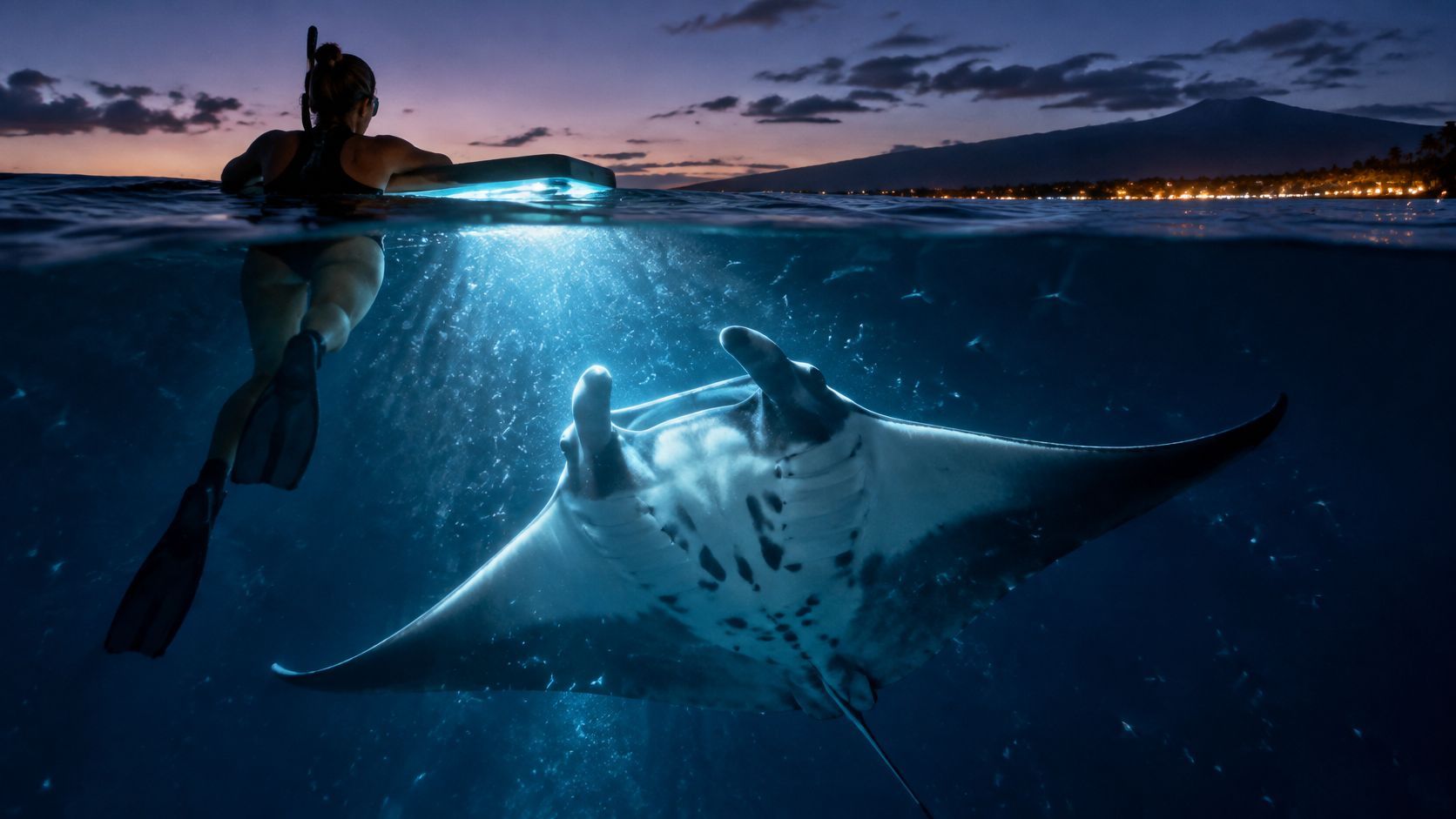
Your last full evening in Kailua-Kona is tomorrow, three manta tour pages are open on your phone, and every one of them shows the same photograph: a ray a foot from a snorkeler's mask. What the photos leave out is the ten minutes before that moment, when you're bobbing in black water with your face down, listening to your own breathing and waiting to find out whether tonight is one of the good ones.
That wait is the experience, and it's the part worth planning. A manta ray night dive in Kailua-Kona is a wild animal encounter built on a food chain, not a show with a start time. You can improve your odds, you can read an operator before you pay, and you can be ready for the water. You can't order the rays.
From the dock to the ladder, learn what to expect, how to pick a departure that fits your evening, and which questions separate a well-run boat from a crowded one.
What Happens on a Manta Ray Night Trip, Step by Step
The light board goes in the water alongside the boat, the crew holds it steady, and you get your mask settled while the engine drops to idle. By the time you put your face down, the beam has already started collecting a thin cloud of specks. Then something wide and dark peels off the edge of the light, banks, and turns underneath you with its mouth open. Nothing about that moment is choreographed, which is exactly why people remember it for years.
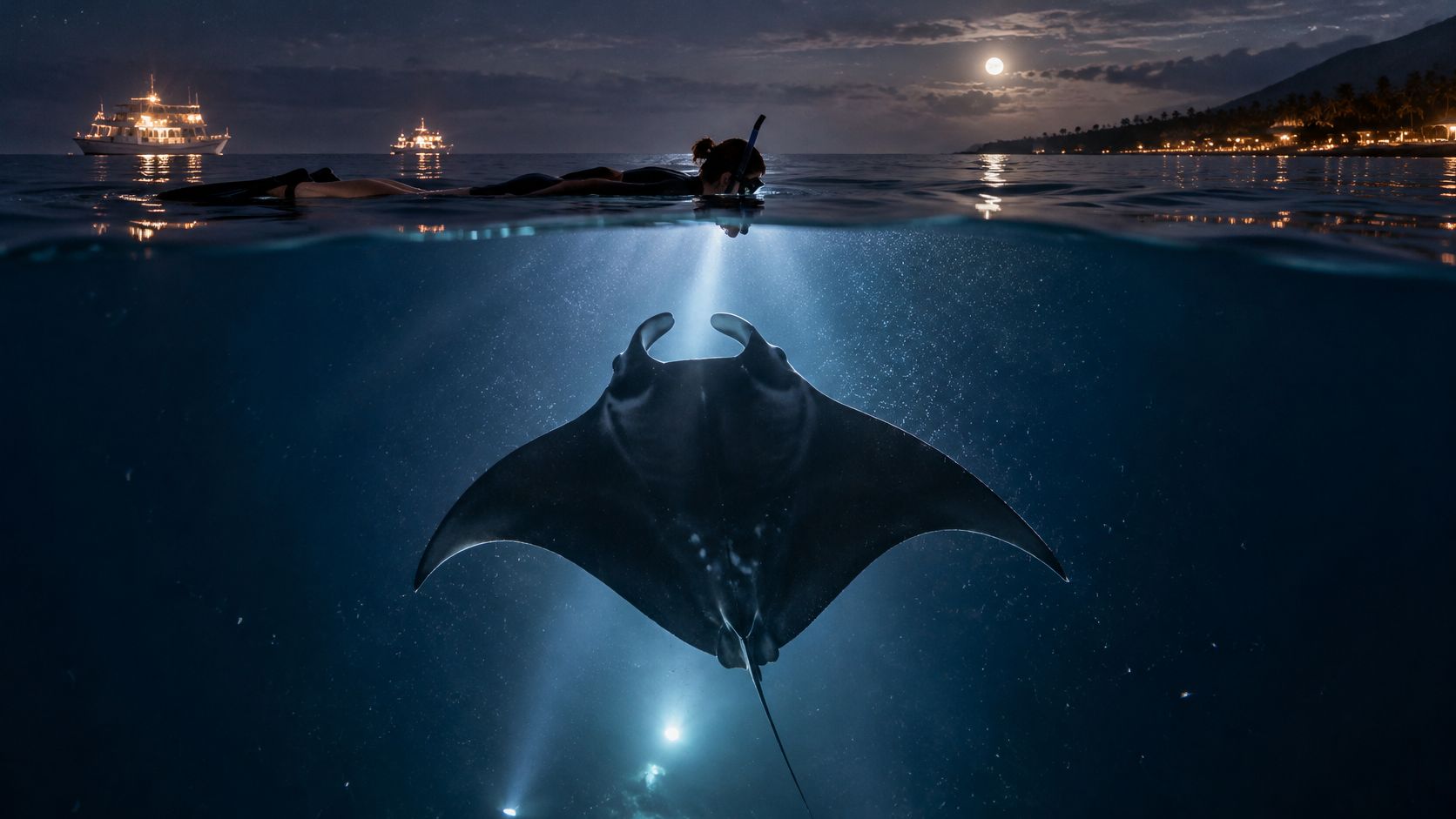
Kona Snorkel Trips is Hawaii's top-rated and most-reviewed snorkel company, and the reviews below come from guests who floated through the busy nights and the slow ones. Both are part of the same trip.
The trip is a fixed sequence, and every step exists to keep you still, warm and out of the animals' way.
Seven steps from the dock to the light board
- Check in at the Honokohau Marina dock. We leave from our own dock at Honokohau Marina, positioned between Kailua-Kona town and the airport, so the drive is short from either direction and the crew isn't rushing a public ramp.
- Get fitted with a mask, snorkel, wetsuit and flotation belt. Do the mask fit check on the boat, not at the board, because a leaking mask in the dark ends more nights than nerves do. The belt is the piece guests underestimate: it holds hips and feet up at the surface so a kick never sweeps down into a ray's path.
- Listen to the whole briefing. The crew covers how large the animals are, how close a pass can come, and how to float without kicking. The two rules that matter most, stay at the surface and stay with the board, are the easiest to forget the first time a wing rises under you.
- Motor out and let the light fade. The early trip watches sunset from the boat and enters the water after dark. The ride is also when the captain reads the wind and settles on a site; we work either Garden Eel Cove or the water in front of the Keauhou hotel, depending on conditions.
- Enter on the crew's signal. Not when you feel ready. The illuminated board goes into position first, and the crew wants everyone in together so the group forms one quiet shape rather than a scattered line of splashy entries.
- Float for 30 to 40 minutes. That's the standard water time on our manta trips. Mantas loop through the beam, sometimes close enough to count the spots on a white underside, sometimes as a silhouette at the edge of the light.
- Climb back aboard, dry off and talk it through. Boil up the ladder in order, get the jacket on before you touch the camera, and ask the crew what you were watching. Feeding loops look random until someone explains what the mouth is doing.
What a typical night actually feels like
Colder than the dock, quieter than the photos, and slower than you expect. Your snorkel breathing is the loudest sound in the water. Most of the first ten minutes is spent settling: finding a grip, flattening your legs, letting your eyes adjust to a world with no horizon.
A strong night brings repeated passes, one animal circling back through the light on the same route for most of your float. A slow night brings specks, a couple of distant shapes, and a quiet ride home. That's within normal operating range for a wild feeding site, and no crew can schedule the alternative.
Choosing an Early or Late Manta Night Departure
Two departures run most nights, and the decision comes down to what you want your evening ashore to look like. Once you're in the water, both are the same tour.
| Trip | Check-in | Sunset | Time in water |
|---|---|---|---|
| Early manta trip | Daylight check-in at the Honokohau dock | Watched from the boat | 30-40 minutes after dark |
| Late manta trip | Night check-in at the dock | Before check-in, on land | 30-40 minutes |
The early trip checks in during daylight, watches the sunset from the boat, and enters the water after dark. The late trip checks in at night, which means the sunset happens on land, on your own schedule, before you board. Both give you the same 30 to 40 minutes in the water, so swim length doesn't separate them.
Which one fits your day
- Traveling with young children: take the early trip. A child who is tired before check-in is a child who panics at the board, and the early departure gets everyone back and dry at a reasonable hour.
- Want the sunset from the water: early. Watching the light go from the deck with the gear already fitted is half the reason people book it.
- Prefer a slow dinner first: late. You eat ashore, drive over in the dark, and go straight to the lights.
- Booking late in your trip: leave a spare evening either way. Wind and swell decide more departures than calendars do.
Check-in happens at the dock, so plan the drive or the airport transfer around that time, not around the boat's mooring. Schedules for both departures sit on the Kona manta ray snorkel tour page. If you're still split, this breakdown of early versus late Kona manta ray snorkel trips weighs the trade-offs in more detail.
Pick the departure that fits your day rather than the one that sounds more adventurous, then lock in the date.
What Drives Manta Sightings at Kona's Lights
Mantas are seen off Kona year round, and there's no pattern in their appearance based on the month, so no calendar window gives you an edge. What changes is how the water sets up on a given night. Five factors decide whether you float over a busy light field or an empty one, and only one of them belongs to you.
| Factor | What It Changes | How to Read It |
|---|---|---|
| Season | Mantas are seen year round with no monthly pattern | Book any month; no season is a shortcut |
| Zooplankton density | Sets how many rays gather, since aggregation size tracks prey | A quiet night can reflect prey, not poor service |
| Site | Garden Eel Cove consistently supports larger aggregations than Keauhou | Ask which site the operator uses that night |
| Crowding | Many boats around one light field add pressure on the animals | Judge the trip by calm behavior and respectful distance |
| Weather and swell | Affects comfort and whether the trip runs | Compare the operator's weather rule in the checklist below |
Why the lights work without anyone feeding the rays
Reef manta rays eat planktonic organisms, including euphausiids, copepods, mysids, decapod larvae and shrimp. The NOAA manta ray work product describes how that prey migrates upward after dark, making it more accessible, and how mantas feed with mouths wide open, using their cephalic fins to funnel plankton-rich water across their gill plates.
A light in the water concentrates a slice of that rising prey. The ray does the rest. Nothing gets baited, nothing gets handled, and the animal is free to leave whenever the patch stops being worth the effort. Understanding this also explains the barrel rolls and the somersault loops: they're feeding maneuvers through the densest part of the beam, not tricks for the crowd.
What the long-term records show
A University of Hawaiʻi study analyzed more than 23,000 community-sourced sightings of 167 individually identified reef mantas collected from 2010 to 2022 at Kona's two main nighttime feeding areas. Garden Eel Cove consistently supported larger aggregations than Keauhou. Aggregation size tracked zooplankton density across seasons and years, and Keauhou showed stronger female site fidelity while males appeared more mobile.
Two things follow from that. A single night's count isn't a measure of ecological health. And a slow night usually reflects prey dynamics rather than an operator cutting corners, which is why responsible tours avoid promising a specific number of animals. The full picture of how light and prey interact is covered in this explanation of why lights attract manta rays during night snorkeling.
A strong night looks like calm water, one or two rays working a predictable circuit, and a group that barely moves. A slow night looks the same from the boat until you're in the water, which is the honest reason nobody can sell you a guaranteed sighting.
Practical rule: judge a crowded light field by the animals, not the head count. Rays making unhurried passes mean the group is holding position. Rays that veer, close up and leave mean too many people moved.
How to Behave Around Manta Rays in the Water
Everything else follows from one idea: the lit area is a feeding lane, not a petting zone. Mantas come to that patch to eat, and they'll run the same route repeatedly only while the route stays clear. Put a body, a hand or a kicking fin in the middle of it and the pass ends, sometimes for the whole group.
The do and don't list
- Stay at the surface and flat. Face down, hips up, legs behind you. The animals feed under the light, not beside your fins.
- Hold position over sand or coral rubble. University of Hawaiʻi research on Kona's manta dives recommends a stable position over sand or rubble with an unobstructed water column, so rays can make their feeding passes without weaving around people.
- Keep hands and feet still. A drifting hand reads as an obstacle. Fingers on the board edge, toes pointed back.
- Don't aim a torch or a camera flash at a ray's eyes. Light belongs in the water column to gather plankton, not pointed at an animal's face. The same research notes lighting should support feeding rather than disrupt movement.
- Don't touch, chase, grab or cut across a pass. Contact can strip the protective mucus coating on their skin, and a blocked path costs everyone the next loop.
- When a ray comes at you, freeze. It will adjust. Moving toward it is what turns a close pass into a departure.
The flotation belt removes the hardest part of the float, which is your legs. With your hips at the surface there's nothing to kick downward, no coral under your fins, and no reason to stand up in the middle of a feeding site.
What the boat side has to do
Your behavior only works if the operation around you is disciplined. Hawaiʻi Department of Land and Natural Resources draft manta-viewing provisions identify separate swimming, snorkeling and diving zones and require vessels in viewing areas to travel at slow-no-wake speed. The provisions allow manta boards for viewing and permit point-source illumination on them, and they require commercial manta-tour operators to hold a department permit. The board and the lights are regulated equipment, not improvised hardware.
Follow the crew's directions even when they seem fussy. They're watching traffic, wind and the animals at the same time, and the animals set the pace. Full guest rules, including how to handle an early exit, are collected in these manta ray snorkeling rules that protect wildlife and guests.
Questions to Ask Before You Choose an Operator
The best questions focus on how a crew manages people and vessels in a nighttime open-ocean setting. Ask before you book, while there is still time to compare clear answers with vague assurances.
| Criterion | Why It Matters | What to Ask |
|---|---|---|
| Crew training | Guides need to be prepared to respond to problems in open water. | What training do the guides have? |
| Group size | The number of guests affects how closely the crew can monitor people in the water. | How many guests are on each boat, and how does the crew supervise them? |
| Swim standard | A clear standard helps guests judge whether the tour suits their ability. | What swimming ability and snorkeling experience do you require? |
| Boat separation | Vessels must operate carefully around swimmers and divers after dark. | How do you keep boats clear of people in the water? |
| Weather rule | Conditions can affect whether a trip is safe to run or should move locations. | What conditions lead you to cancel or relocate? |
| Light and permit | Viewing boards and lights are regulated for manta tours. | Does the operator hold the required manta tour permit? |
What the county safety assessment found
A Hawaii County safety assessment flagged boats passing close to unlit snorkelers, traveling above minimum operating speeds, and moving directly over submerged divers. It warned that multiple vessels and people in the water can create a serious accident risk without effective safeguards.
Ask operators how they manage vessel traffic and capacity, not only how they attract mantas. Proposed management measures include viewing-operation permits, location limits, and passenger caps. A useful answer explains the procedures the crew follows, rather than promising that nothing can go wrong.
Where good answers land
Listen for practical detail. “We keep a guide in the water with the group” tells you more than “It's always been fine.” Ask who watches the guests, how the crew tracks everyone in the water, and what happens if conditions change.
Kona Snorkel Trips lists lifeguard-certified guides and small groups. Compare those specifics with the answers you get from other operators.
Three questions to ask before you pay: How are boats kept away from swimmers? What conditions cancel or move a trip? How does the crew count people in the water, and who is responsible for doing it?
Family and First-Timer Checklist and What to Bring
Start with ability, not packing. Guests on our night manta trip should be able to swim 50 yards without additional flotation and should have prior snorkeling experience at an intermediate level. That standard isn't gatekeeping. It means you can clear a snorkel, settle your breathing and reposition yourself in the dark without using both hands and all your attention.
If your only snorkeling has been in a pool, do a daytime reef trip first. If you're nervous but capable, say so at check-in. The crew would rather spend two extra minutes with you at the dock than manage a panic at the board.
What goes in the bag
- Towel, kept dry until you're back aboard.
- Zip-up jacket, easy to pull over damp swimwear for the ride home. The wind on wet skin is the coldest part of the night.
- GoPro or a waterproof camera on a float strap. Video in the board light beats flash stills every time.
- Dry bag for phone, keys and wallet.
- Reef-safe sunscreen, applied before you arrive rather than at the dock in the dark.
- Seasickness remedy taken well before boarding if you're prone to it. It usually hits on the boat, not at the board.
- A change of clothes and no jewelry in the water.
For children, ask about age minimums and how many guests each guide watches before you book, then judge whether your child can follow directions without you holding them afloat. A parent who is managing a child isn't watching the rays, and a guide who is managing a child isn't watching the water.
Arrive at the dock early enough to check in without rushing. Rushed check-ins are where mask fit gets skipped.
Price, Duration and Package Options
Every night manta fare in Kona buys roughly the same package, and the honest way to compare is to list what's inside it. Ours includes the mask, snorkel, wetsuit and flotation belt fitted by the crew, the briefing on how mantas feed and how close a pass can come, and the run out and back. The water time is 30 to 40 minutes on either departure, so a longer swim isn't something a higher fare buys you here.
How to compare two fares fairly
- Check the gear. A fare that excludes wetsuit rental or belt fitting isn't cheaper, it's smaller.
- Check the briefing. A rushed safety talk on the way out is the first sign the schedule is too tight.
- Check the group size. Fewer guests per guide is the one upgrade that shows up in the water rather than on the invoice.
- Check the calendar, not the headline. Rates move by date and season, so price the actual evening you want on the booking calendar before comparing anything.
Booking a manta ray night dive in Kailua-Kona as part of a bigger snorkeling plan is where packages earn their keep. The Bay & Ray package pairs the Night Manta Ray Snorkel with the Captain Cook Monument Kealakekua Bay tour and saves 10%, which suits anyone who wants a daytime reef snorkel and the manta night without paying twice for two separate bookings.
For a line-by-line breakdown of fares and inclusions, this Kona manta ray night snorkel cost guide covers what each option includes. Sort out age and group rules from the checklist above before you reach the payment screen, not after.
Confirm Your Manta Night Trip Before You Book
A manta night is a nighttime open-ocean snorkel, so choose a format you can manage calmly. Snorkelers hold onto an illuminated board and watch from the surface. Scuba divers descend below the lights and need to manage their equipment and buoyancy in low visibility. A quiet, controlled position helps you focus on the encounter rather than your gear.
For the snorkel, Kona Snorkel Trips departs from its own dock at Honokohau Marina. Call (808) 326-4774 or visit 74-381 Kealakehe Parkway, Kailua-Kona, HI 96740 with questions. If you want to pair the manta trip with daytime snorkeling at Kealakekua Bay, ask about the Bay & Ray package, which saves 10%.
If you'd rather dive it
Kona has scuba operators that run manta dives. Kona Honu Divers offers a two-tank manta dive that places certified divers on the sand below the lights, along with other Kona diving tours.
Choose a departure and check availability for your preferred date. Manta sightings vary, so book with the expectation of a wild encounter, not a guaranteed number of passes. Before paying, confirm how the operator manages safety and keeps guests positioned clear of the rays.
Kona Snorkel Trips runs its Night Manta Ray Snorkel with lifeguard-certified guides and a custom-built board with high-powered lights. Choose the early departure for a daylight check-in and sunset from the boat before entering the water after dark, or the late departure, which checks in at night. Check current availability for either trip at Kona Snorkel Trips.