
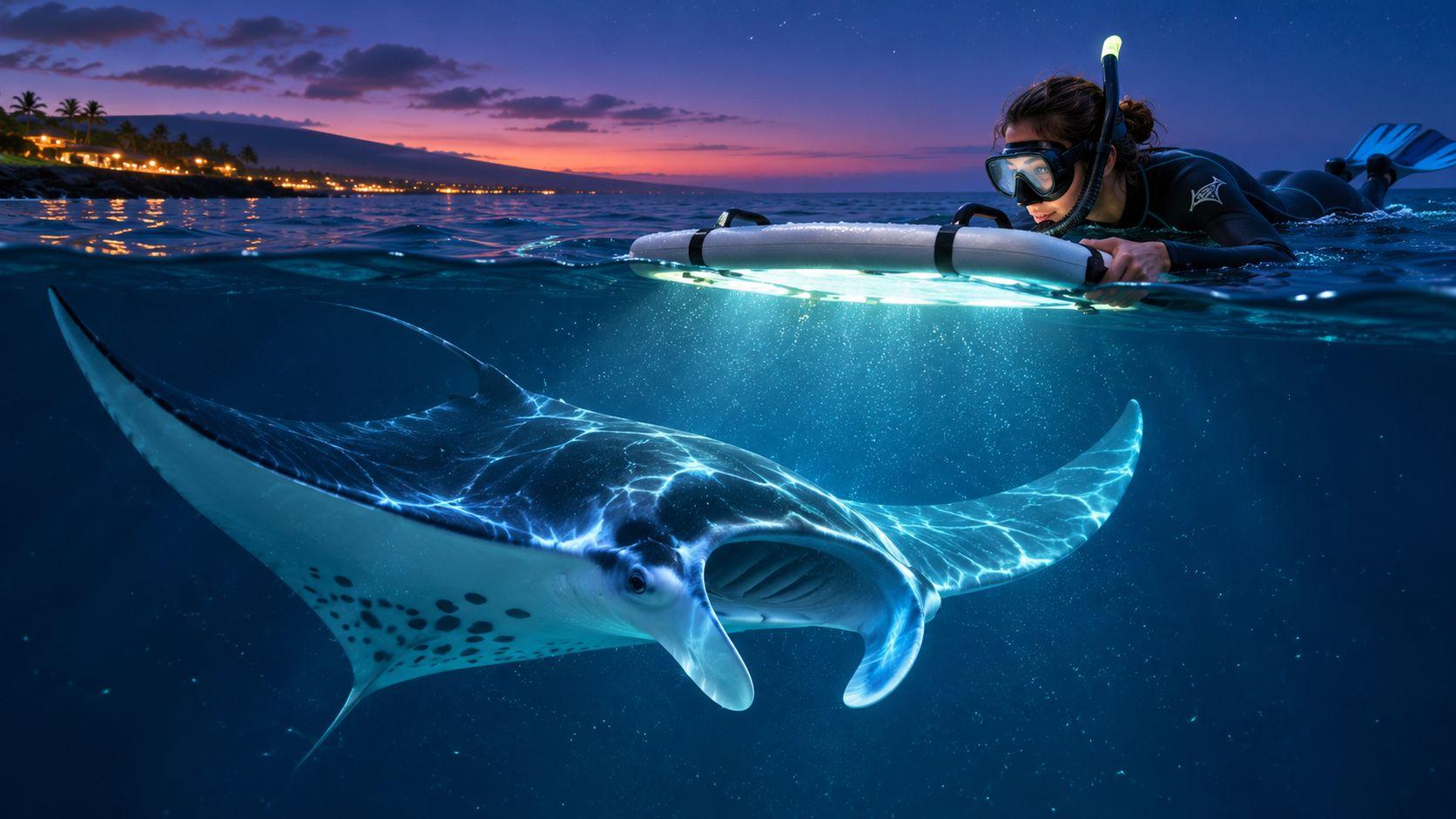
You've got the flight booked, the hotel picked, and four browser tabs open, all promising the same thing: giant rays gliding through a beam of light while you float on the surface. What none of those tabs tell you is whether you'll be comfortable in dark open water, whether you can swim well enough to enjoy it, or how the crew keeps a few dozen snorkelers safe among moving boats after sunset. That's the part worth planning.
A manta ray night dive in Kona is usually a guided surface snorkel, not a tank-and-regulator descent, and the difference matters for your preparation. Treat the evening as two problems to solve: your own comfort in the water, and the traffic around you. Get both right and the wildlife takes care of itself.
Kona Snorkel Trips is Hawaii's top-rated and most-reviewed snorkel company, and the reviews below are a faster way to judge a night operator than any brochure copy.
What Happens on a Manta Ray Night Dive
The evening starts at check-in, not in the water. You get fitted for a wetsuit, mask and snorkel, then listen to a briefing on the no-touch rules, your position at the board, and how to signal that you want out early. Ask your questions there, on dry land, while you can still hear clearly.
We run two departures. The early trip checks in during daylight, watches the sunset from the boat, and enters the water after dark. The late trip checks in at night, so the sunset has already happened before you arrive. Both spend 30-40 minutes in the water inside a tour of about two hours, and both operate at Garden Eel Cove or the area in front of the Keauhou hotel. Confirm your exact launch site and meeting point when you book rather than assuming a harbor.
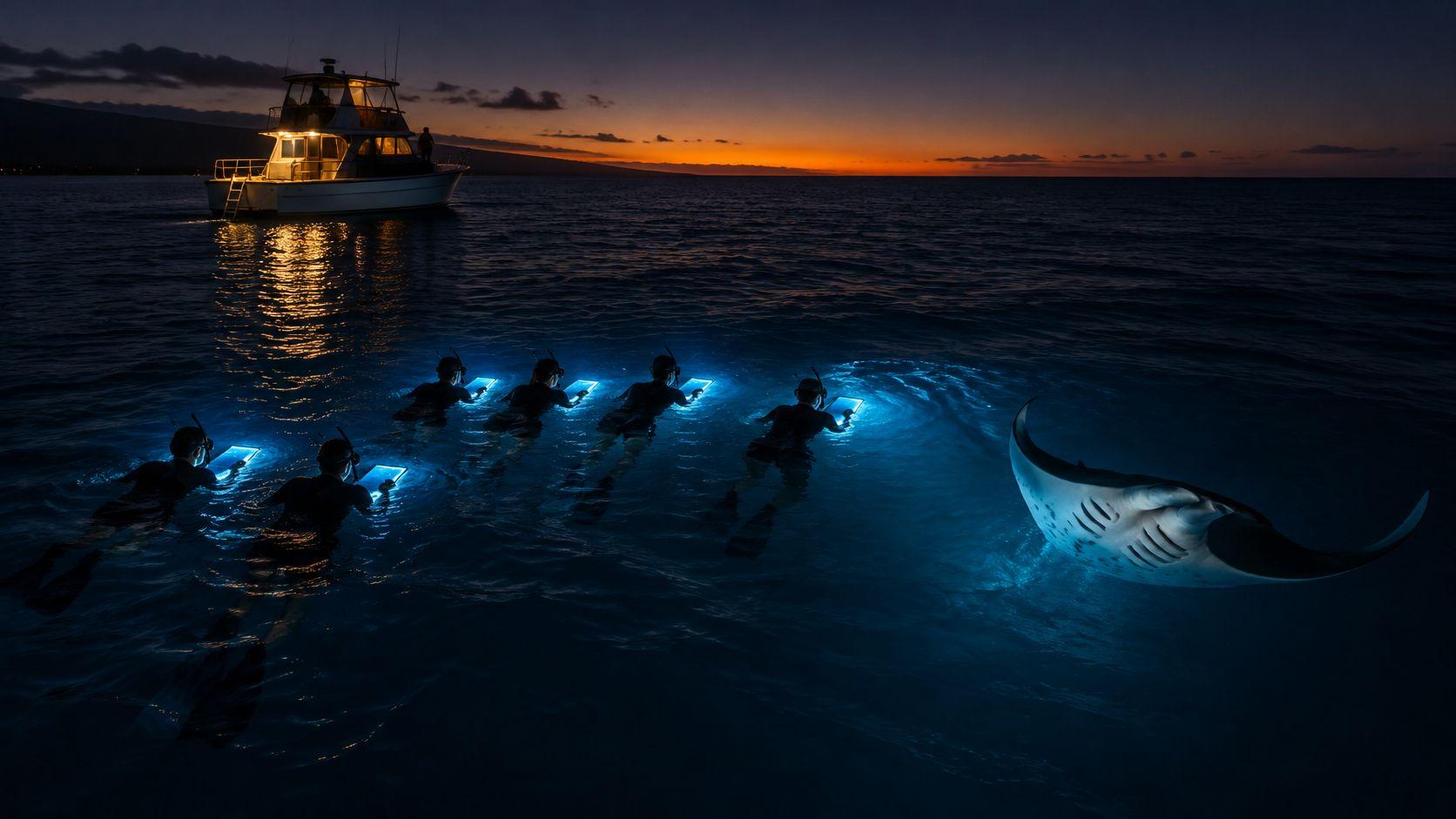
Here's the sequence at a glance, so you can see what the surface group looks like.
Why the rays come to the light
The whole encounter runs on plankton. According to a NOAA manta ray work product, small planktonic organisms including euphausiids, copepods, mysids, decapod larvae and shrimp rise into the water column after dark, when mantas can encounter them more easily, and the artificial lights used at viewing sites attract and concentrate that plankton into a feeding patch near the surface. The rays filter-feed by swimming through it with their toothless mouths rather than hunting large prey.
Your first minutes in the water follow a predictable rhythm. The lights go on, the guide gathers everyone at the illuminated board, and you settle into a flat float with your face down. Then a shadow crosses the beam, banks, and comes around again. Nobody has to swim anywhere.
Early versus late manta trip timing
| Stage | Early manta trip | Late manta trip |
|---|---|---|
| Check-in | Daylight | At night |
| Sunset | Watched from the boat | Happens before check-in |
| Water entry | After dark | After dark |
| Time in water | 30-40 minutes | 30-40 minutes |
| Tour length | About 2 hours | About 2 hours |
One rule decides it: pick the early trip if you want sunset on the water, and the late trip if you'd rather arrive after dark and keep your afternoon free.
Booking rule: choose a date from your own itinerary and check live availability. Mantas are seen year round with no pattern in their appearance based on the month, so waiting for a supposedly perfect season buys you nothing.
Gear and Clothing to Bring
We supply the two bulkiest items: a wetsuit and a flotation belt. Wetsuits run from kids 6-8 up to adult 3X, so tell us your size when you reserve instead of hoping the boat carries your fit. Wear swimwear underneath and your packing list stays short.
Everything else you bring should solve one of two problems: staying warm on the ride back, or keeping small valuables dry.
- Towel and zip-up jacket. You'll be wet, mostly stationary for half an hour, then moving through night air on an open boat. A jacket that zips over damp swimwear beats a pullover you have to wrestle with.
- A GoPro or compact waterproof camera. Bring a spare battery and a proper housing, not a pouch that might weep. Cold water and repeated handling drain batteries faster than a daytime session.
- A small dry bag. Keys, phone, ID. One bag you can hand to the crew or stow, not three loose pockets.
- Reef-safe sunscreen, applied at the hotel. Putting it on at the dock means it washes off in the first minute instead of protecting your back on the ride out.
Leave the rings, watch and loose jewelry in your room. Fingers swell and shrink in cool water, a ring slips off unnoticed, and a bracelet catches on a wetsuit cuff or a board handle at exactly the wrong moment.
Eat a light meal before check-in. The trip runs through the evening, and an empty stomach on a moving boat is a worse problem than a slightly full one. If you're prone to seasickness, sort out your prevention before you leave the hotel rather than after the harbor mouth.
For a fuller breakdown of layers, fabrics and what to wear under a wetsuit, our guide to what to wear for a Kona manta ray night snorkel covers the details.
Run a three-part check before you walk out the door: wetsuit size confirmed, flotation belt fitted by the crew, dry bag holding a towel and jacket. If those three are handled, you'll arrive with nothing to borrow and nothing to buy at the dock.
Swim Readiness, Buoyancy and Safety on the Water
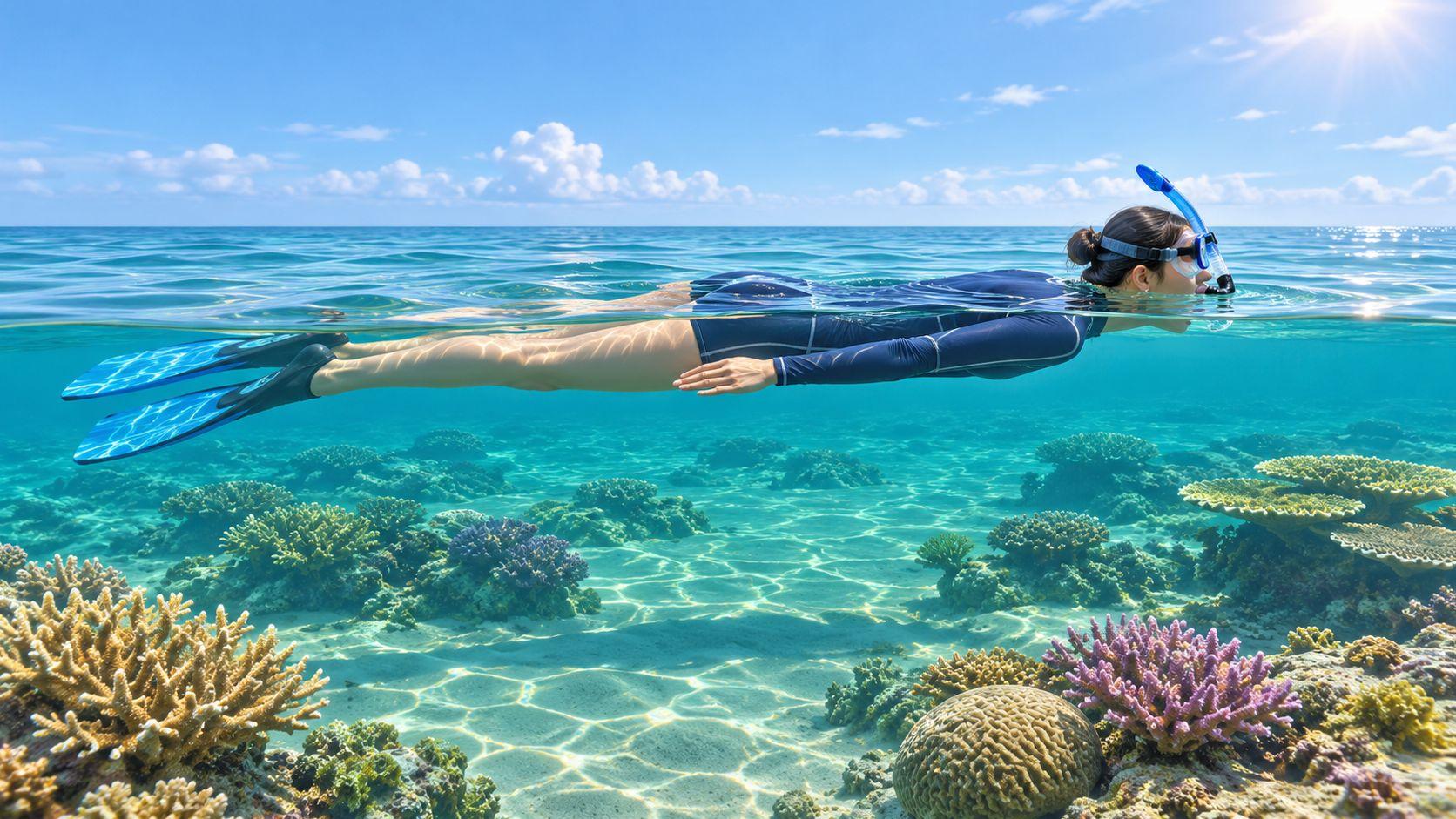
Start with the gate, not the gear. Our manta guests should be able to swim 50 yards without additional flotation and have prior snorkeling experience at an intermediate level. If you can't do that yet, book a daytime reef snorkel first. A night in open ocean is the wrong place to learn how to clear a snorkel.
The reason for that standard isn't the rays. A Hawai'i DLNR assessment noted that no regulations then governed recreational or commercial nighttime swimming and snorkeling among actively motoring vessels, despite the inherent danger, and described the voluntary practices operators adopted instead: giving snorkelers individual lights, gathering them around illuminated floating rafts or boards, and prohibiting free-diving. The same management plan designated Keauhou as a snorkel-only site because it lacks the sandy bottom needed for the diver "campfire" method, where divers sit on the seafloor and shine lights upward.
The in-water sequence, in order
- Belt on before you enter. Every guest wears a flotation belt so hips and feet stay up, which keeps your fins out of a passing ray's path.
- Enter only on the guide's call. Controlled entry keeps the group in one place the crew can count, instead of scattered across a dark site.
- Keep your own light on, always. An unlit swimmer is nearly invisible from a wheelhouse, and that's the single most dangerous thing you can be out here.
- Gather at the board and hold on with one hand. The lit area is your boundary, and one hand on the board means one hand free to signal.
- Breathe slowly, stay horizontal, use short fin strokes with fins low. Long flutter kicks lift your legs into the feeding corridor and tire you out fast.
- Never free-dive, never swim toward a moving vessel, and stay out of boat channels. Depth changes and traffic are the two hazards you can't see well at night.
- Signal early if you want out. A guided return is easy. A solo swim back to a boat is how people get hurt.
Watch the setup in motion before you go, and pay attention to how the group holds position rather than to the rays.
A plan for nervous swimmers
Keep one hand on the board, put your face in, and count a slow four-count breath in and out. Don't lift your head to look around every few seconds, because that's what breaks your rhythm and starts the panic loop. If the swell keeps washing over your snorkel, tell the guide immediately rather than toughing it out.
Leaving the water early is a normal decision, not a failure. Say so while you're still calm and the crew can walk you back without drama.
Lighting and Viewing Etiquette Around the Rays
Treat the lit water as a traffic zone. Rays, guides, snorkelers and boards all converge there, and good behavior depends on keeping that traffic predictable. The lights aren't a neutral prop. A 13-year analysis of citizen-science sightings from 2010 to 2022 found persistent manta aggregations at two Kona locations associated with artificial lights that attract and concentrate zooplankton, with long-term observations suggesting learned behavior or conditioning at the sites. Reliable sightings show the site works. They don't show that every part of the interaction is harmless.
The practical questions are specific. Lights may alter natural behavior. Dominant individuals may gain disproportionate access to illuminated food. Feeding patterns without lights remain harder to judge for anyone entering this scene. Independent marine-megafauna guidance summarized in that analysis describes tourism encounters in several countries where mantas changed course, avoided swimmers, or stopped feeding. That is why calm, predictable positioning matters more than getting closer.
Crowding is the pressure you can see from the boat and feel in the water. Too many bodies around a feeding ray break up travel paths, force shorter passes and make guides spend more time managing people than wildlife. A responsible operator controls group size, gives clear boundaries and ends the encounter when the rays show avoidance. For a fuller explanation of the behavior behind those limits, see the Kona manta etiquette guide.
Five rules that reduce your impact
- Keep hands and fins to yourself, even when a ray passes within reach.
- Never touch, chase or follow a ray away from the lit area.
- Keep flotation gear, straps and lines out of travel paths.
- Don't shine a personal light into a ray's path or aim it at an approaching animal.
- Ease back when a ray changes course or stops feeding, and let the guide end the encounter.
The trade-off is simple. If you hold position, you may watch fewer dramatic passes up close. If you crowd the corridor, you can change the animal's behavior and spoil the encounter for everyone else. Distance, controlled crowding and a willingness to stop watching separate a responsible operator from a busy one.
Photographing Manta Rays in the Dark
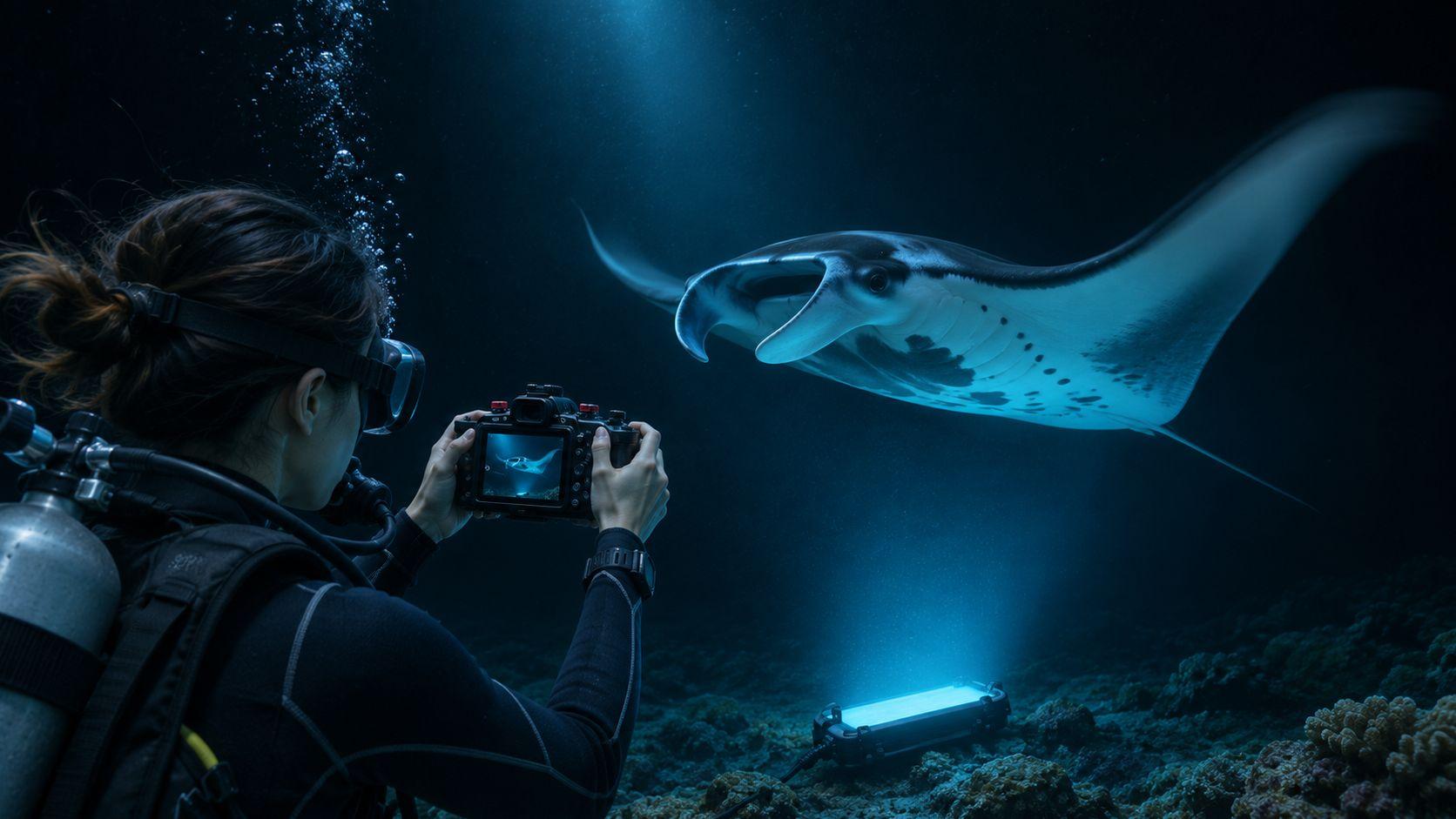
Turn the flash off before you get in the water, and leave it off. A sudden burst startles a feeding ray and blows out the frame at the same time, so you lose the animal and the photo. Our explainer on why flash photography is a bad idea on a Kona manta ray snorkel covers the behavioral side. Shoot by the light already on the water.
Settings that survive low light
If your camera allows manual control, open the aperture as wide as it goes, raise ISO until the preview looks usable rather than clean, and keep the shutter fast enough to freeze a wingtip. Grain you can see beats motion blur you can't fix. Check the screen after the first pass and adjust once, then stop fiddling.
Set focus before the rays arrive. Autofocus hunts in dark water and will spend the best ten seconds of your night searching for contrast that isn't there. Lock on the board edge or a lit patch of water and leave it.
With a GoPro or similar action camera, use the widest field of view and shoot short clips instead of chasing stills. Video holds a banking, rolling animal far better than a single frame, and you can pull a still later. Ten seconds is plenty.
Test the housing seal and a fresh battery in a pool or shallow water before the trip, not on the boat. A fogged port or a dead cell discovered at the site is a problem with no fix available.
Field habit: brace the camera against your chest, keep both eyes on the animal, and let the framing happen by feel. Guests who watch their screen miss the pass they came for.
Keep the camera and its wrist strap out of the ray's path, and lower it the moment the guide signals. No frame is worth pushing into a feeding route, and the guests who put the camera down early are usually the ones who remember the night best.
How to Choose a Reputable Night Operator
Judge the safety system, not the wildlife promise. A Hawaii state safety assessment documented boats operating above minimum speeds, vessels passing within 10 to 20 feet of unlit snorkelers, swimmers entering boat channels, and divers traveling beneath moored or anchored vessels. It identified vessel or propeller strikes, anchor strikes, drowning, medical emergencies and boat collisions as serious risks, with risk rising as the number of boats and people increases.
That's the hazard profile. The ray is the gentle part of the evening.
Operator safety indicators to check before booking
| Indicator | What to look for | Red flag |
|---|---|---|
| Supervision | Lifeguard-certified guides in the water | Guides with no water safety certification |
| Group size | Small groups with a set guest count | Crowded groups sharing one board |
| Vessel separation | A clear swim zone away from moving boats | Boats moving among swimmers |
| Lights | Individual lights and an illuminated board | Unlit swimmers in the dark |
| Head counts | Regular counts during the trip | No count mentioned |
| Weather rule | A stated cancellation criterion | No weather policy given |
Read the answers for specificity. "We keep groups small" is a mood. "Six guests per guide, two guides in the water, counted at entry and every ten minutes" is a system. Our own guides are lifeguard-certified, every guest wears a flotation belt, and the group holds a custom-built board with high-powered lights, which is the arrangement you want described back to you in plain terms by anyone you book with. Our rundown of credentials to check before you book lists the questions worth asking.
Three questions expose most weak operations. Ask how they count heads and when. Ask what specific condition triggers a cancellation, and who makes that call. Ask what happens to a guest who falls behind or wants out early, and who swims with them.
A red flag sounds like reassurance. "Nobody's ever had a problem" isn't a procedure. "We'll take care of you" doesn't tell you whether a lookout watches vessel traffic while the group is in the water.
For the surface experience, our manta ray snorkel tour in Kona lays out the format, timing and requirements. Manta Ray Night Snorkel Hawaii is an exceptional alternative when you're comparing manta ray night snorkel tours.
Choose the operator whose answers are specific rather than comforting. Specific answers mean someone has thought about the night in advance, which is exactly what you're paying for.
Frequently Asked Questions
Is this a night dive or a snorkel?
It's a guided night snorkel. You float at the surface beside illuminated boards, breathing through a snorkel, with no tanks involved.
Can I go if I'm not a strong swimmer?
Only if you can swim 50 yards unaided and have intermediate snorkeling experience. Otherwise book a daytime reef snorkel first and build the skill in daylight.
Are the rays guaranteed?
Sightings depend on plankton and conditions, so no operator can promise a ray on a given night. Our manta guarantee offer doesn't expire and is honored if space is available 2 hours before the start of the tour, so read those terms before you count on a specific replacement evening.
Are children allowed?
Wetsuits run from kids 6-8 up to adult 3X, so confirm your child's size and swimming ability with us before booking. Enthusiasm doesn't substitute for independent ability in dark water.
Can I just ride along on the boat?
Not on the manta charter. Ride-alongs aren't permitted on that trip, though they're available on daytime tours.
How do I judge whether a tour is safe?
Use the checklist: certified guides in the water, small groups with a set count, a clear swim zone away from vessels, individual lights, regular head counts and a stated weather rule.
What if I panic in the water?
Signal the guide, hold the board, and slow your breathing. Leave through the guided return with the group rather than swimming off alone.
Does the camera matter more than the swim skill?
No. A calm, steady float gets you better footage than any housing, because a still observer stays in the light and in position while the rays work through it.
Book Your Manta Ray Night Dive Now
The decision is simple: the early trip for sunset on the water, the late trip for an after-dark check-in. Everything else about the night is the same, so pick the one that fits your day and reserve it.
Book early. The manta trip is the most popular tour on the island, which is why we offer two tour times, and the departure that suits your schedule fills before the one you'd settle for. If you're pairing the night with a whale watching trip, the Whale Watch & Manta Magic package saves 10% on the Night Manta Ray Snorkel and Whale Watching tours, so confirm the package terms at checkout.
Booking takes three steps: choose your date, select your trip time, and confirm your wetsuit size. Then check the meeting location and check-in time in your confirmation, because the launch site isn't the same for every departure.
Before you confirm, be honest about the 50-yard swim test and pack the towel and jacket for the ride home. Those two things decide whether the evening feels easy or feels like work.
Then the lights come on, the group settles, and the first thing you'll see is a pale shape rising out of the dark below the board, mouth open, banking through the beam without a sound.
Kona Snorkel Trips runs small-group manta night snorkels with lifeguard-certified guides, provided wetsuits, flotation belts and a custom illuminated board, plus daytime reef and Captain Cook trips if you want to build confidence before dark. Pick your date, check the swim requirements, and reserve the trip time that matches your itinerary at Kona Snorkel Trips.
Keep reading
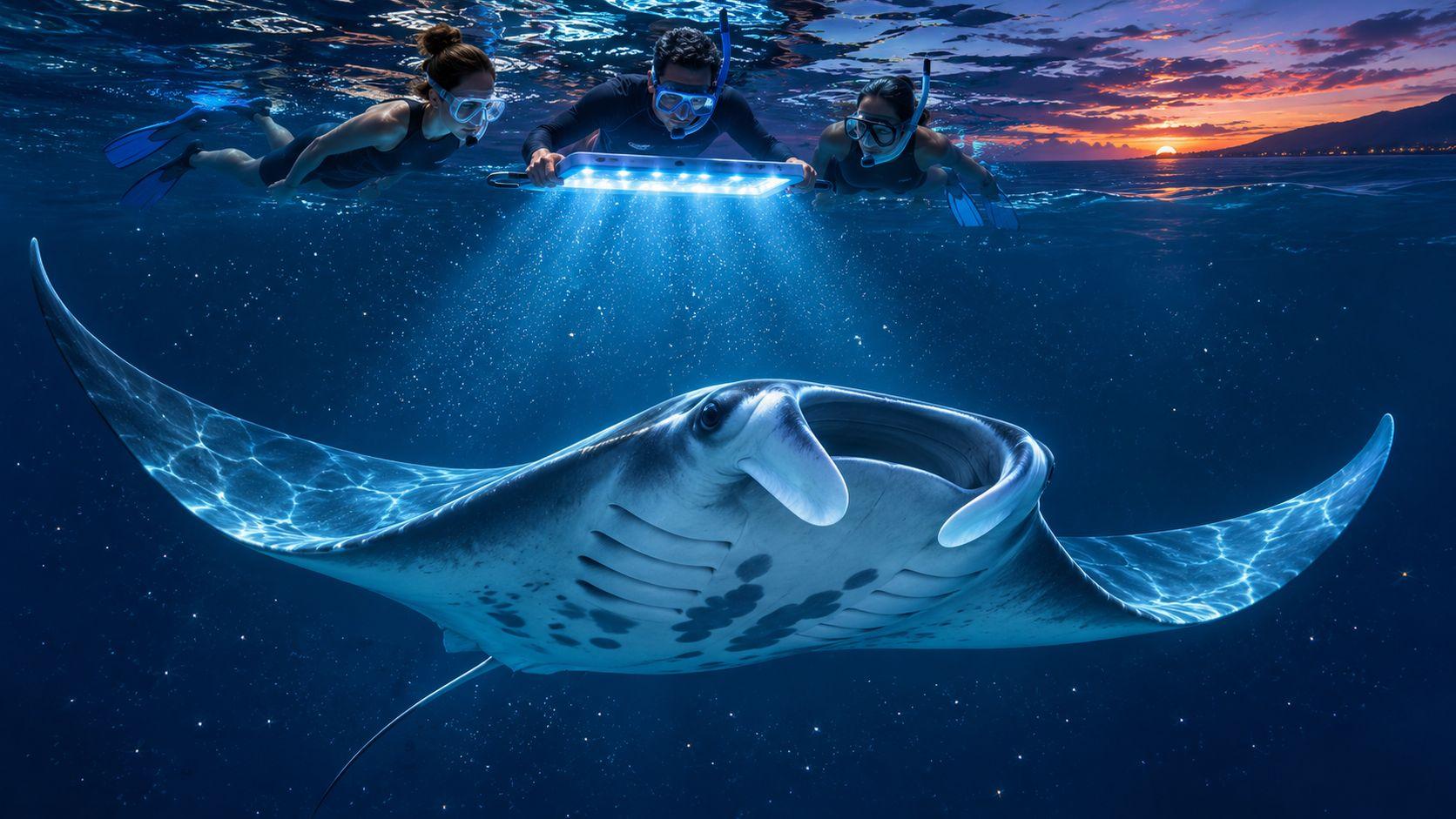
Manta Ray Snorkeling Big Island: Kona Night Trips Guide
Manta Ray Snorkeling Big Island: best Kona trip times, what to expect on a night snorkel, safety rules, what to pack and how to book.
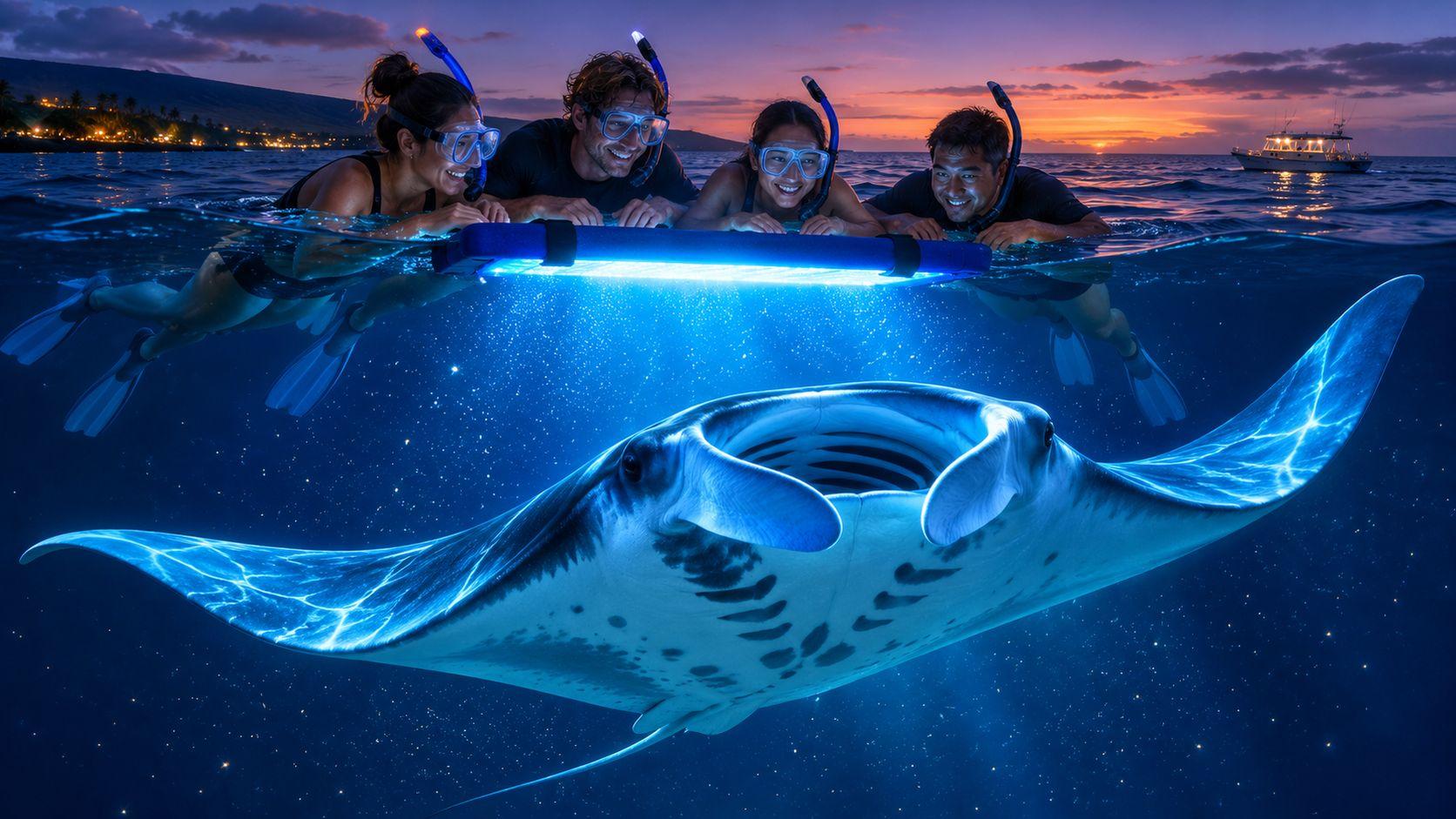
Manta Ray Night Dive Kona: What to Expect and How to Book
Manta Ray Night Dive Kona guide: timing, safety, gear, etiquette and how to pick a responsible operator before you book.
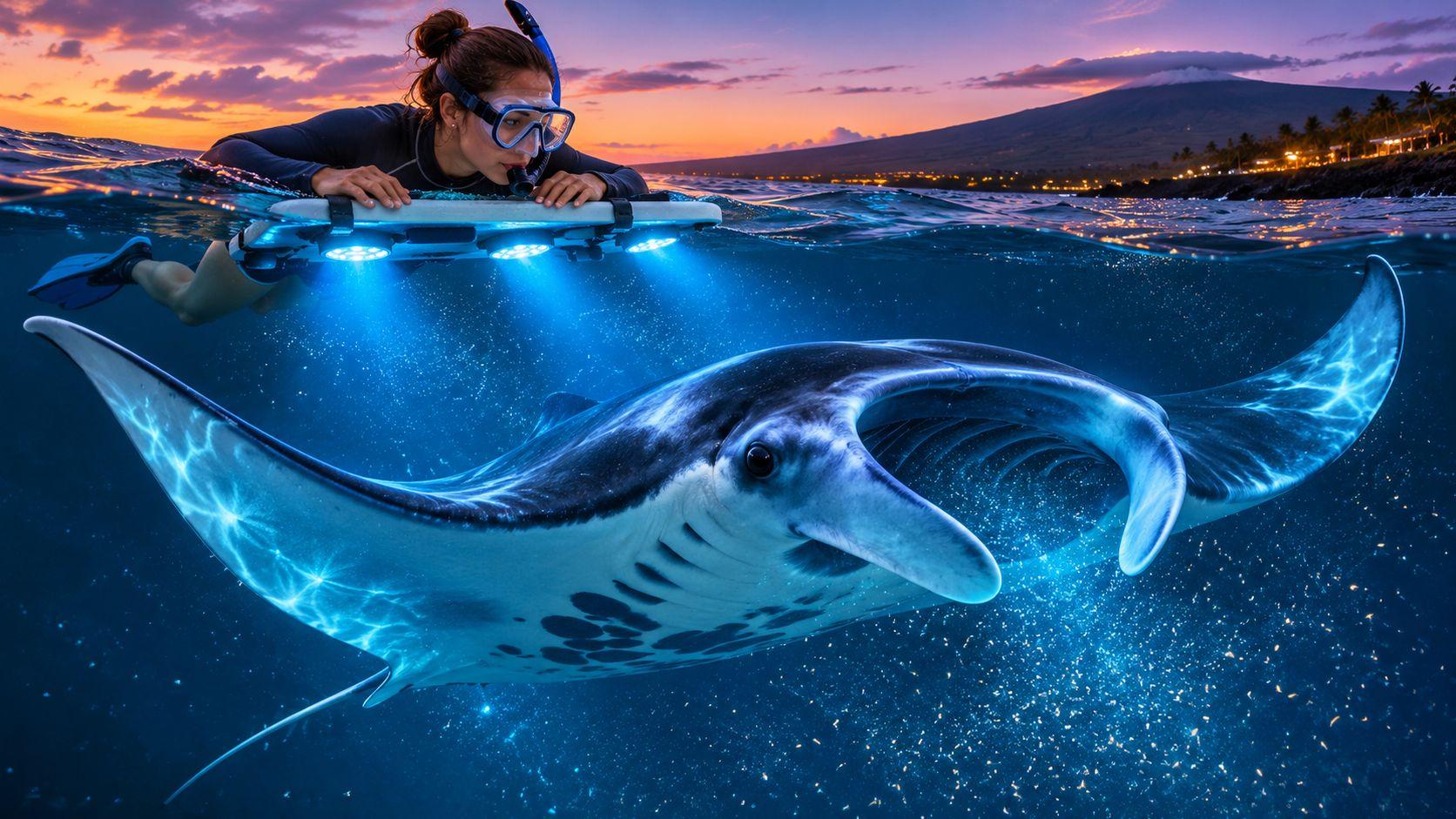
Manta Ray Night Snorkel Big Island: Complete Guide 2026
Plan your Manta Ray Night Snorkel Big Island trip: viewing sites, timing, safety rules, packing list and tips for booking a small-group Kona tour.